

Many English learners ask about bachelors or bachelor’s because both forms look correct. The answer depends on what you want to say. Bachelor’s with an apostrophe is correct when you are talking about a bachelor’s degree. Bachelors without an apostrophe is the plural form of bachelor and usually means more than one unmarried man. This small punctuation mark changes the meaning. That is why many students become confused when writing essays, resumes, or college applications. By the end of this guide, you will know when to use both words. You will also learn an easy trick to remember the difference.
Both forms are correct, but they are used in different situations. Once you understand the meaning of each word, choosing the right one becomes easy. A simple grammar rule can help you avoid this common writing mistake.
In this ultimate guide, you will learn the difference between these words in simple English. You will see clear explanations, real-life examples, common mistakes, and easy tips that will help you use the correct form with confidence in 2026 and beyond.
Simple Answer In One Look
Use bachelor’s when talking about a bachelor’s degree. Use bachelors when talking about more than one bachelor.
What This Means In Simple English
The words look almost the same, but they have different meanings. Bachelor’s with an apostrophe is most often used in the phrase bachelor’s degree.
For example.
She earned a bachelor’s degree in biology.
The apostrophe is part of the correct name of the degree.
Bachelors without an apostrophe is simply the plural form of bachelor.
It means more than one unmarried man.
For example.
The party was full of bachelors.
That sentence talks about several unmarried men.
Here are more simple examples.
- He finished his bachelor’s degree last year.
- Maria is studying for a bachelor’s degree in nursing.
- The park was full of young bachelors.
- Many bachelors attended the event.
- She hopes to earn a bachelor’s degree soon.
- Two bachelors rented the apartment together.
- His bachelor’s degree helped him find a new job.
The meaning becomes clear from the sentence. One form talks about education. The other talks about people.
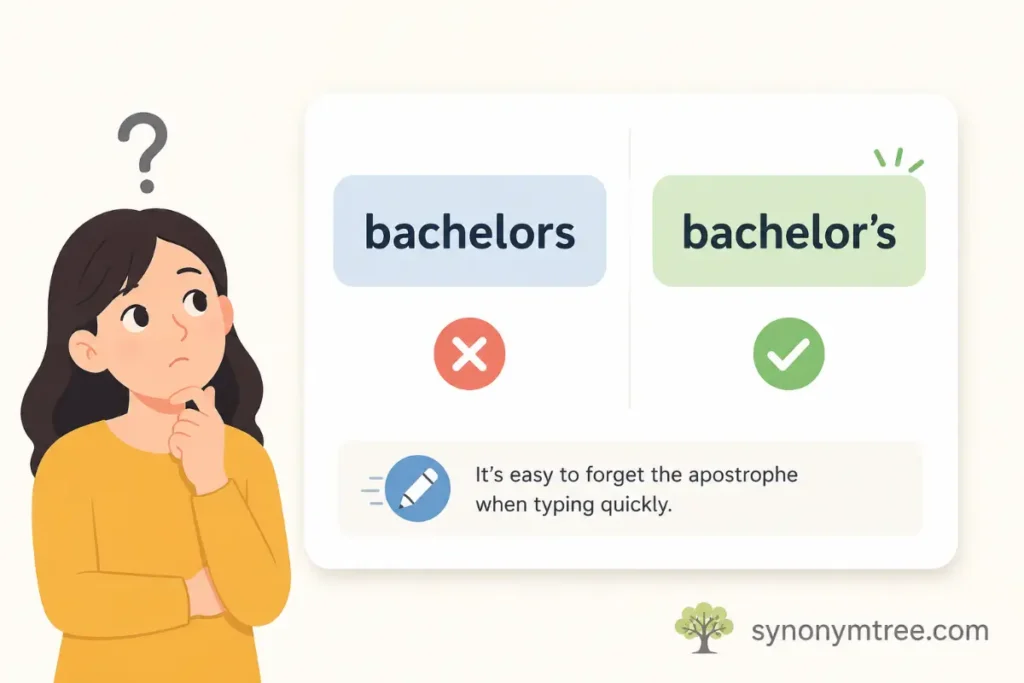
Bachelors Or Bachelor’s Why People Mix These Words
Many learners become confused because bachelors and bachelor’s look almost identical. The only visible difference is the apostrophe, but that small punctuation mark changes the meaning of the word. When people type quickly, they often forget to add the apostrophe or do not realize that it is required in certain situations.
Another reason for the confusion is that many students hear the phrase bachelor’s degree more often than they see it written. As a result, they sometimes write bachelors degree without the apostrophe. However, the official and correct form is bachelor’s degree, and the apostrophe should always be included.
Learners also become confused because bachelors is a real English word. It is simply the plural form of bachelor, meaning more than one unmarried man. Since both spellings are correct in different contexts, understanding the meaning of the sentence is the easiest way to choose the right form.
Here are common questions.
- When should I use bachelors?
- Why does bachelor’s have an apostrophe?
- Can I write bachelors degree?
- Which form is correct?
The answers are simple.
- Write bachelor’s degree.
- Use bachelors for more than one unmarried man.
- The apostrophe is part of the accepted name of the degree.
- No. Do not write bachelors degree.
- Choose the form that matches your meaning.
A quick check before you finish writing can help you avoid this common mistake.
Clear Difference Explained Simply
This comparison makes the rule easy to remember.
- Bachelor’s means the college degree.
Example.
She earned a bachelor’s degree.
- Bachelors means more than one unmarried man.
Example.
The restaurant was popular with bachelors.
Another comparison.
Correct.
He completed his bachelor’s degree.
Correct.
The bachelors met every weekend.
Incorrect.
He completed his bachelors degree.
The apostrophe is missing.
Think about the meaning before you write.
That simple habit helps you choose the correct form.
Which Form Should You Use
Use bachelor’s when talking about education.
Use bachelors when talking about several unmarried men.
Here are common situations.
Use bachelor’s for these.
- College applications.
- Job resumes.
- University websites.
- Graduation certificates.
- School essays.
Use bachelors for these.
- Stories.
- News articles.
- Conversations about unmarried men.
- Books.
- Everyday writing.
A simple memory trick can help.
If you can add the word degree after the word, use bachelor’s.
If you are talking about more than one unmarried man, use bachelors.
Easy Real Life Sentences You Can Use
These examples show the difference clearly.
- She earned a bachelor’s degree in education.
- He is working toward a bachelor’s degree in business.
- My sister has a bachelor’s degree in science.
- Several bachelors attended the charity event.
- The bachelors enjoyed the weekend trip.
- Her bachelor’s degree helped her get the job.
- Two bachelors shared the apartment.
- I hope to finish my bachelor’s degree next year.
Practice reading these examples.
Then try writing a few sentences of your own.
The more you practice, the easier it becomes to choose the correct form.
Where This Expression Comes From
The word bachelor has been part of the English language for many centuries. Over time, universities began using the term bachelor’s degree as the official name for an undergraduate degree, and the apostrophe became part of that traditional title. Meanwhile, the plural form bachelors continued to describe more than one unmarried man. Although the two forms look very similar, they have different meanings and are used in different situations.
As you continue learning English, you will notice that even a small punctuation mark, such as an apostrophe, can change the meaning of a word. In the next section, you will learn how bachelors and bachelor’s are used in culture and everyday conversations, the common mistakes people make, and simple tips to help you choose the correct form with confidence.

How This Word Is Understood In Culture And Stories
The difference between these words is easy to understand once you know what each word means. Both forms appear in books, movies, TV shows, newspapers, and everyday conversations. The correct choice depends on the context. Bachelor’s usually refers to something that belongs to one bachelor or to an undergraduate college degree, while bachelors is simply the plural form of bachelor, meaning more than one unmarried man.
In everyday life, bachelor’s is most common when people talk about education. Students often mention their bachelor’s degree when discussing college, jobs, or future career plans. On the other hand, bachelors is used when talking about a group of unmarried men in conversations, news stories, or entertainment.
Here are some common examples:
- I finally earned my bachelor’s degree.
- She is studying for a bachelor’s degree in business.
- Several bachelors moved into the neighborhood.
- The restaurant is popular with young bachelors.
- He completed his bachelor’s degree with honors.
- The magazine interviewed a group of successful bachelors.
Once you understand the context, choosing the correct form becomes simple. If you are talking about a college degree or something that belongs to one bachelor, use bachelor’s. If you are referring to more than one unmarried man, use bachelors.
Biblical And Mythological Meaning
Some people wonder whether the words bachelors or bachelor’s have a special meaning in the Bible or in mythology. The simple answer is no. Neither form is a religious symbol. They are ordinary English words that are used based on the context of a sentence.
In the Bible, the focus is on topics such as marriage, family, faith, wisdom, and relationships. While a modern reader may use the word bachelor to describe an unmarried man, the word itself is not a special biblical term. It simply describes a person’s marital status in everyday English.
The same idea applies to myths and legends. A hero or character may be unmarried, and a writer may describe him as a bachelor. The word only explains his family situation. It does not carry a hidden spiritual or symbolic meaning.
The phrase bachelor’s degree also has no biblical or mythological meaning. It is simply the official name of an undergraduate college degree. The correct meaning always depends on the sentence in which the word is used.
Symbolism Explained In Simple Words
Even though these words are not symbols by themselves, people often connect them with different ideas. The meaning depends on the form that is used.
What One Version Represents
The form bachelor’s often represents learning, education, hard work, and personal growth. Many people see a bachelor’s degree as the result of years of study and dedication.
Here are a few examples.
- Her bachelor’s degree opened new career opportunities.
- His bachelor’s degree gave him more confidence.
- She celebrated after earning her bachelor’s degree.
In these examples, the phrase represents success through education.
What The Other Version Represents
The form bachelors represents more than one unmarried man. People often connect it with independence, freedom, and a certain stage of life.
Here are some examples.
- The bachelors enjoyed the weekend trip.
- Several bachelors lived in the same apartment building.
- The event welcomed bachelors from across the city.
The word simply describes a group of people. It does not carry a hidden meaning. The important point is to choose the correct form for your sentence.
Bachelors Or Bachelor’s Related Words You Should Know
Learning similar words makes this topic easier to remember.
Here are some helpful words.
- Degree.
A qualification earned after finishing college.
- Graduate.
A person who successfully completes a course of study.
- Diploma.
An official document showing that a course has been completed.
- Student.
A person who studies at a school, college, or university.
- Education.
The process of learning through study and training.
- Single.
A person who is not married.
- Unmarried.
Another word for someone who does not have a husband or wife.
- Qualification.
An achievement that shows a person has completed education or training. Knowing these related words helps you understand the difference between words more easily. You will often see them together in conversations about college, careers, education, and everyday life.
How People Actually Use It In Daily English
People use both words in normal conversations, school writing, job applications, and professional documents. The correct form depends on the meaning of the sentence. When someone talks about college education, they usually mean bachelor’s.
For example.
I completed my bachelor’s degree in marketing.
This tells us that the person finished an undergraduate college program.
When someone talks about a group of unmarried men, they use bachelors.
For example.
The three bachelors lived together for many years.
This tells us that several unmarried men are being discussed.
Here are more everyday examples.
- She earned a bachelor’s degree in psychology.
- He plans to finish his bachelor’s degree next spring.
- My friend has a bachelor’s degree in engineering.
- Several bachelors joined the sports club.
- The movie follows the lives of young bachelors.
- I added my bachelor’s degree to my resume.
- The apartment building was popular with bachelors.
- Many students work hard for their bachelor’s degrees.
- The group of bachelors traveled together.
- Her bachelor’s degree helped her start a new career.
You will often see bachelor’s degree in education and employment settings. You will often see bachelors in stories, conversations, and descriptions of people. The key is to look at the meaning first.

Common Mistakes People Make
Many English learners make mistakes with these forms because they look very similar. Here are the most common mistakes and how to fix them.
Writing Bachelors Degree
This is one of the most common errors.
Incorrect.
I earned a bachelors degree.
Correct.
I earned a bachelor’s degree.
The apostrophe is needed in the degree name.
Using Bachelor’s For More Than One Person
Incorrect.
The bachelor’s attended the meeting.
Correct.
The bachelors attended the meeting.
The second sentence talks about several people, so there is no apostrophe.
Adding An Apostrophe To A Plural Word
Some people think an apostrophe always makes a word plural.
That is not true.
Incorrect.
Many bachelor’s came to the event.
Correct.
Many bachelors came to the event.
The word means more than one unmarried man, so no apostrophe is needed.
Forgetting The Difference In Meaning
The biggest mistake is using the wrong form because the writer does not check the meaning.
Ask yourself a simple question.
Am I talking about a college degree?
If yes, use bachelor’s.
Am I talking about more than one unmarried man?
If yes, use bachelors.
This quick check prevents most mistakes.
Final Teacher Explanation
Imagine we are sitting in an English classroom.
The lesson today is simple.
The apostrophe is not just a small mark.
It helps readers understand your meaning.
When you write bachelor’s degree, the apostrophe tells the reader you are talking about education.
When you write bachelors, the word tells the reader you are talking about several unmarried men.
The two words look almost identical, but they have different jobs.
A good writer does not only focus on spelling.
A good writer also thinks about meaning.
Before you choose a word, ask yourself what you want to say.
Are you talking about a person’s education?
Use bachelor’s.
Are you talking about a group of unmarried men?
Use bachelors.
That one simple question can help you write correctly every time.
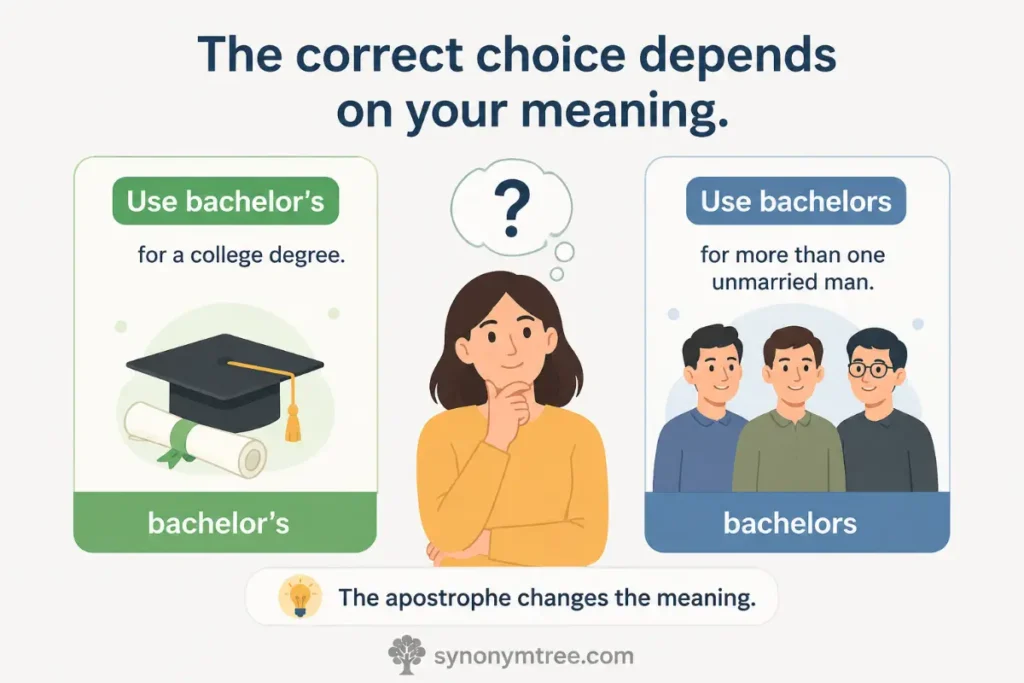
Bachelors Or Bachelor’s Final Answer
The correct choice depends on your meaning.
Use bachelor’s for a college degree.
Use bachelors for more than one unmarried man.
The apostrophe changes the meaning.
Conclusion
The difference between words are small, but it matters. Many English mistakes happen because people forget how punctuation changes meaning. In this case, one small apostrophe helps readers understand the sentence clearly. Remember the easiest rule. A degree is always a bachelor’s degree. Several unmarried men are bachelors. Once you remember this simple difference, you will avoid one of the most common English writing mistakes. Clear writing comes from small details, and learning these details makes your English stronger.
Frequently Asked Questions
Which is correct?
Both can be correct. Bachelor’s is used for a degree, and bachelors means more than one unmarried man.
Which should I write?
The correct form is bachelor’s degree.
Why does bachelor’s have an apostrophe?
The apostrophe is part of the standard phrase used for the college degree.
Can bachelors mean a college degree?
No. Bachelors does not mean a degree.
When should I use bachelors?
Use bachelors when talking about more than one unmarried man.
Can I use bachelor’s in a resume?
Yes. A resume should use bachelor’s degree when listing education.
Why do people confuse these words?
They look almost the same, and many people forget the apostrophe.
How do I remember the difference?
Think of education for bachelor’s and people for bachelors.
