
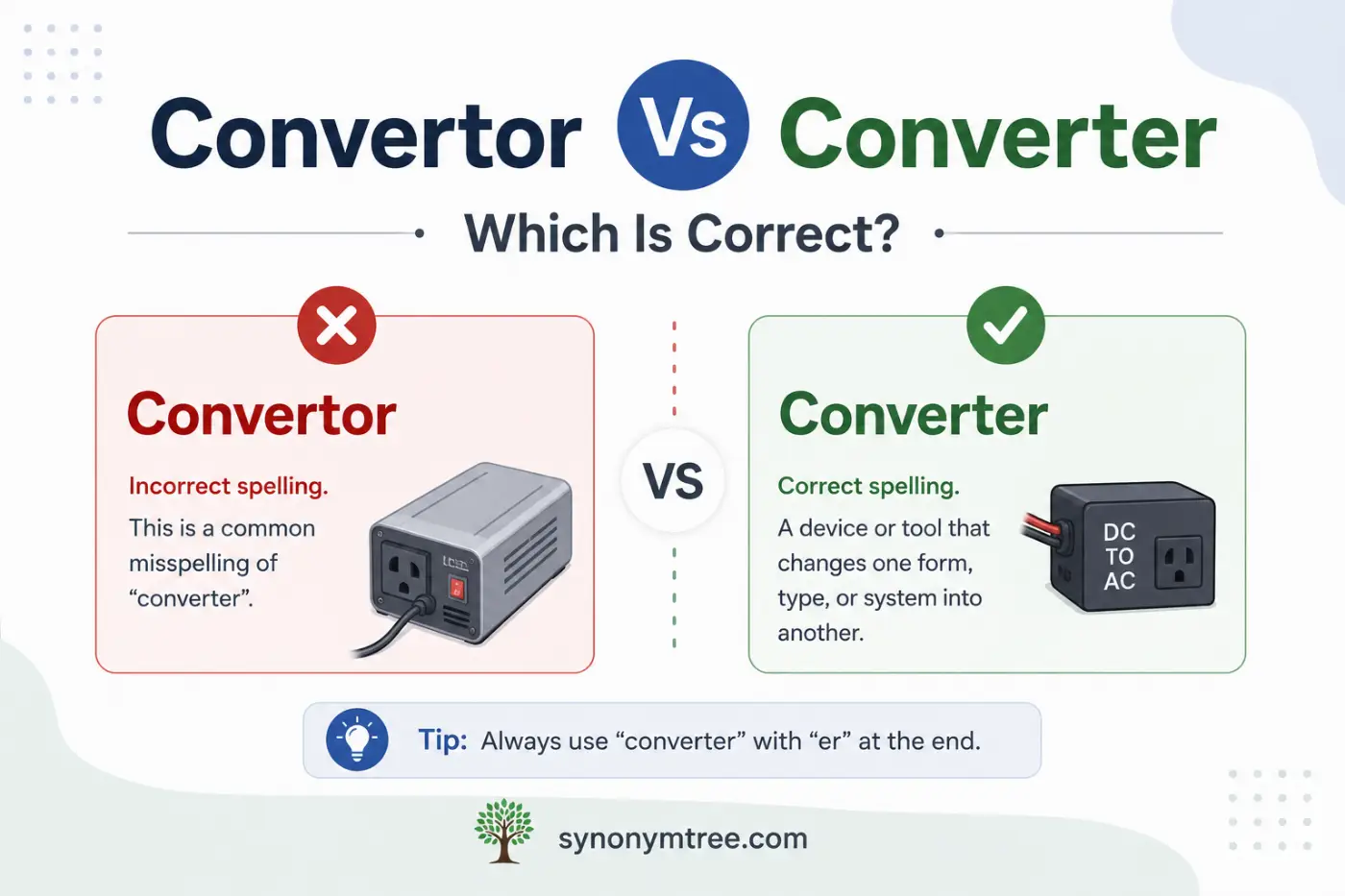
If you searched for convertor vs converter, you’re probably trying to figure out which spelling belongs in your writing. The answer is simple: converter is the standard spelling in American English. Convertor does appear in some dictionaries and forms of English, but it’s much less common in modern US usage.
The two forms can cause confusion because both look logical. The word comes from convert, and English has several ways to turn verbs into nouns. Some nouns end in or. Others end in er. That makes it easy to wonder which ending belongs here.
You’ll see converter in technology, electronics, software, energy, file tools, and everyday writing. A device can be called a converter. A program can be a converter. A tool that changes one type of file into another can also be a converter.
This guide explains the spelling difference, the meaning of each form, how American English uses the word, and the situations where you’re most likely to see it. You’ll also get examples, related words, common mistakes, and an easy way to remember the preferred spelling.
Quick Definition
A converter is a person, device, program, or tool that changes something from one form into another. Convertor is a less common spelling that exists in some English usage, but converter is the normal choice in American English.
Direct Answer
Converter is the preferred spelling in American English. Convertor is a less common variant and usually isn’t the best choice for standard US writing.
Comparison Table
| Word or phrase | Meaning | Example sentence | When to use it |
|---|---|---|---|
| Converter | Something that changes one form into another | I used a file converter to change the document into a PDF. | Use this spelling in standard American English. |
| Convertor | A less common spelling of the same basic word | Some technical sources use convertor for a conversion device. | Use it only when a specific source or established term calls for it. |
Why Converter Is The Preferred Spelling
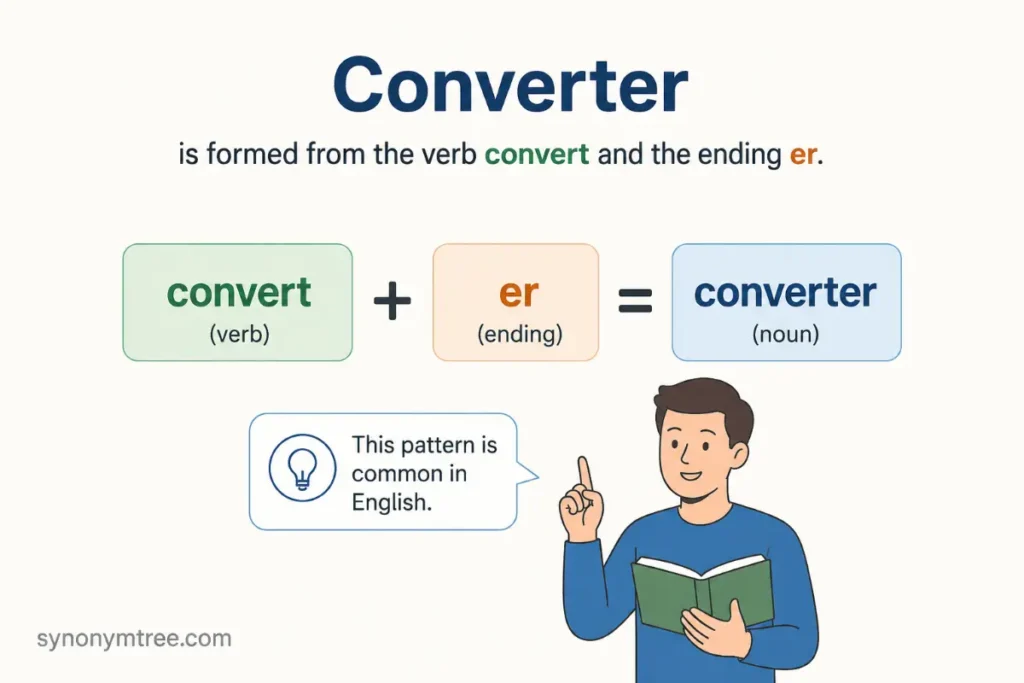
Converter is formed from the verb convert and the ending er. This pattern is common in English.
A converter is something that converts. The noun names the person, device, or tool that performs the action.
You can see the same basic idea in many familiar words.
A mixer mixes.
A printer prints.
A scanner scans.
A calculator calculates.
A converter converts.
This does not mean English always uses er for every noun made from a verb. English has many exceptions and older word forms. Still, converter is the established modern form for most everyday uses.
The spelling is especially common in American technology and business writing. Search for a tool that changes one file type into another and you’ll usually find terms such as file converter, video converter, image converter, and document converter.
The same spelling appears in electronics. You might buy a power converter, voltage converter, digital converter, or signal converter.
So if you’re writing an email, website page, product description, school assignment, technical guide, or resume for a US audience, converter is the safe and natural choice.
Where The Confusion Comes From
The confusion comes from English word formation.
The verb is convert. When you need a noun for something that performs the action, both or and er endings may seem possible. That can lead a writer to form convertor.
There’s also a real reason the alternative looks believable. English uses or in many words that describe people or things that perform an action.
Actor comes from act.
Creator comes from create.
Operator comes from operate.
Translator comes from translate.
So convertor doesn’t look strange when you first see it.
At the same time, English uses er in many common action words.
Teacher comes from teach.
Writer comes from write.
Driver comes from drive.
Printer comes from print.
Converter fits this second group in modern American usage.
The tricky part is that you can’t always predict a noun spelling by applying one universal rule. English has developed over a long period and has borrowed words from many languages. Historical usage often decides which form becomes standard.
That’s why the best approach is to learn the established spelling rather than trying to create the noun from scratch.
For normal American English, that established spelling is converter.
What Converter Means
Converter has a broad meaning. At its core, it refers to something that changes one thing into another form.
The change can involve format, measurement, electricity, signals, energy, or even a system or process.
A file converter changes a file from one format to another.
A currency converter changes one currency amount into another currency amount.
A voltage converter changes electrical voltage.
A signal converter changes one type of signal into another.
A catalytic converter changes harmful substances in vehicle exhaust into less harmful substances.
These examples look different, but they share the same basic idea. Something goes in, a conversion happens, and something different comes out.
That simple meaning makes converter a useful word across many fields.
The word can refer to a physical object. It can also refer to software or an online service.
For example, a small electronic box can convert one voltage to another. A website can convert an image from one file format to another. A computer program can convert a video into a different format.
The word describes the function rather than one specific type of object.
Converter In Technology
Technology is one of the areas where converter appears most often.
You may have used a converter without giving much thought to the word. If you’ve ever changed a Word document into a PDF or turned a video into another file format, you’ve probably used a converter.
A file converter takes data in one format and produces it in another format.
For example, a document converter might change a DOCX file into a PDF. An image converter might change a PNG into a JPEG. A video converter might change one video format into another.
The word is also common in programming and data work.
A developer may use a data converter to transform information from one structure into another. A tool may convert text encoding. Another program may convert units or measurements.
Here are some natural examples.
I need a converter that can change this image into a PNG file.
The video converter finished the file in a few minutes.
We use a data converter to move information between systems.
The online converter supports several document formats.
In each example, converter refers to a tool that changes something from one form to another.
Converter In Electronics
Electronics uses the word in a very specific way.
An electrical converter changes electrical energy from one form into another. The exact type depends on what changes.
A voltage converter can change the voltage supplied to a device.
A power converter can change electrical power from one form to another.
An analog to digital converter changes an analog signal into digital data.
A digital to analog converter performs the reverse process.
These devices are common in computers, phones, audio equipment, vehicles, industrial systems, and other electronic products.
You may also see abbreviations such as ADC and DAC in technical material. ADC stands for analog to digital converter. DAC stands for digital to analog converter.
The spelling remains converter.
For example, a product description might say that the device includes a high quality digital to analog converter. A technical manual might explain how the converter processes a signal.
The term has become so established in electronics that using the alternative spelling can look unusual to a technical reader.
Converter In Cars
Another familiar use appears in automobiles. A catalytic converter is part of a vehicle’s exhaust system. It helps reduce certain harmful pollutants in exhaust gases. This is one of the most common phrases containing the word converter. You might hear a mechanic say that a car needs a new catalytic converter. You might see the term in a repair estimate or vehicle manual.
The spelling is converter. The word describes the basic function of the part. It converts certain harmful compounds in exhaust into less harmful substances through chemical reactions. This example also shows why spelling matters. If you’re searching for repair information or parts, the standard term will usually be catalytic converter. Knowing the common spelling makes it easier to find the information you need.
Converter In Software
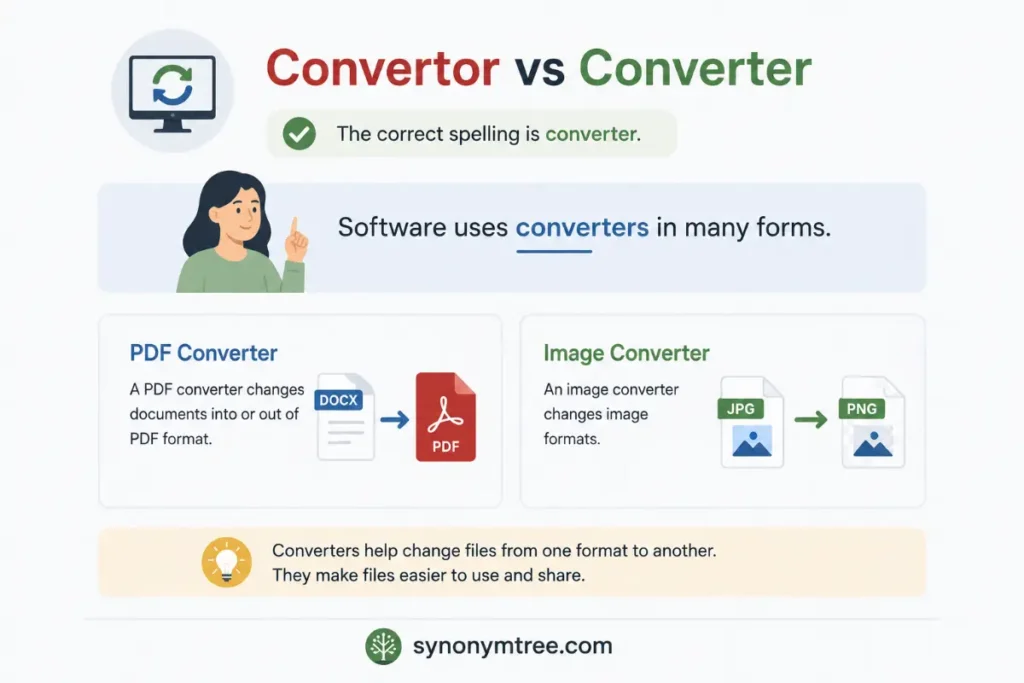
Software uses converters in many forms. A PDF converter changes documents into or out of PDF format. An image converter changes image formats. An audio converter changes audio files. A video converter changes video formats.
You can also find converters for measurements, currencies, dates, colors, text, and data.
For example, a unit converter can change inches into centimeters. A currency converter can calculate the value of one currency in another currency. A time converter can help compare time units.
These tools all follow the same basic idea.
Input goes into the tool.
The tool processes the input.
A new form comes out.
That is conversion.
The noun converter simply identifies the tool that performs that conversion.
Converter In Everyday Writing
You don’t need to be an engineer or programmer to use converter correctly. The word appears in everyday situations. You might say that you need a travel power converter. You might use a currency converter before a trip. You might use an online file converter to prepare a document for someone else.
Here are some natural examples. I checked the price with a currency converter. Do I need a power converter for this device. The website has a free image converter. I used a unit converter to change feet into meters. The new printer needs a different cable and a converter. These sentences sound normal because converter has become a common everyday noun.
Convertor Vs Converter In American English
The spelling difference matters most when you’re writing for an American audience. In US English, converter is the standard and familiar form. It appears in dictionaries, product names, technical documents, websites, manuals, and everyday speech.
Convertor can be found in English language sources, especially in some technical contexts and varieties of English. It isn’t simply a random invented spelling. Still, it is far less common in American English.
That difference matters because readers usually expect the form they see most often. If you use convertor in a US business document, readers will probably understand you. Some may see it as unusual or incorrect. If you want your writing to sound natural and polished, converter is the better choice.
This is a good example of how two forms can exist while one is much more useful for a particular audience. Language has many regional preferences. A word can be accepted in one setting and uncommon in another. Good writers pay attention to the audience they’re addressing. For general US content, choose converter.
Is Convertor A Word
Convertor does exist as a spelling in English. Some dictionaries and technical sources recognize it as a variant.
That does not make it the best choice for every situation.
Think about the difference between a word being possible and a word being common. English contains many variant spellings. Some are strongly preferred in one country or field. Others have become rare.
Convertor falls into the less common category for modern American English.
If you’re writing a general article, product page, school paper, business message, or technical explanation for readers in the United States, converter will usually sound more natural.
You should also keep a specific source in mind. If a company officially calls its product a convertor, changing the spelling in the product name may create a different issue. Proper product names and official terms can follow their own conventions.
Outside such cases, converter is the practical choice.
Why Some Sources Use Convertor
The less common spelling can appear for historical, regional, or technical reasons.
English spelling is not controlled by one worldwide authority. Different countries, industries, publishers, and organizations can develop preferences.
Some technical vocabulary has preserved forms that aren’t as common in everyday American writing. A specialized document may use convertor because that form has been established in that particular field or region.
You may also find the word in older documents. Historical usage can differ from modern usage.
Another factor is regional English. British English and American English share most of their vocabulary, but they sometimes prefer different spellings or forms.
That does not mean convertor is the normal British spelling in every context. Usage can vary even within British and international English.
The important point is practical. If your goal is clear modern American English, converter is the form most readers expect.
How To Use Converter In A Sentence
The word converter can appear in many sentence patterns.
You can use it as the subject.
The converter changes the signal into digital data.
You can use it as the object.
I bought a voltage converter.
You can place an adjective before it.
The digital converter works with several input formats.
You can also use it in a longer technical phrase.
The analog to digital converter processes the incoming signal.
A good sentence does not need to sound technical just because the word converter has technical uses.
For example.
I used a currency converter before booking the hotel.
That sentence is simple and natural.
Another example is.
The file converter saved the document in the format we needed.
Again, the meaning is clear without complicated language.
Common Mistakes With Converter
The first common mistake is spelling the word as convertor when writing for a general US audience.
The second is confusing converter with conversion.
A converter is the tool or device that performs the change.
A conversion is the act or process of changing something.
For example, a currency converter performs a currency conversion.
The converter is the tool.
The conversion is the process.
Another common mistake is confusing convert with converter.
Convert is the verb.
Converter is the noun.
You convert a file.
A converter changes the file.
Keeping the parts of the word family separate makes your writing much clearer.
Converter And Conversion
Converter and conversion are closely related, but they have different jobs. Convert is an action. Conversion is the process of changing something. Converter is the person, device, or tool that performs the conversion. Consider this example. We need to convert the file. The conversion took two minutes. The converter produced a clean result.
Each word has a different role.
You can use the same idea with other word families.
A printer prints.
Printing is the process.
A converter converts.
Conversion is the process.
This connection can help you choose the right noun when writing.
Converter And Convert
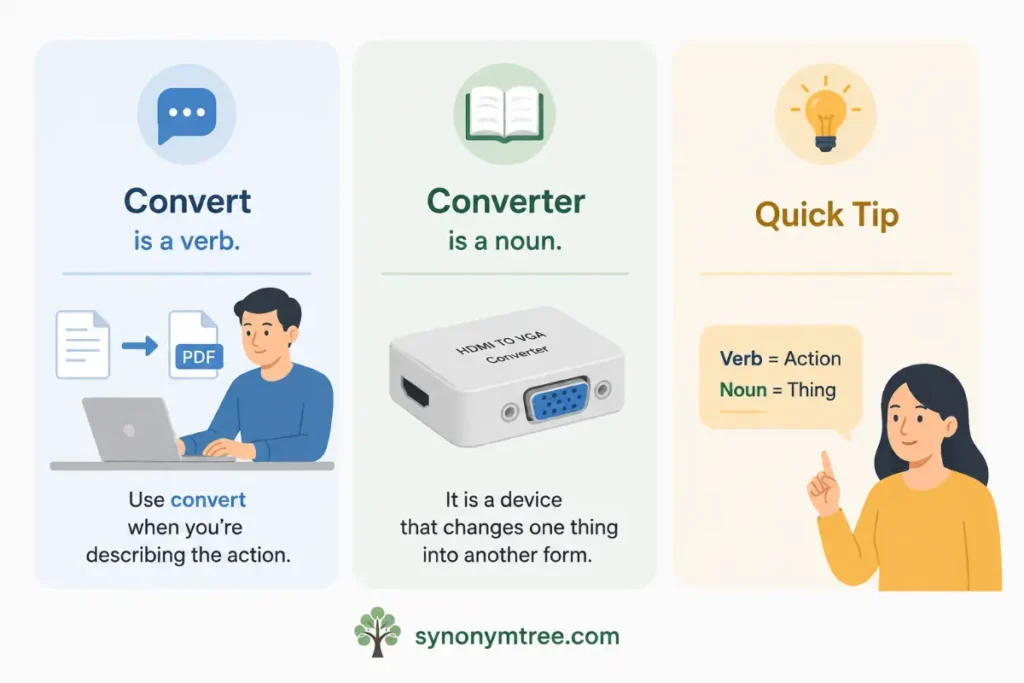
Convert is a verb.
Converter is a noun.
Use convert when you’re describing the action.
We need to convert this file.
She converted the measurements into inches.
The device converts the signal.
Use converter when you’re naming the thing that performs the action.
The converter changed the file format.
This converter works with several voltage levels.
The signal converter is inside the device.
The difference is simple once you see the sentence structure.
If the word describes an action, convert may be the right choice.
If it names the tool or device doing the action, converter is usually the right choice.
Converter And Transformer
Converter and transformer can sound similar because both can describe devices that change electrical energy. However, they are not always the same thing. An electrical transformer is a device that transfers electrical energy between circuits and commonly changes AC voltage levels. A converter is a broader term for equipment that changes electrical energy or signals from one form into another.
For example, an AC to DC power supply includes conversion. A transformer specifically uses electromagnetic induction to transfer energy between circuits. In everyday speech, people sometimes use these terms loosely. In technical writing, the distinction can matter. If you’re describing a specific electronic device, use the name given by the manufacturer or technical documentation. For general spelling questions, though, the key point remains unchanged. The common noun is converter.
Converter And Adapter
Adapter and converter are also easy to confuse.
An adapter usually helps two things work together. It may change a physical connection or allow one standard to connect to another.
A converter actually changes a signal, voltage, format, or other property.
For example, a plug adapter may let a device fit into a different socket shape. A voltage converter can change the electrical voltage supplied to the device.
Some products perform both functions. A travel product may include an adapter and a converter in one unit.
That’s why product descriptions can sometimes seem confusing.
The simplest way to remember the distinction is this.
An adapter helps things connect.
A converter changes something.
The exact technical meaning can depend on the device, so check the product specifications when safety or compatibility matters.
Converter And Translator
The word translator can also seem related because both words describe change.
A translator changes words or meaning from one language into another. A converter changes one form, format, value, signal, or system into another.
For example.
A translator changes Spanish text into English.
A file converter changes a document from one format into another.
The two tools perform different tasks even though both involve transformation.
This distinction can help when choosing software. If you need language conversion, look for a translator. If you need file format conversion, look for a converter.
How To Remember The Spelling
The easiest memory trick is to connect converter with convert plus er.
Think of the action first.
Convert.
Then remember the person or thing that does the action.
Converter.
You can also connect it with familiar technology words.
Printer.
Scanner.
Calculator.
Converter.
These words commonly name tools that perform an action.
Another useful trick is to picture the word in a phrase you already know.
File converter.
Currency converter.
Voltage converter.
Catalytic converter.
Once the correct spelling becomes familiar in common phrases, you’ll be less likely to switch to the less common form.
You don’t need a complicated spelling rule. You just need to remember the standard form.
Real Life Examples
Seeing the word in ordinary sentences is one of the fastest ways to make the spelling feel natural.
I need a converter for this old video file.
The currency converter shows the current exchange rate.
We bought a voltage converter for the trip.
The mechanic said the catalytic converter needs to be replaced.
This image converter supports several file types.
The device has a built in digital converter.
The engineer tested the signal converter before shipping the unit.
I used an online converter to change the document format.
The converter can process several types of input.
The new system includes a power converter.
These examples cover several meanings without changing the basic word.
Examples In Professional Writing
Professional writing often uses converter in technical descriptions and instructions.
A software company might describe a tool that converts files between formats.
A manufacturer might explain how a voltage converter works.
An electronics company might list the specifications of a signal converter.
A mechanic might write about replacing a catalytic converter.
A financial website might provide a currency converter.
The word works in all these settings because the central meaning stays the same.
When you write for a professional audience, avoid switching to the less common spelling simply because it looks technical. Technical writing still benefits from familiar words.
Clear writing helps readers understand the product or process without stopping to question the spelling.
Search And SEO Considerations
If you’re writing online content, spelling the word correctly can also help search visibility.
People commonly search for converter terms because they need a tool or answer. Examples include PDF converter, image converter, currency converter, video converter, voltage converter, and unit converter.
Using the standard term makes your content easier to understand and aligns it with the language people commonly use.
You should still write for people first. Don’t repeat converter in every sentence just to target a keyword. Use natural phrases such as conversion tool, conversion software, file conversion tool, or device when they fit.
Search engines understand related terms and context. Strong content answers the reader’s question clearly and uses the language that naturally belongs to the topic.
If your article explains a file converter, talk about file formats, input files, output files, conversion settings, supported formats, and common errors. That gives the topic useful depth without forcing keywords.
How Spelling Changes Search Results
A misspelling can still produce search results. Search engines often understand what a user intended to type.
That doesn’t mean you should copy the misspelling into your own content.
If someone searches for convertor, the search engine may recognize that they mean converter. It may show pages about converters instead.
For content creators, the better strategy is to answer the spelling question directly and then use the standard form throughout most of the article.
This gives the reader a clear answer while keeping the content natural.
The same principle works for many spelling questions. You can mention the less common form when you need to explain the confusion. After that, use the standard form that your audience expects.
When You Might See Convertor
There are situations where you may encounter the less common form.
You might find it in an older technical document.
You might see it in a regional publication.
You might find it in a specialized industry source.
You might see it in a product name or company term.
You may also encounter it simply because someone made a spelling mistake.
Seeing the word does not automatically mean the writer made an error. Context matters.
If a specific technical standard uses convertor as its official terminology, follow that standard in the relevant document. If a company officially names a product Convertor, preserve the official name when discussing that product.
For ordinary writing, however, converter remains the better choice for American readers.
Does Converter Mean A Person Too
Yes. A converter can refer to a person in some contexts, although modern everyday use more often refers to a device, program, or tool.
The word follows a general English pattern in which a noun can describe something or someone that performs an action.
For example, a person who converts something could technically be called a converter.
Still, context usually tells you what the word means.
If someone says the car needs a new converter, they probably mean a catalytic converter or another vehicle component.
If someone says they used a converter to change a file, they mean software or an online tool.
The surrounding words make the meaning clear.
Is Converter Always The Best Choice
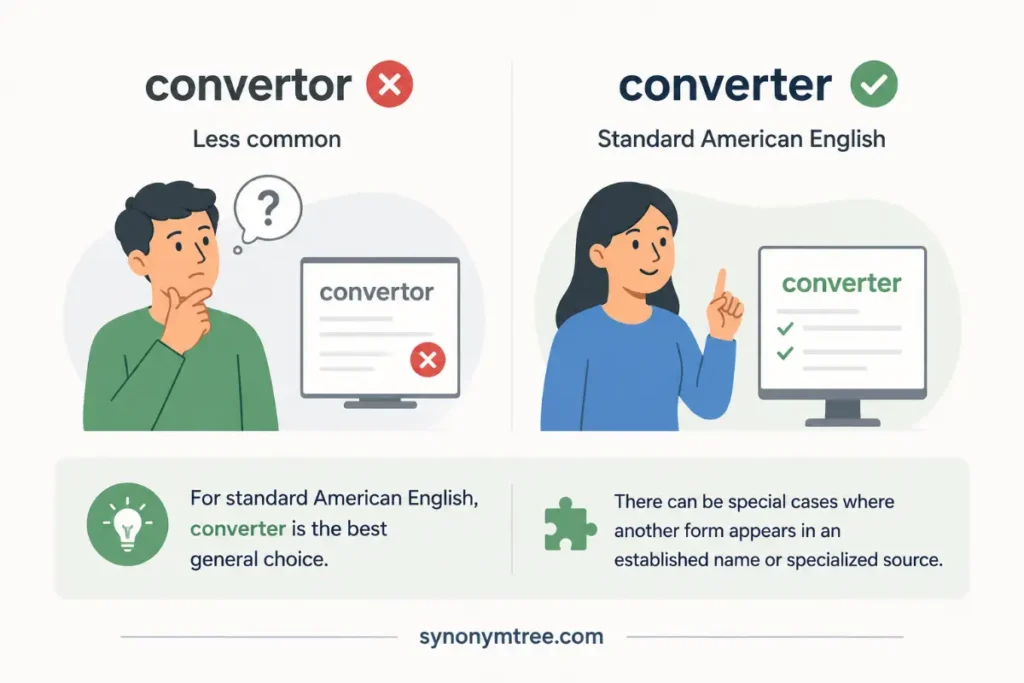
For standard American English, converter is the best general choice. There can be special cases where another form appears in an established name or specialized source. Those cases do not change the normal spelling recommendation. If you are writing a general sentence and need the noun for something that converts, choose converter. If you are editing a US English article and see convertor, check the context. If there is no specific reason for that spelling, change it to converter. This simple approach keeps your writing natural and easy to understand.
A Simple Editing Test
When you finish writing, search your document for convertor. If you find it, ask why it appears. If it’s a normal use of the noun, replace it with converter. If it belongs to an official name, quoted source, product name, or specialized term, check the source before changing it.
Then search for converter and review each use. Make sure the word means a device, tool, program, person, or thing that performs a conversion. Finally, check related words. Use convert as the verb. Use conversion for the process. Use converter for the thing that performs the conversion. This quick check can catch most mistakes.
Conclusion
If you searched for convertor vs converter, use converter in standard American English. It is the familiar and preferred spelling for a device, program, tool, or person that performs a conversion.
Convertor does exist in some sources and specialized contexts. Still, it is much less common. For a US audience, converter will almost always be the more natural choice. Remember the simple connection between convert and converter. The verb describes the action. The noun names the thing that performs the action. You can use the same idea when talking about file converters, currency converters, voltage converters, signal converters, and catalytic converters.
When you’re unsure while editing your next document, choose converter unless a specific official name or technical source requires the other form. That one choice will keep your spelling clear, familiar, and natural for American readers.
Frequently Asked Questions
Is converter or convertor correct?
Converter is the preferred spelling in American English. Convertor exists as a less common variant, but it isn’t the form most US readers expect. Use converter for general American writing.
Why is converter spelled with er?
Converter uses the common English noun ending er to identify something that performs an action. It comes from the verb convert. The form has become the standard spelling in modern American usage.
Is convertor an incorrect word?
Convertor is not simply a made up form. It appears in some English sources and specialized contexts. However, it is much less common than converter, so converter is the better choice for normal US English.
What does a converter do?
A converter changes something from one form into another. It can change a file format, electrical signal, voltage, measurement, currency value, or other type of information or energy.
What is the difference between convert and converter?
Convert is a verb that describes the action of changing something. Converter is a noun that names the person, device, program, or tool that performs that action.
What is the difference between converter and conversion?
A converter is the thing that performs a change. A conversion is the process of changing something from one form into another. For example, a file converter performs a file conversion.
Is converter used in American English?
Yes. Converter is the normal and widely used spelling in American English. You’ll find it in technology, electronics, automotive writing, business, software, and everyday language.
Is convertor used in British English?
Convertor can appear in British and international English sources, but usage varies by field and source. It is not a universal replacement for converter. If you’re writing for a broad audience, converter is usually the clearer choice.
What is a file converter?
A file converter is a program, website, or tool that changes a file from one format into another. For example, it can change a document into PDF format or an image into another image format.
What is a voltage converter?
A voltage converter is an electrical device that changes voltage from one level to another. It can be useful when electrical equipment requires a different voltage from the available supply.
