
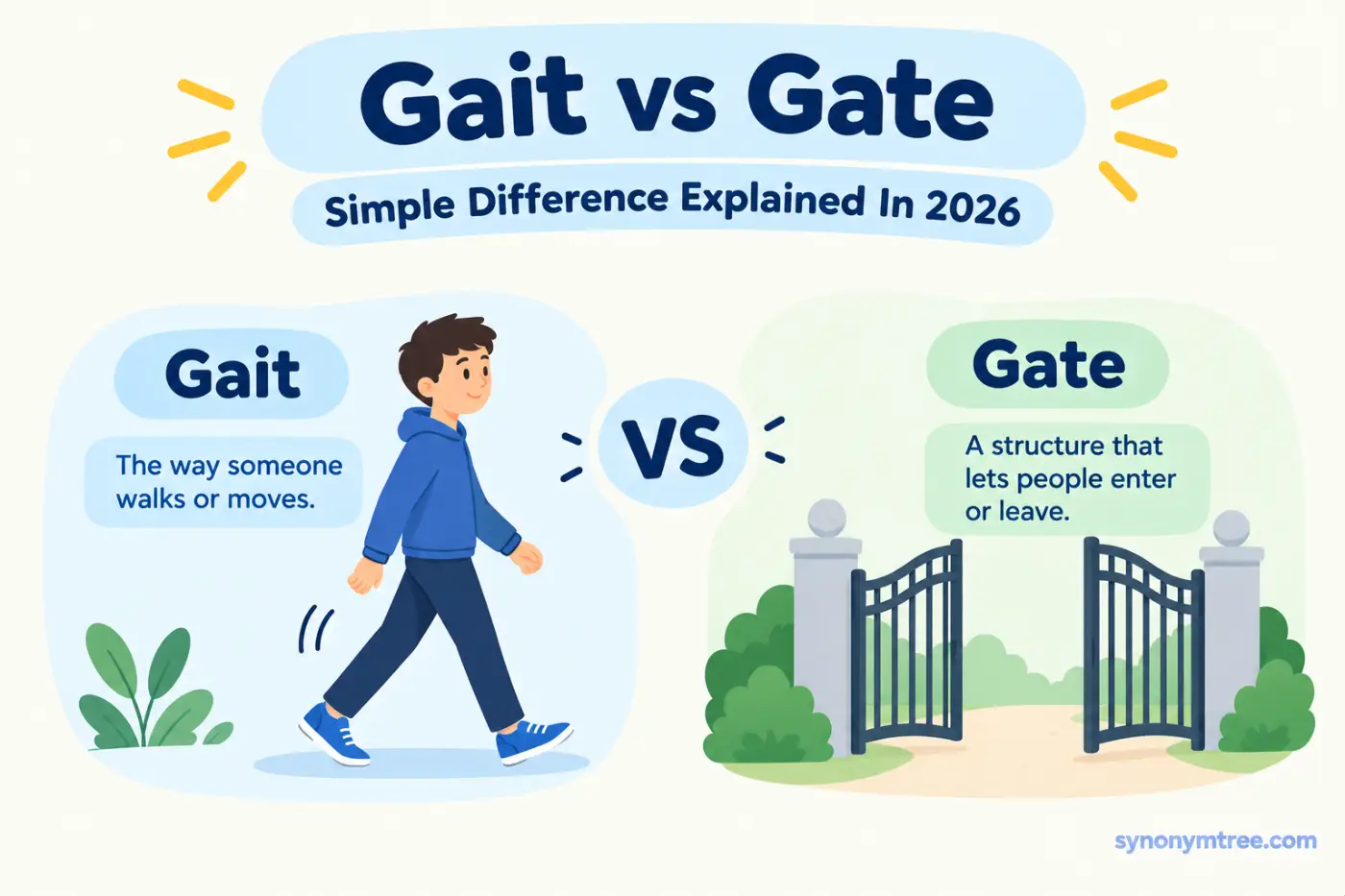
If you are writing an essay, checking a medical term, or trying to describe the way someone walks, you may stop at gait vs gate and wonder which spelling is correct. The two words sound exactly the same, but they have completely different meanings.
Gait means the way a person or animal walks or moves on foot. Gate usually means a movable barrier that opens and closes an entrance.
That difference is easy to remember once you connect each word with its meaning. A doctor may examine your gait, while a homeowner may close a gate. One word describes movement, and the other names a physical barrier.
This guide explains the meanings, origins, pronunciation, grammar, common mistakes, memory tricks, and real sentence examples. You will also see how these words work in medical writing, everyday conversation, formal writing, and common expressions.
Quick Definition
Gait is a noun that describes the way a person or animal walks. It can refer to walking speed, rhythm, posture, balance, and movement.
Gate is a noun that usually refers to a movable barrier used to control access through an opening. It can also have special meanings in airports, sports, computers, and other settings.
Direct Answer
The correct word depends on your meaning. Use gait when you mean someone’s manner of walking or moving, and use gate when you mean a barrier, entrance, or controlled opening.
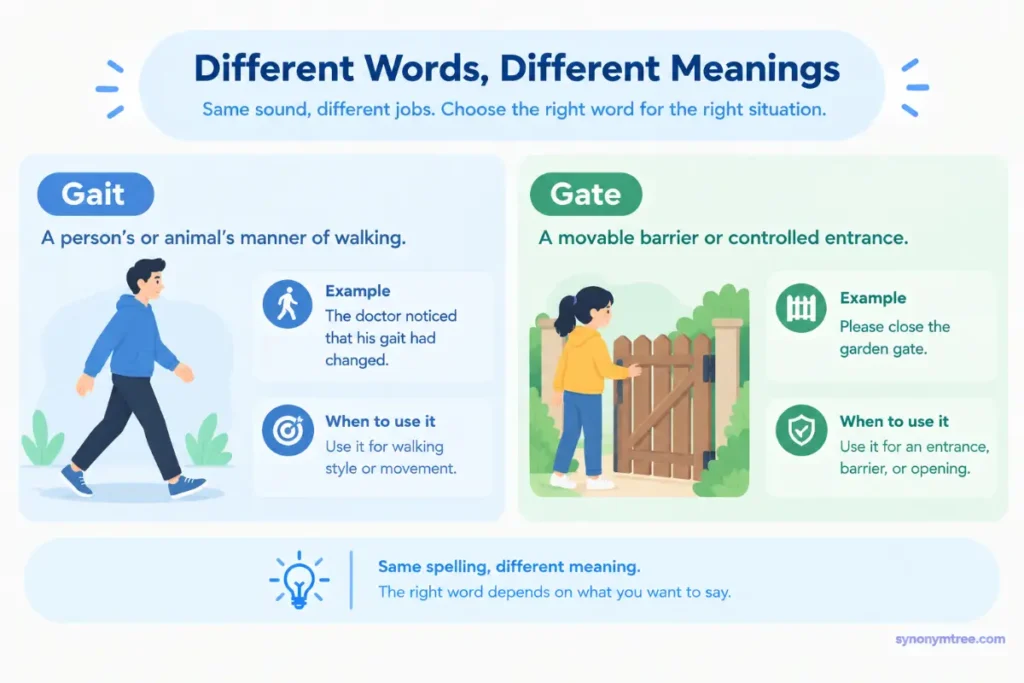
Gait vs Gate Comparison
| Word | Meaning | Example Sentence | When to Use It |
|---|---|---|---|
| Gait | A person’s or animal’s manner of walking | The doctor noticed that his gait had changed. | Use it for walking style or movement. |
| Gate | A movable barrier or controlled entrance | Please close the garden gate. | Use it for an entrance, barrier, or opening. |
The easiest test is to ask what you are talking about.
If you are talking about how someone walks, choose gait.
If you are talking about something that blocks or controls an entrance, choose gate.
Why Gait And Gate Are Confused
These words cause confusion because they are homophones. Homophones are words that sound alike but have different meanings and spellings.
When someone says gait and gate aloud, most listeners cannot tell which word they mean from sound alone. The surrounding sentence provides the clue.
For example, consider these two sentences.
The nurse watched the patient’s gait.
Here, the subject is walking. The nurse is observing how the patient moves.
Now compare it with this sentence.
The nurse opened the gate.
This sentence describes a physical barrier. The nurse is opening an entrance.
The pronunciation is almost the same, but the meanings are far apart. English has many word pairs like this. Knowing the meaning is often more useful than trying to hear the spelling.
What Does Gait Mean
Gait refers to the way a person or animal walks.
The word can describe much more than simply moving from one place to another. It can include a person’s walking pattern, stride, speed, posture, balance, and rhythm.
For example, someone might have a slow gait after an injury. Another person might have a steady gait and walk without difficulty.
Doctors, physical therapists, trainers, and researchers often use the word because it gives them a precise way to talk about walking movement.
You might hear expressions such as:
- normal gait
- abnormal gait
- walking gait
- steady gait
- unsteady gait
- altered gait
- natural gait
- walking pattern
A person’s gait can change because of age, injury, illness, pain, muscle weakness, balance problems, footwear, or changes in movement habits.
What Is An Example Of Gait
Consider this sentence.
The runner had a smooth and efficient gait.
The sentence does not say that the runner is simply walking. It describes the pattern and quality of movement.
Another example is:
Her gait became slower after the long hike.
The focus is on how she walks.
You can also use gait for animals.
The horse changed its gait as it moved across the field.
Here, gait refers to the animal’s manner of moving.
What Does Gate Mean
A gate is usually a movable barrier that controls access to an area.
You may find a gate at a house, garden, farm, school, park, stadium, or other property.
For example:
Please shut the garden gate.
The gate may be made of wood, metal, plastic, or another material. It can open and close to let people, animals, or vehicles pass.
The word can also describe an entrance that is controlled by a barrier.
We waited beside the gate until the concert started.
Gate has several other meanings too. The exact meaning depends on the context.
At an airport, a gate is the area where passengers wait to board a plane.
Our flight leaves from Gate 12.
In sports, a gate can be an object that participants must pass through. Skiers, for example, move through a series of gates during a race.
The skier missed the final gate.
So gate does not always mean a garden entrance. It can refer to different kinds of controlled openings or markers.
Where Does Gait Come From
Gait has a long history in English.
The word comes from an older Germanic language family and is related to words connected with going and walking. Its history is closely tied to the idea of movement.
That connection can help explain why gait refers to a manner of walking.
Modern English uses gait mainly as a noun. You do not normally use it as a verb.
For example, this is natural:
The therapist studied his gait.
This is not standard everyday English:
The therapist gaited him.
Instead, use phrases such as walked, examined his gait, or observed his walking pattern.
The older history of the word also helps explain why its meaning is closely linked to how someone moves.
Where Does Gate Come From
Gate also has an old Germanic history.
Its earlier forms were connected with an opening or passage through which people could enter or leave. Over time, the word developed into the modern meaning of a barrier that controls such an opening.
The modern word is common in both American and British English.
You can find gates at homes, farms, airports, schools, parks, and many other places.
The word has also developed special uses in different fields. That is why you may see gate in phrases that have nothing to do with a garden entrance.
How Gait Is Used In Real Sentences
The best way to understand gait is to see how it works in natural sentences.
The doctor noticed a change in his gait.
The sentence focuses on a change in walking style.
Her gait was slow but steady.
Here, gait describes the quality of her walking.
The therapist watched his gait as he crossed the room.
The therapist is observing movement.
The horse has a powerful gait.
The word can describe animal movement too.
Years of training gave the dancer a graceful gait.
The sentence focuses on the dancer’s manner of walking.
His uneven gait made it difficult for him to climb the stairs.
The word describes the person’s movement pattern.
The coach studied the runner’s gait.
The coach is examining how the athlete moves.
Her gait changed after she injured her ankle.
The injury affected her walking pattern.
The child’s gait became more confident as she learned to walk.
Again, the word describes walking movement.
The horse shifted into a faster gait.
This example shows that gait can also describe different forms or speeds of animal movement.
How Gate Is Used In Real Sentences
Gate is just as common in everyday English.
Please close the gate behind you.
The word refers to a physical barrier.
The dog ran through the open gate.
The gate controls access to the yard.
We met outside the main gate.
The sentence refers to an entrance.
The airport gate changed at the last minute.
Here, gate refers to a boarding area.
The children waited by the school gate.
The word describes an entrance to the school grounds.
The farmer repaired the wooden gate.
The meaning is a physical barrier.
The horse escaped through the broken gate.
Again, gate controls an opening.
Check the departure board to find your gate.
This is an airport use.
The skier passed through the first gate.
This is a sports use.
The security gate opened automatically.
The word refers to a controlled entrance.
Gait vs Gate In Medical Writing
The distinction becomes especially important in medical and health related writing.
Healthcare professionals often use gait to describe how a person walks.
For example:
The patient had a steady gait.
Or:
The therapist assessed the patient’s gait.
In this setting, using gate instead would change the meaning completely.
The patient had a steady gate.
That sentence sounds as if the patient owns or controls an entrance.
Medical writing may use terms such as gait assessment, gait training, gait abnormality, gait pattern, and gait analysis.
These phrases all relate to walking and movement.
A gait assessment may look at balance, stride length, walking speed, coordination, posture, and other parts of movement. The exact assessment depends on the person and the purpose of the evaluation.
Gait vs Gate In Everyday Writing
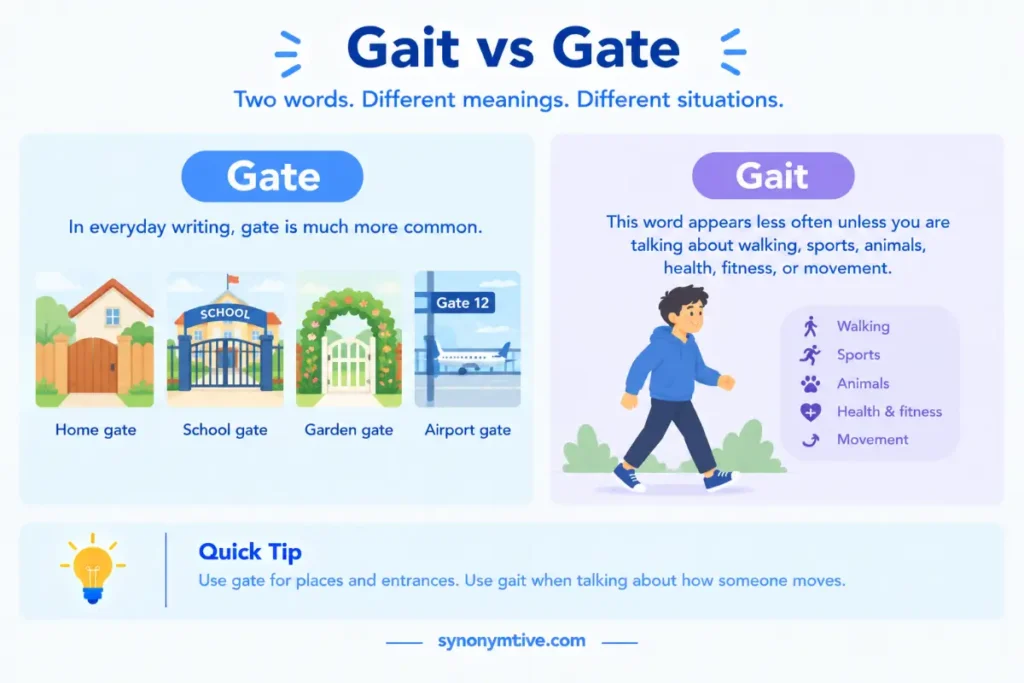
In everyday writing, gate is much more common.
You might write about a gate at your home, a school gate, a garden gate, or an airport gate.
Gait appears less often unless you are discussing walking, sports, animals, health, fitness, or movement.
That difference in frequency can make the spelling confusing. Many people know the sound of gait but rarely see it in ordinary conversation.
If you are writing about someone walking, stop and ask yourself whether you are describing the person’s movement. If so, gait is probably the word you need.
When Should You Use Gait
Use gait when you mean the way someone or something walks.
It works well in medical, sports, fitness, animal, and general descriptive contexts.
In Medical Writing
The doctor observed the patient’s gait.
In Sports Writing
The coach analyzed the athlete’s gait.
The key idea is movement.
When Should You Use Gate
Use gate when you mean a barrier, entrance, or controlled opening.
At Home
Please lock the back gate.
At School
The students waited near the main gate.
In Sports
The skier passed through the final gate.
On A Farm
The farmer fixed the gate before sunset.
The key idea is access.
Gait And Gate As Parts Of Speech
Both words are normally nouns.
A noun names a person, place, thing, or idea.
Gait is a noun because it names a pattern or manner of walking.
His gait was unusual.
Gate is a noun because it names a physical barrier or controlled entrance.
The gate was locked.
The words do not normally function in the same way grammatically.
You can modify gait with adjectives such as slow, fast, steady, uneven, graceful, awkward, or natural.
You can modify gate with adjectives such as wooden, metal, large, small, locked, open, closed, main, or automatic.
Compare:
She has a graceful gait.
She opened the wooden gate.
The adjective tells you something different in each sentence because the nouns have different meanings.
Mild To Strong Ways To Describe Gait
There are many ways to describe someone’s walking pattern.
For a neutral description, you can use:
- normal
- natural
- steady
- regular
- measured
For a slightly negative description, you might use:
Choose the word based on what you actually want to communicate.
For example, unsteady suggests a lack of balance. Slow only tells the reader about speed. Stiff suggests limited or rigid movement.
Those meanings are not interchangeable.
Mild To Strong Ways To Describe A Gate
Gate can also be described with different adjectives.
For a simple description, use:
- open
- closed
- small
- large
- wooden
For a more specific description, use:
- locked
- automatic
- metal
- decorative
- security
The adjective should match the purpose of the sentence.
The gate was open.
Only its position matters.
The security gate was locked.
Now the reader knows that access is being controlled.
Gait Or Walking Pattern Which Is Better
Gait and walking pattern are closely related, but they do not always sound the same.
Walking pattern is plain and easy to understand. Gait is shorter and more technical.
Compare these sentences:
The doctor examined her walking pattern.
The doctor examined her gait.
Both sentences communicate a similar idea. The second sounds more clinical and precise.
For general readers, walking pattern may be easier. In a medical report or professional discussion, gait may be the better choice.
Gait Or Stride Which Is Better
Gait describes the overall manner or pattern of walking.
Stride often refers to the length or style of a person’s steps.
For example:
The runner has an efficient gait.
This describes the runner’s overall movement pattern.
The runner has a long stride.
This focuses more directly on the distance covered by each step.
A person can have a long stride but an awkward gait. The two ideas can overlap, but they describe different parts of movement.
Gait Or Pace Which Is Better
Pace mainly describes speed.
Gait describes the overall way someone walks.
Consider:
She increased her pace.
This means she started walking faster.
Now consider:
Her gait looked unsteady.
This says something about how she moves, especially balance and walking pattern.
You can describe both at the same time.
His pace was slow, and his gait was unsteady.
That sentence gives the reader two separate details.
Gait Or Posture Which Is Better
Posture describes how someone holds or positions the body.
Gait describes how someone walks.
For example:
Her posture was straight.
This tells you about body position.
Her gait was steady.
This tells you about movement.
The two can affect each other, but they are not the same thing.
A person may have good posture but an uneven gait. Another person may have poor posture while still walking with a steady gait.
Gate Or Entrance Which Is Better
Gate and entrance can sometimes refer to the same general location, but they do not mean exactly the same thing.
A gate is usually a physical barrier or a controlled point of entry.
An entrance is the place or way through which someone enters.
For example:
Meet me at the main gate.
The speaker likely means a specific barrier or entry point.
Meet me at the main entrance.
The speaker means the main way into the building or property.
A gate can be part of an entrance, but not every entrance has a gate.
Common Mistakes With Gait
The most common mistake is using gate when you mean walking.
For example:
The doctor noticed an unusual gate.
If the writer means the patient’s walking pattern, this is incorrect.
The correct sentence is:
The doctor noticed an unusual gait.
Another mistake is using gait for a physical barrier.
Please close the gait.
That does not work if you mean a garden or driveway barrier.
The correct sentence is:
Please close the gate.
The safest approach is to focus on meaning before spelling.
Ask yourself, “Am I talking about walking?”
If yes, choose gait.
If you are talking about an entrance or barrier, choose gate.
Common Spelling Errors
Because the words sound alike, writers may type the wrong spelling without noticing.
Common errors include:
The patient had an unusual gate.
when the intended meaning is walking.
Another error is:
Please close the gait.
when the writer means a barrier.
These errors are especially easy to make during fast typing, voice dictation, or proofreading.
A spell checker may not catch the problem because both gait and gate are correctly spelled words.
That is an important point. A spelling checker can tell you that a word is spelled correctly, but it may not know that you chose the wrong word.
Why Spell Check Does Not Always Catch The Error
Consider this sentence:
The doctor examined his gate.
There is nothing wrong with the spelling of gate. It is a real English word.
The problem is meaning.
If the writer intended to describe walking, the software may not recognize the error because the sentence is grammatically possible.
This is why proofreading needs more than a spelling check. You must also check whether each word makes sense in context.
Homophones cause many errors for this reason.
How To Remember The Difference
A simple memory trick can make the distinction much easier.
Think:
Gait has an I because I walk.
The letter I appears in gait. Connect that I with yourself walking.
I walk with a certain gait.
For gate, think of a physical entrance.
The gate lets me enter.
Another useful connection is:
Gait equals walking.
Gate equals entrance.
You can also connect gait with words such as walk, stride, step, and movement.
Connect gate with words such as door, fence, entrance, barrier, and opening.
These word groups make the difference easier to remember.
A Simple Test For Gait And Gate
When you are unsure, replace the word with one of these phrases.
If way of walking fits, use gait.
If barrier or entrance fits, use gate.
For example:
The therapist studied his way of walking.
That makes gait the right choice.
Now try:
Please close the barrier.
That makes gate the right choice.
This substitution test works because it focuses on meaning rather than pronunciation.
More Real Examples To Practice
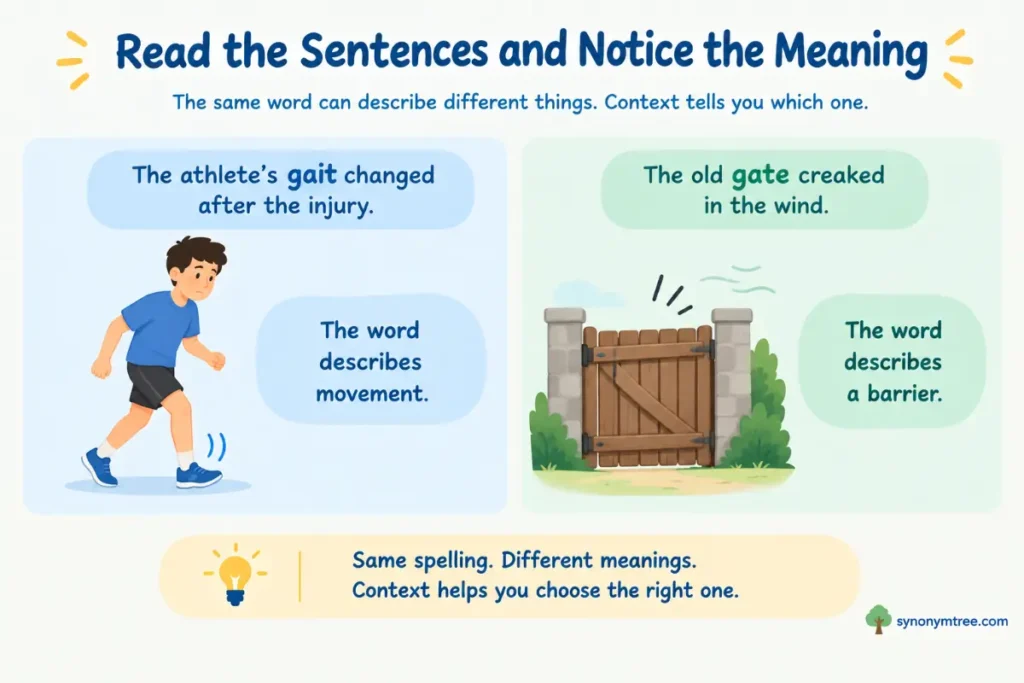
Read each sentence and notice which meaning is being used.
The athlete’s gait changed after the injury.
The word describes movement.
The old gate creaked in the wind.
The word describes a barrier.
The nurse watched the patient’s gait carefully.
Gait And Gate In Formal Writing
Formal writing needs extra care because context may not provide enough clues.
If you are writing a report, essay, research paper, or professional document, use gait only when you are discussing movement.
For example:
The study examined changes in walking gait among older adults.
If you are writing about property or access, use gate.
The main gate remained closed during construction.
The right word makes the sentence clear without adding extra explanation.
Gait And Gate In Creative Writing
Creative writers may use both words to create vivid descriptions.
For example:
He approached with a slow, tired gait.
The reader can imagine the person’s movement.
Now consider:
The old iron gate swung open.
The reader can picture the entrance.
You can even use both in the same passage.
She crossed the yard with a hurried gait and pushed open the garden gate.
That sentence provides a useful contrast. Gait describes how she moves, while gate identifies the object she opens.
Regional Differences Between Gait And Gate
There is no major US and UK spelling difference between these two words.
American English and British English both use gait for a manner of walking.
Both also use gate for a barrier, entrance, airport boarding area, and other related meanings.
Pronunciation can vary slightly across accents, but the words remain homophones in standard English for most speakers.
The spelling does not change based on region.
That means the same basic rule works for American and British writing.
Related Homophones Worth Learning
Gait and gate are one example of a larger English pattern.
Other common homophones include:
| Word | Homophone | Meaning |
|---|---|---|
| Pair | Pear | Two things / a fruit |
| See | Sea | Use your eyes / large body of salt water |
| Right | Write | Correct / put words on a page |
| Flower | Flour | Plant bloom / baking ingredient |
| Bare | Bear | Uncovered / large animal |
| Meet | Meat | Come together / animal food |
| Here | Hear | This place / use your ears |
| Peace | Piece | Calm / part of something |
The lesson is the same. Similar sounds do not mean similar meanings.
When Not To Use Gait
Do not use gait when you mean an actual physical entrance or barrier.
Incorrect:
The wooden gait was broken.
Correct:
The wooden gate was broken.
Do not use gait simply because the word sounds formal or professional. It has a specific meaning connected with movement.
For everyday writing, you may also prefer simpler terms such as walking style or walking pattern if your readers are not familiar with gait.
When Not To Use Gate
Do not use gate when you mean a person’s walking style.
Incorrect:
Her gate was slow and uneven.
Correct:
Her gait was slow and uneven.
Do not use gate as a substitute for walk, stride, or movement.
The sentence needs to be about an actual entrance or barrier for gate to make sense.
Antonyms And Opposite Ideas
Gait does not have one perfect opposite because it describes a broad pattern of movement.
Depending on the context, related contrasts might include:
- steady and unsteady
- smooth and awkward
- fast and slow
- balanced and unbalanced
- natural and abnormal
Gate also has no single direct antonym.
You might contrast:
- open and closed
- accessible and blocked
- unlocked and locked
The right contrast depends on the sentence.
How To Choose The Right Word Quickly
Use these steps when you are writing.
Ask What You Mean
Are you describing walking?
Choose gait.
Are you describing a barrier or entrance?
Choose gate.
Replace The Word
Try replacing it with way of walking.
If the sentence still makes sense, gait is probably correct.
Try replacing it with barrier.
If that works, gate is probably correct.
Look At The Words Around It
Words such as walking, running, stride, balance, therapist, doctor, and movement usually point toward gait.
Words such as fence, garden, airport, entrance, lock, key, yard, and barrier usually point toward gate.
Check The Context
A medical report will often use gait.
A property description will often use gate.
An airport announcement may use gate.
A sports discussion may use gait or gate depending on the sport and context.
Do Not Trust Spell Check Alone
Both words are correctly spelled.
The real question is meaning.
Quick Reference Guide
If you need a fast answer, use this guide.
Gait means the way someone or something walks.
Examples include:
The patient has a steady gait.
The horse changed its gait.
The runner’s gait looked efficient.
Gate means a barrier or entrance.
Examples include:
Close the garden gate.
We waited at the airport gate.
The school gate opened at eight.
The two words sound alike, but their meanings are completely different.
Conclusion
The key difference in gait vs gate is simple once you focus on meaning. Gait describes the way a person or animal walks, while gate usually describes a barrier, entrance, or controlled opening.
Use gait in sentences about walking patterns, movement, stride, balance, or physical therapy. Use gate for gardens, fences, schools, airports, farms, and other entrances.
If you are unsure, replace the word with way of walking or barrier. The correct choice will usually become obvious. Remember the simple connection: I walk with a gait, and I walk through a gate. That small memory trick can help you choose the right spelling quickly the next time these two homophones cause trouble.
Frequently Asked Questions
What is the difference between gait and gate?
Gait means a person’s or animal’s manner of walking, while gate usually means a movable barrier or controlled entrance. They sound alike but have different meanings and spellings.
Is gait the same as walking?
Gait is closely related to walking, but it means the particular manner or pattern of walking. It can include things such as speed, rhythm, balance, stride, and posture.
Is gate related to walking?
Gate is not normally related to the act of walking. It usually refers to a physical barrier or entrance, although people may walk through a gate.
What’s another way to say gait?
Another way to say gait is walking pattern, walking style, or manner of walking. The word gait is often preferred in medical and sports contexts because it is concise and precise.
How do you remember the spelling of gait?
A useful memory trick is to connect the I in gait with the phrase I walk. This can remind you that gait relates to the way someone walks.
Is gait a noun or a verb?
Gait is normally used as a noun. It names a person’s or animal’s manner of walking, as in “The doctor examined his gait.”
Is gate used differently at an airport?
Yes. At an airport, gate usually means the designated area where passengers wait to board a flight. For example, you might be told to go to Gate 14.

1 thought on “Gait vs Gate Simple Difference Explained In 2026”