
If you’re writing about a product, app, website, machine, or piece of software, you may pause over function vs functionality. The two words look closely related, and people often use them as if they mean the same thing. They are connected, but they don’t always fit the same sentence.
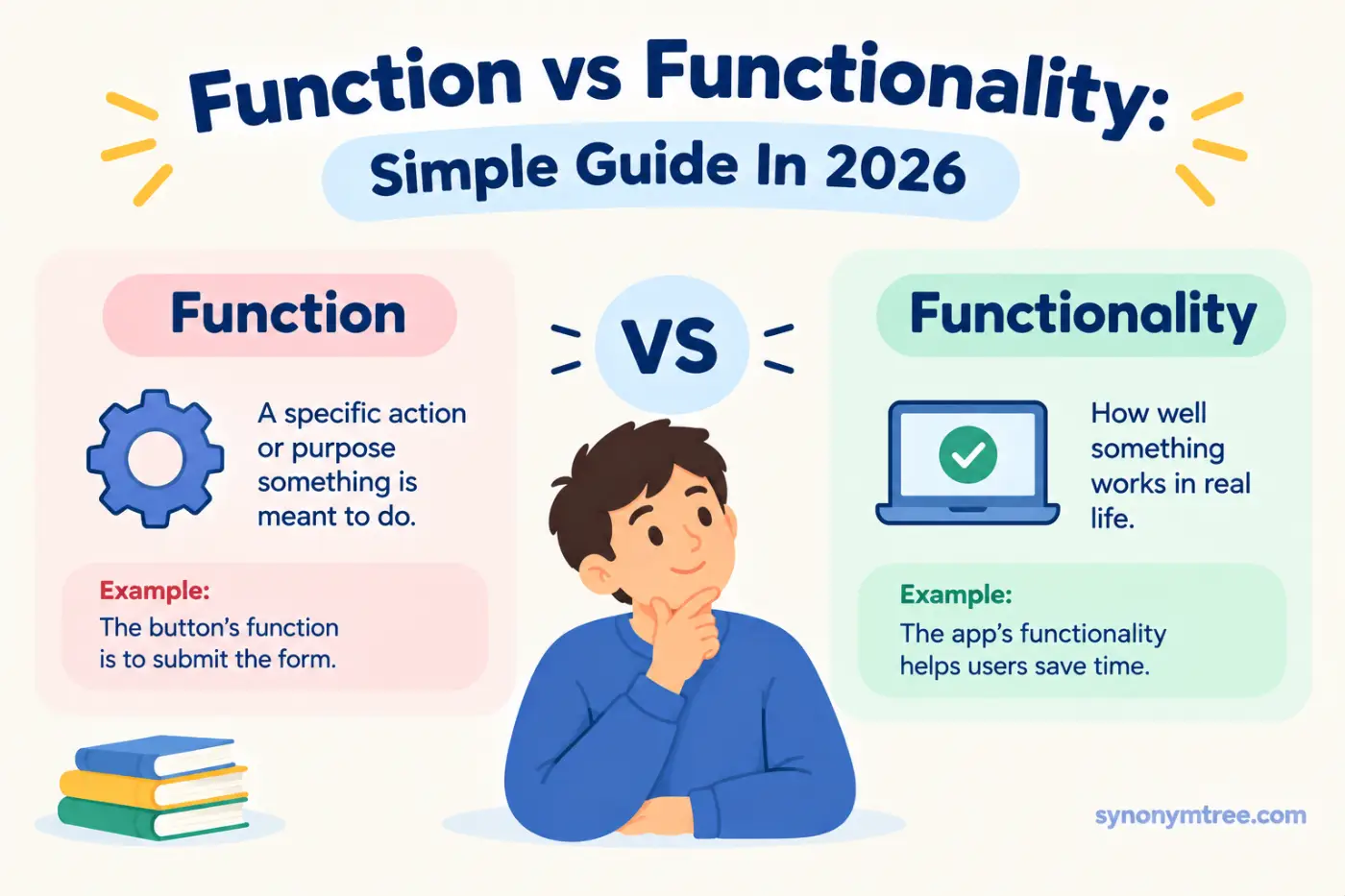
The simplest difference is this: a function is a specific job or action that something performs. Functionality describes the range of functions or the overall ability of a product or system to perform certain tasks.
Think about a smartphone. Making a phone call is a function. Taking photos is another function. The collection of things the phone can do, including calls, photos, messaging, navigation, and payments, can be described as its functionality.
This guide explains the difference in plain English. You’ll see definitions, grammar rules, examples, common mistakes, professional usage, software examples, and practical tips for choosing the right word.
Quick Definition
A function is a specific purpose, job, or action performed by something. For example, a search button has the function of helping users find information.
Functionality refers to the functions or useful capabilities that a product, system, or tool provides. It often describes what something is capable of doing as a whole.
Direct Answer
A function is usually one specific action or purpose, while functionality refers to the set of functions or capabilities that something offers.
For example, sending an email is a function of an email app. The app’s ability to send, receive, organize, search, and manage emails describes its functionality.
Function vs Functionality at a Glance
| Word | Meaning | Example Sentence | When to Use It |
|---|---|---|---|
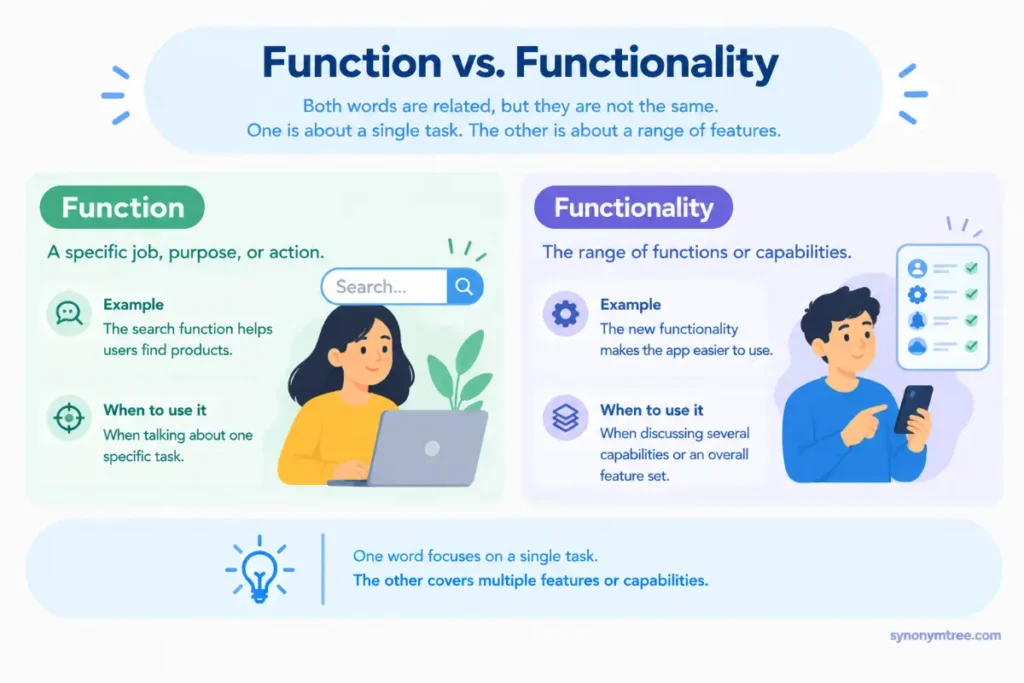
| Function | A specific job, purpose, or action | The search function helps users find products. | When talking about one specific task |
| Functionality | The range of functions or capabilities | The new functionality makes the app easier to use. | When discussing several capabilities or an overall feature set |
The key distinction is specific action versus overall capability.
That distinction becomes especially useful in technical writing. Software teams often discuss individual functions, while product teams may talk about the functionality of an entire system.
What Does Function Mean?
The noun function refers to the purpose or job of something. It can also describe a specific operation that a person, object, machine, or system performs.
Consider a calculator. Its basic function is to perform calculations. A calculator may also have specific functions for addition, subtraction, multiplication, division, percentages, and other operations.
The word has several meanings outside technology too.
For example:
The function of the heart is to pump blood.
The main function of a key is to open a lock.
The button has a useful function.
Each sentence focuses on a particular job or purpose.
In software, function often has an even more specific meaning. A function can refer to a particular operation that software performs. Developers may also use the word as a technical programming term for a reusable piece of code.
What Does Functionality Mean?
Functionality describes what a product, system, tool, or piece of software can do. It often refers to a collection of features, functions, or capabilities.
For example:
The website has strong search functionality.
This sentence doesn’t point to one specific search action. Instead, it talks about the site’s ability to provide search related features.
A different example makes the distinction clearer:
The search function lets customers find products.
The website’s search functionality includes filters, sorting, autocomplete, and saved searches.
The first sentence points to one function. The second describes a wider group of capabilities connected to searching.
Functionality is especially common in technology, software, product design, and business writing.
Where Do These Words Come From?
Both words have a long history connected to the idea of performing a purpose or job.
Function comes from Latin functio, which relates to performing or carrying out a task. English adopted the word centuries ago, and its meaning expanded over time.
Today, function can describe the purpose of a physical object, the role of a person or group, a mathematical relationship, a biological process, or a specific software operation.
Functionality developed from function by adding the suffix ity. The suffix helps form nouns that describe a quality, state, or condition.
You can see a similar pattern in other English words.
Ability describes the quality of being able to do something.
Capability describes the power or ability to perform an action.
Functionality describes the qualities or capabilities related to what something can do.
That connection explains why the words overlap so much.
Why Do People Confuse Function and Functionality?
The confusion comes from their shared root and closely related meanings.
A function tells you what something does. Functionality also tells you what something can do. The difference often comes down to scope.
Imagine a coffee machine.
Its milk frothing function may prepare steamed milk.
Its overall functionality may include brewing coffee, heating water, adjusting strength, setting a timer, and cleaning itself.
The words describe related ideas at different levels.
Another source of confusion is modern technology writing. Product pages, software documentation, and business reports sometimes use functionality as a broad replacement for feature or function.
That usage can make the distinction feel less clear.
The good news is that you don’t need to memorize a complicated grammar rule. Ask yourself one question: Am I talking about one specific job, or the broader set of things something can do?
When Should You Use Function?
Use function when you mean a particular task, purpose, role, or operation.
Here are some natural examples:
The main function of the button is to save the document.
The camera has a zoom function.
The alarm function reminds users about appointments.
The filter function removes unwanted results.
The heart performs an essential biological function.
The remote control has a power function.
Each example focuses on a specific purpose or action.
Function also works well when you describe why something exists.
The main function of this tool is to organize customer data.
That sentence identifies one central purpose.
When Should You Use Functionality?
Use functionality when you’re describing a broader group of capabilities or the overall ability of something to perform tasks.
For example:
The new version offers improved functionality.
The software has advanced editing functionality.
Users praised the platform’s mobile functionality.
The website needs better payment functionality.
These sentences don’t focus on one isolated action. They discuss a broader capability or collection of features.
Functionality is especially useful when several related functions work together.
For example, an online store might offer product search, filters, payment processing, order tracking, and customer accounts.
You could call these individual functions.
You could also describe them together as part of the website’s overall functionality.
Is Functionality Just Another Word for Function?
Not exactly.
The two words overlap, but they don’t have identical uses.
A function usually identifies a specific purpose or operation. Functionality usually refers to the collection of functions or capabilities available in a system.
Consider a messaging app.
Sending a message is a function.
Making voice calls is another function.
Sharing photos is another function.
The app’s messaging functionality includes these capabilities as part of its broader communication system.
Using functionality for one simple action can sometimes sound awkward.
For example:
The functionality that sends the email is useful.
This sentence isn’t necessarily wrong, but it is less direct than:
The email function is useful.
The second version tells the reader exactly what you’re discussing.
Function And Functionality in Software
Software provides one of the clearest settings for this distinction.
A software application can contain many individual functions. Each function performs a particular operation.
A calendar app might have these functions:
- Create an event.
- Edit an event.
- Delete an event.
- Set a reminder.
- Invite another person.
- Search for an event.
- Change the event time.
Together, these functions form part of the application’s functionality.
You might write:
The reminder function alerts users before an event.
That sentence focuses on one capability.
You could also write:
The app offers useful calendar functionality.
Now the focus is broader.
The second sentence could include reminders, scheduling, invitations, search, and other calendar related capabilities.
Function vs Functionality in Web Design
Web designers and developers use both words frequently.
A website might have a search function.
That function allows visitors to enter a word or phrase and find matching content.
The site’s search functionality could include several related features.
For example, it might include:
- Keyword search.
- Autocomplete suggestions.
- Filters.
- Sorting options.
- Search history.
- Spelling corrections.
- Category search.
The individual tools are functions or features. The complete set can be described as search functionality.
This distinction helps teams discuss products clearly.
A designer might ask for a new function.
A product manager might discuss improving the platform’s functionality.
A developer might explain how a particular function works.
Each person can use a different word because they’re discussing a different level of the same system.
Function And Functionality in Apps
Apps offer another easy example.
Imagine a fitness app.
The app may have a step counting function.
It may also have a calorie tracking function.
A workout planning function could help users create routines.
The app’s overall functionality could include all of these capabilities.
You might write:
The step counting function records daily movement.
Or:
The app’s health tracking functionality includes steps, calories, workouts, and sleep data.
The first sentence identifies one specific task.
The second describes a broader group of capabilities.
Function vs Functionality in Business Writing
Business writing often uses both words, but clarity matters.
A report might say:
The main function of the customer service team is to resolve customer issues.
Here, function describes the team’s primary role.
A product report might say:
Customers requested additional payment functionality.
Here, functionality refers to the broader ability of a product to handle payment related tasks.
You can also use function when discussing a department or role.
The finance department performs an important function within the company.
The marketing team’s function is to promote the company’s products.
In these examples, functionality would sound unusual because you’re describing a role rather than a collection of product capabilities.
Function and Functionality in Resumes
The word function can work well on a resume when you describe a role or responsibility.
For example:
Managed the core functions of the customer support team.
Coordinated financial functions across multiple departments.
The word functionality is more useful when your resume discusses software or technical products.
For example:
Improved website functionality by simplifying the checkout process.
Developed new functionality for an internal reporting platform.
Notice the difference.
The first sentence uses function to describe responsibilities.
The second uses functionality to describe what a system can do.
Function vs Functionality in Academic Writing
Academic writing often favors function when discussing purpose or role.
For example:
The primary function of the root system is to absorb water and minerals.
The social function of language extends beyond basic communication.
The function of this structure changes under different conditions.
Functionality can work in academic writing too, especially in studies of technology, design, engineering, or systems.
For example:
The study examined the functionality of the new learning platform.
The researchers evaluated the system’s functionality across several tasks.
The choice depends on what you are describing.
Function vs Functionality in Everyday English
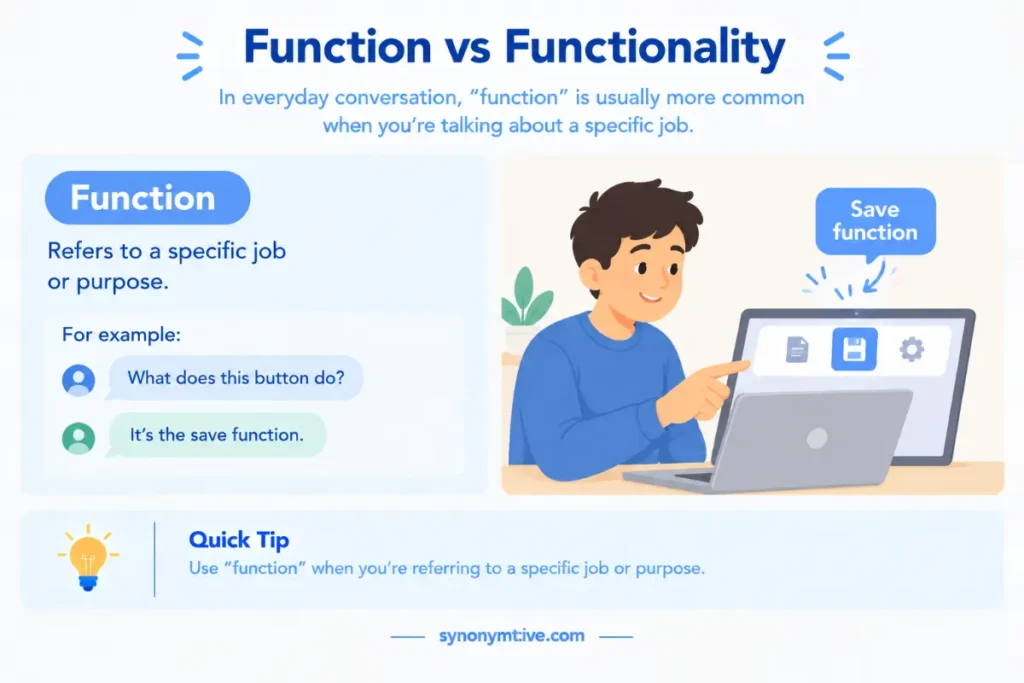
In everyday conversation, function is usually more common when you’re talking about a specific job.
For example:
What does this button do?
It’s the save function.
The word functionality sounds more technical or professional.
You might hear:
The new phone has better functionality.
That sentence is natural, but a friend might simply say:
The new phone can do more things.
This difference is useful to remember. Functionality is not wrong in casual speech, but it can sound more formal than necessary.
What Is the Difference Between Function and Feature?
Function and feature are close, but they are not always interchangeable.
A feature is usually a noticeable part or capability of a product.
A function is the job or operation that something performs.
For example:
The dark mode feature changes the screen’s appearance.
The dark mode function lets users switch between light and dark display settings.
In product writing, feature is often used for something that users can see or choose. Function focuses more directly on what something does.
The distinction can become small in everyday technology writing.
A product team might call something a feature. A technical writer might call the same thing a function.
What Is the Difference Between Function and Capability?
Capability emphasizes what something is able to do.
Function often points to a specific task or purpose.
For example:
The software has a reporting function.
The software has reporting capabilities.
Both sentences are possible, but they carry a slightly different focus.
The first points to a particular operation.
The second emphasizes the software’s ability to handle reporting tasks.
Capability is also useful when talking about potential.
The system has the capability to process large files.
Function is more direct when you name a specific operation.
The system has a file compression function.
What Is the Difference Between Functionality and Features?
Functionality often describes several related features or the broader set of things a product can do.
Features are usually individual elements that a product offers.
Imagine a photo editing app.
Cropping is a feature.
Brightness adjustment is a feature.
Color correction is a feature.
Filters are features.
Together, these features contribute to the app’s image editing functionality.
This distinction isn’t absolute. Many writers use feature and functionality in overlapping ways.
Still, the broader idea remains useful: features are individual parts, while functionality describes what the system can do through those parts.
What Is the Difference Between Functionality and Usability?
These words describe different qualities.
Functionality concerns what a product can do.
Usability concerns how easy it is for people to use.
A website can have excellent functionality but poor usability.
For example, an online store might provide product search, filters, wish lists, payment tools, and order tracking.
That gives it strong functionality.
However, if users can’t find the checkout button, the site may have poor usability.
The system can do many things, but those capabilities aren’t easy to use.
That distinction matters in product design.
A good product needs useful capabilities and a clear user experience.
What Is the Difference Between Functionality and Performance?
Functionality describes what a system can do.
Performance describes how well or how quickly it does those things.
For example:
The app has payment functionality.
The app processes payments quickly.
The first sentence describes capability.
The second describes performance.
A product can have broad functionality but poor performance. It may offer many tools while running slowly.
A simpler product can have fewer functions but perform them very well.
This distinction is common in software reviews, product testing, and technical reports.
How Do You Use Function in a Sentence?
The noun function works naturally in several sentence patterns.
Function as a specific purpose
The main function of the filter is to remove unwanted results.
Function as a software operation
The search function helps users find old messages.
Function as a role
The manager performs an important function within the team.
Function as a biological process
The lungs have an essential function in the human body.
Function as a mathematical term
The graph represents a mathematical function.
The meaning changes with context, but the basic idea remains connected to a purpose, operation, or relationship.
How Do You Use Functionality in a Sentence?
Functionality usually works as an uncountable noun.
Here are several natural examples:
The website offers better functionality on mobile devices.
Users requested additional payment functionality.
The update improves the app’s functionality.
The platform provides useful accessibility functionality.
The new software has advanced search functionality.
The team’s goal is to improve system functionality.
Notice that writers don’t usually say functionalities when they mean several functions.
In most situations, functionality is the better choice for the overall set of capabilities.
Is Functional Related to Function?
Yes.
Functional is an adjective related to function.
It describes something that works properly or serves a useful purpose.
For example:
The design is simple and functional.
This means the design works well and serves its intended purpose.
You can also use functional to describe a working system.
The payment system is fully functional.
That means the system works as expected.
Function, functionality, and functional are related words, but they have different grammatical roles.
| Word | Part of Speech | Basic Meaning | Example |
|---|---|---|---|
| Function | Noun | A specific job or purpose | The button has a useful function. |
| Functionality | Noun | Overall set of capabilities | The software offers strong functionality. |
| Functional | Adjective | Working or useful | The design is functional. |
| Functionally | Adverb | In a practical or working way | The system works functionally as designed. |
Understanding these forms can help you avoid awkward wording.
Common Mistakes With Function and Functionality
One common mistake is using functionality when you mean one specific function.
For example:
The functionality lets users reset their password.
A clearer version is:
The password reset function lets users reset their password.
The second sentence identifies the exact operation.
Another mistake is using function when discussing a broad collection of capabilities.
For example:
The platform has many useful functions.
This sentence is perfectly acceptable.
However, if you’re discussing the overall design and capabilities of the platform, you might write:
The platform offers extensive functionality.
A third mistake is using functionalities as a plural noun.
Writers sometimes say:
The software provides many functionalities.
This form appears in professional and technical writing, but it often sounds less natural than:
The software provides many functions.
Or:
The software offers a wide range of functionality.
Choose the simpler form when it communicates the idea clearly.
Should You Say Functionality or Functions?
Both can be correct.
Use functions when you’re naming separate operations.
The app includes several useful functions.
Use functionality when you’re describing the broader set of capabilities.
The app offers useful functionality.
Compare these examples:
The camera has several functions.
The camera has advanced functionality.
The first sentence suggests several individual operations.
The second sentence gives a broader description of what the camera can do.
Can Functionality Be Plural?
Yes, functionalities exists and appears in some technical and professional writing. However, it is often less natural than functions, features, or capabilities.
For example:
The system supports several functionalities.
This sentence can be understood, but many readers would find this clearer:
The system supports several functions.
Or:
The system offers several useful capabilities.
In most general writing, don’t add the plural ending unless you have a clear reason.
How Do You Choose the Right Word?
Start with the scope of your sentence.
If you’re emphasizing what something is able to do, capability may be the best choice.
If you’re describing a user facing product element, feature may sound more natural.
A quick test can help.
Ask yourself:
Can I point to one specific task?
If yes, function is probably the better word.
Am I describing the overall set of things the system can do?
If yes, functionality may fit better.
Am I describing how well something works?
Consider functional or performance related wording.
Function vs Functionality Examples
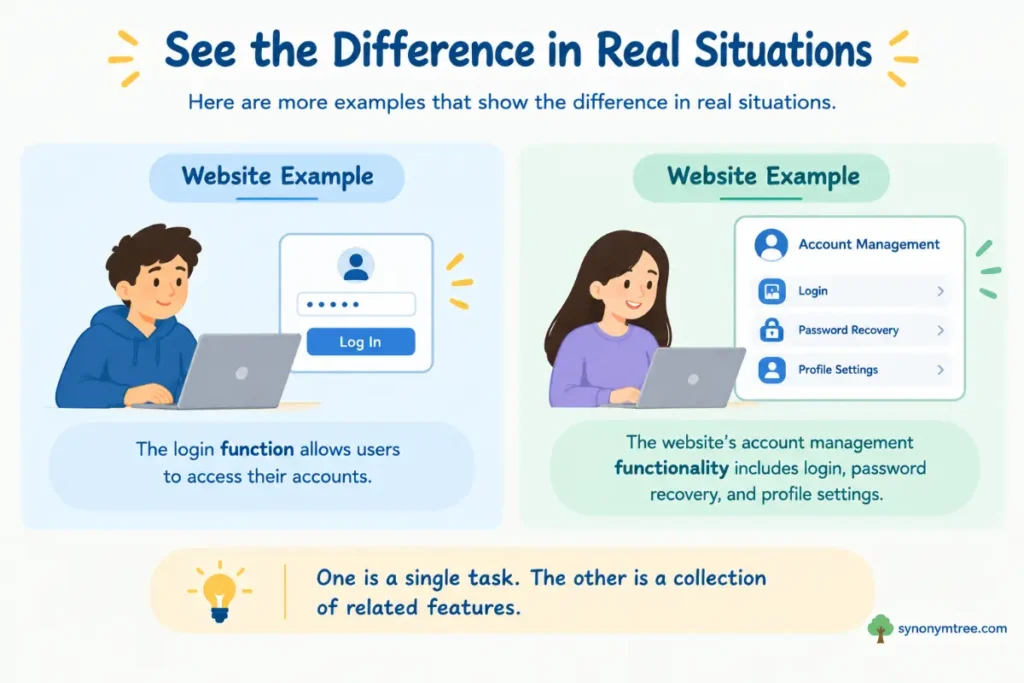
Here are more examples that show the difference in real situations.
Website example
The login function allows users to access their accounts.
The website’s account management functionality includes login, password recovery, and profile settings.
Smartphone example
The camera has a night mode function.
The phone offers advanced photography functionality.
Software example
The export function creates a PDF file.
The software includes powerful document management functionality.
Car example
The lane warning function alerts the driver.
The vehicle has advanced safety functionality.
Kitchen appliance example
The timer function turns the oven off after a set period.
The oven offers several cooking functions.
Medical device example
The monitor has a heart rate function.
The device provides several monitoring capabilities.
Learning platform example
The quiz function lets students test their knowledge.
The platform offers broad learning functionality.
E commerce example
The checkout function processes customer orders.
The store’s payment functionality supports several payment methods.
Workplace example
The main function of the team is to support customers.
The new software improves the team’s workflow functionality.
Mobile app example
The notification function reminds users about appointments.
The app’s notification functionality includes alerts, scheduling, and user preferences.
These examples show why context matters. The same product can have individual functions and broader functionality at the same time.
A Simple Memory Trick
Think of function as one job.
Think of functionality as the full set of jobs.
A calculator’s multiplication tool is a function.
Everything the calculator can do makes up its functionality.
You can also remember the difference with a toolbox.
One screwdriver has a function.
A toolbox contains many tools and supports many tasks.
The broader collection of capabilities is similar to functionality.
This isn’t a strict dictionary rule, but it gives you a quick mental shortcut when you’re writing.
When Should You Avoid Functionality?
Avoid functionality when a simpler word gives the reader the answer faster.
For example:
The functionality of the button is to save the file.
This sounds unnecessarily formal.
A clearer version is:
The function of the button is to save the file.
Likewise:
The functionality of the key is to open the door.
The function of the key is to open the door.
Simple writing often works better when the meaning is simple.
Functionality has a useful place in technical and product writing. It becomes less useful when it replaces an ordinary word for no clear reason.
When Is Functionality the Better Choice?
Functionality is useful when you need to describe a product or system at a broader level.
For example:
The team evaluated the functionality of the new platform.
This sentence makes sense because the team is likely looking at many aspects of what the platform can do.
Another example is:
The update adds new functionality for managing customer accounts.
The update may include several related capabilities. Functionality gives you a concise way to describe them together.
In technical writing, this can save repetition.
Instead of listing every function each time, you can discuss the system’s functionality.
How Does Context Change the Best Choice?
Context can change which word sounds natural.
In academic writing, function often works well for purpose or role.
In software development, both terms are common.
For example, a developer might discuss a specific function in code. A product manager might discuss the functionality that users need.
Neither speaker is necessarily using a better word. They are focusing on different levels of the product.
Quick Comparison With Related Words
| Word | Main Idea | Example |
|---|---|---|
| Function | Specific job or operation | The search function finds products. |
| Functionality | Overall set of capabilities | The website has strong search functionality. |
| Feature | Individual product element | The search filter is a useful feature. |
| Capability | Ability to do something | The system has advanced search capabilities. |
| Purpose | Reason something exists | The purpose of the tool is to save time. |
| Role | Part played by a person or thing | The team’s role is to support customers. |
| Performance | How well something works | The search system has fast performance. |
| Usability | How easy something is to use | The site has excellent usability. |
These terms overlap, but they aren’t identical.
Choosing the most precise word can make technical and professional writing much easier to understand.
Quick Tips to Remember Function and Functionality
Use purpose when explaining why something exists.
Use performance when describing how well or quickly it works.
If you’re unsure, rewrite the sentence in plain English first.
For example:
The functionality of this button is to submit the form.
becomes:
The function of this button is to submit the form.
The second version is shorter and more direct.
Conclusion
The easiest way to remember function vs functionality is to think about scope. A function describes a particular job, purpose, or operation. Functionality describes the broader set of things a product, system, or tool can do.
If you’re talking about one button that saves a file, call it a save function. If you’re describing a complete software system with saving, sharing, editing, searching, and exporting tools, you can discuss its overall functionality.
Context should guide your choice. In technical writing, the distinction can make your explanation more precise. In everyday writing, simpler words such as function, feature, or capability may sometimes work better.
When you’re unsure, ask yourself what you’re describing. One specific task points to function. A wider collection of capabilities points to functionality. That quick check will help you choose the clearer word every time.
Frequently Asked Questions
What is the difference between function and functionality?
A function is a specific task or action that something performs. Functionality refers to the range of functions or features a system, product, or tool offers.
Is functionality the same as a function?
No. A function is usually one specific capability, while functionality describes the overall set of capabilities available.
Can I use function and functionality interchangeably?
Not always. Use function for a particular task or purpose, and functionality when talking about several features or the overall capability of something.
What is an example of functionality?
A smartphone’s functionality can include calling, messaging, taking photos, browsing the internet, and using apps. Each of these is an individual function.
Which word is better for a resume?
Function usually works better when you are describing a specific task or purpose. Functionality fits better when discussing the features or capabilities of a system or tool.
