
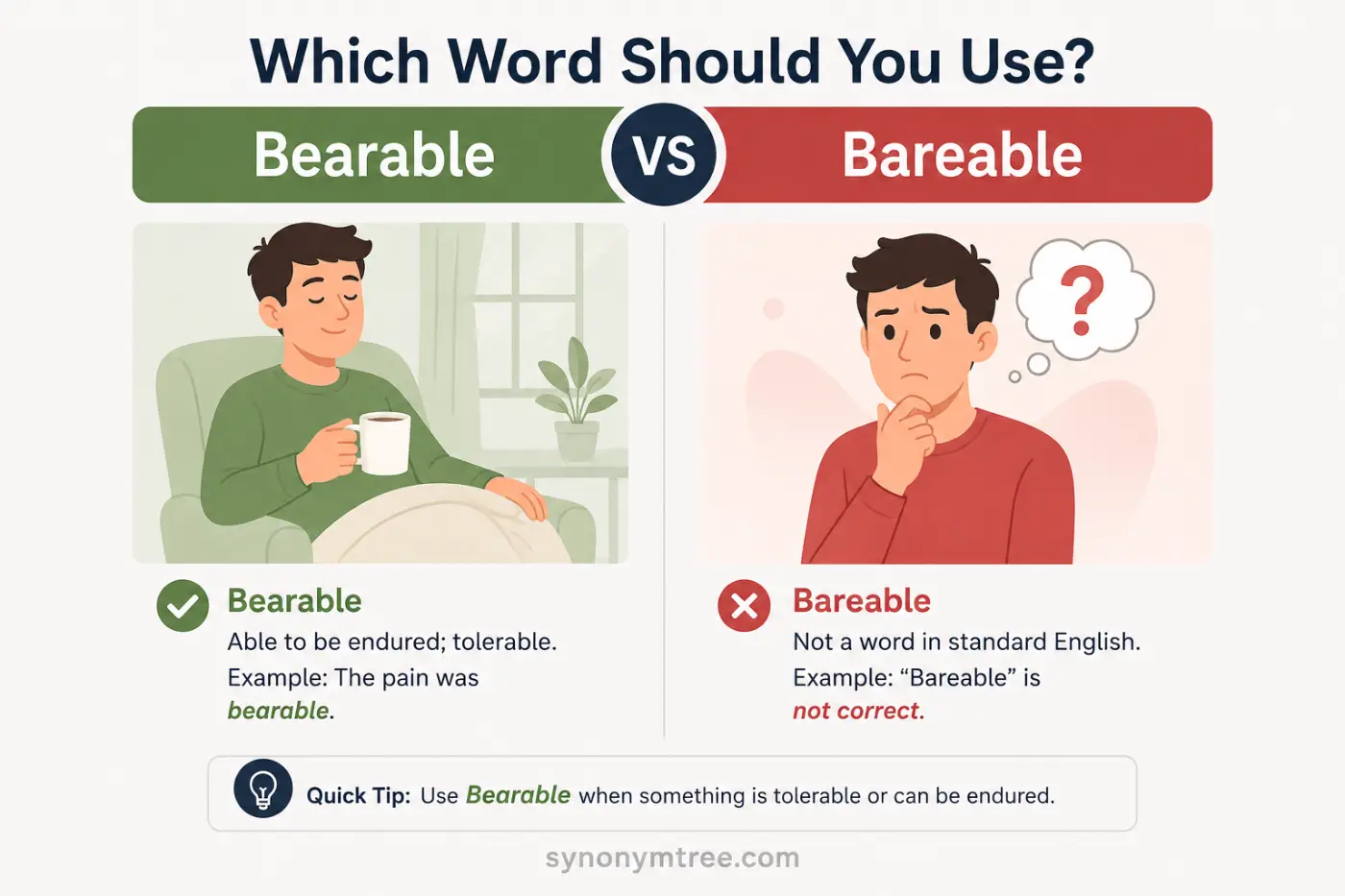
Many English learners get confused about bearable vs bareable because the two words look almost the same. They also sound alike when people say them. That makes it easy to choose the wrong spelling even if you know what the sentence means.
The good news is that this word pair is much easier than it first appears. One word is a standard English word that people use every day. The other is almost never correct and rarely appears in dictionaries.
This guide explains these words in simple English. You will learn what each word means why people mix them up and how to choose the correct spelling every time.
Simple Answer In One Look
Bearable is the correct spelling. It means something is not too difficult painful or unpleasant to handle. Bareable is almost always a spelling mistake in modern English.
What Bearable Vs Bareable Means In Simple English
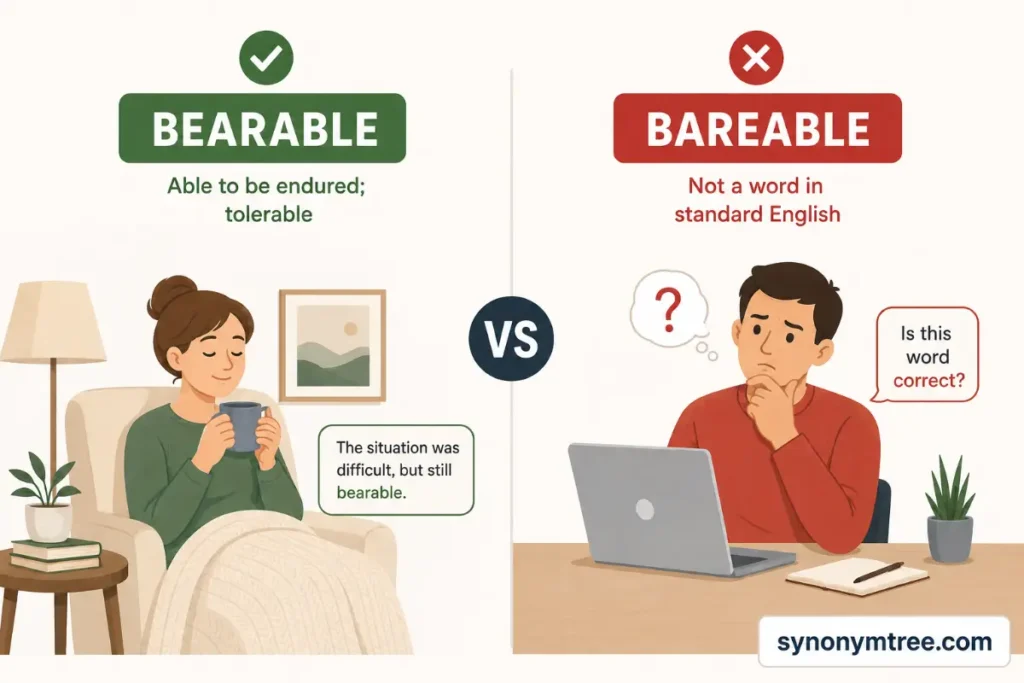
The word bearable means something you can live with even if you do not enjoy it.
Think about a hot summer day.
It feels uncomfortable.
Still you can handle it.
You could say.
The heat is bearable.
Now think about waiting in a long line.
You may not like waiting.
Still the wait is short enough that you can manage it.
That wait is bearable.
The word often describes things that are difficult but not impossible.
People use it when talking about pain weather noise stress work and many other everyday situations.
Here are a few simple examples.
The traffic was bearable today.
The movie was slow but still bearable.
The headache became more bearable after I rested.
Now look at bareable.
Most dictionaries do not accept this as a standard English word.
People usually write it by mistake because they know the word bare.
The word bare means uncovered open or without clothing.
Since bear and bare sound the same many writers accidentally choose the wrong spelling.
The correct word for something you can handle is always bearable.
Why People Mix These Words
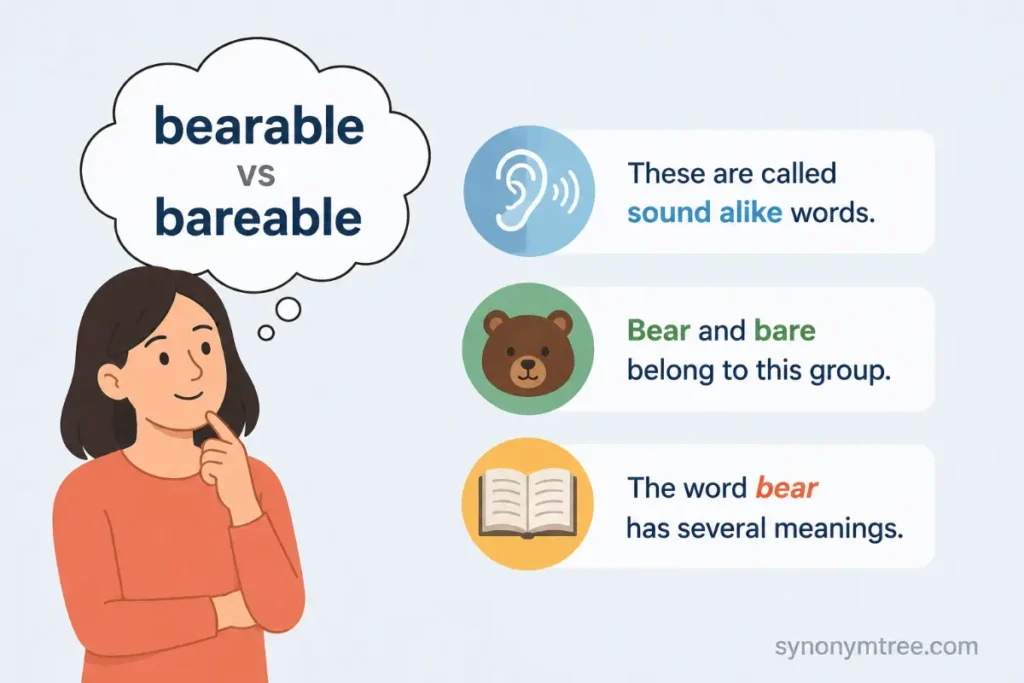
English has many words that sound alike but have different spellings.
These are called sound alike words.
Bear and bare belong to this group.
The word bear has several meanings.
It can mean the animal.
It can also mean to carry support or put up with something.
The word bare means uncovered empty or plain.
Because both words sound exactly the same many people type the wrong one without noticing.
Another reason is that spell check does not always explain why one spelling is wrong.
A writer may quickly type bareable because it looks logical.
After all the word begins with bare.
Still English follows the older meaning of bear which means to carry or endure.
Here are a few situations where confusion happens.
- A student writes the pain was bareable.
- Someone posts online that the weather is bareable.
- A worker writes the job became bareable after lunch.
All three examples should use bearable.
Reading the sentence aloud does not help because both spellings sound the same.
That is why understanding the meaning matters more than listening to the pronunciation.
Clear Difference Between These Words
The easiest way to remember these words is to compare them.
- Bearable is the correct English spelling.
- Bearable means something can be handled or endured.
- Bareable is almost always incorrect.
- Bearable comes from the word bear which means to carry or endure.
- Bare means uncovered and does not create the correct adjective in this situation.
Here is a simple memory trick.
Imagine carrying a heavy backpack.
It feels heavy.
Still you can keep walking.
You are able to bear it.
That makes it bearable.
Now think about someone with bare feet.
The word bare means uncovered.
It has nothing to do with handling pain stress or difficulty.
This picture helps many students remember the correct spelling.
Which Form Should You Use In These Words
You should almost always choose bearable.
It is the correct spelling in school writing work emails books articles and everyday conversations.
Use it when talking about something that is difficult but still manageable.
Here are common situations.
The weather is bearable.
The noise is bearable.
The pain is bearable.
The price is bearable.
The workload is bearable.
Do not use bareable unless you are discussing a spelling mistake or explaining the difference between the two words.
If you ever feel unsure remember this easy question.
Can I replace the word with manageable or tolerable?
If the answer is yes the correct spelling is bearable.
That quick check works almost every time.
Easy Real Life Sentences You Can Use With These Words
Reading examples makes learning much easier.
Here are some simple sentences.
- The weather became bearable after the rain.
- The pain was bearable by the evening.
- This chair is not very comfortable but it is bearable.
- The traffic was bearable today.
- The movie was long but still bearable.
- My backpack is heavy but it is bearable.
- The classroom was warm but still bearable.
- The noise became more bearable after we closed the windows.
Notice that every sentence talks about something people can still handle.
Now look at this sentence.
The weather was bareable.
This is incorrect.
The correct sentence is.
The weather was bearable.
The same correction works in almost every case.
Where Bearable Vs Bareable Comes From
The history of bearable helps explain the spelling.
The word comes from the old English verb bear.
Long ago bear did not only mean the large animal.
It also meant to carry support or endure something difficult.
Over many years people added the ending able to show that something could be endured.
That created the word bearable.
The spelling has stayed the same for hundreds of years.
The word bare has a different history.
It means uncovered empty or without clothing.
Because the pronunciation is the same many people accidentally replace bear with bare.
That creates the incorrect spelling bareable.
Knowing the story behind the word makes it much easier to remember.
Think about carrying a heavy box.
You bear the weight.
If you can keep carrying it the weight is bearable.
That simple picture connects the meaning with the correct spelling.
How Bearable Vs Bareable Is Understood In Culture And Stories
The words bearable vs bareable do not appear as famous symbols in stories. Still the idea behind bearable shows up in many books movies and everyday conversations. People often talk about hard times that become bearable because someone offers help. A friend listens. A family member gives support. A teacher explains a difficult lesson. The problem does not disappear but it becomes easier to handle.
That is the heart of the word bearable.
It reminds people that difficult moments do not always stay difficult forever.
You may also hear someone say.
The long trip was bearable because we talked the whole way.
The work became bearable after we took a short break.
These examples show that people use the word to describe hope during uncomfortable situations.
The spelling bareable does not have this kind of meaning because it is not a standard English word.
Biblical And Mythological Meaning Of These Words
There is no special biblical meaning for bearable vs bareable.
The Bible does not use these words as important symbols.
The same is true for well known myths from Greece Rome and other ancient cultures.
Still the idea behind bearable matches many lessons found in religious and cultural stories.
People often learn about patience courage faith and staying strong during difficult times.
Those ideas connect naturally with something that is bearable because it can be endured.
This is only a simple comparison.
It is not an official religious meaning.
Symbolism Explained In Simple Words About These Words
What Bearable Vs Bareable Represents As Bearable
The word bearable often represents strength.
It reminds people that they can keep moving forward even during hard times.
It also represents patience.
Some problems take time to solve.
People keep going one step at a time until life becomes easier.
Many readers also connect the word with hope.
A difficult day can become bearable when people help each other.
What Bearable Vs Bareable Represents As Bareable
The spelling bareable does not carry its own meaning because it is not accepted as a standard English word.
Most people simply see it as a spelling mistake.
That mistake reminds us that English has many words that sound alike but have different spellings.
Learning the correct spelling helps your writing look clear and professional.
Related Words You Should Know About Bearable Vs Bareable
Learning related words makes this lesson easier to remember.
- Endure.
To continue through something difficult without giving up.
- Tolerable.
Something that is unpleasant but still manageable.
- Manageable.
Something that is not too difficult to handle.
- Difficult.
Something that takes effort or causes problems.
- Comfortable.
Something that feels pleasant and easy.
- Uncomfortable.
Something that does not feel pleasant but may still be bearable.
- Bare.
Without covering clothing or protection.
- Bear.
To carry support or endure something.
These words help you understand why bearable is the correct spelling.
How People Actually Use Bearable Vs Bareable In Daily English
People use bearable in many everyday situations.
Here are some natural examples.
- The weather is finally bearable today.
- My headache became bearable after I rested.
- The traffic was bearable this morning.
- The noise was loud but still bearable.
- The long meeting was bearable because everyone stayed positive.
- The heavy backpack was bearable after I adjusted the straps.
- The summer heat became bearable once the wind started blowing.
- The homework looked difficult but it became bearable after the teacher explained it.
- The wait was bearable because we had good company.
- The pain was bearable after taking medicine.
Notice that every sentence describes something difficult but still possible to handle. That is the main idea of bearable.
Common Mistakes People Make With Bearable Vs Bareable
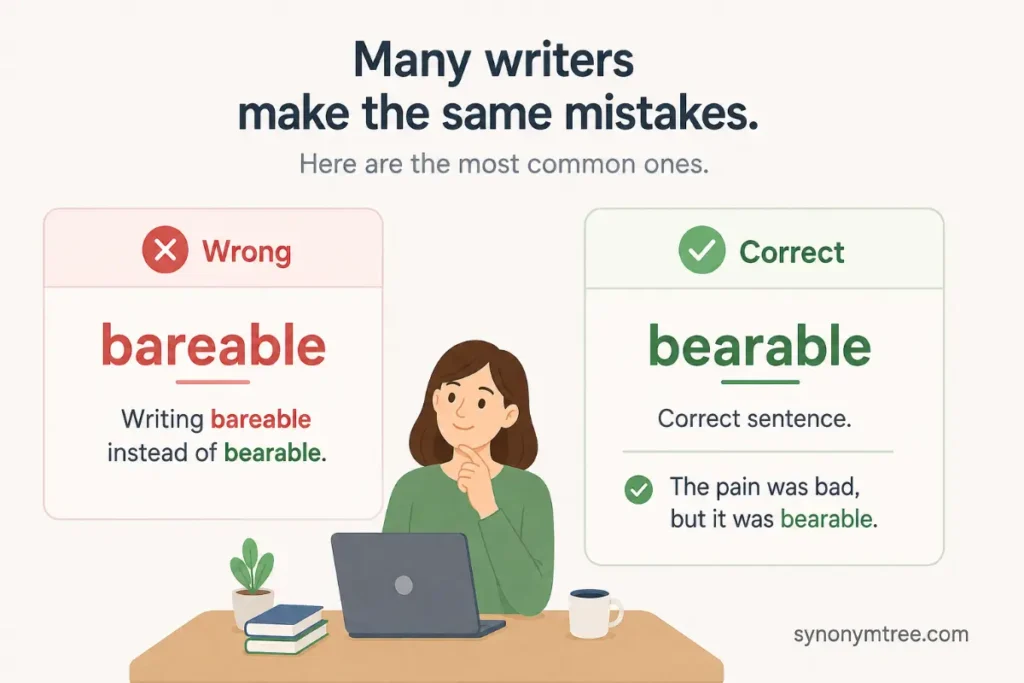
Many writers make the same mistakes.
Here are the most common ones.
- Writing bareable instead of bearable.
Correct sentence.
The weather is bearable today.
- Thinking bareable is another accepted spelling.
It is not.
Standard English uses bearable.
- Connecting the word with bare because both words sound the same.
Remember that bearable comes from the verb bear which means to endure.
- Trusting pronunciation more than spelling.
Both words sound alike.
Only one is correct.
- Forgetting the meaning behind the word.
If something can be endured the correct spelling is bearable.
A simple memory trick can help.
You can bear a heavy load.
If you can bear it then it is bearable.
Final Teacher Explanation About These Words
Imagine we are ending today’s English lesson.
You only need to remember one important rule.
The correct spelling is bearable.
It means something is difficult but still possible to handle.
The spelling bareable is almost always wrong.
Do not let the pronunciation confuse you.
Think about the meaning instead.
Ask yourself one simple question.
Can I replace this word with manageable or tolerable?
If the answer is yes then write bearable.
That small habit will help you avoid this mistake every time.
Good writers do not guess.
They choose words because they understand the meaning behind them.
That is exactly what you are learning to do.
Final Answer About These Words
Use bearable for something that can be endured or handled.
Do not use bareable because it is not a standard English spelling.
Remember the word bear means to endure.
That simple connection makes the correct spelling easy to remember.
Conclusion
The difference between bearable vs bareable is simple once you know where the word comes from. Even though both spellings sound the same only bearable is accepted in standard English. It describes something that is difficult but still possible to handle.
The easiest way to remember the spelling is to think about the verb bear. If you can bear a problem then the problem is bearable. The spelling bareable comes from mixing up two words that sound alike.
Keep practicing with real sentences and pay attention to meaning instead of sound alone. The more you read and write the more natural the correct spelling will become.
Frequently Asked Questions About Bearable Vs Bareable
What does bearable mean in simple words?
Bearable means something is difficult or unpleasant but you can still handle it.
Is bareable a real word?
No. Bareable is almost always a spelling mistake in modern English.
Which is correct bearable or bareable?
Bearable is the correct spelling in standard English.
Why do people confuse these words?
The words bear and bare sound the same. That makes many people choose the wrong spelling.
Can I use bareable in writing?
No. You should use bearable unless you are talking about the spelling mistake itself.
When should I use bearable?
Use it when something is manageable or can be endured.
How can I remember the correct spelling?
Think about the verb bear which means to endure. If you can bear it then it is bearable.
Is bearable a positive or negative word?
It is usually neutral. It describes something that is not pleasant but is still possible to handle.
