
Many English learners get confused about begun or began because both words come from the same verb. They look similar and have related meanings. Still they are not used in the same way. Choosing the wrong one is one of the most common English mistakes.
The good news is that the difference is simple once you see the pattern. You do not need to memorize long grammar rules. You only need to know when an action happened and look for a helping word in the sentence.
This guide explains begun or began in easy English. You will learn what each word means why people mix them up and how to choose the correct one with confidence.
Simple Answer In One Look
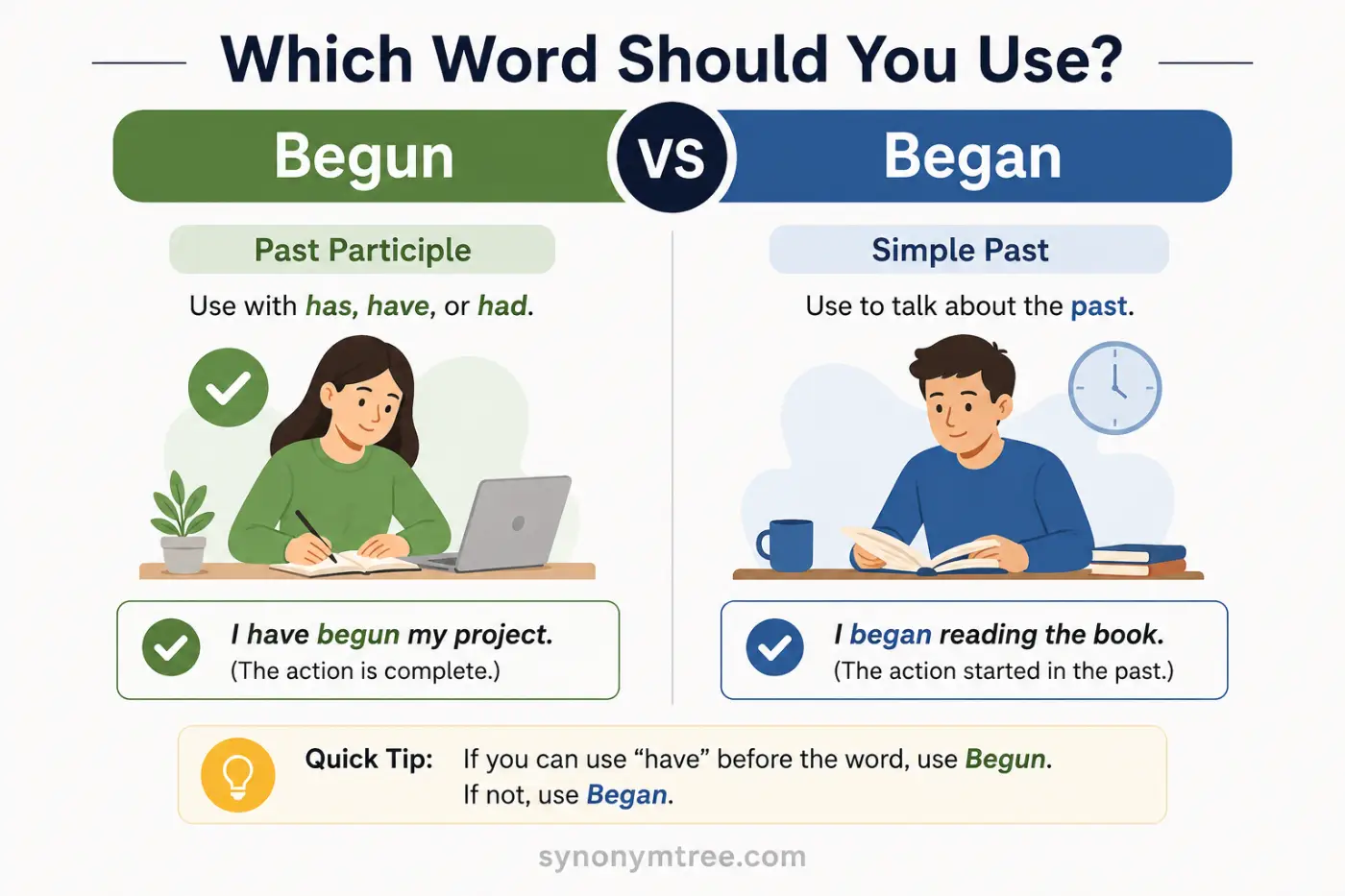
Began is used by itself to talk about something that started in the past. Begun needs a helping word like has have or had before it.
What Begun Or Began Means In Simple English
Both begun and began come from the verb begin. The verb has three main forms. Begin is the base form, began is the simple past form, and begun is the past participle, which is normally used with a helping verb such as has, have, or had.
The easiest way to remember the difference is to look at the sentence structure. If has, have, or had comes before the verb, begun is usually the correct choice. If you are simply describing something that happened in the past without these helping verbs, use began.
Examples should then be separated for easy scanning:
- I begin my homework after dinner.
- Yesterday I began my homework early.
- I have begun my homework already.
- The movie began at seven.
- The game has begun.
- Our vacation had begun before the rain arrived.
Notice that begun does not normally work by itself as the main verb in standard constructions like these. It needs a helping verb such as has, have, or had. This is one of the easiest clues for choosing between began and begun.
Why People Mix These Words
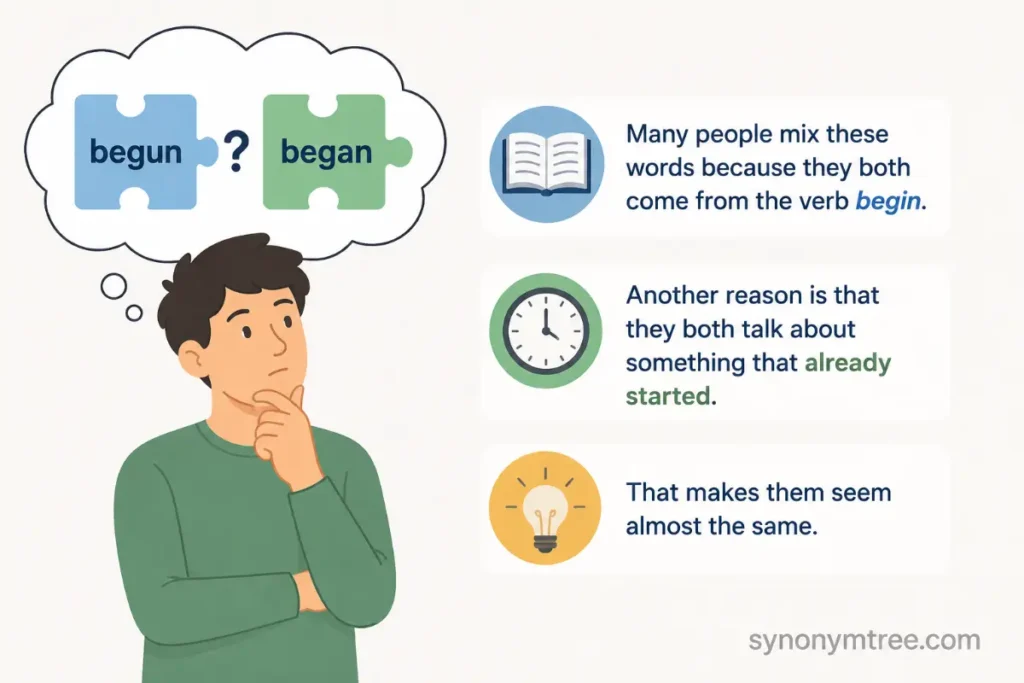
Many People often mix up began and begun because both words come from the verb begin and both refer to an action that has already started. Since they have similar meanings, many learners assume they can be used in the same way. English also has many verbs with different forms, so it is common to remember one form but forget when to use the other.
Many mistakes happen because people focus on the meaning instead of the sentence structure. The easiest way to choose the correct word is to look for a helping verb. If there is no helping verb, began is usually correct. If the sentence includes has, have, or had, begun is the correct choice.
Here are some common mistakes and their correct forms:
- Incorrect: The class begun at eight.
Correct: The class began at eight. - Incorrect: I have began my homework.
Correct: I have begun my homework. - Incorrect: The meeting has began.
Correct: The meeting has begun.
Reading the entire sentence before choosing the verb makes the difference much easier to understand. Instead of looking only at the meaning, always check whether a helping verb comes before the main verb. This simple habit will help you use began and begun correctly in both writing and everyday English.
Clear Difference Between These Words
The easiest way to remember these words is to compare them.
- Began works by itself.
- Begun needs a helping word.
- Say The movie began at six.
- Say The movie has begun.
- Never write The movie begun at six.
- Never write The movie has began.
Here is a simple memory trick.
Imagine someone opens a race.
The runner starts moving.
You can say.
The race began.
Now imagine the race is already under way.
You can say.
The race has begun.
The helping word tells you to choose begun.
That one idea solves most mistakes.
Which Form Should You Use In These Words
The correct choice between began and begun depends on the sentence structure. Use began when describing a completed action in the past without a helping verb. Use begun only after helping verbs such as has, have, or had. Looking for these helping words is the easiest way to decide which form is correct.
Here are examples of began:
- The concert began late.
- School began in September.
- The rain began this morning.
Here are examples of begun:
- The concert has begun.
- School had begun before we arrived.
- The movie has begun already.
Before you write a sentence, ask yourself one simple question: Is there a helping verb before the main verb? If the answer is yes, use begun. If the answer is no, use began. This simple rule will help you avoid most grammar mistakes and use both words with confidence.
Easy Real Life Sentences You Can Use With These Words
Reading examples is one of the best ways to remember these words.
Here are some simple sentences.
- The game began on time.
- Our trip began early in the morning.
- The baby has begun to smile.
- The movie had begun before we arrived.
- The class began after lunch.
- Spring has begun in our town.
- The meeting began with a welcome speech.
- The lesson has begun already.
Look at these pairs.
The show began at eight.
The show has begun.
The first sentence tells about a past event.
The second sentence uses a helping word.
That changes the verb form.
Where Begun Or Began Comes From
The words began and begun both come from the Old English verb begin. People have used this verb for hundreds of years, and over time English developed different forms for different sentence structures. That is why we use begin, began, and begun instead of relying on a single form. Each word has its own purpose and is used in a specific type of sentence.
Many common English verbs follow the same pattern. Learning these verb families makes it much easier to understand and remember the correct form. Instead of thinking of them as separate words, think of them as different forms of the same verb.
Here are a few examples:
- See → Saw → Seen
- Write → Wrote → Written
- Break → Broke → Broken
- Begin → Began → Begun
You do not need to memorize complicated grammar terms to use these words correctly. Simply look for a helping verb in the sentence. If you see has, have, or had, choose begun. If there is no helping verb and you are talking about a completed action in the past, choose began. This simple habit will help you write more naturally and speak with greater confidence.
How Begun Or Began Is Understood In Culture And Stories
The words begun and began appear in stories, songs, movies, and everyday conversations because they help describe the start of an action or event. Whether people are talking about a new adventure, a school year, a job, or an important life moment, these words show that something has started. The correct choice depends on the sentence structure, not the meaning.
Here are a few examples:
- The adventure began on a cold morning.
- The journey had begun before anyone noticed.
- Your school year has begun.
- Our family began living here many years ago.
Notice how begun follows a helping verb such as has or had, while began stands alone to describe a completed action in the past. This simple pattern appears in everyday English and in stories from many cultures. It reminds us that every journey, goal, or achievement begins with a single step.
Biblical And Mythological Meaning Of These Words
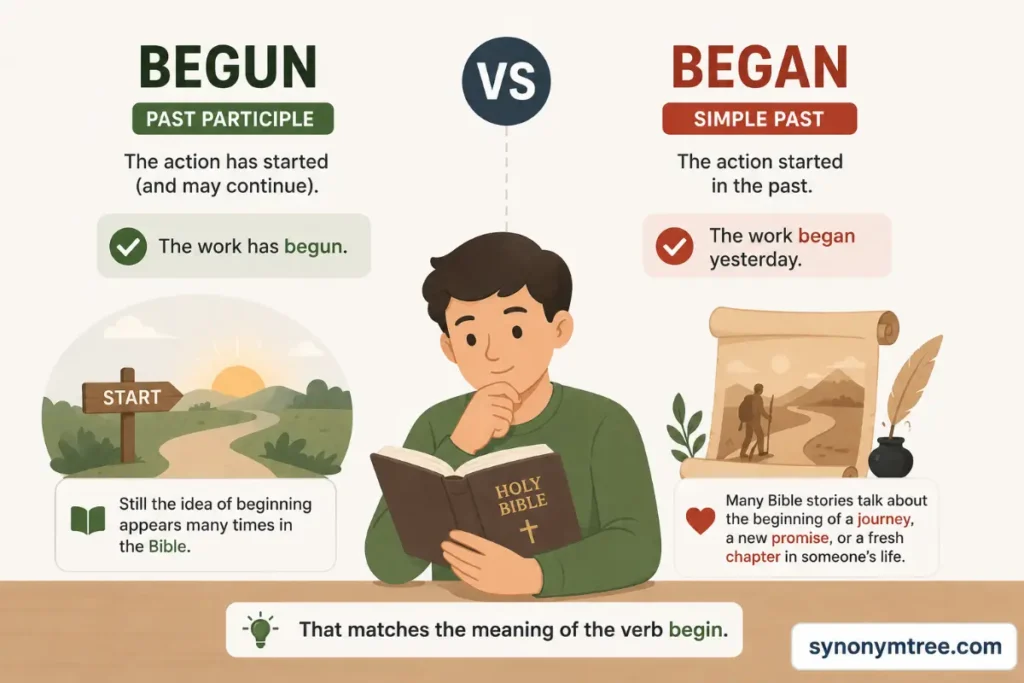
There is no special biblical meaning for begun or began. They are simply different forms of the verb begin. However, the idea of beginning appears throughout the Bible, where many stories describe the start of a journey, a new promise, a period of growth, or a fresh chapter in someone’s life. These stories focus on the concept of a new beginning rather than the specific English words.
A similar theme appears in many myths and legends. Heroes often begin a journey before facing challenges, gaining wisdom, or achieving an important goal. These stories highlight the importance of new beginnings, but they do not give began or begun any special symbolic or spiritual meaning. The words are simply used to describe when an action or event starts.
Symbolism Explained In Simple Words About These Words
What Begun Or Began Represents As Began
The word began often represents the first step.
It points to the moment something started.
People use it to remember an important day or event.
It may be the beginning of a friendship a vacation a school year or a new goal.
It reminds us that every success has a starting point.
What Begun Or Began Represents As Begun
The word begun often represents progress.
It shows that something has already started and is now moving forward.
When someone says.
The project has begun.
It tells us the work is already happening.
That small difference helps readers understand the time of the action.
Related Words You Should Know About These Words
Learning related words makes this lesson even easier.
- Begin.
The base form of the verb. It means to start something.
- Start.
A common word with almost the same meaning as begin.
- Finish.
To complete something.
- End.
To stop or reach the final part.
These words often appear in the same kinds of sentences as begun and began.
How People Actually Use These Words In Daily English
People use these words every day.
Here are some natural examples.
- The game began at six.
- The class began after lunch.
- The movie has begun already.
- Spring has begun in our town.
- The meeting began on time.
- Our vacation had begun before the rain started.
- The baby has begun walking.
- The party began with music.
- Dinner has begun so come inside.
- The lesson began a few minutes ago.
Notice the pattern.
When you see has or had the correct word is usually begun.
Without those helping words you normally use began.
Common Mistakes People Make With These Words
Many English learners make the same mistakes.
Here are the most common ones.
- Writing has began.
Correct sentence.
The meeting has begun.
- Writing begun without a helping word.
Correct sentence.
The meeting began at nine.
- Thinking both words can be used anywhere.
They cannot.
Each word has its own job.
- Forgetting to check for helping words.
This is the biggest reason people make mistakes.
- Trying to choose the word by sound alone.
Both words sound natural in conversation.
The sentence structure tells you the correct answer.
A simple trick can help.
Look for has have or had.
If you see one of those words choose begun.
If you do not see one choose began.
Final Teacher Explanation About These Words
Imagine we are finishing today’s lesson together. You only need to remember one simple rule. Began works by itself to describe a completed action in the past, while begun always needs a helping verb such as has, have, or had. This is the easiest way to tell the difference between the two words.
Before writing a sentence, read it carefully and ask yourself one question: Is there a helping verb before the main verb? If the answer is yes, choose begun. If the answer is no, choose began. You do not need to memorize complicated grammar terms. With a little practice, this simple habit will become natural and help you use both words correctly in speaking and writing.
Final Answer About These Words
Use began for a simple action that started in the past.
Use begun after helping words like has have or had.
Remember this easy rule and you will choose the correct word almost every time.
Conclusion
The difference between begun or began is much easier than many learners expect. Both words come from the same verb but they do different jobs in a sentence. Once you learn that begun needs a helping word and began does not the confusion quickly disappears.
The best way to remember this lesson is to practice with simple everyday sentences. Read carefully look for helping words and think about how the action is described. With regular practice choosing the correct form will become a natural habit. Every strong English skill starts with small lessons like this. Keep learning one word pair at a time and your speaking and writing will become clearer and more confident.
Frequently Asked Questions About Begun Or Began
What is the difference between these words?
Began is used by itself for a past action. Begun needs a helping word like has have or had.
Is it correct to say has began?
No. The correct phrase is has begun.
When should I use began?
Use began when talking about something that started in the past without a helping word.
When should I use begun?
Use begun after helping words such as has have or had.
Why do people confuse begun or began?
Both words come from the verb begin and have similar meanings. Many learners forget to check for helping words.
Can I use begun without has have or had?
Usually no. Begun normally needs a helping word before it.
Is began the past tense of begin?
Yes. Began is the simple past form of begin.
How can I remember the difference?
Think of this simple rule. No helping word means began. A helping word means begun.
