
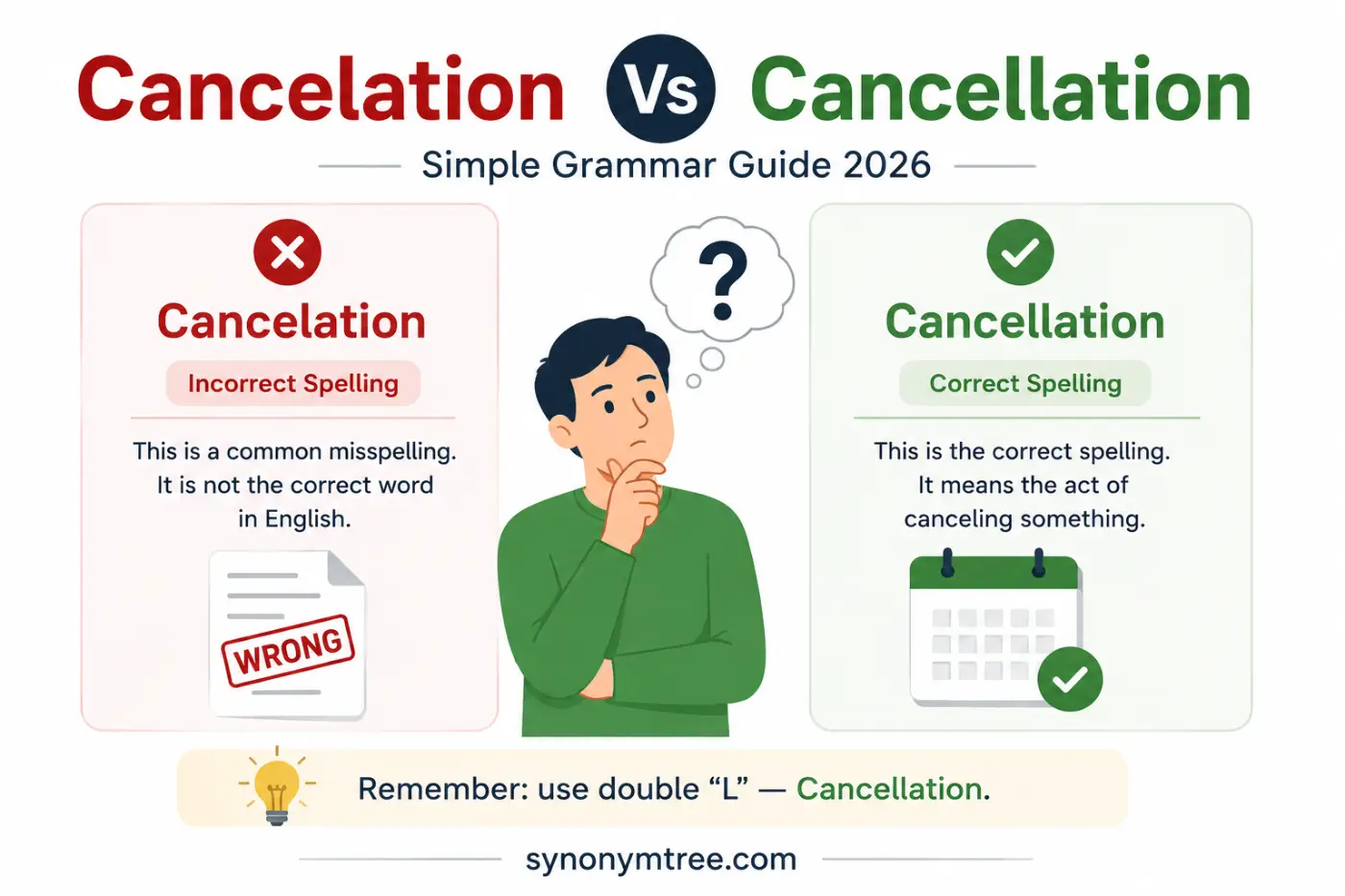
Many people search for cancelation vs cancellation because both spellings appear online. That makes the choice confusing. The good news is that the answer is simple. One spelling is much more common and accepted in standard English while the other appears only in limited cases.
The spelling cancellation is the standard form in American English and British English. Most dictionaries style guides schools and businesses recommend this spelling. You will see it in books websites newspapers contracts emails and everyday writing.
In this lesson you will learn the difference between these words in very simple English. You will also learn why people confuse these spellings how to choose the right one and how to use the correct word with confidence.
Simple Answer In One Look
If you are choosing between these words use cancellation. It is the standard and recommended spelling in almost every situation.
What Cancelation Vs Cancellation Means In Simple English
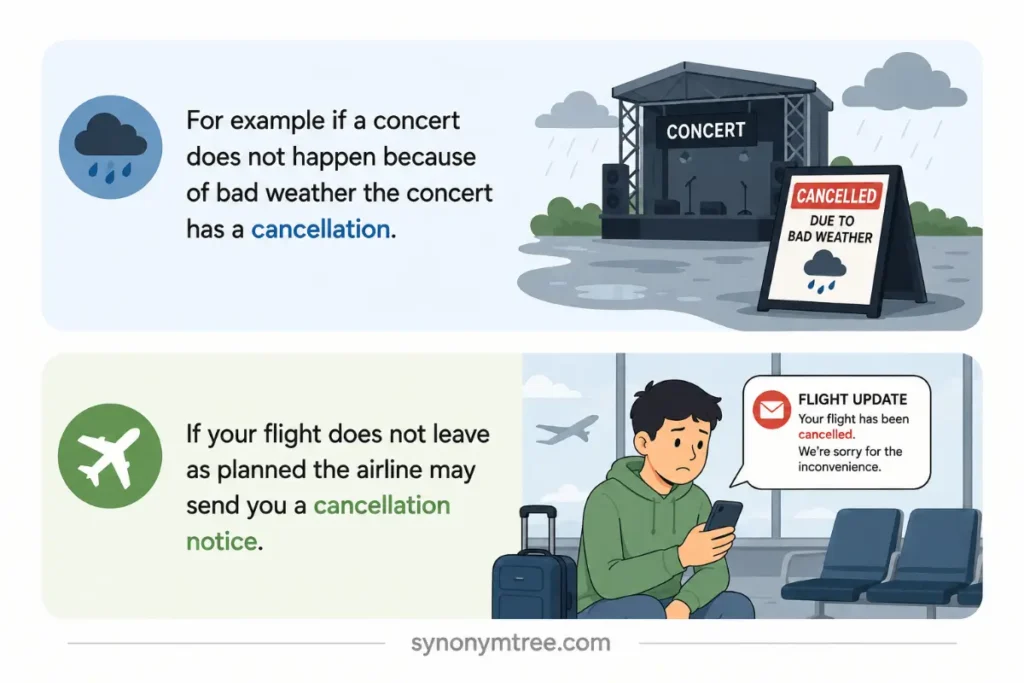
The word cancellation means that something has been called off stopped or ended before it happens. It can describe plans meetings trips events subscriptions orders or many other things. For example if a concert does not happen because of bad weather the concert has a cancellation. If your flight does not leave as planned the airline may send you a cancellation notice.
People use this word every day because plans often change. Schools cancel classes. Families cancel dinner plans. Companies cancel meetings. Stores cancel orders. The same word works in all of these situations. The spelling cancelation has the same meaning. The difference is not the meaning. The difference is the spelling. Today almost everyone uses cancellation because it follows the standard spelling found in modern dictionaries.
Think about these everyday situations.
- Your teacher announces a cancellation because of snow.
- Your doctor calls about the cancellation of your appointment.
- You receive an email about a flight cancellation.
- A sports game ends with a cancellation after heavy rain.
- Your streaming service confirms the cancellation of your membership.
Each sentence uses the same idea. Something that was planned will no longer happen.
Why People Mix These Words
Many English words can have confusing spellings. This pair is one of them. The biggest reason is the base word cancel. Since cancel has one letter l many people naturally think cancelation should also have one letter l before adding the ending. That seems logical at first. English spelling does not always follow simple patterns. Some words change slightly when endings are added. Cancellation is one example.
Another reason is that older books and a few older dictionaries sometimes listed cancelation as a spelling variant. Because of that people still find it online and believe both forms are equally common. Typing mistakes also add to the confusion. When people write quickly they may leave out one letter without noticing it. Search engines can also show both spellings because they try to help people find the information they need even if the search contains a spelling mistake.
Here are a few similar spelling pairs that confuse many learners.
- Traveler and traveller.
- Labeled and labelled.
- Canceled and cancelled.
- Modeled and modelled.
- Cancelation and cancellation.
Some of these pairs depend on American English or British English. Cancellation is different because it is the preferred spelling in both varieties of English.
Clear Difference Explained Simply
The easiest way to remember the difference is to focus on the extra letter l. Cancellation is the standard spelling used in schools businesses newspapers and professional writing. Cancelation is much less common. Many teachers editors and writing tools mark it as incorrect or suggest changing it to cancellation.
Here is a simple comparison.
- Cancellation is the standard spelling.
- Cancellation is accepted in American English and British English.
- Cancellation appears in dictionaries style guides and professional writing.
- Cancelation is rare and not recommended for everyday writing.
- Choosing cancellation helps you avoid spelling mistakes and confusion.
A simple memory trick can help. The word cancel grows by adding another letter l before the ending. That gives you cancellation.
Which Form Should You Use
The answer is easy.
Cancellation works well in school assignments.
Emails often use cancellation.
Business documents commonly use cancellation.
Blog posts can use cancellation.
Books and reports may use cancellation.
Everyday messages can use cancellation.
You do not need to stop and think every time you write this word. Choosing cancellation is the safest option because it is the spelling most readers expect to see. If you are taking an English test this spelling is also the best choice. Teachers and exam writers almost always expect cancellation. Reading your work before sending it also helps. A quick review can catch small spelling mistakes before someone else sees them.
Easy Real Life Sentences You Can Use
The best way to remember a new word is to see it in real sentences. These examples sound natural and use the standard spelling that English speakers expect. Read each sentence slowly. Notice how the word fits into everyday situations. After reading them a few times you will start to remember the correct spelling without thinking about it.
- The school announced the cancellation of the field trip because of heavy rain.
- We received a cancellation email before leaving for the airport.
- Her doctor’s office called about the cancellation of her appointment.
- The company sent a refund after the cancellation of the order.
- Everyone understood the cancellation because the weather was dangerous.
- The hotel confirmed the cancellation of our reservation.
- My brother was disappointed after the cancellation of the soccer game.
- The event organizer explained the cancellation to everyone.
Now look at these incorrect examples.
- Incorrect. We received a cancelation email this morning.
- Correct. We received a cancellation email this morning.
- Incorrect. The cancelation surprised everyone.
- Correct. The cancellation surprised everyone.
When you practice with correct examples your brain starts to recognize the right spelling naturally.
Where Cancelation Vs Cancellation Comes From
The story of this word begins with the verb cancel. The verb has been part of English for hundreds of years. People used it to mean crossing something out ending an agreement or stopping a planned event. As English grew people needed a noun to describe the act of canceling something. That noun became cancellation. Over time dictionaries style guides teachers and publishers agreed that cancellation should be the standard spelling. That is why you see it in books newspapers business letters websites and classrooms today.
You may still find the spelling cancelation in some older books older documents or on websites that have not been edited carefully. That does not make it the best choice for modern writing. Language changes slowly. Some spellings become more common while others slowly disappear. Cancellation became the spelling that most English speakers trust and use every day. A good habit is checking a trusted dictionary when you are unsure about a spelling. Doing this helps you build strong writing skills and gives you confidence every time you write.
The more often you read good English the easier correct spelling becomes. After enough practice cancellation will look completely natural while cancelation will look unusual. Learning one spelling rule may seem small but many small lessons work together to make you a stronger writer. Every correct word helps your writing become clearer and easier to understand. In the next section we will move beyond spelling. You will learn how cancellation is used in everyday life stories culture and common expressions. You will also discover mistakes people often make and simple ways to avoid them for good.
Common Mistakes People Make
Many English learners make small spelling mistakes. That is normal. The important part is learning from them. One common mistake is writing cancelation instead of cancellation. Since the verb cancel has one letter l many people think the noun should follow the same pattern. Modern English does not work that way. The standard noun is cancellation.Another mistake is using cancellation when they really mean postpone. These words are not the same. A cancellation means something will not happen. A postponement means it will happen later. Some people also use cancellation and refund as if they have the same meaning. They are connected but different. A cancellation stops a service event or order. A refund is money returned after that cancellation in some cases.
Look at these examples.
- Incorrect. The school sent a cancelation notice.
Correct. The school sent a cancellation notice. - Incorrect. The game had a cancellation and will happen tomorrow.
Correct. The game was postponed and will happen tomorrow. - Incorrect. My refund means my trip was canceled every time.
Correct. A refund may happen after a cancellation but not every cancellation includes a refund.
Reading your work one more time before sending it is a simple way to catch these mistakes.
Final Teacher Explanation
If one of my students asked me about cancelation vs cancellation I would give a very short answer. Always choose cancellation. It is the spelling used in schools dictionaries newspapers business writing and everyday English. Most people expect to see this spelling and understand it right away. Do not worry if you have written cancelation before. Many people make the same mistake. Every spelling error is a chance to learn something new. The best way to remember this lesson is to read the word often and use it in your own sentences. After a little practice the correct spelling will become natural. Good writing is built one word at a time. Small improvements like this make a big difference.
Final Answer Quick Recap
If you are choosing between these words use cancellation. Cancellation is the standard spelling in American English and British English. It is the safest and best choice for school work business writing and daily communication.
How Cancelation Vs Cancellation Is Understood In Culture And Stories
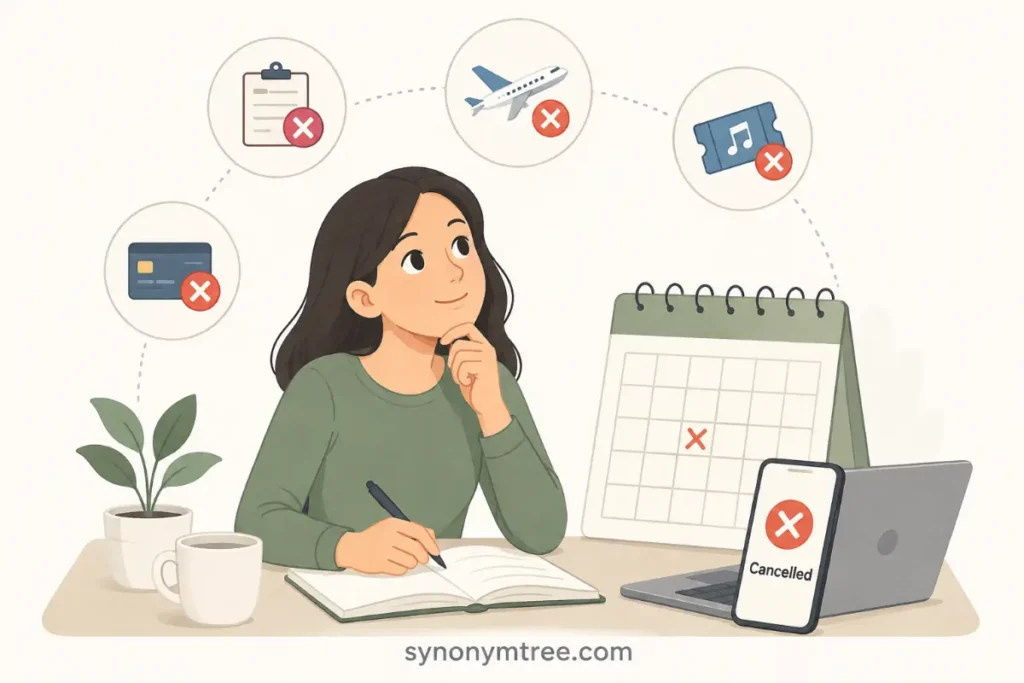
Language grows because people use words every day. Some words appear in stories because they describe real experiences that almost everyone understands. The same is true for these words. Even though this article focuses on spelling the word cancellation is also connected to many everyday moments.
A cancellation often changes the direction of a story. A family may plan a vacation for months. Then bad weather forces a cancellation. At first everyone feels disappointed. Later they spend time together at home and create happy memories they never expected. This simple change makes the story more interesting and more realistic. Many children’s books include a cancellation because it teaches an important lesson. Children learn that life does not always go as planned.
Movies use this idea too. A canceled flight may bring two strangers together. A canceled meeting may give a character time to help a friend. These moments remind us that one small change can create something even better. People also talk about cancellations in daily conversations.
Here are a few simple examples.
- The family enjoyed a game night after the cancellation of their picnic.
- The class learned online because of the cancellation of school.
- The friends laughed together after the cancellation of the concert.
- The story changed after the cancellation of the train ride.
- The team practiced indoors after the cancellation of the match.
- A canceled trip helped the family discover fun places close to home.
- The main character grew stronger after the cancellation of an important event.
These examples show that a cancellation may feel disappointing at first but it can also lead to something positive.
Biblical And Mythological Meaning
The word cancellation is not an important symbol in the Bible. It is also not a famous symbol in Greek Roman or other ancient myths. Still people sometimes connect the idea of cancellation with forgiveness or starting fresh. For example a debt can be canceled. A promise can be canceled. A mistake can be forgiven. Because of this some readers see cancellation as a sign that people can leave the past behind and begin again. This is a symbolic idea created by readers and writers. It is not the official meaning of the word. The word itself simply means that something planned has been stopped before it happens.
Cancelation Vs Cancellation Symbolism Explained In Simple Words
What Cancellation Represents
Cancellation often represents change. Life does not always follow our plans. A cancellation reminds us that unexpected things happen to everyone. It can also represent flexibility. People who stay calm after a cancellation often find another solution. They change their plans and keep moving forward. Some people connect cancellation with wisdom. Canceling a trip during dangerous weather is a smart choice. Canceling an event because people are not safe shows care and responsibility. Another common meaning is a fresh start. When one plan ends another one can begin. Sometimes a better opportunity appears after an unexpected cancellation.
What Cancelation Represents
The spelling cancelation does not carry its own meaning because it is not the standard English spelling. If you see cancelation in a sentence the writer almost always means cancellation. The spelling changes but the idea stays the same. This is why teachers editors dictionaries and writing tools recommend using cancellation every time. It keeps your writing clear and easy for everyone to understand.
Related Words You Should Know
Learning related words helps you understand English more naturally. These words often appear with cancellation in conversations articles emails and news stories.
- Cancel. This means to stop something before it happens.
- Canceled. This describes something that will no longer happen.
- Postpone. This means moving something to another day instead of ending it.
- Delay. This means something starts later than expected.
- Reschedule. This means choosing a new date or time.
- Refund. This means money returned after an order booking or ticket is canceled.
- Reservation. This means booking a room table seat or service before you need it.
- Appointment. This means a planned meeting with someone at a certain time.
- Schedule. This is a plan that shows times dates or events.
- Notice. This is a message that gives important information about a change.
Learning these words together helps you understand real conversations more easily. You will often see them in emails from airlines schools hospitals hotels and businesses.
How People Actually Use Cancellation In Daily English
The word cancellation appears almost everywhere. People use it at work at school while traveling and even at home. Once you notice it you will start seeing it every day.
Here are some natural examples.
- We received a cancellation email before leaving for the airport.
- The school announced the cancellation of classes because of snow.
- My dentist called about the cancellation of my appointment.
- The concert ended with a last minute cancellation.
- Our hotel accepted the cancellation without extra charges.
- Heavy rain caused the cancellation of the baseball game.
- The teacher explained the cancellation to every student.
- The airline sent a text about the cancellation of our flight.
- I asked for a refund after the cancellation of my order.
- Everyone understood the cancellation because safety came first.
Notice that every example uses the spelling cancellation. That is the spelling you should use in your own writing.
Common Mistakes People Make
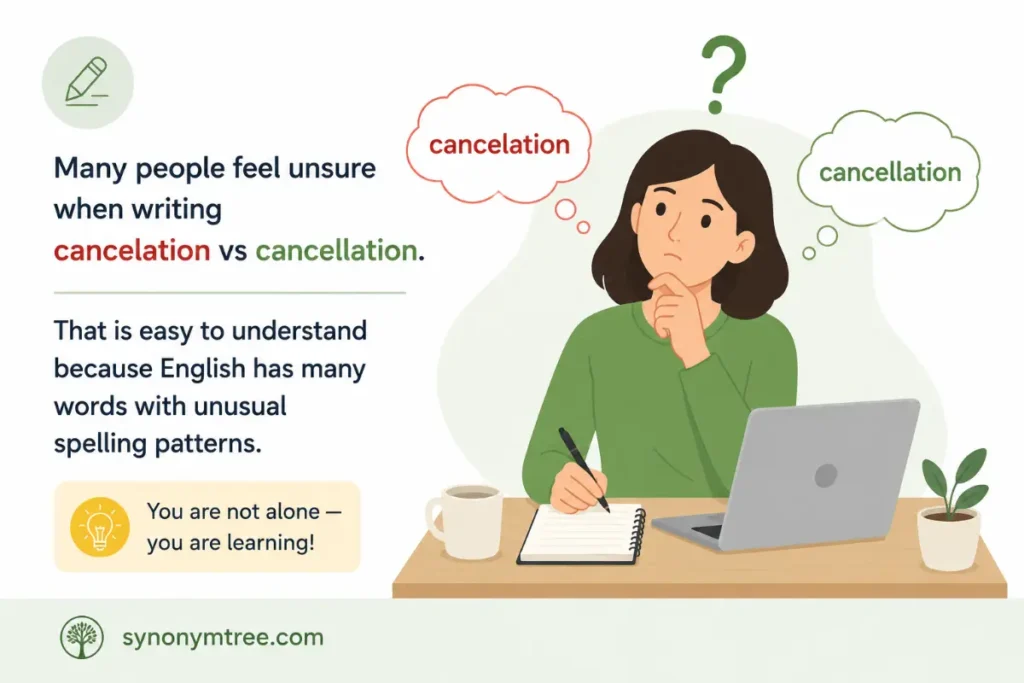
Many people feel unsure when writing cancelation vs cancellation. That is easy to understand because English has many words with unusual spelling patterns. The good news is that this mistake is simple to fix once you know the correct form. The most common mistake is dropping one letter l and writing cancelation. This happens because the verb cancel has one letter l before the ending. Many writers expect the noun to follow the same pattern. Modern English does not. The accepted spelling is cancellation.
Another mistake is thinking cancellation and postponement mean the same thing. They are different. A cancellation means the plan will not happen. A postponement means the plan will happen later. Some people also confuse cancellation with refund. A refund is money returned to a customer. A cancellation is the act of stopping a plan booking service or event. Sometimes a cancellation includes a refund but not always. Reading your work before sending it helps you catch these mistakes. Most spelling checkers also suggest changing cancelation to cancellation.
Look at these simple examples.
- Incorrect. The cancelation surprised everyone.
- Correct. The cancellation surprised everyone.
- Incorrect. The meeting had a cancellation and will happen tomorrow.
- Correct. The meeting was postponed and will happen tomorrow.
- Incorrect. My refund is the same as the cancellation.
- Correct. My refund came after the cancellation.
Small corrections like these make your writing clearer and more professional.
Final Teacher Explanation
Imagine you are sitting in my classroom and asking one last question about cancelation vs cancellation. My answer would be very simple. Always choose cancellation. This is the spelling you will find in trusted dictionaries school books newspapers business writing websites and everyday English. It is the form that teachers editors and employers expect to see.
Do not feel bad if you have written cancelation before. Almost every English learner makes spelling mistakes. Even native speakers sometimes do the same thing. Every mistake gives you a chance to improve. A simple habit can help you remember the correct spelling. Read the word cancellation every time you see it in books emails or articles. Then write it in your own sentences. Repeating the correct form helps your brain remember it naturally. Learning English is like building a house. Every correct word becomes another strong brick. One lesson may seem small but many small lessons create excellent writing.
Final Answer Quick Recap
If you are choosing between cancelation vs cancellation always use cancellation.
Cancellation is the standard spelling in American English and British English. It is the safest choice for school business writing emails articles and everyday communication.
Conclusion
English has many words that can look confusing at first especially when two spellings seem almost identical. Cancellation is one of those words. Once you learn that cancellation is the accepted spelling in standard English the choice becomes much easier. Knowing the correct form also helps your writing look clear and polished in school assignments emails business writing blog posts and everyday communication.
Keep reading good English and pay attention to how words appear in books articles newspapers and trusted websites. Practice using new vocabulary in real sentences instead of only memorizing definitions. When you see cancellation used correctly several times it becomes easier to remember the spelling and recognize incorrect forms.
Every small lesson can help you become a stronger writer and a more confident speaker. You don’t need to learn every spelling rule in one day. Focus on one confusing word at a time and keep practicing. One correct word today can lead to clearer sentences better writing and greater confidence tomorrow.
Frequently Asked Questions
Is cancelation or cancellation correct?
Cancellation is the standard and recommended spelling. Cancelation is a rare spelling that most writers should avoid.
Why do people write cancelation?
Many people think the noun should match the verb cancel. Others simply make a typing mistake.
Is cancellation correct in American English?
Yes. Cancellation is the standard spelling in American English.
Is cancellation correct in British English?
Yes. British English also uses cancellation as the standard spelling.
Can I use cancelation in school writing?
It is better to use cancellation because it is the spelling most teachers and style guides expect.
What does cancellation mean in simple words?
No. A cancellation ends the plan. A postponement moves it to a later time.
