
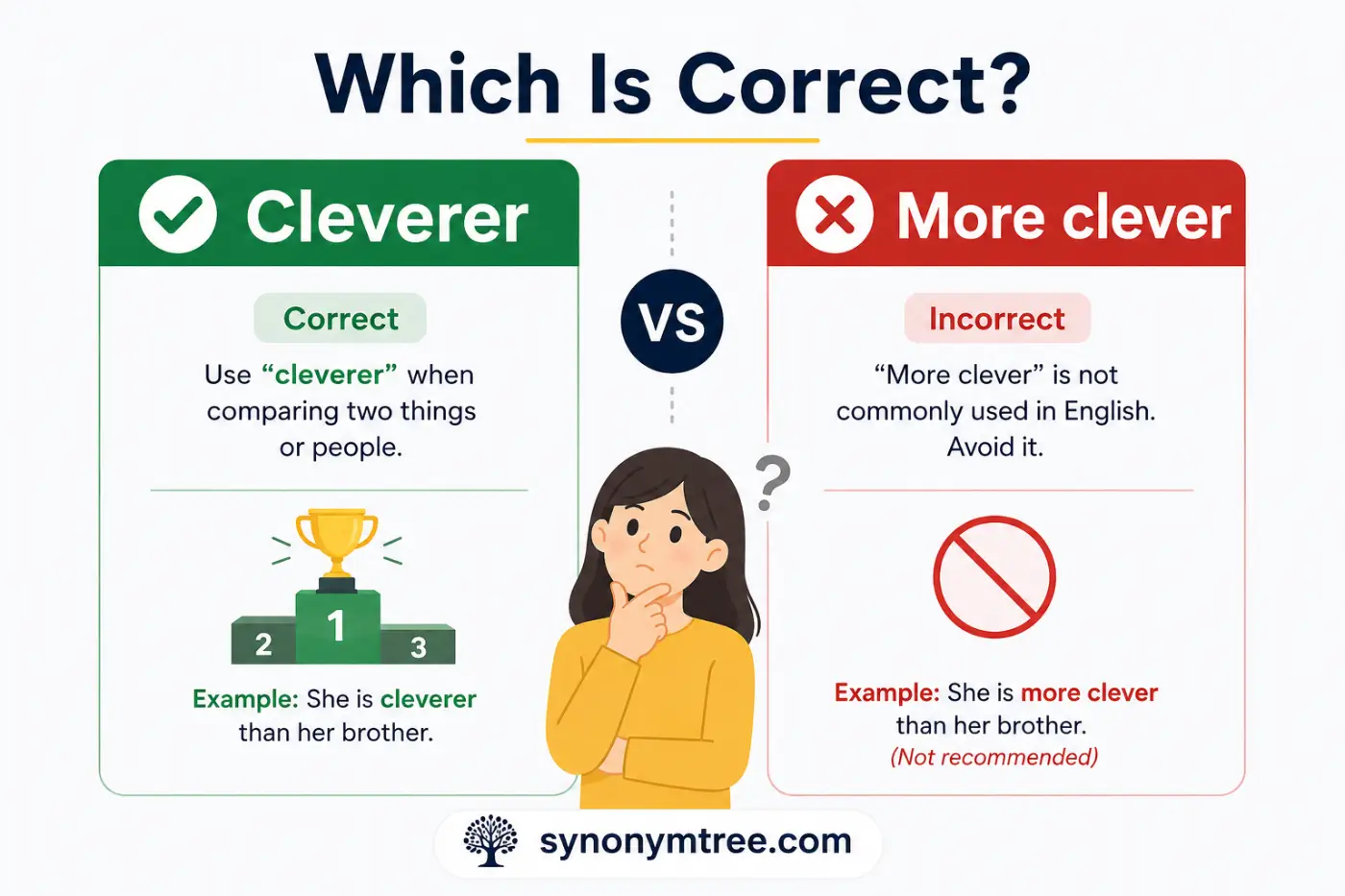
If you are unsure about cleverer vs more clever you are not alone. Both forms can be correct in English. Cleverer is the shorter comparative form. More clever is also used and can sound natural in many situations.
Clever means smart or quick to understand things. When you compare two people or things you can say that one is cleverer than the other. You can also say that one is more clever than the other. Both forms can communicate the same basic idea.
For most everyday writing cleverer is a simple and natural choice. However more clever is not automatically wrong. Native English speakers use both forms. The important part is knowing how each form works and choosing the one that sounds right in your sentence.
Simple Answer in One Look
Cleverer and more clever can both be correct. Cleverer is the usual one word comparative form. More clever is also accepted and often sounds natural. If you want a simple everyday choice use cleverer. For example you can say Tom is cleverer than Jack.
What This Means in Simple English
The word clever means smart. It can describe someone who learns quickly or finds good ways to solve problems. It can also describe an idea that shows skill or careful thinking.
When you compare two people or things you need a comparative form. A comparative form shows that one person or thing has more of a quality than another. Clever can become cleverer. You can also use more clever. The meaning is almost the same.
Imagine that two students are working on a puzzle. One student finds the answer faster. You might say that student is cleverer. You could also say that student is more clever. Both sentences give the same basic message.
Sarah is cleverer than Mia.
Sarah is more clever than Mia.
Both sentences compare Sarah with Mia. The word clever is fairly short. Many short adjectives can take er when we compare them. That gives us cleverer. However clever is a little different from very simple words such as tall or fast because speakers also commonly use more clever. That is why learners often stop and ask which form they should use. The good news is that you do not need to worry too much. Both forms have a place in English.
Why People Mix These Words
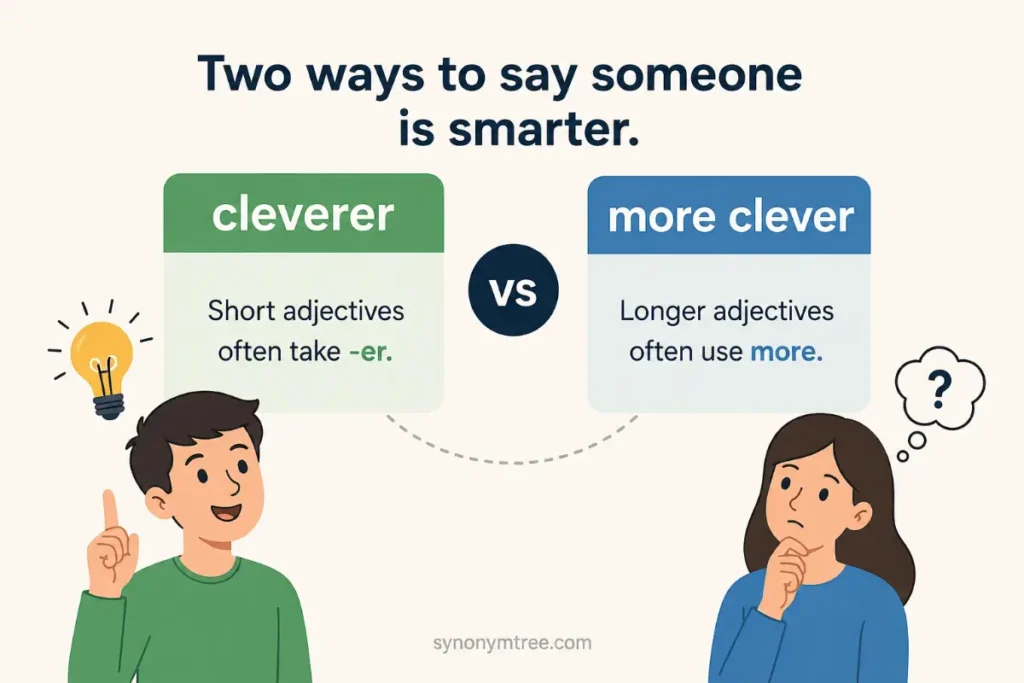
People often mix up cleverer and more clever because English gives speakers two ways to form the comparative. Learners may first learn a simple rule that short adjectives often take er while longer adjectives often use more. For example tall becomes taller. Fast becomes faster. Small becomes smaller.
Clever follows the first pattern well. Clever becomes cleverer. However English also allows more clever. Speakers may choose more before an adjective because they feel it makes the sentence clearer or more natural.
The word clever also has different uses. It can mean intelligent or skillful. It can describe something smart or creative. Because of these uses people may prefer different comparative forms.
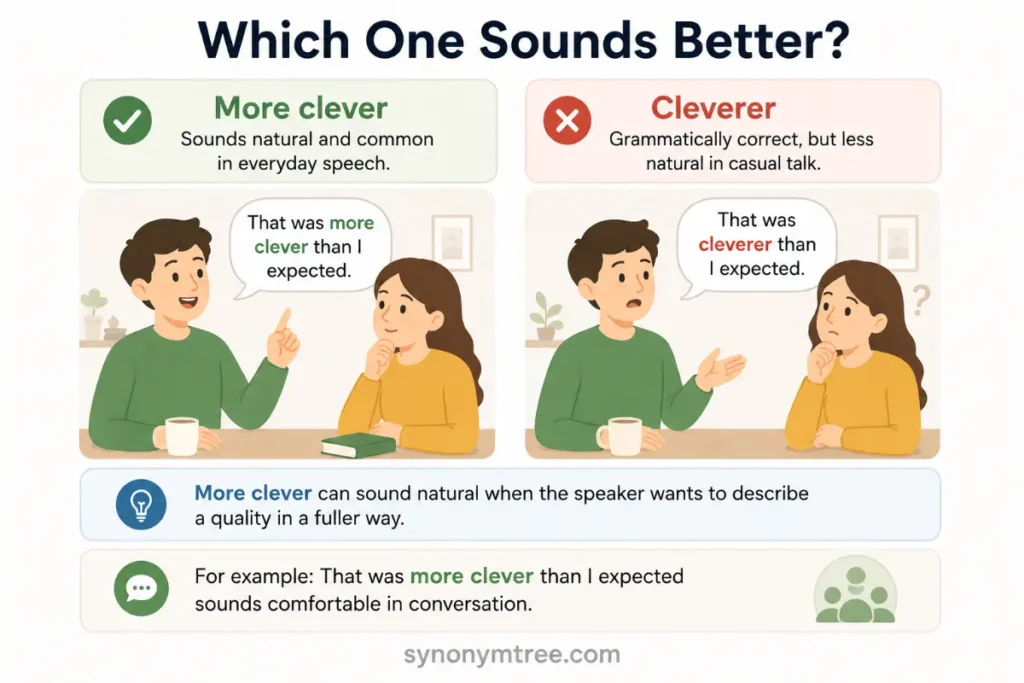
There can also be a difference in style. Cleverer can sound short and direct. More clever can sound more conversational in some situations. For example a speaker might say That was more clever than I expected. Another speaker might say That was cleverer than I expected. Both sentences are easy to understand.
The confusion does not mean one form is always wrong. It means English gives you more than one natural option.
Clear Difference Explained Simply
The difference between cleverer and more clever is mainly about form and style. Both forms can compare two people things ideas or actions. Cleverer adds er to clever while more clever places more before clever.
You can see the pattern clearly. Clever means smart. Cleverer means smarter than another person or thing. More clever also means smarter than another person or thing. Cleverer is a common one word comparative while more clever is also used in standard English.
Neither form changes the basic meaning. Imagine two ideas. Idea A is smart. Idea B is even smarter. You could say Idea B is cleverer than Idea A. You could also say Idea B is more clever than Idea A. The meaning remains almost the same.
The choice often comes down to what sounds natural in the sentence.
Which Form Should You Use
If you want a simple rule for everyday English use cleverer when you need the comparative form of clever. For example you can write My brother is cleverer than me. You can also use more clever. It is not wrong simply because it has more before the adjective.
For school writing cleverer is a simple choice. It follows a common comparative pattern and is easy to understand. Still you should not treat more clever as an error. Speakers use it in both conversation and writing.
The best approach is to focus on the sentence rather than trying to force one form every time. If cleverer sounds natural use cleverer. If more clever fits the sentence better you can use more clever.
For example both of these sentences work.
This plan is cleverer than the first plan.
This plan is more clever than the first plan.
Your answer is cleverer than mine.
Your answer is more clever than mine.
All four sentences are easy to understand.
Easy Real Life Sentences You Can Use
Cleverer and more clever often appear when people compare ideas people solutions or actions. They can be used in school conversations at work and in everyday speech.
Here are some simple examples.
- Jake is cleverer than his brother.
- Maria is cleverer than I expected.
- This solution is more clever than the old one.
- That was a cleverer way to solve the problem.
- Your idea is more clever than mine.
- The second plan is cleverer.
- She found a more clever way to save time.
- He is cleverer than he looks.
These examples show that both forms can fit naturally into normal sentences. The important part is the comparison. You are saying that one person or thing has more cleverness or intelligence than another.
Is Cleverer More Common Than More Clever
Cleverer is a normal comparative form and many speakers use it naturally. More clever is also used in books articles conversations and other forms of writing. The frequency can vary by region speaker and context.
Some people naturally prefer cleverer while others feel more comfortable saying more clever. This is not unusual in English because some adjectives can be compared in more than one way.
For learners the most useful point is simple. You do not need to panic when you see more clever. It is not automatically a grammar mistake. If someone writes She is more clever than her sister the sentence can be correct. She is cleverer than her sister is also correct.
Cleverer vs More Clever In American English
American English uses both cleverer and more clever. However clever is somewhat more common in British English when people mean intelligent. In everyday American English speakers may often choose smart when talking about intelligence.
For example an American speaker might naturally say She is smarter than her brother. Still clever is a normal English word in American writing and speech. You can use cleverer and more clever when the context calls for clever.
The important point is not to assume that more clever is incorrect simply because cleverer is possible. Both forms can be understood by American readers.
When Cleverer Sounds Natural
Cleverer often sounds natural when the adjective appears in a simple comparison. For example you can say My sister is cleverer than me. The word is short and easy to say. It also works well when the sentence is brief and direct.
He is cleverer.
This idea is cleverer.
She is cleverer than him.
That answer is cleverer.
The new plan is cleverer.
The form can feel quick and direct. It is especially useful when you want a simple sentence that gets straight to the comparison.
When More Clever Sounds Natural
More clever can sound natural when the speaker wants to describe a quality in a fuller way. For example That was more clever than I expected sounds comfortable in conversation. You may also see more clever when the sentence contains another comparison or when the writer wants a certain rhythm.
That was more clever than I thought.
His second idea was more clever than his first.
This design is more clever than it looks.
She found a more clever way to handle the problem.
The ending was more clever than I expected.
These sentences show why more clever remains useful in everyday English. It can fit naturally into comparisons and gives speakers another way to express the idea of being smarter or more skillful.
Cleverer vs More Clever With Than
Both forms can be followed by than when you compare two people or things. Than introduces the second part of the comparison. For example you can say Anna is cleverer than Ben. You can also say Anna is more clever than Ben. The meaning is clear in both sentences.
The word than shows what you are comparing the first person or thing with. Here are more examples.
This answer is cleverer than the other one.
This answer is more clever than the other one.
John is cleverer than Mark.
John is more clever than Mark.
Her solution was cleverer than mine.
Her solution was more clever than mine.
The sentence pattern is easy. Person or thing plus comparative form plus than plus comparison.
Cleverer Does Not Always Mean Better
This is an important point about meaning. Clever means smart or skillful. It does not always mean good. Someone can have a clever plan that causes problems. A person can find a clever trick that is not kind or helpful.
For example someone might create a clever way to avoid doing work. The idea may be smart but not responsible. Cleverer simply means more clever. It does not automatically mean better or nicer.
Context tells you how the speaker feels about the clever action. This is useful when reading stories. A writer may describe a character as clever but also show that the character uses that intelligence in a harmful way.
Cleverer Can Describe Ideas Too
Clever does not only describe people. You can use it for ideas plans solutions designs jokes tricks and inventions. When comparing these things you can use cleverer or more clever.
Her solution was cleverer.
His idea was more clever.
The new design is cleverer than the old one.
That joke was more clever than I expected.
Their plan was cleverer than ours.
This wider use makes the word useful in everyday English. The meaning depends on what you are describing but the comparative forms still work in the same way.
The History Of Clever
The word clever has an interesting history. It developed in English with meanings connected to being skillful or quick to learn. Over time clever became strongly connected with intelligence and smart thinking.
The meaning can still change slightly depending on context. A clever child may learn quickly. A clever idea may show skill. A clever trick may show smart planning.
The comparative forms developed from the same adjective. Cleverer uses the er ending. More clever uses more before the adjective. Both forms have been used in English. That is why modern speakers can encounter both.
A Simple Memory Trick For Cleverer
If you want to remember cleverer start with the word clever. Then add er. Clever plus er becomes cleverer. The word does not need a spelling change before the ending.
Think of the pattern as simple as this.
Clever.
Cleverer.
The meaning changes from smart to smarter. This is a useful way to remember the form when writing quickly. Keeping the base word in mind makes the comparative spelling easier to recall.
A Simple Memory Trick For More Clever
More clever is even easier to build. Start with clever and put more before it. The result is more clever. The meaning is also smarter.
You can remember the two forms like this. Cleverer equals more clever. Both compare cleverness. The important difference is how the comparison is formed. One uses the er ending while the other places more before clever.
Choosing The Best Form For Your Sentence
When you are unsure which form to use read the full sentence aloud. If cleverer sounds smooth use cleverer. If more clever sounds smoother use more clever. You can also consider the tone.
Cleverer can feel short and direct. More clever can feel a little more conversational in some sentences. Neither choice needs to change your meaning. The goal is clear communication. That is more important than forcing one form into every sentence.
Cleverer and more clever can both be correct. Understanding how each form works makes the choice easier when you write or speak.
How This Word Is Understood In Culture And Stories
Clever is a popular word in stories because smart characters are often interesting to readers. A clever character may solve a difficult problem. They may escape danger or find an unusual answer when everyone else feels stuck.
When a story compares two characters you may see cleverer or more clever. For example a writer might say The younger brother was cleverer than his older brother. The sentence tells us that the younger brother showed more intelligence or skill.
Stories sometimes use cleverness in a positive way. A clever hero may use intelligence to help others. But cleverness can also have a negative side. A clever villain may use smart plans to trick people.
This gives the word a wider meaning than simply smart. The word can describe intelligence creativity and skill. That is why clever appears so often in fairy tales children’s stories mysteries and adventure stories.
Biblical And Mythological Meaning
Cleverer and more clever do not have a special biblical meaning. They are ordinary comparative forms of the word clever.
The idea of wisdom appears often in religious stories. People may be praised for wisdom or criticized for using their intelligence in the wrong way. That connects with the general idea of being clever but does not give cleverer or more clever a special religious meaning.
Mythological stories also contain clever characters. Some characters solve problems through intelligence rather than physical strength. A clever character may use a plan instead of force.
Still the words cleverer and more clever simply describe comparison. If one character is smarter than another you can say that the first character is cleverer or more clever. The context creates the deeper meaning.
Symbolism Explained In Simple Words
Cleverness can symbolize intelligence. It can also represent creativity quick thinking and problem solving.
In stories a clever character often finds a way forward when others cannot. The word can also symbolize trickery. A clever person may know how to get around a problem. That can be helpful or harmful depending on the person’s goal.
What Cleverer Represents
Cleverer represents a higher level of cleverness when comparing two people things ideas or actions.
For example if two students solve a puzzle and one finds a faster solution you might call that student cleverer. The word can suggest smart thinking quick learning or skill.
What More Clever Represents
More clever carries the same basic meaning. It says that one person or thing shows more cleverness than another.
For example This plan is more clever than the first plan.
The meaning is almost the same as This plan is cleverer than the first plan. The main difference is the form of comparison rather than the basic meaning.
Related Words You Should Know
Learning related words helps you understand cleverer and more clever in a wider way.
Clever means smart or skillful. It is the basic adjective.
Cleverer means smarter than another person or thing.
More clever also means smarter or more skillful than another person or thing.
Cleverest means the smartest or most skillful in a group.
Most clever has the same basic superlative meaning as cleverest.
Smart means intelligent. It is very common in American English.
Bright can mean intelligent. It is often used to describe someone who learns quickly.
Sharp can describe someone who thinks quickly and notices details.
Wise means having good judgment and experience. It is not exactly the same as clever.
Intelligent means having a good ability to learn and understand. It is a more formal word.
Skillful means being good at doing something.
These words are related but they are not perfect replacements in every sentence.
How People Actually Use It In Daily English
People use clever when talking about people ideas jokes plans solutions and actions. The comparative forms work in the same areas.
You may hear cleverer when someone makes a simple comparison. You may hear more clever when a speaker wants the phrase to sound natural in the sentence.
My brother is cleverer than I am.
This idea is more clever than the first one.
She found a cleverer way to finish the job.
His plan was more clever than ours.
That was a cleverer answer.
Your solution is more clever than mine.
The second design looks cleverer.
This trick is more clever than it seems.
He is cleverer than people think.
The new system is more clever than the old one.
These sentences show that both forms work in real communication.
Cleverer vs More Clever In School Writing
If you are writing for school you can use cleverer when making a simple comparison.
For example The second student was cleverer than the first.
You can also write The second student was more clever than the first. Both sentences are understandable and acceptable.
Still you should pay attention to your teacher’s preferred style. Some teachers may prefer the shorter comparative form because it is simple and direct.
If your teacher has given you a specific grammar rule follow that rule for the assignment. For general English writing you can use either form when the sentence is clear and natural.
Cleverer vs More Clever In Formal Writing
Formal writing often values clarity. Both forms can provide that clarity.
Cleverer is shorter. More clever is a two word phrase. Neither one automatically makes a sentence more formal.
For example a report might say The second method was more clever because it reduced the number of steps. Another report could say The second method was cleverer because it reduced the number of steps.
The choice depends on the writer’s style. Do not assume that longer always means more formal. Good writing is often simple.
Common Mistakes People Make
One common mistake is thinking that only cleverer is correct. That is too strict. More clever can also be correct.
Another mistake is thinking that only more clever is correct. That is also too strict. Cleverer is a standard comparative form.
Some learners may also confuse cleverer with cleverest. Cleverer compares two things. Cleverest compares one thing with a larger group.
For example if you compare Tom and Jack you can say Tom is cleverer than Jack. If you compare Tom with everyone in the class you might say Tom is the cleverest student in the class.
More clever and most clever follow the same basic idea. More clever compares. Most clever shows the highest level in a group.
Another mistake is forgetting than in a direct comparison. For example Tom is cleverer than Jack is clear. Tom is cleverer Jack is incomplete when you are making a direct comparison.
Cleverer And Cleverest
It helps to understand cleverer by comparing it with cleverest.
Cleverer means more clever than another person or thing. Cleverest means more clever than everyone or almost everyone in a group.
For example imagine three students. Ali is cleverer than Ben. Sara is the cleverest student in the class.
The first sentence compares two people. The second sentence describes the highest level in the group.
More clever and most clever work in the same way. This small difference can help you avoid mistakes.
More Clever And Most Clever
More clever and most clever are both possible forms.
More clever means smarter than another person or thing. Most clever means the smartest or most skillful in a group.
For example you can say This is more clever than the first idea. You can also say This is the most clever idea in the group.
The forms match the type of comparison.
Clever.
Cleverer or more clever.
Cleverest or most clever.
The first form gives the basic quality. The second form compares. The third form shows the highest level.
Is Cleverer Better Than More Clever
Not always.
Cleverer is often a simple and natural choice. More clever is also correct in many sentences.
The word better suggests that one form is superior in every situation. That is not the case here.
Instead think about natural usage. If cleverer sounds smooth use it. If more clever sounds smooth use it. If you are following a particular style guide or teacher instruction follow that preference.
The most important goal is to make your meaning clear.
Cleverer vs More Clever In Conversation
Conversation is flexible. Native speakers do not always follow one single pattern when using comparative adjectives.
You may hear both forms. For example someone might say Your idea is cleverer than mine. Another person might say Your idea is more clever than mine.
The listener understands both immediately.
This is a good reminder that real English can have more than one natural option. As an English learner you do not need to copy every variation. Start with the simple form you know well and build confidence from there.
How To Use Cleverer Correctly
Use cleverer when you want to compare two people things ideas or actions.
The basic pattern is simple.
Something is cleverer than something else.
For example My new plan is cleverer than my old plan.
You can also leave out the second part when the comparison is already clear.
For example The new plan is cleverer.
The listener can understand that you mean it shows more cleverness than the old plan or another option already mentioned.
How To Use More Clever Correctly
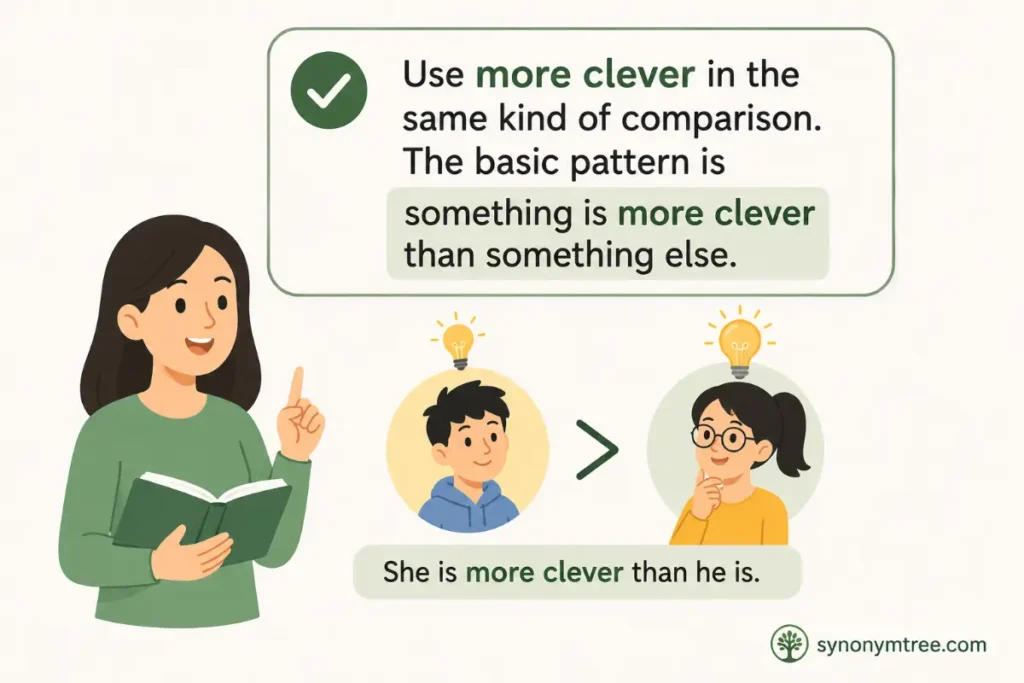
Use more clever for the same type of comparison as cleverer. The basic pattern is something is more clever than something else. For example Her answer is more clever than mine.
You can also use more clever before a noun. For example He found a more clever solution. Here more clever describes the solution.
Both forms can appear naturally before nouns or after linking verbs.
Final Teacher Explanation
Imagine that we are in class and I write clever on the board.
Clever means smart.
Now we want to compare two students. We can add er. Clever becomes cleverer.
We can also put more before clever. More clever.
Both forms tell us that one person is smarter or more skillful than another.
So if you see cleverer do not think it is strange. If you see more clever do not think it is automatically wrong. Both forms can work.
The easiest form to remember is cleverer because it follows the simple er pattern. But real English gives speakers another choice with more clever.
The best habit is to read the complete sentence. Choose the form that sounds natural and fits the style you are using.
If your teacher asks for one comparative form use the form your teacher teaches. In general English both cleverer and more clever can be used.
Final Answer Quick Recap
Cleverer and more clever can both be correct.
Cleverer is the simple one word comparative form. More clever is also used in standard English.
Both mean more clever or smarter than another person or thing.
Conclusion
The difference between cleverer vs more clever is much easier than it may first seem. Both forms compare two people things ideas or actions. Cleverer adds er to clever. More clever puts more before clever.
If you want the simplest everyday choice cleverer is a good option. Still more clever should not be treated as a spelling or grammar error. English speakers use it naturally in many situations.
The main lesson is simple. Cleverer means smarter. More clever also means smarter. Use the form that fits your sentence and sounds natural for your audience.
Frequently Asked Questions
Is cleverer or more clever correct?
Both can be correct. Cleverer is the common one word comparative form while more clever is also used.
Is cleverer better than more clever?
Not always. Cleverer is shorter but more clever can sound natural in many sentences.
Which is more common cleverer or more clever?
Both are used. Cleverer is a common direct comparative form while more clever is also familiar in everyday English.
Can I use cleverer in American English?
Yes. Cleverer is understood and used in American English.
Can I use more clever in school writing?
Yes. More clever can be correct. Follow your teacher’s preferred style if they have given you one.
What does cleverer mean?
Cleverer means smarter or more skillful than another person or thing.
What is the difference between cleverer and cleverest?
Cleverer compares two people or things. Cleverest shows the highest level in a group.
Can I say more clever than?
Yes. More clever than is a correct comparison when the sentence is formed clearly.
