
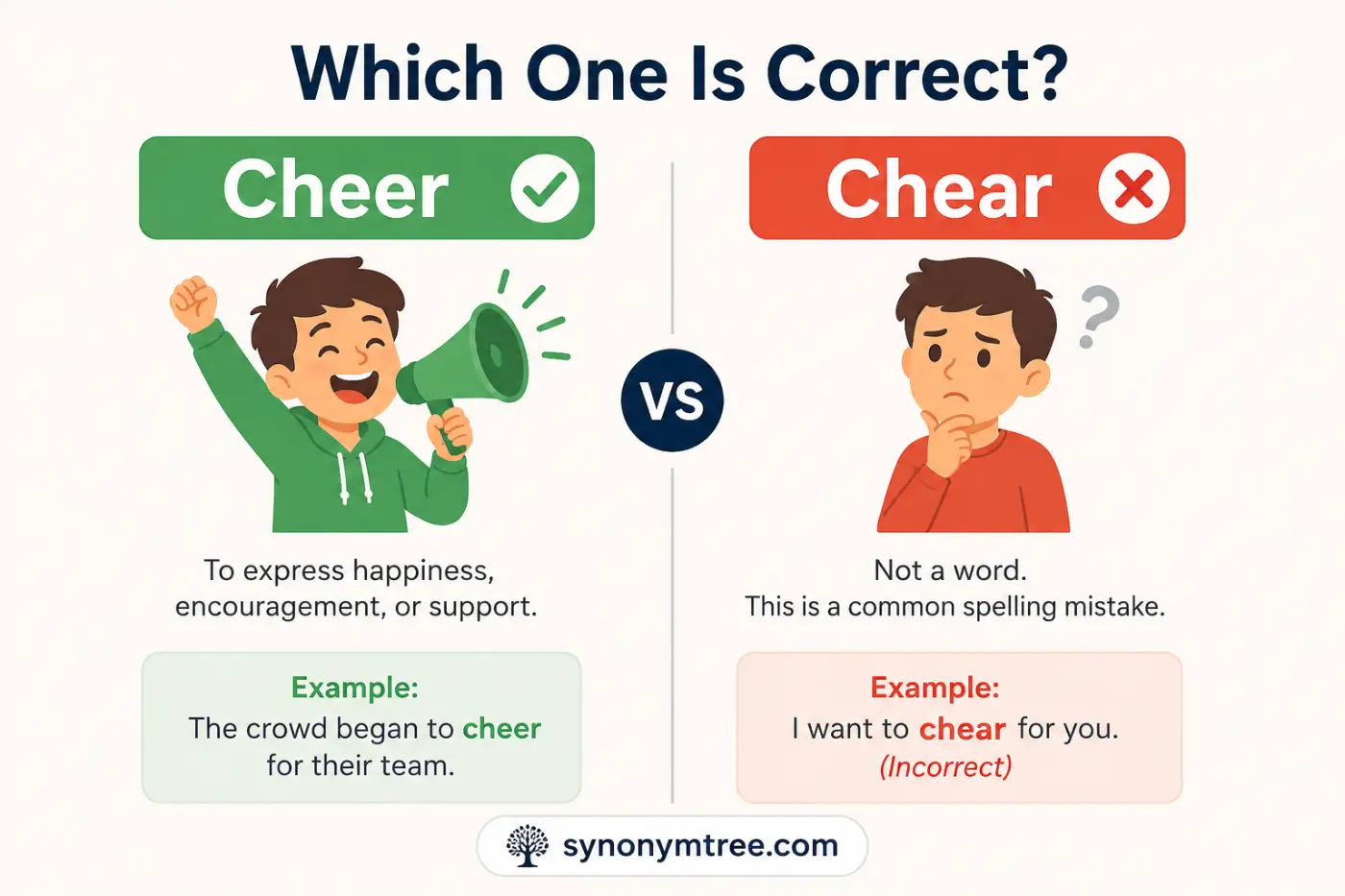
If you have ever stopped while writing and wondered about cheer vs chear you are not alone. These two forms look very close. One is the correct modern English word. The other is usually a spelling mistake.
The correct word is cheer. You can use cheer as a noun or a verb. It can describe happiness and good feelings. It can also mean giving someone support or encouragement. Chear is not the standard spelling in modern US English.
This simple guide will help you understand the difference between cheer vs chear without confusing grammar rules. You will learn which spelling to use what cheer means and how people use it in everyday English.
Simple Answer in One Look
The correct modern spelling is cheer. Chear is normally incorrect in modern US English. Use cheer when you mean happiness support encouragement or a loud expression of support.
The easiest rule is simple. If you are writing normal English today use cheer.
What This Means in Simple English
Think of cheer as a word connected with happiness and support. When you feel cheerful you feel happy and positive. When you cheer for a team you show support. When you cheer someone up you help that person feel better.
Chear looks like it should be a real word because English has many words with similar vowel patterns. That visual similarity can make the spelling hard to remember. Still modern English uses cheer.
For example you might say that a child was full of cheer. You might cheer for your favorite team. You might also tell a friend to cheer up after a hard day. The word can work in several simple situations. Its meaning depends on how you use it in the sentence. The spelling does not change. If you are writing an email school paper social media post or work message choose cheer. That choice will look natural to an American English reader.
Here are a few simple examples.
- Her smile brought cheer to the room.
- We went to cheer for our school team.
- I tried to cheer my brother up.
- The children were full of cheer.
- Everyone cheered when the singer came on stage.
Notice that cheer can talk about a feeling. It can also talk about an action. The same spelling works in both cases.
Why People Mix These Words
People often mix up cheer and chear because the two forms look almost the same. Only the order of the vowels changes. That small difference can be easy to miss when you are typing quickly. English spelling has many words that sound different from the way they look. It also has many words that look similar but have different meanings. This can make spelling feel like a puzzle.
The sound of cheer can add to the confusion. When people hear the word they do not see the letters in their minds. They hear one sound and then try to build the spelling from memory. This happens often with learners of English. It can also happen to native speakers when they type fast or write without checking their spelling. Another reason for confusion is that chear has appeared in older forms of English. A reader may find the spelling in an old book or historical text. That can make it seem like chear is simply another accepted spelling of cheer today.
Modern English is different. Old spellings do not always match the spelling people use now. You can think of it like an old road sign. The sign may have been correct many years ago. That does not mean people still use the same sign today. So when you see cheer and chear together remember that modern US English normally uses cheer.
Clear Difference Explained Simply
The difference between cheer and chear is mainly a difference between the standard modern spelling and a nonstandard spelling. Cheer is a real and common English word. It has several meanings. It can describe happiness. It can mean support. It can also describe the act of making someone happier. Chear is not the normal modern spelling for these meanings. If you write chear in a school assignment or professional message most readers will see it as a spelling error.
A simple comparison makes the point clear.
- Cheer is the correct modern spelling.
- Chear is usually an incorrect spelling in modern English.
- Cheer can mean happiness or a positive feeling.
- Cheer can mean support for a person or team.
- Cheer can mean helping someone feel better.
- Chear should normally be changed to cheer.
The spelling rule is easier to remember than the meanings. You do not need to memorize a long grammar lesson.
Just remember this sentence.
Cheer is correct. Chear is usually incorrect.
Which Form Should You Use
Use cheer in normal modern English. This is the form you should choose for school writing work messages essays websites emails and everyday conversations. You should also use cheer when you are writing for an American audience. It is the familiar spelling that readers expect.
If your spelling checker marks chear as an error it is usually giving you the right advice. Change it to cheer when you mean happiness support encouragement or the act of making someone happy. There is one small point to remember. Older English texts can contain spellings that look strange to modern readers. If you are studying an old document you may see chear or another older spelling. In that setting the spelling may belong to the history of the text. That does not mean you should use chear in normal modern writing. For everyday writing the rule stays simple.
Use cheer.
Easy Real Life Sentences You Can Use
The best way to remember a spelling is to see it in real sentences. These examples use common situations you may hear at school at home or at work.
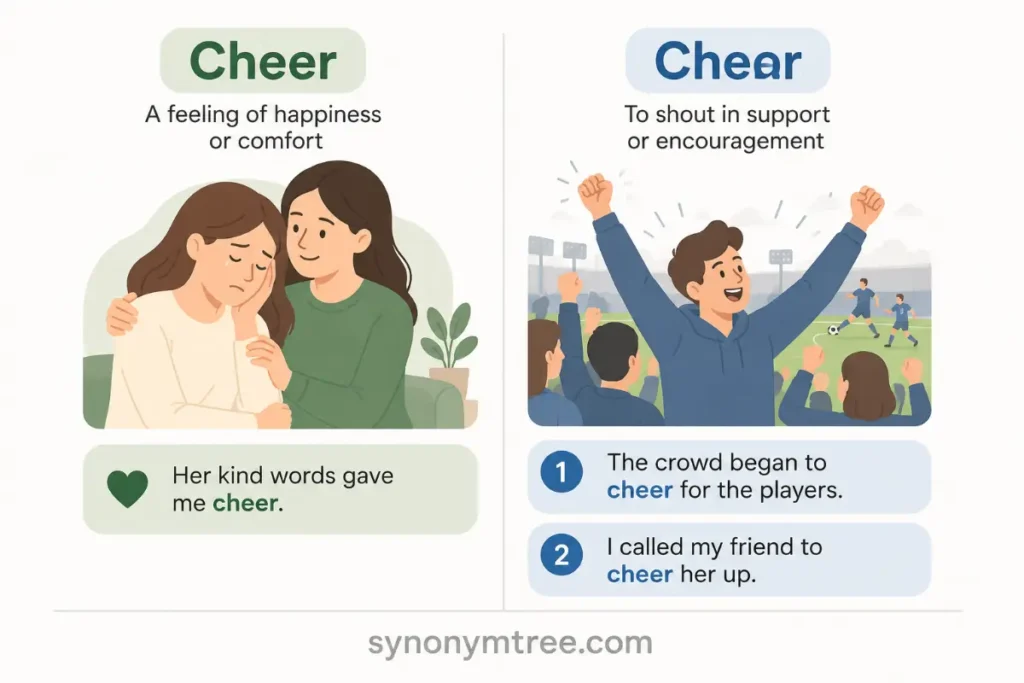
- Her kind words gave me cheer.
- The crowd began to cheer for the players.
- I called my friend to cheer her up.
- His cheerful voice filled the room with cheer.
- We heard a loud cheer from the stadium.
- A little good news can bring cheer to a hard day.
- The students cheered when the teacher announced the holiday.
- Music can bring cheer when you feel tired.
These sentences show the most common uses of cheer. The word can describe a feeling. It can describe a sound from a group. It can also describe an action that gives support or improves someone’s mood.
Where This Word Comes From
The history of cheer helps explain why the word has several meanings today. Cheer came into English from older forms of the language. Its history is connected with a word that referred to the face or expression. Over time the meaning moved toward mood and feelings. Later the word became connected with happiness support and encouragement.
This kind of meaning change is normal in English. Words do not always keep one meaning forever. People use words in new situations and those uses can become part of the language.
Today cheer has several common meanings that are easy to understand. It can mean a feeling of happiness or good spirits. It can also mean a shout that shows support. As a verb it can mean giving support or making someone feel happier. That history also helps explain why you may see older spellings in old texts. English spelling was not always fixed in the same way it is now. Modern readers should still use the standard spelling cheer in normal writing.
How Cheer Works in Everyday English
Cheer is useful because it can fit many ordinary situations. You do not need a special setting to use it. At a sports game people cheer for their team. At a celebration people may make a loud cheer. A friend can cheer you up after a difficult day. A kind person can bring cheer to other people. The word also appears in common expressions. One of the best known is cheer up. When you tell someone to cheer up you are telling that person to try to feel happier. The phrase is common in casual English.Another common use is cheer for. If you cheer for a team you support that team.
You can also cheer someone on. This means you encourage someone while that person is trying to do something. For example a parent may cheer a child on during a race. Friends may cheer each other on before a test performance or competition. These uses make cheer a useful word for both speaking and writing.
Is Cheer Always About Happiness
Not always. Cheer can also mean support.
Imagine a football game. A crowd may cheer loudly even though the people in the crowd are not laughing or feeling playful. Their cheer shows support for the players. The word can also describe a positive mood. A room may have a feeling of cheer because people are smiling talking and enjoying themselves. This is why context matters. You can understand the basic meaning by looking at the words around cheer.
Consider these examples.
- The children were full of cheer.
Here cheer means happiness or good spirits.
- The crowd gave a huge cheer.
Here cheer means a loud sound of support.
- I tried to cheer him up.
Here cheer means help someone feel happier.
The spelling stays the same in all three sentences.
Cheer vs Chear in School Writing
Students sometimes make spelling mistakes because they write a word the way they think it sounds. That is understandable. English does not always give you an easy spelling clue. Still school writing needs the standard spelling. If you write chear in an essay your teacher will likely mark it as a spelling mistake.
A good habit is to connect the word with a simple phrase you already know.
Think of cheer up.
Think of cheer for.
Think of cheer loudly. These phrases can help you remember the spelling. You can also connect cheer with cheerful. The two words share the same spelling pattern at the beginning. For example you may know that cheerful means happy or positive. That can remind you that cheer uses the letters c h e e r.
Cheer vs Chear in American English
American English uses cheer as the standard spelling. You will see it in everyday speech writing books school materials news reports and online content. The spelling chear is not the normal choice for modern American English. If you are learning English for school work travel or daily communication you should focus on cheer. This is especially helpful for voice search. When you ask a question such as which is correct cheer or chear the answer is simple. Cheer is the standard spelling in modern English. You do not need to worry about rare historical spellings unless your work specifically deals with older English.
A Quick Memory Trick
Here is an easy classroom trick.
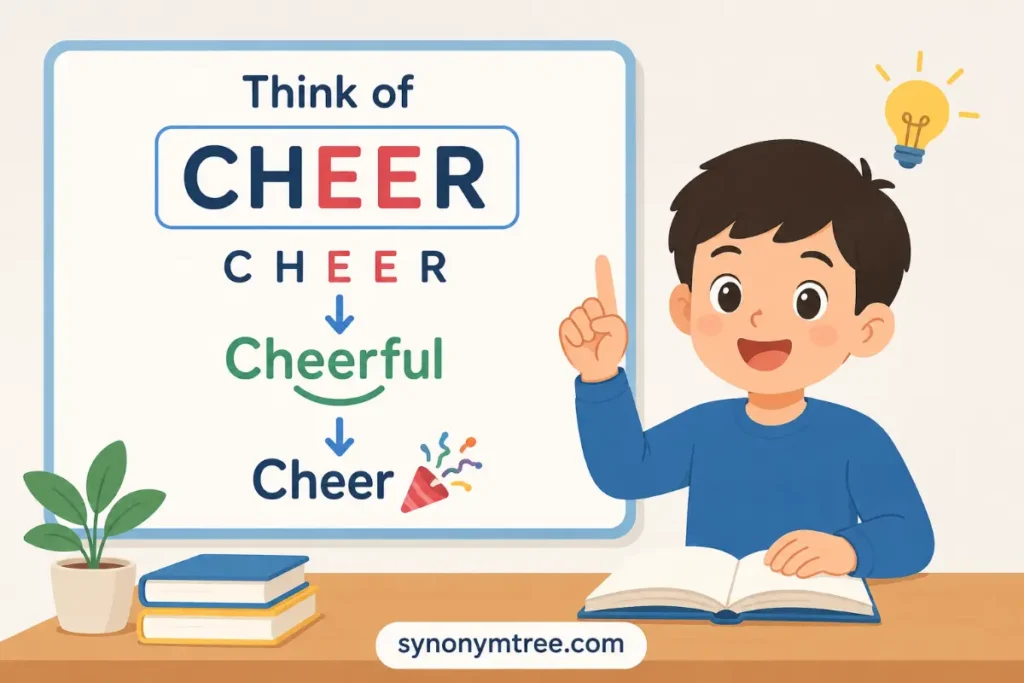
Think of cheer as having two e letters in the middle.
C H E E R.
You can connect it with cheerful.
Cheer.
Cheerful.
The shared beginning can make the spelling easier to remember. You can also remember the phrase cheer up. It is common and easy to say. When you see chear ask yourself if you mean cheer up or cheer for. If the answer is yes use cheer. This small memory trick can save you from repeating the same spelling mistake.
Transition Into Deeper Meaning
Now you know the main answer. Cheer is the standard modern spelling. Chear is usually a spelling mistake in modern English. But the word cheer has more meaning than its spelling. It carries ideas about happiness support courage and community. That is why it appears so often in stories celebrations sports and everyday conversations. The next section looks at those deeper uses in a simple way.
How This Word Is Understood in Culture and Stories
Cheer is more than a spelling word. It is also a word people use to describe human feelings and social support.nThink about a crowd at a sports game. One person starts cheering. Soon many people join in. The sound grows louder. That cheer becomes a shared feeling. This is one reason the word appears often in stories. A cheer can show excitement. It can show hope. It can show support for someone who needs courage.
Writers also use cheer to create a warm mood. A cheerful room may feel bright and friendly. A cheerful person may make other people feel comfortable. The word does not always describe a huge celebration. A small act can bring cheer too. A smile can bring cheer. A kind message can bring cheer. A funny story can bring cheer after a hard day. In simple terms cheer often connects one person’s positive feeling with another person’s experience. That makes it a very human word.
Biblical and Mythological Meaning
Cheer does not have a special mythological meaning that changes its modern spelling. The word appears in older religious English and can be connected with ideas such as joy courage gladness and encouragement depending on the passage and translation. The important point is simple. Biblical or historical use does not make chear the standard spelling for modern English.
Older translations can contain language that feels different from the English people use today. This happens because language changes over time. A reader studying an old religious text should look at the exact version and date of the text. A modern writer should use the spelling expected in modern English. The same basic lesson applies to historical literature. Older spelling can tell us something about the text. It does not automatically tell us how to spell the word today.
Symbolism Explained in Simple Words
Cheer can carry several simple ideas in stories and everyday life. It can represent happiness. It can represent support. It can represent hope after a difficult moment. For example a writer may describe a room filled with cheer after a family receives good news. The word helps readers feel the positive mood without a long explanation. Cheer can also represent strength from other people. When a crowd cheers for a runner the sound tells the runner that people are standing behind them. This is why cheer can have an emotional meaning beyond its basic dictionary definition.
What One Version Represents
Cheer represents a real modern English word connected with positive feelings support and encouragement. It can represent joy when people feel happy together. It can represent courage when people support someone who is facing a challenge. It can also represent community because a group can cheer together. The word has a positive feeling in many common situations.
What The Other Version Represents
Chear does not have a normal modern English meaning that contrasts with cheer. This point is important. Some people think cheer and chear may be two words with different meanings. In modern US English that is not the usual case. Chear is normally just a misspelling of cheer. If you see chear in an old text you should consider the age and style of that text. If you are writing today use cheer.
Related Words You Should Know
Learning related words can make cheer easier to remember. Many of these words appear in common conversations. Cheerful means happy and positive. A cheerful person often brings a pleasant feeling to a room. Cheerfully means in a happy or positive way. You might say that someone spoke cheerfully. Cheer up means to become happier or to help another person feel happier. Cheer for means to support a person or team.
Cheer on means to encourage someone while that person is doing something difficult. Cheering means the act of making a loud sound to show support. A cheer can be a loud sound made by a group. It can also mean a feeling of happiness or good spirits. These words share the same basic spelling pattern. That gives you several chances to remember the correct form.
How People Actually Use It in Daily English
You can hear cheer in many normal conversations. It does not sound formal or strange. It is part of common English. Imagine a student preparing for a school race. Her friends may cheer her on. They want her to keep going. Imagine someone has had a bad day. A friend may say cheer up. The friend is trying to make that person feel better Imagine a team wins a big game. The fans may cheer loudly. Imagine a family gathers for a holiday. The house may be full of good humor and cheer. These examples show why the word is useful. It connects feelings actions and social support.
Here are more natural examples.
- We all cheered when she finished the race.
- My friends cheered me on during the game.
- He tried to cheer his sister up.
- The crowd gave a loud cheer.
- Her smile brought cheer to everyone.
- The children cheered when they heard the news.
- I could hear people cheering outside.
- A funny movie can bring some cheer after a long day.
- The team heard a huge cheer from the fans.
- She always brings cheer to the classroom.
Each example uses the same standard spelling. You will not need chear in any of these sentences.
Common Mistakes People Make
The most common mistake is writing chear when the writer means cheer. This usually happens because the word is heard rather than seen. The writer knows the sound but is not sure about the letters. Another mistake is thinking that cheer and chear have different meanings. In modern English they normally do not. Some learners also forget that cheer can be both a noun and a verb. That can make the word seem more difficult than it really is.
For example you can say a loud cheer. Here cheer is a thing or sound. You can also say we cheer for our team. Here cheer describes an action. You can say cheer up too. Here the phrase means to become happier or help someone become happier. The spelling remains cheer. If you wrote chear by mistake do not worry. Just replace it with cheer.
How To Use Cheer Without Thinking Twice
When you need the word in normal modern English follow three simple steps. First think about the meaning. Are you talking about happiness support encouragement or a loud expression from a group. Next remember the spelling with two e letters. Finally read the whole sentence. Make sure the sentence sounds natural. For example you might write I want to cheer my friend up.
That sentence sounds natural. You would not normally write I want to chear my friend up. The second version looks wrong to a modern English reader. This simple check works in school writing emails messages and most other situations.
Why Spelling Still Matters
Spelling helps readers understand your meaning quickly. A spelling mistake may not always stop communication. Still it can distract the reader. In school writing correct spelling shows care. In professional writing it helps your message look clear and polished.
You do not need perfect spelling of every word to communicate well. But common words such as cheer are worth learning because you will see them often. Good spelling also makes writing easier to read. The reader can focus on your ideas instead of stopping to guess what you meant. That is why learning small differences like cheer vs chear can improve your writing over time.
Cheer vs Chear For Voice Search
Voice search often brings simple questions. You might ask which is correct cheer or chear. The direct answer is cheer. You might ask how to spell cheer. The answer is C H E E R. You might ask what cheer means. It can mean happiness support encouragement or a loud expression of support.These short answers work well because they give the main fact first. That is also useful for learners who want a quick answer before reading more detail. If you remember only one sentence from this guide remember this one. Cheer is the correct modern spelling. Chear is usually incorrect.

Final Teacher Explanation
Imagine I am writing the word on a classroom board. I write C H E E R. Then I write CHEERFUL beside it. Now I write CHEAR and mark it as the form you normally should not use in modern English. That is the whole lesson. You do not need a difficult grammar rule. You do not need to memorize a long history of English spelling. Use cheer.
Use cheer when you talk about happiness. Use it when you talk about supporting a team. Use it when you want to make someone feel better. Use it when you describe a loud sound from a happy or excited crowd. If you see chear in your own writing change it to cheer unless you are directly discussing an old text where that spelling belongs to the original source.
Final Answer Quick Recap
Cheer is the correct spelling in modern US English. It can mean happiness support encouragement or a loud expression of support. Chear is usually a spelling mistake. If you are writing normal English today choose cheer. The easiest memory trick is simple. Cheer has two e letters in the middle and connects with cheerful.
Conclusion
The difference between cheer vs chear is simple once you understand the spelling pattern. Cheer is the standard modern spelling used in American English. Chear is not normally accepted as the correct spelling in modern US English. If you are writing a school assignment an email a blog post or a social media caption cheer is the form you should choose.
You can use cheer in many everyday situations. You can cheer for your favorite team during a game. You can cheer someone on when they need encouragement. You can cheer someone up when they feel disappointed. The word can also describe happiness or a positive mood. For example a cheerful person can bring cheer to a room with kindness and an upbeat attitude.
So the next time you pause over cheer vs chear remember the simple spelling pattern. Write cheer with two e letters. This is the form readers expect to see in modern English. Keeping the correct spelling in mind will help your writing look clear natural and polished. A small spelling detail can make a big difference when you want your message to sound confident.
Frequently Asked Questions
What does cheer mean in simple words?
Cheer can mean happiness support encouragement or a loud sound that shows support.
Is cheer or chear correct?
Cheer is the correct standard spelling in modern US English. Chear is usually a spelling mistake.
Can I use chear in modern writing?
Normally no. Use cheer in school work professional writing messages and everyday English.
Why do people confuse cheer and chear?
The words look almost the same and sound similar. People may write the spelling they remember from sound.
How do I remember the spelling of cheer?
Yes. You can cheer for a team or cheer someone on to show support.
What does cheer up mean?
Cheer up means to become happier or to help another person feel happier.
Does chear have a different meaning?
Not normally in modern English. Chear is usually an incorrect spelling of cheer. Older texts may contain the form as part of historical spelling.
