
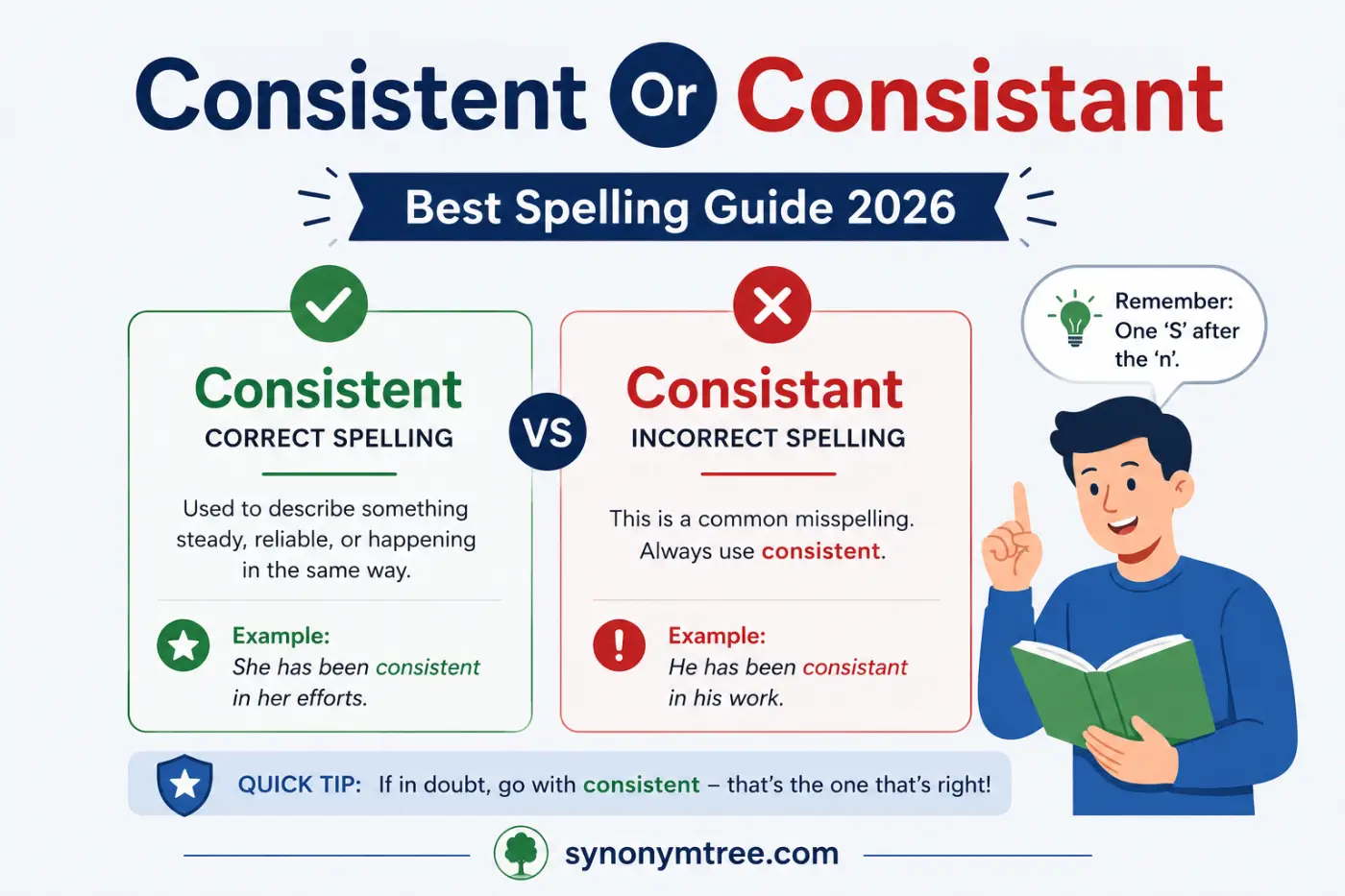
If you are unsure about consistent or consistant, you are not alone. These two spellings look very close. Only a small part of the word changes, but that small change matters. The correct spelling in standard English is consistent. Consistant is a common spelling mistake and should not be used in normal English writing.
The word consistent means staying the same or doing something in the same way over time. You can use it to talk about a person, a habit, a result, a quality, or an idea. For example, if a student studies every day and gets good results, you can say the student is consistent.
The easiest way to remember this word is to focus on the ending. The correct form is consistent with an e before the final nt sound. Once you learn this pattern, the difference between consistent and consistant becomes much easier to remember.
Simple Answer In One Look
Consistent is the correct spelling. Consistant is incorrect in standard English.
Use consistent when you mean something that stays the same or happens in a steady way.
What This Means In Simple English
The word consistent describes something that stays steady. It does not suddenly change from one situation to another. Think about a person who goes for a walk every morning. They do it today. They keep doing it next week. That person has a consistent habit.
You can also use consistent to describe good work. Imagine a student who gets strong grades on every test. The student does not get one great grade and then several very low grades. The results stay fairly steady. You could say the student has been consistent with their schoolwork.
The same idea works for behavior. A friend may always arrive on time. You can count on that person to be there when they say they will. Their behavior is consistent because it stays much the same.
Consistent can also describe ideas. Two statements can be consistent if they fit together and do not disagree. For example, a person might say they love reading. Later, they might say they read for an hour every night. Those ideas are consistent because they make sense together.
There is also another useful meaning. Consistent can describe something that produces similar results again and again. A good worker may complete tasks carefully each day. A good player may perform well in many games. A machine may work at the same level for a long time. In each case, the idea is steadiness.
The word is common in school, work, sports, business, and daily conversation. You may hear someone say that a person needs to be more consistent. This usually means the person needs to keep doing something well instead of doing it only sometimes.
For example, a student may understand math very well but only study before some tests. The student might get an excellent grade one week and a poor grade the next week. A teacher could advise the student to be more consistent with studying.
The basic idea is simple. Consistent means steady, regular, or staying the same in a way that can be expected.
Why People Mix These Words
People often confuse consistent and consistant because the words sound very similar when spoken. The middle and ending can blend together when we say the word quickly. That makes it easy to remember the wrong letters.
Another reason comes from familiar spelling patterns. English has many words that end in ant. Words such as important, pleasant, distant, and constant can make the spelling consistant look natural. Your brain may simply choose a pattern that it has seen many times before.
There is also a useful connection between consistent and consistency. When you know the noun consistency, the correct spelling of consistent becomes easier to remember. The two words share the same main spelling pattern.
Many people also spell a word from the way it sounds. That can cause trouble in English because English spelling does not always match pronunciation perfectly. You may hear the ending clearly but still choose the wrong vowel when writing it.
This is why a quick spelling check can help. If you are writing an email, school paper, report, or resume and you type consistant, your spelling tool may mark it as an error. The correction will usually suggest consistent.
Consider a simple example. A student wants to write that their teacher gives clear advice every week. The student types, My teacher is very consistant. The meaning is clear, but the spelling is wrong. The sentence should use consistent.
Another example could appear at work. Someone might write, She has been consistant with her work. Again, the meaning is easy to understand, but the spelling needs correction. The correct sentence is, She has been consistent with her work.
So why do people mix these words? The main reasons are simple. The words sound close. The incorrect form looks natural. English spelling can be tricky. Once you learn the correct form, though, the problem becomes much easier.
Clear Difference Explained Simply
The difference between consistent and consistant is mainly a matter of correct spelling. Consistent is the standard English word. Consistant is not the standard spelling.
Think of the two forms this way. Consistent is the word you should write. Consistant is the spelling you should avoid.
The correct word contains the letters e n t near the end. The full spelling is consistent. The incorrect form changes the e to an a and becomes consistant.
The meaning does not change because consistant is not a separate English word with a different meaning. It is simply a common spelling error for consistent.
You can remember the difference with a simple idea. Consistency and consistent belong together. If you know how to spell consistency, you can use that knowledge to spell consistent correctly.
Here are some examples that show the correct spelling in natural sentences.
- Maria is consistent with her homework.
- His work has been consistent all year.
- Try to keep your writing style consistent.
- The team needs more consistent practice.
- She gives consistent results every month.
- His answer was not consistent with the facts.
- Good sleep can help you stay consistent with your routine.
Notice that consistent works in many different situations. It can describe a person, work, results, behavior, writing, or ideas. The central meaning stays the same. Something remains steady instead of changing too much.
Which Form Should You Use
Use consistent in your writing and speaking. It is the correct spelling in standard English.
Do not use consistant in formal writing. You may see it online or in informal messages because people often make this spelling mistake. Seeing the incorrect form does not make it correct.
A simple spelling trick can help. Remember the word consistency. Then connect it to consistent. The spelling pattern stays connected.
You can also remember a short sentence such as, Consistent has an e. This gives you a quick mental check when you are writing.
Another useful trick is to break the word into smaller parts in your mind. Think of con plus sist plus ent. You do not need to pronounce each part this way when speaking. This is only a spelling tool.
If you are writing quickly, stop for one second when you reach the end of the word. Ask yourself if you wrote consistent or consistant. Choose consistent.
This small check can save you from a common spelling mistake. It is especially useful in school essays, work emails, applications, reports, and other writing where correct spelling matters.
The rule is very simple. When you mean steady, regular, or staying the same, write consistent.
Easy Real Life Sentences You Can Use
The best way to learn a word is to see how people use it in normal sentences. Consistent is very common in everyday English, so you do not need to force it into unusual sentences. These examples show how naturally it fits into different situations.
- I need to be more consistent with my workouts.
- She has been consistent with her schoolwork.
- His performance is very consistent.
- Try to keep your answers consistent.
- The team has shown consistent improvement.
- We need consistent results from this process.
- He is consistent about arriving on time.
- Her writing is clear and consistent.
In each sentence, consistent points to something steady. The person keeps doing something in a similar way. The results remain similar. The style stays the same. The important idea is stability.
You can also use consistent when talking about your own goals. For example, you might say, I want to be more consistent with reading. This means you want to read regularly instead of reading once and then stopping for several weeks.
A teacher might say, You are making progress, but you need to be more consistent. That does not always mean the student is doing poorly. It can mean the student has the ability but needs to use that ability more regularly.
A coach may say the same thing to an athlete. A player might perform very well in one game but struggle in the next few games. The coach may ask for more consistent performance.
At work, a manager might praise an employee for being consistent. This can mean the employee does reliable work and can be trusted to maintain a good standard.
In daily speech, consistent often has a positive feeling. Being consistent shows that you can keep going. It suggests reliability and steady effort.
Where This Word Comes From
The word consistent has a long history. It comes from Latin roots connected to the idea of standing together or remaining firm. The word later entered English through French and developed into the form we use today.
The older idea of standing firm connects well with the modern meaning. When something is consistent, it stays steady instead of changing in an unexpected way.
The word can now describe many things. A person can be consistent. A habit can be consistent. Results can be consistent. Ideas can be consistent. A style can be consistent.
Its spelling has stayed fairly stable in standard English, but the incorrect form consistant appears often because of pronunciation and familiar spelling patterns.
You do not need to know the full history to spell the word correctly. Still, knowing that consistent is connected to the idea of staying firm can make the word easier to remember.

How To Remember Consistent Or Consistant
If spelling this word gives you trouble, do not try to memorize a long rule. Use a small memory trick instead.
Think about consistency. The words are close relatives, so their spelling should remind you of each other. Consistent contains the same main spelling pattern found in consistency.
You can also connect the word with the idea of steady action. Imagine a person standing firmly in one place. The person stays steady. That image can help you remember that consistent has the e before the final nt.
Another useful method is to write the correct word a few times. Repeated exposure helps your eyes recognize the right form. After you have seen consistent many times, consistant may start to look strange.
Try reading these two forms slowly in your mind. Consistent looks familiar once you know the correct spelling. Consistant should stand out as the wrong form.
You can also make a small personal sentence. For example, I want to be consistent. If you write that sentence often, the spelling becomes easier to remember.
The key is not to memorize a complicated spelling rule. Just remember that the correct word is consistent.
Consistent Vs Consistant In School Writing
Students often need this word in essays and assignments. It can describe study habits, grades, behavior, ideas, writing style, and results.
For example, a teacher may write that a student has shown consistent effort. This means the student keeps working hard instead of making an effort only once in a while.
A student might also write about consistent practice. A sentence such as Consistent practice helped me improve my reading is clear and natural.
The word also works when comparing ideas in an essay. You might say that one part of an argument is not consistent with another part. This means the two ideas do not fit together.
If you are writing an essay, spelling matters because a spelling error can distract the reader. Using consistent correctly helps your writing look polished and careful.
Remember that simple writing can still be strong writing. You do not need a difficult word when consistent says exactly what you mean.
Consistent Or Consistant In Professional Writing
The correct spelling matters even more in professional writing because people often judge writing by small details. A spelling mistake can make an email, report, application, or resume look less careful.
You may use consistent to describe work quality. For example, a manager might say that an employee produces consistent work.
You may also describe a process as consistent. This means the process works in the same basic way each time.
A company may want consistent service. A customer may expect consistent quality. A team may need consistent communication. These are all common uses.
If you are writing a professional message and you are unsure about consistent and consistant, choose consistent. That is the safe and standard form.
The good news is that this is a spelling problem you can fix permanently. Once you connect consistent with consistency and remember the e, you are much less likely to make the mistake again.
A Simple Bridge To The Deeper Meaning
Now that the spelling is clear, the next step is understanding how consistent works in real communication. The word does more than describe something that stays the same. It can describe trust, effort, habits, quality, ideas, and behavior. Understanding these uses will help you choose the word naturally instead of simply remembering its spelling.
How Consistent Vs Consistant Is Used in Real English
Now that you know the basic spelling, the next step is to see how consistent works in real English. This word appears in school writing, work emails, sports, business, daily conversations, and many other situations. People use it when something stays the same, follows a pattern, or happens again and again in a similar way. The word can also describe a person who keeps doing something at the same level.
For example, a student who studies every evening shows consistent effort. A worker who always arrives on time is consistent with their schedule. A sports player who performs well in many games can have consistent results. In all these examples, the main idea is steady behavior or a steady result.
The spelling consistant may appear because the sound of consistent can make the ending hard to remember. When people say the word quickly, the final part can sound less clear. This can lead writers to replace the final ent with ant. That spelling looks possible, but it is not the standard spelling.
The correct spelling is consistent. It ends with ent. You should use consistent in school assignments, professional writing, emails, articles, and everyday written English.
Is Consistent or Consistant Used in Different Situations
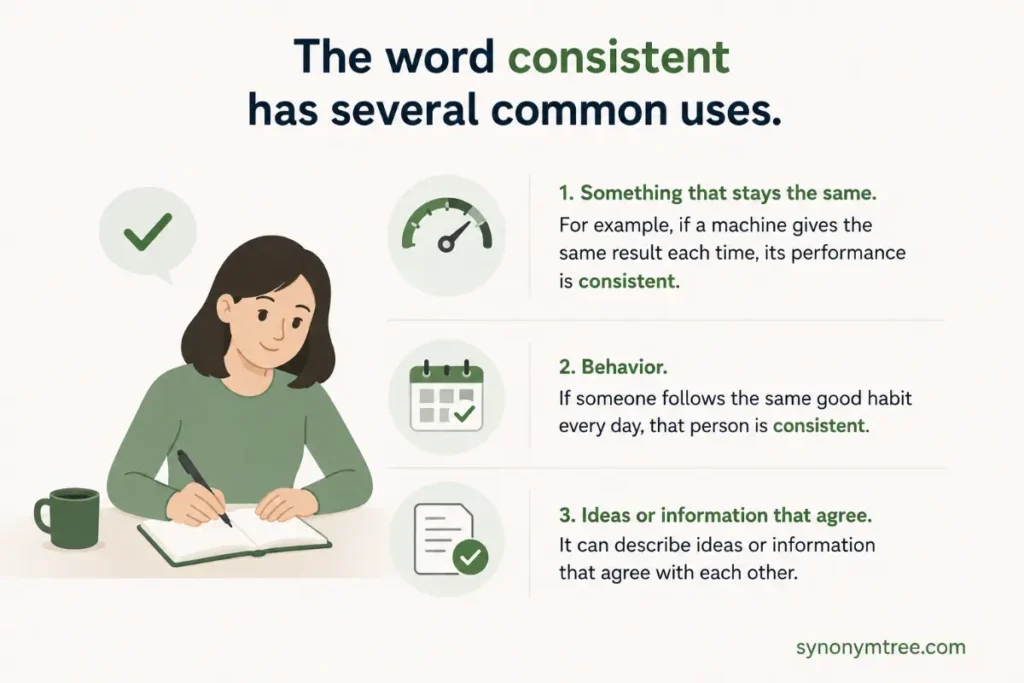
The word consistent has several common uses. The first use describes something that stays the same. For example, if a machine gives the same result each time, its performance is consistent. The second use describes behavior. If someone follows the same good habit every day, that person is consistent. The third use can describe ideas or information that agree with each other.
This makes the word useful in many simple sentences. You might say that a student has consistent grades. You might also say that two reports are consistent with each other when the information in them agrees.
The key idea is steadiness. Something consistent does not keep changing in a surprising way. It follows a pattern that you can recognize.
The incorrect spelling consistant does not become correct just because it sounds similar. English has many words that sound different from the way they are spelled. This is one reason spelling can be tricky even for people who speak English very well.
How to Use Consistent in a Sentence
The easiest way to learn a word is to see it inside normal sentences. Consistent usually describes a person, action, result, habit, quality, or pattern. It can also appear with the word with when you want to show that two things agree.
Before looking at examples, notice the simple meaning in each sentence. The word consistent usually tells us that something stays steady or agrees with something else.
- She is a consistent student who finishes her work on time.
- His grades have been consistent this year.
- The team has shown consistent effort all season.
- Try to keep a consistent sleep schedule.
- The machine gives consistent results.
- Her story was consistent with the information in the report.
- He delivers consistent work every week.
- The weather has been fairly consistent this month.
These sentences show that consistent can work in many everyday situations. You do not need a complicated rule to use it. Think about something that stays steady or follows the same pattern.
Why Consistent Vs Consistant Confuses So Many Writers
The spelling mistake has a simple cause. Many people hear the word before they see it in writing. When they pronounce consistent, the final sound can make them think of words that end in ant. This can lead to consistant.
Another reason is that English has many words with similar endings. Words such as important, distant, constant, and instant can make the spelling pattern feel confusing. A writer may remember the sound but not the exact letters.
There is also another small problem. The word constant is spelled with ant at the end, while consistent ends with ent. The two words are closely related in meaning, so some people mix their spellings.
Constant usually means something that continues without stopping or changing. Consistent usually means something that stays steady or follows a pattern. The meanings can overlap in some situations, but the spelling of consistent always ends with ent.
A useful habit is to connect consistent with consistency. The noun consistency also uses ency at the end. Thinking about the family of words can help you remember the correct spelling.
Consistent or Consistant in School and Work
In school writing, consistent is the spelling you should use. Teachers expect the standard form, so writing consistant can count as a spelling error even when the meaning is easy to understand.
For example, you might write about consistent practice in a sports essay. You might describe a consistent study routine in a personal essay. You might say that a character in a story shows consistent behavior. In each case, the spelling stays the same.
The same rule applies at work. You may use consistent to describe quality, service, results, performance, or behavior. A manager might want consistent work from a team. A customer may expect consistent service from a company. A report may show consistent results over several months.
Using the correct spelling makes your writing look cleaner. It also helps readers trust that you have checked your work.
Related Words You Should Know
Learning related words can make consistent easier to remember. Consistency means the quality of staying steady or following the same pattern. For example, consistency is important when you are building a good study habit.
Consistently is the adverb form. It tells us that someone does something in a steady way. For example, she consistently arrives early.
Inconsistent is the opposite of consistent. It describes something that changes too much or does not follow a steady pattern. For example, his results are inconsistent.
Inconsistently is the adverb form of inconsistent. It describes an action that does not happen in a steady way.
Constant is another related word, but it does not always mean exactly the same thing as consistent. Constant often means continuing all the time or happening again and again without stopping.
These related words can help you understand the main idea. Consistent is about being steady. Inconsistent is about lacking that steadiness.
Common Mistakes With Consistent or Consistant
The most common mistake is simply writing consistant. The correction is easy. Change the final ant to ent and write consistent.
Another mistake is using constant when you really mean consistent. These words can look similar in meaning, but they are not always interchangeable. If you mean that something stays at a similar level or follows a steady pattern, consistent is often the better word.
A third mistake is forgetting the word family. If you know consistency and consistently, you have two useful reminders for the spelling of consistent.
A fourth mistake is thinking that pronunciation can always tell you the spelling. English does not work that way. Many words have spellings that are not obvious from their sounds. Consistent is one of those words that is worth learning by sight.
A fifth mistake is adding extra letters because the word feels long. Keep it simple. The correct spelling is consistent.

How Consistent or Consistant Connects With Daily Life
The idea behind consistent is easy to see in everyday life. Think about brushing your teeth every morning and night. That is a consistent habit. Think about exercising three times each week. If you keep following the same plan, your exercise routine is consistent.
You can also use the word for things you notice around you. A restaurant may provide consistent food quality. A teacher may give consistent instructions. A bus service may have a consistent schedule. A phone may show consistent performance.
The word can describe both good and bad things. Someone can show consistent kindness. A person can also show consistent carelessness. The word itself does not mean good or bad. It simply tells us that a pattern stays steady.
This is an important point for learners. Do not think that consistent always means excellent. It means steady or similar over time. The situation tells you if that steady quality is good or bad.
What Does Consistent Mean in Simple Words
Consistent means steady, regular, or staying the same in a clear way. If someone acts consistently, they usually act in a similar way over time. If something produces consistent results, the results stay close to the same pattern.
For example, a consistent student studies regularly and keeps putting in effort. A consistent worker completes tasks at a steady level. A consistent machine produces similar results.
The simplest memory sentence is this. Consistent means staying steady.
Once you understand that meaning, the spelling becomes easier to remember too. The correct spelling is consistent with ent at the end.
Final Teacher Explanation
If I were teaching this word in a classroom, I would write two forms on the board. One would be consistent. The other would be consistant. Then I would tell students to choose consistent.
The reason is simple. Consistent is the standard English spelling. Consistant is a spelling mistake. The word means steady, regular, or staying in the same pattern.
The mistake happens because the ending can be hard to hear. Writers may think the word ends with ant, but it ends with ent. This is one of those spelling details that you need to remember rather than guess.
You can also connect the word with consistency and consistently. These related words can help you keep the correct spelling in mind.
So if you are writing an email, essay, report, school assignment, or article, use consistent. Do not use consistant.
Final Answer Quick Recap
The correct spelling is consistent.
Consistant is incorrect in standard English.
Use consistent when you mean steady, regular, or staying the same over time.
Conclusion
The difference between consistent or consistant is really a spelling question, not a meaning question. Consistent is the correct form, while consistant is a common spelling mistake. The correct word ends with ent, so remember consistent when you write about steady actions, regular results, or a pattern that stays the same.
A simple way to remember it is to connect consistent with consistency and consistently. All these words belong to the same word family. If you see the ending clearly, you are less likely to write consistant by mistake.
When you are unsure, choose consistent. It is the form you should use in everyday writing, school work, professional communication, and formal English.
Frequently Asked Questions
What is the correct spelling consistent vs consistant?
Consistent is the correct spelling. Consistant is a common spelling mistake.
What does consistent mean in simple English?
Consistent means steady, regular, or staying the same over time.
Is consistant a correct word?
No. Consistant is not the standard spelling. Use consistent instead.
Why do people spell consistent as consistant?
The ending can sound unclear when the word is spoken. This can make people choose ant instead of the correct ent ending.
How can I remember the spelling of consistent?
Remember that consistent ends with ent. You can also connect it with consistency and consistently.
What is the difference between constant and consistent?
Constant usually means continuing without stopping. Consistent means staying steady or following a similar pattern.
Can I use consistent in formal writing?
Yes. Consistent is correct for school work, business writing, reports, emails, and other formal writing.
What is the opposite of consistent?
The common opposite is inconsistent. It describes something that does not stay steady or follow the same pattern.
