
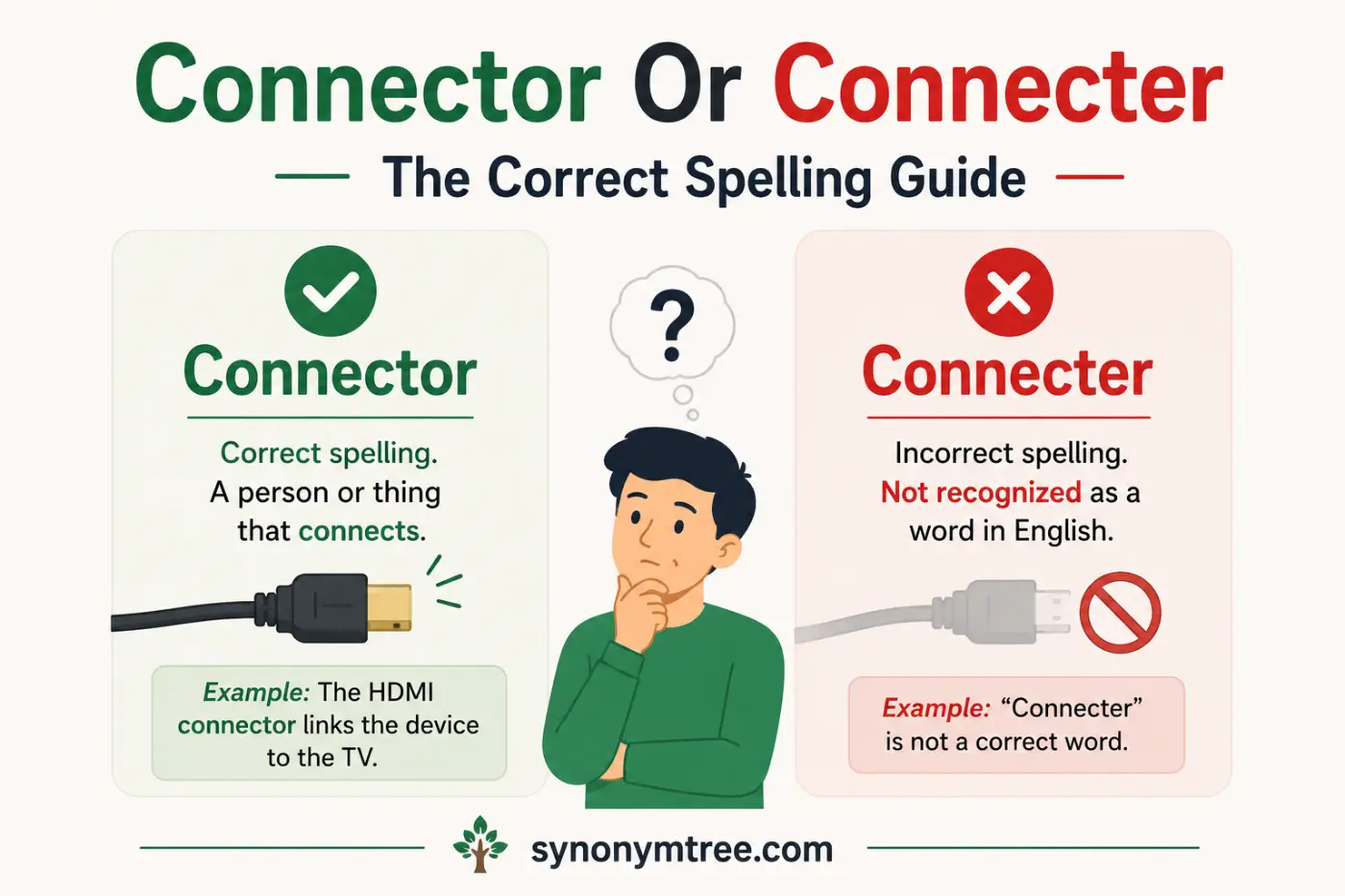
If you are unsure about connector or connecter, you are not alone. Both forms can appear in English, but they do not have the same level of use. The safest and most common spelling in modern American English is connector.
A connector is a person or thing that connects two things. You can use it for a physical part such as a cable connector. You can also use it for a person who brings people together. The word connecter can also have this meaning, but it is much less common.
So if you are writing an email, school paper, website, report, or other everyday English text, choose connector. It is the clearer and more familiar spelling for most readers.
Simple Answer In One Look
Connector is the standard and much more common spelling. Connecter is also found in dictionaries as a less common form. For normal writing, connector is the better choice.
Think of the word this way. Something that connects is a connector. A person can also be called a connector when that person helps people meet or work together.
What Connector Means In Simple English
The easiest way to understand connector is to start with the word connect. To connect means to join two things or bring them together. A connector is something or someone that does that job.
Imagine two pieces of a toy that need to fit together. A small part may help join them. That part can be called a connector. Now imagine two people who do not know each other but have a friend who introduces them. That friend can also act as a connector because the friend brings the two people together.
This idea stays the same in many situations. A connector creates a link. It helps one thing reach another thing. It can join wires, pipes, machines, ideas, groups, or people.
A connector is often a physical device that joins electrical equipment. It can also describe an object that joins pipes or tubes.
The word can also describe a person. If someone knows many people and often introduces them to each other, you might call that person a connector. This use is easy to understand because the person connects people in the same basic way that a cable connector joins parts.
For example, think about a school project. One student may know the teacher. Another student may know someone who can provide the materials. A student who brings those people together can be called a connector. The word describes the job that person performs.
The same idea works with technology. Your phone charger has parts that need to connect. A connector helps those parts fit together and carry a signal or power. So the basic meaning is simple. A connector helps two things become connected.
Why People Mix Connector Or Connecter
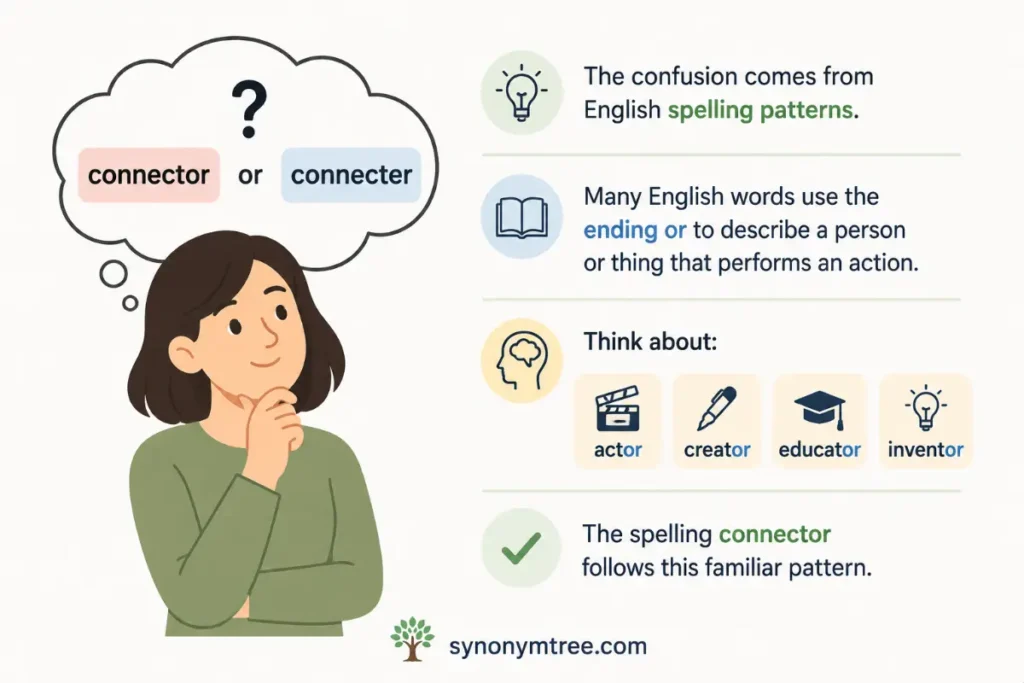
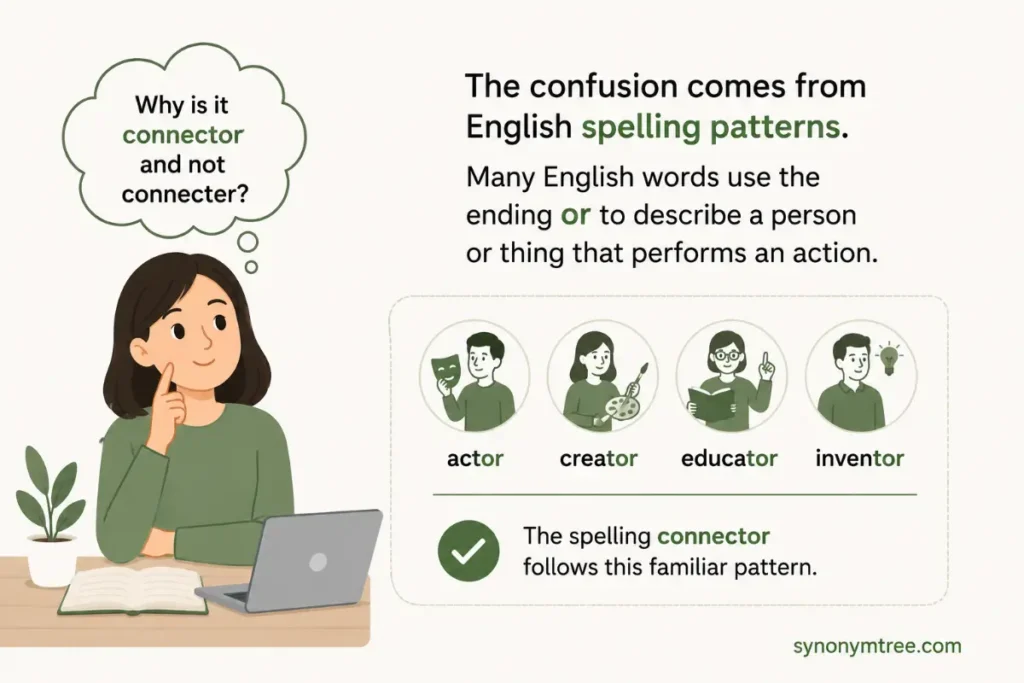
The confusion comes from English spelling patterns. Many English words use the ending or to describe a person or thing that performs an action. Think about actor, creator, educator, and inventor. The spelling connector follows this familiar pattern.
At the same time, English sometimes allows words ending in er. We see this pattern in many words that describe someone who does something. A runner runs. A writer writes. A teacher teaches. Because of this pattern, connecter may look natural to some writers.
There is also a simple spelling clue in the base word. The base verb is connect. When we form connector, we keep the full word connect and add or. That gives us connector.
The form connecter also makes sense from a spelling point of view because English has many words that use er. This explains why people sometimes write it. It does not mean that the spelling is always wrong. Connecter is recognized as a less common form of connector.
This is an important point for English learners. A less common spelling can still be a real word. You should not assume that every less familiar spelling is automatically incorrect.
Still, common usage matters. If your goal is clear everyday writing, the familiar form is usually the best choice. Connector is the form most readers will expect.
You can see this clearly in technology. People commonly talk about cable connectors, USB connectors, audio connectors, and pipe connectors. These terms all use connector because it is the established spelling.
What Is The Difference Between Connector And Connecter
The main difference is frequency and standard use. Connector is the common form. Connecter is a less common form that dictionaries recognize.
The meaning is basically the same when connecter is used as a noun. Both forms can refer to a person or thing that connects. The real difference for most writers is which spelling sounds natural and familiar.
You can remember the difference with a simple rule. If you need the noun in normal English writing, use connector.
Here are the key points to remember.
- Connector is the common spelling.
- Connecter is a less common spelling.
- Both forms can refer to something or someone that connects.
- Connector is the safer choice for school writing and general communication.
- Technical writing commonly uses connector for a physical part that joins equipment.
- A person who brings people together can also be called a connector.
Which Form Should You Use
Use connector in most situations. This is the simple answer.
If you are writing a school assignment, use connector. If you are writing a work email, use connector.
You do not need to search for a different spelling every time you see this word. Connector is clear and widely understood.
For example, imagine that you are describing a broken cable. You would say that the connector is damaged. If you are writing about a person who introduces people at events, you can also call that person a connector.
The same spelling works in both situations.
This makes connector an easy word to use. Once you remember it, you will probably stop worrying about the spelling.
Connecter can appear in dictionaries and in some writing. It is listed as another form but marked as less common. That means you should not treat connecter as a completely made up word. However, most writers will benefit from choosing the more familiar form.
Easy Real Life Sentences You Can Use
The best way to remember a word is to see it in normal sentences. The examples below show the most useful ways to use connector in daily English.
- I need a new connector for this cable.
- The connector on my charger is damaged.
- This connector joins the two pipes.
- Make sure the connector is firmly attached.
- She is a great connector who introduces people to each other.
- The device needs a special connector.
- We bought a connector for the new monitor.
- He became a connector between the two teams.
Notice that the basic idea stays the same in every sentence. The connector helps create a link.
Some examples describe a physical object. Other examples describe a person. This is one reason the word is useful. Its meaning can stretch across different situations while keeping the same basic idea.
How Connector Works In Technology
Technology is one of the most common places where you will see connector. A connector is often a physical part that joins one piece of equipment to another.
Think about a cable. One end may have a connector that fits into a port. The connector allows the two parts to make contact. Without the right connector, the equipment may not work together.
You may see the word in phrases such as cable connector, power connector, audio connector, and pipe connector. These phrases all follow the same idea.
A cable connector joins a cable to another part. A pipe connector joins pipes. An electrical connector helps electrical parts make contact.
The exact design can change, but the main purpose stays the same. The connector creates the link.
This meaning also explains why the word feels natural in technical writing. It clearly names the part that performs the connecting job.
How Connector Works For People
Connector is not limited to machines and cables. It can describe a person too.
Suppose you know someone who seems to know everyone. That person introduces coworkers to useful contacts. They introduce friends to new groups. They help people find the right person for a problem. You could describe that person as a connector.
This use is based on the same idea as the technical meaning. A physical connector joins things. A person connector brings people together.
Imagine a new employee who needs help finding a designer. Another employee knows a good designer and makes the introduction. That employee has acted as a connector.
You may also hear this idea in business and social settings. Someone who builds relationships and introduces people can be described as a strong connector.
The word does not have to describe a formal job. It can simply describe what a person does.
Where This Word Comes From
Connector comes from the verb connect. The history of connect goes back to Latin. The Latin roots carry the idea of binding or joining together.
The basic idea has stayed surprisingly steady. Connect means to join or bring together. Connector names something that performs that connecting job.
The word connector developed from this basic idea. English speakers created related forms to describe the action, the result, and the thing that performs or allows the action.
Connect became the everyday verb. Connection became the noun for the link. Connector became the noun for something that connects.
The spelling connecter also developed from the same basic pattern. It can function as a noun meaning someone or something that connects, but modern usage favors connector.
That history also helps explain why connector feels like a natural English word. It follows a familiar pattern where a word describes something that performs an action.
Why Connector Is Usually The Better Choice
When you have two possible spellings, the best choice often depends on common use. English has many words that dictionaries recognize even though one form appears much more often.
Connector is the form most readers will recognize quickly. It is common in technical writing, everyday writing, education, and general communication.
Connecter exists, but it is much less common. So if you want your writing to sound natural, connector is the easy winner.
There is no need to make the choice harder than it is. Remember the common form and use it with confidence.
The spelling may seem like a tiny detail. Still, small spelling choices can affect how natural your writing feels. A familiar word helps the reader move through your sentence without stopping.
Now that the basic difference is clear, we can look at the word in a wider way. The spelling question is simple, but the idea of connection appears in technology, language, friendships, work, stories, and everyday life.
How Connector Is Understood In Culture And Stories
The idea behind connector is easy to find in stories and everyday culture. People have always needed ways to bring things together. A bridge connects two places. A messenger connects people who are far apart. A friend can connect two strangers. A road can connect two towns.
That is why the word connector can carry a positive feeling when it describes a person. A connector often helps people meet, share ideas, solve problems, or build friendships.
In stories, a character who brings two groups together may act as a connector. The character may help people understand each other. The character may carry news from one place to another.
You do not need a special literary meaning to understand this use. The main idea stays simple. A connector brings separate things closer together.
The same idea appears in modern life. Social groups depend on people who introduce others. Schools depend on teachers who connect students with information. Workplaces depend on people who connect teams. Technology connects people across long distances.
So connector has a simple human idea behind it. It represents a link.
Biblical And Mythological Meaning
Connector and connecter do not have a special biblical or mythological meaning. They are ordinary English nouns used to describe something or someone that connects.
However, the idea of connection appears in many religious and old stories. People often tell stories about bridges, messengers, guides, and other figures who bring people or places together. Those ideas can remind us of the basic meaning of connector.
Still, you should not give connector a special biblical meaning when explaining the word. That would go beyond what the word itself means.
The safest explanation is simple. Connector means something or someone that connects. Its meaning comes from the verb connect rather than from a special religious or mythological symbol.
Symbolism Explained In Simple Words
The word connector can have a simple symbolic meaning when people use it to talk about relationships. A connector can represent a bridge between two sides.
Think about a bridge. Two places may be separated by water. The bridge gives people a way to move from one side to the other. In a similar way, a person can connect two groups that do not normally meet.
This does not change the dictionary meaning. It simply gives the word a wider human picture.
What Connector Represents
Connector can represent unity, communication, friendship, access, and cooperation. A connector helps something reach something else.
A person who introduces two friends can be a connector. A teacher who helps a student find useful information can act as a connector. A machine part that joins two pieces can be a connector.
The common idea is the link.
What Connecter Represents
Connecter can carry the same basic idea because it is recognized as a less common form of connector. The main difference is not a special meaning. The difference is how often people use the spelling.
So do not think of connector and connecter as two words with different symbolic meanings. They are forms of the same basic noun. Connector is simply the form you will normally want.
Related Words You Should Know
Learning related words can make the main word easier to remember. The words below all connect to the same basic idea.
- Connect means to join two things or bring them together.
- Connected means joined or linked to something else.
- Connection means a link or relationship between two things.
- Connecting means joining or bringing things together.
- Connector means a person or thing that connects.
- Connective describes something that helps connect things.
- Disconnect means to separate something that was connected.
- Reconnect means to connect something again.
Once you understand connect, many of these words become easier. They all carry the same central idea of joining or linking.
How People Actually Use Connector In Daily English
You can use connector in many normal situations. The most common use involves technology and physical parts. Another useful meaning describes people who bring others together.
Here are examples that sound natural in everyday American English.
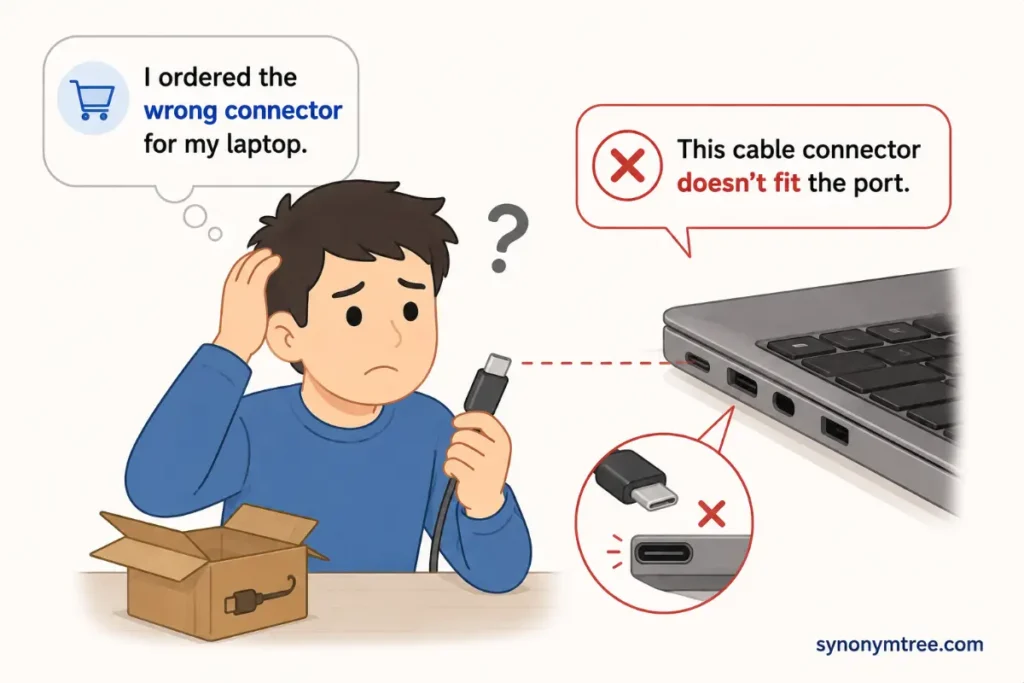
- I ordered the wrong connector for my laptop.
- This cable connector doesn’t fit the port.
- The plumber replaced the old pipe connector.
- Check the connector before you turn the machine on.
- Sarah is a natural connector. She knows people everywhere.
- Our teacher was the connector between the students and the community group.
- We need a stronger connector for this cable.
- He acted as a connector between the two departments.
- The new connector makes the setup much easier.
- She became a connector for people looking for jobs.
These examples show why context matters. In one sentence, connector can mean a small physical part. In another, it can describe a person.
The word always keeps the same central idea. Something is being joined.
Common Mistakes People Make
One common mistake is assuming that connecter must be wrong because connector looks more familiar. Connecter is actually listed as a less common form of connector.
A second mistake is using connecter in formal writing simply because it looks possible. If your goal is clear and natural English, connector is usually the better choice.
A third mistake is confusing connector with connection. These words are related but they do different jobs in a sentence. Connector names the person or thing that connects. Connection names the link itself.
For example, you can say that a cable has a connector. You can also say that the cable has a connection. The two words are related, but they do not mean exactly the same thing.
Another mistake is thinking that connector only applies to technology. It can also describe people. Someone who brings people together can be a connector.
You may also see writers use connector when they mean a linking word in writing. That use is possible in language study. Words and expressions can act as connectors because they help link ideas.
The important lesson is to look at the context.
Final Teacher Explanation
If I were explaining connector and connecter to a student in class, I would keep the lesson very simple.
First, remember the main word connect. It means to join or link. Then remember connector. It means a person or thing that connects.
Now look at connecter. It is also found in dictionaries, but it is less common. That gives you an easy writing rule. When you need this word in normal English, choose connector.
You can use connector for a cable part. You can even see the same idea in language when something helps connect ideas.
The spelling is not something you need to fear. Just remember the form that readers see most often.
Connector is the word to keep in your everyday writing.
Final Answer Quick Recap
Connector is the standard and more common spelling. Connecter is a recognized but less common form.
For school, work, technology, and everyday English, use connector. It means a person or thing that connects two things.
The easiest memory trick is simple. Connect gives you connector.
Conclusion
The difference between connector and connecter is easier than it first appears. Both forms can refer to something or someone that connects. The main point is that connector is far more common and is the better choice for most modern English writing.
You will see connector often in technology because devices, cables, wires, and pipes need parts that join them. You can also use connector for people who bring other people together. The meaning stays clear because the word always carries the idea of creating a link.
If you remember only one thing from this lesson, remember connector. It is the spelling you can confidently use in most situations. Connect things together and you have a connector.
Frequently Asked Questions
Is Connector Or Connecter Correct?
Connector is the common and preferred form. Connecter is also recognized as a less common form.
Which Spelling Should I Use?
Use connector in normal writing. It is the clearer and more familiar choice.
Is Connecter A Real Word?
Yes. Connecter is recognized as a less common form of connector.
What Does Connector Mean?
A connector is a person or thing that joins or links two things.
Can Connector Describe A Person?
Yes. A person who brings people together can be called a connector.
Is Connector Used In Technology?
Yes. Connector is widely used for parts that join electrical equipment, cables, pipes, and other devices.
What Is The Difference Between Connection And Connector?
A connection is the link between things. A connector is the person or thing that creates or helps create that link.
Can I Use Connecter In Formal Writing?
You can find connecter in dictionaries, but connector is the safer and more natural choice for most formal and everyday writing.
