
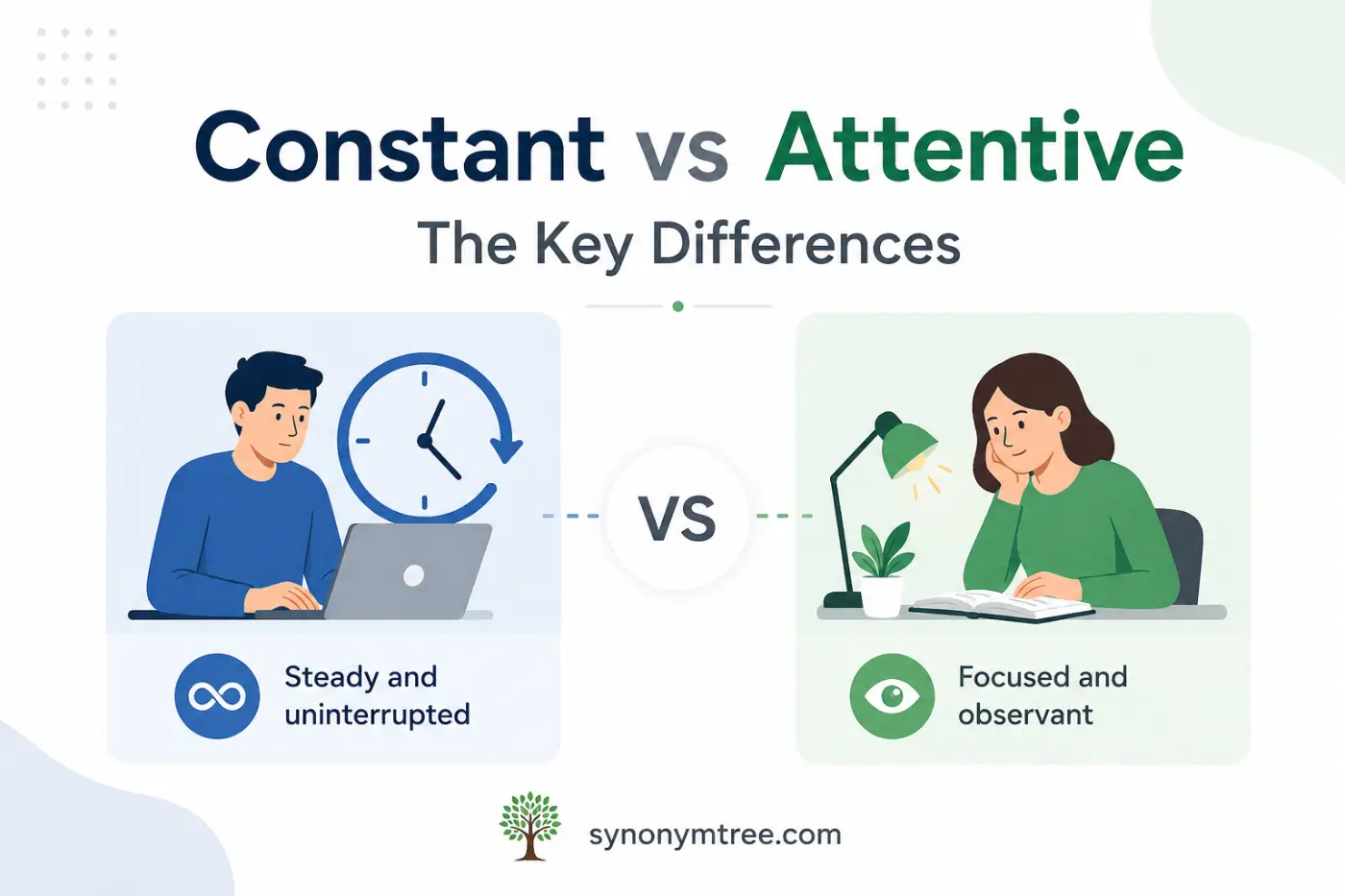
When comparing constant vs attentive, the key difference is simple. Constant describes something that continues, stays the same, or happens again and again. Attentive describes someone who listens, watches, or pays close attention. These words do not have the same meaning, so you cannot normally use one in place of the other.
Think about a student in class. If the student listens carefully to the teacher, the student is attentive. If the student studies every day without giving up, the student is constant in effort. The two words can describe good habits, but they describe different parts of those habits.
Understanding constant vs attentive the key differences can help you choose the right word in school writing, work emails, conversations, and everyday English. Once you know what each word focuses on, the difference becomes much easier to remember.
Simple Answer in One Look
Constant means continuing, steady, or happening again and again. Attentive means giving careful attention to someone or something. A constant person or thing stays steady. An attentive person pays close attention.
What Constant Means in Simple English
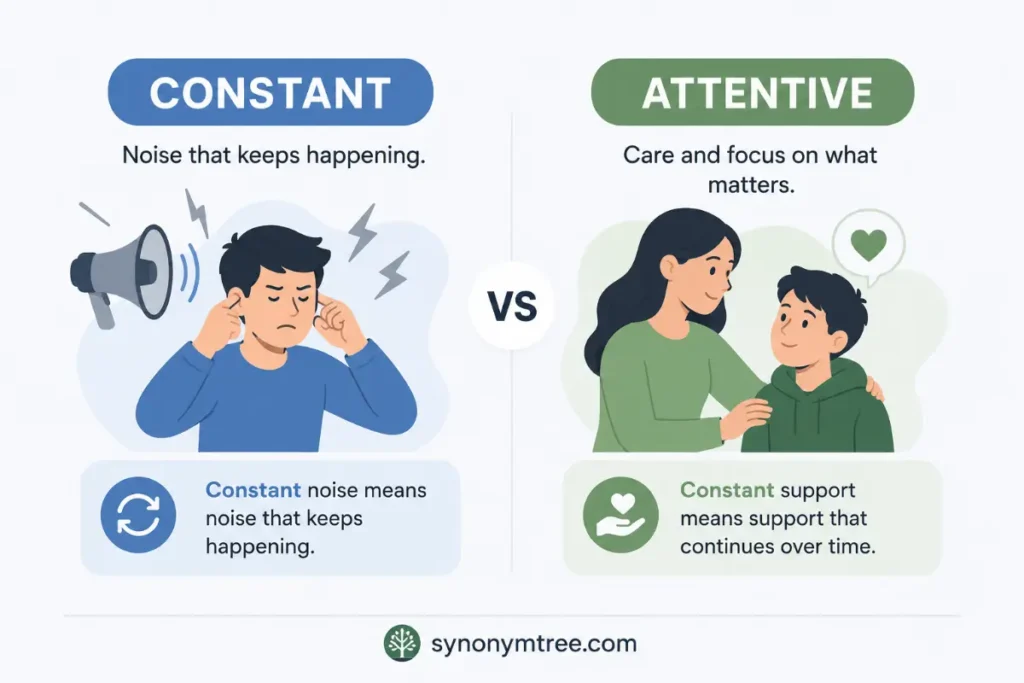
Constant describes something that continues or stays the same. It can describe an action, condition, feeling, sound, change, or situation. For example, constant rain means rain that keeps falling for a long time. Constant noise means noise that keeps happening. Constant support means support that continues over time.
The word can also describe something that happens very often. If a child asks constant questions, the child asks questions again and again. Constant can also mean steady. A constant speed means the speed does not change much. A constant temperature means the temperature stays at the same level. The main idea is time and steadiness. When you see constant, think about something that keeps going or remains steady.
Here are some simple examples.
- The machine makes a constant sound.
- She gave me constant support.
- The car moved at a constant speed.
- He was under constant pressure.
- The constant rain made the roads wet.
Notice that none of these examples means paying close attention. Constant tells us that something continues or stays steady.
What Attentive Means in Simple English
Attentive describes someone who pays close attention. An attentive person listens carefully, watches carefully, and notices what is happening. For example, an attentive student listens when the teacher explains a lesson. An attentive doctor listens carefully to a patient. An attentive friend notices when someone needs help.
The word is about focus. It tells us that a person is aware and careful about what they see or hear. You can also use attentive for a person who notices small details. If someone remembers what you said and responds carefully, that person may be attentive.
Here are some simple examples.
- The students were attentive during the lesson.
- She is an attentive listener.
- The nurse was attentive to the patient’s needs.
- He was attentive during the meeting.
- The teacher was attentive to every student.
The main idea is attention. When you see attentive, think about listening, watching, noticing, and caring about details.
Why People Mix These Words
People may confuse constant and attentive because both words can describe positive qualities. A person can be constant in support and attentive to another person’s needs. Both words may appear when talking about relationships, school, work, or care.
Still, their meanings are different. Constant focuses on something continuing or staying steady. Attentive focuses on paying attention. Imagine a friend who calls you every day. The friend’s calls may be constant. If the friend listens carefully when you talk, the friend is attentive.
One person can be both constant and attentive, but the words describe different actions. The confusion can also come from sentences about care. A person may provide constant care and attentive care. In the first phrase, constant tells us that the care continues. In the second phrase, attentive tells us that the care is careful and focused.
The easiest way to separate them is to ask a question. Ask, Does it keep going or stay steady? If yes, constant may be the right word. Ask, Does someone pay close attention? If yes, attentive may be the right word.
Constant vs Attentive The Key Differences
The clearest way to understand constant vs attentive the key differences is to focus on the main idea behind each word.
- Constant means continuing or steady.
- Attentive means paying close attention.
- Constant often relates to time, repetition, or stability.
- Attentive usually relates to focus, listening, watching, or noticing.
- Constant can describe things, actions, conditions, feelings, and people.
- Attentive usually describes people and the way they give attention.
- Constant asks you to think about something that keeps going.
- Attentive asks you to think about someone who notices and listens carefully.
Consider this simple example. A teacher may give constant support to a student. The teacher may also be attentive to the student’s needs. Constant means the support continues. Attentive means the teacher pays close attention to what the student needs.
That small difference is the key.
Which Word Should You Use
Choose constant when you want to show that something continues, repeats often, or remains steady. Choose attentive when you want to show that someone pays careful attention. You can use this simple rule. If the main idea is continuing, use constant. If the main idea is careful attention, use attentive.
For example, constant practice means practice that happens regularly. Attentive practice would suggest careful attention during practice, but it is not the normal way to describe regular practice. Likewise, an attentive student listens carefully. A constant student is not a common phrase because constant does not naturally mean careful listening.
This rule will help you in most everyday situations.
Easy Real Life Sentences You Can Use
Both words appear in normal English, but they work in different kinds of sentences. These examples show how people naturally use them.
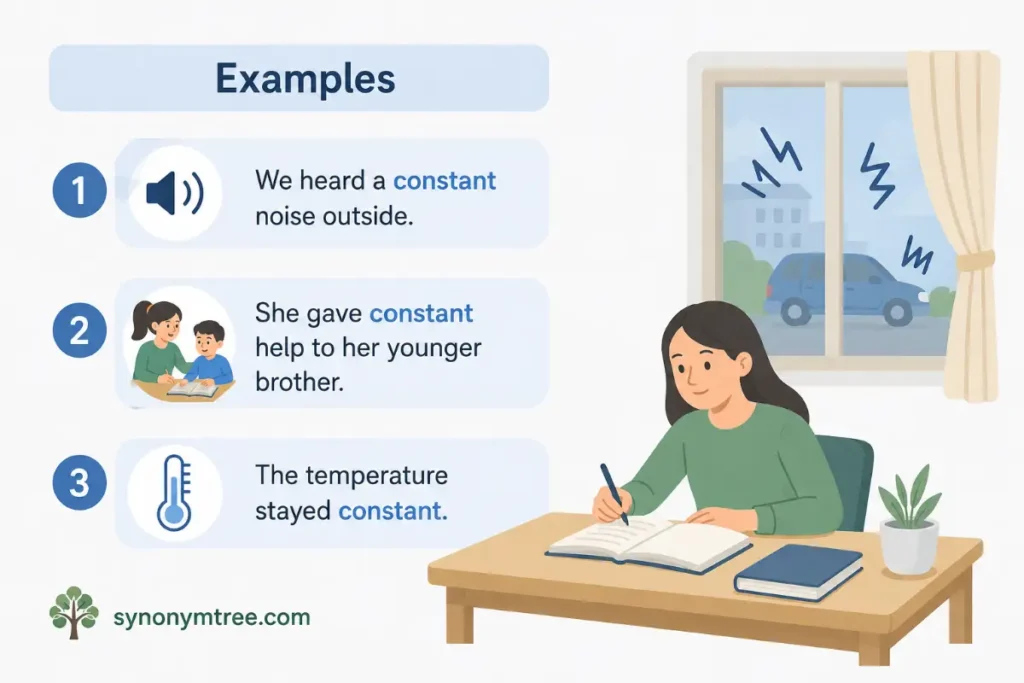
- We heard a constant noise outside.
- She gave constant help to her younger brother.
- The temperature stayed constant.
- He faced constant changes at work.
- The student was attentive in class.
- She is attentive when people speak.
- The doctor was attentive to my concerns.
- He became more attentive during the meeting.
The first four examples focus on something continuing or staying steady. The last four focus on attention and careful listening.
Where These Words Come From
Constant comes from a Latin word linked to the idea of standing firm or remaining steady. The word entered English through French and Latin use. Its basic idea has remained connected to steadiness and continuation.
Attentive comes from the Latin verb meaning to pay attention or give heed. It entered English through French and developed the meaning of being careful about what someone sees, hears, or notices. The histories are different, but you do not need to remember the older languages to use the words correctly. A simple memory idea is enough. Constant stays. Attentive notices.
How Constant Can Describe Time
One of the most common uses of constant relates to time. When something happens continuously or very often, we can call it constant. The action may not literally happen every second. The word can simply show that it happens again and again or seems to continue without much of a break.
For example, constant phone calls can mean that someone keeps calling you many times. Constant rain can mean rain that continues for a long period. Constant questions can mean questions that keep coming.
This meaning makes constant useful in everyday speech. You might say that a noisy room has constant talking. You might say that a worker faces constant interruptions. You might say that a child needs constant supervision. In all these examples, the important idea is that something keeps happening.
How Constant Can Mean Steady
Constant can also mean staying at the same level. Think about speed. If a car travels at the same speed for a period of time, its speed is constant. The same idea works with temperature, pressure, size, or other measurements.
For example, a refrigerator may keep food at a constant temperature. A machine may work at a constant speed. A person’s income may remain constant for a period.
Here, constant does not mean repeated action. It means that something does not change. That gives us two useful meanings to remember. Constant can mean continuing. Constant can also mean staying the same. Both meanings are connected by the idea of steadiness.
How Attentive Shows Care
Attentive can sometimes show more than simple listening. It can also suggest that someone cares enough to notice what another person needs.
For example, an attentive parent notices when a child looks tired. An attentive waiter notices when a customer needs help. An attentive teacher notices when a student is confused.
The person is not simply present. The person is paying attention.
This is why attentive is often used as a positive description of people.
If someone says you are attentive, they usually mean you listen well, notice details, and respond carefully.
Attentive Does Not Mean Constant
This is one of the most useful points to remember. Someone can be attentive for five minutes. Attention does not have to continue for a long time. For example, a student may be attentive during a ten minute explanation. The student listens carefully during that time.
Constant describes continuation or steadiness. Attentive describes the quality of attention. A person can be attentive without being constant. A person can also be constant without being attentive. For example, a phone can make a constant noise, but the phone is not attentive. A student can be attentive during class, but the student may not study constantly.
The words describe different ideas.
A Simple Test for Choosing the Right Word
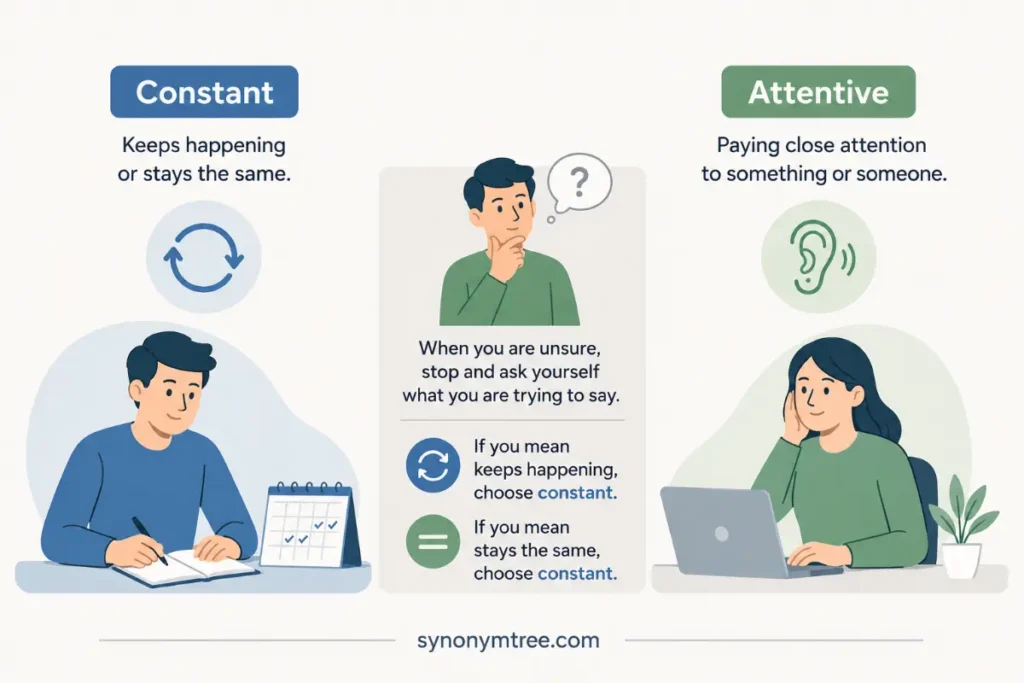
When you are unsure, stop and ask yourself what you are trying to say.
If you mean keeps happening, choose constant.
If you mean stays the same, choose constant.
If you mean listens carefully, choose attentive.
If you mean watches carefully, choose attentive.
If you mean notices details, choose attentive.
This test works well because it focuses on meaning rather than memorizing a long grammar rule. Suppose you want to describe a worker who checks every detail before finishing a report. Attentive is a good choice. Suppose you want to describe a worker who comes to work at the same time every day and keeps producing steady results. Constant may fit in some contexts, although consistent is often the more natural word for regular performance. That last point matters because English has many words with similar meanings. The best word depends on the exact idea you want to express.
Constant and Consistent Are Not the Same
Constant and consistent are close in some situations, but they are not identical. Constant usually means continuing or staying unchanged. Consistent usually means steady, reliable, or following the same pattern. For example, constant rain means rain that keeps falling. Consistent rain may mean rain that follows a steady pattern. A student can be consistent in studying. This means the student studies regularly. Calling the student constant is less natural.
This shows why word choice matters. Two words can be related but still have different uses. When you want to describe a regular habit or dependable performance, consistent is often better. When you want to describe something that keeps going or does not change, constant is often better.
Constant and Careful Are Different
Attentive is close to careful, but the two words are not exactly the same. Careful often means trying not to make mistakes or avoid danger. Attentive means paying close attention. A careful driver tries to drive safely. An attentive driver watches the road closely. A person can be both careful and attentive, but the words focus on different things. This distinction can help you understand attentive more clearly. It is not simply another word for good or careful. It specifically points to attention.
Constant vs Attentive in School
Students see both words in school settings. A teacher may ask students to remain attentive during a lesson. This means students should listen and focus. A teacher may also talk about constant practice. This means students need to practice again and again.
The difference becomes clear in these examples.
- Be attentive during the lesson.
- Keep practicing consistently.
- The class had constant noise outside.
- She gave constant support to her classmates.
- The students were attentive to the teacher’s instructions.
These sentences show that constant and attentive can appear in the same setting while keeping different meanings.
Constant vs Attentive in Relationships
Both words can also describe relationships. A person may give constant support to a friend. This means the support continues over time. A person may be attentive to a friend’s feelings. This means the person listens, notices, and responds with care. For example, a good friend may be constant in loyalty and attentive in conversation.
The two qualities can work together. Someone can stay loyal over many years and also pay close attention when you need to talk. That is a good way to remember the difference. Constant describes how long or how steadily something continues. Attentive describes how carefully someone pays attention.
Constant vs Attentive in Work
In the workplace, both words are useful. An attentive employee listens carefully during meetings and notices details in instructions. A constant source of support continues to help the team over time.
For example, a manager can be attentive to employee concerns. A company can face constant changes. A worker can provide constant support during a difficult project. Again, the meaning depends on the focus of the sentence. If the focus is attention, attentive is usually the better choice. If the focus is continuation or steadiness, constant is usually the better choice.

A Quick Classroom Trick
Imagine two students sitting in a classroom. Student A listens carefully. The student watches the teacher, takes notes, and notices every instruction. That student is attentive.
Student B keeps practicing the same skill every day. The student does not give up and keeps working. That student shows steady or consistent effort. Now imagine a clock ticking again and again. Its ticking is constant. This simple picture can help you remember the difference. Attentive means eyes and ears are focused. Constant means something keeps going or stays steady.
Final Teacher Explanation
If I were explaining constant and attentive to a student in class, I would give you one simple question for each word. For constant, ask, Does it keep going or stay the same? For attentive, ask, Is someone paying close attention? If the answer is yes to the first question, constant may be right.
If the answer is yes to the second question, attentive may be right. Constant is about continuation or steadiness. Attentive is about attention. You can remember the difference with two short phrases. Constant stays. Attentive notices. Once you remember those two ideas, choosing the right word becomes much easier.
Final Answer Quick Recap
Constant means continuing, repeated, or staying steady. Attentive means paying close attention and noticing details. The key difference is simple. Constant focuses on continuation or steadiness, while attentive focuses on attention.
Conclusion
The difference between constant and attentive becomes clear when you focus on the main idea of each word. Constant is about something that keeps going or stays steady. Attentive is about someone who gives careful attention.
You can use constant for things such as constant noise, constant rain, constant support, and constant pressure. You can use attentive for an attentive student, attentive listener, attentive teacher, or attentive worker.
The easiest way to remember the difference is simple. Constant stays. Attentive notices. Keep that small rule in mind, and you will have a much easier time choosing the right word in everyday English.
Frequently Asked Questions
What does constant mean in simple words?
Constant means continuing, happening often, or staying the same.
What does attentive mean in simple words?
Attentive means listening, watching, or noticing carefully.
What is the difference between constant and attentive?
Constant describes continuation or steadiness. Attentive describes careful attention.
Can a person be both constant and attentive?
Yes. A person can give constant support and also be attentive to someone’s needs.
Is constant a synonym for attentive?
No. The words have different meanings and should not normally replace each other.
When should I use constant?
Use constant when something continues, happens repeatedly, or remains steady.
When should I use attentive?
Use attentive when someone pays close attention, listens carefully, or notices details.
What is the difference between constant and consistent?
Constant often means continuing or unchanged. Consistent often means steady, reliable, or following the same pattern.
