
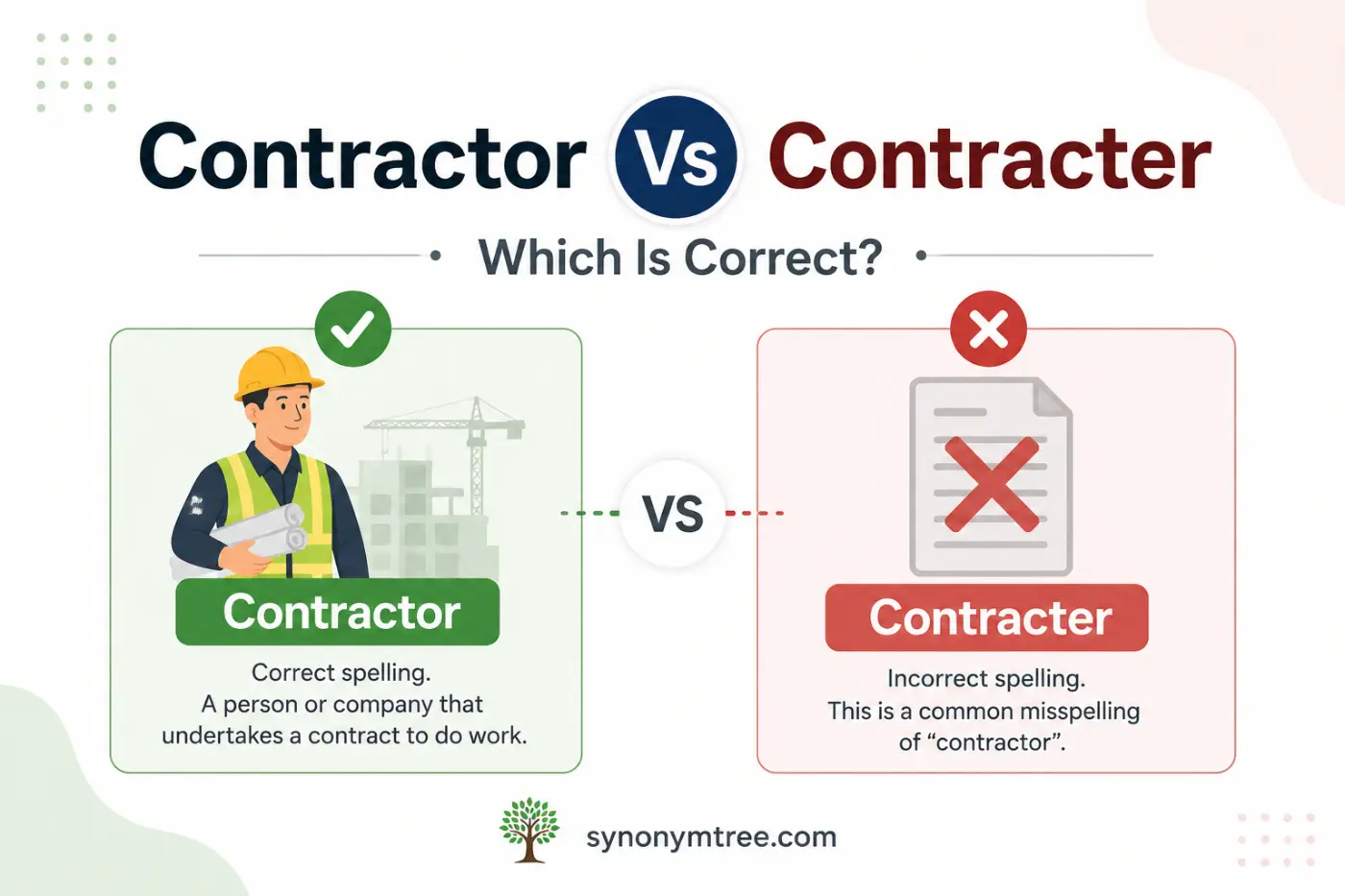
If you searched for contractor vs contracter, you probably want one simple answer: contractor is the correct spelling. Contracter is not the standard English spelling of the word. The extra o can be easy to miss because the word contract is right there at the start.
A contractor is a person or company hired to do a specific job. The word can describe someone who builds homes, repairs plumbing, manages a project, or provides another service under an agreement. You may also see contractor used in business, government, and technology.
The spelling can cause trouble in emails, resumes, invoices, job posts, and business documents. A small spelling error can make otherwise good writing look careless. This guide explains the correct form, why the mistake happens, how to remember the spelling, and how to use the word naturally in a sentence.
Quick Definition
Contractor is the correct English spelling for a person or company hired to perform work under a contract or agreement. Contracter is a common spelling mistake and should not be used in standard English.
Direct Answer
The correct spelling is contractor. Contracter is incorrect in standard English.
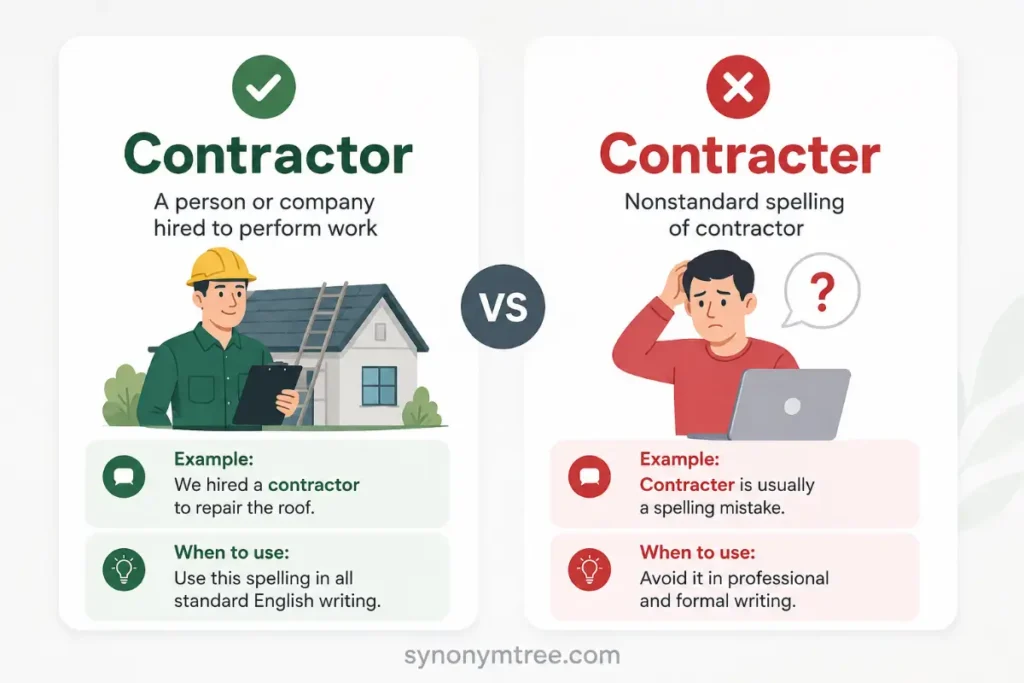
Comparison Table
| Word or phrase | Meaning | Example sentence | When to use it |
|---|---|---|---|
| Contractor | A person or company hired to perform work | We hired a contractor to repair the roof. | Use this spelling in all standard English writing. |
| Contracter | Nonstandard spelling of contractor | Contracter is usually a spelling mistake. | Avoid it in professional and formal writing. |
Why Contractor Is The Correct Spelling
The word contractor comes from contract plus the suffix or. The suffix or often forms a noun for a person or thing that performs an action. You can see the same pattern in words such as actor, creator, operator, and administrator.
Contractor follows that pattern. A contractor is someone who contracts to do work. The noun describes the person or business that takes on the work.
The spelling also keeps the full form of contract visible. That gives you a useful clue when you write it. Start with contract. Then add or. The result is contractor.
Contracter looks tempting because English has many words that end in er. Think about worker, builder, teacher, and driver. Those words can make contracter feel natural. However, contractor has a different word building pattern. Standard English uses contractor for this meaning.
This is one reason spelling can be tricky even for strong writers. English does not use one simple rule for every noun that describes a person who does something. Some words take er. Others take or. Some use a different form altogether.
You do not need to memorize every word pattern to get this one right. You only need to remember the established spelling of contractor.
Where The Confusion Comes From
The main source of confusion is the word contract. When people think about someone who works under a contract, they may naturally add er to the end. That creates contracter in their mind.
The problem is that English words do not always form related nouns in the way a speaker might expect. Contractor has been established as the standard noun. Contracter does not replace it in normal English.
Pronunciation can also play a small role. When you say contractor quickly, the middle sounds can blend together. A writer who is thinking about the sound instead of the spelling may leave out the o.
Another reason comes from familiar words. English has many job words ending in er. A person who paints is a painter. A person who drives is a driver. A person who farms is a farmer. That pattern is so common that contracter can look reasonable at first glance.
Search results can add to the confusion too. If you type the misspelling into a search engine, you may still find pages that contain it. A search result does not prove that a spelling is correct. User generated pages, old documents, automatic text, and other mistakes can all appear online.
The safest approach is to use a trusted dictionary or established style guide when a spelling feels uncertain. For this word, the standard form is contractor.
What Contractor Means
Contractor has a few closely related uses. The basic idea stays the same: someone takes responsibility for work under an agreement.
In construction, a contractor may organize workers, materials, schedules, permits, and other parts of a project. A general contractor can manage a building project from start to finish. A specialty contractor may focus on one area such as electrical work, plumbing, roofing, or heating.
The word also appears outside construction. A business may hire an IT contractor for a specific project. A company may bring in a marketing contractor for a short term assignment. A government agency may hire contractors to provide services.
The key idea is the work arrangement. A contractor is usually hired to provide a service based on agreed terms. The exact legal meaning can vary by situation and location.
Contractor can refer to an individual or a company. For example, you can say that a contractor repaired the kitchen. You can also say that a construction company is the contractor for a new office building.
The word does not automatically tell you the size of the job. A contractor might work alone on a small repair. A large contractor might manage a major commercial project with many workers.
Contractor In Construction
Construction is one of the most common areas where people use the word contractor.
A homeowner may hire a contractor to remodel a kitchen. A property owner may hire a contractor to repair a roof. A developer may hire a contractor to build an apartment complex.
A general contractor often coordinates different parts of a construction project. They may hire subcontractors for specific tasks. For example, the general contractor may bring in an electrician for wiring and a plumber for pipes.
A subcontractor works for the contractor on a particular part of the project. The subcontractor may have a separate agreement with the main contractor.
Here are some natural examples.
The contractor gave us an estimate for the kitchen remodel.
Our contractor said the roof repair should take three days.
The general contractor hired a licensed electrician for the new building.
We asked the contractor to explain the changes to the project schedule.
These sentences use contractor as a normal countable noun. You can use a before it when you mean one contractor. You can also use the plural form contractors when you mean more than one.
Contractor In Business
The word contractor has a wider meaning in business.
A company may hire a contractor for a project that needs special skills. The contractor may work for a set period or complete a defined task. The exact arrangement depends on the contract and the laws that apply.
For example, a software company might hire a contractor to help build a new feature. A small business might hire a contractor to redesign its website. A company might use a contractor for bookkeeping, consulting, writing, design, or technical work.
This use is common because businesses do not always need a full time employee for every task. A contractor can provide a specific skill for a specific project.
The word can also appear in job titles and business descriptions. You might see phrases such as independent contractor, government contractor, construction contractor, electrical contractor, or general contractor.
These phrases all use contractor with the same standard spelling.
Contractor And Employee Are Not The Same
People sometimes use contractor and employee as if they mean the same thing. They can both describe people who work for a business, but the relationship can be different.
An employee usually works as part of an organization under an employment arrangement. The employer often controls important parts of the employee’s work. The employee may receive wages or salary and may qualify for benefits under the applicable rules.
An independent contractor generally provides services as a separate business or self employed worker. The contractor may have more control over how the work gets done. The contractor may also handle taxes, insurance, equipment, and other business costs.
The legal difference matters. In the United States, worker classification can affect taxes, benefits, and legal rights. The exact rules depend on the facts of the working relationship and the laws that apply.
So do not assume that calling someone a contractor automatically makes them an independent contractor under the law. A label in a contract is not always enough to determine legal status.
For everyday spelling questions, though, the answer stays simple. Contractor is the standard spelling.
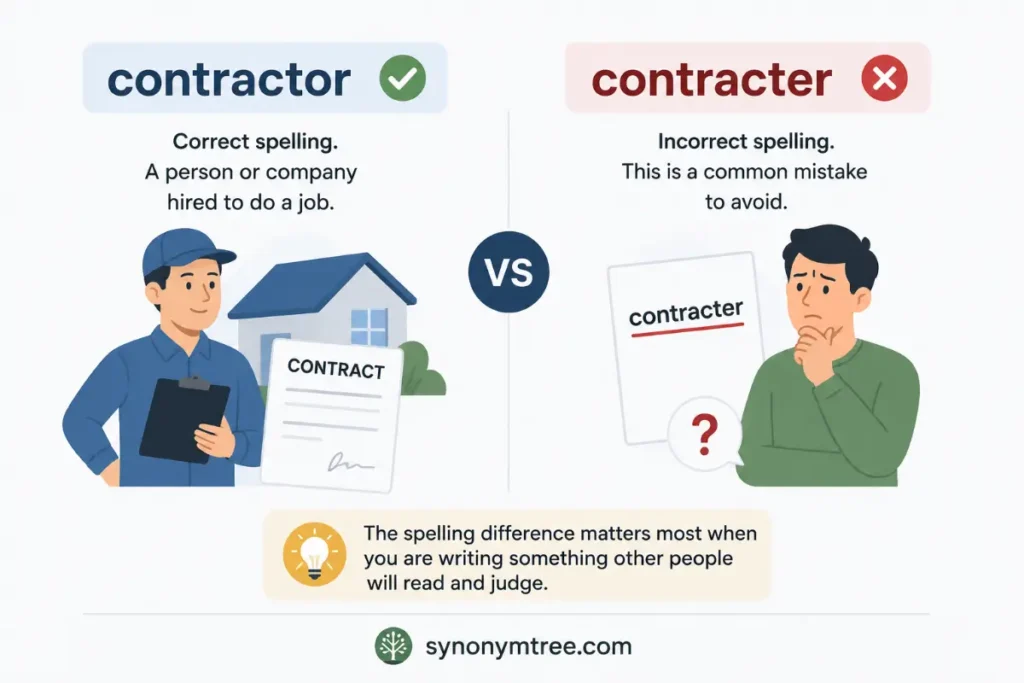
Contractor Vs Contracter In Professional Writing
The spelling difference matters most when you are writing something other people will read and judge. A resume may describe someone as a contractor. A business website may list contractor services. An invoice may name the contractor responsible for a repair. A proposal may explain what the contractor will provide.
Using contracter in any of these places can make the document look less polished. The reader may understand your meaning, but the mistake still stands out because contractor is a common word in business and construction.
Professional writing does not require fancy words. It does require correct words. When a simple spelling check can prevent an error, it is worth taking the extra moment.
The same advice applies to job applications. If you worked as an independent contractor, spell the job title correctly. A resume should make your experience easy to understand. A spelling mistake in a key job term can distract from your skills.
The same goes for online business pages. If you provide contracting services, use contractor in your service descriptions and page titles. Clear spelling helps readers understand your business and gives search engines the correct word to associate with your content.
How To Use Contractor In A Sentence
The easiest way to learn a word is to see it used in real situations. Contractor works naturally in many sentence patterns.
You can use contractor as the subject of a sentence.
The contractor finished the repairs on Friday.
You can use it after a verb.
We hired a contractor for the bathroom project.
You can use it after an adjective.
The local contractor has a strong reputation.
You can also use it in a longer noun phrase.
The general contractor for the project submitted a new schedule.
The independent contractor sent an invoice after completing the work.
The electrical contractor inspected the wiring before the building opened.
Notice that the spelling never changes to contracter. The same form works across these examples.
Plural Form
The plural of contractor is contractors. One contractor visited the property. Three contractors submitted bids. Several contractors are working on the project. The plural ending does not create a new spelling problem. Add s to contractor.
Possessive Form
You may also need the possessive form contractor’s when something belongs to one contractor. The contractor’s estimate was higher than expected. We reviewed the contractor’s insurance documents.
The contractor’s team arrived early. For more than one contractor, use contractors’ when something belongs to multiple contractors. The contractors’ bids were reviewed by the project manager. The contractors’ schedules overlapped.These forms can look complicated at first, but the base word remains contractor.
Common Mistakes With Contractor
The biggest mistake is spelling the word as contracter. That error usually comes from applying a familiar spelling pattern.
Another mistake is dropping the second o and writing contractr or another shortened form. This can happen when someone types quickly or relies on sound.
Some writers also confuse contractor with contract. These words are related but they do different jobs in a sentence.
Contract is often a noun for an agreement.
We signed the contract yesterday.
Contract can also be a verb.
The company agreed to contract a local builder.
Contractor is the person or company that performs work under an agreement.
The contractor started work yesterday.
Knowing the difference makes your writing clearer.
Contractor Versus Contract
Contract and contractor share the same root but have different meanings. A contract is an agreement between people or organizations. It sets out duties, terms, rights, payments, deadlines, or other conditions. A contractor is a person or company that agrees to perform work or provide services. Think of the contract as the agreement and the contractor as the party doing the work. That simple connection can help you keep the words apart. For example, a homeowner may sign a contract with a contractor. The contract describes the work. The contractor performs the work. The two words often appear together in business and construction writing, but they are not interchangeable.
Contractor Versus Subcontractor
A subcontractor is a contractor hired by another contractor to handle part of a larger job. Imagine that a general contractor is responsible for building a new house. The general contractor may hire a plumbing company to install the pipes. That plumbing company can act as a subcontractor. The main contractor manages the larger project. The subcontractor handles a specific part.
This relationship can vary from project to project. A company can be a contractor on one job and a subcontractor on another. The spelling stays simple in both words. Contractor is the base word. Subcontractor adds sub before it.
Contractor Versus Consultant
Contractor and consultant can overlap in business settings, but they are not exact synonyms. A contractor is usually hired to perform defined work or provide a service. A consultant is usually hired to provide advice, knowledge, analysis, or recommendations. For example, a business may hire a contractor to build a website. It may hire a consultant to advise the company about its online strategy.
The roles can overlap. A consultant may also carry out some work. A contractor may also give advice as part of a project. The actual duties depend on the agreement.
If you need a word for someone hired to complete a particular service, contractor may be the better choice. If the main role involves expert advice, consultant may fit better.
Independent Contractor
Independent contractor is a common phrase in American business and work discussions.
An independent contractor generally operates independently rather than as a traditional employee. They may serve several clients and manage parts of their own business operations.
Freelancers can sometimes work as independent contractors. So can tradespeople, consultants, designers, programmers, writers, and other service providers.
However, not every freelancer is automatically classified as an independent contractor under every law. Worker classification depends on the actual facts and the rules that apply.
In ordinary writing, the phrase can describe a person who provides services independently under an agreement. For example, the company hired an independent contractor to create the new logo. The independent contractor billed the client after the project was completed.
Government Contractor
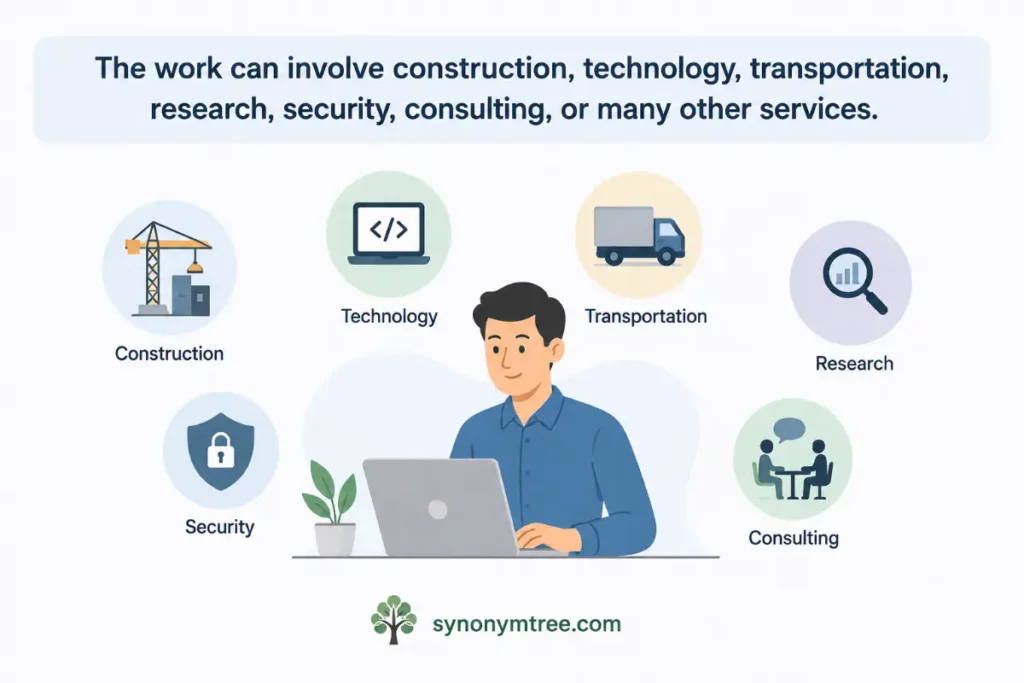
Government contractor is another common phrase. A government contractor is a person or company that provides goods or services to a government agency under an agreement. The work can involve construction, technology, transportation, research, security, consulting, or many other services. Large companies can work as government contractors. Small businesses can also receive government contracts. The term appears often in news reports, business documents, job descriptions, and public records. Again, the spelling is contractor. The same word works in construction, business, and government contexts.
Why Spelling Matters In Professional Writing
A single spelling mistake rarely ruins a message. Still, spelling matters when the word appears in a resume, proposal, invoice, contract, website, or business email.
Professional readers often scan documents quickly. A misspelled job title or service description can distract them from the main point. Several spelling mistakes can also affect how careful your work appears.
This does not mean every error needs panic. It simply means that common business terms deserve a quick check before you publish or send them.
Contractor is especially worth remembering because the incorrect form looks believable. A spell checker may catch it in many cases, but you should not rely on software for every correction. A dictionary check takes only a moment. Once you remember the correct form, you probably will not need to look it up again.
A Simple Memory Trick
Use this memory trick: contract plus or gives contractor.
Start with contract.
Then add or.
Contract plus or equals contractor.
The extra o is the part people often forget. Think of the o as staying with the word contract before the ending is added.
Another useful trick is to connect contractor with actor. Both use or at the end. You do not need to force a perfect grammar rule from this comparison. Just use it as a reminder that contractor is an established or ending word.
You can also connect the word with familiar phrases.
General contractor.
Independent contractor.
Government contractor.
Construction contractor.
Once you recognize these common phrases, the correct spelling becomes easier to remember.
How Dictionaries Treat Contracter
Standard English dictionaries list contractor as the established noun for this meaning. Contracter is generally treated as a misspelling rather than as a standard alternative spelling.
That distinction matters. You may find contracter in online text, but seeing a word on the internet does not make it standard English. If a spelling appears in a formal document, dictionary, textbook, or professional publication, it carries more weight than an isolated online use. For everyday writing, use contractor.
What About Contracted Work
The phrase contracted work can sometimes cause another layer of confusion.
Contracted is the past participle of contract when contract means to arrange for services or work. It can describe work that a person or company has agreed to perform.
For example, the company completed the contracted work on time.
Here, contracted describes the work. Contractor names the person or company doing the work.
You can also say that a company contracted a builder to complete a project. In that sentence, contracted is a verb.
These related forms can look similar because they come from the same root. Their grammatical roles differ.
Contract is the agreement or action.
Contracted describes work or refers to an action completed under an agreement.
Contractor names the person or company that performs the contracted service.
Understanding that family of words can help you use each one correctly.
Examples From Everyday English
Here are natural examples that show how contractor fits into different situations.
The contractor called this morning to confirm the appointment.
We need a contractor who can repair the damaged floor.
The contractor sent us a detailed estimate.
Our general contractor handled the permits.
The building owner hired a local contractor for the repairs.
The contractor brought two workers to the site.
The company uses an independent contractor for graphic design.
The government awarded the project to a major contractor.
The contractor completed the job ahead of schedule.
We are still looking for a reliable contractor.
The plural form works just as naturally.
Several contractors visited the property.
Three contractors submitted proposals.
The city inspected work completed by local contractors.
These examples also show why context matters. Contractor is not limited to construction. The word can describe many kinds of service providers.
How To Choose The Right Word
When you are unsure about the spelling, first ask what you mean.
If you mean a person or company hired to do work under an agreement, use contractor.
If you mean the agreement itself, use contract.
If you mean a person hired by another contractor to complete part of a project, use subcontractor.
If you mean someone whose main role is to give expert advice, consultant may be more accurate.
If you mean a worker who operates independently, independent contractor may fit. Still, legal classification requires more than simply choosing that label.
This quick meaning check can prevent both spelling and word choice errors.
Common Search Variations
People search for this spelling question in many forms. You might see searches such as contractor or contracter, contracter or contractor, correct spelling of contractor, how to spell contractor, contractor spelling, and is contracter a word. They all point to the same basic issue. The standard spelling is contractor.
If you are writing an email, resume, invoice, job listing, business page, or report, use that form. If you see contracter in someone else’s writing, you can usually understand what they meant, but the spelling should be corrected in polished standard English.
Is Contracter Ever Correct
In standard English, contracter is not the spelling you should use for the person or company that performs contracted work. You may still encounter the form in user generated content, informal writing, old material, or text created by someone who made a spelling mistake. Its presence in a document does not make it a standard alternative. For normal American English, choose contractor.
Why English Has Contractor Instead Of Contracter
English vocabulary has developed from many sources over hundreds of years. Word formation does not always follow one neat rule.
The suffix or appears in many words connected with actions or roles. Actor is a familiar example. Creator, operator, editor, and administrator also show how English uses different endings to form nouns.
The suffix er is also very common. Worker, teacher, driver, and builder all use it.
Because both endings are common, speakers cannot always predict the correct noun just by looking at the verb or root. Established usage decides the standard form.
That is why contracter can feel logical while still being incorrect.
Language often works this way. A form can look as if it should be right but still fail to match the standard word used by fluent speakers and dictionaries.
The best approach is not to invent a spelling from a pattern when a standard form already exists.
A useful way to think about it is this: English has patterns, but it also has history. You need both to spell every word correctly.
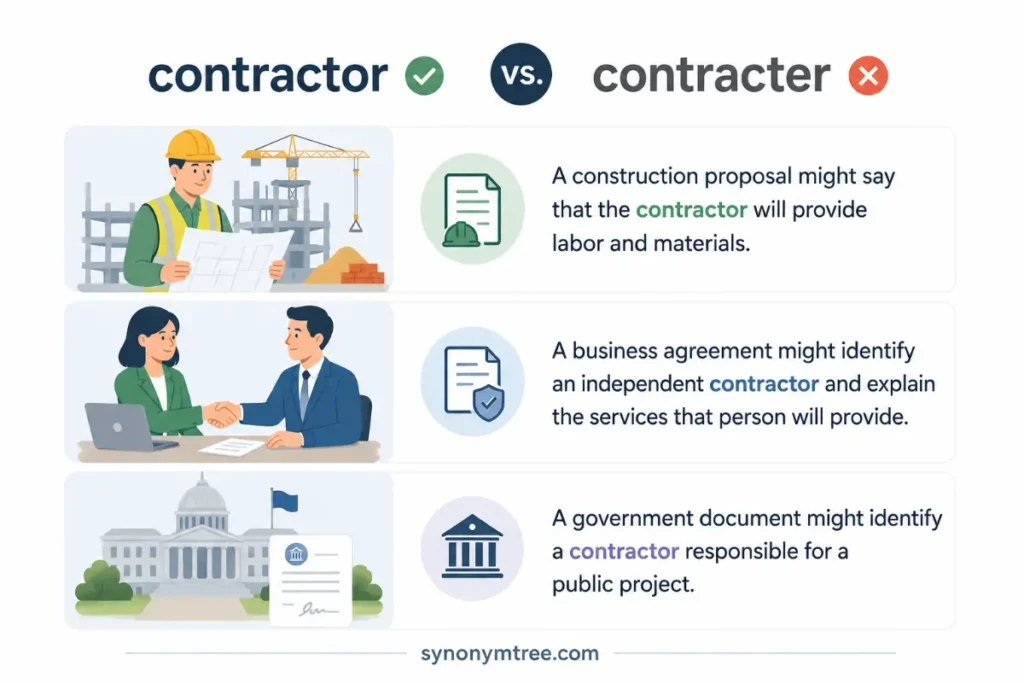
Professional Examples
The word contractor appears in many types of professional writing.
A construction proposal might say that the contractor will provide labor and materials.
A business agreement might identify an independent contractor and explain the services that person will provide.
A government document might identify a contractor responsible for a public project.
A resume might describe experience working as a contractor.
A website might advertise services offered by a local contractor.
An email might say that the contractor needs access to the property before work begins.
In all of these cases, contractor is the correct spelling.
If you are writing a formal document, consistency matters too. Do not switch between contractor and contracter. Pick the standard spelling and use it throughout the document.
Editing Tips For This Word
If you often write about construction, business, or freelance work, add contractor to your personal spelling check list.
When editing, search the document for contracter. If the word appears, replace it with contractor.
Then check related forms such as contractors, contractor’s, and contractors’. Make sure the apostrophe placement matches your meaning.
You can also search for contract and contractor separately. This helps you catch cases where the wrong word appears even though the spelling itself looks correct.
For example, if a sentence says the contract arrived at the job site, the spelling is fine but the meaning may be wrong. The contract is the agreement. The contractor is the party doing the work.
A quick read aloud can also help. If a sentence sounds strange, check the noun you used. Good editing is not only about spelling. It is also about choosing the word that fits the meaning.
Conclusion
If you came here searching contractor vs contracter, the answer is simple. Contractor is the correct spelling. Contracter is a common mistake that comes from applying the familiar er ending to a word that uses or.
Remember the word as contract plus or. That small spelling trick can save you from an easy error in emails, resumes, invoices, proposals, and other professional writing.
Also keep the meaning clear. A contract is an agreement. A contractor is the person or company that performs work or provides services under an agreement. A subcontractor handles part of a larger job for another contractor.
The next time you need the word, write contractor. Keep the o after the contract root. That is the standard form you can use with confidence.
FAQs
Is contractor the correct spelling?
Yes. Contractor is the correct standard spelling for a person or company hired to perform work or provide services under an agreement. Contracter is a common misspelling.
Why do people spell contractor as contracter?
People often make this mistake because English has many job words that end in er. Words such as worker and builder can make contracter look natural. The standard form is contractor.
Is contracter a real word?
Contracter can appear in written material, but it is not the standard spelling for this meaning in American English. Treat it as a spelling error in normal professional and academic writing.
How do you spell contractor?
The standard spelling is contractor. Remember contract plus or to help keep the second o in the word.
What is a contractor?
A contractor is a person or company hired to perform a specific service or complete agreed work. Contractors can work in construction, technology, consulting, design, government services, and many other fields.
What is the difference between a contractor and an employee?
A contractor usually provides services under a separate business or service arrangement, while an employee works under an employment relationship. The exact legal difference depends on the facts and applicable law.
What is a subcontractor?
A subcontractor is a person or company hired by another contractor to complete part of a larger project. For example, a general contractor may hire a plumbing company as a subcontractor.
Can contractor refer to a company?
Yes. Contractor can refer to an individual or a company. A construction company can act as the contractor on a building project.
Is contractor only used for construction?
No. Construction is a common use, but contractors also work in technology, marketing, design, consulting, government services, and many other areas.
What is the plural of contractor?
The plural is contractors. For example, several contractors submitted bids for the project.
