
If you have searched for cryer vs crier you probably want a simple answer. The correct spelling depends on the meaning you have in mind. In modern standard English the word for a person who cries is usually crier. The spelling cryer exists too but it is much less common and can appear in older writing or in specific names and uses.
This small spelling difference can cause a surprising amount of confusion. Both forms look logical because the verb is cry. When we add a person ending we might expect the spelling to stay close to the original word. English does not always work that neatly.
The good news is that you usually do not need to think too hard about this one. If you mean a person who cries or someone who cries out loudly then crier is the normal choice. This article explains why the spelling changes how the word is formed and when you might still see cryer in real writing.
Quick Definition
A crier is a person who cries out or cries. It can describe someone who weeps or someone who calls out loudly to announce something. Cryer is a less common spelling that appears in some dictionaries and older or specialized uses.
Direct Answer
The standard modern spelling is crier when you mean a person who cries or cries out. Cryer is possible but uncommon and is not the usual spelling for everyday English.
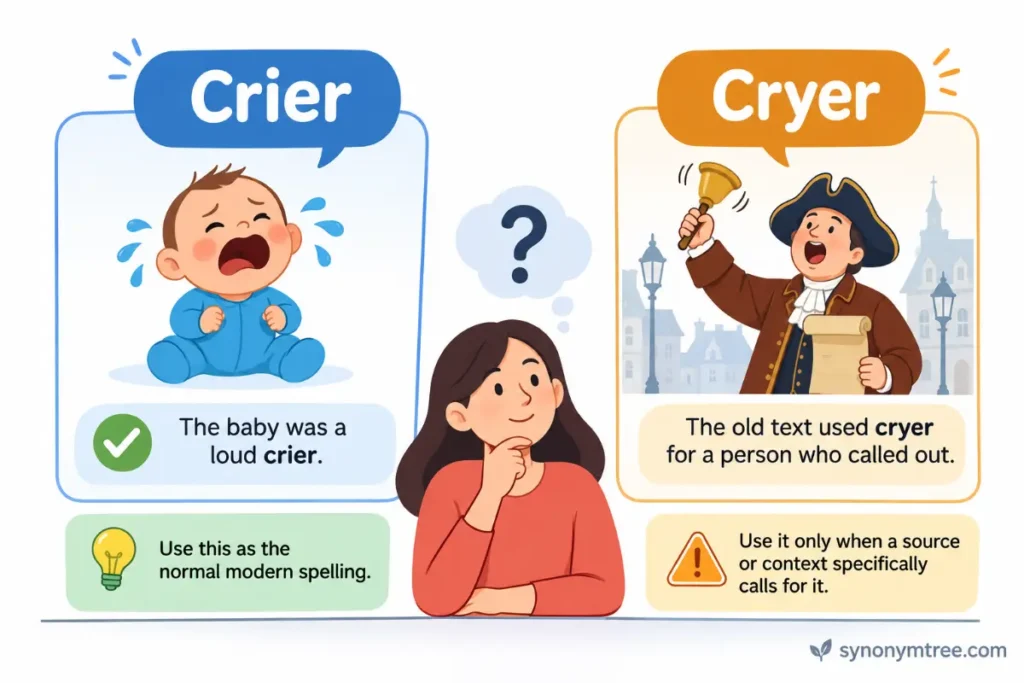
Comparison Table for Cryer vs Crier
| Word | Meaning | Example Sentence | When to Use It |
|---|---|---|---|
| Crier | A person who cries or cries out | The baby was a loud crier. | Use this as the normal modern spelling. |
| Cryer | A less common spelling of the same basic word | The old text used cryer for a person who called out. | Use it only when a source or context specifically calls for it. |
Where The Confusion Comes From
The confusion starts with the verb cry. Most people know that a person who runs is a runner and a person who sings is a singer. That makes it natural to wonder why the person form of cry is not simply cryer. English spelling often changes slightly when we add an ending. The goal is not always to keep every letter exactly as it appears in the base word. Some spelling patterns developed over many centuries. Others help show how a word sounds.
The spelling crier follows a familiar English pattern. The final y in cry changes to i before the ending is added. You can see the same pattern in several other words.
For example, try looks like this when we add an ending that starts with a vowel. Try becomes tried. Try becomes tries. Cry becomes cried. Cry becomes cries. Cry can also become crier.
That change from y to i may look strange at first. Once you see it in other words it becomes easier to remember.
There is another reason the spelling feels confusing. English does allow many words ending in er to be formed directly from verbs. We have player from play and buyer from buy. So cryer looks perfectly reasonable.
In fact it is reasonable enough that you can find it in real English. That does not make it the best choice for normal modern writing. Frequency and accepted usage matter too.
Think of crier as the everyday form. Think of cryer as a less common form that you may encounter in older texts or special contexts.
Why Crier Is The Usual Modern Spelling
The word crier has been used in English for a long time. It has more than one related meaning.
The most familiar meaning describes someone who cries. A parent might say that a newborn is a frequent crier. A teacher might describe a child as a quiet crier who rarely makes a sound when upset.
The word can also describe someone who cries out or makes a public announcement. This older meaning is closely linked to the word crier in historical settings.
For example a town crier was a person who publicly announced news. Before modern newspapers and instant communication people often depended on public announcements. A town crier could walk through a town and call out important information.
The word crier therefore has a wider history than the simple idea of someone shedding tears.
Modern readers are most likely to meet crier in one of three ways. They may see it used for a person who cries. They may see it in the phrase town crier. Or they may see it in a discussion about babies and children who cry often.
In all of these common cases crier is the spelling you should choose.
How The Verb Cry Changes When You Add An Ending
Understanding the spelling rule makes this word much easier. The base verb is cry. When an ending begins with a vowel the y often changes to i. This pattern appears in several common forms.
Cry becomes cries. Cry becomes cried. Cry becomes crying.
Notice something interesting in the last example. The spelling does not always change in the same way. Before ing the y stays in place.
That means you cannot apply one simple rule to every ending. English spelling depends on the ending being added.
The form crier follows the same general pattern seen in other words that change y to i before certain endings.
Compare cry with dry. Dry becomes drier. Dry becomes driest.
Compare cry with fry. Fry becomes fried. Fry becomes fries.
Compare cry with try. Try becomes tried. Try becomes tries.
These forms show why crier feels more natural once you understand the pattern.
The spelling cryer keeps the original y. That spelling is not completely impossible. It simply does not match the spelling pattern most readers expect in standard modern usage.
The Difference Between Cryer And Crier
The biggest point to remember is that these two forms are not normally treated as two completely different everyday words. In most contexts crier is the preferred spelling for a person who cries or cries out.
Cryer may appear as an alternative spelling. It can also appear in older writing. You may find it in historical documents or in a family name. A proper name can follow its own spelling history and should not be changed just because another form is more common.
For ordinary writing you should not switch between the two spellings randomly. If you are writing an email about a crying baby use crier. If you are writing about a person who cries easily use crier. If you are describing a town crier use crier. If you are copying the exact spelling of an old document and it uses cryer then keep cryer.
This simple approach will cover almost every situation most writers face.
Crier As A Person Who Cries
The most direct use of crier refers to a person who cries. For example you could write that a baby is a frequent crier. You could say that a child was a loud crier after getting hurt. You could also describe an adult as an emotional crier.
The word can sound a little less natural in some situations than simply saying person who cries. That depends on the sentence.
For example:
The baby is a frequent crier.
This sentence is natural enough. It often appears when parents or caregivers describe a baby who cries often.
You could also say:
The baby cries a lot.
That sentence sounds more casual and direct.
Both are correct. The choice depends on the style of your writing.
In everyday conversation people often prefer the verb form. Instead of saying someone is a crier they may simply say that the person cries easily.
Still crier has a useful place in English because it gives you a short noun for a person who cries.
Crier As A Person Who Calls Out
Crier has another important meaning. It can describe a person who calls out loudly.
This meaning is especially common in historical phrases.
The best known example is town crier.
A town crier traditionally announced news in public places. The person might ring a bell and then call out the announcement so people nearby could hear it.
The word crier makes sense here because the person was literally crying out the news. In older English the verb cry could mean much more than shedding tears.
That older sense still survives in several expressions. Someone can cry out in pain. Someone can cry for help. Someone can cry a warning. Someone can cry out a command.
In these cases cry means to call or shout loudly. The word crier can therefore describe someone who performs that action.
This is one reason the word has stayed useful over time.
The Historical Meaning Of Crier
The history of crier helps explain why the word can seem to have two different meanings. Today many people connect cry with tears. In older English the verb had a broader sense connected to calling out or shouting.
A person who publicly announced something could be called a crier. This person might announce news in a town or marketplace.
The role of the town crier became especially useful before people had modern forms of mass communication. Public announcements needed a human voice. A crier could make sure that people gathered in a public place heard important information.
This historical meaning still appears in books about medieval towns and early communities.
It also appears in modern events that recreate older traditions. Some towns and organizations still use town criers for ceremonies and public events.
So when you see crier in town crier it does not mean a person who spends the day crying tears. It refers to someone who cries out an announcement.
That distinction is useful because it prevents a common misunderstanding.
Is Cryer Ever Correct
Yes. You can find cryer as a word and as a spelling used in real sources. The issue is not that the form is completely impossible. The issue is that it is not the normal modern spelling most writers should choose.
English contains many alternate spellings that survive even though one form is much more common.
A dictionary may list an uncommon form without suggesting that it is the best choice for everyday writing. Historical documents can also preserve spellings that are no longer common.
Names create another special case.
Suppose a family name is spelled Cryer. You should use that spelling when referring to the person or family. Proper names belong to the people who use them. You should not change a surname to crier just because crier is more common as a word.
You may also see cryer in older books or quoted material. In that situation the spelling may reflect the language or spelling habits of the source.
For modern original writing the safe choice is simple. Use crier.
Common Mistakes With These Spellings About Cryer vs Crier
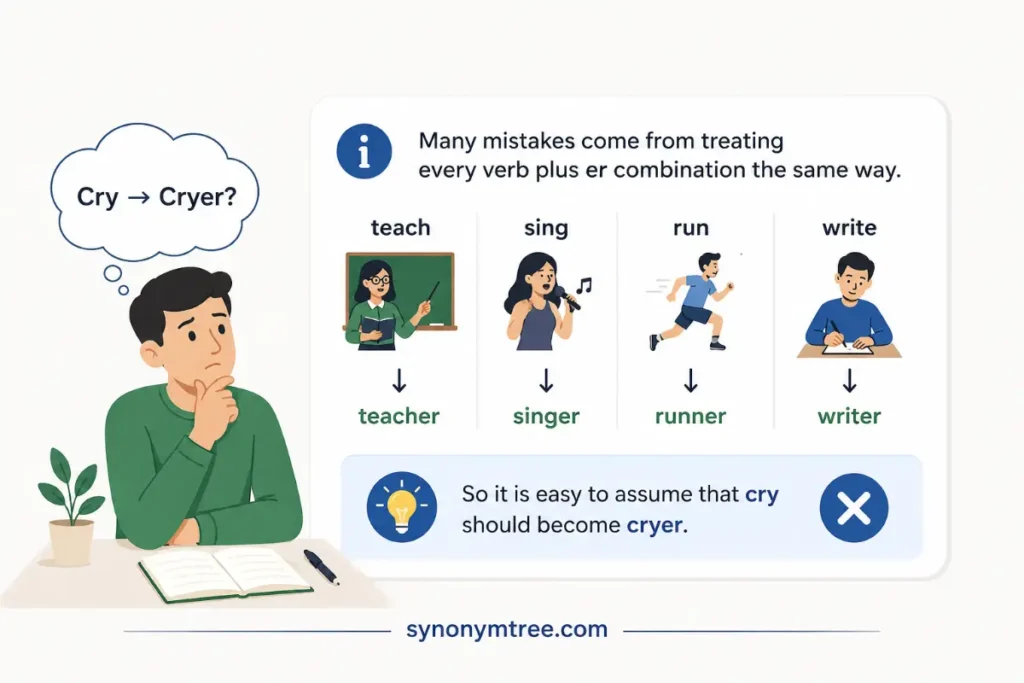
Many mistakes come from treating every verb plus er combination the same way.
English has many nouns formed by adding er. Teach becomes teacher. Sing becomes singer. Run becomes runner. Write becomes writer.
So it is easy to assume that cry should become cryer.
The problem is that spelling rules can change the base word when an ending is added. Cry follows the y to i pattern in forms such as cries and cried. Crier follows that pattern too.
Another common mistake is assuming that cryer and crier must have different meanings.
In normal use they do not give you two separate meanings that you need to memorize. Crier is the standard form for the common meaning.
A third mistake is thinking that cryer must be wrong because crier is more common. That goes too far. Cryer can appear as an alternative spelling and as a surname.
The better rule is not simply never use cryer.
The better rule is use crier in normal modern writing unless you have a specific reason to preserve or use cryer.
Crier In Everyday Sentences
Seeing the word in real sentences is one of the fastest ways to understand it. Here are natural examples that show the most common uses.
- The baby was a loud crier during the first few weeks.
- My little brother was a frequent crier when he was tired.
- She is an emotional crier and tears up during sad movies.
- The town crier announced the news in the main square.
- The crier called for everyone to gather outside.
- He became a crier for help when he realized he was lost.
- The book describes a town crier who delivered news to the villagers.
- The newborn is a quiet crier compared with her older sister.
- He was never much of a crier even during difficult moments.
- The historical festival included a costumed town crier.
These examples show why context matters. The same word can describe someone who sheds tears or someone who calls out.
Crier And Crybaby Are Not The Same
Another useful distinction involves the word crybaby. A crier is simply someone who cries. The word does not automatically criticize the person.
Crybaby is different. It usually describes someone who cries easily in a way the speaker sees as annoying or childish.
For example:
The baby is a frequent crier.
This is a fairly neutral description.
The child is being a crybaby.
This sounds critical.
That difference matters in everyday English. If you are writing about a child or adult in a respectful way crier is usually safer than crybaby.
You can also say someone cries easily. That expression is clear and neutral.
The choice between these words is not only about spelling. It also changes the tone of your sentence.
Crier And Weeper
The word weeper is another related noun. A weeper is a person who weeps or cries. It can also describe something that makes people cry such as a sad movie or story.
For example:
That film is a real weeper.
This means the film is very sad and likely to make people cry.
Crier is more direct when you mean a person who cries.
Weeper can sound more literary or expressive. It also has uses that crier does not.
In ordinary conversation you might simply say that someone cries easily. In more formal writing you may choose crier if you need a noun.
Crier And Crying Person
Sometimes the clearest answer is not another noun.
Instead of writing:
She is a frequent crier.
You could write:
She cries often.
Instead of:
He is an emotional crier.
You could write:
He cries easily.
This is worth remembering because good writing is not only about finding the correct word. It is also about choosing the clearest sentence.
If crier feels stiff in your sentence then use the verb cry.
For example:
The child cries whenever he gets frustrated.
That sounds very natural.
The child is a frequent crier whenever he gets frustrated.
That sounds more formal and slightly less direct.
Both can work. The second version simply has a different rhythm.
How To Remember The Correct Spelling in Cryer vs Crier
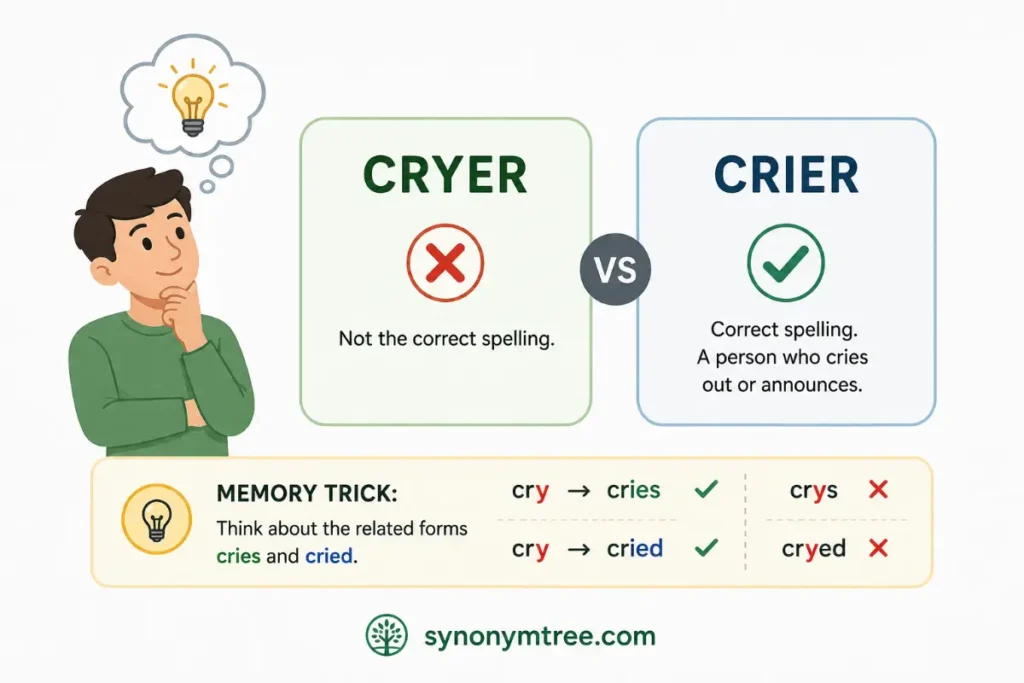
A simple memory trick can help. Think about the related forms cries and cried.
You do not write crys. You do not write cryed. You change the y to i.
Crier follows the same pattern.
Cry becomes crier.
This does not mean every form of cry changes y to i. Crying keeps the y. The trick only helps with the forms that use the relevant spelling pattern.
You can also remember the phrase town crier. It is one of the most familiar expressions containing the word. Once you connect crier with town crier the spelling becomes easier to recall.
Another useful memory cue is to think of crier as the common dictionary style form for a person.
When you are unsure ask yourself a simple question.
Am I writing normal modern English about a person who cries or cries out.
If the answer is yes then crier is almost certainly the form you want.
Why English Has So Many Spelling Patterns
The confusion around crier is part of a larger English spelling issue.
English has borrowed words from many languages. Its spelling has also changed over hundreds of years. As a result some words follow neat patterns while others seem to break the rules.
You can learn useful patterns but you will still find exceptions.
That does not mean spelling rules are useless. They give you a strong starting point.
The y to i change is one of those useful patterns.
Study a few related examples and the spelling becomes much easier to predict.
For example:
Happy becomes happier.
Easy becomes easier.
Busy becomes busier.
Dry becomes drier.
Try becomes tries.
Cry becomes cries.
Crier fits naturally beside these examples.
The pattern is especially useful for learners because it connects spelling with other familiar words.
When To Use Crier In Formal Writing
Crier works well in formal writing when you need a noun for someone who cries or calls out.
For example a report about infant behavior might use the term crier.
A historical article might discuss a town crier.
A literary analysis might describe a character as a crier.
Still you should not force the noun into every sentence.
Good formal writing values clarity. If a simple verb gives the reader a faster answer then use it.
Compare these sentences.
The child is a frequent crier.
The child cries frequently.
The second sentence is often cleaner.
Now compare these:
The town crier entered the square.
The person who announced the news entered the square.
The first sentence is much better because town crier is an established term.
The best word depends on the job the sentence needs to do.
When Cryer May Appear
You may come across cryer in several situations.
The first is historical writing. Older sources sometimes use spelling patterns that differ from modern standards.
The second is a surname. Cryer can be a family name. Names should retain their established spelling.
The third is an alternate spelling in some dictionaries or references. A less common spelling can survive even when another form dominates modern usage.
The fourth is copied material. If you are reproducing the exact wording of an old document you may need to preserve the original spelling.
These cases do not change the main advice for everyday writing.
If you are writing a new sentence and you mean a person who cries then choose crier.
Related Word Forms You Should Know
Understanding related forms makes the whole word family easier.
Cry is the main verb. It can mean to shed tears or to call out loudly.
Cries is the third person singular form. For example, the baby cries every night.
Cried is the past tense. For example, she cried after hearing the news.
Crying is the present participle. For example, the child is crying.
Crier is a noun for a person who cries or cries out.
Crybaby is an informal and often negative term for someone who cries easily.
Weeper can describe a person who weeps or something that makes people cry.
These words are related but they do not all carry the same tone.
That is why simply finding a synonym is not enough. You also need to think about the feeling and meaning of the sentence.
Crier In American English
In American English crier is easy to understand and widely recognized.
You may hear it when people talk about babies. Parents often describe babies as good sleepers or frequent criers. The word can also appear in discussions about personality.
For example someone might say that they are a crier when they watch emotional movies.
That does not necessarily mean they cry all the time. It simply means they tend to cry in emotional situations.
The historical phrase town crier is also familiar to American readers because it appears in history books and stories.
Cryer is much less likely to be the spelling a modern American writer chooses for a common noun.
That makes crier the practical choice for US English.
Crier In British English
British English also uses crier. The historical phrase town crier remains familiar there and has a strong connection with traditional public announcements.
You may find cryer in older British texts or specific historical material. As with American English the spelling does not normally replace crier in standard modern writing.
So the main spelling advice works across both major varieties of English.
You can write crier confidently in American English. You can also expect to see crier in British English.
The main difference may come from historical sources and names rather than from a basic modern spelling rule.
How Dictionaries Treat The Two Forms
Dictionaries are useful when a spelling question feels unclear. They help show how a word is used and how common different forms are.
A dictionary entry can sometimes include an alternative spelling without making it the preferred form. This is why seeing cryer listed somewhere does not automatically mean you should use it.
Usage matters.
When one spelling appears far more often in current standard writing it is usually the better choice for general readers.
For this word that practical choice is crier.
If you are writing for school work, business writing, a website, or general readers, crier will normally be the clearest option.
If your assignment asks you to discuss historical spelling then the less common form may be worth mentioning.
Common Search Questions About The Spelling
People often search for this word pair because they have encountered both forms.
The first question is usually simple. Is crier the correct spelling.
Yes. It is the standard modern spelling for a person who cries or cries out.
Another common question asks why the word is not spelled cryer.
The answer comes from English spelling patterns. The y changes to i in crier just as it changes in forms such as cried and cries.
Some people also wonder if cryer has a completely different meaning.
Usually it does not. It is a less common spelling and can appear in older sources or as a surname.
Another question involves the phrase town crier. This phrase uses crier because it refers to someone who cries out a public announcement.
These questions all point back to the same practical rule. Use crier in ordinary modern writing.
A Simple Editing Test
If you are editing your own work and find cryer ask what the word is doing.
If it describes a person who cries then change it to crier in most modern writing.
If it appears as part of a person’s name then keep the established spelling.
If it comes from a historical source then check the source and preserve the spelling when accuracy requires it.
If it appears in a quotation then do not silently change it.
This test takes only a few seconds.
It also keeps you from making the opposite mistake of changing every instance of cryer to crier without checking the context.
Good editing is not just about replacing words. It is about understanding why the word appears there.
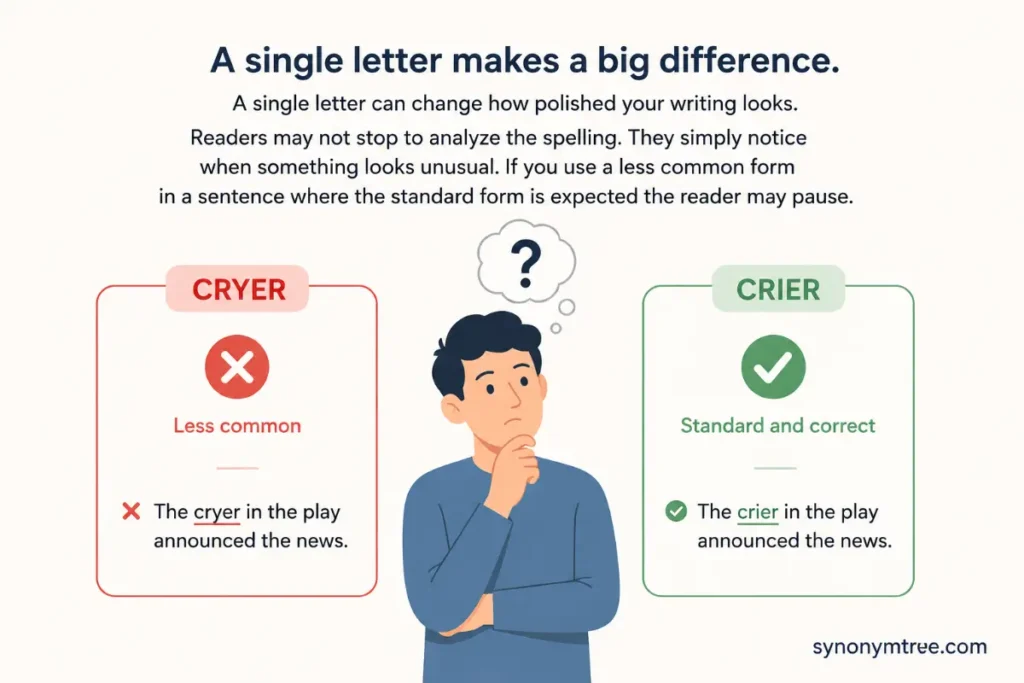
Why The Small Difference Matters in Cryer vs Crier
A single letter can change how polished your writing looks.
Readers may not stop to analyze the spelling. They simply notice when something looks unusual. If you use a less common form in a sentence where the standard form is expected the reader may pause.
That pause can weaken the flow of your writing.
This matters most in school writing professional writing and online content. You want the reader to focus on your message rather than wonder if a spelling choice is intentional.
Using the standard form removes that distraction.
That is one reason crier is the better default.
It is familiar. It is clear. It fits normal modern English.
Conclusion
The answer to cryer vs crier is simple for most modern writing. Choose crier when you mean a person who cries or cries out. It is the standard form and the one most readers will expect. Cryer is not simply nonsense. You may find it in older material or as a surname. That is why it can look familiar even though it is not the usual spelling for everyday English.
The spelling also makes more sense when you connect it with other forms of cry. Cry becomes cries and cried. Crier follows the same general spelling pattern. Once you notice that pattern the word becomes much easier to remember.
So when you are writing a sentence and stop to wonder which form to use, go with crier for standard modern English. Save cryer for a specific name, historical source, or context that calls for it. That small choice will keep your writing clear and natural.
FAQs
Is Crier The Correct Spelling?
Yes. Crier is the standard modern spelling for a person who cries or cries out. It is also the spelling used in the familiar phrase town crier.
Is Cryer A Real Word?
Yes. Cryer appears as an alternative spelling and can also occur as a surname. It is much less common than crier in ordinary modern English.
Why Is Crier Spelled With An I?
The spelling follows a common English pattern in which a final y changes to i before certain endings. You can see a similar change in words such as cried and cries.
Is Cryer Or Crier Better?
Crier is the better choice for normal modern writing. Use cryer only when the context specifically calls for that spelling such as a proper name or historical source.
Is A Town Cryer Correct?
The standard phrase is town crier. It refers to a person who traditionally announced news or public information by calling it out to people.
Does Crier Mean Someone Who Cries A Lot?
It can. Crier can describe someone who cries often or easily. The exact meaning depends on the sentence and context.
Can Cryer Be A Last Name?
Yes. Cryer can be a surname. A person’s name should keep its established spelling even if another spelling is more common as an ordinary English word.
What Is The Difference Between A Crier And A Crybaby?
Crier is generally a neutral word for someone who cries. Crybaby is usually informal and can sound insulting because it suggests that someone cries too easily or behaves childishly.
