
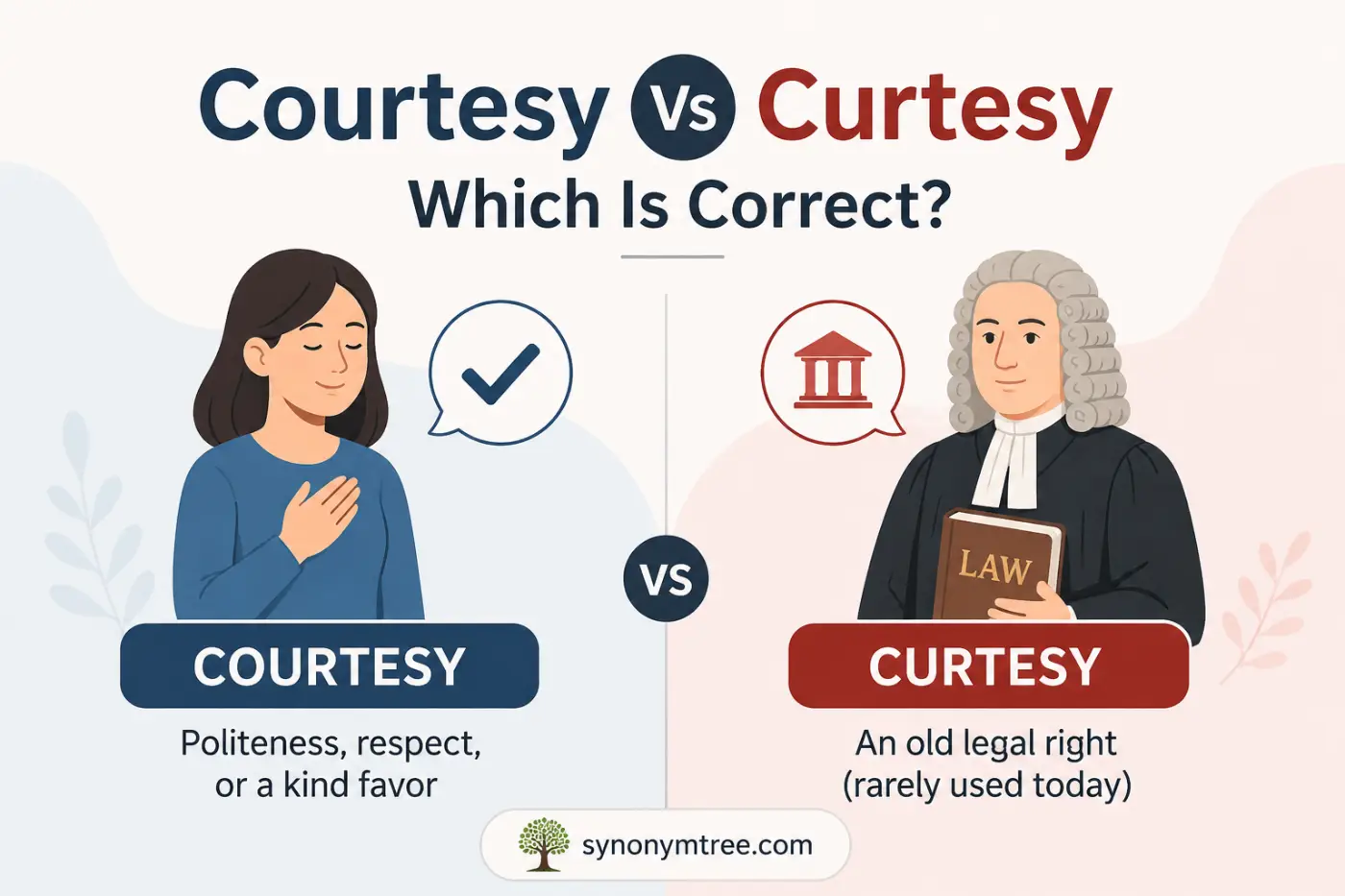
If you are searching courtesy vs curtesy you probably want to know which spelling belongs in your sentence. The answer is simple. Courtesy is the standard modern spelling for polite behavior or a respectful act. Curtesy is a rare historical spelling that you may still find in older texts or special legal contexts.
Most writers should use courtesy. You will see it in phrases such as common courtesy, professional courtesy, courtesy of, and as a courtesy. It can describe good manners, a kind action, or something given as a favor.
Curtesy can cause confusion because it looks like a possible spelling of the same word. In modern American English, however, it is not the normal choice for everyday writing. It has a different history and can carry a special meaning in older English or legal writing.
This guide explains the difference in plain English. You will learn what each word means, where the spellings came from, how people use courtesy today, when curtesy may appear, and how to avoid the mistake in your own writing.
Quick Definition
Courtesy means polite behavior, respect, or a kind action done for someone. Curtesy is an uncommon historical form and can also refer to a traditional legal right once associated with a husband and his deceased wife.
Direct Answer
Courtesy is the correct spelling for the common modern meaning of politeness or a kind gesture. Curtesy is rare and is mainly found in historical or specialized legal contexts.
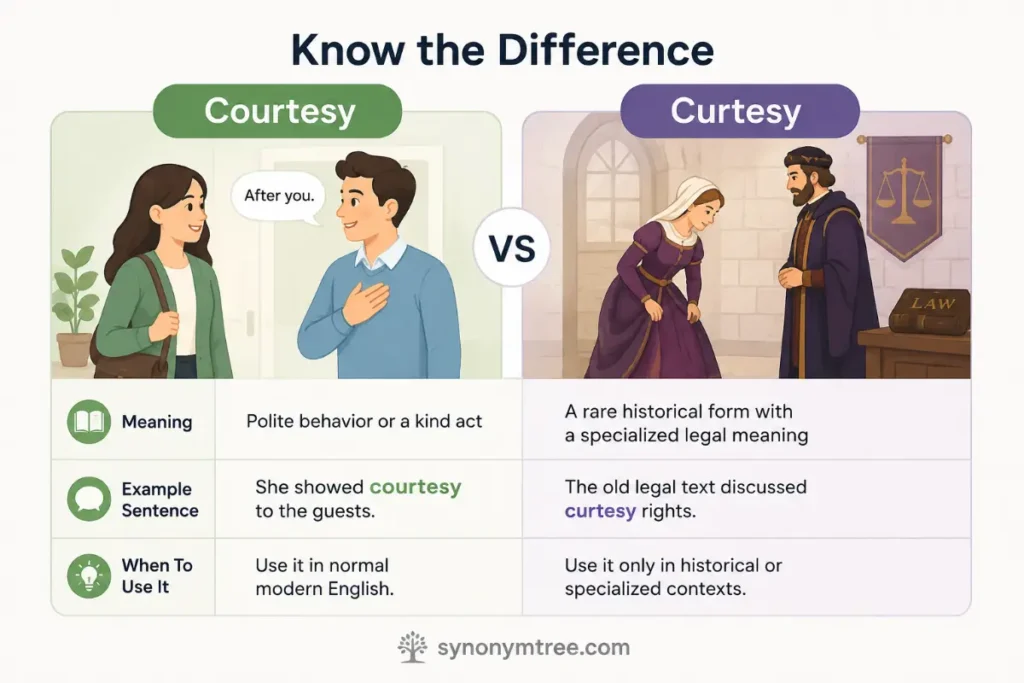
Comparison Table With Courtesy Vs Curtesy
| Word | Meaning | Example Sentence | When To Use It |
|---|---|---|---|
| Courtesy | Polite behavior or a kind act | She showed courtesy to the guests. | Use it in normal modern English. |
| Curtesy | A rare historical form with a specialized legal meaning | The old legal text discussed curtesy rights. | Use it only in historical or specialized contexts. |
Why Courtesy Is The Standard Spelling
Courtesy is the word you will use in almost all modern writing. It describes behavior that shows respect and good manners. It can also describe a favor or service provided as a kindness.
For example: Please show courtesy to the other passengers. He treated everyone with courtesy. The hotel offered a courtesy shuttle. She called as a courtesy before arriving. These sentences use the standard modern spelling.
Courtesy can describe something small but thoughtful. Holding a door open, letting someone go first, answering a message politely, or giving someone advance notice can all be acts of courtesy. The word does not always describe a formal act. Sometimes it simply means treating people with basic respect.
What Courtesy Means
Courtesy has several closely related meanings. The first is polite behavior. If you speak kindly to someone and show respect, you are showing courtesy.
For example: The receptionist treated every guest with courtesy. The driver showed courtesy by letting the pedestrian cross.
The second meaning is a kind act or favor.
For example: The company gave us a courtesy call. The restaurant provided a courtesy ride to the hotel.
The third meaning appears in phrases such as courtesy of. This phrase often identifies the person or organization that provided something.
For example: The photos are courtesy of the local library. The event was covered courtesy of a community sponsor.
The meaning depends on context, but the central idea remains kindness, respect, or a favor.
What Curtesy Means
Curtesy is much less common. In older English, curtesy appeared as a variant spelling related to courtesy. Historical texts may use different spellings because English spelling was not always as fixed as it is today.
Curtesy also developed a specialized legal meaning. In traditional English law, the term referred to a husbands right to certain property connected with his deceased wife. The rules around this right were complex and varied by time and place.
You are unlikely to need this word in ordinary American English. If you are writing about good manners, use courtesy. If you are writing about a historical legal rule and the source uses the term curtesy, the specialized spelling may be appropriate.
That distinction prevents most confusion.
The Difference In Modern English
The easiest way to remember courtesy vs curtesy is to focus on modern usage. Courtesy is common. Curtesy is rare.
If you mean politeness, good manners, respect, or a kind favor, choose courtesy.
For example: Thank you for your courtesy. That sentence is natural modern English.
You would not normally write: Thank you for your curtesy.
The second form looks unusual because it does not fit standard modern usage. A good editor would normally change it to courtesy.
Where The Confusion Comes From
The confusion comes from pronunciation, spelling history, and the fact that both forms have appeared in English.
English has many words whose spellings changed over time. Before modern dictionaries and publishing standards became widespread, writers often spelled words in different ways.
Courtesy has roots connected with ideas of courtly behavior and polite conduct. The word passed through French and Middle English forms before developing into the spelling commonly used today.
Curtesy survived in some historical forms and developed its own specialized legal use. Because the two spellings look so close, modern readers may assume they are simply alternate spellings. In most everyday situations, that assumption will lead to an error.
The History Of Courtesy
Courtesy has a long history connected with polite behavior.
The word is related to court and courtly life. In medieval Europe, behavior associated with a royal or noble court became linked with ideas such as good manners, respect, grace, and proper conduct.
Over time, the meaning became broader. Courtesy was no longer limited to people at a royal court. It came to describe polite behavior in everyday life.
That shift explains why we now use courtesy in ordinary situations. A person can show courtesy at work, at school, on public transportation, in a store, or at home.
The word has moved far beyond its historical setting.
The History Of Curtesy
Curtesy has a different story. The spelling appeared in older English usage. It is also connected with the legal term tenancy by the curtesy, a traditional property right in English law.
Historically, the term described a husbands right to certain interests in property after his wife died. The right generally depended on specific conditions, including the birth of a qualifying child in some legal traditions.
Modern property law has changed greatly. The old doctrine has little practical role in ordinary modern writing.
You may still encounter the term in legal history books, old court records, historical property discussions, and legal dictionaries.
That is why curtesy has not disappeared completely. It simply belongs to a much narrower area of language.
Courtesy In Everyday Life
Courtesy is everywhere in everyday communication. When you thank someone, apologize for an inconvenience, wait your turn, or speak respectfully, you are showing courtesy.
For example: She showed courtesy by lowering her voice. Thank you for your courtesy. He offered his seat as a courtesy. The staff treated us with courtesy. The driver waited as a courtesy to the passengers.
These examples show how broad the word can be. Courtesy does not require a grand gesture. Small actions can show courtesy too.
Common Phrases With Courtesy
Several common expressions can help you recognize the correct spelling.
Common Courtesy
Common courtesy means basic polite behavior that people generally expect from one another.
For example: Please use common courtesy when speaking with your coworkers. Most people understand that common courtesy includes saying thank you and respecting personal space.
The phrase is common in American English.
As A Courtesy
As a courtesy means something is done as a polite gesture or favor.
For example: We called ahead as a courtesy. The hotel gave us a free ride as a courtesy. She sent a reminder as a courtesy.
The action may not be required. It is offered to be helpful or respectful.
Courtesy Call
A courtesy call is a call made as a polite gesture.
For example: The manager made a courtesy call after the service was completed. The nurse made a courtesy call to check on the patient.
The phrase can also refer to a brief call intended to maintain good communication.
Courtesy Of
Courtesy of can mean provided by or supplied by someone.
For example: The photographs are courtesy of the museum. The information was provided courtesy of the research team.
The phrase can also have a more casual meaning when someone provides something as a favor.
For example: Dinner tonight is courtesy of my brother. That means my brother provided dinner. The spelling remains courtesy.
Courtesy In Professional Writing
Courtesy matters in professional communication because polite writing helps maintain trust.
Consider a work email that says: Please send the report today. That sentence is direct.
Now consider: Could you please send the report today as a courtesy to the team. The second sentence adds a polite element, although the best wording depends on the situation.
Professional courtesy can include replying to messages, giving reasonable notice, thanking people for their time, and communicating changes clearly.
The word often appears in business settings because people use it to describe respectful conduct.
For example: As a professional courtesy, we notified the client before changing the schedule. That is a natural modern use of courtesy.
Courtesy In Customer Service
Customer service often uses the word courtesy to describe small services or polite actions. You might hear phrases such as courtesy call, courtesy vehicle, courtesy shuttle, or courtesy reminder.
For example: The dealership provided a courtesy vehicle. The hotel offers a courtesy shuttle. The company sent a courtesy reminder before the appointment.
The business may provide the service for free or simply as a helpful gesture. The exact details depend on the company.
Courtesy And Respect
Courtesy and respect are closely related, but they are not identical.
Respect is a broader idea. It involves recognizing the value, rights, or feelings of another person.
Courtesy is often the behavior that shows that respect.
For example, listening while someone speaks can be an act of courtesy. It can also show respect.
You can think of respect as an attitude and courtesy as one way that attitude appears in your behavior.
This distinction is useful when choosing words.
Courtesy And Politeness
Courtesy and politeness are also close synonyms. Politeness usually describes good manners and appropriate social behavior.
Courtesy can mean the same thing, but it can also describe a specific favor or service.
For example: She answered politely. She showed courtesy by answering the question.
The first sentence describes how she answered. The second emphasizes the respectful action.
Both words are useful, but they are not always perfect substitutes.
Courtesy And Kindness
Courtesy is related to kindness but has a narrower focus. Kindness means treating someone in a caring or helpful way.
Courtesy often involves social manners and respect.
For example: Giving a friend a thoughtful gift can be an act of kindness. Holding a door open for a stranger can be an act of courtesy.
The same action can sometimes be both. The words overlap, but courtesy often focuses more on proper social behavior.
Courtesy And Etiquette
Etiquette means accepted rules or customs for polite behavior. Courtesy describes the actual behavior.
For example, an etiquette guide might explain that guests should arrive on time. Arriving on time can then be an act of courtesy toward the host.
Etiquette gives people guidance. Courtesy appears in how people treat one another.
This difference can help you understand why courtesy appears in many social and professional situations.
Examples Of Courtesy In Sentences
The following sentences show natural modern uses.
- She showed courtesy to everyone at the meeting.
- Please use common courtesy when sharing the space.
- He called as a courtesy before coming over.
- The hotel provides a courtesy shuttle.
- Thank you for your courtesy.
- The company offered a courtesy replacement.
- As a courtesy, we notified the customer about the delay.
- His calm response showed great courtesy.
- The staff treated the visitors with courtesy.
- She thanked him for the small courtesy.
Each sentence uses courtesy in a normal modern way.
Examples of “Courtesy” vs. “Curtesy” That Need Correction
Some writers use “curtesy” when they mean “courtesy.”
Consider this sentence:
Please show curtesy to your guests.
The intended meaning is polite or respectful behavior. The correct spelling is courtesy.
Please show courtesy to your guests.
Another example:
Thank you for your curtesy.
Correct:
Thank you for your courtesy.
One more example:
The hotel offers a curtesy shuttle.
The standard modern spelling is:
The hotel offers a courtesy shuttle.
The pattern is simple: if the word means politeness, respectful behavior, or a considerate favor, use courtesy, not curtesy.
When Curtesy May Be Correct
Curtesy can be correct in a historical or specialized legal context.
Suppose you are writing about traditional English property law. You may need to discuss the doctrine of tenancy by the curtesy.
In that context, changing the spelling to courtesy could remove an important legal distinction.
For example: The legal historian examined the husbands right of curtesy.
This is not ordinary modern vocabulary. It refers to a specific historical legal concept.
The word can also appear in old documents where spelling conventions differed from modern standards.
So it would be wrong to say that curtesy is never a word. It is a real word with a very limited modern role.
The Legal Meaning Of Curtesy
The traditional legal meaning deserves a little more explanation.
Under old English common law, a husband could receive a particular interest in property that had belonged to his wife after her death. This interest was known as a tenancy by the curtesy.
The rules were not simple. They depended on factors such as the type of property, marriage, inheritance, and the existence of children who met certain legal requirements.
Different jurisdictions later changed or abolished these rules.
Today, the term mainly appears in historical legal writing.
If you encounter curtesy in an old property law discussion, do not assume it is simply a misspelling of courtesy. Context matters.
Curtesy In Historical Texts
Historical texts often preserve words and spellings that modern readers rarely use.
You might find curtesy in old legal documents, historical books, genealogical records, or discussions of property law.
The spelling may also appear in dictionaries that document older forms.
When reading an old document, avoid automatically correcting every unfamiliar spelling. The writer may be using a form that was valid in that period.
Modern editing has a different goal. If you are writing a current article for American readers, use the standard modern spelling unless the historical term itself is the subject.
Is Curtesy A Misspelling
Not always.
If someone writes curtesy when they mean politeness, it is normally a spelling mistake in modern American English.
However, curtesy is also a genuine historical and legal term.
That means context decides the issue.
Compare these examples: Please show courtesy to your guests. This uses the standard word for polite behavior.
The book explains the historical doctrine of curtesy. This uses the specialized legal term.
The spellings are similar, but the meanings are different.
A Simple Memory Trick
There is an easy way to remember the common spelling.
Think of courtesy as a word connected with courtly manners. The word contains the letters our after the c.
Courtesy.
If you mean polite behavior, kindness, or a respectful gesture, choose courtesy.
You can also use a simple replacement test.
If you can replace the word with politeness, courtesy is almost certainly correct.
For example: Thank you for your courtesy. Thank you for your politeness. The meaning stays close.
Now try the same test with a historical legal sentence. The replacement does not work.
That tells you that the sentence may involve the specialized word curtesy.
How To Choose The Right Word
When you are unsure, ask what you mean.
If you are discussing an old legal property right, curtesy may be the correct specialized term.
If you are writing normal emails, essays, websites, reports, or social posts, courtesy will almost always be the word you need.
This simple rule handles most situations.
Courtesy In School Writing
Students often use courtesy when writing about manners or social behavior.
For example: Courtesy is important in the classroom. Students should show courtesy to their teachers and classmates. Good manners and courtesy can make group work easier.
These are clear and natural sentences.
Curtesy would not normally belong in this type of writing unless the assignment specifically discusses historical language or property law.
Courtesy In Formal Writing
Courtesy works well in formal writing.
For example: We appreciate your courtesy and cooperation. As a courtesy, the office notified all visitors about the change. The organization thanked the community for its courtesy.
The word sounds natural in both formal and informal writing.
You do not need a complicated synonym. Simple words often communicate the idea more clearly.
Courtesy In Emails
You may use courtesy in an email when describing a polite action.
For example: As a courtesy, I wanted to let you know that the meeting time has changed. Thank you for your courtesy. I am sending this reminder as a courtesy.
These sentences are polite without sounding overly formal.
In many emails, you may not need the word at all. Sometimes simply writing please, thank you, or I wanted to let you know is enough.
Good writing does not require you to use courtesy every time you want to sound polite.
Courtesy In Business
Businesses use courtesy to describe actions that help customers or partners.
For example: The company provided a courtesy replacement. We sent a courtesy reminder before the appointment. The hotel offered a courtesy shuttle. The manager made a courtesy call.
These phrases are common because businesses often provide small services as gestures of goodwill.
Again, the correct modern spelling is courtesy.
Courtesy In Public Life
Courtesy also plays a role in public spaces.
People show courtesy when they wait their turn, keep noise at a reasonable level, follow shared rules, and respect other people’s space.
For example: Basic courtesy makes public transportation easier for everyone. Please show courtesy to other visitors. The signs ask guests to use courtesy when using the facility.
The word works because the focus is on respectful behavior.
Common Mistakes People Make With “Courtesy” vs. “Curtesy”
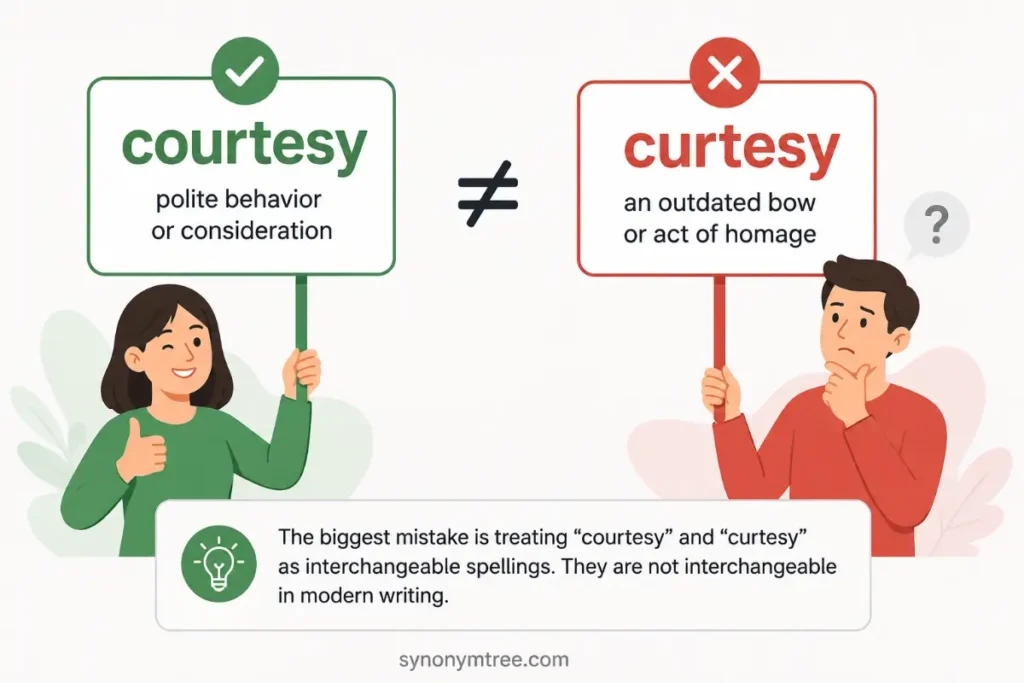
The biggest mistake is treating “courtesy” and “curtesy” as interchangeable spellings. They are not interchangeable in modern writing.
Another mistake is assuming that “curtesy” must be correct because it looks like a shorter spelling. English does not always work that way.
A spelling that looks logical may still be incorrect for the meaning you want to convey.
A third mistake is correcting the historical legal term without checking the context. If a legal history text uses “curtesy,” the writer may be referring to a specific legal doctrine.
Good editing requires more than simply checking spelling. You also need to understand the meaning and context of the word.
Mistake With Courtesy Of
Writers sometimes use courtesy of incorrectly.
Courtesy of can mean provided by someone.
For example: The image is courtesy of the museum. This tells the reader that the museum provided the image or gave permission for its use.
In modern informal writing, courtesy of can also have a playful or casual tone.
For example: Dinner tonight is courtesy of my brother. That means my brother provided dinner.
The spelling remains courtesy.
Mistake With Common Courtesy
Common courtesy refers to basic good manners.
For example: Common courtesy means listening when someone else is speaking. Please use common courtesy in shared spaces.
A common mistake is writing common curtesy. That spelling does not fit the normal modern meaning.
The correct phrase is common courtesy.
Mistake With Courtesy Call
Courtesy call is another phrase that should use courtesy.
For example: The manager made a courtesy call after the visit. The doctor received a courtesy call from the office. The company made a courtesy call to confirm the appointment.
If you are writing customer service material, this is a useful phrase to know.
Related Words You Should Know
Learning related words can make the distinction easier.
Courteous
Courteous is the adjective form. It means polite and respectful.
For example: The staff was courteous and helpful. He gave a courteous reply. She remained courteous during the discussion.
Courteously
Courteously is the adverb form. It describes an action done in a polite way.
For example: She responded courteously. He courteously thanked the visitors.
Courtesy
Courtesy is the noun.
For example: Thank you for your courtesy.
The three forms connect clearly. Courteous describes a person or behavior. Courteously describes how an action happens. Courtesy names the quality or act itself.
Courtesy And Courteous
Do not confuse courtesy with courteous.
Courtesy is a noun. Courteous is an adjective.
You can say: She showed courtesy. You can also say: She was courteous.
Both sentences describe polite behavior, but they use different grammatical forms.
This distinction is useful when editing.
If you need to name the quality or action, use courtesy. If you need to describe someone, use courteous.
Courtesy And Curtsy
There is another word that sometimes causes confusion.
Curtsy is completely different from courtesy.
A curtsy is a traditional gesture in which a person bends the knees slightly as a sign of respect or greeting.
For example: The performer gave a curtsy after the show.
Curtsy is related to a physical gesture. Courtesy means politeness or a kind act.
The words look somewhat similar, but their meanings are different.
Courtesy And Court
Courtesy is historically connected with ideas associated with courtly behavior.
Court can refer to a royal court, a legal court, or a place where certain sports are played.
The connection between court and courtesy comes from the older idea of behavior expected in a royal or noble setting.
Over time, courtesy became a general word for polite behavior.
Understanding this history makes the spelling feel less random.
Why English Has Similar Spellings
English has borrowed words from many languages over centuries.
Words often changed spelling as people used them in different regions and periods.
Courtesy is one example of a word whose history stretches back through older forms of English and French.
Curtesy also appears in historical English and legal language.
The two forms are therefore not simply a random spelling mistake invented by modern writers.
Their shared history helps explain why they look alike.
Modern English has standardized the common word as courtesy.
How Dictionaries Treat The Words
Modern dictionaries generally distinguish the common word courtesy from the historical or legal word curtesy.
Courtesy is listed as a normal noun used for polite behavior, respect, and a kind act.
Curtesy is treated as a much less common term with historical or legal meaning.
This is a useful reminder that a dictionary entry does not mean every word has equal value in everyday writing.
Some words are common. Some are rare.
Knowing the difference helps you choose natural language.
When To Use Courtesy
Use courtesy when you mean:
- Polite behavior.
- Good manners.
- Respectful treatment.
- A kind gesture.
- A favor.
- A service provided as a kindness.
- A polite phone call or reminder.
- Something supplied by another person or organization.
Examples include courtesy call, common courtesy, professional courtesy, and courtesy of.
These are all normal modern uses.
When To Use Curtesy
Use curtesy only when the context calls for the historical or legal term.
You may encounter it in:
- Historical property law.
- Old legal documents.
- Legal history books.
- Historical dictionaries.
- Discussions of traditional English inheritance rules.
- Reproductions of older texts.
If none of these situations applies, courtesy is probably the word you want.
A Quick Editing Test
Try replacing the word with politeness.
If the sentence still makes sense, courtesy is likely correct.
For example: She treated the visitors with courtesy. She treated the visitors with politeness. The meaning is close.
Now try: The historian discussed the husbands right of curtesy. Replacing curtesy with politeness would make no sense.
That tells you the word has a specialized meaning.
This test is especially useful when proofreading.
A Second Editing Test
Look at the phrase around the word.
Words such as common, professional, personal, good, and show often appear with courtesy.
Words connected with property, inheritance, husbands, wives, estates, and old legal rules may point toward curtesy.
Context gives you a strong clue.
Still, if you are writing ordinary modern English, courtesy is the safe choice.
How Pronunciation Adds To The Confusion
The two words can sound similar enough to cause mistakes.
That is especially true when someone hears the word before seeing it written.
This happens often with English homophones and near homophones.
A listener may know the meaning but not know the spelling.
When that happens, think about the meaning first.
If you mean manners, think courtesy.
If you are reading about an old legal property right, check for curtesy.
The meaning should guide the spelling.
Examples From Real Writing Situations
Imagine you are writing a customer service email. You want to say that you called someone to be polite.
Write: I am calling as a courtesy to confirm your appointment.
Now imagine you are writing about local government. You are discussing a city council member.
That is a completely different word problem.
The important point is that courtesy belongs to normal discussions of polite conduct.
Curtesy belongs to a narrow historical and legal area.
Once you understand that difference, the spelling becomes much easier.
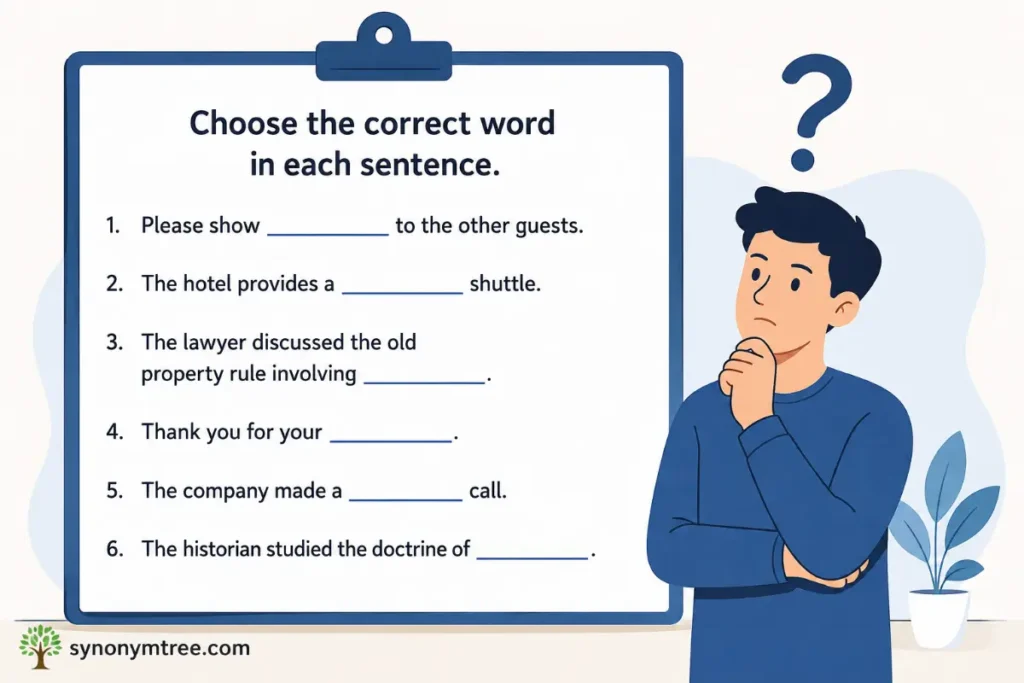
A Short Practice Exercise: “Courtesy” vs. “Curtesy”
Choose the correct word in each sentence.
- Please show ______ to the other guests.
- The hotel provides a ______ shuttle.
- The lawyer discussed the old property rule involving ______.
- Thank you for your ______.
- The company made a ______ call.
- The historian studied the doctrine of ______.
The answers are:
- Courtesy.
- Courtesy.
- Curtesy.
- Courtesy.
- Courtesy.
- Curtesy.
The first, second, fourth, and fifth examples involve normal modern politeness or a service.
The third and sixth examples involve historical legal language.
How Writers Can Avoid The Error
The best way to avoid the error is to remember one main rule.
Courtesy is the everyday word. Curtesy is the specialized historical word.
Do not choose curtesy simply because you think it looks like another spelling of courtesy.
Instead, identify the meaning first.
If you are writing about manners, respect, kindness, or a favor, use courtesy.
If you are discussing a historical legal doctrine, check the source and use the specialized term when appropriate.
That approach keeps your writing accurate and natural.
Conclusion
The difference in courtesy vs curtesy is mostly a matter of meaning and context. Courtesy is the standard modern word for politeness, respect, good manners, and kind gestures. It is the form you should use in everyday American English.
Curtesy is much less common. It survives mainly in historical and legal language, especially discussions of traditional property rights. It can also appear in older texts where spelling practices differed from modern standards. When you mean good manners, kindness, or a polite favor, choose courtesy. Common courtesy, professional courtesy, courtesy call, and courtesy of all use this spelling.
The quickest rule is simple. If you are talking about politeness, write courtesy. If you are reading about an old legal property rule, stop and check the context because curtesy may be the specialized term you need.
Frequently Asked Questions
Is courtesy or curtesy correct?
For normal modern English, courtesy is correct. It means polite behavior, respect, or a kind gesture. Curtesy is a rare historical and legal term.
What is the difference between courtesy vs curtesy?
The common word courtesy refers to politeness, good manners, or a favor. Curtesy is mainly used in historical legal contexts and can refer to an old property right associated with a husband.
Is curtesy a real word?
Yes. Curtesy is a real word, but it is uncommon. It can appear in historical texts and discussions of traditional property law.
Should I use courtesy in everyday writing?
Yes. Use courtesy when you mean politeness, respect, good manners, or a kind act. It is the standard spelling for these meanings in American English.
What does courtesy mean?
Courtesy means polite and respectful behavior. It can also mean a favor or service given as a kind gesture.
What does curtesy mean in law?
Curtesy is a historical legal term connected with a husbands traditional property interest in certain property belonging to his deceased wife. The doctrine developed under older property law and has little role in ordinary modern writing.
Is courtesy of correct English?
Yes. Courtesy of is a standard phrase that can mean provided by or supplied by someone. For example, a photograph may be described as being courtesy of a museum.
What does common courtesy mean?
Common courtesy means basic polite behavior that people generally expect from one another. Saying thank you, respecting personal space, and waiting your turn can all be examples of common courtesy.
What is a courtesy call?
A courtesy call is a phone call made as a polite gesture. Businesses often use courtesy calls to confirm appointments or provide updates.
Is courtesy a noun?
Yes. Courtesy is a noun. It names polite behavior, respect, or a kind action.
What is the adjective form of courtesy?
The adjective form is courteous. For example, you can say that someone gave a courteous response.
Is curtesy the same as courtesy?
No. The two words have related historical roots, but they have different modern uses. Courtesy is the normal word for politeness, while curtesy has a rare historical and legal meaning.
Is courtesy used in American English?
Yes. Courtesy is very common in American English. It appears in everyday phrases such as common courtesy, professional courtesy, courtesy call, and courtesy of.
Why do people spell courtesy as curtesy?
The mistake often happens because the words sound similar and because curtesy has existed as a historical spelling. Modern writers may also assume that the shorter spelling is acceptable. For the normal meaning of politeness, the correct modern spelling is courtesy.
Can curtesy be used in modern writing?
It can appear in modern writing when the writer is discussing its historical or legal meaning. It should not normally replace courtesy when the subject is good manners or a kind gesture.
