
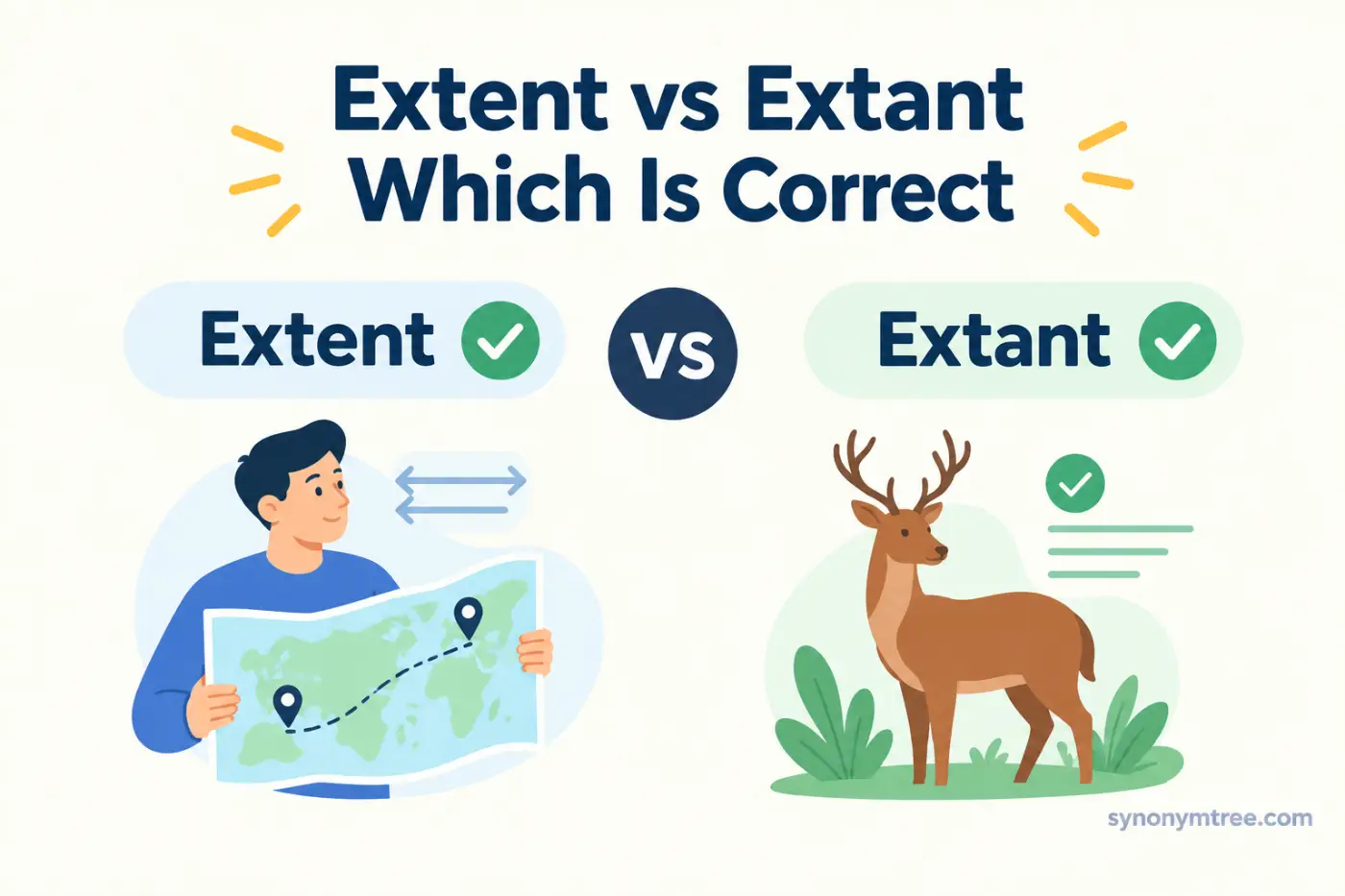
If you are confused by extent vs extant, the difference comes down to meaning. Extent refers to the size, range, degree, or scope of something. Extant means something still exists, especially when it has survived from the past.
These words look and sound similar, but they are not interchangeable. You might ask about the extent of a problem when you want to know how large or serious it is. You might describe an ancient document as extant when it has survived and still exists today.
The confusion often comes from their spelling and pronunciation. Both words begin with ext and have similar sounds. Yet they belong to different word families and perform different jobs in a sentence.
This guide explains the difference between the two words in plain English. You will learn their meanings, grammar, origins, common sentence patterns, mistakes to avoid, memory tricks, and many real examples.
Quick Definition
Extent is a noun that means the size, range, degree, or scope of something. Extant is an adjective that means still existing or still surviving, especially from an earlier time. The words may look similar, but their meanings are completely different.
Direct Answer
Use extent when you mean the size, degree, range, or scope of something. Use extant when you mean something still exists or has survived from the past.
Comparison Table
| Word | Meaning | Example Sentence | When to Use It |
|---|---|---|---|
| Extent | Size, range, degree, or scope | We do not know the full extent of the damage. | Use it to discuss how large, serious, or wide something is. |
| Extant | Still existing or surviving | The library contains several extant copies of the book. | Use it for things that still exist, especially from the past. |
Why Extent And Extant Get Confused
The main reason these words cause trouble is their appearance. Extent and extant share several letters and have similar sounds. When someone is writing quickly, it is easy to choose the wrong spelling.
Their meanings do not overlap, though. Extent deals with size, degree, range, or scope. Extant deals with existence and survival.
Consider these sentences.
We need to understand the extent of the damage.
Several ancient buildings are still extant.
The first sentence asks how much damage occurred. The second sentence says that certain buildings still exist.
The words also tend to appear in formal writing. You may see extent in reports, research papers, news stories, business writing, and everyday conversations. Extant is less common and often appears in history, archaeology, literature, law, art, religion, and academic writing.
That difference in frequency can make extant seem unfamiliar. Many people know the word extent well but have seen extant only in specialized reading.
The easiest way to separate them is to focus on the core idea. If you can replace the word with size, degree, range, or scope, use extent. If you can replace it with still existing, surviving, or remaining, use extant.
What Extent Means
Extent is a noun. It refers to how large, wide, serious, or complete something is.
You might talk about the extent of damage after a storm. You could discuss the extent of a person’s influence. You might measure the extent of a forest or the extent of a problem.
For example, consider this sentence.
The engineers inspected the building to determine the extent of the damage.
Here, extent refers to how much damage the building suffered.
Another example is:
The report examines the extent of poverty in the region.
The writer wants to discuss the size or degree of the problem.
The word can refer to physical size, but it does not have to. It can also describe an abstract degree or range.
You can discuss the extent of someone’s knowledge, the extent of a person’s influence, the extent of a disagreement, or the extent of a change.
Extent Means Degree
One of the most common meanings of extent is degree.
For example:
I did not realize the extent of her concern.
This sentence does not refer to physical size. It refers to how serious or strong her concern was.
Another example is:
The investigation revealed the full extent of the problem.
Again, the writer means the complete degree or scale of the problem.
This use is common in news reports and formal writing. Phrases such as full extent, great extent, and limited extent are especially common.
You might read:
The storm caused damage to a great extent.
However, this sentence is less natural than many other constructions. More natural choices include:
The storm caused extensive damage.
The full extent of the damage is still unknown.
The report shows the extent of the damage.
The noun extent works best when you are identifying or discussing the size or degree of something.
Extent Means Range
The word can also refer to the range or scope of something.
For example:
The study measured the extent of the forest.
Here, the meaning relates to how far the forest reaches.
Another example is:
We need to understand the extent of the project before setting a budget.
In this sentence, the word refers to the project’s scope. The writer wants to know how large the project is and how much work it will involve.
You can also talk about the extent of someone’s responsibilities.
Her role expanded to a surprising extent.
The manager was unaware of the full extent of his responsibilities.
In each example, the word describes a range, scope, or degree.
Common Phrases With Extent
Learning common phrases can make the word easier to recognize.
One very common phrase is to some extent.
For example:
I agree with you to some extent.
This means I agree with you partly or to a certain degree.
Another common phrase is to a great extent.
For example:
The new policy changed the company to a great extent.
This means the policy caused a large or significant change.
You may also see to a certain extent.
For example:
The criticism is justified to a certain extent.
This means the criticism is justified in some degree but not completely.
The phrase the full extent is also common.
For example:
We do not yet know the full extent of the damage.
This means we do not yet know how much damage occurred.
These expressions can help you remember that extent is connected to degree, range, and size.
What Extant Means
Extant is an adjective. It means still existing, still surviving, or still remaining.
The word is especially useful when talking about something from the past that has survived into the present.
For example:
Only a few extant copies of the manuscript are known.
This means only a few copies of the manuscript still exist.
Another example is:
The museum displays one of the oldest extant examples of the artwork.
The word tells us that the artwork still survives today.
You may see extant used with historical records, manuscripts, buildings, artifacts, texts, traditions, species, laws, and other things that have continued to exist.
Extant Means Still Existing
The easiest definition to remember is still existing.
If something is extant, it exists now.
That does not necessarily mean it is common, useful, active, or popular. It simply means that it has survived and remains in existence.
For example:
Few extant copies of the original document remain.
The important idea is that some copies still exist.
You could rewrite the sentence in simpler English:
Few copies of the original document still exist.
The meaning is almost the same.
This replacement test is one of the best ways to understand the word.
Extant Often Refers To The Past
Although extant can technically describe something that still exists, it is especially common when discussing things that have survived from an earlier period.
For example:
The scholar studied the extant writings of the philosopher.
This means the writings that have survived and remain available.
Another example is:
The castle is one of the few extant medieval structures in the region.
The castle still exists, even though many other structures from that period may have disappeared.
This gives the word a strong connection with history and preservation.
Extant In History And Archaeology
Historians and archaeologists often use extant because many objects from the past have been lost.
Imagine that a writer produced fifty manuscripts hundreds of years ago. Over time, most were destroyed. Five copies survive today.
Those five copies are extant manuscripts.
The word helps distinguish surviving evidence from material that once existed but no longer does.
For example:
Researchers compared the three extant manuscripts.
This means researchers compared the three manuscripts that still survive.
The term is useful because historical research often depends on surviving evidence. A document may have been described in an old record, but if the original document is gone, it is no longer extant.
Extant Buildings
The word can also describe old buildings.
For example:
The village has several extant buildings from the eighteenth century.
The sentence means several buildings from that period still exist.
You might also write:
Only a few extant homes from the original settlement remain.
Here, extant emphasizes survival over time.
The word does not mean the buildings are perfect or unchanged. A building can be repaired, altered, or partly restored and still be extant.
Extant Texts And Manuscripts
Literature is another area where extant appears frequently.
A writer may have produced many works, but only some may have survived. Scholars can describe the surviving works as extant.
For example:
The author is known from several extant poems.
This means several of the author’s poems still exist.
You might also see:
The historian compared all extant versions of the text.
The word tells the reader that these are the versions that have survived.
The Difference Between Extant And Existing
Extant and existing are close in meaning, but they are not always used in the same way.
Existing is the everyday word. It simply means something exists.
For example:
The existing system needs improvement.
That sounds natural in ordinary conversation.
Extant is more formal and often highlights survival from the past.
For example:
The researcher examined the extant records.
This sounds like academic or historical writing.
You could replace extant with existing in many sentences, but the tone may change.
The extant manuscripts.
The existing manuscripts.
The second phrase is easier and more common. The first carries a more formal sense of surviving material.
The Difference Between Extant And Remaining
Remaining can also be close in meaning to extant.
For example:
Only three copies remain.
Only three extant copies are known.
Both sentences communicate that three copies still exist.
The difference is mostly one of style and emphasis. Remaining is common in everyday English. Extant is more formal and often emphasizes survival from an earlier time.
You might say:
Only two houses remain from the original village.
You could also say:
Only two extant houses from the original village survive.
The first is simpler. The second sounds more academic.
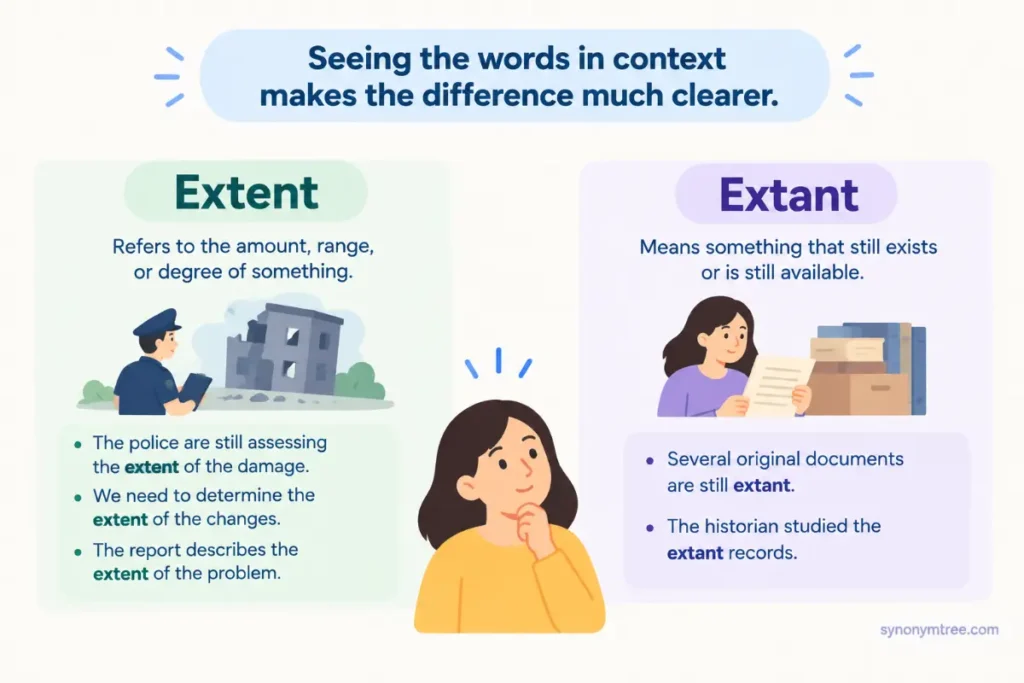
Extent vs Extant In Real Sentences
Seeing the words in context makes the difference much clearer.
The police are still assessing the extent of the damage.
Several original documents are still extant.
We need to determine the extent of the changes.
The historian studied the extant records.
The report describes the extent of the problem.
The library owns several extant copies of the rare book.
The extent of the forest surprised the researchers.
Only a small number of ancient buildings remain extant.
Each sentence gives the word a different job. Extent describes size, degree, range, or scope. Extant describes continued existence.
How To Use Extent Correctly
Because extent is a noun, it often follows words such as the, an, some, or great.
For example:
The extent of the damage was severe.
We need to measure the extent of the problem.
The full extent of the loss is unknown.
To some extent, I agree.
The extent of his influence is difficult to measure.
One of the most useful patterns is the extent of.
This construction lets you describe the size or degree of something.
The extent of the damage.
The extent of the problem.
The extent of the change.
The extent of the influence.
The extent of the research.
The extent of the risk.
If you see of followed by a noun after extent, the word often refers to the degree or scope of that noun.
Extent Of The Damage
This is one of the most common combinations.
The storm damaged hundreds of homes, but officials have not yet determined the full extent of the damage.
Here, extent means the total amount or scale of the damage.
You can use the same pattern for many situations.
The company is still assessing the extent of the financial loss.
Scientists are studying the extent of the environmental impact.
Doctors need more information to understand the extent of the injury.
The phrase works because each sentence asks how large, serious, or widespread something is.
To Some Extent
The phrase to some extent means partly or to a certain degree.
For example:
I agree with the argument to some extent.
This does not mean the speaker agrees completely. The agreement is limited.
Another example is:
The new system improved productivity to some extent.
The improvement happened, but it was not complete or dramatic.
This phrase appears often in conversation and formal writing.
How To Use Extant Correctly
Because extant is an adjective, it describes a noun.
For example:
The extant manuscript is stored in the library.
Here, extant describes the manuscript.
You could also write:
The library contains several extant manuscripts.
The word comes before the noun and tells us that these manuscripts still exist.
You can use it with many types of surviving things.
The extant records are incomplete.
Researchers studied the extant buildings.
The museum protects several extant artifacts.
Only a few extant copies have been found.
The historian examined every extant version of the text.
In each case, extant describes something that remains in existence.
Extant Is Not A Verb
One important grammar point is that extant is not a verb.
You should not write:
The manuscript extanted for centuries.
That is not standard English.
Instead, say:
The manuscript survived for centuries.
The manuscript remained in existence for centuries.
The manuscript is still extant.
The final sentence uses extant correctly as an adjective.
This distinction can prevent awkward or incorrect sentences.
Common Mistakes With These Words
The most common mistake is using extant when you mean extent.
For example:
We need to understand the extant of the damage.
That is incorrect.
The correct sentence is:
We need to understand the extent of the damage.
The writer is talking about the size or degree of the damage, not something that still exists.
Another common mistake is using extent when you mean extant.
For example:
Only three extent copies of the manuscript survive.
That is incorrect.
The correct sentence is:
Only three extant copies of the manuscript survive.
Here, the writer is describing copies that still exist.
Mistake With Extent Of
Some learners use extent without understanding that it normally refers to degree or scope.
For example:
The extent is a problem.
This sentence is unclear because extent usually needs something to describe.
A better sentence would be:
The extent of the problem is difficult to measure.
Now the reader knows what the word refers to.
Mistake With Extant And Extensive
Another word that can cause confusion is extensive.
Extensive means large in size, amount, range, or scope.
Extant means still existing.
For example:
The storm caused extensive damage.
The museum contains several extant buildings.
The first sentence says the damage was large or widespread. The second says the buildings still exist.
These words may look related, but they have different meanings.
Extent And Extensive
The words extent and extensive are related in meaning.
Extent is a noun.
The extent of the damage was difficult to measure.
Extensive is an adjective.
The damage was extensive.
Both sentences discuss the scale of the damage.
The difference is grammatical as well as structural. Extent names the degree or scope. Extensive describes something as large or wide in scope.
You might write:
The investigation revealed the full extent of the damage.
Or:
The investigation revealed extensive damage.
Both are correct, but the sentence structures are different.
This distinction is useful because writers sometimes choose extant when they actually mean extensive.
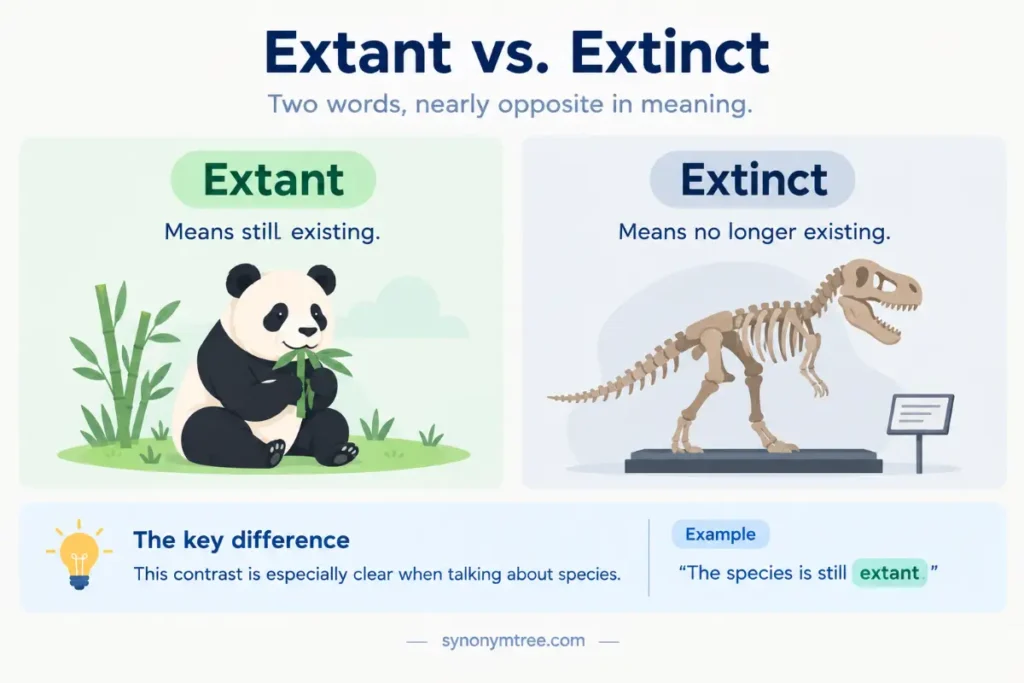
Extant And Extinct
Another useful comparison is extant and extinct.
These words are nearly opposites in some contexts.
Extant means still existing.
Extinct means no longer existing.
This contrast is especially clear when talking about species.
For example:
The species is still extant.
The species became extinct centuries ago.
The first sentence says the species still exists. The second says it no longer exists.
The same basic contrast can apply to traditions, languages, practices, and other things.
An extant language is still spoken or otherwise still exists. An extinct language no longer has living speakers.
Learning this pair can make the meaning of extant easier to remember.
Extent And Degree
One of the strongest synonyms for extent is degree.
Consider this sentence:
We need to understand the extent of the problem.
You could often rewrite it as:
We need to understand the degree of the problem.
The exact wording may change depending on context, but the core idea is similar.
Other useful synonyms include scope, range, size, scale, amount, and magnitude.
For example:
The scope of the project is large.
The extent of the project is large.
The range of the study is broad.
The extent of the study is broad.
These words are not always perfect substitutes, but they show the general meaning.
Extant And Survival
The strongest connection for extant is survival.
If something is extant, it has not disappeared.
Think about a historical object that was made hundreds of years ago. If the object still exists in a museum today, you can describe it as extant.
For example:
The museum has one extant example of the original design.
This means one original example has survived.
That survival idea is the key to understanding the word.
You can also think of extant as a formal way to say still around.
The old building is still around.
The old building is still extant.
The first sentence sounds natural in conversation. The second sounds more formal.
Where You Are Most Likely To See Extant
You are much more likely to see extant in formal or specialized writing than in casual conversation.
Historians may write about extant documents.
Archaeologists may discuss extant structures.
Literary scholars may study extant manuscripts.
Art historians may examine extant paintings.
Researchers may compare extant records.
Scientists may discuss extant species.
Legal writers may refer to extant laws or rules.
The word is useful in all of these fields because it clearly identifies something that still exists.
In ordinary conversation, people usually choose simpler words such as existing, surviving, or remaining.
Word Origins
The two words also have different histories.
Extent comes from Latin roots connected with the idea of stretching out. It entered English through French and developed the meaning of size, range, or degree.
This origin connects naturally with the modern meaning. When you think about something being stretched out over a distance, you can understand how the idea of range or scope developed.
Extant also comes from Latin. It is related to a Latin verb meaning to stand out, stand forth, or exist. The word later developed its English meaning of still existing or surviving.
The two words therefore have separate histories even though their modern spellings look similar.
Knowing their origins is not required to use them correctly. Still, the history can make the distinction easier to remember.
A Simple Memory Trick
The easiest way to remember the difference is to connect each word with a short phrase.
Extent means how much.
Extant means still here.
If you are asking how large, how far, how serious, or how broad something is, think extent.
If you are asking if something from the past still exists, think extant.
You can also connect extent with extend. Both words relate to size, range, or how far something reaches.
For example:
The road extends for ten miles.
The extent of the road is ten miles.
The spelling is not identical, but the connection can help.
For extant, think exists.
The first letters are not the same, but the meanings are closely connected. If something is extant, it exists.
A simple memory sentence is:
Extent measures. Extant survives.
That short rule covers the main difference.
A Fast Test For Choosing The Right Word
When you are unsure, replace the word with a simpler term.
Try size, degree, range, or scope.
If one of those words fits, you probably need extent.
For example:
We need to know the extent of the damage.
Replace extent with scale.
We need to know the scale of the damage.
The meaning still works, so extent is correct.
Now try extant.
The museum contains several extant manuscripts.
Replace extant with surviving.
The museum contains several surviving manuscripts.
The meaning stays clear. That tells you extant is correct.
This replacement method works well because it forces you to think about meaning rather than spelling.
Examples In Everyday Writing
Although extant is more formal, extent appears often in everyday English.
You might say:
I did not understand the extent of the problem.
She was surprised by the extent of the damage.
We need to know the full extent of the work.
To some extent, I agree with you.
The company has not measured the extent of the losses.
These sentences sound natural in conversation, school writing, business communication, and news writing.
By contrast, extant tends to appear in more formal contexts.
For example:
The researcher examined the extant records.
The museum displays an extant example of the original sculpture.
Only two extant copies of the text have been identified.
The word is correct in these sentences, but surviving might sound more natural for everyday readers.
Examples In Academic Writing
Academic writing often needs precise language. Both words can be useful.
A researcher might write:
The study examines the extent of the environmental damage.
This tells readers that the study focuses on the scale or degree of the damage.
A historian might write:
The study compares all extant records from the period.
This tells readers that the study uses all surviving records that are still available.
Another example combines both ideas:
The researchers assessed the extent of the damage using all extant records.
This sentence uses both words correctly. The first describes the degree of damage. The second describes records that still exist.
Examples In Historical Writing
Historical writing provides some of the clearest examples of extant.
Consider:
Only a handful of extant letters reveal details about the writer’s life.
The letters still exist, so they are extant.
Another example is:
The historian compared the extant maps of the city.
The maps survived and remain available for study.
You could use surviving instead:
The historian compared the surviving maps of the city.
That version is easier for most readers. Extant simply gives the sentence a more formal and specialized tone.
Examples In Science
The word extant can also appear in science.
For example:
Researchers studied several extant species from the region.
Here, the species still exist.
You may also see the word in discussions of evolution and ancient life.
The study compares extinct species with their extant relatives.
This sentence creates a clear contrast. Extinct species no longer exist. Extant relatives still exist.
The word extent can appear in science in a completely different way.
Scientists measured the extent of the ice loss.
Here, the researchers are measuring how much ice has been lost.
Again, the meanings remain separate.
Examples In Business Writing
Extent is common in business because organizations often need to measure the size or degree of a problem.
For example:
The company is assessing the extent of the financial loss.
The report examines the extent of customer dissatisfaction.
Managers need to understand the extent of the supply problem.
The audit revealed the full extent of the errors.
These examples all involve measurement or degree.
Extant is much less common in ordinary business writing. It might appear in a report about old records, regulations, contracts, or historical documents.
For example:
The legal team reviewed all extant copies of the agreement.
Here, extant means all copies that still exist.
Examples In Literature
Literary scholars often use extant when discussing works that have survived.
For example:
Only a few extant poems can be confidently attributed to the writer.
The researcher examined the extant versions of the story.
Several extant manuscripts contain different versions of the text.
In each case, the word emphasizes survival.
Extent would have a different meaning.
The essay examines the extent of the author’s influence.
Here, the focus is on how large or important the influence was.
Can Extant Mean Existing Today
Yes. Extant means still existing or surviving.
The word often carries an extra sense of survival from an earlier time, especially in formal writing.
For example:
The oldest extant copy dates from the twelfth century.
This means the oldest copy that still survives dates from the twelfth century.
The word does not necessarily mean something is old. Context determines that.
You could theoretically describe a recently created object as extant if you need to emphasize that it still exists, but that would sound unusual. In normal English, extant is most useful when discussing something whose continued existence matters.
Can Extent Mean Size
Yes. Extent can refer to physical size, distance, range, or area.
For example:
The map shows the full extent of the flood.
Here, the word refers to how far the flood reached.
It can also refer to abstract size or degree.
The report shows the extent of the company’s influence.
Now the word refers to the degree or range of influence.
So extent can describe both physical and abstract ideas.
Is Extant A Common Word
Extant is a legitimate English word, but it is less common than extent.
You are more likely to encounter it in academic, historical, scientific, literary, legal, or museum writing.
In everyday speech, people usually say existing, surviving, or remaining.
That does not make extant incorrect or overly complicated. It simply means that the word has a narrower and more formal use.
If your audience is unfamiliar with the word, surviving may be clearer.
For example:
The museum has three surviving copies.
This is easier for a general audience than:
The museum has three extant copies.
Both sentences are correct.
How To Avoid The Mistake
The safest approach is to identify the meaning before thinking about spelling.
If you mean how much, use extent.
If you mean still existing, use extant.
If you mean large or widespread, consider extensive.
If you mean no longer existing, consider extinct.
If you mean still remaining, remaining or surviving may be the clearest everyday choice.
This gives you a useful group of related words.
Extent means size or degree.
Extensive means large or wide in scope.
Extant means still existing.
Extinct means no longer existing.
Existing means currently present or real.
Remaining means still left.
Once you understand these meanings, the spelling becomes much easier.
A Quick Practice Exercise
Consider these sentences and choose the correct word.
The researchers measured the ______ of the damage.
Only three ______ copies of the manuscript remain.
We still do not know the full ______ of the problem.
The historian examined every ______ record.
The flood reached a surprising ______ across the valley.
Several ______ buildings from the original town still stand.
The correct answers are extent, extant, extent, extant, extent, and extant.
The pattern is simple. Use extent for size, degree, range, or scope. Use extant for things that still exist.
Try making your own examples. Write one sentence about the size of a problem using extent. Then write another sentence about something surviving from the past using extant.
That small exercise can make the distinction stick.
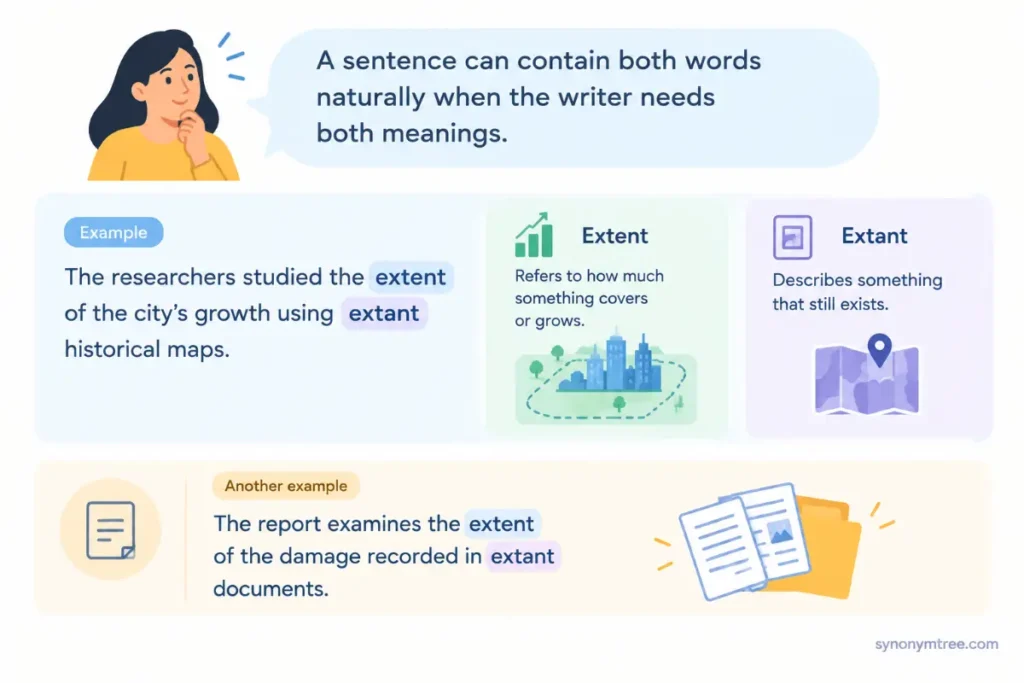
Extent vs Extant In A Sentence
A sentence can contain both words naturally when the writer needs both meanings.
For example:
The researchers studied the extent of the city’s growth using extant historical maps.
Here, extent refers to how much the city grew. Extant describes maps that still exist.
Another example is:
The report examines the extent of the damage recorded in extant documents.
Again, the first word refers to degree. The second refers to documents that have survived.
These examples are useful because they show that the two words are not competing spellings of the same word. They are separate words with separate meanings.
The Most Useful Rule To Remember
If you only remember one rule, remember this:
Extent is about measurement. Extant is about existence.
You use extent to talk about how large, broad, serious, deep, or widespread something is.
You use extant to say that something still exists, especially something that has survived from an earlier period.
That rule works in most situations.
If you write, The extent of the damage, you are talking about how much damage occurred.
If you write, An extant manuscript, you are talking about a manuscript that still exists.
The two words may look alike, but their meanings point in different directions.
Conclusion
The difference between extent vs extant is simple once you connect each word with its main idea. Extent is about size, degree, range, or scope. Extant is about something that still exists or has survived.
Use extent in phrases such as the extent of the damage, the extent of the problem, and to some extent. Use extant when describing surviving records, manuscripts, buildings, artifacts, species, or other things that remain in existence.
A quick replacement test can help when you are unsure. If you can replace the word with size, degree, range, or scope, choose extent. If you can replace it with surviving, remaining, or still existing, choose extant.
Keep one short rule in mind when you write: extent measures, while extant survives. That distinction will help you choose the right word quickly and avoid one of English’s more easily confused word pairs.
FAQs
What is the difference between extent and extant?
Extent means the size, degree, range, or scope of something. Extant means still existing or surviving. Use extent when discussing how much or how far something reaches, and use extant when describing something that remains in existence.
Is extant the same as existing?
Extant is close in meaning to existing, but it is more formal. It often refers to something that has survived from an earlier period. For example, an extant manuscript is a manuscript that still survives and is available.
What does extent mean in simple English?
Extent means how much, how large, how far, or how serious something is. For example, the extent of the damage means the amount or scale of the damage.
What does extant mean in simple English?
Extant means still existing or still surviving. It is often used for old documents, buildings, manuscripts, artworks, records, species, and other things that have survived over time.
Is extant the opposite of extinct?
In many contexts, yes. Extant means still existing, while extinct means no longer existing. The contrast is especially clear when discussing species or things from the past.
Can extent mean degree?
Yes. Extent can mean degree or level. In a sentence such as I agree to some extent, it means I agree to a certain degree or partly.
Is extant a noun or an adjective?
Extant is an adjective. It describes a noun that still exists or survives. For example, extant records means records that still exist.
What is an easy way to remember extent and extant?
Think of extent as measurement and extant as existence. If you mean size, range, degree, or scope, choose extent. If you mean still existing or surviving, choose extant.
