
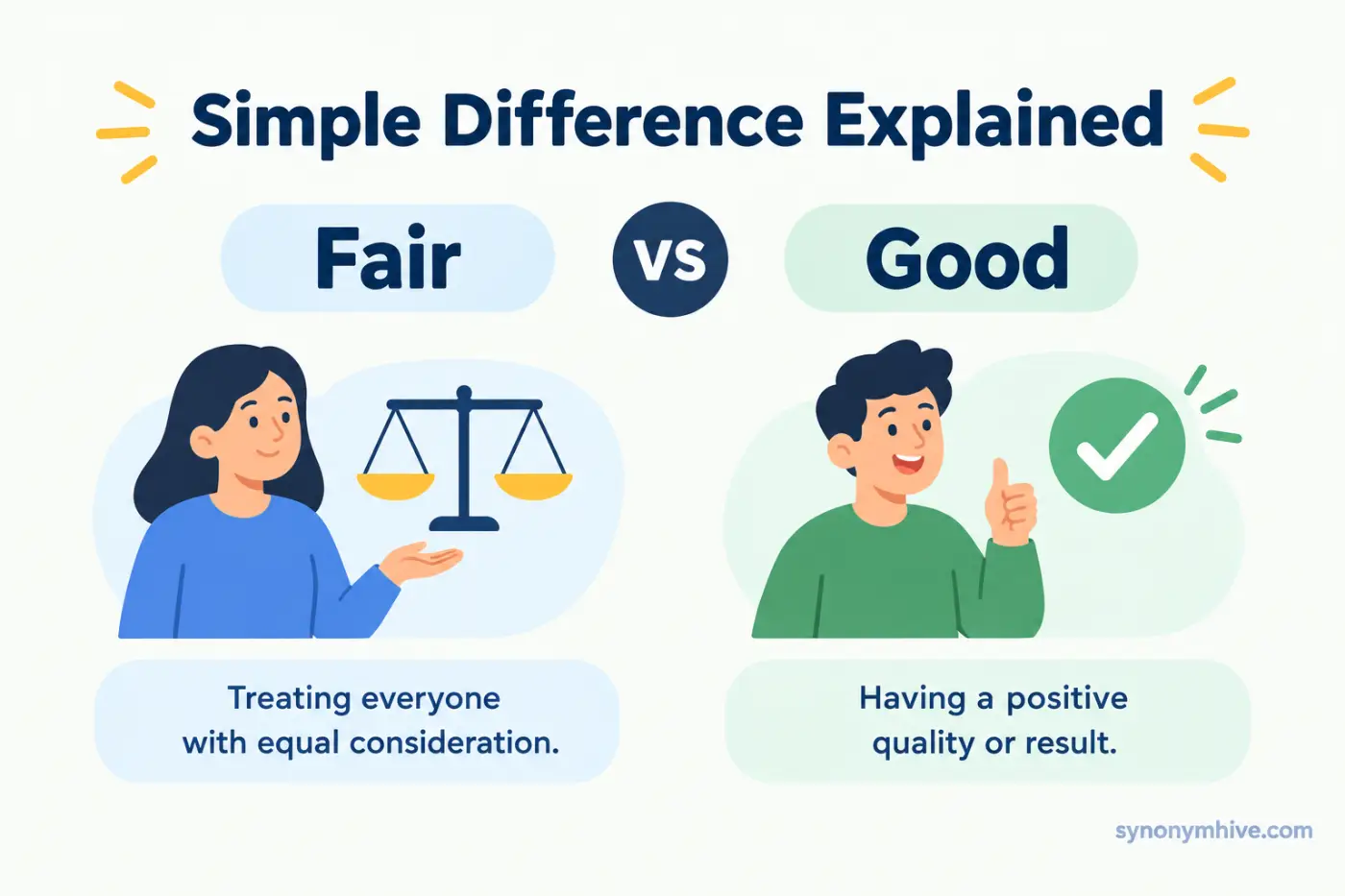
When someone asks if their work is fair vs good you might pause because both words can describe something positive. Still they don’t mean the same thing. A fair result may be acceptable or reasonable while a good result usually means it meets a higher standard.
The difference matters in everyday English. You might describe a student’s test score as fair. You might call the same student’s performance good after seeing strong answers and steady effort. A fair price can also be reasonable without being especially cheap or attractive.
Fair usually means acceptable reasonable or just. Good usually means satisfactory successful useful or of a positive quality.
This guide explains the difference between these common words in clear everyday English. You’ll learn what each word means how context changes the meaning which word fits school work reviews grades prices and personal opinions and how to avoid common mistakes.
Quick Definition
Fair can mean reasonable acceptable or just. It can also describe something that is neither very good nor very bad. In other contexts fair can describe light colors or a clear day.
Good is a broad positive word. It can describe quality ability behavior results health food experiences and many other things.
The key difference is simple. Fair often sits near the middle of a scale while good normally shows clear approval. Yet fair can also mean morally right or equal which gives it a meaning that good does not always have.
Direct Answer
If you are rating quality good is usually stronger than fair. Fair often suggests an average or acceptable result while good suggests a result that meets a higher standard.
However the two words are not always direct opposites. Fair can also mean just or reasonable while good can describe something useful kind effective or morally positive.
Comparison Table
| Word | Meaning | Example Sentence | When to Use It |
|---|---|---|---|
| Fair | Reasonable or acceptable | The teacher gave me a fair grade. | Use it for an average result or reasonable treatment. |
| Good | Positive or satisfactory | She did a good job on the project. | Use it when you want to show clear approval. |
| Fair | Just and equal | Everyone received a fair chance. | Use it for equal or reasonable treatment. |
| Good | High enough quality | The report is good and easy to understand. | Use it to praise quality or performance. |
| Fair | Neither poor nor excellent | His test score was fair. | Use it for middle level performance. |
| Good | Better than average | His test score was good. | Use it for stronger performance. |
Why Are Fair And Good Easy To Confuse
The confusion comes from the fact that both words can sound positive. If someone says your work is fair they aren’t always criticizing you. They may simply mean your work is acceptable.
The trouble starts when people assume fair always means good. It doesn’t. A fair result may be enough to meet a basic standard while a good result suggests stronger quality.
Consider a restaurant review. Saying the food was fair usually sounds less positive than saying the food was good. A customer who says the meal was fair may mean it was acceptable but not memorable.
Now consider a workplace situation. If your manager says your workload is fair the manager isn’t rating the quality of your work. The manager is saying the workload is reasonable.
That small change in context matters. Fair can describe quality but it can also describe justice and reasonableness. Good has a much wider positive meaning but it doesn’t always express fairness.
What Does Fair Mean
Fair has several common meanings in American English. The meaning comes from the sentence around it.
One common use describes something as average or acceptable. If you say a movie was fair you probably mean it wasn’t terrible but it also wasn’t especially impressive.
For example.
- The student gave a fair answer.
- The weather was fair during the trip.
- The quality of the product was fair.
- The employee received a fair review.
In each sentence the exact meaning depends on context.
Fair can also mean just or reasonable. This meaning is especially common when people talk about rules decisions prices treatment and opportunities.
For example.
- The coach gave every player a fair chance.
- The customer received a fair price.
- The judge made a fair decision.
- The teacher treated the students fairly.
Here fair has nothing to do with average quality. It means the situation was reasonable or just.
Fair also appears in descriptions of appearance. A person can have fair skin or fair hair. This use has a different meaning from the quality rating.
English also uses fair in phrases such as fair enough. This phrase usually means that you accept or understand someone’s point.
If a friend says they don’t want to go out because they’re tired you might respond with fair enough. You’re not saying their choice is good. You’re saying their reason seems reasonable.
What Does Good Mean
Good is one of the most useful adjectives in English. It can describe quality ability behavior results and personal traits.
When you call something good you usually show approval.
For example.
- She wrote a good essay.
- He gave a good presentation.
- That restaurant serves good food.
- You did a good job.
- This is a good idea.
Good can also describe moral behavior. A good person is often someone who is kind honest helpful or responsible.
The word can also describe health. Someone may say they are in good health. A person recovering from an illness may say they feel good.
Good can describe usefulness too. A good tool is one that works well for its purpose. A good plan helps someone reach a goal.
That makes good broader than fair. Fair often gives you a specific idea about reasonableness or middle level quality. Good can praise many different aspects of a person thing action or result.
Is Fair Better Or Worse Than Good
When fair and good describe the same type of quality good is generally more positive.
Imagine a teacher using a simple rating scale.
Poor means the work has major problems.
Fair means the work meets some basic expectations but needs improvement.
Good means the work meets the standard well.
Excellent means the work is very strong.
On that scale fair comes before good.
Still you shouldn’t treat this as a fixed rule for every sentence. Fair has meanings that have nothing to do with quality.
For example saying a price is fair means the price is reasonable. Saying a price is good may mean the price is attractive or gives you good value.
The same pattern appears with treatment.
A fair manager treats employees equally. A good manager may also be fair but can have other strengths such as strong communication planning and leadership.
How Does Context Change The Meaning
Context controls a lot of the difference between these words.
Suppose someone asks about a new laptop.
You say the laptop is fair.
The listener may think you weren’t impressed. The laptop probably works but has noticeable limits.
Now say the laptop is good.
The listener expects stronger performance. The laptop probably works well and meets your needs.
Change the topic to price.
You say the price is fair.
Now you’re saying the price is reasonable.
You say the price is good.
Now you may be saying the price is attractive or that the buyer gets good value.
The words may appear similar but the message changes.
Fair For Average Quality
Use fair when you want to describe something that is acceptable but not outstanding.
A student might say.
My math grade was fair.
That sentence suggests the grade was somewhere around an average or acceptable level.
A reviewer might write.
The picture quality is fair in low light.
This tells the reader that the quality is usable but limited.
Fair can therefore sound polite. People often choose it instead of a harsher negative word.
Saying a service was fair may sound less critical than saying the service was poor.
Still fair doesn’t automatically mean bad. It simply places the result below clearly positive praise.
Good For Positive Quality
Use good when you want to give clear positive approval.
A manager might say.
You did a good job on the report.
That statement praises the employee’s work.
A teacher might write.
This is a good example of clear writing.
The teacher is saying the example works well.
A customer might say.
The food was good.
The customer enjoyed the food or thought it had satisfactory quality.
Good usually gives the reader a stronger positive signal than fair.
Fair For Justice And Equal Treatment
One of the biggest differences between the words appears when people talk about justice.
Fair is the natural choice for equal treatment.
You might say.
Everyone deserves a fair chance.
The company offered a fair deal.
The teacher made a fair decision.
The rules should be fair to everyone.
Replacing fair with good can change the meaning.
Everyone deserves a good chance sounds understandable but it doesn’t clearly communicate equal treatment. A fair chance means people have a reasonable opportunity.
The same idea applies to negotiations. A fair deal means neither side is being treated in an unreasonable way.
Good For Character And Behavior
Good is often the better word when you describe someone’s character.
You might say.
She is a good person.
He is a good friend.
They are good neighbors.
The child showed good behavior.
These examples focus on positive personal qualities.
Fair can describe someone’s treatment of others. For example you can say that a teacher is fair because the teacher treats students equally.
That doesn’t always mean the teacher is good in every way. The teacher may be fair but poor at explaining lessons. Another teacher may be both fair and good.
Fair Vs Good For Grades
Students often encounter these words when talking about school performance.
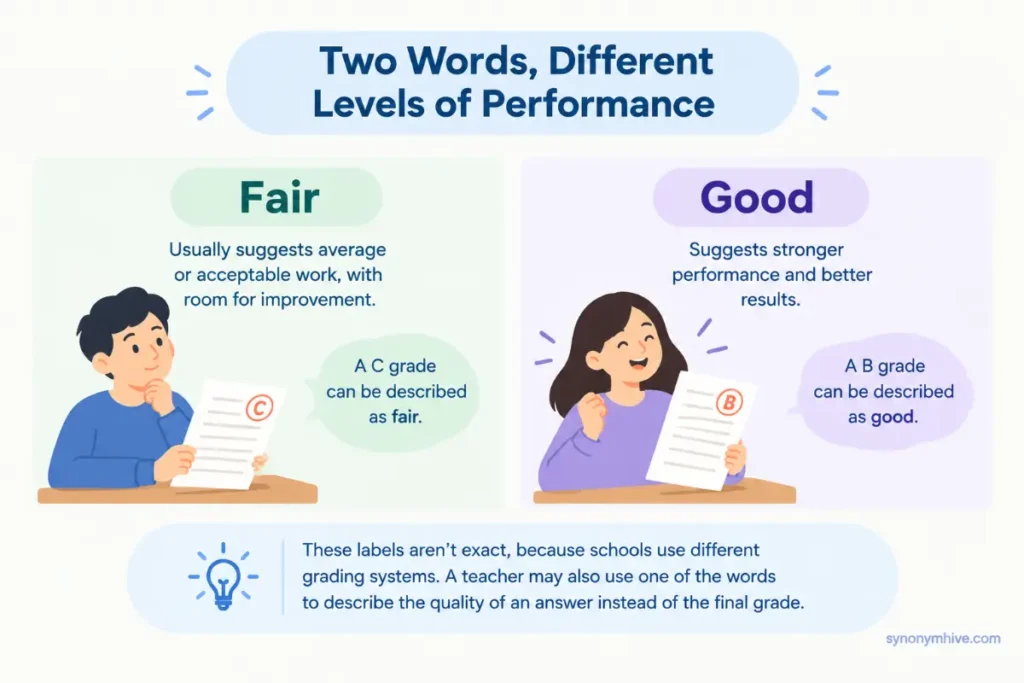
A fair grade usually suggests average or acceptable work. The student may have answered enough questions correctly but still have areas to improve.
A good grade suggests stronger performance.
For example a student may receive a C and describe the result as fair. Another student may receive a B and describe it as good.
These labels aren’t exact because schools use different grading systems. A teacher may also use fair to describe the quality of an answer instead of the final grade.
For example.
Your answer is fair but you need more evidence.
Here the teacher is saying the answer has some value but needs more support.
Fair Vs Good For Work Performance
The difference becomes useful in job reviews.
If a manager says your performance is fair the comment may suggest that you meet some expectations but still need improvement.
If the manager says your performance is good the comment is more clearly positive.
A workplace review might say.
Your communication skills are fair.
That sounds like communication is acceptable but could become stronger.
A stronger review might say.
Your communication skills are good.
Now the employee has received clear praise.
For professional writing you should choose the word that matches the actual level of performance. Don’t use good simply to sound positive if the evidence only supports an average result. Clear language builds trust.
Fair Vs Good For Prices
Prices create another useful distinction.
A fair price is a reasonable price. It doesn’t necessarily mean the price is low.
If a jacket costs $80 and you think the jacket is worth that amount you might call $80 a fair price.
A good price often suggests better value. It may mean the price is lower than expected or attractive for the quality.
For example.
The store offered a fair price for my old car.
The store offered a good price for my old car.
The first sentence focuses on reasonableness. The second can suggest that the offer was favorable.
Fair Vs Good In Reviews
Reviews often use a range of words to show quality.
Poor suggests a serious problem.
Fair suggests an average or limited experience.
Good suggests a positive experience.
Very good suggests stronger praise.
Excellent suggests a high level of quality.
This scale isn’t official. Different reviewers use different standards.
Still readers often understand these words in roughly this order.
Poor → Fair → Good → Very Good → Excellent.
That’s why a review that calls a product fair usually sounds less positive than one that calls it good.
How Should You Use Fair In A Sentence
Fair works naturally before nouns and after linking verbs.
You can say.
The price is fair.
She received fair treatment.
We reached a fair agreement.
He gave a fair answer.
The result was fair.
Fairly is the adverb form when you need to describe how something happens.
For example.
The students were treated fairly.
The manager divided the work fairly.
The judge listened fairly to both sides.
Notice the difference between fair and fairly. Fair describes a noun or subject. Fairly describes an action or manner.
How Should You Use Good In A Sentence
Good usually works as an adjective.
You can say.
She is a good writer.
He gave a good answer.
We had a good experience.
The plan is good.
That was a good decision.
The adverb form is usually well.
This creates a common grammar point.
You can say.
She is a good writer.
You can also say.
She writes well.
Good describes the person or thing. Well describes how the action happens.
For example.
He is a good speaker.
He speaks well.
Both sentences praise his speaking ability but they use different grammar.
Why Is Good Not Always The Same As Well
This distinction matters because learners sometimes use good where well is needed.
If you describe a noun use good.
She is a good singer.
If you describe an action use well.
She sings well.
The same pattern works with many verbs.
He is a good writer.
He writes well.
They are good dancers.
They dance well.
This isn’t a direct comparison between fair and good but it helps explain how good behaves in real English.
Fair also has an adverb form.
She played fair.
She played fairly.
Both forms can work in different contexts but fairly is often clearer when describing the manner of an action.
Fair And Good In Everyday Conversation
People often use these words in casual speech without giving exact ratings.
Imagine someone asks how your day went.
You might say.
It was fair.
That sounds like the day was okay but not especially enjoyable.
You could say.
It was good.
That sounds more positive.
If someone asks about a meal you can say.
The food was fair.
This sounds like the food was acceptable.
The food was good.
This clearly expresses approval.
Small word choices can change the mood of a conversation. Good usually gives the listener a warmer response.
Examples Of Fair And Good In Real Sentences
The best way to understand the difference is to see it in real situations.
- The student earned a fair grade after missing several questions.
- The student earned a good grade after showing strong understanding of the lesson.
- The manager offered a fair salary based on the role and experience.
- The company offered a good salary that was above what the employee expected.
- The movie was fair but the ending felt rushed.
- The movie was good and kept my attention from beginning to end.
- Everyone deserves a fair chance to explain their side.
- She is a good friend who always checks on people.
- The restaurant offers fair prices for large portions.
- The restaurant serves good food and has friendly service.
- His presentation was fair but needed more detail.
- Her presentation was good because the ideas were clear and well organized.
- The coach made a fair decision after listening to both players.
- The coach did a good job of keeping the team focused.
- The repair shop gave us a fair estimate.
- The repair shop did a good job fixing the car.
These examples show that the words can appear in similar sentences while carrying different ideas.
Fair Vs Good In Writing
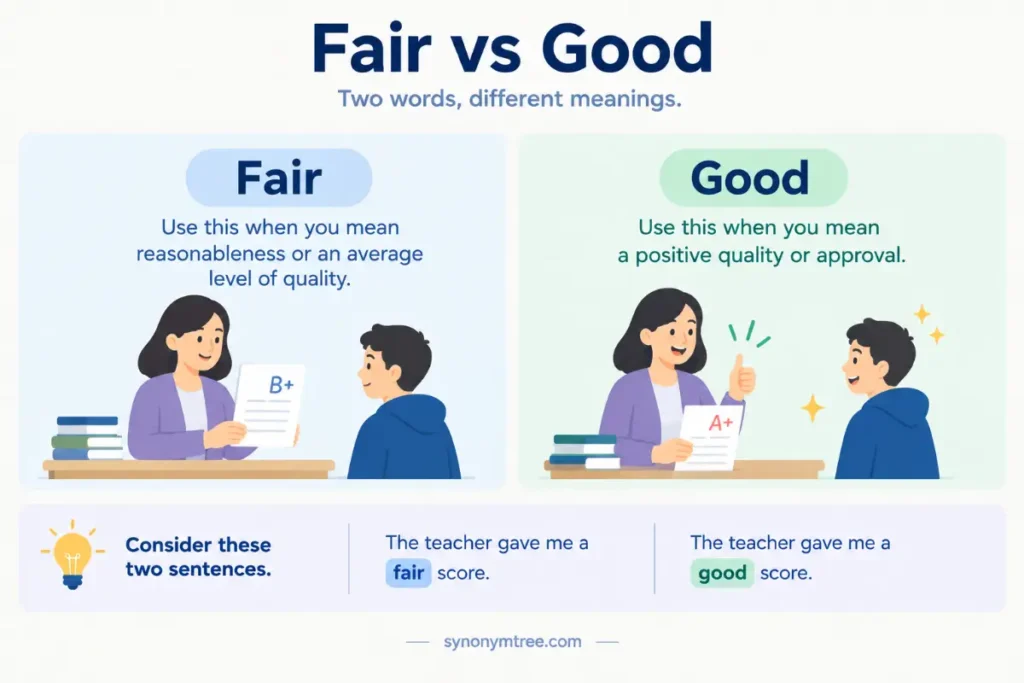
Writers should choose fair when the main idea is reasonableness or an average level of quality.
Use good when the main idea is positive quality or approval.
Consider these two sentences.
The teacher gave me a fair score.
The teacher gave me a good score.
The first suggests the score was reasonable or average.
The second suggests the score was positive.
In formal writing the difference can matter even more. Precise word choice helps readers understand your point without guessing.
Instead of writing that something was good in every situation you can choose a more exact word.
Useful alternatives include effective useful strong successful positive helpful suitable and satisfactory.
Instead of using fair for every middle level result you can choose acceptable reasonable average adequate or moderate.
The best word depends on the exact idea.
Synonyms For Fair
Fair has different synonyms for its different meanings.
When fair means reasonable you can use reasonable or just.
When fair means average you can use average or acceptable.
When fair means equal you can use impartial or unbiased.
When fair describes treatment you can use equitable or just.
For example.
The judge made a fair decision.
The judge made an impartial decision.
The price is fair.
The price is reasonable.
The work was fair.
The work was acceptable.
These words aren’t perfect replacements in every sentence. Each carries its own shade of meaning.
Synonyms For Good
Good also has many alternatives.
Strong can describe quality or performance.
Effective can describe something that works well.
Excellent shows a higher level of praise.
Useful describes practical value.
Kind describes positive behavior toward others.
Skilled describes ability.
Successful describes a result that meets its goal.
Positive describes a favorable outcome or attitude.
Satisfactory means something meets a basic standard.
Choosing a more exact word can make your writing stronger.
Instead of saying the presentation was good you might say the presentation was clear.
Instead of saying the plan was good you might say the plan was practical.
Instead of saying the employee was good you might say the employee was reliable.
Specific words tell readers more.
What Does Fair Enough Mean
Fair enough is a common phrase in American English.
It usually means that you accept a point or decision as reasonable.
For example.
I don’t want to go to the movie tonight.
Fair enough.
The second speaker isn’t praising the decision. They are showing that they understand it.
You can also use the phrase during disagreements.
I think we should leave at six.
Fair enough. Six works for me.
This phrase is friendly and natural in conversation.
It can also sound slightly less enthusiastic than phrases such as sounds good or that’s great.
What Does Good Enough Mean
Good enough means something meets the needed standard.
It doesn’t necessarily mean excellent.
For example.
This draft is good enough to send.
That means the draft has enough quality for the purpose.
The phrase can sometimes sound dismissive. If someone works hard on a project and hears that it is good enough they may think the speaker isn’t impressed.
The meaning depends on tone and situation.
Fair enough and good enough therefore serve different purposes. Fair enough usually expresses acceptance of an idea. Good enough describes something that meets a needed level.
Common Mistakes With Fair
One common mistake is assuming fair always means good.
It doesn’t. Fair can suggest average quality or reasonable treatment.
Another mistake is using fair when you mean equal.
The phrase fair treatment works because it describes just treatment. The word good would not carry the same meaning.
Some learners also confuse fair with fairly.
For example.
The teacher treated everyone fairly.
The word fairly tells us how the teacher treated everyone.
The teacher was fair.
Here fair describes the teacher’s behavior or character.
Common Mistakes With Good
One common mistake is using good when you need well.
She sings good is common in informal speech but standard American English uses she sings well.
Another mistake is using good for every positive idea.
The word is useful but sometimes too broad.
For example saying a job candidate is good tells the reader very little.
You could say the candidate is skilled organized reliable or experienced.
Those words give more useful information.
A third mistake is assuming good always means excellent. Good is positive but it doesn’t automatically mean the highest possible quality.
When Should You Not Use Fair
Don’t use fair if you clearly mean excellent.
Saying a highly successful project was fair may make the result sound average.
Don’t use fair when you mean morally good unless the idea is specifically about justice.
For example fair treatment means just treatment. It doesn’t simply mean kind treatment.
Don’t use fair when you mean attractive or high quality unless the context supports that meaning.
Precision matters. The reader should understand your intended message from the word itself.
When Should You Not Use Good
Don’t use good if you specifically mean equal treatment.
Use fair for ideas such as a fair chance a fair rule or a fair decision.
Don’t rely on good when you need to describe a specific strength.
If a product is durable say durable. If a person communicates clearly say clear or effective. If an employee meets deadlines say reliable or punctual.
Good is useful but specific words often make your writing more powerful.
Antonyms Of Fair
The opposite of fair depends on the meaning.
If fair means just the opposite can be unfair or unjust.
If fair means average or acceptable the opposite might be poor or unacceptable.
If fair describes clear weather the opposite might be stormy or cloudy.
This is why context matters so much with this word.
Antonyms Of Good
The most common opposite of good is bad.
Other choices include poor weak harmful ineffective unsuccessful and unpleasant.
The best antonym depends on the sentence.
A poor performance is not the same as a harmful action. A bad smell is not the same as an unsuccessful plan.
Strong writers choose the opposite that matches the exact idea.
Fair Vs Good In American English
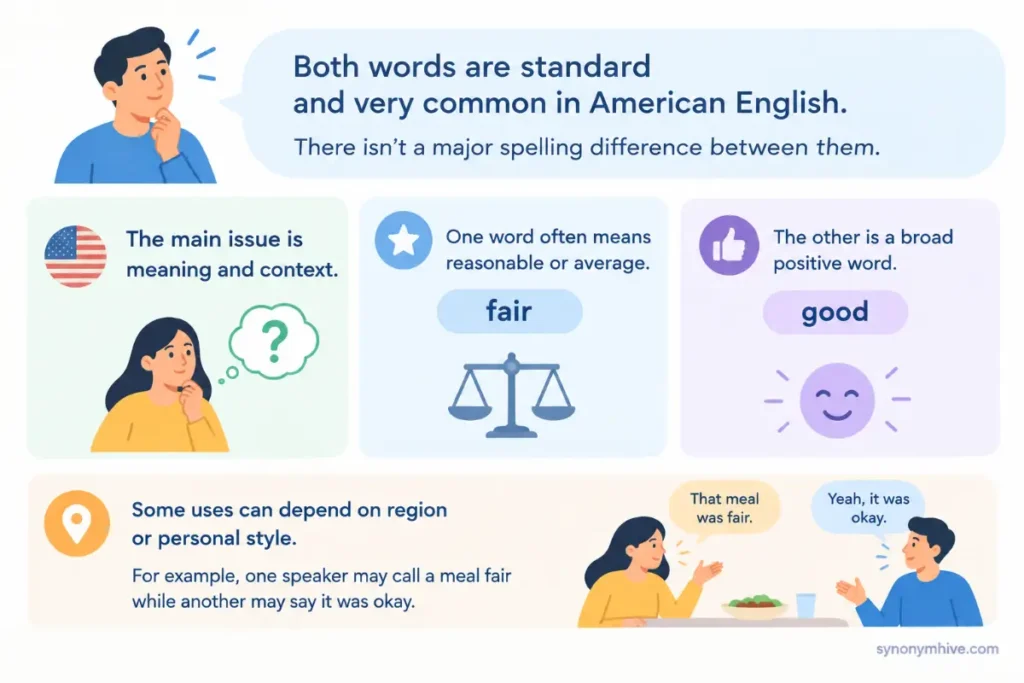
Both words are standard and very common in American English.
There isn’t a major US spelling difference between them.
The main issue is meaning and context.
American speakers often use fair to mean reasonable or average. They use good as a broad positive word.
Some uses can depend on region or personal style. For example one speaker may call a meal fair while another may say it was okay.
The meaning also changes with tone. A speaker who says that’s fair may be agreeing with a point. A speaker who says that’s good is usually expressing approval.
Fair Vs Good In Professional Writing
Professional writing benefits from precise word choice.
If you’re reviewing an employee you should explain what fair means. Simply saying performance was fair can leave the reader unsure about the actual strengths and weaknesses.
You might write.
The employee met basic expectations but needs stronger attention to detail.
That’s clearer than simply saying the performance was fair.
If the performance is positive you could write.
The employee consistently completed assignments on time and communicated clearly with clients.
That is stronger than simply saying the employee did a good job.
Specific evidence supports E E A T because readers can see why a statement is being made. Strong writing doesn’t hide behind broad praise.
Fair Vs Good In School Writing
Students should also avoid using these words too often.
If you’re writing an essay and say every idea is good the reader gets little detail.
Instead describe the exact strength.
The argument is convincing.
The evidence is useful.
The explanation is clear.
The example is relevant.
If you use fair to describe an opposing argument you might say the argument has some value but lacks strong evidence.
This creates a more balanced academic tone.
Fair Vs Good In Text Messages
Texting is more flexible.
You can say.
The movie was fair.
The movie was good.
You can also use casual phrases such as pretty good or fair enough.
Pretty good usually means clearly positive but not amazing.
Fair enough usually means you accept what someone said.
Tone matters a lot in short messages because there isn’t much context.
If someone asks how their new haircut looks and you reply fair they may think you dislike it.
If you want to be encouraging say it looks good or it looks great.
Fair Vs Good In Job Interviews
Job candidates should understand this difference because both words can appear in interview questions.
An interviewer may ask you to rate your skills.
Saying my skills are fair may make you sound unsure or average.
If your skills are strong you can say you’re confident in them and support the statement with an example.
Instead of saying.
I’m good at solving problems.
You can say.
I solve customer problems quickly and usually find a practical solution on the first attempt.
The second answer gives evidence. It sounds more professional and credible.
How To Choose Between Fair And Good
Start by asking what you actually mean.
- If you mean reasonable use fair.
- If you mean equal or just use fair.
- If you mean average or acceptable use fair.
- If you mean positive quality use good.
- If you mean strong performance use good or a more exact word.
- If you mean kind behavior use good.
- If you mean something works well use effective or good.
- If you mean a reasonable price use fair.
- If you mean an attractive price or strong value use good.
- If you mean a specific strength choose a more precise word.
This simple check can prevent most mistakes.
A Simple Memory Trick
Think of fair as a balanced scale.
A fair decision gives people reasonable treatment. A fair price doesn’t take advantage of the buyer. A fair result may sit around the middle of a quality scale.
Think of good as a thumbs up.
When you say something is good you are usually showing approval.
This isn’t a rule for every use but it works well as a quick memory tool.
You can also remember two short phrases.
Fair means reasonable.
Good means positive.
If your sentence is about justice or an average result fair may fit.
If your sentence is about praise or quality good may fit.
Why Specific Words Are Often Better
Both fair and good are useful everyday words. Still neither tells the reader everything.
Imagine a manager writes.
The employee’s work was good.
That sounds positive but it doesn’t explain why.
A stronger sentence might say.
The employee completed every report on time and made very few errors.
Now the reader has evidence.
The same principle works with fair.
Instead of saying.
The price was fair.
You could write.
The price matched the quality and was similar to other stores in the area.
Specific details make your writing clearer.
Good writers use simple words but they choose those words carefully.
Conclusion
The difference between fair vs good becomes much easier once you look at the main idea behind each word. Fair often points to something reasonable average or just. Good usually shows positive quality approval or success.
Remember that fair has more than one meaning. A fair price is reasonable. A fair decision is just. A fair test result may be average or acceptable. Good has a wider positive meaning and can describe quality behavior ability results health and usefulness.
For clearer writing choose the word that matches your exact message. If you’re talking about equal treatment or a reasonable result fair may be the right choice. If you’re praising quality or performance good will usually fit better. When possible use an even more specific word such as reliable effective skilled clear or successful. That small change can make your writing much stronger.
Frequently Asked Questions
What is the main difference between fair and good?
Fair often means reasonable acceptable or average. Good usually means positive satisfactory or better than average. Fair can also mean just or equal which gives it a meaning that good does not always have.
Is fair better than good?
Good is usually more positive than fair when both words rate quality. Fair often suggests an average or acceptable result while good suggests stronger quality.
Does fair mean bad?
Fair does not mean bad. It often means acceptable or average and can also mean reasonable or just.
Can fair mean good?
Fair can sometimes describe something positively when it means reasonable or appropriate. Still fair usually sounds less positive than good when both words describe quality.
What is a better word than fair?
The best replacement depends on your meaning. Use reasonable for a fair price or decision and acceptable for an average result. Use impartial or just when talking about equal treatment.
What’s the difference between fair and good in a review?
Fair usually suggests an average or limited experience while good gives a clearer positive rating. A review that says a product is good generally sounds more favorable than one that calls it fair.
Should I use fair or good in a job review?
Use fair when performance meets some basic expectations but still has room for improvement. Use good when the employee performs well and deserves clear positive praise.
