
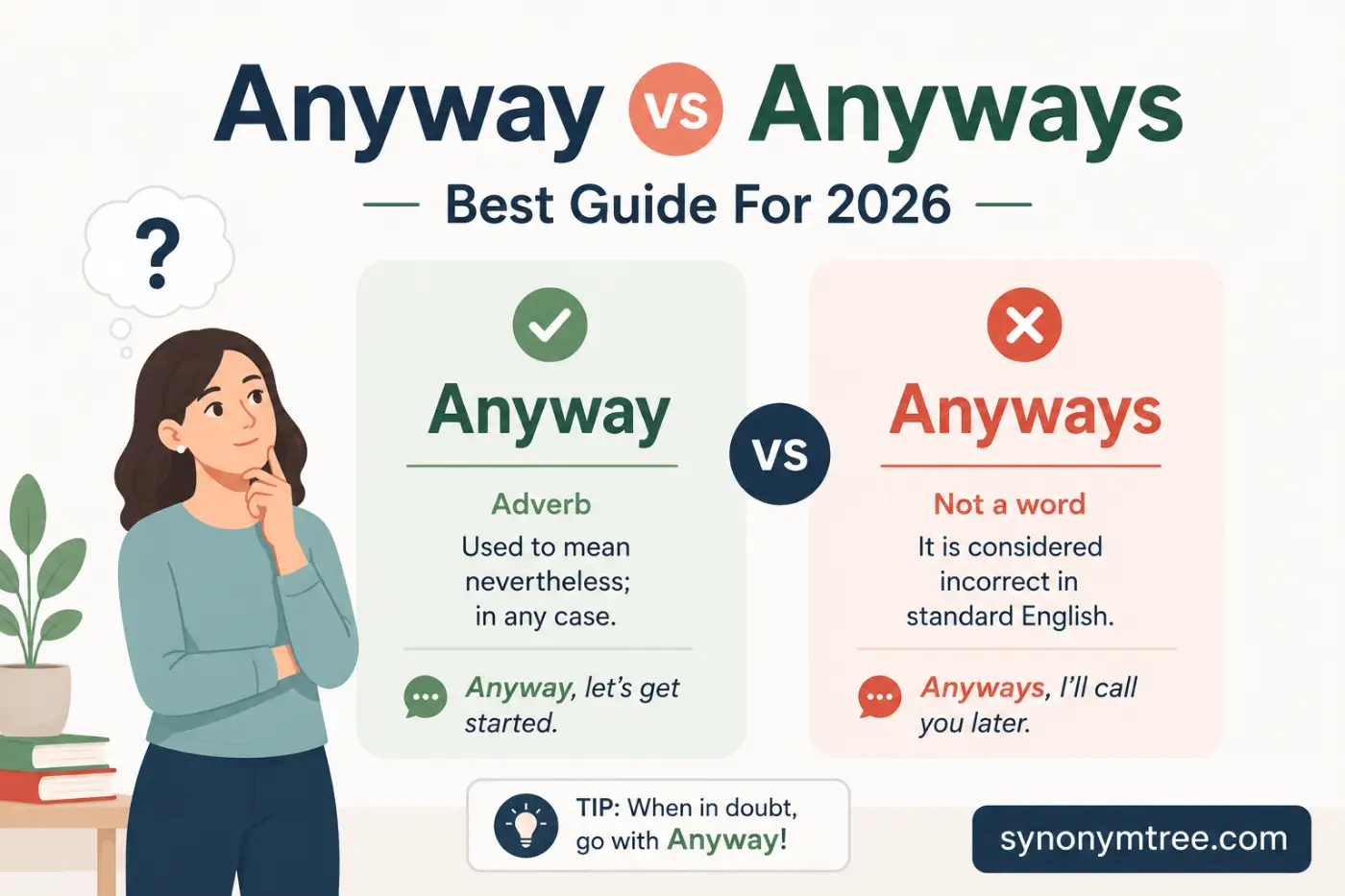
When comparing anyway vs anyways, many people wonder which one is correct. The confusion is common because both forms appear in everyday speech. So which one should you use? The short answer is simple. Anyway is the standard form and the preferred choice for formal writing. Anyways is also used in casual American English, but it sounds more relaxed and informal.
Anyway usually means in spite of that or moving to another point. It can also mean regardless or at any rate. For example you might say I was tired but I went anyway. You could also say Anyway I need to finish my homework. The word helps you move past one idea and continue with another.
Anyways has the same basic meaning in casual speech. Many people use it when talking with friends or family. You may hear someone say Anyways I need to go now. This sounds natural in casual conversation for many American speakers. Still anyway is the better choice for school work professional writing and most edited content.
Simple Answer in One Look
Anyway is the standard form. Use it in formal writing and everyday speech.
Anyways is common in casual American speech. It has the same basic meaning but sounds more informal.
If you are unsure which form to choose use anyway. It works in almost every setting.
What This Means in Simple English
Think of anyway as a word that helps you keep going. You may have talked about a problem or an idea. Then you decide to move forward.
For example you might say I did not feel ready but I went anyway.
The word anyway shows that something happened despite a problem. You were not ready. You still went.
It can also help you change the direction of a conversation. Imagine that you are talking about your plans for the weekend. You suddenly remember that you need to call your brother. You might say Anyway I need to call my brother.
Here anyway works like a small bridge between two thoughts. It helps the speaker move from one point to another without making the change feel sudden.
You can also use anyway when you want to show that something does not change your final choice.
Imagine that your friend says the movie starts late. You still want to watch it. You could say I will watch it anyway.
Here the speaker means the same action was already planned. The extra information does not change the plan.
So anyway has several useful jobs. It can show that you continue despite something. It can also show that a final decision stays the same. Anyways can do these same jobs in casual speech. The main difference is the feeling of the word. Anyways often sounds more relaxed. Think of the two words like two shirts that fit the same purpose. Anyway is the plain shirt that works almost everywhere. Anyways is more like the shirt you might wear when you are relaxing with friends.
Why People Mix These Words
People often mix anyway and anyways because they sound very similar. They also carry almost the same meaning in casual conversation. When people speak quickly they do not always think about formal grammar rules. They use words that feel natural to them. That is one reason you may hear anyways often in American conversations.
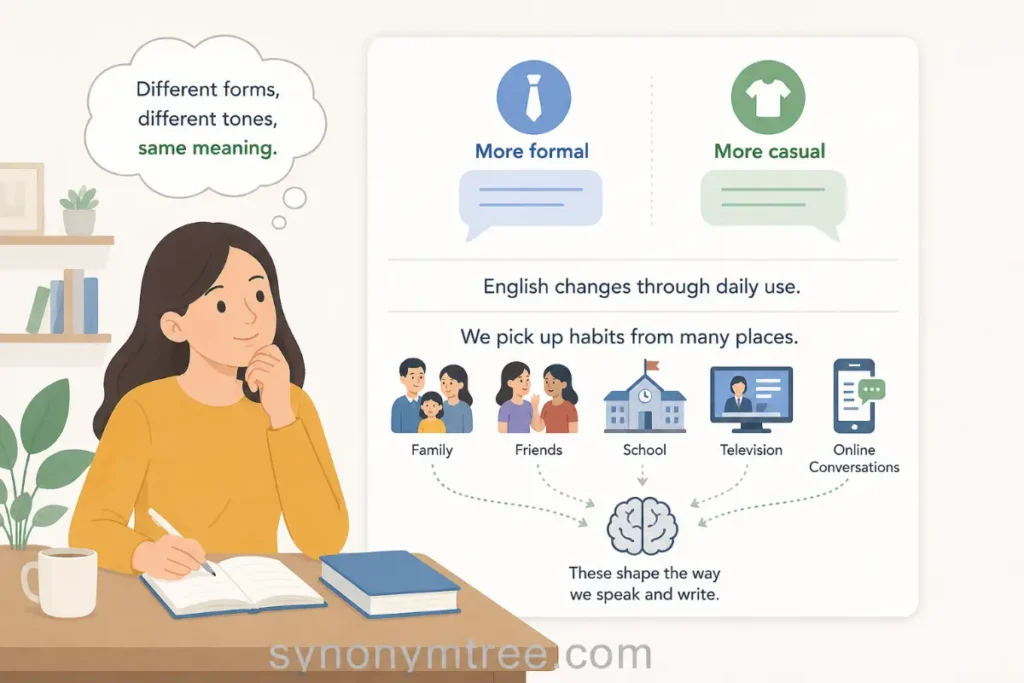
Another reason is that many English words have more than one accepted form. Some forms sound more formal. Others sound more casual. English changes through daily use. People create habits based on what they hear from family friends school television and online conversations.
The ending in anyways can also feel natural because English has many words that end in s. For example people say always sometimes and sometimes use anyways. That can make the extra s feel normal. Still the standard form is anyway. If you are writing an essay for school or sending a formal email you should choose anyway.
For example this sentence is a safe choice.
I was tired but I finished the project anyway.
This sentence is also natural in casual speech.
Anyways I need to get going.
The second sentence sounds like normal conversation. It does not sound like careful formal writing.
This difference explains much of the confusion. People hear both forms so they may think both forms have exactly the same place in English. They are close but their style is different.
Clear Difference Explained Simply
The difference between anyway and anyways is mainly about standard use and style.
- Anyway is the standard form.
It works in casual speech professional writing school work emails articles and other forms of edited English.
- Anyways is mainly casual.
You may hear it in conversations texts social posts and relaxed messages.
- Anyway is the safer choice.
If you need one form that works almost everywhere choose anyway.
- Both can express the idea of continuing.
For example you could say I was nervous but I went anyway.
In casual speech someone might say I was nervous but I went anyways.
- Anyway has a longer history as the standard form.
It has been used in English for a very long time. Anyways developed as an informal variant.
- Anyways can sound more conversational.
It may give a sentence a relaxed spoken feeling. That does not make it wrong in every situation. It simply makes it less suitable for formal writing.
The easiest rule is this. Use anyway when you want a standard choice. Use anyways only when you want a casual conversational sound.
Which Form Should You Use
Use anyway in most situations.
This is especially true for school essays job applications business emails reports articles and other formal writing. You do not need to worry about sounding too formal. Anyway is also very common in normal conversation.
Use anyways mainly when you are speaking casually or writing something that is meant to sound like casual speech.
For example you might text a friend like this.
Anyways I will see you tomorrow.
That can sound natural and friendly.
Now imagine you are writing a school essay. You would normally write this.
The plan was difficult but we continued anyway.
That sounds clean and standard.
If you are learning English you do not need to spend much time worrying about anyways. Learn anyway first. It is more useful and gives you a strong standard form.
You can think of this as a simple classroom rule.
Anyway is your default choice.
Anyways is a casual choice.
If you remember that one rule you will avoid most mistakes.
Easy Real Life Sentences You Can Use
Here are some simple examples that show how anyway works in everyday English.
- I was tired but I went anyway.
This means the person was tired but still went.
- We missed the bus but we walked anyway.
The missed bus did not stop the people from going.
- I do not know the answer anyway.
Here anyway can show that the information does not change the situation.
- Anyway I need to finish my work.
Here the speaker is moving to another point.
- It might rain but we are going anyway.
The possible rain will not change the plan.
- I did not like the food anyway.
Here anyway adds a reason that supports the speaker’s final thought.
- Anyways I have to leave now.
This is casual speech. The speaker is changing the topic or ending the conversation.
- Anyways we can talk about it later.
This sounds relaxed and conversational.
Notice how anyway can work in many settings. You can use it with friends. You can also use it in careful writing. That makes it a very useful word for English learners.
Anyways is more limited because it carries a casual tone. You may hear it often in speech. That does not mean you should use it in every type of writing.
Where This Word Comes From
The word anyway has a long history in English. It developed from older forms that joined the ideas of any and way. Over time the word came to mean something like in any manner or regardless of the situation. Its modern uses grew from that basic idea. When you say I will do it anyway you are saying that you will do it regardless of the problem.
The word later became useful for moving from one idea to another. That is why people often say anyway when they want to return to the main point or start a new thought. Anyways came later as an informal variation. The extra s does not create a completely new meaning. It mainly gives the word a more casual sound.
This is a useful lesson about English. Language is shaped by real people. People speak differently in different places and situations. Some forms become standard in writing while other forms stay more common in casual speech. That is why you can hear anyways without needing to think that the speaker has no knowledge of English. It is a real form used in informal conversation. Still standard edited English usually favors anyway.
Anyway Vs Anyways In Everyday Conversation
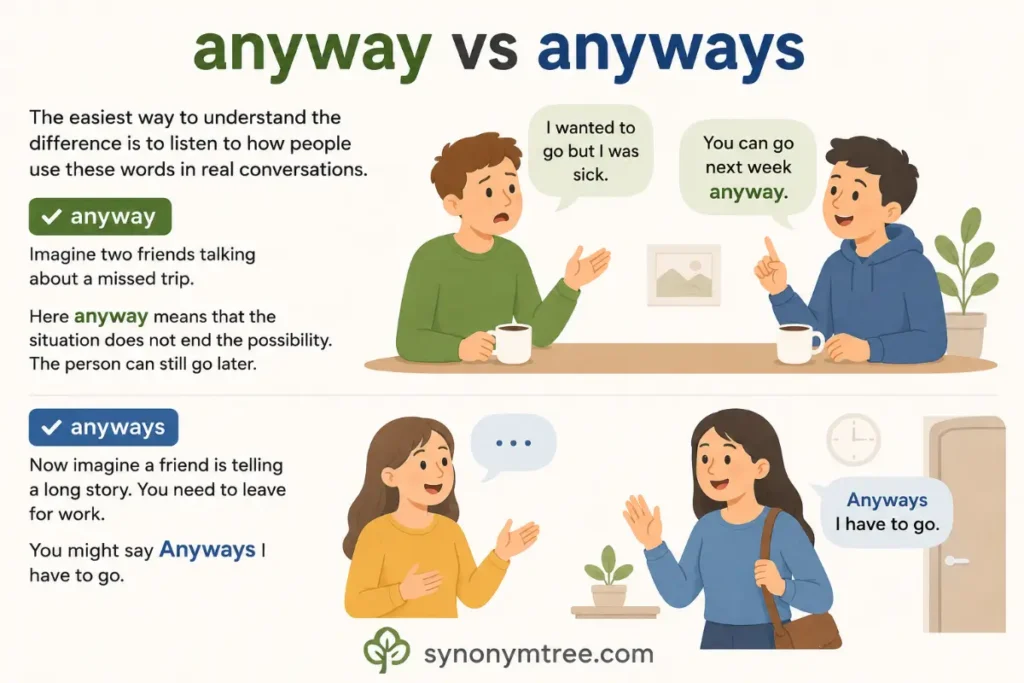
The easiest way to understand the difference is to listen to how people use these words in real conversations.
Imagine two friends talking about a missed trip.
One friend says I wanted to go but I was sick.
The other friend says You can go next week anyway.
Here anyway means that the situation does not end the possibility. The person can still go later.
Now imagine a friend is telling a long story. You need to leave for work. You might say Anyways I have to go.
The word helps you move away from the story and return to your own point.
In this setting anyways can sound friendly and relaxed. It feels like spoken English.
You might also hear someone say Anyways what were we talking about.
This use helps the speaker return to an earlier topic.
The same person could say Anyway what were we talking about. That is also natural. The standard form works perfectly well in conversation.
This shows why anyway remains the best word to learn first. You can use it in both speech and writing without changing your style.
How To Remember The Difference
A simple memory trick can help.
Think of anyway as the all purpose choice. It can go to school with you. It can also appear in a text to a friend.
Think of anyways as a relaxed conversation choice. You may hear it when people speak freely or write casual messages.
You do not need a complicated rule.
Remember this.
Anyway is standard.
Anyways is casual.
If you are writing something important and you are not sure which one to choose use anyway.
That small choice will keep your writing clear and natural.
Anyway Vs Anyways In School Writing
Students often wonder which form should appear in an essay. The answer is simple. Use anyway.
For example you might write this.
The first plan failed but the team continued anyway.
That sentence is clear and suitable for school writing.
You would normally avoid this in a formal essay.
The first plan failed but the team continued anyways.
The second sentence may appear in casual speech. It does not give the same polished feeling in formal writing.
This does not mean the second form has no place in English. It simply means the setting matters.
Your teacher may also want you to use the most standard form. In that case anyway is the clear choice.
The same rule works for reports and professional messages. When your goal is clear formal English choose anyway.
A Simple Classroom Rule
If I were teaching this to a student in class I would give one short rule.
Use anyway as your normal choice.
Use anyways when you want a relaxed conversational sound.
That is enough for most situations.
You do not need to memorize a long grammar lesson. You only need to understand the small difference in style.
When you see anyway in a book or article it is standard English. When you hear anyways in casual conversation it is an informal form that many speakers use.
The meaning is usually close. The setting is what changes.
A Short Bridge To Deeper Meaning
Now that the basic difference is clear we can look at how these words work in real conversations and everyday situations. The best way to learn a word is not only to know its definition. You should also understand the feeling it gives a sentence. That small detail can help you sound more natural when you speak and write.
How Anyway Vs Anyways Is Understood in Culture and Stories
Words can carry a little feeling beyond their basic meaning. Anyway is a good example. It often appears when someone wants to move forward. A person may face a problem. They may feel unsure. They may even change their mind. Then they say anyway and continue. This makes anyway feel natural in everyday American English. People use it when they want to finish one thought and move to another. They also use it when they want to show that something did not change their decision.
Imagine a friend says the weather may be bad tomorrow. You still plan to go to the park. You might say I am going anyway. The word shows a simple attitude. The problem is real but the plan stays the same. That idea appears often in stories too. A character may fail at something and try again anyway. A person may feel scared but walk forward anyway. A family may face a hard choice but keep moving anyway. The word does not make the story dramatic by itself. Instead it helps show a person’s choice. It tells us that something happened but did not stop the action. Anyways can carry a similar feeling in casual speech. It often sounds more relaxed. It can feel like a person speaking freely with a friend.
For example someone may tell a long story and then say anyways I have to go. The word helps close one thought and move to another. It feels like a natural part of conversation. This is why the difference between anyway and anyways is not mainly about meaning. It is mostly about style and setting. Anyway is the standard choice. Anyways has a more casual sound.
Biblical And Mythological Meaning For Anyway Vs Anyways
Anyway and anyways do not have a special biblical meaning. They are ordinary English words used to connect ideas and show that something continues despite a situation. You will not normally find a special religious symbol connected to the difference between these two forms. Their meaning comes from ordinary language use.
The same applies to mythology. There is no well known mythological meaning attached to anyway or anyways. They do not represent a god a hero an object or a special event. Still these words can appear when people talk about stories from the Bible or mythology. A speaker may describe a person who continued despite trouble.
For example a person might say the journey was hard but the traveler continued anyway. The word simply means that the traveler continued despite the difficulty. This is useful because it shows how ordinary words can work inside many kinds of stories. The word itself does not need a special cultural meaning. Its job comes from the sentence around it. The key lesson stays simple. Anyway means that something still happens despite another fact. It can also help a speaker move from one topic to another. Anyways can express a similar idea in casual speech. It does not gain a new religious or mythological meaning.
Symbolism Explained In Simple Words
Anyway and anyways do not have fixed symbols like a heart can represent love or a dove can represent peace. Still the ideas behind these words can suggest something about how people communicate.
Both forms can point toward movement. A speaker may be moving past a problem. They may be moving to another topic. They may be returning to the main point.
That gives the word anyway a useful emotional idea. It can suggest persistence. It can show that a person has decided not to let one problem stop them. The word can also show acceptance. A person may understand that something went wrong. They accept the fact and continue.
What Anyway Represents
Anyway often represents continuing despite something.
Think about this sentence.
I was nervous but I spoke anyway.
The speaker admits the fear. Then the speaker shows action. Fear did not end the plan.
Anyway can also represent a return to the main point. Imagine someone tells a long story and then says anyway I need to finish my work.
The speaker is gently closing one part of the conversation. Then they return to something that matters.
This makes anyway useful in both serious and simple situations. It can appear in a story about a difficult decision. It can also appear when someone talks about dinner plans. The emotional meaning depends on the sentence. The word itself stays simple.
What Anyways Represents
Anyways often represents a relaxed move in conversation. A person may say anyways when they want to change the topic or finish a thought. The extra s gives the word a casual spoken feeling for many American speakers. Imagine a friend tells you about a problem at school. After explaining everything the friend says anyways I have to get ready for work. The word helps the conversation turn toward a new subject. This is why anyways can sound friendly and informal. It often feels like something you would hear in relaxed speech. The key point is that anyways does not represent a completely different idea. It usually carries the same basic meaning as anyway.
Related Words You Should Know
Several words and phrases can help you understand anyway more clearly.
Regardless means that something does not change the result.
For example you might say I will go regardless.
Still can show that something happens despite another fact.
For example you might say It was raining but we went still.
Anyhow is very close to anyway. It can mean in spite of that or in any case. It can also help move a conversation forward.
At any rate can mean that the final result stays the same. It often sounds a little more formal than anyway.
In any case can also show that the final decision does not change.
For example you might say In any case we need to finish the job.
By the way is different but useful to know. It often introduces a new piece of information or a new topic.
For example you might say By the way I saw your brother yesterday.
Actually can also help change or correct a point in a conversation. It does not have the same meaning as anyway.
These words may appear in similar conversations but they do different jobs. Learning their small differences can help you choose the right word instead of using the same expression every time.
How People Actually Use Anyway Vs Anyways In Daily English
The best way to understand these words is to see them in normal situations.
Imagine you planned to walk home but it starts to rain. You decide to walk anyway.
I know it is raining but I am walking anyway.
Here anyway means despite the rain.
Now imagine you are talking with a friend about your plans.
Anyways I need to leave soon.
Here anyways helps the speaker move toward a new point. The tone is casual.
Consider another situation. You wanted to buy a blue shirt but the store only has a black one. You decide to buy the black one.
I wanted the blue one but I bought this one anyway.
The word shows that the final choice happened despite the first problem.
Here are more natural examples.
I was tired but I finished the book anyway.
We missed the first train but we got there anyway.
It may take longer but I want to try anyway.
Anyway I need to call my mom.
Anyway what were we talking about.
I did not want to go at first but I went anyway.
Anyways I will see you tomorrow.
Anyways I have to get back to work.
These examples show an important point. Anyway works in all of these situations. It can sound natural in casual speech and careful writing.
Anyways works best when the conversation is relaxed. It can appear in texts and informal messages. Many speakers use it naturally when talking.
If you are writing for school or work then anyway is the stronger choice.
Common Mistakes People Make
One common mistake is thinking that anyways is always wrong. That is too simple.
Many people use anyways in casual American English. You may hear it often in relaxed conversations. The word has a real place in informal speech.
The better rule is to think about the setting.
If you are writing a formal essay use anyway.
If you are talking with friends you may hear anyways.
Another mistake is thinking that the two forms have completely different meanings. They usually do not.
Anyway and anyways can both express the idea of continuing despite something.
For example.
I was tired but I went anyway.
I was tired but I went anyways.
The first sentence is the standard choice. The second sentence has a casual feeling.
A third mistake is using anyway without understanding its purpose. Some learners add it to a sentence because they have seen it many times.
That can make the sentence sound unclear.
Ask yourself what you want the word to do. Do you want to show that something happened despite a problem. Do you want to show that a decision will stay the same.
If the answer is yes then anyway may fit.
Another common mistake is using anyways in formal writing just because it sounds natural when spoken. Speech and writing do not always follow the same style.
For school work it is best to choose the standard form. That small choice can make your writing look cleaner.
Final Teacher Explanation About Anyway Vs Anyways
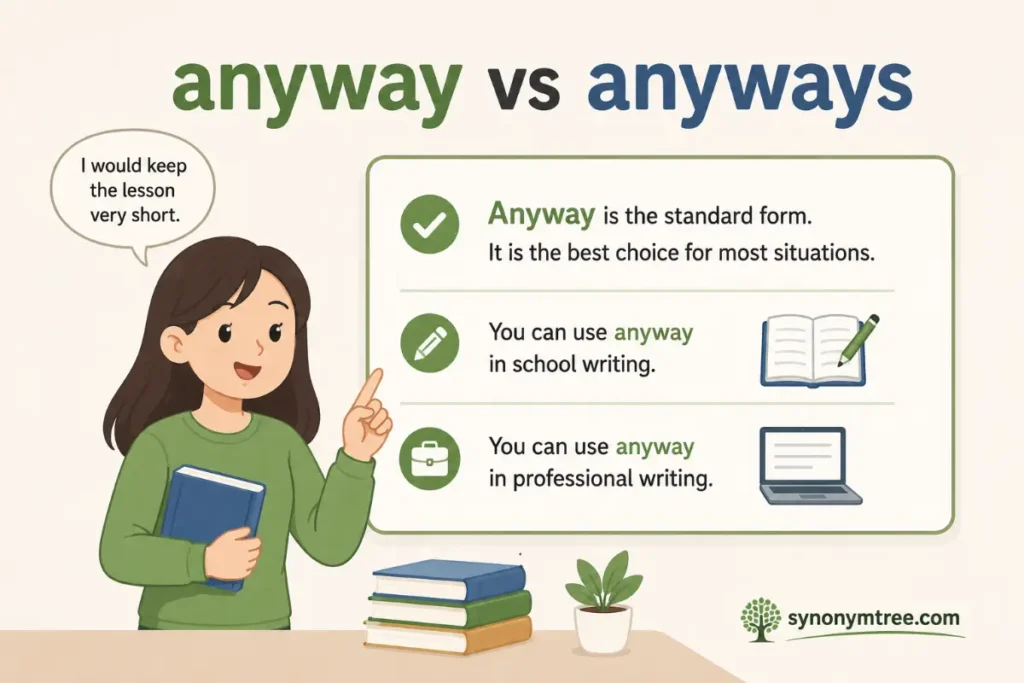
If I were explaining this to a student in class I would keep the lesson very short. Anyway is the standard form. It is the best choice for most situations. You can use anyway in school writing. You can use it in professional writing. You can use it in everyday conversation. It works almost everywhere. Anyways is an informal form. Many people use it in casual American speech. You may also see it in texts social posts and relaxed messages. The meaning is usually very close. The main difference is the style. Think of anyway as your safe everyday word. You do not need to worry about the situation. It fits formal and casual settings. Think of anyways as a relaxed conversation form.
Final Answer About Anyway Vs Anyways
Anyway is the standard English form. It works in formal writing and casual speech.
Anyways is mainly informal. It has a similar meaning but sounds more relaxed.
If you are unsure which one to use choose anyway. It is the safest and most useful choice.
The simple rule is easy to remember. Anyway is standard. Anyways is casual.
Conclusion
The difference between anyway and anyways is small but useful to understand. Both forms can express a similar idea in casual speech. The main difference comes from style and setting.
Anyway is the better choice for school work professional writing essays reports and careful English. It can also sound completely natural when you talk with friends. That makes it the best form to learn and use as your normal choice.
Anyways is more casual. You may hear it often in relaxed American conversations. It can sound friendly and natural in texts or informal messages. Still you should choose anyway when your writing needs a standard and polished form. You do not need a long grammar rule to remember this lesson. Just keep one idea in mind. Use anyway as your default choice. Use anyways when you want a casual conversational sound.
Frequently Asked Questions About Anyway Vs Anyways
Is Anyway Correct English?
Yes. Anyway is standard English and is correct in both formal writing and everyday speech.
Is Anyways Correct English?
Anyways is used in informal American English. It is common in casual speech but is less suitable for formal writing.
Which Is Correct Anyway Or Anyways?
Anyway is the standard choice. If you are unsure which form to use choose anyway.
What Does Anyway Mean In Simple Words?
Anyway can mean despite that or regardless. It can also help you move to another topic.
Can I Use Anyway In Formal Writing?
Yes. Anyway works well in essays reports professional emails and other formal writing.
Can I Use Anyways In School Writing?
It is better to use anyway in school writing. Anyways can sound too casual for an essay or formal assignment.
Why Do People Say Anyways?
Many speakers use anyways as a casual form of anyway. It often appears in relaxed American conversations.
Is Anyway More Professional Than Anyways?
Yes. Anyway is the standard form and works better in professional and formal writing.
Can Anyway And Anyways Mean The Same Thing?
In many casual sentences they can express the same basic idea. The main difference is that anyways sounds more informal.
How Do I Remember The Difference?
Use anyway as your normal choice. Think of anyways as a casual conversation form.
