
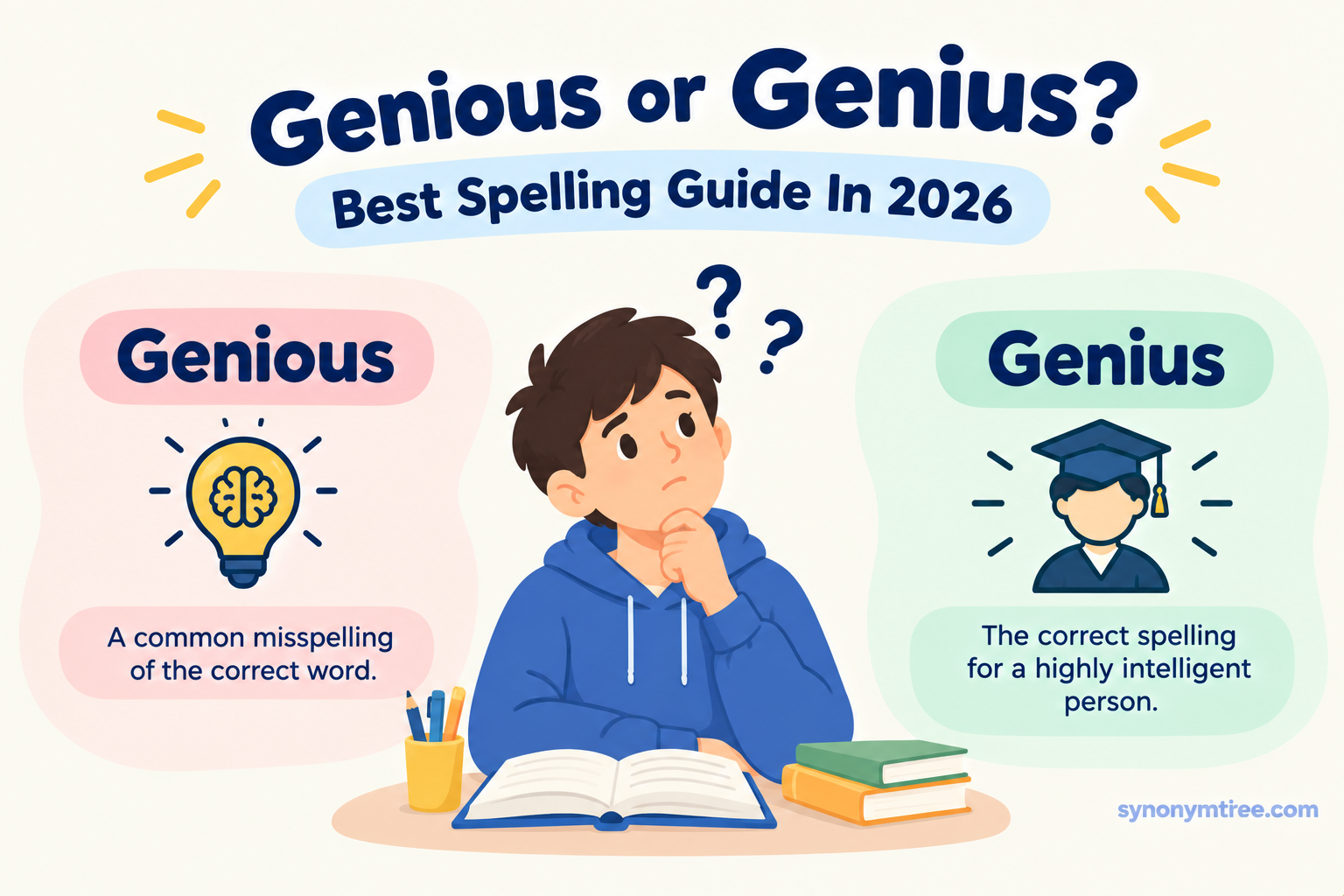
If you have ever typed genious or genius and stopped to wonder which spelling is correct, you are not alone. The two forms look close, but only one is the standard English spelling. The correct word is genius.
A genius is a person with exceptional intelligence, skill, creativity, or ability. The word can describe someone known for remarkable thinking, or it can describe an unusually brilliant idea, invention, or solution.
The spelling mistake often happens because the ending can sound like it contains an extra vowel. English has many words that do not sound exactly the way they look, so it is easy to add letters that do not belong. This guide explains the correct spelling, meaning, pronunciation, history, common mistakes, and useful examples.
Quick Definition
Genius is the correct spelling. It is a noun that usually refers to a person with exceptional intellectual ability, but it can also describe exceptional talent or a remarkably clever idea.
Direct Answer
The correct spelling is genius, not genious. Use genius when you mean a highly intelligent or exceptionally talented person, or something remarkably clever.
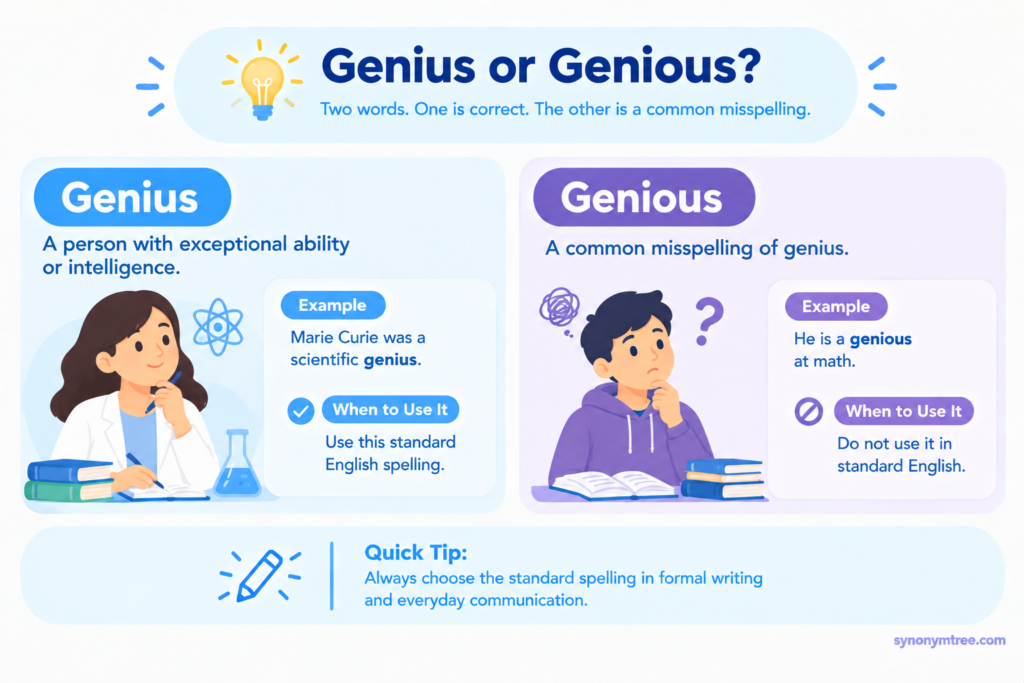
Genious or Genius Comparison
| Word | Meaning | Example Sentence | When to Use It |
|---|---|---|---|
| Genius | A person with exceptional ability or intelligence | Marie Curie was a scientific genius. | Use this standard English spelling. |
| Genious | A common misspelling of genius | He is a genious at math. | Do not use it in standard English. |
The difference is simple. Genius is the word you want in schoolwork, professional writing, emails, essays, and everyday communication.
Why Is Genius the Correct Spelling?
The word genius has been part of English for centuries. Its spelling comes from older forms of the word, rather than from the way many English speakers might expect it to sound.
That history helps explain why the word does not follow a spelling pattern that seems obvious at first. People sometimes write genious because the ending sounds close to words that contain ou or because they expect the spelling to match the sound more closely.
English spelling often keeps older forms even after pronunciation changes. That is one reason spelling and pronunciation do not always line up perfectly.
The important point for modern writers is simple. The accepted standard spelling is genius.
What Does Genius Mean?
The main meaning of genius is a person who has an unusually high level of intelligence, creativity, skill, or talent.
For example:
Albert Einstein was widely regarded as a genius.
Here, the word refers to Einstein’s exceptional intellectual ability.
The word can also describe someone who has outstanding ability in a specific area.
She is a musical genius.
This does not necessarily mean she is brilliant at every subject. It means her musical ability is exceptional.
The word can also describe an idea or action that shows remarkable intelligence.
That was a genius solution to the problem.
In this sentence, genius describes the solution rather than a person.
How Do You Spell Genius Correctly?
The correct spelling is:
G E N I U S
It has six letters.
A common mistake is to insert an o before the u and write genious. That extra letter does not belong in the standard spelling.
Another useful point is that the word ends with ius, not ious.
You can remember the spelling by breaking it into two simple parts:
gen + ius
The ending is ius.
That small detail can help prevent the most common spelling mistake.
Genius in a Sentence
Here are several natural examples:
- Everyone considered the young scientist a genius.
- Her genius for solving puzzles became clear at an early age.
- The engineer came up with a genius solution.
- He has a genius for explaining difficult ideas simply.
- Many people admired her creative genius.
- The teacher called the student’s answer genius.
- His genius helped the company solve a difficult problem.
- She showed real genius when designing the new system.
- The artist was known for her creative genius.
- That simple idea was a stroke of genius.
Notice that the word can describe a person, an ability, or an idea.
What Is the Difference Between Genius and Intelligent?
Genius and intelligent are related, but they are not identical.
Someone who is intelligent can learn quickly, understand difficult ideas, solve problems, or think clearly. The word describes a strong ability to understand and reason.
Genius usually suggests an unusually high level of ability. It is a much stronger word.
For example:
Daniel is intelligent.
This tells us that Daniel has strong thinking or learning skills.
Now consider:
Daniel is a genius.
This makes a much stronger claim. It suggests that Daniel has exceptional ability.
The difference matters in writing. Calling someone intelligent is fairly common and measured. Calling someone a genius is much stronger and can sound dramatic.
Intelligent vs Genius
| Word | Strength | Meaning |
|---|---|---|
| Intelligent | Moderate to strong | Able to learn, reason, and understand well |
| Brilliant | Strong | Exceptionally clever or impressive |
| Genius | Very strong | Exceptionally gifted or highly creative |
You should choose the word that matches what you actually want to say.
What Is the Origin of the Word Genius?
The English word genius comes from Latin genius, which referred to a guardian spirit or an inner spirit associated with a person.
Over time, the meaning changed. The word became linked to a person’s natural talent, special ability, or distinctive intellectual power.
English later developed the modern meaning of genius as a person with exceptional intellectual or creative ability.
This history is useful because it shows why spelling should not be guessed from modern pronunciation. The spelling reflects the history of the word.
The modern English sense is now much broader than the older Latin idea.
Today, you can use genius to talk about intelligence, creativity, invention, artistic talent, problem solving, or an unusually clever idea.
Why Do People Spell Genius as Genious?
The misspelling genious is easy to understand.
One reason is pronunciation. When people hear the word, the sounds do not always make the spelling obvious. Someone who has never seen the word written may try to spell it based on how it sounds.
Another reason is the familiar spelling pattern in words ending in ious.
English has many words with that ending, including:
- curious
- serious
- obvious
- various
- mysterious
- delicious
Because ious is common, some writers may expect it in genius too.
There is also the word genious, which looks like it could be a normal English form. It is not the standard spelling of the noun meaning an exceptionally intelligent person.
The safest approach is to memorize the shorter form.
Genius has no o after the n.
How Do You Pronounce Genius?
The standard American English pronunciation is commonly represented as:
JEE nee us
The word has three syllables.
The first syllable sounds like jee. The second sounds like nee. The final syllable sounds like us.
The pronunciation can make the spelling seem less obvious because the middle sounds do not clearly tell you which letters to write.
A useful way to practice it is:
genius = JEE nee us
Say it slowly while looking at the correct spelling. Then say it normally.
Genius as a Noun
The most common grammatical use of genius is as a noun.
A noun names a person, place, thing, or idea. In this case, the word can name a person known for exceptional ability.
For example:
The professor was a genius.
Here, genius is a noun describing the person.
It can also refer to an exceptional ability.
Her genius was obvious from her early work.
In that sentence, the word refers to her extraordinary intellectual or creative ability.
Common Noun Patterns
You will often see genius used in these patterns:
a genius
He is a genius.
the genius of someone
The genius of the design is its simplicity.
creative genius
The painter was known for his creative genius.
mathematical genius
She showed signs of mathematical genius.
These combinations are common in natural English.
Genius as a Descriptive Word
In casual English, genius can also appear after a noun or phrase to describe something exceptionally clever.
For example:
That was a genius move.
Here, the speaker is not saying the move itself is a person. Instead, genius acts as an informal description of how clever the move was.
You may also hear:
Genius idea.
Genius design.
Genius solution.
This use is common in conversation, social media, advertising, and informal writing.
For formal writing, you may want to use a more precise adjective such as brilliant, clever, innovative, or ingenious, depending on the meaning.
Genius vs Ingenious
These two words are closely related in spelling and meaning, so they can cause another kind of confusion.
Genius usually refers to exceptional intelligence, talent, or a person with extraordinary ability.
Ingenious means clever, inventive, or skillful at solving a problem.
Compare these examples:
She is a genius.
This describes the person.
She created an ingenious device.
This describes the device as clever and inventive.
The words are related, but they do different jobs.
Genius and Ingenious Side by Side
| Word | Main Meaning | Example |
|---|---|---|
| Genius | Exceptional intelligence or talent | He is a genius. |
| Ingenious | Clever and inventive | She found an ingenious solution. |
A simple memory trick is to remember that ingenious describes clever ideas or methods, while genius commonly names a person or exceptional ability.
Genius vs Brilliant
Brilliant is another common synonym, but it does not always mean exactly the same thing.
A brilliant person may be highly intelligent or exceptionally talented. The word is also widely used for impressive work or ideas.
She gave a brilliant presentation.
This does not necessarily mean she is a genius. It means the presentation was excellent or very impressive.
By contrast:
She is a genius.
This makes a stronger statement about her overall ability.
In everyday conversation, people often use brilliant more freely than genius.
Genius vs Smart
The difference becomes even clearer with smart.
Smart is a common everyday word. It can mean intelligent, quick to understand, or good at making decisions.
Maya is smart.
That is a normal and fairly broad statement.
Maya is a genius.
That is much stronger.
A person can be smart without being called a genius. In fact, using genius for every intelligent person can make your writing sound exaggerated.
Choose smart for ordinary intelligence. Choose genius when the level of ability is truly exceptional or when you are using the word informally for emphasis.
Genius vs Gifted
Gifted is often used for someone who has unusual natural ability.
The gifted student learned the material quickly.
This word is especially common in education.
Genius is stronger.
The student was a genius.
That statement suggests an exceptional level of ability.
A gifted student may have outstanding talent in one area. Calling someone a genius usually carries a broader or stronger meaning.
Genius vs Talented
Talent and genius are not the same thing.
A talented person has a strong natural ability in a particular area.
She is a talented musician.
A genius may show exceptional ability that goes beyond ordinary talent.
He was a musical genius.
The second sentence makes a much stronger claim.
Talent can grow through practice. Genius is often associated with unusually high ability, original thinking, or extraordinary achievement.
Common Examples With Genius
Seeing the word in different settings makes its meaning easier to understand.
Academic Example
The professor was known for his genius in theoretical physics.
The word points to exceptional intellectual ability.
Creative Example
Her creative genius changed the way people viewed the subject.
Here, genius means exceptional creativity.
Everyday Example
Turning the old shelf into a desk was a genius idea.
This is informal. The speaker means the idea was very clever.
Professional Example
His genius for simplifying complex problems made him an excellent engineer.
This sentence focuses on a special ability.
Humorous Example
I forgot my keys again. Genius move.
This is sarcastic and informal. The speaker does not literally mean the action was brilliant.
Context matters greatly with this word.
When Should You Use Genius?
Use genius when you want to describe exceptional intelligence, creativity, talent, or cleverness.
It works well in several situations.
Use Genius for Exceptional People
She is a genius at mathematics.
This tells the reader that her mathematical ability is extraordinary.
Use Genius for Creative Ability
His artistic genius was clear from his early paintings.
This emphasizes creativity and talent.
Use Genius for Clever Ideas
That was a genius solution.
This is common in casual speech and informal writing.
Use Genius for a Special Skill
He has a genius for making complicated subjects easy to understand.
This construction highlights a person’s unusual strength.
When Should You Avoid Genius?
Avoid using the word simply to make ordinary praise sound stronger.
For example:
She answered all five questions correctly, so she is a genius.
That conclusion may sound exaggerated.
A better sentence might be:
She is very smart and understands the subject well.
You should also avoid using the word in formal settings when a more exact description is available.
Instead of:
He is a genius employee.
You might write:
He is an exceptionally skilled problem solver.
The second version gives the reader useful information instead of a broad label.
Common Spelling Mistakes With Genius
The most common spelling mistake is adding an o.
Incorrect:
genious
Correct:
genius
Another mistake is changing the ending because the word sounds like it should have a different spelling.
The best way to avoid these errors is to memorize the exact form rather than trying to build the word from pronunciation.
A Simple Spelling Trick
Think:
GENIUS has no O.
The word begins with gen and ends with ius.
You can also connect the spelling to a familiar phrase:
Genius has no O.
Repeat that a few times and the correct form becomes easier to remember.
How to Remember the Spelling of Genius
Memory tricks work best when they are short.
Try this one:
A genius needs no O.
The point is not that the sentence describes a real rule. It simply gives you a quick reminder that genius contains no o.
Another trick is to picture the word as:
GEN + IUS
The middle does not contain an o.
You can also write the word several times:
genius
genius
genius
Then use it in a sentence:
She is a genius.
Connecting spelling to actual use can make the correct form easier to recall.
Common Phrases With Genius
Learning common word combinations can help you use the word naturally.
Creative Genius
This means exceptional creative ability.
Her creative genius was clear in every painting.
Mathematical Genius
This describes someone with exceptional ability in mathematics.
The young mathematician was considered a mathematical genius.
Musical Genius
This refers to extraordinary musical ability.
The composer was remembered as a musical genius.
Stroke of Genius
This phrase describes an unusually clever idea or action.
Hiring a local guide was a stroke of genius.
Sheer Genius
This means something is extremely clever or impressive.
The simple design was sheer genius.
Genius Idea
This is informal and means a very clever idea.
That is a genius idea.
Is Genius Always a Compliment?
Usually, yes, but context can change the meaning.
If you say:
You are a genius.
You are normally praising someone’s intelligence or cleverness.
However, tone can make the statement sarcastic.
Imagine someone spills coffee on an important document and then says:
Well, I’m a genius.
The speaker is being sarcastic. They mean the opposite of the literal words.
This is common in spoken English and casual writing.
The same thing happens with phrases such as great job or nice work. Tone and context can change the meaning.
Can Genius Describe an Idea?
Yes.
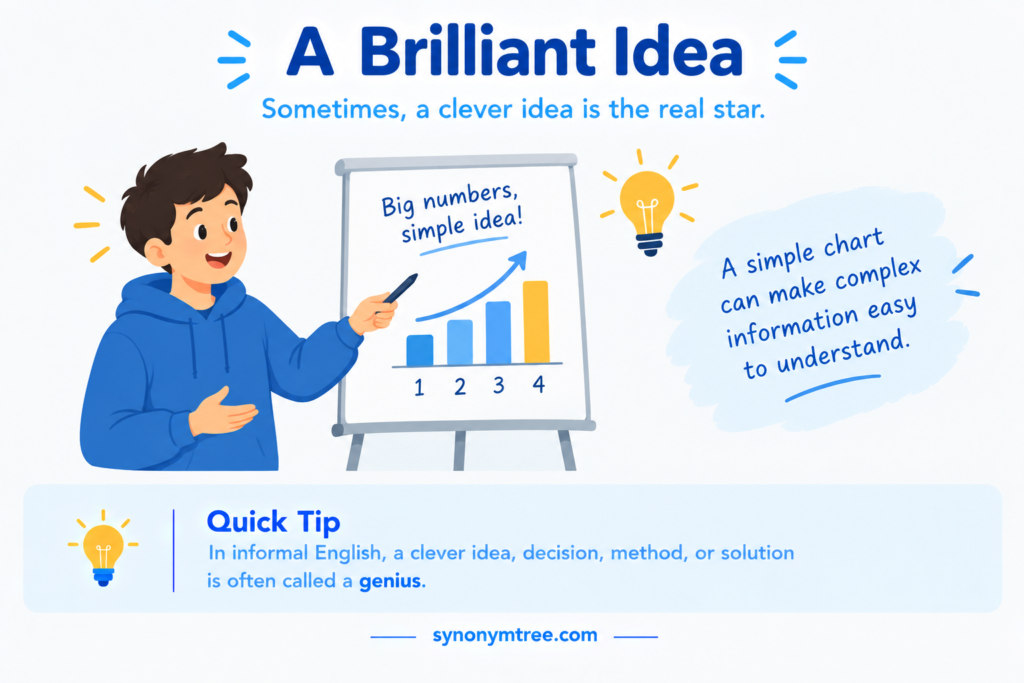
In informal English, genius can describe an idea, decision, method, or solution that is especially clever.
For example:
Using a simple chart to explain the numbers was genius.
This use is common in conversation.
For more formal writing, consider alternatives such as:
- brilliant
- clever
- inventive
- ingenious
- innovative
- highly effective
The best choice depends on what you want to emphasize.
Can Genius Be Used as an Adjective?
In traditional grammar, genius is mainly a noun.
However, modern informal English often uses it before another noun to describe something as exceptionally clever.
For example:
That was a genius move.
This use is common in casual speech.
In formal writing, genius is usually better treated as a noun, while an adjective such as brilliant, ingenious, or clever may be more suitable.
Compare:
That was a genius solution.
with:
That was an ingenious solution.
The second version is more conventional in formal writing.
What Is the Plural of Genius?
The standard plural is geniuses.
For example:
The museum displayed works by several famous geniuses.
There is also an older plural form, genii, but it has a different history and is not normally needed when talking about several exceptionally intelligent people.
For everyday English, use geniuses.
Singular and Plural Examples
He is a genius.
They are geniuses.
The class studied several famous geniuses.
Many geniuses have produced work that changed their fields.
Using geniuses is the safest choice in ordinary modern English.
What Is the Adjective Form of Genius?
There is no simple adjective formed by adding a standard ending directly to genius.
Words such as brilliant, exceptional, gifted, intellectual, and ingenious can express related ideas.
The right choice depends on what you mean.
If you are describing a person:
She is exceptionally intelligent.
If you are describing an idea:
It was an ingenious solution.
These choices are often clearer than forcing the noun into a different grammatical role.
Examples of Genius in Real Life
The word appears in many types of writing and speech.
A teacher might say:
Your solution was genius.
A friend might say:
That was a genius idea.
A journalist might write:
The scientist was recognized for his intellectual genius.
A student might write:
Einstein is often described as a genius.
A manager might say:
She has a genius for finding simple solutions.
An artist might say:
I admire his creative genius.
A parent might tell a child:
You don’t have to be a genius to solve this.
A sports fan might say:
That was a genius move by the coach.
Each sentence uses the same word, but the meaning shifts slightly with context.
How to Use Genius in Formal Writing
Formal writing needs careful word choice.
If you are writing an essay, research paper, report, or professional document, do not use genius simply as a general compliment.
Instead, explain the specific ability.
For example:
The researcher demonstrated exceptional skill in statistical analysis.
This is more precise than:
The researcher was a genius at statistics.
However, genius can still work in formal writing when the context supports it.
For example:
The artist’s creative genius influenced generations of painters.
The phrase has a clear meaning and fits the subject.
Precision matters more than using the strongest possible word.
How to Use Genius in Everyday Speech
Everyday English is more flexible.
You can say:
You’re a genius.
Genius idea.
That was genius.
What a genius move.
These phrases are common ways to praise someone’s cleverness.
They can also be playful or sarcastic.
The meaning depends on the situation, facial expression, tone, and surrounding words.
That is why a sentence that sounds strange in a formal essay may sound completely natural in conversation.
Common Mistakes to Avoid
Several mistakes appear often with this word.
Mistake 1: Adding an O
Incorrect:
He is a genious.
Correct:
He is a genius.
Remember that the standard spelling has no o.
Mistake 2: Confusing Genius With Ingenious
Incorrect use:
She is an ingenious.
The word ingenious is an adjective, so it needs a noun or another suitable structure.
Correct:
She created an ingenious device.
Or:
She is a genius.
Mistake 3: Overusing Genius
Calling every good idea genius weakens the word.
If something is simply useful, call it useful.
If it is clever, call it clever.
Save genius for stronger praise or use it casually when you deliberately want an enthusiastic tone.
Mistake 4: Assuming Genius Means Perfect
Being a genius does not mean a person is always correct.
The word refers to exceptional ability. It does not guarantee perfect judgment, behavior, or knowledge.
Mistake 5: Using Genius When You Mean Talent
A talented person may have a strong skill without being a genius.
Use talented when you want to praise ability without making such a strong claim.
Genius Synonyms
Several words can replace genius, depending on the context.
Intelligent
A person who learns and reasons well.
She is highly intelligent.
Brilliant
Someone or something exceptionally impressive or clever.
He came up with a brilliant idea.
Gifted
Someone with unusual natural ability.
She is a gifted musician.
Expert
Someone with advanced knowledge or skill in a field.
He is an expert in computer science.
Prodigy
A young person with exceptional ability, especially for their age.
The child was a piano prodigy.
Mastermind
A person responsible for planning or organizing something complex, often successfully.
She was the mastermind behind the project.
Visionary
Someone with original ideas about the future.
The designer was a visionary.
Savant
A person with remarkable ability in a particular field, especially in a context involving unusual cognitive abilities.
This word is more specialized and should be used carefully.
Genius Antonyms
There is no single perfect opposite of genius.
Depending on the meaning, possible contrasts include:
- unintelligent
- foolish
- unskilled
- inexperienced
- ordinary
- average
These words do not all mean the same thing.
For example, average simply means typical. It does not mean unintelligent.
Likewise, someone can lack experience without lacking intelligence.
Choose the opposite carefully based on the idea you want to express.
How Genius Works in Different Contexts
The best word choice depends on where you are writing.
In a Resume
Avoid calling yourself a genius.
A resume should show evidence of your abilities.
Instead of:
Genius software developer.
Write:
Skilled software developer with experience building reliable web applications.
Specific skills are more useful than broad praise.
In an Essay
Use genius when discussing exceptional ability or a person’s historical reputation.
The author’s literary genius can be seen in the way he uses language.
Support the statement with examples.
In an Email
In a casual email, genius can be friendly and natural.
That was a genius solution to the scheduling problem.
For a formal business email, a more precise word may work better.
That was an excellent solution to the scheduling problem.
In a Text Message
The informal use is common.
Genius!
You’re a genius.
That’s a genius idea.
These are natural ways to praise someone.
In Speaking
The word is very common in conversation.
He’s a genius.
That was genius.
She’s a genius at fixing things.
Tone carries a lot of meaning in spoken English.
Conclusion
If you are choosing between genious or genius, use genius. The other form is a common spelling mistake, not the standard spelling of the English word.
Remember the simple pattern: genius = gen + ius. There is no extra o in the middle. The word usually describes exceptional intelligence or talent, but it can also describe a remarkably clever idea or solution in informal English.
Context still matters. Use genius for strong praise, and choose words such as intelligent, talented, brilliant, or ingenious when they give a more exact meaning.
The next time you hesitate over the spelling, think of the short rule: a genius needs no O. That quick memory trick can help you write the correct form with confidence.
Frequently Asked Questions
Is genious or genius the correct spelling?
Genius is the correct spelling. Genious is a common misspelling and should not be used in standard English.
Why do people spell genius as genious?
People often spell it that way because the pronunciation does not make the spelling obvious. The familiar ious pattern in words such as serious and curious may also lead writers to add an unnecessary o.
How do you spell genius correctly?
Spell it G E N I U S. A useful reminder is that genius has no o between the n and u.
What does genius mean?
Genius usually means a person with exceptional intelligence, creativity, or ability. It can also describe an unusually clever idea, action, or solution in informal English.
Is genius the same as intelligent?
No. Intelligent means able to understand, learn, and reason well, while genius usually suggests an exceptional level of ability. Genius is a much stronger word.
What is another word for genius?
Good alternatives include brilliant person, gifted person, expert, prodigy, mastermind, or visionary. The best choice depends on the person’s specific ability and the context.
Is genius a noun or an adjective?
Genius is primarily a noun. In informal English, it can sometimes be used before a noun, as in genius idea or genius move, but formal writing often uses adjectives such as brilliant or ingenious instead.
What is the plural of genius?
The usual modern plural is geniuses. For example, you can say, “The book discusses several famous geniuses.”
What is the difference between genius and ingenious?
Genius is mainly a noun referring to exceptional intelligence or ability. Ingenious is an adjective meaning clever, inventive, or skillful at solving problems.

1 thought on “Genious or Genius Best Spelling Guide In 2026”