
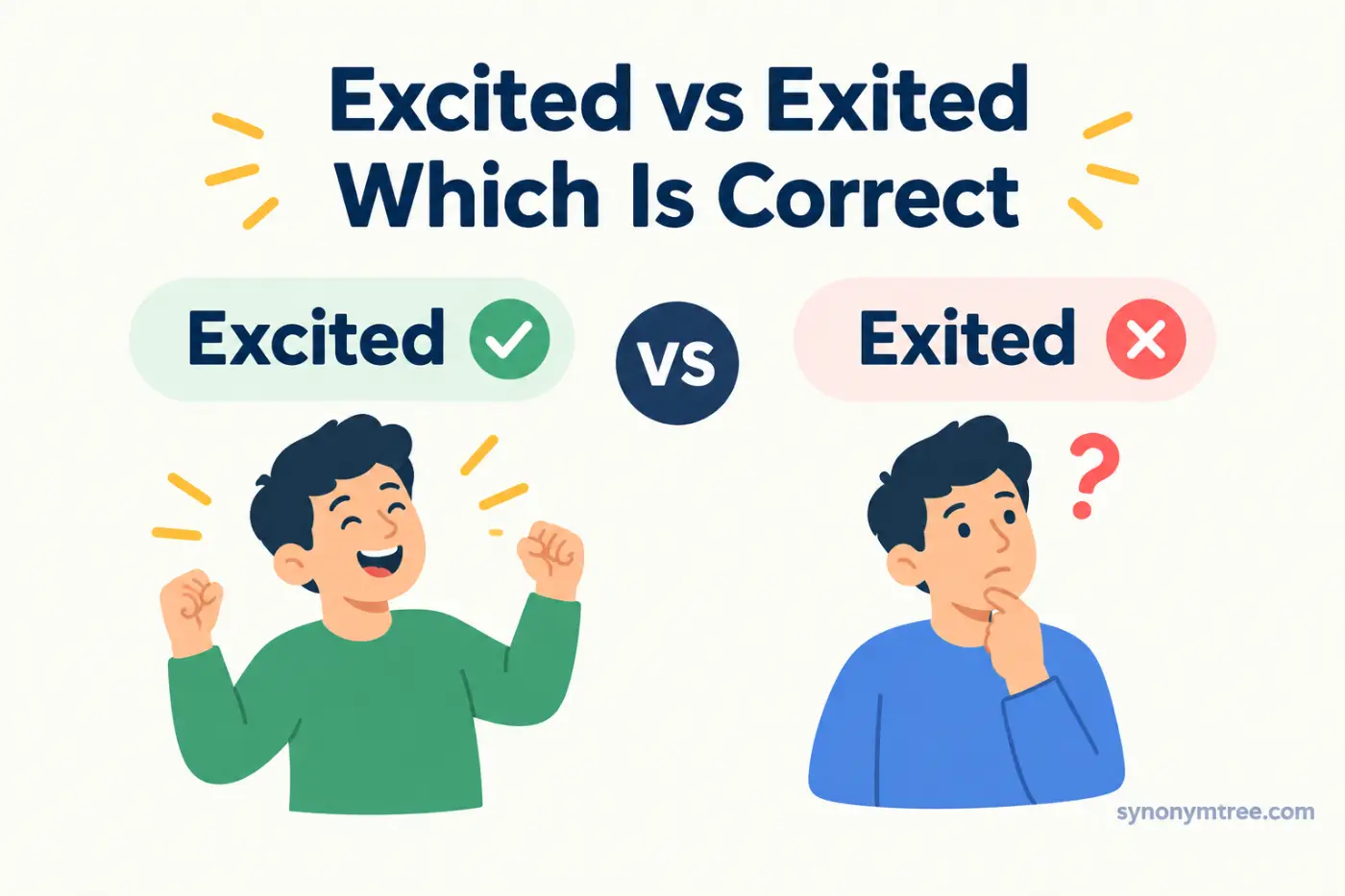
If you are confused by excited vs exited, you are not alone. These two words look almost the same, but they have very different meanings. One describes a strong feeling of happiness or enthusiasm. The other means leaving a place or going out.
The correct word depends on what you want to say. You might be excited about a vacation because you cannot wait for it. You might have exited the building after the event ended. Mixing them up can change the meaning of your sentence completely.
This guide explains the difference between excited and exited in simple English. You will learn their meanings, pronunciation, grammar forms, common mistakes, examples, and easy ways to remember which word to use.
Quick Definition
Excited means very happy, eager, or enthusiastic about something. Exited is the past tense of exit, which means left a place or went out. Although the words differ by only one letter, they describe completely different ideas.
Direct Answer
Excited describes a strong feeling of happiness or enthusiasm, while exited means left a place or went out. Use excited for feelings and exited for leaving.
Comparison Table
| Word | Meaning | Example Sentence | When to Use It |
|---|---|---|---|
| Excited | Very happy, eager, or enthusiastic | I am excited about the trip. | Use it for feelings and anticipation. |
| Exited | Left a place or went out | She exited the theater after the show. | Use it when someone leaves a place. |
Why These Words Get Confused These Excited Vs Exited
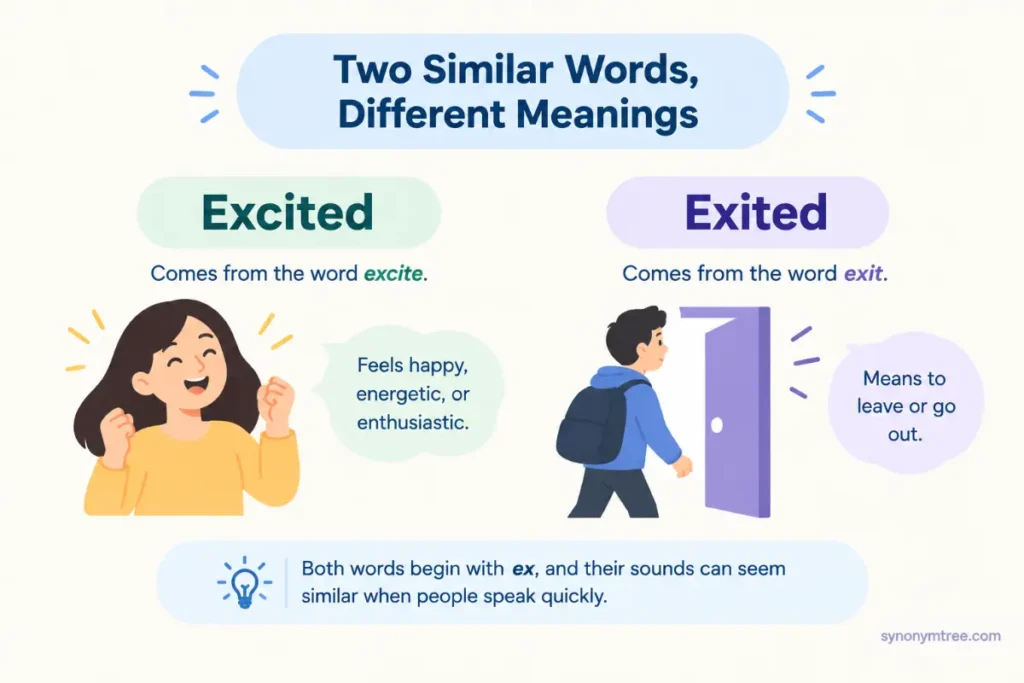
The confusion comes from the spelling. Excited contains the letters in excite, while exited comes from exit. Both words begin with the letters ex, and their sounds can seem similar when people speak quickly.
There is also a grammar reason for the confusion. Both words can describe something connected to the past, but they work differently in a sentence. One normally describes an emotional state, while the other describes an action.
Consider these two sentences.
I was excited about the concert.
I exited the concert hall at midnight.
The first sentence tells us how the person felt. The second tells us what the person did. The spelling is similar, but the meaning is completely different.
Another reason for the mistake is that many people learn these words through speech before they learn how to spell them. If you hear someone say one of them without seeing it written down, the difference may not stand out.
The best way to avoid the mistake is to focus on meaning first. Ask yourself what the sentence is trying to describe. If it describes a feeling, excited is probably the word you need. If it describes leaving a place, exited is the better choice.
What Excited Means
Excited is an adjective that describes a strong feeling of happiness, enthusiasm, or anticipation. It often appears when someone is looking forward to something.
For example, you might say, I am excited about my birthday. You could also say, The children were excited to see the animals. In both sentences, the word describes a person’s emotional reaction.
The word can describe a small amount of enthusiasm or a very strong emotional reaction. Context tells the reader how strong the emotion is.
You could say, I am excited about dinner tonight. That might simply mean you are looking forward to the meal. You could also say, The fans were excited when their team won. Here, the word suggests a much stronger reaction.
Excited As An Adjective
The most common use of excited is as an adjective. An adjective describes a person, place, thing, or state. In this case, excited describes how someone feels.
She is excited.
He looks excited.
The students became excited when the teacher announced the trip.
I am excited to start my new project.
Notice that the word describes the person or group experiencing the emotion. It does not describe an action of leaving.
We often use excited about before a noun, activity, event, or idea. For example, I am excited about the weekend. They are excited about the new movie. We are excited about the opportunity.
We can also use excited to before a verb. For example, I am excited to meet you. She is excited to begin college. He was excited to open the gift.
Both patterns are common in American English.
Excited Can Describe Anticipation
Excitement often happens before something takes place. That is why the word is closely connected to anticipation.
If you have tickets for a concert next week, you might say, I am excited about the concert. The concert has not happened yet. You are describing your current feeling about something that will happen later.
The same idea works in many situations. She is excited about starting school. We are excited to see our friends. The children are excited about the holiday. He is excited to receive his new phone.
The event does not have to happen yet. The emotion can exist before the event.
Excited Can Describe Positive Reactions
You can also use excited after something good happens. The crowd was excited when the singer came on stage. Everyone was excited by the news. The students were excited when they heard about the field trip.
In these examples, the people are reacting to something that has already happened or has just been announced.
What Exited Means
Exited is the past tense and past participle of the verb exit. It means left a place, area, building, vehicle, website, or situation.
For example, you might say, She exited the building. You could also write, The driver exited the highway. Another natural example is, We exited the theater after the movie.
The word tells us about movement away from a place or situation. It does not describe happiness or enthusiasm.
The base verb is exit. In the present tense, you might say, I exit the building through the side door. In the past tense, you say, I exited the building through the side door. For an ongoing action, you can say, I am exiting the building. You can also say, I have exited the building.
The form changes because of grammar, but the central meaning stays the same. The person or thing leaves.
Exited Is A Verb
Unlike excited, which commonly works as an adjective, exited is a verb form.
Look at this sentence: The guests exited the restaurant. The action is exited. The guests performed the action by leaving the restaurant.
Now compare it with this sentence: The guests were excited about the restaurant. Here, excited describes how the guests felt.
That simple grammar difference can help you choose the correct spelling.
Exited Can Refer To Places
A person can exit almost any defined place or area.
The passengers exited the plane.
The students exited the classroom.
The shoppers exited the store.
The workers exited the office.
The family exited the stadium.
In each example, someone moves out of a location.
The word can also describe a vehicle leaving a road or route. For example, The driver exited the highway at the next ramp. We exited the freeway near downtown.
In these cases, exit describes leaving a route or area.
Excited And Exited In Real Sentences
Looking at the two words side by side makes the difference easier to understand.
I was excited about the trip.
I exited the airport after picking up my luggage.
The children were excited about the new playground.
The children exited the playground before dark.
She was excited to meet her favorite author.
She exited the bookstore after the signing.
He was excited about his new apartment.
He exited the old apartment for the final time.
These examples show a useful pattern. Excited answers a question about emotion. Exited answers a question about movement.
Ask yourself what the person felt. If the answer is happiness, enthusiasm, eagerness, or anticipation, use excited.
Then ask yourself what the person did. If the answer is left, went out, or moved away from a place, use exited.
That quick test works in most everyday situations.
How To Use Excited Correctly
There are several common sentence patterns with excited. Learning them can make your writing sound more natural.
Excited About
Use excited about before a noun, activity, event, or idea.
I am excited about the weekend.
She is excited about her new position.
They are excited about the wedding.
We are excited about the school trip.
He was excited about the surprise.
The phrase can also appear with a gerund. For example, I am excited about starting my new job. She is excited about meeting the team. They are excited about moving into their new house.
The word after about can be a thing or an activity.
Excited To
Use excited to before a base verb.
I am excited to see you.
She is excited to start college.
We are excited to announce the winner.
He was excited to open the package.
They are excited to visit their grandparents.
This structure is especially common in emails, announcements, and professional communication.
For example, We are excited to announce our new service. I am excited to join the team. We are excited to work with you.
These sentences express enthusiasm about something that is happening or will happen.
Excited For
In American English, excited for is also common in informal speech.
I am excited for the weekend.
She is excited for her birthday.
We are excited for the game.
They are excited for the trip.
Traditional grammar advice may favor excited about in some contexts, but excited for is widely used in everyday American English. It often focuses on an upcoming event.
For formal writing, excited about or excited to can sometimes sound more polished.
How To Use Exited Correctly
Use exited when someone or something left a location or route.
The guests exited the building.
The car exited the highway.
She exited the room.
The passengers exited the train.
We exited the store through the back door.
The verb can also describe leaving an activity or situation. You might write, The actor exited the stage. Another example is, The player exited the game after an injury.
In each case, the word still describes leaving or withdrawing from a place, activity, or situation.
Exited Does Not Describe Happiness
A common mistake is to use exited when you mean excited.
For example, I am exited about my vacation is incorrect if you mean that you are looking forward to the vacation.
The correct sentence is, I am excited about my vacation.
The word exited would suggest that you left something.
For example, I exited the airport means I left the airport. It does not mean I was happy about my airport visit.
The Pronunciation Difference
Spelling becomes easier when you understand the sounds.
Excited is commonly pronounced like ik SAI tid.
Exited is commonly pronounced like EG zit id.
The first syllable is the key difference. Excited begins with the sound associated with excite. Exited comes from exit, so the pronunciation follows the verb exit.
When speaking naturally, the sounds can pass quickly. That is one reason listeners may confuse the words.
Reading them aloud slowly can help.
Excited.
Exited.
Now connect each sound to its base word. Excited comes from excite. Exited comes from exit.
Once you connect the spelling to the base word, the difference becomes much easier to remember.
The Word Family For Excited
Understanding related forms can help you recognize the correct spelling.
The main word family includes excite, excites, excited, exciting, and excitement.
Excited describes the person experiencing the emotion. For example, I am excited.
Exciting describes something that causes the emotion. For example, The movie was exciting.
This distinction is useful because learners sometimes confuse excited and exciting.
Excited And Exciting
Use excited for the person or group experiencing the emotion.
The children were excited.
Use exciting for the thing that causes the emotion.
The trip was exciting.
This distinction prevents another common grammar mistake. You would not normally say, The trip was excited. A trip can be exciting, while a person can be excited.
The Word Family For Exited
The related forms of exited come from the verb exit.
The word family includes exit, exits, exited, and exiting.
The basic meaning remains connected to leaving.
He exits the building at five.
He exited the building at five.
He is exiting the building now.
He has exited the building.
The spelling changes because of tense and grammar, but the idea stays the same.
Exit As A Noun
Exit can also be a noun.
The emergency exit is near the stairs.
We took the next exit.
The theater has two exits.
Look for the exit.
In these sentences, exit refers to a door, route, or place used for leaving.
That noun form can help you remember exited. If the sentence relates to an exit, the verb exited may describe the action of leaving.
Common Mistakes With These Words
The most common error is using exited when the writer means excited.
I am exited about my new job.
The intended meaning is enthusiasm, so the sentence should be, I am excited about my new job.
Another mistake goes in the opposite direction.
The passengers excited the plane.
This is not the normal way to say that the passengers left the plane. The natural sentence is, The passengers exited the plane.
There is also a grammar mistake where people use exciting instead of excited.
I am exciting about the vacation.
The correct sentence is, I am excited about the vacation.
The vacation may be exciting. You are excited.
Mistake With Past Tense
Because excited looks like a past tense form, some learners assume it always describes something that happened in the past.
That is not true.
I am excited about the trip.
This sentence uses excited to describe a current feeling.
The same word can appear with different forms of the verb be.
I am excited.
She is excited.
They are excited.
We were excited.
He was excited.
The tense comes from am, is, are, or was. The word excited describes the emotional state.
Mistake With Exited And Exit
Some writers use exited after a helping verb incorrectly.
I did exited the building.
In standard English, this should be, I did exit the building.
After did, use the base form exit, not the past form exited.
The same rule applies to other regular verbs. We say, I did walk home, not I did walked home.
So the correct sentence is, I did exit the room. You should not write, I did exited the room.
This grammar point is separate from the spelling confusion, but it helps you use the verb correctly.
Excited And Exited In School Writing
Students often use these words in stories, essays, and personal writing.
Suppose you are writing about a school trip. You could write, I was excited about the trip from the moment my teacher announced it.
Later, you could write, When the trip ended, we exited the museum through the main door.
The first sentence describes anticipation. The second sentence describes movement.
You can even use both words in the same short passage. The students were excited to see the science exhibit. After an hour, they exited the museum and returned to the bus.
The students feel excited. Then they leave the museum.
Teachers may see this mistake in assignments because the words sound similar. Students who learn the base words excite and exit can usually correct the error quickly.
Excited Vs Exited In Professional Writing
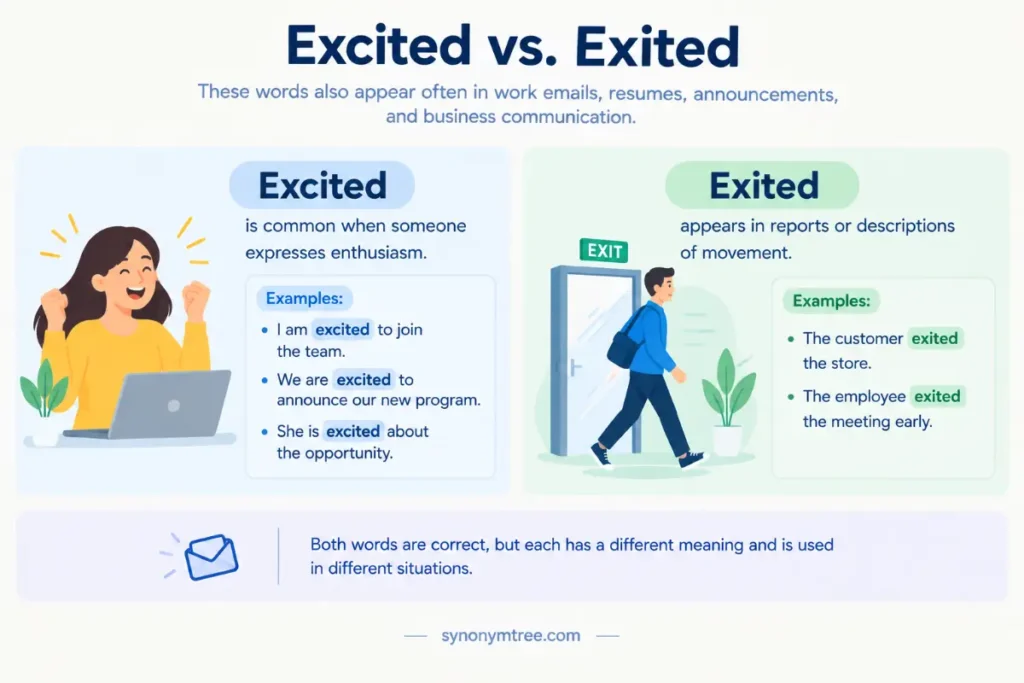
These words also appear often in work emails, resumes, announcements, and business communication.
Excited is common when someone expresses enthusiasm.
I am excited to join the team.
We are excited to announce our new program.
She is excited about the opportunity.
Exited appears in reports or descriptions of movement.
The customer exited the store.
The employee exited the meeting early.
The vehicle exited the parking area.
A single letter can change the message.
Compare these two ideas. I am excited to join the company expresses enthusiasm. I exited the company describes leaving.
For professional writing, always check the meaning before sending the message. A spelling mistake can make an otherwise clear sentence confusing.
Excited And Exited In Text Messages
Text messages often contain spelling mistakes because people type quickly. This pair is especially easy to mix up.
Someone might write, I am so exited for the concert.
Most readers will understand the intended meaning, but the spelling is still incorrect.
The correct version is, I am so excited for the concert.
In casual messages, people may overlook small spelling errors. Still, using the correct word is better when the message matters.
This becomes especially important in work emails, school assignments, social media posts, invitations, and public writing.
Related Confusing Words
English has many word pairs that look or sound similar but have different meanings. Learning the difference between these words can also help you understand similar spelling problems.
Affect And Effect
Affect is commonly used as a verb meaning to influence.
The weather can affect your plans.
Effect is commonly used as a noun meaning a result.
The storm had a major effect on traffic.
The words are different in meaning even though they are often confused.
Advice And Advise
Advice is a noun.
She gave me good advice.
Advise is a verb.
I advise you to arrive early.
The final sound helps distinguish them in speech.
Accept And Except
Accept means to receive or agree to something.
She accepted the invitation.
Except means excluding someone or something.
Everyone came except John.
These words are another example of English words that can create problems because they look or sound similar.
Then And Than
Then often relates to time or sequence.
We ate dinner and then watched a movie.
Than is used for comparisons.
She is taller than her brother.
The best approach with confusing words is the same each time. Learn the meaning and connect the spelling to that meaning.
More Examples To Make The Difference Clear
I was excited when I received the invitation.
The guests exited the hall after dinner.
She is excited about her new position.
She exited her previous position after accepting another offer.
The children were excited to see the fireworks.
The children exited the park before the rain began.
We are excited about the upcoming trip.
We exited the airport through the north door.
He was excited to open his birthday gift.
He exited the room after opening the gift.
The fans were excited when the game started.
Some fans exited the stadium before the final whistle.
These examples show how the two words can appear in similar situations while still carrying different meanings.
When Both Words Can Appear Together
It is possible to use both words in one sentence.
The audience was excited when the band arrived, but many people exited the theater before midnight.
Here, excited describes an emotional response. Exited describes an action.
Another example is, The students were excited about the trip, but they exited the bus as soon as they reached the museum.
The students feel excited. Then they leave the bus.
You can use this contrast as a mental exercise. Write one sentence with excited and another with exited. Make sure one describes a feeling and the other describes leaving.
A Fast Test For Choosing The Right Word
When you are unsure, replace the word with a simpler phrase.
If you can replace it with very happy, eager, or enthusiastic, use excited.
For example, I am excited about the vacation. The meaning is about anticipation and enthusiasm, so excited is the correct choice.
If you can replace the word with left or went out, use exited.
For example, She exited the building. You can replace exited with left and keep almost the same meaning. That tells you exited is the correct word.
This replacement test works quickly because it focuses on meaning instead of spelling.
Why Context Matters
A word cannot always be chosen by looking at its letters alone. You need to consider the whole sentence.
Take this example: The guests were excited. There is no place being left. The sentence describes an emotional state.
Now look at: The guests exited. The sentence may need more information, but the meaning suggests that the guests left.
Add a location and the meaning becomes clear. The guests exited the restaurant.
Context tells the reader what the word is doing. If the sentence talks about emotions, anticipation, happiness, or enthusiasm, excited fits. If it talks about doors, rooms, buildings, roads, stages, vehicles, or places, exited may fit.
How To Remember The Difference
The easiest long term method is to connect each word to its root.
Excited comes from excite.
Exited comes from exit.
Then connect each root to a simple meaning.
Excite relates to strong interest or enthusiasm.
Exit means leave or go out.
From there, the forms become easy.
Excite becomes excited.
Exit becomes exited.
You can also picture an exit sign when you see exited. An exit tells you where to go out. Someone who exited has already gone out.
For excited, picture someone looking forward to a birthday, vacation, concert, game, or special event.
The mental images are completely different, which makes the spelling easier to recall.
A Short Practice Exercise
Try choosing the correct word in each sentence.
I am very ______ about my vacation.
The passengers ______ the plane after it landed.
She was ______ to receive the award.
We ______ the building through the main door.
The children are ______ about the school trip.
Several people ______ the theater before the movie ended.
The answers follow a simple pattern. The first sentence needs excited because it describes a feeling. The second needs exited because the passengers left the plane. The third uses excited because it describes enthusiasm. The fourth uses exited because the people left the building. The fifth uses excited because it describes anticipation. The sixth uses exited because people left the theater.
How To Correct The Mistake In Your Writing
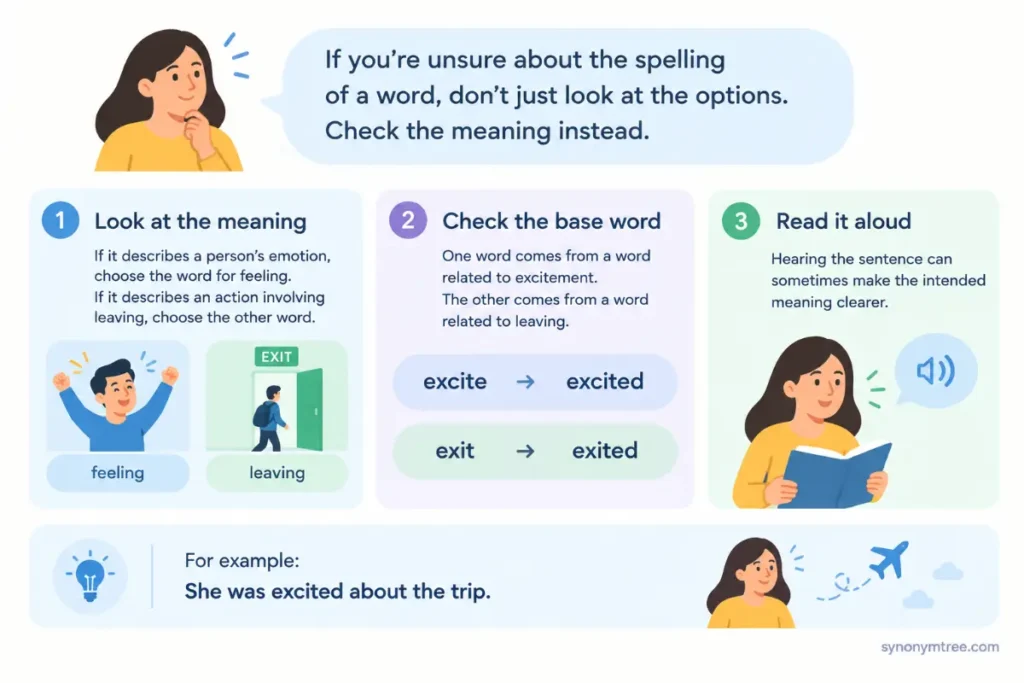
If you have already written a sentence and are unsure about the spelling, do not stare at the two words. Check the meaning instead.
Start by asking what the word describes. If it describes a person’s emotion, use excited. If it describes an action involving leaving, use exited.
Next, check the base word. Excited comes from excite. Exited comes from exit.
Finally, read the sentence aloud. Hearing the sentence can sometimes make the intended meaning clearer.
For example, I am exited to see my family is incorrect when the writer means anticipation. The phrase to see my family shows that the person is looking forward to something. The corrected sentence is, I am excited to see my family.
Now consider the sentence, We exited to see our family. That does not express anticipation. Exited describes leaving, so it needs a context involving movement away from a place.
Conclusion
The difference between excited vs exited comes down to one simple idea. Excited describes a feeling of happiness, enthusiasm, or anticipation. Exited means left a place or went out.
Think about the base words when you write. Excited comes from excite, so use it for emotions and enthusiasm. Exited comes from exit, so use it for leaving a room, building, vehicle, road, event, or other place.
When you are unsure, replace the word with eager or happy for excited, and left for exited. If the replacement makes sense, you have your answer. That quick check can prevent one of the most common spelling mistakes between these two similar looking words.
FAQs
What is the difference between excited and exited?
Excited describes a strong feeling of happiness, enthusiasm, or anticipation. Exited is the past tense of exit and means left a place or went out. The two words look similar but have different meanings.
Is excited or exited correct for happiness?
Excited is correct when you are talking about happiness, enthusiasm, or anticipation. For example, I am excited about my new job describes a positive feeling. Exited does not have this meaning.
Is excited or exited correct for leaving?
Exited is correct when you mean someone left a place or went out. For example, She exited the building means she left the building. Excited would describe how she felt, not the act of leaving.
How do you remember the difference between excited and exited?
Connect excited with excite, which relates to enthusiasm and strong interest. Connect exited with exit, which means a way out or the act of leaving.
Is it correct to say I am exited for the trip?
No. If you mean that you are looking forward to the trip, the correct sentence is I am excited for the trip. You can also say I am excited about the trip.
Is exited the past tense of exit?
Yes. Exited is the simple past form of the verb exit. For example, She exited the room means she left the room.
Can excited and exited be used in the same sentence?
Yes. The two words can appear together when one describes a feeling and the other describes an action. For example, The children were excited about the trip, then they exited the bus at the museum.
Is excited an adjective?
Yes. Excited commonly works as an adjective that describes a person’s emotional state. In I am excited about the concert, excited describes how the speaker feels.

1 thought on “Excited vs Exited Which Is Correct In 2026”