

When you write a text or an email and want to say you expect something good to happen, you might wonder if hoping or hopeing is the correct spelling. Many English learners make this mistake because both forms look like they could be right. However, only one follows the normal spelling rule.
The correct spelling is hoping. You drop the final letter e from hope before adding ing. For example, you should write, “I am hoping for good news.” You should not write, “I am hopeing for good news.”
This rule is easy to learn once you see how it works. In this lesson, you’ll learn why hoping is correct, why hopeing is wrong, and how to use the word in everyday English. You’ll also learn a simple spelling trick that can help you avoid the same mistake with other words.
Simple Answer in One Look.
Hoping is correct. Hopeing is incorrect. When you add ing to hope, remove the final e first. The correct spelling is hope + ing = hoping.
What This Means in Simple English.
The word hoping means that you want something good to happen or think something you want may happen. It shows that you have a wish or a positive feeling about the future.
For example, imagine that you have an important test tomorrow. You studied hard and want to get a good grade. You might say, “I am hoping to get an A.” This means you want to get an A and believe it may happen.
The word hope is the basic form. When you talk about an action that is happening now or continuing for some time, you can use hoping.
Here are a few easy examples.
- I hope you feel better soon.
- I am hoping for a sunny day.
- She is hoping to win the game.
- We are hoping to visit Grandma this weekend.
- They are hoping for good news.
Notice that hope and hoping have almost the same meaning. The main difference is how you use them in a sentence.
You can say, “I hope you pass the test.” You can also say, “I am hoping you pass the test.” Both sentences express a wish. The second one puts more focus on the hope you have right now.
The spelling stays simple once you learn the rule. Start with hope. Remove the final e. Then add ing. That gives you hoping.
Why People Mix These Words.
People often confuse hoping or hopeing because they know that adding ing to a verb can make it describe an action in progress. They may think they should keep every letter in the original word and simply add ing at the end.
That idea works with some words. For example, play becomes playing, and read becomes reading. Neither word loses a letter when you add ing.
However, words that end in a silent e often follow a different rule. In these words, the final e usually disappears before ing is added. This is why hope becomes hoping instead of hopeing.
The final e in hope does not make a separate sound. It helps show how the word is pronounced. When you add ing, you no longer need that final e.
Think about how these words change.
- Hope becomes hoping.
- Smile becomes smiling.
- Write becomes writing.
- Dance becomes dancing.
- Bake becomes baking.
Each word loses its final e before ing is added.
This mistake is also common because English spelling has several rules. Some words keep their final letters, while others change when you add a word ending. You cannot always guess the correct spelling just by saying the word aloud.
For example, hoping and hopping sound similar, but they have different spellings and meanings. Hoping means wishing for something good. Hopping means making small jumps.
Here are two sentences that show the difference.
- I am hoping to see my friend today.
- The rabbit is hopping across the garden.
In the first sentence, someone wants to see a friend. In the second sentence, a rabbit is jumping.
Learning these small differences can make your writing clearer. The good news is that you do not need to memorize hundreds of rules at once. Start with the final e rule, practice it with common words, and use it whenever you write.
Clear Difference Explained Simply.
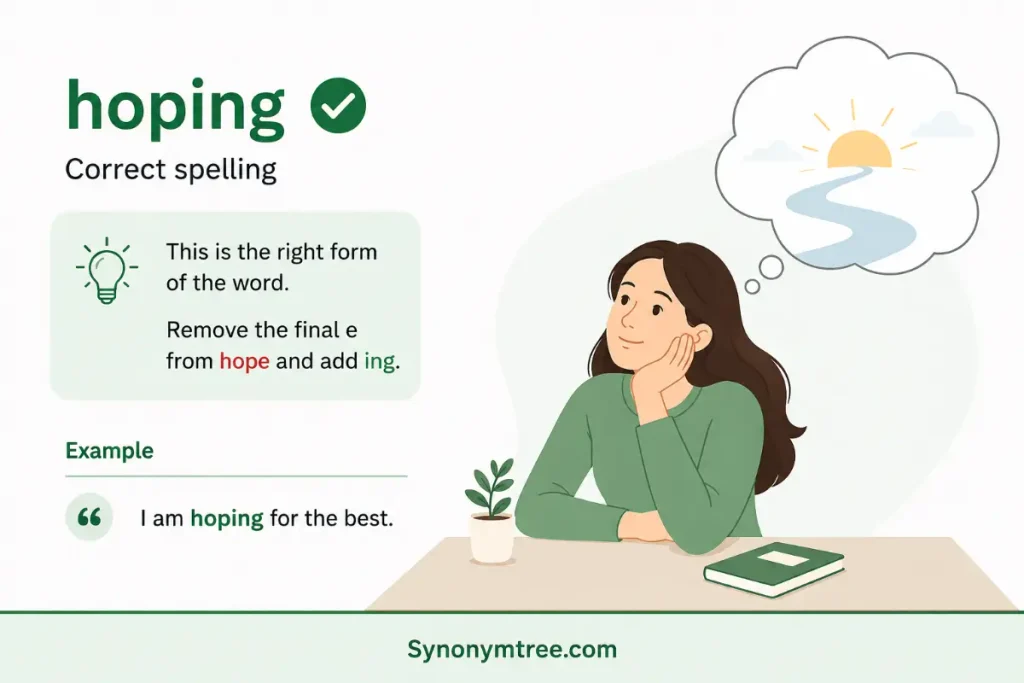
The difference between hoping and hopeing is simple. Hoping follows the correct spelling rule. Hopeing keeps a letter that should be removed.
Hoping
Correct spelling
This is the right form of the word. Remove the final e from hope and add ing.
Example. I am hoping for the best.
Hopeing
Incorrect spelling
This form is wrong in standard English because the final e should be removed before adding ing.
Incorrect example. I am hopeing for the best.
You can remember the difference by looking at the word hope itself. It ends with a silent e. When you add ing, remove that letter.
The spelling change does not make the word’s meaning completely different. Instead, it gives you the correct form for a sentence. The word hoping still carries the idea of wishing for something good.
Compare these examples.
- Correct. We are hoping to arrive early.
- Incorrect. We are hopeing to arrive early.
- Correct. He is hoping to find his keys.
- Incorrect. He is hopeing to find his keys.
The first and third sentences are correct because they follow the spelling rule. The other two contain the same spelling mistake.
Which Form Should You Use.
Use hoping whenever you want to write the ing form of the verb hope. Never keep the final e when adding ing to this word.
The easiest way to remember the rule is to think of it in three small steps. First, write hope. Next, remove the final e. Finally, add ing. You will get hoping every time.
You can also use this rule with many other common verbs that end in a silent e. For example, make becomes making, take becomes taking, and come becomes coming.
Here is a simple way to compare them.
- Hope becomes hoping.
- Make becomes making.
- Take becomes taking.
- Come becomes coming.
- Give becomes giving.
These examples follow the same basic pattern. The final e disappears before ing is added.
Still, remember that English has exceptions and other spelling patterns. For now, focus on words like hope, smile, and write. These common examples will help you build confidence.
You should also remember that hope does not always need ing. The correct form depends on your sentence.
For example, “I hope you have a good day” is correct. So is “I am hoping you have a good day.” The first sentence uses hope. The second uses hoping. Both are spelled correctly because each word fits its sentence.
If you are unsure, read your sentence again and ask yourself one simple question. Am I using the word hope with ing at the end? If the answer is yes, write hoping.
This quick check can save you from a common spelling error in school assignments, work emails, text messages, and everyday writing.
Easy Real Life Sentences You Can Use.
You will learn the spelling rule faster when you see it in normal conversations. People use hoping when they talk about plans, wishes, good news, and things they want to happen.
Read these sentences and notice how naturally the word fits into everyday English.
- I am hoping to see you tomorrow.
- She is hoping for a good grade.
- We are hoping the weather stays nice.
- He is hoping to get a new job.
- They are hoping to win the match.
- I am hoping everything goes well.
- My brother is hoping to buy a new bike.
- We are hoping for good news from the doctor.
Each sentence uses the correct spelling. You can use the same pattern to talk about your own plans and wishes.
For example, if you have a job interview next week, you might say, “I am hoping to get the job.” If your family is planning a trip, you might say, “We are hoping to visit the beach.” If a friend is sick, you could say, “I am hoping you feel better soon.”
The word works in many situations because people often talk about things they want or expect to happen. Once you know the spelling, you can use it with confidence.
Remember that you do not need to change hoping to hopeing just because the word hope contains an e. The final e disappears when you add ing. That small change is the key to spelling the word correctly.
Where the Word Hoping Comes From.
The word hoping comes from the verb hope. People have used the word hope for hundreds of years to talk about wishes and good things they want to happen.
The word hope can describe a feeling you have when you want something good in the future. When you add ing correctly, you get hoping. The spelling changes because English usually drops the final silent e before adding ing.
You do not need to study the history of the word to spell it correctly. Just remember the simple pattern. Hope becomes hoping, not hopeing.
Now that you understand the basic rule, you can use it in your daily writing. In the next section, you can build on this knowledge by learning more examples, comparing similar words, and practicing the spelling rule in different sentences.
How This Word Is Understood in Culture and Stories.
The word hoping often carries a warm and positive feeling in English. It appears in stories about family, friendship, hard work, and dreams. A character might be hoping to find a lost friend, pass a test, or return home safely. In each case, the word shows that the character wants something good to happen.
In everyday American English, people also use hoping to share their feelings without making a promise. For example, someone might say, “I am hoping we can meet this weekend.” This means the person wants to meet but may not know if the plan will work out.
Hoping can also show kindness. If your friend feels worried about an exam, you might say, “I am hoping you do well.” You are showing that you care about your friend and want a good result.
Stories often use hope to show that a person has not given up. A character may face a hard problem but keep hoping for a better result. This makes the word useful when writers want to show courage, patience, or a positive attitude.
However, the meaning of hoping depends on the sentence. It does not always mean that a person feels happy or sure. Someone can be hoping for good news while feeling nervous. The word simply tells us that the person wants something to happen.
The spelling stays the same in every situation. You should always write hoping when you add ing to hope. Stories, text messages, school essays, and work emails all follow the same spelling rule.

Biblical and Mythological Meaning.
Hope has an important place in many religious stories and old myths. People often connect it with faith, courage, patience, and the belief that life can improve. The word hoping can express the same feeling when someone waits for a good result.
In the Bible, hope often refers to trust in God and confidence in the promises of faith. People may hope for comfort during hard times or look forward to a better future. In simple words, biblical hope means trusting that good can come even when life feels difficult.
For example, a person who is facing a problem might keep praying and hoping for strength. The word hoping describes the person’s wish and trust. It does not change its spelling because of its religious use.
Hope also appears in Greek mythology. The story of Pandora’s box is a well known example. In the story, many troubles enter the world after Pandora opens a container. Hope remains inside in many familiar versions of the tale. People often discuss this ending as a sign that hope can remain even when life brings pain.
Different readers understand this myth in different ways. Some see hope as a comfort that helps people face trouble. Others ask if hope can sometimes keep people waiting for a change that never comes. The story leaves room for thought.
These religious and mythological ideas help explain why hope has such a strong place in human life. People use the word when they talk about faith, wishes, and better days ahead.
Still, there is no special religious or mythological spelling for hoping. The correct spelling is always hoping. You do not need to change the spelling based on the story or belief you are discussing.
Symbolism Explained in Simple Words.
Symbolism means using a word, object, or action to represent a bigger idea. For example, a heart can represent love, and a sunrise can represent a fresh start.
The word hope often represents the wish for something good. The word hoping shows that a person is holding on to that wish or waiting for something they want to happen.
There is no separate symbolic meaning for hoping and hopeing. One is the correct spelling, and the other is a spelling mistake. Only the correct form can be used in standard English writing.
What One Version Represents.
The correct word hoping can represent a wish, a goal, or a positive feeling about the future. In a story, a character who keeps hoping may be showing patience or courage.
For example, a student who studies for a difficult test may be hoping to pass. A family waiting for good news may be hoping for a happy result. In both cases, the word shows what they want to happen.
Hoping does not mean that success is certain. It simply shows that someone wants a good result and thinks it may happen.
What the Other Version Represents.
The spelling hopeing does not have a separate meaning in standard English. It does not represent a different emotion, belief, or cultural idea. It is simply an incorrect spelling of hoping.
For example, if a student writes, “I am hopeing to win,” the reader can probably understand the message. However, the spelling should be corrected to “I am hoping to win.”
This difference is easy to remember. Hoping is the correct word and can express a wish for the future. Hopeing is a spelling mistake and should not be used in formal or everyday writing.
Related Words You Should Know.
Learning related words can help you understand hoping and use it more naturally. These words share ideas about wishes, plans, feelings, or actions. Some follow the same spelling rule, while others help express a similar meaning.
1. Hope. This is the basic verb. You can say, “I hope you have a great day.”
2. Hoped. This is the past form of hope. For example, “I hoped to see you yesterday.”
3. Hopes. This form can describe what someone wants or expects. For example, “She hopes to become a teacher.”
4. Hoping. This is the correct form made by adding ing to hope after removing the final e. For example, “We are hoping for rain.”
5. Hopeless. This word describes a situation that seems to offer little chance of success. For example, “The task felt hopeless at first.”
6. Hopeful. This describes someone who expects a good result. For example, “He feels hopeful about his interview.”
7. Hopefully. This word often expresses a wish for a good result. For example, “Hopefully, the bus will arrive soon.”
8. Wish. A wish is something you want to happen. For example, “I wish you good luck.”
9. Expect. This means you think something will happen. For example, “I expect the package to arrive today.”
10. Dream. A dream can be something you see while sleeping or a goal you want to reach. For example, “Her dream is to become a doctor.”
These words do not all mean exactly the same thing. Hope usually expresses a wish or a positive feeling about a possible result. Expect often suggests that you think something is likely to happen. Wish can express a desire that may or may not come true.
Knowing these differences helps you choose words that fit your message. It also helps you avoid repeating the same word in every sentence.
How People Actually Use It in Daily English.
People use hoping in conversations about school, work, family, travel, health, and future plans. It sounds natural when you want to share a wish without saying that something will definitely happen.
For example, you might use hoping when you are waiting for a reply, planning a trip, or wishing someone well. The word fits both casual conversations and more formal writing.
Here are some natural examples you can use in daily life.
1. I am hoping to finish my homework before dinner.
2. We are hoping to visit our cousins next month.
3. She is hoping to get good news today.
4. He is hoping his team wins the game.
5. I am hoping you feel better soon.
6. They are hoping to find a bigger house.
7. My parents are hoping for good weather during the trip.
8. I was hoping to talk to you after class.
9. We have been hoping for a chance to visit New York.
Notice that hoping can appear in different sentence patterns. You can say you are hoping to do something, hoping for something, or hoping that something will happen.
Use hoping to when you want to describe an action or goal. For example, “I am hoping to learn English.” Use hoping for when you want something, such as “I am hoping for a quiet weekend.” Use hoping that when you want to describe a possible result, such as “I am hoping that everyone arrives on time.”
You can also use hoping in polite requests. For example, “I was hoping you could help me with this form.” This sentence sounds gentle because it shares what you want without making a strong demand.
The spelling does not change in any of these examples. You should write hoping every time.
Common Mistakes People Make.
Many English learners make small spelling mistakes when they add ing to words. The good news is that you can fix most of these errors by learning a few simple patterns.
The most common mistake with hoping is keeping the final e. People may write hopeing because they start with hope and add ing without changing anything. The correct form removes the e first.
Here are some mistakes to watch for.
1. Incorrect. I am hopeing for a good grade. Correct. I am hoping for a good grade.
2. Incorrect. She is hopeing to get the job. Correct. She is hoping to get the job.
3. Incorrect. We are hopeing for sunny weather. Correct. We are hoping for sunny weather.
4. Incorrect. He was hopeing to meet us. Correct. He was hoping to meet us.
Another common mistake is confusing hoping with hopping. These words have different meanings. Hoping means wanting something to happen. Hopping means making small jumps.
For example, “I am hoping to see a rabbit” means you want to see one. “The rabbit is hopping in the grass” means the rabbit is jumping.
Some writers also use hope and hoping in the wrong sentence pattern. For example, “I am hope to win” is incorrect. You should write “I hope to win” or “I am hoping to win.”
The first sentence uses hope by itself. The second uses hoping after am. Both are correct.
Finally, do not assume that every word ending in e follows exactly the same pattern in every situation. English has different spelling rules. However, for hope plus ing, the rule is clear and easy to remember.
Final Teacher Explanation.
Imagine that we are in an English classroom. I write two words on the board. The first word is hoping. The second word is hopeing. I ask the class to choose the correct spelling.
The answer is hoping.
Why is it correct? Because the word hope ends with a silent e. When we add ing, we remove that final e. We do not keep it.
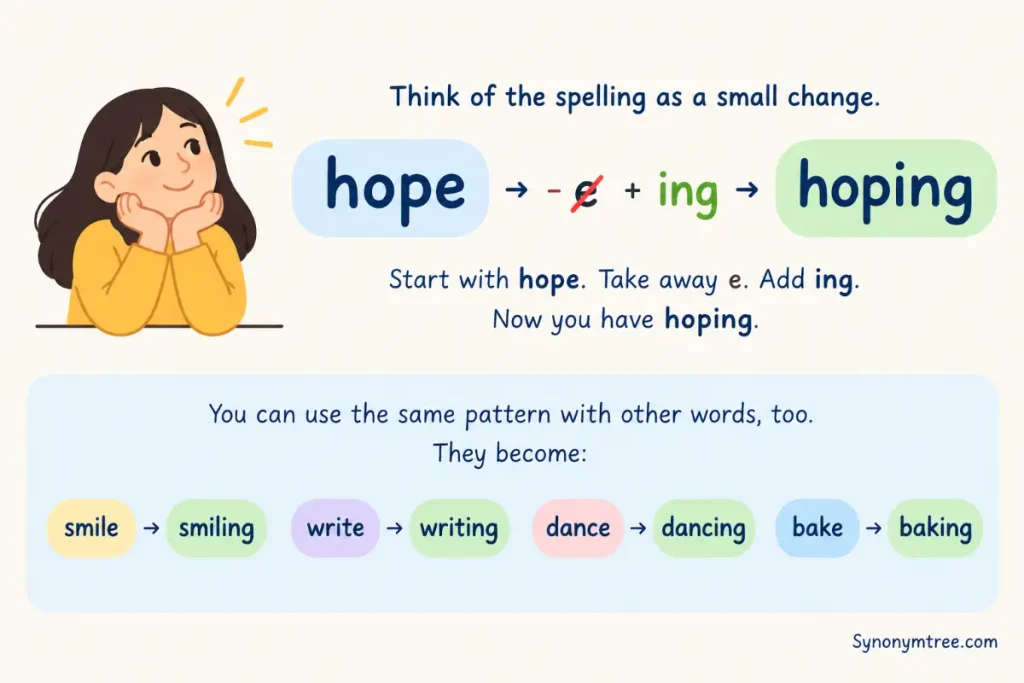
Think of the spelling as a small change. Start with hope. Take away e. Add ing. Now you have hoping.
You can use the same pattern with words like smile, write, dance, and bake. They become smiling, writing, dancing, and baking.
The meaning is just as simple. Hoping means wanting something good to happen or looking forward to a possible result. You might be hoping to pass a test, hoping to see a friend, or hoping for good news.
You do not need a special rule for schoolwork, texting, emails, or stories. The spelling stays the same in every setting.
If you remember only one thing from this lesson, remember this sentence. When you add ing to hope, drop the final e and write hoping.
Final Answer Quick Recap.
Hoping is the correct spelling. Hopeing is incorrect because the final e must be removed before adding ing.
Remember the simple rule. Hope plus ing becomes hoping.
Use hoping when you talk about a wish, a goal, or something good you want to happen.
Conclusion.
English spelling becomes easier when you learn the patterns behind common words. Hoping is a good example because one small change makes the difference between correct and incorrect spelling.
The next time you write a message or finish a school assignment, remember to remove the final e from hope before adding ing. Write hoping for good news, hoping to pass a test, or hoping to see a friend. Each example follows the same rule.
Keep practicing with simple words and sentences. The more you use the correct form, the easier it will become to remember. Soon, you will write hoping without stopping to think about the spelling.
Frequently Asked Questions (FAQs).
Is hoping or hopeing correct.
Hoping is correct. Hopeing is a spelling mistake because you must remove the final e before adding ing.
Why is hoping spelled without an e.
The word hope ends in a silent e. When you add ing, you remove that e to make hoping.
What does hoping mean in simple English.
Hoping means wanting something good to happen. For example, you might be hoping to pass a test or receive good news.
Is hoping a real word.
Yes. Hoping is the correct ing form of the verb hope. People use it when talking about wishes and future plans.
Can I use hopeing in an email.
No. Use hoping in emails and other writing. Hopeing is incorrect in standard English.
What is the difference between hoping and hopping.
Hoping means wishing for something to happen. Hopping means making small jumps. The two words have different meanings and spellings.
Does hope become hoping or hopeing.
Hope becomes hoping. Remove the final e and then add ing.
How can I remember the correct spelling of hoping.
Remember this simple pattern. Hope loses its final e before ing is added. That gives you hoping.

2 thoughts on “Hoping or Hopeing The Complete Spelling Lesson 2026.”