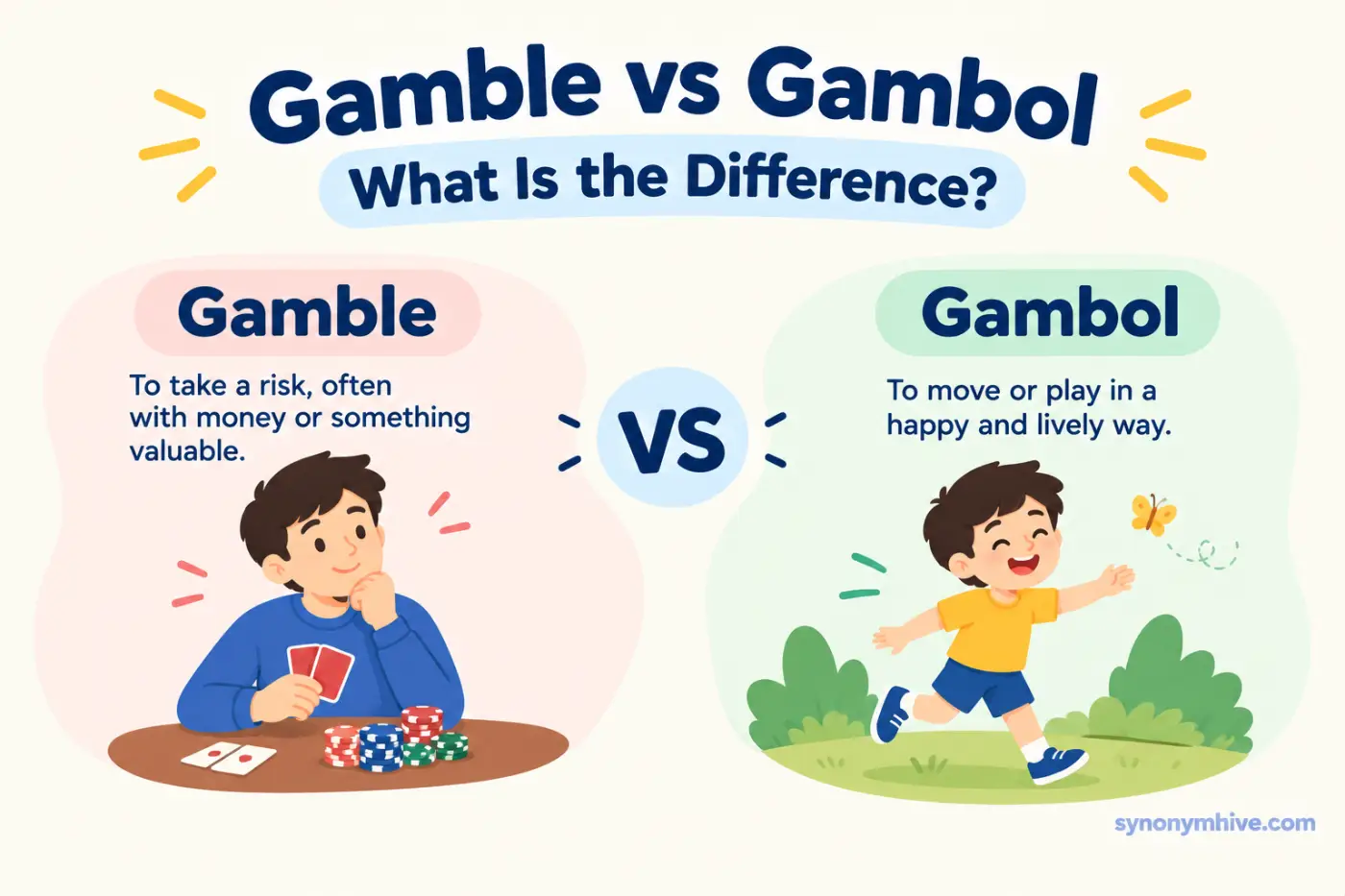
You may have seen gamble vs gambol and wondered if these two words are related. They look and sound similar, but they have very different meanings. One is about taking a risk, often with money. The other describes playful movement, especially when someone or something moves in a lively, carefree way.
The easiest way to remember them is simple. Gamble is about risk. Gambol is about play. If someone puts money on a horse race, they gamble. If a puppy runs and jumps around the yard, it gambols.
Gamble can work as both a noun and a verb. Gambol can also work as both, although it is less common in everyday speech. The words have different meanings, different uses, and different histories.
This guide explains the difference in plain English. You will see clear definitions, example sentences, common mistakes, memory tricks, related words, and answers to questions people often ask about these two easily confused terms.
Quick Definition
Gamble means to risk money or something valuable on an uncertain result. It can also mean taking a risky action when the outcome is not certain.
Gambol means to move or play in a lively, cheerful, and often playful way. It is commonly used for children, animals, or people moving with carefree energy.
Direct Answer
The correct word depends on what you mean. Use gamble for risk, betting, or a risky decision, and use gambol for playful movement or activity.
For example, “He decided to gamble on the race” means he took a risk by betting. “The lambs gambol across the field” means the lambs run and play happily.
Comparison Table
| Word | Meaning | Example Sentence | When to Use It |
|---|---|---|---|
| Gamble | To risk money or something valuable | She decided to gamble on the new business. | Use it for betting, risk, or uncertain choices. |
| Gamble | A risky choice or bet | Buying the old house was a gamble. | Use it as a noun for a risky action. |
| Gambol | To run, jump, or play in a lively way | The puppies gambol in the grass. | Use it for playful movement. |
| Gambol | A playful movement or activity | The children enjoyed a cheerful gambol outdoors. | Use it as a noun for playful activity. |
Why Are Gamble and Gambol Confused?
The confusion comes mainly from spelling and sound. Both words begin with gam and contain similar letters. They also have a similar rhythm when spoken.
Their meanings, however, developed along very different paths.
When people see an unfamiliar word, they often connect it to a familiar word that looks similar. That can cause mistakes. Someone who knows gamble well might assume gambol is another form of the same word. It is not.
The difference becomes much easier once you connect each word with a strong mental picture.
Think of gamble and imagine a person placing a bet.
Think of gambol and picture a group of puppies jumping and playing in a field.
Those two pictures are far apart, and that is exactly what you want when learning the distinction.
Gamble Is About Risk
The central idea behind gamble is uncertainty.
A person gambles when they risk money or something valuable because they hope for a desired result. The word is strongly connected with betting and games of chance, but its use goes beyond casinos or sports.
You can also gamble on a business decision, a career choice, or a prediction.
For example:
The company gambled on a new product.
This does not mean the company literally placed money on a table. It means the company took a risk because the result was uncertain.
Another example is:
She gambled that the weather would improve.
Here, gambled means she took a chance based on an uncertain prediction.
Gambol Is About Playful Movement
The central idea behind gambol is lively movement.
A person, animal, or sometimes group can gambol when they move around in a playful and energetic way. The word often creates a cheerful image.
For example:
The young goats gambol across the hillside.
The goats are not taking a financial risk. They are running, jumping, and playing.
You might also write:
The children gambol through the garden.
This gives the scene a light and playful quality.
Because of its slightly literary sound, gambol appears more often in descriptive writing than in casual conversation. In everyday American English, people are more likely to say run, play, jump, or skip.
Where Does Gamble Come From?
The history of gamble is connected to the idea of betting or taking a chance.
English developed the word from older forms connected with games and wagering. Over time, its meaning became closely tied to risking money or something valuable on an uncertain outcome.
The word later gained a broader sense. Today, a person can gamble without placing a traditional bet.
Consider this sentence:
Leaving a secure job to start a business was a gamble.
No casino is involved. The speaker is describing a risky decision.
That broader meaning is common in modern English. You can gamble on a person, idea, plan, investment, strategy, or prediction.
What Does Gamble Mean as a Verb?
As a verb, gamble means to risk something in the hope of getting a desired result.
Examples include:
He gambled away his savings.
They gambled on a quick recovery.
She gambled that the plan would work.
The first example refers directly to money. The other two use the broader meaning of taking a chance.
What Does Gamble Mean as a Noun?
As a noun, gamble means a risky action, choice, or bet.
For example:
Opening the store in that location was a gamble.
His investment was a gamble.
Taking the shortcut was a gamble.
The noun often describes a decision where the result could go well or badly.
Where Does Gambol Come From?
Gambol has a different history from gamble. Its meaning developed around playful movement and jumping.
The word is related to an older French term associated with the leg. That connection makes sense because playful movement often involves the legs, jumping, running, and skipping.
Over time, English speakers came to use gambol for lively and playful movement.
Today, the word still carries that sense.
A sentence such as:
The foals gambol beside their mothers.
creates an image of young horses moving freely and playfully.
What Does Gambol Mean as a Verb?
As a verb, gambol means to move, run, or jump in a playful way.
Examples include:
The puppies gambol around the yard.
The children gambol along the beach.
Young deer gambol through the meadow.
The movement does not have to follow one exact pattern. The key idea is that it is energetic, playful, and carefree.
What Does Gambol Mean as a Noun?
As a noun, gambol refers to a playful movement or period of play.
For example:
The puppies had a lively gambol in the garden.
The children enjoyed a short gambol before dinner.
The noun form is much less common than the verb. Most readers will encounter gambol as a verb, especially in descriptive writing.
Gamble vs Gambol in Simple Sentences
The easiest way to understand the difference is to compare sentences that use each word.
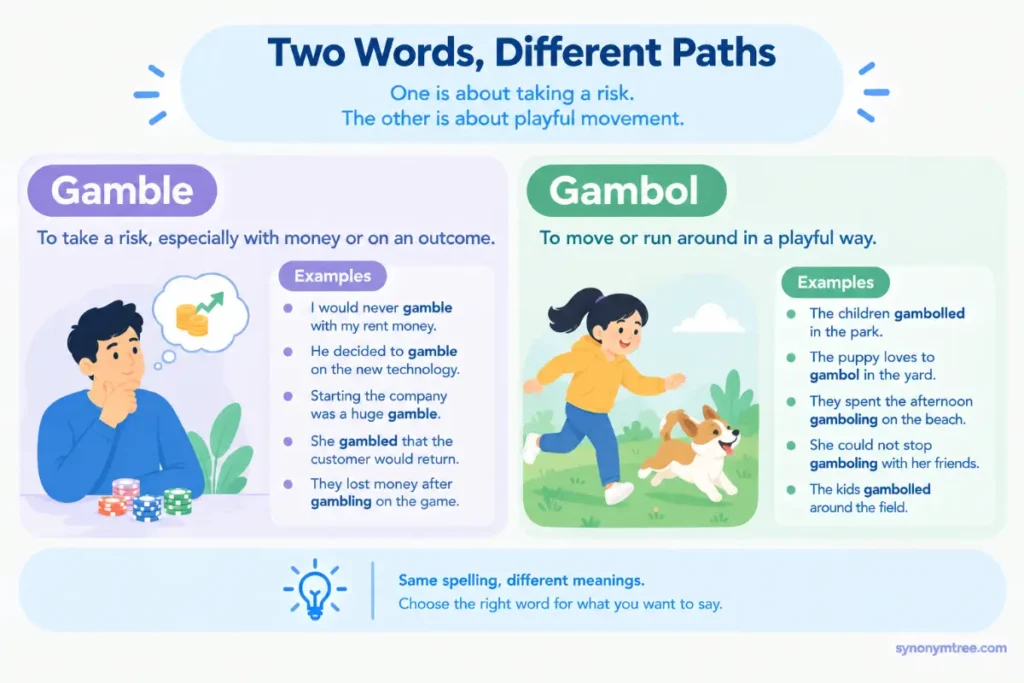
Examples With Gamble
I would never gamble with my rent money.
He decided to gamble on the new technology.
Starting the company was a huge gamble.
She gambled that the customer would return.
They lost money after gambling on the game.
Each sentence involves risk, uncertainty, betting, or a risky decision.
Examples With Gambol
The puppies gambol around the yard.
The lambs gambol in the meadow.
The children gambol across the grass.
The young horses gambol beside the fence.
The kittens gambol around the room.
Each sentence describes lively or playful movement.
When Should You Use Gamble?
Use gamble when the main idea is risk.
This includes literal betting.
He likes to gamble at the casino.
It also includes figurative risk.
The manager gambled on an early launch.
The word works well in business writing, news reports, everyday conversation, and informal speech.
Gamble for Betting
This is the most direct use.
They gambled on the final race.
She gambled $50 on the team.
He lost money because he continued to gamble.
Here, the word refers to betting money on an uncertain outcome.
Gamble for Risky Decisions
The word can also describe choices.
Moving to a new city was a gamble.
Hiring an unknown candidate was a gamble.
Investing all their savings in the project was a gamble.
In these examples, nobody necessarily places a formal bet. The word simply highlights risk.
Gamble With Something
The phrase gamble with means to put something valuable at risk.
Don’t gamble with your future.
He was gambling with his reputation.
The company was gambling with its remaining cash.
This construction is often used when the speaker thinks the risk is too serious.
Gamble On Something
The phrase gamble on means to take a chance based on something.
They gambled on strong holiday sales.
She gambled on the team winning.
The investor gambled on a quick recovery.
This phrase is useful when you want to emphasize the thing you are betting or relying on.
When Should You Use Gambol?
Use gambol when you want to describe playful physical movement.
The word works especially well for young animals.
The lambs gambol through the field.
It can also describe children.
The children gambol along the shore.
Writers sometimes use it for adults, but that use is less common.
Gambol for Animals
Animals are one of the most natural subjects for gambol.
The puppies gambol around their mother.
The calves gambol in the pasture.
The young goats gambol over the rocks.
The foals gambol in the open field.
The word suggests movement that is free, cheerful, and energetic.
Gambol for Children
Children can also gambol.
The children gambol through the park.
The boys gambol across the lawn.
The kids gambol beside the stream.
Still, many speakers would simply say the children ran, played, or skipped. Gambol adds a more colorful and descriptive tone.
How Strong Is the Difference in Meaning?
The two words are not close synonyms.
That point matters because some confusing word pairs have meanings that overlap. This pair does not.
Gamble centers on uncertainty and risk.
Gambol centers on movement and play.
You cannot normally replace one with the other.
For example:
He decided to gamble on the result.
This means he took a risk.
If you change it to:
He decided to gambol on the result.
the sentence no longer makes sense in normal English.
Likewise:
The puppies gambol in the yard.
means the puppies play and move around.
Replacing gambol with gamble changes the meaning completely:
The puppies gamble in the yard.
Now it sounds as if the puppies are betting or taking risks.
That is not the intended meaning.
Gamble vs Gambol in Different Contexts
The right word becomes easier to choose when you think about the situation.
In Business Writing
Use gamble when discussing risk.
The company gambled on strong demand for its new product.
Do not use gambol unless you are actually describing playful movement.
In Academic Writing
Gamble can work when discussing risk, probability, decisions, or uncertain outcomes.
The policy was a gamble that depended on quick economic growth.
Gambol is more likely to appear in literature, creative writing, or an example about movement.
In Creative Writing
Both words can be useful, but they create very different images.
The trader gambled everything on one final deal.
The sentence creates tension.
Compare it with:
The puppies gambolled through the garden.
The second sentence creates a playful scene.
In Everyday Conversation
Gamble is common.
People regularly talk about gambling, taking a gamble, gambling on an outcome, or gambling with something important.
Gambol is less common. Many speakers would choose simpler words such as play, run, jump, or skip.
15 Natural Example Sentences
The following examples show how the two words work in real situations.
- The investor decided to gamble on the young company’s future.
- The puppies gambol around the garden every morning.
- Buying the damaged house was a risky gamble.
- The lambs gambol across the green field.
- She gambled that the store would stay open late.
- The children gambol through the grass after school.
- He knew that accepting the offer was a gamble.
- Several young goats gambol along the hillside.
- The company gambled on customers adopting the new service.
- The foals gambol beside the fence.
- She refused to gamble with her family’s savings.
- The puppies gambol happily beside the older dog.
- His decision to move abroad was a gamble, but it worked out.
- The children gambol along the beach as the sun sets.
- The coach gambled on a young player in the final minutes.
Notice the pattern. Every example involving risk uses gamble. Every example involving playful movement uses gambol.
Gamble and Gambol as Different Parts of Speech
Both words can act as nouns and verbs, but their uses are not equally common.
Gamble as a Verb
As a verb, it means to risk something.
They gamble on uncertain investments.
Gamble as a Noun
As a noun, it means a risky action or bet.
The investment was a gamble.
Gambol as a Verb
As a verb, it means to move playfully.
The lambs gambol across the field.
Gambol as a Noun
As a noun, it means a playful movement or activity.
The puppies enjoyed a short gambol outside.
The verb gambol is more common than the noun in modern usage.
Gamble vs Gambol: Risk or Play?
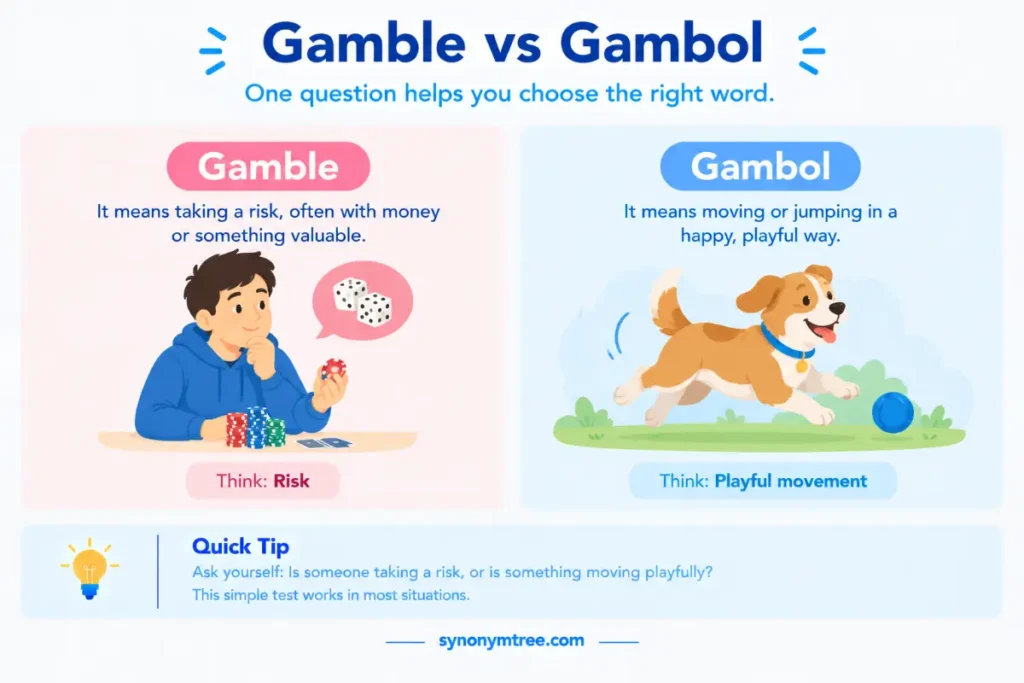
A useful way to separate the words is to ask one question.
Is someone taking a risk, or is something moving playfully?
If the answer is risk, choose gamble.
If the answer is playful movement, choose gambol.
This simple test works in most situations.
Consider:
The company took a chance on the new product.
That is a gamble.
Now consider:
The puppies ran and jumped around the garden.
That is a gambol.
The first idea involves uncertainty. The second involves movement.
Gamble vs Bet
Gamble and bet are closely related, but they are not always interchangeable.
A bet usually means putting money or something valuable on a particular result.
I bet $20 on the horse.
Gamble can describe that same act, but it can also refer to a broader risky decision.
Starting a business was a gamble.
You would not normally say:
Starting a business was a bet.
The broader meaning of gamble makes it useful for decisions that involve risk but do not involve formal betting.
Gamble vs Risk
Risk is broader than gamble.
To risk something means to expose it to possible loss or harm.
She risked her health by ignoring the warning.
To gamble usually suggests a deliberate choice to take a chance.
She gambled on the plan succeeding.
A gamble can involve risk, but not every risk is a gamble.
Gambol vs Frolic
Gambol and frolic are much closer in meaning.
Both can describe playful activity.
Frolic often suggests lively, cheerful play in a broader sense.
The children frolicked on the beach.
Gambol focuses more strongly on physical movement such as running, jumping, or leaping.
The lambs gambolled across the field.
Both words are somewhat more literary than plain words such as play or run.
Gambol vs Romp
Romp can also describe energetic play or movement.
The puppies romped around the yard.
Gambol has a lighter and often more graceful feeling.
The deer gambol through the meadow.
The difference is not absolute, but the images are slightly different.
Common Mistakes With Gamble and Gambol
The biggest mistake is using gambol when you mean gamble.
For example:
Incorrect: She decided to gambol on the investment.
Correct: She decided to gamble on the investment.
The second mistake is using gamble for playful movement.
Incorrect: The puppies gamble through the field.
Correct: The puppies gambol through the field.
Another mistake is assuming that the words are related simply because they look similar. Their spelling gives no useful clue about their modern meanings.
Mistake 1: Using Gambol for Betting
If money or risk is involved, gamble is usually the word you need.
He gambled his savings on the business.
Not:
He gambolled his savings on the business.
Mistake 2: Using Gamble for Play
If the subject is running and jumping in a cheerful way, gambol may be the better choice.
The lambs gambol in the meadow.
Not:
The lambs gamble in the meadow.
Mistake 3: Assuming Similar Spelling Means Similar Meaning
English has many words that look or sound alike but have unrelated meanings.
The safest approach is to focus on meaning rather than appearance.
How to Remember the Difference
A strong memory trick can make this pair much easier.
Remember the L in Gambol
The word gambol contains an L.
Think of the L as standing for lively.
Gambol = lively movement.
This is not the historical origin of the word. It is simply a memory trick.
Remember the Risk in Gamble
Think of gamble as connected with money, betting, and risk.
You can remember:
Gamble = risk.
Gambol = play.
That two word contrast is enough for most everyday situations.
Use the Picture Test
Imagine a casino table.
That points to gamble.
Now imagine puppies jumping across a field.
That points to gambol.
If you can picture the meaning, you are less likely to confuse the spelling.
Is Gambol a Common Word?
Gambol is a real and correct English word, but it is less common than gamble.
You are more likely to see it in novels, poetry, descriptive writing, nature writing, and literary prose.
In casual American English, people often choose simpler verbs.
Instead of:
The children gambolled through the park.
Someone might say:
The children ran through the park.
Or:
The children played in the park.
That does not make gambol wrong. It simply gives the sentence a more descriptive or literary tone.
Is Gamble Always About Money?
No. Gamble can describe risks that have nothing to do with money.
This is an important part of modern usage.
For example:
He gambled that she would accept the offer.
No money is mentioned.
Another example is:
The director gambled on an unknown actor.
Again, the idea is risk rather than betting money.
You can also say:
They gambled with their reputation.
Here, the thing at risk is their reputation.
The word has therefore moved beyond its original association with games and betting.
Can Gambol Describe Adults?
Yes, but it is less common.
You might see:
The hikers gambolled down the hill.
That sentence is grammatically possible, but it has a playful and somewhat literary tone.
In everyday speech, most people would say:
The hikers ran down the hill.
The choice depends on the tone you want. Gambol adds a sense of cheerful, carefree movement.
Is Gambol the Same as Skip?
Not exactly.
Skip usually describes a particular kind of movement in which a person steps and hops in a repeated pattern.
Gambol is broader. It can describe running, jumping, leaping, or moving playfully.
For example:
The child skipped down the sidewalk.
This gives a more specific picture.
The child gambolled across the grass.
This gives a broader picture of playful movement.
Which Word Is Better for Formal Writing?
There is no single answer because the meanings differ.
Use gamble when you need to describe risk, betting, or an uncertain decision.
Use gambol when you need to describe playful movement.
If you are writing a formal report about a business decision, gamble may be useful.
The expansion was a gamble based on uncertain demand.
If you are writing a literary description, gambol may add color.
The young deer gambolled through the clearing.
The best word is the one that matches the idea you need to express.
Related Words for Gamble
Several words are closely connected to gamble.
Bet means to risk money or something valuable on an uncertain result.
Risk means exposing someone or something to possible loss or harm.
Wager means to bet money or something valuable on a result.
Chance can refer to an uncertain possibility.
Speculate can mean to make an uncertain financial or other judgment in the hope of gaining something.
These words overlap, but their meanings are not identical.
For example:
He wagered $100 on the race.
He risked $100 on the race.
He gambled $100 on the race.
All three can work in the right context, but each has a slightly different tone.
Related Words for Gambol
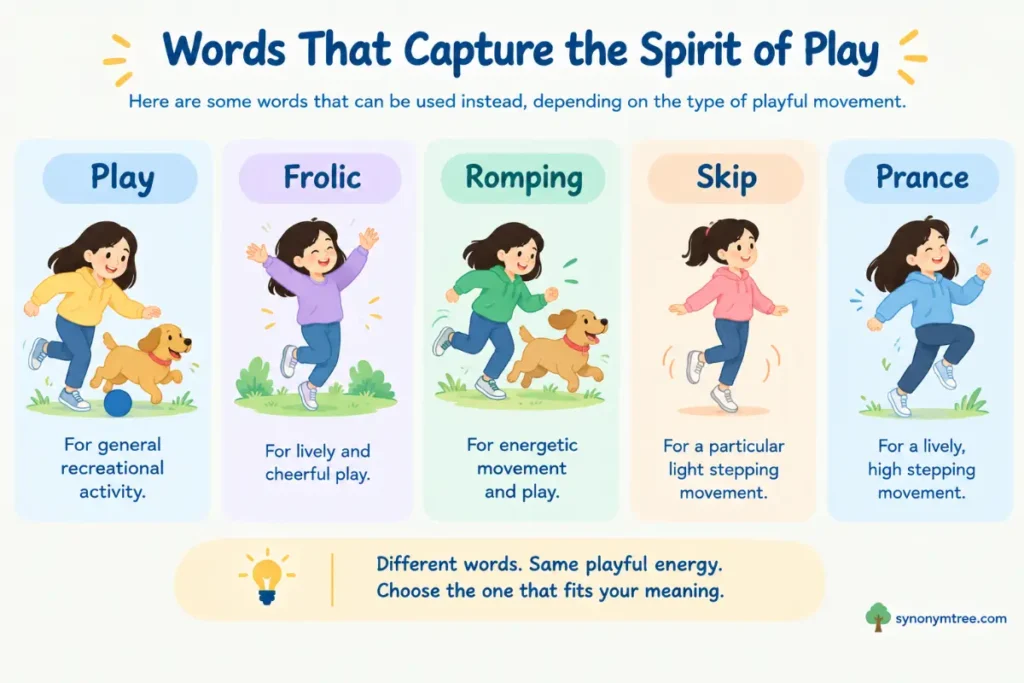
Words connected to gambol include:
Play for general recreational activity.
Frolic for lively and cheerful play.
Romping for energetic movement and play.
Skip for a particular light stepping movement.
Prance for a lively, high stepping movement.
Leap for jumping into the air.
Bound for moving forward with long jumps.
The best choice depends on the exact movement you want to describe.
Antonyms and Opposites
The opposite of gamble depends on the context.
If gamble means taking a risk, possible opposites include:
avoid, protect, secure, play it safe, and guarantee.
For example:
She avoided the risk instead of gambling on an uncertain result.
The opposite of gambol is also context based.
Possible contrasts include:
stand still, remain still, sit, or move slowly.
There is no single perfect opposite for every use.
Quick Tips for Choosing the Right Word
Use these questions when you are unsure.
- Is there a risk or uncertain result? Use gamble.
- Is someone betting money? Use gamble.
- Is someone taking a risky chance? Use gamble.
- Is an animal running and jumping playfully? Use gambol.
- Are children moving around in a cheerful, playful way? Use gambol.
- Could you replace the word with playfully run or jump? If yes, gambol may fit.
- Could you replace the word with take a risk? If yes, gamble is probably correct.
The strongest shortcut is still this:
Gamble means risk. Gambol means playful movement.
A Final Practice Test
Try choosing the correct word in each sentence.
Sentence One
The company decided to ___ on a new advertising strategy.
The answer is gamble because the company is taking a risk.
Sentence Two
The young goats ___ across the field.
The answer is gambol because the goats are moving playfully.
Sentence Three
He did not want to ___ with his savings.
The answer is gamble because his savings are at risk.
Sentence Four
The puppies ___ around their mother.
The answer is gambol because the puppies are playing and moving energetically.
Sentence Five
Buying the property was a major ___.
The answer is gamble because the purchase involved uncertainty and risk.
Sentence Six
The lambs ___ beside the stream.
The answer is gambol because the lambs are playing and moving around.
If you got these right, you have the core distinction.
Conclusion
The difference between gamble vs gambol becomes simple once you focus on the main idea behind each word. Gamble is connected with risk, betting, uncertainty, and taking a chance. Gambol is connected with playful movement, running, jumping, and carefree activity.
Use gamble when someone risks money, makes a risky decision, or takes a chance on an uncertain result. Use gambol when an animal, child, or person moves around in a lively and playful way.
If you are stuck, ask yourself what is happening in the sentence. Is someone taking a risk? Choose gamble. Is something moving playfully? Choose gambol. That quick test will help you choose the right word without having to stop and second guess yourself.
Frequently Asked Questions
What is the difference between gamble and gambol?
Gamble means to take a risk or place a bet, while gambol means to move or play in a lively way. The two words look similar but have different meanings.
Is gamble or gambol correct for taking a risk?
Gamble is correct for taking a risk. You can gamble on an uncertain result, gamble with something valuable, or describe a risky decision as a gamble.
Is gambol a real English word?
Yes, gambol is a standard English word. It means to run, jump, or move in a playful and lively way.
What’s another way to remember gamble and gambol?
Think gamble equals risk and gambol equals play. You can also remember the L in gambol as a clue for lively movement.
Can you use gambol for people?
Yes, you can use gambol for people, especially when describing cheerful or playful movement. It is more common in descriptive or literary writing than in casual conversation.
Does gamble always involve money?
No, gamble does not always involve money. It can also mean taking a chance on a plan, decision, person, prediction, or uncertain result.
Is gambol a synonym for frolic?
They are close in meaning, but gambol focuses more on playful physical movement such as running and jumping. Frolic has a broader meaning and can describe lively, cheerful play in general.
