
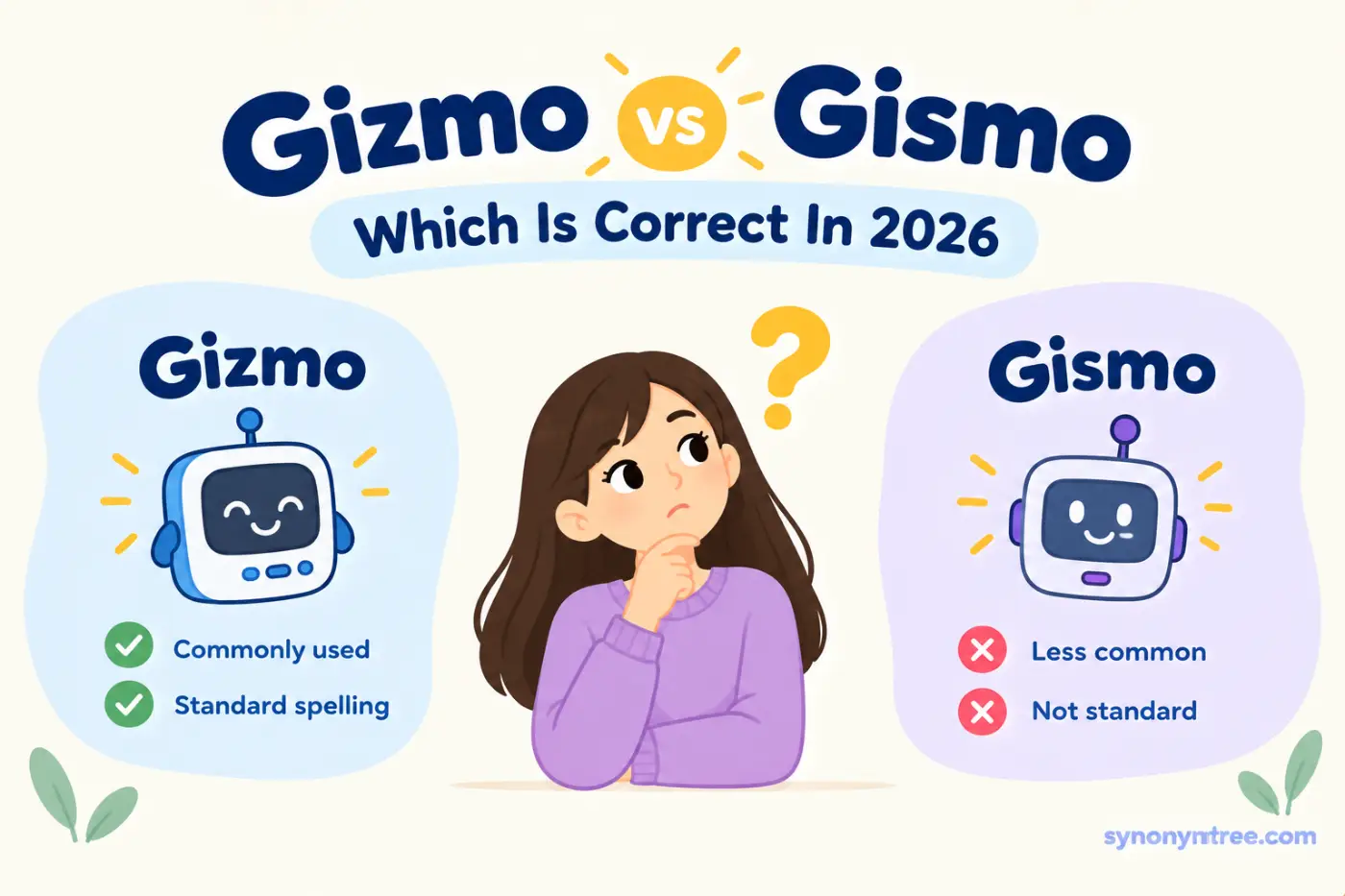
If you’ve ever typed gizmo vs gismo into a search box, you’re probably trying to answer one simple question: Which spelling is correct? The short answer is that gizmo is the standard spelling in American English, while gismo is a less common variant. Both forms can refer to a small device, gadget, or object whose name you don’t know or don’t want to give.
Gizmo is the spelling you’ll see most often in dictionaries, general writing, and everyday American English. Gismo is also a recognized spelling, but it is much less common. If you need the safest choice for school, work, a website, or general writing, use gizmo.
The two spellings have the same basic meaning. The real difference is usage and frequency, not meaning. This guide explains where the word came from, how it is used, why the spelling causes confusion, and how to choose the right form in real sentences.
Quick Definition
A gizmo is a small device, tool, gadget, or object whose exact name is unknown, forgotten, or not important. It can describe something useful, unusual, mechanical, or electronic.
Gismo has the same basic meaning, but it is a less common spelling. In most situations, gizmo is the better choice.
Direct Answer
Gizmo is the preferred spelling in standard American English. Gismo is a recognized variant, but it is far less common, so use gizmo when you want the clearest and most familiar form.
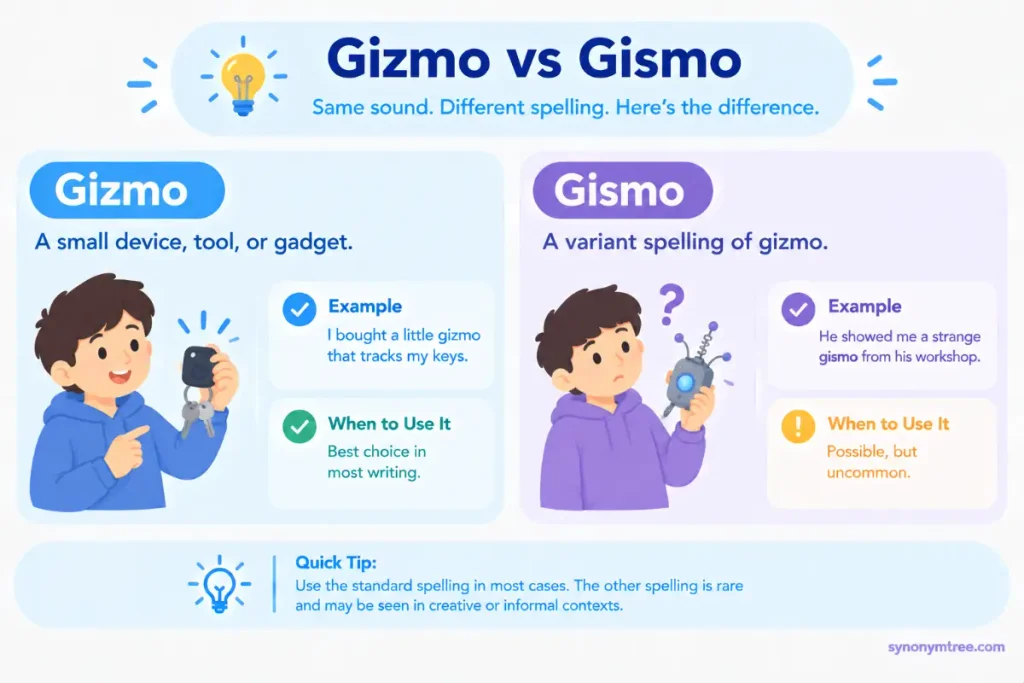
Gizmo vs Gismo Comparison Table
| Word | Meaning | Example Sentence | When to Use It |
|---|---|---|---|
| Gizmo | A small device, tool, or gadget | I bought a little gizmo that tracks my keys. | Best choice in most writing |
| Gismo | A variant spelling of gizmo | He showed me a strange gismo from his workshop. | Possible, but uncommon |
| Gadget | A small useful device | This kitchen gadget saves time. | Use when the device itself is the focus |
| Device | A piece of equipment made for a purpose | The device measures air pressure. | Best for formal or technical writing |
| Contraption | A device that looks complicated or unusual | He built a strange contraption from spare parts. | Use for something complex or homemade |
| Thingamajig | An informal name for an object whose name is unknown | Pass me that thingamajig on the table. | Very casual speech or writing |
| Doohickey | An informal name for an object you cannot name | I need the doohickey that opens this case. | Casual and playful language |
Why Do People Confuse These Two Spellings?
The confusion comes from pronunciation.
When people say gizmo, the final sound can make the word seem as if it should have a different spelling. English has many words where the sound does not make the spelling obvious. That can lead writers to choose gismo simply because it looks reasonable.
There is another reason for the confusion. Gismo is not a completely invented spelling. It appears as a variant form in dictionaries and word references. That means someone who writes it has not necessarily misunderstood the word. The form exists, but it is much less common than gizmo.
This matters because English often has more than one accepted spelling for the same word. One form can become much more popular over time. When that happens, the less common version may remain correct but still sound unusual to many readers.
That is the situation here. The two forms are closely related, but modern readers are much more likely to expect gizmo.
What Does Gizmo Mean?
A gizmo is usually a small object or device. The word is especially useful when you know what something does but do not know its proper name.
Imagine that someone hands you a tiny plastic tool and says, “Can you pass me that thing?” You might call it a gizmo if you do not know its exact name.
The word can also be used when the name does not matter.
For example:
This little gizmo keeps my phone upright.
You do not need to identify the object as a particular type of phone stand. The word gizmo tells the reader that it is some kind of small device.
The term can also suggest that the object is interesting or unusual. A person might call a new electronic product a gizmo because it has several buttons, lights, sensors, or moving parts.
The meaning is flexible. It can describe a practical tool, an electronic gadget, a mechanical part, or almost any small device whose exact name is not being given.
Where Did the Word Gizmo Come From?
The exact origin of gizmo is uncertain.
The word appeared in American English during the early 20th century. Its origin is often described as unknown or disputed. That makes it different from many common English words that have a clear history through Latin, French, Greek, Germanic languages, or other sources.
Several possible explanations have been suggested over the years. Some theories connect the word to earlier slang terms or expressions used for unnamed objects. Other theories suggest that it developed as an informal placeholder for an object whose proper name was unknown.
The lack of a certain origin is part of the word’s history. It became useful because speakers needed a quick way to refer to an object without stopping to name it.
That function remains important today.
You might say:
Where’s the gizmo that connects these two cables?
The speaker may know exactly what the object does. They simply do not know, remember, or care about its technical name.
The word later became strongly associated with small gadgets and devices. Modern English uses it often for electronic products, tools, mechanical objects, and clever little inventions.
Is Gismo a Real Word?
Yes. Gismo is a real spelling variant of the word.
That does not mean it is equally common. English dictionaries can include variant spellings that are accepted but uncommon. A word can be legitimate while still being a poor choice for most everyday writing.
Think of it this way. If a reader sees gismo, they can usually understand what you mean. The problem is that the spelling may look unusual because gizmo is far more familiar.
For that reason, writers generally benefit from choosing the common spelling.
If you are writing a school assignment, product description, blog post, email, instruction guide, or social media post, gizmo will usually look more natural.
Why Is Gizmo More Common Than Gismo?
Usage is the main reason.
English spelling is shaped by long-term use. When one form becomes more popular, writers and editors tend to favor it. Readers then become more familiar with that form, which makes it even more likely to be used.
That cycle has made gizmo the dominant form.
You can see the same pattern in many English spelling questions. Two forms may exist, but one becomes the normal choice in modern writing.
Frequency also affects reader expectations. If a reader sees a familiar spelling, they can process it quickly. An uncommon spelling may make them stop for a moment and wonder if there is a typo.
That is why choosing the common form matters even when another spelling is technically recognized.
In practical writing, the goal is usually not to prove that a rare spelling exists. The goal is to communicate clearly.
When Should You Use Gizmo?
Use gizmo when you need an informal word for a small device, gadget, tool, or unnamed object.
It works especially well in casual writing and everyday conversation.
For example:
I bought a new gizmo for cleaning my keyboard.
What does this gizmo do?
She keeps a useful little gizmo in her car.
The repair kit came with a strange gizmo for tightening screws.
The word can also make writing sound relaxed. It is less formal than device, instrument, or apparatus.
That makes it useful when the technical name is not important.
Gizmo in Everyday Conversation
People often use the word when they are pointing to something they cannot name.
Can you hand me that gizmo?
The sentence sounds natural because both speakers may understand the object from context.
You can also use the term when describing a new product.
My brother bought some smart-home gizmo that controls the lights.
Here, gizmo suggests a small piece of technology. The speaker may know the product’s name but chooses a casual word instead.
Gizmo in Informal Writing
The word works well in blogs, reviews, social posts, personal emails, and casual articles.
This little gizmo makes charging my phone much easier.
It gives the sentence a friendly tone. A more formal word would sound more technical.
Compare these:
This gizmo makes charging my phone easier.
This device makes charging my phone easier.
Both sentences are correct. The first sounds more casual. The second sounds more neutral and professional.
When Should You Use Device Instead?
Use device when precision matters.
A device is a broad and neutral term for something designed or made for a particular purpose. It is common in technical, medical, scientific, business, and professional writing.
For example:
The device measures blood pressure.
The technician inspected the device.
This device connects to your computer through USB.
Calling these objects gizmos would not always be wrong, but it could make the writing sound too casual.
The choice depends on your audience and purpose.
A product review might say:
This handy gizmo lets you control your lights from your phone.
A technical manual might say:
This device allows users to control connected lights through the application.
The object can be the same. The word changes the tone.
When Should You Use Gadget Instead?
Gadget is one of the closest everyday alternatives.
A gadget is usually a small mechanical or electronic device that performs a useful function. The word often has a positive or playful tone.
For example:
He loves buying new kitchen gadgets.
This gadget turns your phone into a portable scanner.
I found a useful gadget for organizing cables.
Gadget is more specific than gizmo in some situations. It usually suggests that the object has a practical purpose and some clever feature.
Gizmo is broader. It can refer to almost any small object or device when its exact name is unknown or unimportant.
Gizmo vs Gadget
These words overlap, but they are not always interchangeable.
| Gizmo | Gadget |
|---|---|
| Can refer to an unnamed object | Usually refers to a useful device |
| Often used when the exact name is unknown | Often used when the function is known |
| Can sound playful or vague | Often suggests clever technology |
| Very informal | Informal to neutral |
| Broad meaning | Slightly more specific |
Consider this sentence:
What is this gizmo?
The speaker may have no idea what the object is called.
Now consider:
I bought a new kitchen gadget.
The speaker knows it is a useful device designed for a particular purpose.
That difference can help you choose the better word.
Gizmo vs Contraption
Contraption is another useful alternative, but it has a different tone.
A contraption is usually a device that looks complicated, awkward, unusual, or homemade. The word can suggest that something has many parts connected together.
For example:
Dad built a strange contraption to water the garden.
The word creates an image of something unusual.
Compare that with:
Dad bought a small gizmo to water the garden.
The second sentence sounds more neutral and casual. The first suggests something more complicated or homemade.
Use contraption when the unusual design matters.
Use gizmo when you simply need a casual name for a small device or object.
Gizmo vs Thingamajig
Thingamajig is much more openly used as a placeholder name.
You might say:
Where did you put the thingamajig?
This means that you either do not know or cannot remember the object’s name.
Gizmo can work in the same way, but it is more closely associated with devices and gadgets.
Thingamajig is especially common in casual speech. It can sound playful or humorous.
Other similar expressions include thingamabob, whatchamacallit, doohickey, and widget.
These words all have slightly different tones, but they share a common purpose. They let speakers talk about something without giving its exact name.
What Is a Widget?
The word widget deserves special attention because it can also mean a small device or component.
In general English, a widget may refer to a small unnamed mechanical object. In technology, however, it has more specific meanings.
A software widget can be a small interface element that performs a function. For example, a weather widget can display current weather information on a screen.
That meaning is more specialized than gizmo.
So you might say:
I found a useful little gizmo for my desk.
But in software writing, you might say:
Add the weather widget to your home screen.
The words overlap in some contexts, but widget can carry a technical meaning that gizmo does not.
How Do You Use Gizmo in a Sentence?
The easiest way to use the word is as a noun.
A noun names a person, place, thing, or idea. Gizmo names an object.
Here are several natural examples.
- I bought a small gizmo that helps organize my charging cables.
- Do you know what this gizmo is supposed to do?
- The mechanic showed me a useful gizmo for checking tire pressure.
- My son loves taking apart every electronic gizmo he finds.
- She ordered a kitchen gizmo that cuts vegetables into thin slices.
- I have no idea what that gizmo is called.
- This little gizmo makes opening jars much easier.
- The technician replaced an old gizmo inside the machine.
- He keeps a box full of odd gadgets and gizmos in his garage.
- I found a clever gizmo that helps keep my desk organized.
- The package included a small gizmo for attaching the camera to the stand.
- We need some kind of gizmo to connect these two parts.
- She showed me a strange gizmo she found at a yard sale.
- That gizmo looks complicated, but it is easy to use.
- I forgot the name of the gizmo that fixes the loose cable.
These examples show how flexible the word can be. It can describe an electronic device, a tool, a mechanical part, or an object whose name is simply not worth mentioning.
Can Gizmo Be Used for Technology?
Yes. The word is often used for small technology products.
People may call phones, smart devices, accessories, tools, sensors, and electronic gadgets gizmos in casual conversation.
For example:
My dad bought a new gizmo that tracks his sleep.
This little gizmo connects to your phone.
I saw a cool gizmo that charges three devices at once.
The word does not tell the reader exactly what the technology does. It only gives a broad, informal label.
That can be useful when the specific product name is not important.
Still, avoid the word in formal technical documentation when precision is required. A reader who needs exact instructions should know the actual name of the component.
Can Gizmo Describe Something That Is Not Electronic?
Yes.
A common mistake is assuming that a gizmo must be electronic. It does not.
The word can describe a simple tool, mechanical part, kitchen item, craft tool, or other small object.
For example:
This gizmo helps remove the lid from a jar.
The carpenter used a small gizmo to hold the pieces together.
I found a strange gizmo in the bottom of the toolbox.
None of these objects needs to contain electronics.
The key idea is that the word acts as an informal label for an object or device whose exact name is unknown, forgotten, or not important.
Is Gizmo a Formal Word?
No. Gizmo is informal.
It works well in conversation and casual writing. It can also appear in advertising, product reviews, entertainment writing, and other contexts where a relaxed tone is acceptable.
It is less suitable for highly formal documents.
For example, this sentence is fine in a casual review:
This gizmo makes cleaning the keyboard much easier.
A technical report would probably use a more precise term:
This cleaning device removes dust from the keyboard.
Neither sentence is grammatically wrong. The difference is tone and precision.
Can You Use Gizmo in Academic Writing?
You can, but you should be careful.
Academic writing usually values precise terms. If the object has a known technical name, use that name instead of a vague informal term.
For example, instead of writing:
The researcher placed the gizmo inside the container.
you might write:
The researcher placed the sensor inside the container.
The second sentence tells the reader exactly what object was used.
If the exact name truly is unknown or irrelevant, a general term may be acceptable. Still, device, tool, instrument, or component may be better choices depending on the subject.
Is Gizmo Appropriate in a Resume?
Usually, no.
Resumes need clear and specific language. Calling something a gizmo can make your work sound less precise.
Instead of:
Tested new gizmos for the production team.
write:
Tested electronic devices for the production team.
Better yet, name the exact products, tools, or systems if you can.
Specific words show the reader that you understand your work.
The same principle applies to professional reports, business proposals, instructions, and technical documents.
Is Gizmo Used in British English?
Yes, gizmo is understood in British English as well as American English.
The word is not limited to the United States. English speakers in different regions can understand it as an informal term for a small device or gadget.
The spelling gizmo is also widely recognizable internationally.
Regional differences are more likely to affect related vocabulary than the basic meaning. Some speakers may prefer words such as gadget, device, contraption, or thingamajig depending on context and personal style.
The safest general choice remains the familiar spelling gizmo.
Does Gizmo Have a Plural Form?
Yes. The plural is gizmos.
For example:
The store sells all kinds of gizmos.
I have several old gizmos in my garage.
These gizmos are useful for small repairs.
The plural follows the normal English pattern of adding s to the singular noun.
There is no need to write gizmoes.
The same basic plural pattern applies when you use the word in compounds or lists.
The box contained wires, tools, and several gizmos.
That form is straightforward and natural.
Is Gizmo Countable or Uncountable?
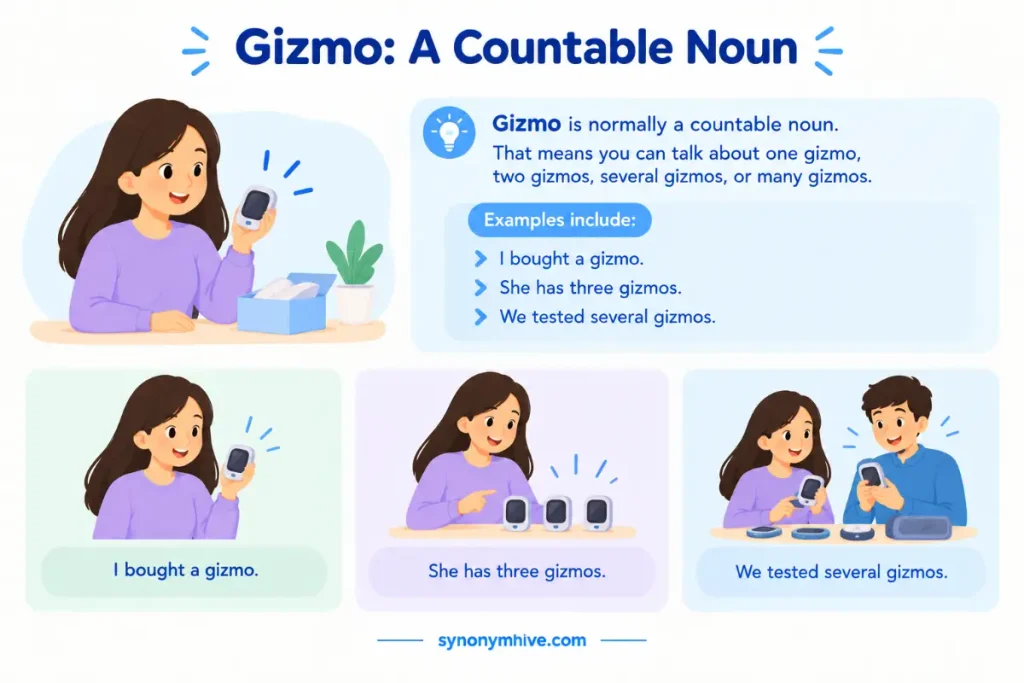
Gizmo is normally a countable noun.
That means you can talk about one gizmo, two gizmos, several gizmos, or many gizmos.
Examples include:
I bought a gizmo.
She has three gizmos.
We tested several gizmos.
You would not normally treat it as an uncountable noun like water or information.
This matters when choosing articles and plural forms.
Say:
I found a gizmo.
Not:
I found gizmo.
Say:
We tested several gizmos.
Not:
We tested several gizmo.
Common Mistakes With This Word
The most common problem is choosing the less familiar spelling.
Mistake 1: Assuming Gismo Is Always Wrong
Calling gismo a completely incorrect spelling is too strong. It is recognized as a variant.
The better point is that it is uncommon. Most readers will be more familiar with gizmo, so that spelling is usually the better choice.
Mistake 2: Using Gizmo When a Precise Name Is Needed
A vague word is not always useful.
If you know that the object is a thermostat, sensor, adapter, valve, or connector, use the specific word when accuracy matters.
For example:
The technician replaced the gizmo.
This leaves the reader wondering what was replaced.
A clearer sentence would be:
The technician replaced the pressure sensor.
The second version gives useful information.
Mistake 3: Treating Gizmo as a Synonym for Every Object
Gizmo usually suggests a small device, tool, gadget, or similar object.
You would not normally call a chair, tree, building, or book a gizmo.
The word has a strong connection to objects that have a function or seem like devices.
Mistake 4: Using It in Highly Technical Writing
A technical audience may need exact terms.
Instead of:
Attach the gizmo to the machine.
write:
Attach the adapter to the machine.
Precision makes instructions easier to follow.
Common Spelling Errors Related to Gizmo
Because the word is informal and its origin is uncertain, people sometimes create other spellings.
You may occasionally see forms that change the vowel or consonant pattern. These forms are not the standard choice.
The safest approach is simple: use gizmo.
When a word is informal, writers sometimes assume that spelling does not matter. It still does. Readers learn common words by seeing them repeatedly, and an unusual spelling can look like an error.
If you are unsure, choose the form that readers are most likely to recognize.
A Simple Memory Trick for Gizmo
Try connecting gizmo with gadget.
Both are short informal words for small devices.
You can also remember the ending with this simple pattern:
giz + mo = gizmo
The spelling has a z before the final mo.
If you keep seeing the word in phrases such as electronic gizmo, little gizmo, and handy gizmo, the spelling becomes easier to remember.
Another useful trick is to think of the word as a placeholder for a gadget.
If you would say “that little gadget,” you can often say “that little gizmo.”
When Is Gismo Acceptable?
The variant gismo may appear in older texts, informal writing, or sources that use the alternate spelling.
You may also encounter it because someone learned the word that way.
There is no need to treat every appearance as a spelling mistake. Context matters. If you are quoting an original source, preserving its spelling may be appropriate.
In normal new writing, however, the common form is the safer option.
That is especially true for content intended for a broad audience. Familiar spelling reduces distraction and makes the sentence easier to read.
Does Gizmo Have a Negative Meaning?
Usually, no.
Gizmo is generally neutral or playful.
Depending on the sentence, it can suggest something useful, clever, odd, or unnecessary. The surrounding words create the tone.
For example:
This little gizmo saves me ten minutes every morning.
That is positive.
Now consider:
I have no idea why he bought another useless gizmo.
That sounds negative because useless changes the meaning.
The word itself does not automatically suggest praise or criticism.
Is Gizmo the Same as Gadget?
Not exactly, although the two words overlap heavily.
A gadget is usually a small device with a useful or clever purpose. A gizmo can be a gadget, but the speaker may not know or care about the exact function.
This difference becomes clear in questions.
What does this gadget do?
The speaker expects the object to have a known purpose.
What is this gizmo?
The speaker may not even know what the object is called.
In casual English, people can use the two words almost interchangeably. The choice depends on how specific you want to be.
Is Gizmo the Same as Thingamajig?
They can serve the same basic purpose, but their tone differs.
Thingamajig openly tells the listener that the speaker cannot remember or does not know the object’s name.
Gizmo sounds more like a casual name for a small device.
Compare:
Hand me that gizmo.
Hand me that thingamajig.
Both can refer to an unnamed object. The second sounds more playful and more clearly suggests that the name has been forgotten.
Related Words You Should Know
Learning nearby terms can help you choose the right word.
| Word | Meaning | Typical Tone |
|---|---|---|
| Gadget | Small useful device | Casual |
| Device | Object made for a purpose | Neutral |
| Tool | Object used to perform a task | Neutral |
| Instrument | Tool used for a specific purpose | Formal |
| Machine | Device with moving or working parts | Neutral |
| Contraption | Complicated or unusual device | Informal |
| Doohickey | Unnamed object or device | Very informal |
| Thingamajig | Object whose name is unknown | Very informal |
| Widget | Small component or device | Technical or informal |
| Apparatus | Set of equipment used for a purpose | Formal |
Knowing these differences gives you more control over your writing.
How to Choose the Right Word
Start by asking what you actually know about the object.
If you know its exact name, use that name.
If you know it is a general piece of equipment but do not need to identify it precisely, device may work.
If it is a small useful product and you want a casual tone, gadget is a strong choice.
If you do not know its name and want a simple informal label, gizmo works well.
If it looks complicated or homemade, contraption may be better.
If you have completely forgotten the name and want a playful expression, thingamajig or doohickey may fit.
The best word depends on the information you want the reader to receive.
How to Use the Word in Different Contexts
In a Text Message
Informal vocabulary works naturally in texts.
Do you know what that little gizmo is called?
The word keeps the message casual and clear.
In an Email to a Friend
Can you bring that phone gizmo you used last week?
Again, the relaxed word fits the relationship.
In a Product Review
This small gizmo makes cable management much easier.
It can create a friendly review style.
In a School Essay
Use it only if the informal tone fits the assignment.
The inventor created a small gizmo that could open the valve.
If the essay is formal, a more exact term may be better.
In Technical Instructions
Avoid it when a precise term exists.
Connect the adapter to the port.
is clearer than:
Connect the gizmo to the port.
In Fiction
The word can help show a character’s voice.
“Hand me that gizmo,” she said. “I need it for the repair.”
Here, the informal term can make the dialogue sound natural.
Examples of Better Word Choices
Consider the purpose of each sentence.
I bought a gizmo for my kitchen.
This works when the exact product name is not important.
I bought a vegetable slicer for my kitchen.
This is better when the reader needs to know exactly what the product does.
The engineer tested the device.
This is better in a technical report.
He built a strange contraption.
This works when the object is complicated or unusual.
Pass me that thingamajig.
This works when the speaker has forgotten the object’s name.
The point is not to find one word that replaces all the others. Good writing uses the word that gives the reader the right amount of information.
Why Context Matters More Than Spelling Alone
Spelling questions often look simple because they appear to ask which version is right. In practice, good word choice involves more than spelling.
The spelling gizmo is the standard choice for most modern writing. But the larger question is often whether the word itself fits the sentence.
A reader may understand:
The engineer repaired the gizmo.
Yet a more precise sentence might be:
The engineer repaired the pressure regulator.
The second sentence tells us much more.
That does not make gizmo a bad word. It simply makes it a less precise word.
Use informal vocabulary when informality helps. Use precise vocabulary when precision matters.
How to Avoid Repeating Gizmo Too Often
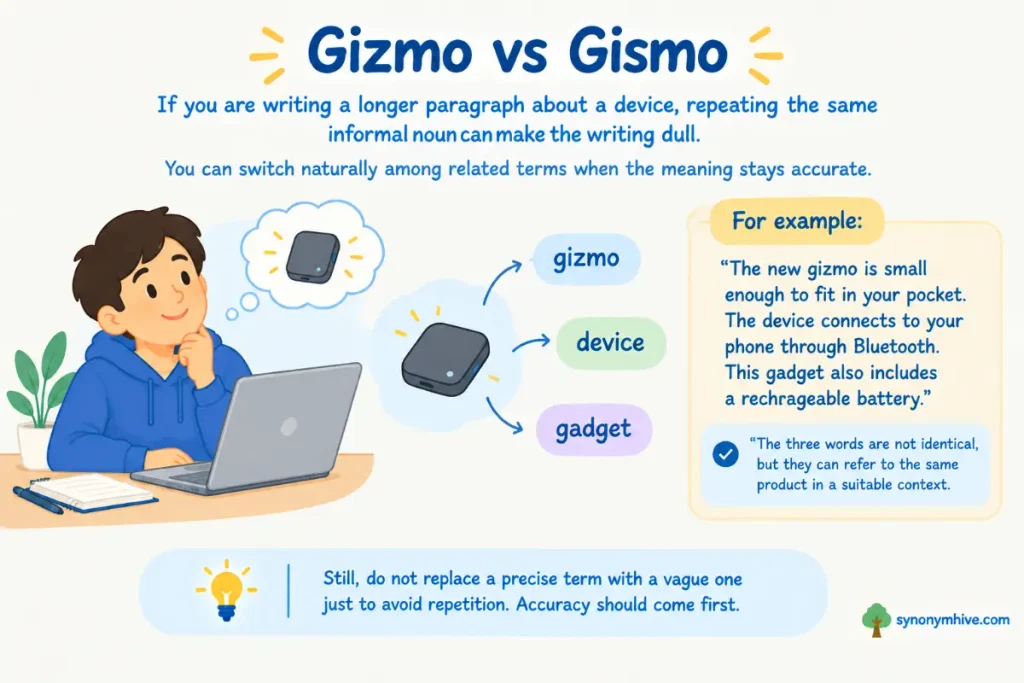
If you are writing a longer paragraph about a device, repeating the same informal noun can make the writing dull.
You can switch naturally among related terms when the meaning stays accurate.
For example:
The new gizmo is small enough to fit in your pocket. The device connects to your phone through Bluetooth. This gadget also includes a rechargeable battery.
The three words are not identical, but they can refer to the same product in a suitable context.
Still, do not replace a precise term with a vague one just to avoid repetition. Accuracy should come first.
What Should You Write in Most Cases?
For most readers, the choice is simple.
Write gizmo.
Use it when you need a casual term for a small device, tool, gadget, or object whose exact name is unknown or not important.
Use gadget when you want to emphasize that the object is a useful or clever device.
Use device when you want a neutral and more professional term.
Use contraption when the object seems complicated or unusual.
Use thingamajig or doohickey when you want a very informal or playful placeholder.
Use the exact technical name when accuracy matters most.
Conclusion
The main point in gizmo vs gismo is simple: gizmo is the standard and much more familiar spelling, while gismo is a less common variant. Both forms refer to a small device, gadget, tool, or unnamed object.
In everyday conversation, gizmo is useful when you do not know the exact name of something or when its name does not matter. It can describe electronic products, mechanical tools, kitchen devices, and many other small objects.
For formal or technical writing, think beyond spelling. Ask if a more exact word would give the reader better information. Device, tool, component, sensor, adapter, or another specific term may be stronger.
When you simply need the safest spelling, choose gizmo. That is the form most readers will recognize immediately.
Freqently Asked Questions
Is gizmo or gismo the correct spelling?
Gizmo is the preferred spelling in modern American English. Gismo is a recognized variant, but it is much less common.
Is gismo a misspelling of gizmo?
No, gismo is an established variant spelling. Still, gizmo is the more familiar and widely used form, so it is usually the better choice.
What does the word gizmo mean?
Gizmo means a small device, tool, gadget, or object whose exact name is unknown, forgotten, or not important. It is an informal word.
What’s another word for gizmo?
Common alternatives include gadget, device, tool, contraption, widget, thingamajig, and doohickey. The best choice depends on how formal or precise you want to be.
Is gizmo a formal word?
No. Gizmo is an informal word. In technical, academic, or professional writing, a more specific term such as device, tool, component, or instrument is often clearer.
Can gizmo mean an electronic device?
Yes. Gizmo can describe a small electronic device or gadget. However, it can also describe mechanical tools and other small objects.
What is the plural of gizmo?
The plural of gizmo is gizmos. For example, you can say, “The store sells several useful gizmos.”
Can I use gizmo in a formal essay?
You can, but it may sound too casual if the essay requires formal language. If you know the object’s exact name, using that specific term will usually make the writing stronger.

1 thought on “Gizmo vs Gismo Which Is Correct In 2026”