
If you have ever written girlie or girly and wondered which one belongs in your sentence, the confusion is understandable. Both forms are used in English, but they do not always have the same tone or meaning. The right choice depends on what you want to say.
Girly is the more common adjective when you mean traditionally associated with girls or women. Girlie is also a real English word, but it often sounds more informal, playful, cute, or conversational. It can also be used as a noun or form of address in some contexts.
The difference matters because these words can carry different feelings even when they point to similar ideas. A sentence about a dress, style, personality, or decoration may sound natural with either form, but one may fit the tone much better.
This guide explains the difference, spelling, meaning, pronunciation, history, examples, common mistakes, and the best choice for formal and casual writing.
Quick Definition
Girly is usually an adjective meaning feminine or traditionally associated with girls. Girlie can also mean feminine or associated with girls, but it often has a more informal, playful, cute, or affectionate tone.
Direct Answer
Both girly and girlie are correct English words, but they are used differently. Use girly as the standard adjective in most general and formal writing, while girlie is more informal and often suggests a cute, playful, or youthful style.
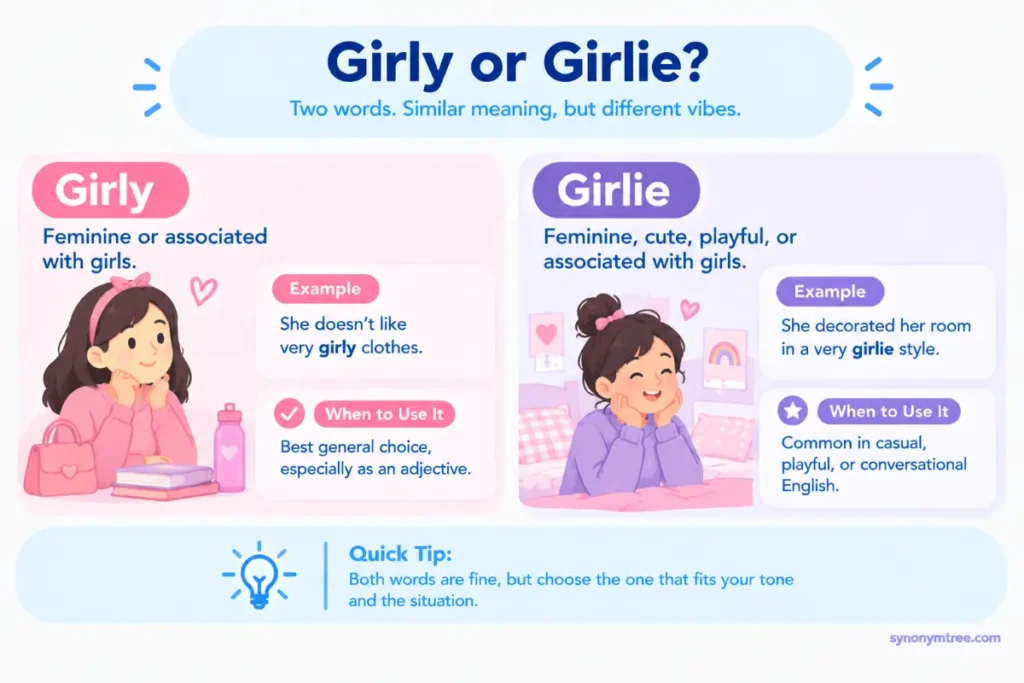
Girlie or Girly Comparison
| Word | Meaning | Example Sentence | When to Use It |
|---|---|---|---|
| Girly | Feminine or associated with girls | She doesn’t like very girly clothes. | Best general choice, especially as an adjective. |
| Girlie | Feminine, cute, playful, or associated with girls | She decorated her room in a very girlie style. | Common in casual, playful, or conversational English. |
The key difference is tone. Girly is usually the safer choice when you simply need an adjective. Girlie can sound softer, cuter, or more informal.
What Does Girly Mean?
Girly is an adjective. It describes something that is traditionally associated with girls or feminine style.
For example:
She wore a girly pink dress.
The speaker is describing the dress as feminine or traditionally associated with girls.
The word can refer to many things, including:
- clothing.
- colors.
- hobbies.
- decorations.
- behavior.
- interests.
- personal style.
- appearance.
For example:
Her bedroom has a very girly design.
She prefers girly clothes.
Pink is often seen as a girly color.
The word does not have to be negative. The tone depends on the speaker and the situation.
What Does Girlie Mean?
Girlie can have a similar basic meaning, but it often sounds more playful or informal.
For example:
She loves girlie dresses and cute accessories.
The speaker is not simply describing the style as feminine. The word can add a sense of cuteness or youthful charm.
You may also hear girlie in friendly expressions.
Hey, girlie!
Here, girlie is not describing a person as feminine. It is being used as an informal term of address.
That makes the word more flexible than girly in some situations.
Why Are Girly and Girlie Both Used?
The two forms developed from the word girl, with the suffix -y or a related -ie form.
English often creates informal words by adding endings such as -y, -ie, or -ey. These endings can change the tone of a word without creating a completely different basic idea.
For example, English has forms such as:
- doggy.
- kitty.
- mommy.
- daddy.
- sweetie.
- birdie.
These forms often sound informal, affectionate, playful, or childlike.
Girlie can have a similar effect. It may suggest something cute, youthful, or informal.
Girly, on the other hand, works more clearly as a regular adjective.
That is why you will often see girly in straightforward descriptions and girlie in casual language.
Is Girly More Common Than Girlie?
In general English, girly is the more common choice when the word functions as an adjective meaning feminine or associated with girls.
For example:
She has a very girly style.
That sounds natural in everyday English.
You can also say:
She has a very girlie style.
This is possible, but it has a more informal or playful tone.
The distinction becomes clearer in formal writing. If you are writing an essay, report, article, or professional description, girly is usually the safer adjective.
In casual writing, social media, text messages, or friendly conversation, girlie may fit naturally.
When Should You Use Girly?
Use girly when you want a straightforward adjective.
It works well in sentences such as:
She doesn’t like girly clothes.
The room has a girly design.
Her style is colorful but not too girly.
She wanted something less girly.
The word is especially natural when you are comparing styles.
Girly for Clothing
She prefers simple clothes rather than very girly outfits.
Here, girly describes a style that may include traditionally feminine colors, patterns, decorations, or shapes.
Girly for Decorations
The room has a girly look with pink walls and floral curtains.
The word describes the overall style.
Girly for Hobbies
She enjoys some girly hobbies, but she also loves hiking and sports.
This sentence uses the word to refer to activities that society may traditionally associate with girls.
When Should You Use Girlie?
Use girlie when you want a more casual, playful, cute, or youthful tone.
For example:
I bought a cute girlie notebook.
She loves girlie accessories.
The party had a fun, girlie theme.
In these examples, girlie gives the sentence a lighter and more informal feel.
It is especially common in personal writing, conversations, social posts, and friendly messages.
Girlie as a Friendly Term
Girlie can also be used when speaking directly to someone.
Hi, girlie!
Thanks, girlie!
Come on, girlie, let’s go.
This use is informal. Depending on the relationship and tone, it can sound affectionate, friendly, playful, or patronizing.
Context matters a lot.
Girly vs Girlie as Adjectives
Both words can describe something associated with girls or femininity.
Compare:
She bought a girly dress.
She bought a girlie dress.
Both sentences can mean that the dress has a traditionally feminine style.
However, the second sentence may sound more playful or cute.
This is one of those cases where grammar alone does not explain the difference. Tone matters.
Girly usually sounds more neutral.
Girlie usually sounds more informal.
That small difference can change how a sentence feels.
Girly or Girlie for a Person
You can use both words to describe a person’s style or behavior, but be careful.
For example:
She’s very girly.
This may mean that she has a traditionally feminine style, interests, mannerisms, or appearance.
You could also hear:
She’s very girlie.
This sounds more casual and can suggest a cute or youthful personality.
However, these descriptions can be subjective. What counts as feminine or girly varies between people and cultures.
It is often better to describe the specific quality you mean.
Instead of:
She’s girly.
You could say:
She loves floral dresses and bright colors.
Or:
She has a very feminine style.
Those sentences give the reader more information.
Is Girly a Negative Word?
Not necessarily.
Girly can be positive, neutral, negative, or simply descriptive depending on context and tone.
Consider:
She loves girly clothes.
This may be a positive statement about her personal style.
Now consider:
He thinks anything pink is too girly.
This could express a negative attitude toward traditionally feminine styles.
The word itself does not automatically carry a negative meaning.
Still, it can sometimes reinforce stereotypes about what girls or women should like.
If you are writing carefully about gender, a more specific description may be better.
Is Girlie a Negative Word?
Not automatically.
Girlie is often playful or affectionate.
For example:
She loves a girlie night with her friends.
This sounds casual and friendly.
However, the word can sound childish or dismissive in some settings.
If someone describes an adult woman as girlie, the listener may interpret it as affectionate, playful, patronizing, or overly familiar depending on the situation.
Tone and relationship are important.
What Is the Difference in Tone?
The easiest way to remember the difference is this:
Girly = more neutral.
Girlie = more playful or informal.
This is not an absolute grammar rule. English speakers may use the two forms in overlapping ways.
Still, the distinction is useful when choosing the best word for your sentence.
Tone Comparison
| Word | Typical Tone | Example |
|---|---|---|
| Girly | Neutral, descriptive, sometimes informal | She has a girly style. |
| Girlie | Cute, playful, affectionate, informal | She loves girlie accessories. |
If you are unsure, girly is usually the safer choice when you simply need an adjective.
Girly vs Feminine
These words are related but not identical.
Feminine is a broader and often more neutral word. It describes qualities traditionally associated with women or girls.
Girly is usually more casual and can suggest a youthful or stereotypically feminine style.
Compare:
She has a feminine appearance.
This sounds neutral and fairly formal.
She has a girly appearance.
This sounds more casual and may suggest a youthful or cute style.
In professional or academic writing, feminine is often the better choice if that is what you mean.
Girly vs Womanly
Womanly usually refers to qualities traditionally associated with adult women.
Girly tends to suggest qualities associated with girls or youthful femininity.
For example:
She has a womanly figure.
This focuses on adult female physical characteristics.
She has a girly style.
This focuses more on youthful or traditionally feminine style.
The two words should not be treated as exact synonyms.
Girly vs Cute
Cute and girly overlap, but they describe different things.
Cute means attractive, charming, or pleasing in a sweet way.
Girly means feminine or associated with girls.
Something can be cute without being girly.
For example:
He bought a cute blue backpack.
The backpack is cute, but nothing suggests that it is feminine.
A pink backpack covered with flowers might be described as both cute and girly.
The words can work together, but they are not interchangeable.
Girly vs Feminist
These words are not opposites.
Girly describes a style, quality, or behavior associated with girls or femininity.
Feminist relates to beliefs about gender equality and women’s rights.
Someone can enjoy traditionally feminine clothing and also hold feminist beliefs.
For example:
She has a very girly style and is also a strong feminist.
The sentence shows that the two ideas describe different things.
Examples of Girly in Real Sentences
Here are natural examples you might see or hear.
- She wore a girly dress to the party.
- Her room has a soft and girly design.
- I don’t usually choose girly colors.
- She loves girly accessories.
- The movie has a very girly style.
- Her handwriting looks neat and slightly girly.
- She wanted something feminine without looking too girly.
- The store sells a lot of girly clothing.
- She enjoys traditionally girly hobbies as well as sports.
- The decorations were colorful and girly.
- That hairstyle looks cute but not too girly.
- She has always had a girly sense of style.
Each sentence uses girly as an adjective.
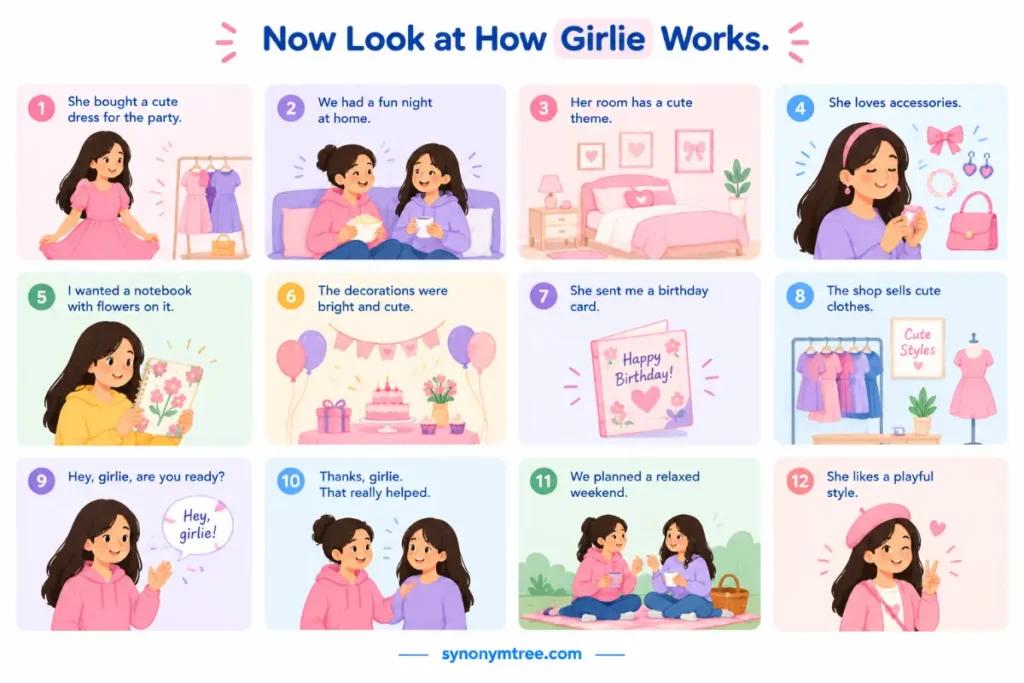
Examples of Girlie in Real Sentences
Now look at how girlie works.
- She bought a girlie dress for the party.
- We had a fun girlie night at home.
- Her room has a cute girlie theme.
- She loves girlie accessories.
- I wanted a girlie notebook with flowers on it.
- The decorations were bright and girlie.
- She sent me a girlie birthday card.
- The shop sells cute girlie clothes.
- Hey, girlie, are you ready?
- Thanks, girlie. That really helped.
- We planned a relaxed girlie weekend.
- She likes a playful, girlie style.
Notice how many of these examples have a casual or affectionate feeling.
Common Phrases With Girly
Certain combinations sound especially natural.
Girly Clothes
She prefers girly clothes with floral patterns.
Girly Style
Her girly style includes pastel colors and dresses.
Girly Colors
She avoids traditional girly colors.
Girly Room
She decorated her bedroom with a girly theme.
Girly Hobbies
The idea of girly hobbies can depend on culture and personal opinion.
Girly Girl
Girly girl is a common informal phrase for a girl or woman who strongly enjoys traditionally feminine styles, interests, or behaviors.
She’s a girly girl who loves dresses and makeup.
The phrase is casual and can be positive, neutral, or stereotypical depending on context.
Common Phrases With Girlie
Girlie Night
We planned a girlie night with movies and snacks.
This usually means a relaxed social evening with female friends.
Girlie Stuff
We spent the afternoon talking about girlie stuff.
This is very informal and vague. It may refer to topics traditionally associated with women or girls.
Hey, Girlie
Hey, girlie! How have you been?
This is an informal form of address.
Thanks, Girlie
Thanks, girlie. I appreciate it.
This can sound affectionate between friends.
Is Girlie Formal English?
Girlie is a real English word, but many uses are informal.
If you are writing a formal report, academic paper, business document, or professional description, consider using a more precise word.
For example, instead of:
The product has a girlie design.
You might write:
The product has a feminine design.
Or:
The product uses soft colors and floral patterns.
The second option is even more specific.
For casual writing, girlie can be completely natural.
Is Girly Formal English?
Girly is also informal in many contexts, but it is more widely accepted as the ordinary adjective.
It can appear in general writing, but the best word depends on what you mean.
In formal writing, feminine, youthful, playful, or a specific description may be more precise.
For example:
The design has a feminine style.
is more formal than:
The design is girly.
Neither is automatically wrong. They simply have different levels of formality.
US and UK Usage
Both girly and girlie are used in American and British English.
There is no simple rule saying that one belongs only to the United States and the other belongs only to the United Kingdom.
However, usage can vary by speaker, age, context, and region.
Girly is widely understood in both varieties of English.
Girlie is also widely understood, especially in casual speech and writing.
The meaning is usually clear from context.
Regional and Cultural Differences
Ideas about what is considered girly can vary across cultures.
Pink, dresses, makeup, flowers, and certain hobbies may be labeled feminine in one setting but not another.
That means the word describes a social idea rather than an objective fact.
If your writing is meant for a broad audience, specific descriptions can reduce confusion.
Instead of:
It has a girly design.
You could say:
It uses pastel colors, floral patterns, and decorative details.
That tells readers exactly what you mean.
Can Girlie Mean a Girl?
In some informal contexts, girlie can refer to a girl or woman, especially as a term of address.
For example:
Come here, girlie.
Or:
Thanks, girlie.
This use is different from the adjective girly.
You would not normally use girly in the same way.
You would not say:
Thanks, girly.
That sounds different and may sound unnatural or teasing.
The -ie ending gives girlie a different role and tone.
Can Girlie Be Affectionate?
Yes.
Friends may use girlie as an affectionate nickname or casual term of address.
For example:
Good morning, girlie!
Love you, girlie!
This type of use is common in friendly conversation.
Still, it should not automatically be used with everyone. A term that feels warm between close friends can sound overly familiar with a stranger.
Knowing your audience matters.
Is Girly an Insult?
It can be used as an insult, but it is not inherently insulting.
For example:
He called the color girly.
That may simply describe a color.
But:
Stop acting so girly.
could be insulting if the speaker uses femininity as something negative.
This is especially relevant because words describing gender can reflect social stereotypes.
If your goal is neutral writing, describe the specific behavior instead.
Instead of:
He was acting girly.
You might write:
He was speaking in a playful and expressive way.
That removes the judgment and gives a clearer description.
Common Mistakes With Girly and Girlie
Mistake 1: Treating Them as Completely Identical
They overlap, but their tone can differ.
Girly usually works as a straightforward adjective.
Girlie can be more playful or informal.
Mistake 2: Using Girlie in Formal Writing
The word is not automatically incorrect, but it may sound too casual.
Choose feminine or a more specific description when the writing needs a formal tone.
Mistake 3: Assuming Girly Is Always Negative
It is not.
The word can simply describe a style or preference.
Mistake 4: Using Gender Labels Without Explaining Them
Words such as girly and feminine can mean different things to different people.
When precision matters, explain the specific feature you mean.
Mistake 5: Confusing Girlie With Girly
The spelling ending matters.
Girly is normally the adjective.
Girlie can be an adjective with a playful tone and can also function as an informal noun or term of address.
How to Remember the Difference
A simple memory trick is:
Girly = regular adjective.
Girlie = playful or friendly form.
Think of the ie in girlie as adding a softer, more informal sound.
This is not a strict grammar rule, but it is a useful guide.
If you are describing something in ordinary writing, start with girly.
If you are writing a casual message, social post, or friendly conversation, girlie may be a better fit when you want a playful tone.
Which Word Should You Use in a Resume?
Neither word is usually ideal for a professional resume.
Instead of:
Created girly marketing materials.
Use a specific description:
Created feminine product packaging for a young female audience.
Or:
Designed colorful packaging with floral patterns for a youth market.
The second versions tell the reader what you actually did.
Which Word Should You Use in an Essay?
For an academic essay, girly may be acceptable if you are discussing the word itself, popular culture, gender, or informal language.
For example:
The term girly is often used to describe activities that society traditionally associates with girls.
If you are simply describing a style, feminine or a more specific adjective may be better.
Girlie is usually less suitable for formal academic writing because of its casual tone.
Which Word Should You Use in a Text?
Either can work.
For example:
That dress is so girly.
Or:
That dress is so girlie.
The first sounds more straightforward.
The second can sound more playful or cute.
If you are addressing a friend:
Hey, girlie!
is natural in some relationships.
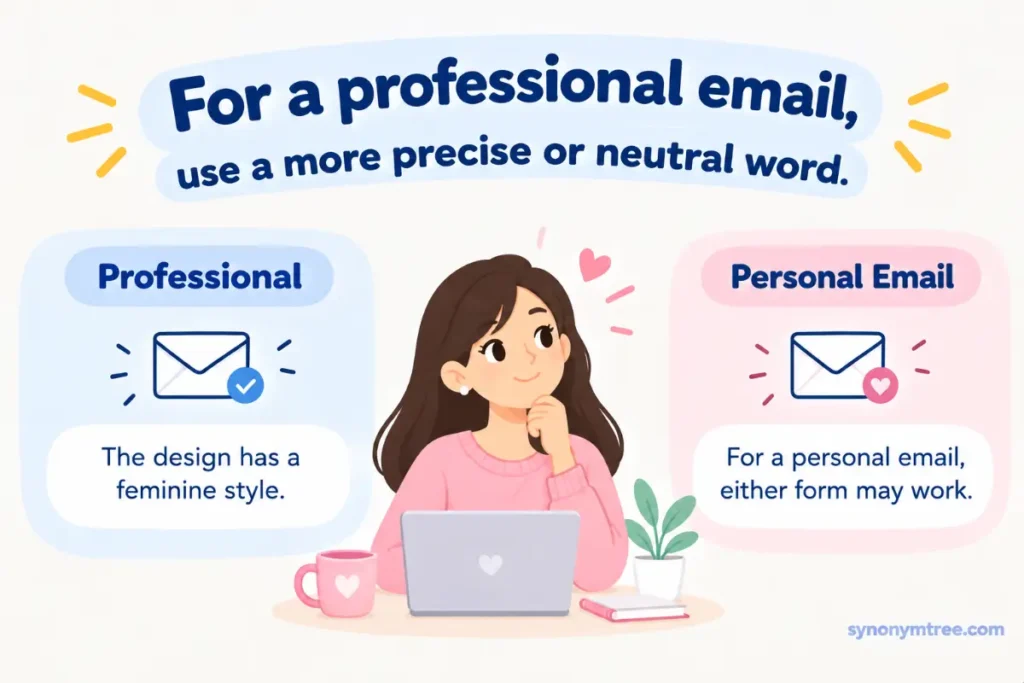
Which Word Should You Use in an Email?
For a professional email, use a more precise or neutral word.
For a personal email, either form may work.
Professional:
The design has a feminine style.
Personal:
I found the cutest girlie dress today.
The audience determines the best choice.
Which Word Sounds More Natural?
If you are simply describing something as feminine, girly will usually sound more natural.
If you want to sound playful, affectionate, or casual, girlie may fit better.
That is why you should not think of the two spellings as a simple right-versus-wrong question.
Both are legitimate forms. Their use depends on meaning, grammar, and tone.
Conclusion
When choosing between girlie or girly, remember that both forms can be correct. The main difference is tone and use.
Girly is usually the better choice when you need a simple adjective meaning feminine or traditionally associated with girls. Girlie can express the same general idea, but it often sounds more playful, cute, youthful, or informal.
For formal writing, consider using feminine or describing the exact style instead. For texts, social posts, and friendly conversations, girlie can sound natural and warm.
The easiest rule is to start with girly for ordinary descriptions. Choose girlie when you want a more casual or affectionate feel.
FAQs
Is girlie or girly the correct spelling?
Both are correct English words, but they have different uses and tones. Girly is the more common general adjective, while girlie often sounds more playful, cute, or informal.
Is girly or girlie more common?
Girly is generally the more common choice when describing something as feminine or associated with girls. Girlie is also widely understood and is especially common in casual language.
What is the difference between girly and girlie?
Girly usually works as a straightforward adjective meaning feminine or associated with girls. Girlie can have the same basic meaning but often adds a playful, youthful, or affectionate tone.
Is girlie a real word?
Yes. Girlie is a real English word. It can describe something feminine or cute, and it can also be used informally as a term of address for a girl or woman.
Can I say girlie in formal writing?
You can, but it may sound too casual for formal writing. Words such as feminine, youthful, or a specific description may be a better choice.
Is girly a negative word?
No. Girly can be neutral or positive when describing someone’s style or preferences. However, it can sound negative if the speaker uses femininity as an insult.
What’s another word for girly?
Depending on the context, alternatives include feminine, womanly, cute, delicate, pretty, youthful, or playful. The best choice depends on the exact quality you want to describe.
Can girlie be used as a nickname?
Yes. Girlie can be used informally as a friendly or affectionate term of address. The tone depends on the relationship between the speakers.

1 thought on “Girlie or Girly Best Spelling Guide In 2026”