
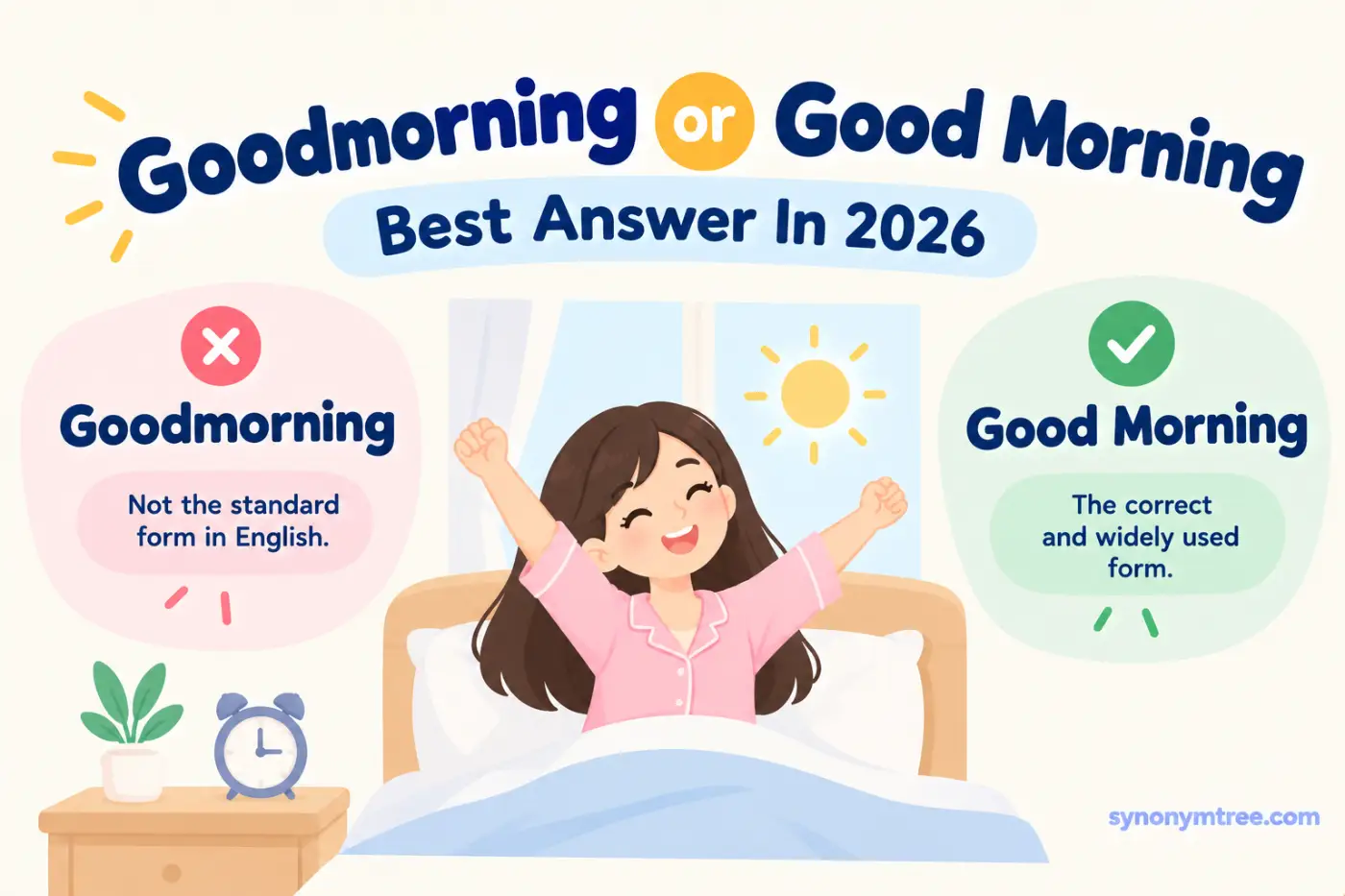
If you are writing a text, email, card, school assignment, or work message, you may stop and wonder if it should be goodmorning or good morning. The two forms look almost identical, but only one is normally correct in standard English. That small space matters.
The correct form is good morning. It is written as two separate words when you use it as a greeting or as a phrase referring to the morning. The form goodmorning is not standard English and should not be used in normal writing.
Good morning is more than a simple greeting. It can appear at the start of an email, in a conversation, in a speech, on a card, or as part of a sentence. The capitalization and punctuation can change based on how you use it.
This guide explains why the two words stay separate, how the expression developed, how to use it in different situations, and what mistakes to avoid. You will also see examples for texts, emails, school writing, professional messages, and everyday conversations.
Quick Definition
Good morning is a standard English greeting used when you meet or address someone during the morning. It is made up of the adjective good and the noun morning, and the two words are normally written separately.
Goodmorning is not the standard spelling of the greeting. If you are writing in standard English, use good morning.
Direct Answer
The correct form is good morning. Write it as two words when you are greeting someone or referring to the morning.
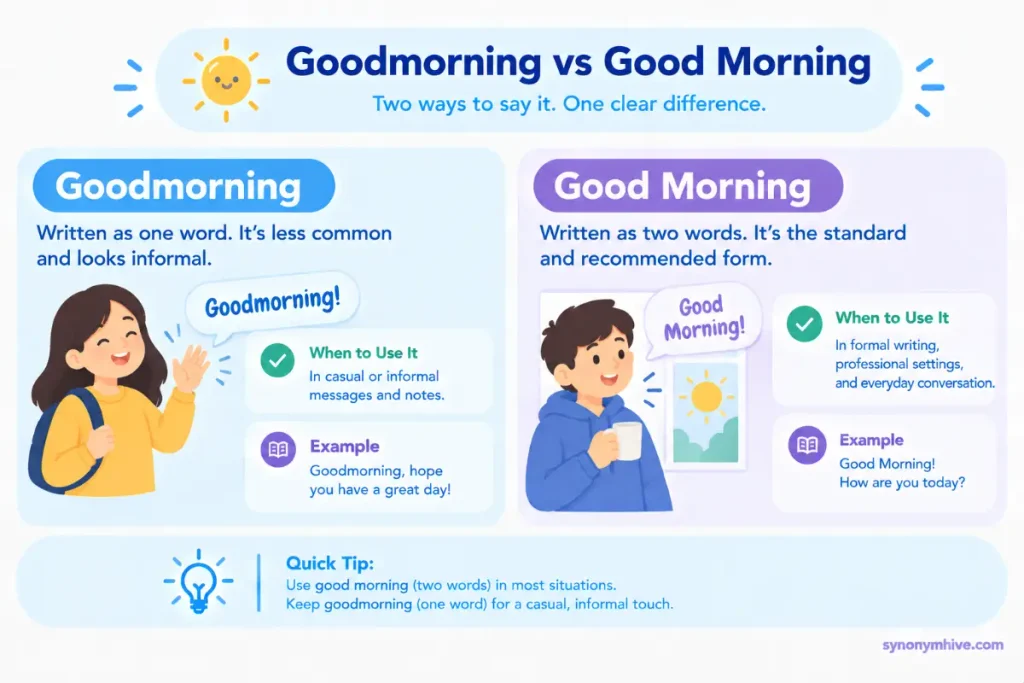
Goodmorning or Good Morning Comparison
| Form | Meaning | Example Sentence | When to Use It |
|---|---|---|---|
| good morning | A morning greeting | Good morning, Sarah. | Use this in standard English. |
| goodmorning | Nonstandard closed form | Goodmorning, Sarah. | Avoid this spelling in standard writing. |
| Good morning | Capitalized greeting | Good morning, everyone. | Use at the start of a sentence or greeting. |
| good morning | Lowercase phrase inside a sentence | I wished him good morning. | Use when the phrase appears within a sentence. |
The key point is simple. Good morning contains a space because it is normally written as two words.
Why Is Good Morning Written as Two Words
The reason is tied to how the expression works in English. Good morning is a phrase made from two ordinary words. The word good describes the morning, while morning names the part of the day.
When you say Good morning, you are essentially offering someone a pleasant morning. Over time, this became a fixed and familiar greeting, but the words did not normally merge into one standard word.
English has many expressions that contain two words but act as a familiar unit. Good afternoon and good evening work in the same way.
For example, you would write:
Good morning, James.
Good afternoon, Ms. Lee.
Good evening, everyone.
You would not normally combine these greetings into forms such as goodafternoon or goodevening.
The same basic pattern helps explain why the space matters. The expression became common as a greeting, but standard spelling kept the two words separate.
This is also why writing goodmorning can look unusual to an English reader. The meaning is usually clear, but the spelling does not follow the standard form.
What Does Good Morning Mean
Good morning is a polite greeting used during the morning. It can be friendly, formal, warm, respectful, or neutral depending on the situation and the way you say it.
A simple Good morning can be enough when you meet someone at work. A cheerful Good morning can sound warm when you greet a friend. In a formal email, Good morning, Dr. Patel can sound respectful and professional.
The phrase does not always describe the weather or quality of the morning. When you say Good morning to someone, you are usually not making a factual claim that the morning is good.
Instead, it functions as a social greeting.
This is similar to expressions such as Have a good day. The speaker is using language to show goodwill rather than simply reporting a fact.
Consider these examples.
Good morning, Mom.
Good morning, everyone.
Good morning, Mr. Davis.
I said good morning to my neighbor.
Each example uses the same basic expression, but the context changes the tone.
Where Did Good Morning Come From
The greeting has a long history in English. Morning itself comes from Old English words connected with the early part of the day. The word good has Germanic roots and has been part of English for many centuries.
The exact modern greeting developed over time as English speakers used good with different parts of the day.
Good morning follows the same basic pattern as good day, good afternoon, and good evening. These expressions combine a positive word with a time of day to form a polite greeting.
In older English, greetings could be more elaborate than the short expressions people often use today. As everyday speech became more familiar and direct, short greetings became common.
Today, Good morning is one of the most widely recognized English greetings. It appears in casual speech, formal communication, schools, workplaces, customer service, speeches, and written messages.
The spelling has remained two words in standard English.
Is Good Morning One Word or Two
Good morning is two words.
This is the main spelling rule to remember. The adjective good and the noun morning remain separate when the phrase is used as a greeting.
You can see the same pattern in related greetings.
Good afternoon.
Good evening.
Good night.
These expressions are normally written as separate words too.
The fact that a phrase is commonly used does not automatically mean it becomes one word. English contains many common phrases that remain open phrases.
For example, people write high school, post office, real estate, and coffee shop as separate words. Their frequent use does not turn them into single words.
The same idea applies here.
When Should You Capitalize Good Morning
Capitalization depends on where the phrase appears.
If Good morning starts a sentence or greeting, capitalize Good.
Good morning, everyone.
Good morning, Dad.
Good morning, Professor Smith.
If the expression appears in the middle of a sentence, good can usually be lowercase.
I said good morning before I left.
She wished her teacher good morning.
He smiled and said good morning.
In a greeting at the beginning of a letter or email, capitalization usually follows normal greeting style.
Good morning, Mr. Brown.
Good morning, Team.
Good morning, Dr. Carter.
The word morning does not normally need a capital letter simply because it follows Good. It is usually lowercase.
So this is standard.
Good morning, Anna.
This is not normally needed.
Good Morning, Anna.
The second version may appear in titles, designs, signs, or stylized writing, but standard sentence capitalization generally uses Good morning.
How to Use Good Morning in a Sentence
The expression can work in several ways.
The most common use is as a direct greeting.
Good morning, Lisa.
You can also use it after someone has already addressed you.
Good morning. How are you today?
Another common use places it inside a sentence.
I wished my teacher good morning.
The phrase can also introduce a speech or announcement.
Good morning, everyone. Thank you for joining us.
It can appear in dialogue.
“Good morning,” Daniel said as he walked into the room.
The punctuation changes based on the sentence structure, but the spelling remains the same.
Should You Write Good Morning With a Comma
A comma is often used after good morning when you directly address a person or group.
Good morning, Sarah.
Good morning, everyone.
Good morning, Mr. Jones.
The comma separates the greeting from the name or group being addressed.
You can also use a period when the greeting stands alone.
Good morning.
How are you?
In dialogue, the comma may appear before a speaker tag.
“Good morning,” she said.
This follows common dialogue punctuation rules.
However, the comma is not part of the spelling of the greeting itself. The most important spelling point is that good and morning remain separate.
Good Morning in Emails
Good morning is common in professional emails, but the best form depends on the relationship and the time you send the message.
For a formal email, you might write:
Good morning, Dr. Wilson.
Good morning, Ms. Adams.
Good morning, Professor Clark.
For a message to a team, you could write:
Good morning, everyone.
Good morning, team.
For a friendly work email, you might use:
Good morning, John.
I hope your day is going well.
The phrase can make an email sound polite without adding much length. Still, you do not need to use it in every message. If you are replying to someone in an ongoing conversation, a direct opening may sound more natural.
For example:
Good morning, David. I wanted to follow up on yesterday’s meeting.
This works well because the greeting is followed immediately by the reason for the email.
Avoid writing goodmorning in professional communication. Even though most readers will understand it, the closed form can look like a spelling error.
Good Morning in Text Messages
Text messages are more flexible than formal writing, but the standard spelling is still good morning.
You might text:
Good morning.
Good morning! How did you sleep?
Good morning, hope you have a great day.
Good morning 😊
Informal texting allows creative spelling, shortened words, emojis, and unusual punctuation. Even so, good morning remains the normal written form.
A person may type goodmorning as a casual shortcut. That does not make it the standard spelling.
If you are writing a message that you want to look polished, keep the space.
Good Morning in School Writing
Students often use greetings in letters, stories, dialogue, and creative writing. Standard spelling matters in these settings.
A letter might begin:
Good morning, Mrs. Taylor.
A story could include:
“Good morning,” Emma said as she entered the classroom.
An essay might say:
The students greeted their teacher with a cheerful good morning.
In all three examples, the expression stays open.
School writing is a good place to remember the difference between informal typing and standard English. A spelling choice that appears in casual messages may still be marked wrong in an assignment.
Good Morning in Professional Speaking
Good morning is especially common in workplaces, meetings, classrooms, conferences, and public speaking.
A manager might begin a meeting by saying:
Good morning, everyone. Let’s get started.
A teacher might say:
Good morning, class.
A speaker might say:
Thank you for being here.
The phrase helps establish a polite opening. It can also signal that the speaker is ready to begin.
In professional speech, tone matters as much as the words. A warm voice can make the greeting friendly. A calm voice can make it sound formal.
Good Morning in Casual Conversation
Friends and family use the phrase too.
Good morning, Mom.
Morning, Alex.
Good morning! Did you have a good night?
The shorter Morning is also common in casual American English. It is an informal shortening of Good morning.
For example:
Morning. How are you?
This is fine in a relaxed conversation. It would usually sound less formal than Good morning.
The important point is that informal speech does not change the standard spelling of the full greeting.
Is Good Morning Formal or Informal
Good morning can be either formal or informal.
That flexibility is one reason the phrase is so useful. You can say it to a close friend, a family member, a teacher, a customer, or a manager.
Compare these examples.
Good morning, Mom.
Good morning, Mr. Harris.
Good morning, everyone.
Good morning, sweetheart.
The wording is the same, but the relationship changes the tone.
If you need a safe greeting for a professional situation, Good morning is usually a strong choice.
For a close friend, it can sound warm and natural.
Good Morning vs Morning
Good morning is more complete and usually more polite. Morning is shorter and more casual.
| Greeting | Tone | Example |
|---|---|---|
| Good morning | Neutral or polite | Good morning, Chris. |
| Morning | Casual | Morning, Chris. |
| Hey, good morning | Friendly and casual | Hey, good morning! |
| Good morning, everyone | Polite and group focused | Good morning, everyone. |
Morning works well with people you know. Good morning is more flexible because it works in both casual and professional settings.
If you are unsure which one to choose, Good morning is the safer option.
Good Morning vs Good Day
Good morning specifically refers to the morning. Good day is broader and has a different tone.
Good morning is a common everyday greeting.
Good day can be used as a greeting, but it may sound more formal, old fashioned, dramatic, or regional depending on the speaker.
For example:
Good morning, Mr. Brown.
Good day, Mr. Brown.
The first sentence sounds normal in many modern American settings. The second may sound more formal or theatrical.
Good day can also be used as a farewell in some contexts.
Good morning does not usually serve as a farewell. It is primarily used when greeting someone during the morning.
Good Morning vs Good Night
These two expressions refer to different parts of the day and often have different functions.
Good morning is generally a greeting.
Good night is often used when leaving someone at night or before going to sleep.
For example:
Good morning, Dad.
Good night, Dad.
The first is used when starting the day or greeting someone in the morning. The second is often used when ending a conversation or going to sleep.
This distinction can help learners who are studying English greetings.
Is Good Morning a Phrase or a Compound Word
Good morning is generally treated as a phrase rather than a single compound word when used as a greeting.
A compound word is made when two or more words combine into a recognized word or fixed form. Some compounds are closed, such as notebook. Others are open, such as post office.
Good morning remains an open expression.
This matters because people sometimes assume that frequent use should turn the phrase into one word. English does not work that way.
A common expression can stay as two words for centuries.
Why Do People Write Goodmorning
People write goodmorning for several reasons.
One reason is simple typing speed. In casual messages, people sometimes remove spaces or punctuation.
Another reason is that English learners may assume the greeting works like a compound word. Since the expression is used so often, it can look like something that should be joined.
Social media can also spread unusual spellings. Once people see a form often enough, it can start to look normal.
Search behavior creates another source of confusion. Someone may type goodmorning into a search box because they are unsure about the spelling. Other people may copy the same form from usernames, hashtags, captions, or informal posts.
None of these uses changes the standard spelling.
If you are writing for school, work, publication, or any situation that calls for standard English, use good morning.
Common Mistakes With Good Morning
The biggest mistake is joining the words.
Incorrect:
Goodmorning, everyone.
Correct:
Good morning, everyone.
Another mistake is capitalizing both words in ordinary sentences.
Less standard:
Good Morning, everyone.
Standard:
Good morning, everyone.
A third mistake is forgetting the comma when directly addressing someone.
Good morning Sarah.
Good morning, Sarah.
The second version makes the direct address clearer.
Another common issue is using Good morning at a time when it no longer sounds natural. The exact boundary of morning varies by person and context, but people generally stop using the greeting later in the day and switch to Good afternoon.
Common Sentences With Good Morning
Here are natural examples that show how the expression works.
- Good morning, everyone.
- Good morning, Mom.
- Good morning, Mr. Lee.
- Good morning. Did you sleep well?
- She smiled and said good morning.
- I wished my neighbor good morning.
- Good morning, class. Please take your seats.
- He sent me a good morning text.
- Good morning, team. The meeting starts in ten minutes.
- We exchanged a quick good morning before work.
- Good morning, Sarah. I have a question for you.
- The receptionist greeted every visitor with a cheerful good morning.
- I heard Dad say good morning from the kitchen.
- Good morning, everyone. Thanks for coming.
- She always says good morning when she arrives.
Notice that the phrase stays separate in every example.
How to Remember the Correct Spelling
The easiest memory trick is to connect the phrase with its related greetings.
Think of this set:
Good morning.
Good afternoon.
Good evening.
Good night.
All four expressions use separate words.
You can also think of the phrase as meaning something close to a pleasant morning greeting. Good describes the morning, and morning names the time of day.
Another trick is to remember the common question.
Would you write good afternoon as one word?
No.
So you should not normally write good morning as one word either.
You can also remember the phrase by focusing on how it sounds. There is a natural pause between good and morning when many people say it.
The pause is not a spelling rule by itself, but it can help you remember that the expression contains two words.
Is Goodmorning Ever Correct
Goodmorning is not the standard form of the English greeting.
You may still see it in usernames, brand names, informal posts, creative writing, hashtags, or other situations where someone intentionally changes normal spelling.
A name or brand can use unusual spelling for its own reasons. That does not make the spelling standard English.
The same idea applies to social media. A person might write goodmorning without a space as a stylistic choice. You can recognize what they mean, but you should not copy that spelling into formal writing.
For standard English, use good morning.
Good Morning as a Noun Phrase
The expression can also appear inside a sentence as a noun phrase.
Consider:
I gave her a good morning smile.
The phrase is not functioning exactly like a direct greeting there. It helps describe something connected with the morning.
Another example is:
He sent me a good morning message.
Here, good morning describes the type of message.
You may also see:
She wished everyone a good morning.
In this sentence, the expression is part of a larger noun phrase.
These uses explain why you should not treat Good morning as only a greeting. Its exact grammatical role can change with context.
Can You Say Good Morning at Noon
Good morning is normally used during the morning, so using it at noon may sound unusual.
The exact time when morning ends is not fixed by one universal rule. People use the term differently depending on schedules, workplaces, location, and context.
Still, if it is clearly afternoon, Good afternoon is usually the better greeting.
For example:
At 8:30 a.m., Good morning sounds natural.
At 1:30 p.m., Good afternoon is usually more appropriate.
In casual situations, people may use Good morning later than you expect if they are greeting someone who has just woken up. Context can affect the choice.
Good Morning in American English
American English commonly uses Good morning as a standard greeting.
It appears in homes, schools, offices, stores, customer service settings, meetings, and public events.
Americans also frequently shorten the greeting to Morning in casual speech.
For example:
Morning, Mike.
This is natural among people who know each other.
Professional settings often favor the full expression.
Good morning, everyone.
Good morning, Mr. Johnson.
The spelling remains the same in both casual and formal American English.
Good Morning in British English
British English also uses Good morning as a standard greeting.
The phrase is familiar and normal in both British and American English. There is no major spelling difference between the two varieties for this expression.
You may hear differences in pronunciation, tone, or regional greeting habits, but the written form remains good morning.
This is useful for English learners because you do not need to memorize separate British and American spellings for this phrase.
What Is the Opposite of Good Morning
There is no exact opposite of Good morning because it is a greeting rather than a word with a direct opposite.
However, several expressions relate to different times or situations.
Good afternoon refers to the afternoon.
Good evening refers to the evening.
Good night is commonly used when leaving at night or before sleep.
Morning can also be contrasted with afternoon, evening, and night as parts of the day.
The word good itself can have an opposite, bad, but Bad morning is not the normal opposite of the greeting Good morning.
You might say:
I had a bad morning.
That describes the quality of your morning. It is not a normal greeting.
This distinction is useful because the phrase has a social function that is different from the literal meanings of its individual words.
When Not to Use Good Morning
Avoid Good morning when the context calls for a different time based greeting.
If it is clearly afternoon, Good afternoon will usually sound more natural.
You may also skip the greeting entirely in a short professional reply when the conversation is already underway.
For example, if someone writes:
Can you send me the report?
A simple answer might be:
Yes. I will send it this afternoon.
There is no need to add Good morning unless the context makes it useful.
Another point concerns tone. A very formal letter may use a more specific greeting depending on the relationship and purpose. A casual text may simply say Morning or Hey.
The right choice depends on the situation, but the standard spelling does not change.
How to Choose the Right Greeting
A few simple questions can help.
First, ask what time of day it is.
If it is morning, Good morning is usually appropriate.
Next, think about the person you are addressing.
A teacher, manager, customer, or client may call for a polite greeting. A close friend may be fine with Morning or Hey.
Then consider the purpose of the message.
A professional email benefits from clear and respectful wording. A quick text can be more relaxed.
Finally, check the spelling.
Keep good and morning separate.
That last step solves the main spelling problem.
Good Morning in Cards and Notes
Greeting cards often use Good morning in messages about birthdays, holidays, travel, or everyday encouragement.
For example:
Good morning. I hope you have a wonderful day.
Good morning, Mom. I hope you enjoy your birthday.
Good morning, sweetheart. Have a beautiful day.
In a decorative design, you may see both words capitalized for visual reasons. That is a design choice rather than a general spelling rule.
If you are writing ordinary prose, use standard sentence capitalization.
Good Morning in Social Media Captions
Social media captions can be more flexible than formal writing.
You might see:
Good morning, friends.
Good morning from the beach.
Good morning, sunshine.
People also use unusual spellings for style. A caption may contain emojis, repeated letters, missing punctuation, or creative capitalization.
That does not mean every social media spelling is standard English.
If you want your caption to look polished, write Good morning as two words.
The same advice applies to blogs, newsletters, public posts, and other content intended for a broad audience.
Why Spacing Matters in English
A single space can change how readers understand a phrase.
English has many word combinations that must remain separate.
For example:
a lot, not alot.
at least, not atleast.
each other, not eachother.
good morning, not goodmorning.
These mistakes are common because the phrases are often used together. The brain starts to treat them as one unit, especially when people type quickly.
Learning common word groups as complete phrases can help. Instead of memorizing only the individual words, remember the standard written form.
For this greeting, the pattern is simple.
Good space morning.
Once that becomes familiar, the spelling becomes much easier.
Related Greetings You Should Know
Learning related greetings can reinforce the correct form.
Good morning is used during the morning.
Good afternoon is used during the afternoon.
Good evening is used during the evening.
Good night is commonly used when saying goodbye at night or before sleep.
Hello can be used at many times of day.
Hi is usually casual and can also be used at many times of day.
Hey is generally more casual.
These greetings do not all have the same function, but they are useful comparisons when learning English.
If you know that Good afternoon contains two words, it becomes easier to remember that Good morning does too.
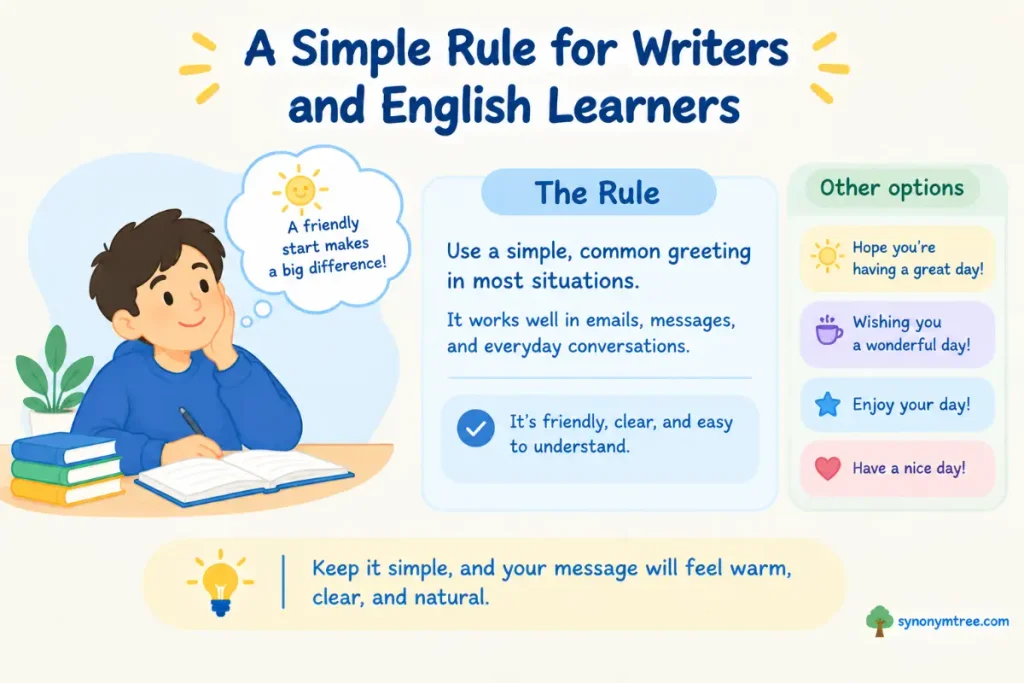
A Simple Rule for Writers and English Learners
Use good morning when you are greeting someone in the morning.
Keep the words separate.
Capitalize Good when it begins a sentence or greeting.
Use a comma before a person’s name when you directly address that person.
For example:
Good morning, Emma.
Good morning, everyone.
Good morning. How are you?
Inside a sentence, use lowercase unless normal capitalization requires otherwise.
I said good morning to Emma.
These four rules cover most everyday situations.
Conclusion
The correct spelling is good morning, with a space between the two words. If you are asking about goodmorning or good morning, the standard English form is good morning. It is a common English greeting used during the morning, and it works in casual conversations, professional emails, school writing, speeches, and many other settings.
The form goodmorning may appear in informal online writing, usernames, captions, or creative text, but it is not the standard spelling. If you want your writing to follow normal English rules, keep the words separate.
Remember three simple points. Write good morning as two words. Capitalize Good when it begins a sentence or greeting. Add a comma before a person’s name when you are speaking directly to that person.
When in doubt, use Good morning, Sarah or Good morning, everyone. That simple pattern will keep your greeting clear, natural, and correct.
Frequently Asked Questions
Is good morning one word or two?
Good morning is two words. The standard English spelling keeps good and morning separate when the expression is used as a greeting.
Is goodmorning correct English?
Goodmorning is not the standard spelling of the greeting. Use good morning in school, work, emails, articles, and other standard English writing.
What’s another way to say good morning?
You can say Morning, Hello, Hi, or Good day depending on the situation. Morning is a common casual option, while Hello and Hi can be used at many times of day.
Should I capitalize both words in Good Morning?
Usually, you capitalize only Good when the greeting begins a sentence. The standard form is Good morning, everyone.
Do you put a comma after good morning?
Use a comma when you directly address a person or group. For example, write Good morning, Sarah and Good morning, everyone.
Is good morning formal or informal?
Good morning can be both formal and informal. It works in professional settings, family conversations, classrooms, emails, and friendly messages.
Can I use good morning in an email?
Yes, good morning is a polite and common email greeting. You can write Good morning, Mr. Smith or Good morning, everyone depending on who you are addressing.
Why do people spell goodmorning as one word?
People may join the words because they type quickly, see the form online, or treat the familiar phrase like a compound word. Even so, standard English keeps the two words separate.

1 thought on “Goodmorning or Good Morning Best Answer In 2026”