
If you have ever typed a sentence such as “I am grately thankful,” you may have stopped and wondered if something looks wrong. The confusion between grately and greatly is common because both spellings seem like they could come from the word great. Only one is the standard English word.
The correct spelling is greatly. It is an adverb that means to a large degree, very much, or in an important way. The spelling grately is not standard English and should not be used in normal writing.
Quick answer: Greatly is the correct spelling. Grately is a misspelling that often appears because people naturally connect the word with great.
This guide explains why greatly is correct, how the word is formed, what it means, and how to use it in real sentences. You will also see common mistakes, memory tips, related words, and examples for emails, essays, school writing, work messages, and everyday speech.
Quick Definition
Greatly is an adverb that means very much, to a large degree, or significantly. It comes from the adjective great and is used to describe the degree or effect of something.
Grately is not the standard spelling of this adverb. If you need the correct form in formal or everyday English, use greatly.
Direct Answer
Greatly is the correct word. Grately is a misspelling and should generally be avoided.
For example, write “Your help is greatly appreciated,” not “Your help is grately appreciated.”
Comparison Table
| Word | Meaning | Example Sentence | When to Use It |
|---|---|---|---|
| Greatly | Very much or to a large degree | Your support is greatly appreciated. | Use in standard English writing and speech. |
| Grately | No standard meaning as the adverb intended here | The form is usually a spelling mistake. | Avoid it in normal English writing. |
Why Do People Confuse These Two Spellings?
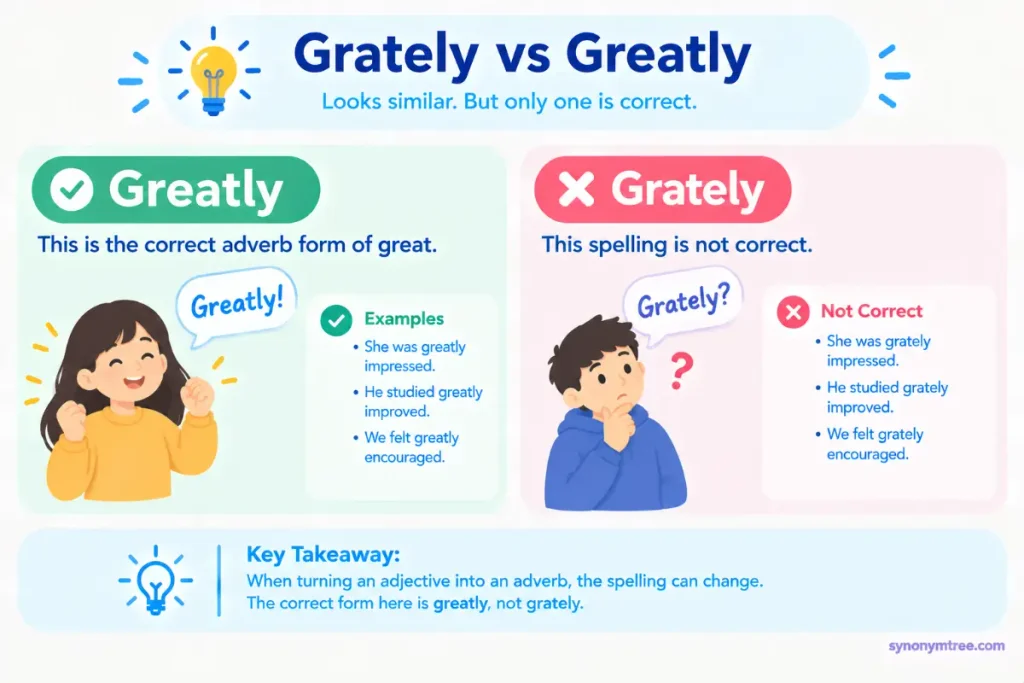
The confusion starts with the word great. When people want to turn an adjective into an adverb, adding ly often seems like the obvious rule.
For example, quick becomes quickly. Careful becomes carefully. Slow becomes slowly. Natural becomes naturally. Based on those patterns, someone might think great should become grately.
English does not always work in such a simple way. The standard adverb formed from great is greatly. The spelling changes before the ending is added.
This kind of spelling issue happens often because English has many words that do not follow the most basic pattern. A writer may know the meaning of the word but still hesitate over its spelling.
There is also a sound issue. Greatly can be pronounced in a way that makes the spelling feel less obvious. When people hear the word rather than see it, they may connect the final sound with the spelling of great plus ly.
That can lead to forms such as grately. The mistake is understandable, but the standard written form remains greatly.
What Does Greatly Mean?
Greatly means very much, to a high degree, or significantly. It usually tells us how strongly something happens or how large an effect something has.
Consider this sentence:
“Your advice greatly helped me.”
Here, greatly tells us how much the advice helped. It means the advice helped a lot.
Now look at another example:
“The new system greatly improved our results.”
The word greatly shows that the improvement was significant. The results did not improve only a little. They improved by a large amount.
The word can also show strong emotion or appreciation.
“I greatly appreciate your time.”
This means “I appreciate your time very much.”
Greatly is especially common with verbs such as appreciate, improve, reduce, increase, affect, influence, benefit, admire, value, regret, and change.
Where Does Greatly Come From?
Greatly is built from the adjective great and the adverb ending ly. The word great has a long history in English and has been used for centuries to describe something large, important, powerful, excellent, or significant.
Over time, great developed several related meanings. It can describe physical size, importance, ability, degree, or quality.
For example:
“She has great skill.”
“The project had great importance.”
“He showed great courage.”
When the idea of great is used to modify a verb, English uses greatly.
“She greatly improved her writing.”
The relationship is easy to see once you compare the parts.
Great describes a noun.
“Great progress was made.”
Greatly describes the degree of an action or effect.
“The team greatly improved.”
The two words are related, but they do different jobs in a sentence.
Why Is Greatly Correct Instead of Grately?
Greatly is the established standard form in English. The spelling follows the accepted form of the adverb rather than simply adding ly to the exact written form of great.
This is a useful reminder that spelling cannot always be predicted by one simple rule.
You may know that many adjectives form adverbs by adding ly.
“She spoke calmly.”
“He answered honestly.”
“They worked carefully.”
But some words change slightly when an ending is added. Greatly is one of the forms that learners need to remember.
The best approach is not to treat grately as an alternative spelling. It is better to recognize greatly as the correct form and learn a few common phrases that use it.
How Is Greatly Used in a Sentence?
Greatly usually comes before the word or phrase it modifies, but its exact position can vary depending on the sentence.
Greatly Before a Verb
This is one of the most common patterns.
“The experience greatly changed her.”
“Exercise greatly improved his health.”
“The new policy greatly reduced costs.”
In these examples, greatly tells the reader how strongly the action happened.
Greatly Before a Past Participle
Greatly often appears before words such as appreciated, affected, reduced, improved, increased, and influenced.
“Your kindness is greatly appreciated.”
“The area was greatly affected by the storm.”
“Production has greatly increased.”
This pattern is common in professional writing.
Greatly With Feelings
Greatly can describe a strong emotional response.
“I was greatly relieved when I heard the news.”
“She was greatly disappointed by the decision.”
“He was greatly surprised by the result.”
In each case, the adverb adds strength to the feeling.
Greatly With Appreciation
One of the most familiar phrases is greatly appreciated.
“Your help is greatly appreciated.”
“We greatly appreciate your support.”
“I greatly appreciate your patience.”
These sentences are common in emails, business messages, thank you notes, and formal communication.
Greatly vs Great
The difference between great and greatly is not only spelling. The two words have different grammatical roles.
Great is usually an adjective. It describes a noun.
“She did a great job.”
Greatly is an adverb. It usually describes a verb, adjective, or another adverb.
“She greatly improved her skills.”
Compare these examples:
“He has great respect for his teacher.”
“He greatly respects his teacher.”
The first sentence uses great to describe respect. The second uses greatly to describe the degree of his respect.
Another example makes the difference even clearer.
“The change had a great effect.”
“The change greatly affected the team.”
Great describes the noun effect.
Greatly vs Very
Greatly and very can sometimes both show a high degree, but they do not always work in the same places.
Very commonly modifies adjectives and adverbs.
“She is very happy.”
“He ran very quickly.”
Greatly usually modifies verbs or past participles.
“She greatly improved.”
“He was greatly relieved.”
You would not normally replace greatly with very in every sentence.
For example:
“Your help is greatly appreciated.”
This is natural.
“Your help is very appreciated.”
This sounds less natural in standard English.
The two words overlap in meaning, but their grammar and common usage differ.
Greatly vs Significantly
Greatly is common when talking about personal reactions, appreciation, change, or strong effects.
“Your support greatly helped me.”
Significantly often sounds more precise or formal.
“The new rule significantly reduced waiting times.”
In academic or business writing, significantly can be useful when you are discussing measurable change. Greatly is often more natural in personal or general writing.
Greatly vs Considerably
Considerably means by a large amount or degree. It often works in situations involving measurable change.
“The price increased considerably.”
“The workload has decreased considerably.”
Greatly can express a similar idea.
“The price greatly increased.”
“The workload greatly decreased.”
However, considerably often sounds more neutral when discussing numbers, amounts, or measurable differences. Greatly can sound stronger or more personal depending on the sentence.
Greatly vs Highly
Highly and greatly are both common adverbs, but they do not have the same use.
Highly often means to a very high degree, especially when describing quality, opinion, ability, or recommendation.
“She is highly skilled.”
“This book is highly recommended.”
Greatly is more often connected to actions, effects, feelings, and changes.
“The book greatly influenced me.”
“The decision greatly affected the company.”
Choosing between these words depends on the word that follows.
Common Phrases With Greatly
Learning common phrases can make the spelling easier to remember.
Here are some useful combinations:
- Greatly appreciated.
- Greatly appreciated your help.
- Greatly improved.
- Greatly reduced.
- Greatly increased.
- Greatly affected.
- Greatly influenced.
- Greatly admired.
- Greatly valued.
- Greatly concerned.
- Greatly relieved.
- Greatly disappointed.
- Greatly surprised.
- Greatly benefited.
- Greatly changed.
- Greatly expanded.
- Greatly increased.
- Greatly decreased.
- Greatly respected.
- Greatly regretted.
These phrases appear in both everyday and professional English.
Real Examples of Greatly in Sentences
Seeing the word in different situations is one of the easiest ways to understand it.
Everyday Examples
“I greatly enjoyed the concert.”
“She greatly values her family.”
“He was greatly relieved after the test.”
“The news greatly surprised me.”
“We greatly enjoyed our visit.”
School Examples
“The experiment greatly improved our understanding of the topic.”
“The invention greatly changed the way people communicate.”
“The event greatly influenced the writer’s work.”
“The new evidence greatly strengthened the argument.”
Work Examples
“Your feedback greatly helped our team.”
“The new process greatly reduced the time needed to complete the task.”
“Our sales have greatly increased this year.”
“We greatly appreciate your continued support.”
Email Examples
“Thank you for your help. It is greatly appreciated.”
“I greatly appreciate you taking the time to explain this.”
“Your feedback greatly helped me improve the report.”
Personal Writing Examples
“I was greatly moved by her kindness.”
“The experience greatly changed my view of the situation.”
“He greatly admired his grandfather.”
“She greatly regretted missing the opportunity.”
Is Grately Ever Correct?
In standard English, grately is not the normal spelling of the adverb that means very much or to a large degree.
You may still see the form online. It can appear in spelling mistakes, informal posts, usernames, search queries, or other user created content. Seeing a word online does not automatically make it a standard English word.
If you are writing an essay, email, report, application, article, school assignment, or professional message, use greatly.
A search engine may also show results for grately because people search for misspelled words. Search results reflect what people type, not always what standard English recommends.
Common Mistakes With Greatly
The most obvious mistake is writing grately instead of greatly.
Another common problem is using greatly where great is needed.
For example:
“Thank you for your greatly support.”
This is incorrect because support is a noun, and the adjective great is needed.
The correct sentence is:
“Thank you for your great support.”
Now compare:
“Your support greatly helped me.”
Here, greatly is correct because it modifies the verb helped.
A simple test is to look at the word after the blank.
If you are describing a noun, great may be the better choice.
“She showed great courage.”
If you are describing an action, greatly may be the right choice.
“She greatly impressed the judges.”
Great or Greatly in Professional Writing
Professional writing often uses greatly because it clearly expresses strong effects or appreciation.
For example:
“We greatly appreciate your assistance.”
This is a polite and natural business sentence.
Another example is:
“The updated process greatly reduced errors.”
This sentence clearly states that the change had a strong effect.
However, professional writing does not require greatly in every sentence. Avoid adding it just to make a sentence sound formal.
Instead of:
“The team greatly completed the project on time.”
write:
“The team completed the project on time.”
Greatly should add meaning. It should show degree or strength.
Greatly in Emails
Greatly is common in polite email language.
Here are some natural examples:
“Thank you for your assistance. It is greatly appreciated.”
“I greatly appreciate your quick response.”
“We greatly value your feedback.”
“Your support has greatly helped our team.”
These sentences work well in professional communication.
For a casual email, you can use simpler wording.
“Thanks so much for your help.”
“I really appreciate your help.”
The choice depends on the tone you want.
Greatly in Academic Writing
Greatly can work well in essays and academic writing when you need to describe a strong effect.
For example:
“Industrialization greatly changed urban life.”
“The discovery greatly influenced later research.”
“The policy greatly affected local communities.”
Still, academic writing benefits from precise language. If you have exact data, you may want a more specific word such as significantly, substantially, or considerably.
For example:
“The new method greatly improved accuracy.”
If your data shows the exact change, a more precise sentence might be:
“The new method increased accuracy by 18 percent.”
Specific evidence is often stronger than a general statement about degree.
Greatly in Resumes
Greatly can appear in resume writing, but it should be used carefully.
A resume should focus on clear results.
Instead of:
“Greatly helped the company grow.”
write:
“Helped increase monthly sales by 20 percent.”
The second sentence gives the reader a measurable result.
Greatly is not wrong in a resume, but strong resume writing often benefits from numbers and direct action verbs.
You might write:
“Greatly improved customer response times.”
That can work if you can explain the improvement.
An even stronger version is:
“Reduced customer response times by 30 percent.”
The key lesson is simple. Use greatly when it adds useful information. Do not use it just to make an achievement sound bigger.
Greatly in Everyday Speech
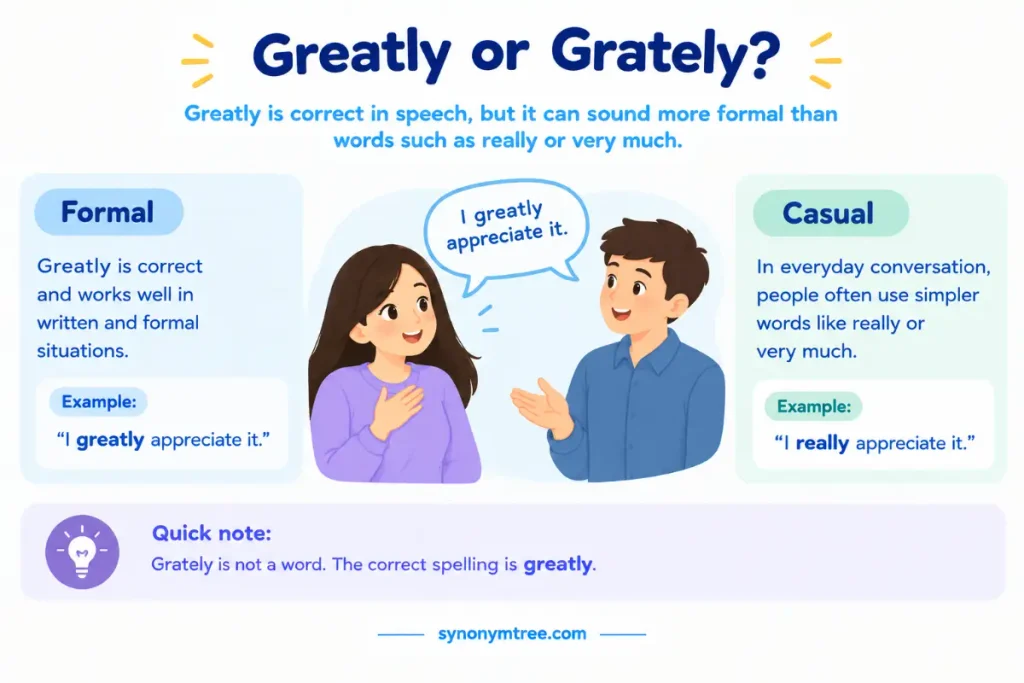
Greatly is correct in speech, but it can sound more formal than words such as really or very much.
For example:
“I greatly appreciate it.”
This is perfectly correct.
In a casual conversation, someone might say:
“I really appreciate it.”
Both sentences are natural. The second sounds more relaxed.
Similarly:
“I greatly enjoyed the movie.”
is correct, but:
“I really enjoyed the movie.”
may sound more natural in casual conversation.
The choice depends on the setting and the speaker’s style.
Greatly and Really
Really is common in casual English. Greatly often sounds more formal.
Compare:
“I really appreciate your help.”
“I greatly appreciate your help.”
Both mean that you appreciate the help a lot. The first feels more conversational. The second is common in polite professional writing.
Neither is automatically better. Choose the one that matches the situation.
Greatly and Very Much
Very much is another common alternative.
“I appreciate your help very much.”
“I greatly appreciate your help.”
Both sentences are correct.
The first is simple and direct. The second is slightly more formal and compact.
You can choose based on the tone of the sentence.
How to Remember the Correct Spelling
A useful memory trick is to connect greatly with phrases you already know.
Think:
Great plus ly becomes greatly.
Do not try to write the word based only on how it sounds.
Another helpful trick is to remember the phrase greatly appreciated.
You have probably seen this phrase many times in emails and messages.
“Your help is greatly appreciated.”
Once that pattern becomes familiar, the spelling becomes easier to recall.
You can also remember that the word contains the full sequence great followed by ly, with the spelling changing from great to greatly.
Write greatly.
Do not add an extra letter or rearrange the letters.
A Simple Spelling Check
If you are unsure while writing, stop and ask yourself what you are trying to say.
If you mean very much or to a large degree, choose greatly.
For example:
“I greatly appreciate your help.”
If you mean excellent, important, or large in degree as an adjective, you may need great.
For example:
“Your help was a great benefit.”
This small grammar check can prevent many mistakes.
Words Related to Greatly
Understanding related words can make the difference clearer.
Great
Great is an adjective.
“She did a great job.”
Greatness
Greatness is a noun.
“His greatness came from years of practice.”
Greatly
Greatly is an adverb.
“She greatly improved her skills.”
Greater
Greater is a comparative form.
“This challenge requires greater effort.”
Greatest
Greatest is a superlative form.
“That was her greatest achievement.”
These words all connect to the same basic idea, but they serve different grammatical roles.
Other Adverbs Like Greatly
English has many adverbs ending in ly.
Examples include:
“strongly”
“deeply”
“highly”
“closely”
“carefully”
“clearly”
“strongly”
“greatly”
These words often tell us how an action happens or how strong an effect is.
For example:
“She strongly disagreed.”
“He deeply cared about the issue.”
“They carefully reviewed the document.”
“The change greatly improved the results.”
Learning common adverb patterns can help you recognize the role of greatly in a sentence.
When Should You Use Greatly?
Use greatly when you want to show a strong degree, effect, change, feeling, or response.
It works especially well with verbs such as:
- Appreciate.
- Improve.
- Increase.
- Reduce.
- Affect.
- Influence.
- Change.
- Benefit.
- Admire.
- Value.
- Regret.
- Surprise.
- Relieve.
- Disappoint.
- Respect.
For example:
“We greatly value your opinion.”
“The change greatly improved the service.”
“She greatly admired her teacher.”
“He greatly regretted his decision.”
When Should You Use Great Instead?
Use great when you need an adjective to describe a noun.
For example:
“She is a great teacher.”
“He made a great decision.”
“They showed great courage.”
“The project was a great success.”
You can compare this with sentences that use greatly.
“She greatly influenced her students.”
“He greatly improved his decision making skills.”
“They were greatly encouraged by the result.”
“The project greatly increased sales.”
The position and grammatical role help you decide which word belongs in the sentence.
Common Sentence Corrections
Here are some common mistakes and their corrections.
Wrong:
“I grately appreciate your help.”
Correct:
“I greatly appreciate your help.”
Wrong:
“Your support is grately appreciated.”
Correct:
“Your support is greatly appreciated.”
Wrong:
“She grately improved her writing.”
Correct:
“She greatly improved her writing.”
Wrong:
“The new rule grately reduced costs.”
Correct:
“The new rule greatly reduced costs.”
The problem in each example is the same. The writer used grately instead of greatly.
A Few More Examples to Practice
Read each sentence and notice how greatly works.
“The experience greatly increased his confidence.”
“Her advice greatly helped me prepare for the interview.”
“The weather greatly affected our travel plans.”
“His work greatly influenced younger artists.”
“We greatly appreciate your patience.”
“The changes greatly improved the website.”
“The mistake greatly delayed the project.”
“She greatly admired her coach.”
“The scholarship greatly benefited the student.”
“The decision greatly affected the community.”
These examples show that the word can describe many kinds of strong effects.
What Are the Opposites of Greatly?
The best opposite depends on the sentence.
Possible alternatives include:
“slightly”
“barely”
“minimally”
“hardly”
“a little”
For example:
“The change greatly improved the system.”
The opposite idea could be:
“The change slightly improved the system.”
Here, greatly shows a large degree, while slightly shows a small degree.
Another example is:
“The storm greatly affected the town.”
A contrasting sentence might be:
“The storm barely affected the town.”
The exact opposite depends on the meaning you want.
Is Greatly Formal?
Greatly can sound somewhat formal, but it is not limited to formal writing.
It appears in everyday English, professional emails, academic work, news writing, and conversation.
“I greatly appreciate it.”
This sentence can be used in many settings.
In very casual speech, people may prefer:
“I really appreciate it.”
So greatly is best described as standard English with a slightly more formal tone in some contexts.
Is Greatly American or British English?
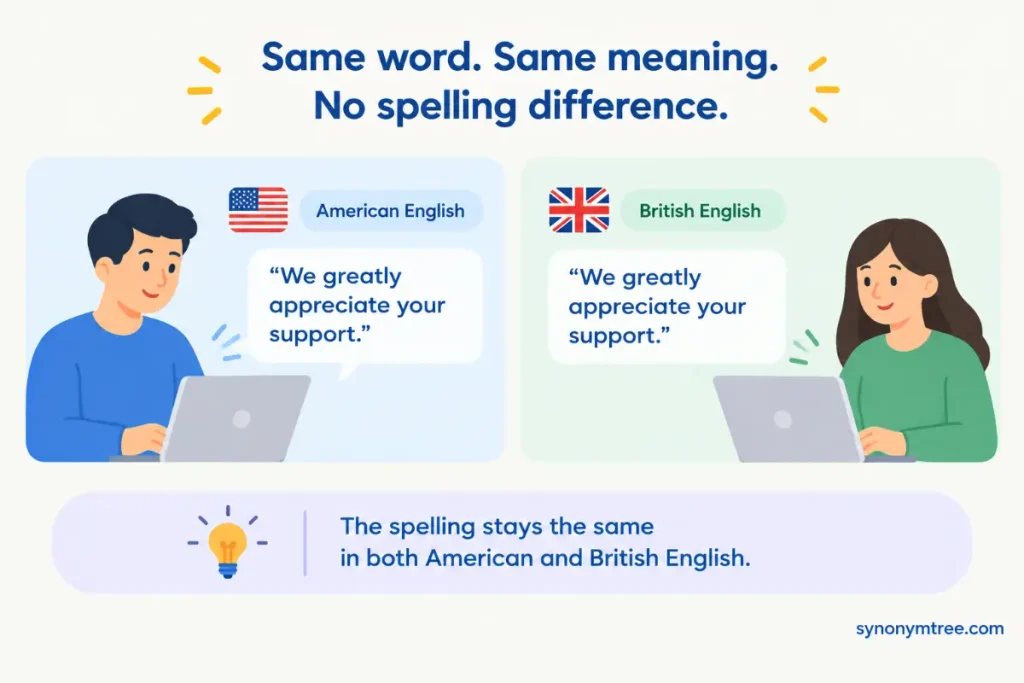
Greatly is standard in both American English and British English.
There is no major US versus UK spelling difference for this word.
An American writer can say:
“We greatly appreciate your support.”
A British writer can use the same sentence.
The spelling remains greatly.
This makes the word easy to use across English speaking regions.
Why Does the Mistake Sound Natural?
Grately sounds possible because English has many adverbs that are formed by adding ly to adjectives.
Kind becomes kindly.
Slow becomes slowly.
Quick becomes quickly.
Careful becomes carefully.
Great seems like it should follow the same pattern.
However, the standard form is greatly. This is one of those spellings that is best learned as a fixed word.
English contains many similar examples where the form of a word is not exactly what a learner might predict.
That does not mean the spelling is random. It simply means that a basic spelling rule does not explain every word perfectly.
A Useful Grammar Pattern
One of the easiest patterns to learn is:
Subject plus greatly plus verb.
Examples:
“I greatly appreciate your help.”
“She greatly improved her skills.”
“They greatly reduced the cost.”
“He greatly influenced the team.”
Another pattern is:
Subject plus be plus greatly plus past participle.
Examples:
“Your help is greatly appreciated.”
“The community was greatly affected.”
“The project was greatly improved.”
“The students were greatly encouraged.”
These patterns cover many common uses.
How to Make Your Writing More Precise
Greatly is useful, but sometimes another word gives a clearer picture.
If you know the exact amount, say it.
Instead of:
“Sales greatly increased.”
you could write:
“Sales increased by 25 percent.”
If you do not know the exact number but want to show a strong effect, greatly is useful.
“The training greatly improved employee confidence.”
If the change was moderate, considerably or noticeably may be more suitable.
“The training noticeably improved employee confidence.”
Good writing is not about choosing the strongest word every time. It is about choosing the word that matches the facts.
Final Takeaway
The key point in grately vs greatly is simple. Greatly is the correct standard spelling when you mean very much, to a large degree, or significantly. Grately is a common spelling mistake, not the form you should choose for standard English writing.
Remember the difference between great and greatly as well. Great usually describes a noun, as in “great support” or “great success.” Greatly is an adverb, as in “greatly appreciate” or “greatly improved.”
If you are writing an email, essay, report, resume, or school assignment, choose greatly. When you see a sentence such as “Your help is greatly appreciated,” the spelling is correct. A quick memory trick is to connect the word with that familiar phrase. Once you remember greatly appreciated, you will be much less likely to write the incorrect form.
Common Questions About Greatly
Is grately a word?
Grately is not the standard spelling of the adverb that means very much or to a large degree. In standard English writing, use greatly instead.
Is greatly the correct spelling?
Yes, greatly is the correct standard spelling. It is commonly used to mean very much, significantly, or to a large degree.
Why do people spell greatly as grately?
People often make this mistake because they expect great plus ly to produce grately. The standard English form is greatly, so the correct spelling needs to be learned and remembered.
Is greatly a real word?
Yes. Greatly is a standard English adverb. It is used to describe the degree or strength of an action, change, feeling, or effect.
Can I use greatly in a formal email?
Yes. Greatly is common in professional emails, especially in phrases such as “greatly appreciate” and “greatly appreciated.”
Can greatly be used in everyday conversation?
Yes. It is grammatically correct in conversation, although really or very much may sound more casual in some situations.
What is the difference between great and greatly?
Great is usually an adjective that describes a noun, while greatly is an adverb that describes an action, effect, or degree. For example, “great support” uses great, while “greatly appreciate” uses greatly.
What is another way to say greatly?
Depending on the sentence, alternatives include very much, significantly, considerably, strongly, deeply, or substantially. The best choice depends on the exact meaning and level of emphasis.
Should I write grately appreciated or greatly appreciated?
Write “greatly appreciated.” This is the standard phrase used to express strong appreciation.
Is greatly used in American English?
Yes. Greatly is standard in American English and British English. The spelling does not change between these varieties.

1 thought on “Grately vs Greatly: Which Is Correct?”