
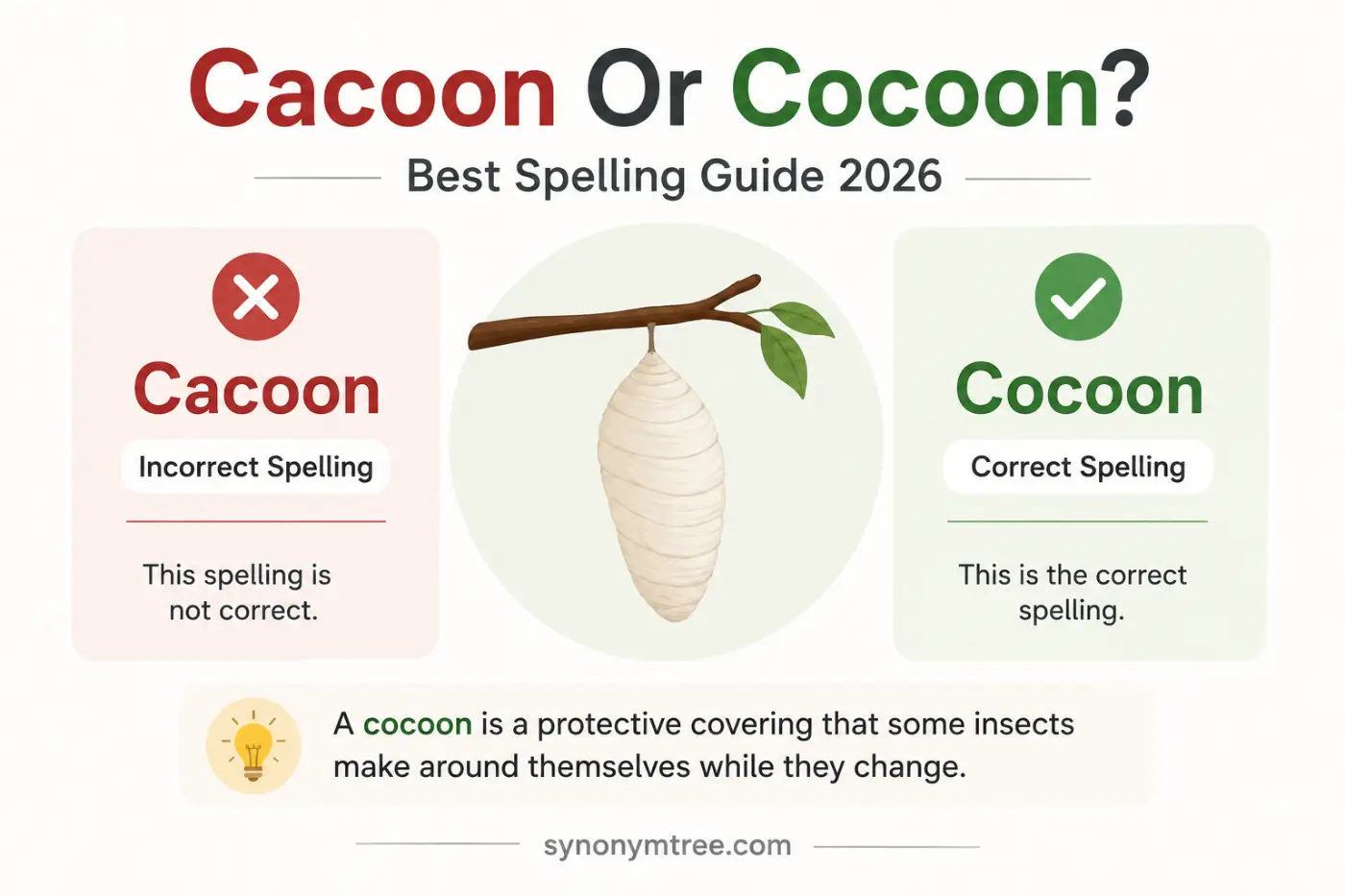
Many people search for cacoon or cocoon because they are not sure which spelling is correct. This is a very common question. The good news is that the answer is simple. Only one spelling is correct in standard English. Once you learn the difference you will never have to guess again.
The correct spelling is cocoon. The word cacoon is a spelling mistake. People often type it because the two words sound similar when spoken quickly. Spell check tools also catch this mistake most of the time.
In this lesson you will learn what cocoon means why people confuse these spellings how to use the correct word in everyday English and where the word came from. By the end you will feel confident every time you write it.
Simple Answer In One Look
If you are asking cacoon or cocoon the correct answer is simple. The correct spelling is cocoon. The spelling cacoon is incorrect and should not be used in English writing.
What Cacoon Or Cocoon Means In Simple English
A cocoon is a soft protective covering made by some insects before they become adults. You can think of it as a safe little home where an insect rests and grows. A caterpillar spins a cocoon around itself. Inside that cocoon its body changes until it is ready to come out as a different insect. This change is one of nature’s most amazing processes. People also use the word cocoon in everyday conversations. In this case it does not describe an insect. Instead it describes a person who stays in a safe quiet and comfortable place away from the outside world.
For example someone may spend a rainy weekend at home reading books watching movies and relaxing. A friend might say that person is living in a cocoon. This does not mean they are inside an insect covering. It simply means they are enjoying comfort and privacy. The word can also describe emotional safety. Someone recovering from a hard time may want to stay close to family and friends for a while. That safe feeling can also be called a cocoon. The important point is easy to remember. Cocoon has both a real meaning and a figurative meaning. Cacoon has no accepted meaning because it is only a misspelling.
Why People Mix These Words
Many English spelling mistakes happen because people write words the way they hear them. That is exactly what happens with cacoon or cocoon. The first reason is pronunciation. When people speak quickly the first sound can seem unclear. Some people hear a short a sound while others hear an o sound. This causes spelling confusion. The second reason is typing too fast. A single wrong letter can completely change a word. Many people never notice the mistake before pressing send.
Another reason is that English spelling is not always predictable. Many words do not sound exactly like they are written. Students often learn this after making small spelling mistakes like this one. Autocorrect can also create confusion. Sometimes a phone changes words in unexpected ways. If someone is not paying attention they may think the spelling is correct. People who are learning English as a second language may also mix these spellings. That is normal because many English words have unusual spelling patterns.
Here are a few examples of similar spelling mistakes people often make.
- Recieve instead of receive.
- Definately instead of definitely.
- Untill instead of until.
- Writting instead of writing.
- Cacoon instead of cocoon.
These mistakes happen to native English speakers too. The key is learning the correct spelling and using it often.
Clear Difference Explained Simply
The difference between these words is actually very easy once you see it clearly. The word cocoon is the correct English spelling. It appears in dictionaries books newspapers schools and professional writing. The word cacoon is not accepted as a correct English word. It is simply a spelling mistake. You can remember the difference with one easy trick. Think about the two round letter o shapes in cocoon. They look like the soft round shape of a real cocoon. This little memory trick helps many students remember the correct spelling.
Here is a simple comparison.
- Cocoon means a protective covering made by some insects before becoming adults.
- Cocoon can also describe safety comfort or privacy.
- Cocoon is correct in school work business writing books and everyday conversations.
- Cacoon is not a correct English spelling.
- Replace cacoon with cocoon every time you write.
This simple rule will help you avoid the mistake forever.
Which Form Should You Use
The answer is always the same. Use cocoon every time.
If you are writing an essay use cocoon.
If you are sending an email use cocoon.
If you are writing a story use cocoon.
If you are posting on social media use cocoon.
If you are taking an English test use cocoon.
There is no situation where cacoon becomes correct English. It does not matter if the writing is formal or casual. The spelling stays the same. A good habit is reading your work before sharing it. Many spelling mistakes disappear after a quick review. Another helpful tip is reading more books articles and magazines. Seeing correct spelling again and again trains your brain naturally. After some practice cocoon will look correct right away and cacoon will look strange. Learning spelling works a little like riding a bicycle. At first you think about every move. Later it becomes automatic.
Easy Real Life Sentences You Can Use
Now that you know the correct spelling it helps to see it in everyday English. Reading simple examples makes new words easier to remember.
Here are some natural sentences you can use.
- The caterpillar made a cocoon before becoming a moth.
- We found a cocoon hanging from the tree branch.
- The science teacher showed us a real cocoon in class.
- She stayed home all weekend in her cozy cocoon.
- After the busy week I wanted to hide in my little cocoon.
- The butterfly came out of the cocoon early in the morning.
- The child watched the cocoon every day until the insect appeared.
- My bedroom feels like a warm cocoon during winter.
Notice that every example uses the spelling cocoon. None of them use cacoon because that spelling is incorrect.
Where Cacoon Or Cocoon Comes From
The word cocoon has been part of English for many years. It originally came from French. Before that it came from even older languages connected with the word for shell or egg covering. As English changed over time the spelling became cocoon. Writers dictionaries and teachers all accepted this spelling. That is the form we still use today. The meaning also grew over time. At first people mainly used the word for the protective covering around insects. Later writers began using it to describe safety comfort warmth and protection in everyday life.
Today the word appears in science books children’s stories newspapers novels and daily conversations. It is a good example of how one simple word can have both a real meaning and a figurative meaning. Learning where a word comes from also makes it easier to remember. Every time you see cocoon you can think about protection growth and change. As you continue learning there is even more to discover about this word. It appears in stories culture symbols everyday conversations and many expressions that give it a deeper meaning. In the next section we will look at those ideas using simple examples that are easy to understand.
How Cacoon Or Cocoon Is Understood In Culture And Stories
Words often become more meaningful because people use them in stories movies and everyday life. The same is true for these words. Since cocoon is the correct spelling it appears in many books and stories. The spelling cacoon does not. A cocoon usually stands for change. It reminds people that good things often take time. Just as a caterpillar stays inside a cocoon before becoming a butterfly people also need time to learn grow and become stronger. Parents may use the word when talking to children. Teachers may use it in the classroom. Writers often use it to describe someone who is changing in a positive way.
Here are some simple examples.
- The young artist stayed in a creative cocoon before sharing her work.
- He spent the summer in a learning cocoon and came back more confident.
- The story shows how the hero grows inside his own cocoon before helping others.
- After moving to a new town she needed time in her cocoon before making friends.
- Every child grows at a different pace just like a butterfly inside a cocoon.
These examples show that cocoon is more than an insect home. It can also describe personal growth and new beginnings.
Is Cocoon Mentioned In The Bible Or Mythology
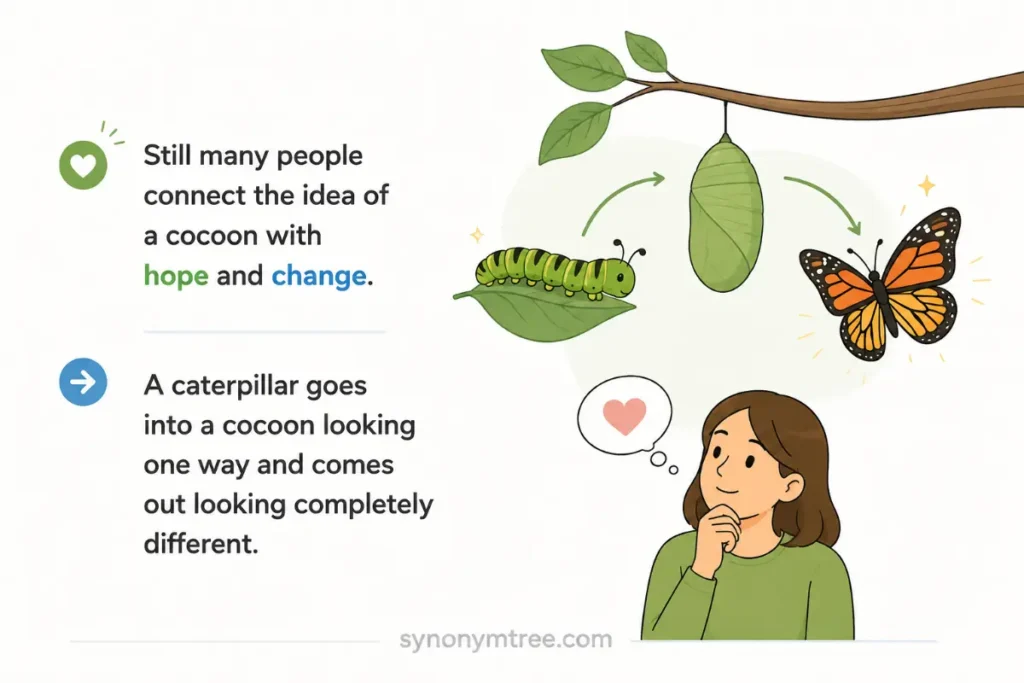
The word cocoon does not appear as an important symbol in the Bible. It is also not a major symbol in ancient myths. Still many people connect the idea of a cocoon with hope and change. A caterpillar goes into a cocoon looking one way and comes out looking completely different. Because of this people sometimes compare it with personal growth spiritual change or a fresh start. These comparisons are symbolic. They are not official religious teachings. They simply help people explain change in an easy and meaningful way.
Cocoon Symbolism Explained In Simple Words
What Cocoon Represents
A cocoon often represents safety. It is a place where something can rest grow and prepare for the future. Many people also see a cocoon as a symbol of patience. Big changes do not happen overnight. Growth takes time. A cocoon can also stand for healing. Someone recovering from a difficult experience may need quiet time before feeling strong again.
What Cacoon Represents
The word cacoon has no accepted meaning because it is not a correct English word.
If you see cacoon in writing it is almost always a spelling mistake. The intended word is cocoon.
Remember this simple idea.
- Cocoon has meaning.
- Cacoon does not.
That rule will help you every time.
Related Words You Should Know
Learning related words makes your vocabulary stronger. These words are connected to cocoon and often appear in similar topics.
- Caterpillar. A young insect that later changes into a butterfly or moth.
- Butterfly. A colorful flying insect that comes out after the cocoon stage in many life cycle lessons.
- Moth. An insect that often forms a cocoon before becoming an adult.
- Chrysalis. A protective stage for butterflies. Many people confuse this with cocoon but they are not exactly the same.
- Metamorphosis. This means a complete change in form during an insect’s life.
- Transform. This means to change into something different.
- Protect. This means to keep someone or something safe.
- Growth. This means becoming stronger wiser or more developed over time.
Knowing these words helps you understand stories science lessons and everyday conversations more easily.
How People Actually Use Cocoon In Daily English
People often use cocoon in both its real and figurative meanings. The real meaning talks about insects. The figurative meaning talks about comfort safety and personal growth.
Here are some natural examples.
- I stayed in my cozy cocoon all weekend with books and coffee.
- The butterfly finally came out of its cocoon.
- She created a peaceful cocoon in her bedroom.
- After a stressful month he wanted to hide in his own cocoon for a few days.
- The science class watched the cocoon every morning.
- My blanket feels like a warm cocoon during winter.
- The baby slept safely in a soft cocoon.
- She needed time in her emotional cocoon before starting a new job.
- The movie shows a girl growing from her cocoon into a confident person.
- Spring reminds us that life can bloom after every cocoon stage.
Notice that every example uses cocoon correctly.
Common Mistakes People Make
Many learners make the same spelling mistakes. Once you know them they become easy to avoid. The biggest mistake is writing cacoon instead of cocoon. Remember that dictionaries only accept cocoon. Another mistake is thinking cocoon and chrysalis are always the same. They are related but they are not identical. A butterfly forms a chrysalis while many moths spin a cocoon. Some people also think cocoon can only describe insects. That is not true. English speakers often use it as a symbol of comfort safety or personal growth.
Here are some corrections.
- Wrong. I found a cacoon on the tree.
Correct. I found a cocoon on the tree. - Wrong. She wrapped herself in a cacoon of blankets.
Correct. She wrapped herself in a cocoon of blankets. - Wrong. Cacoon is the correct spelling.
Correct. Cocoon is the correct spelling.
Reading carefully before sending your writing helps you catch these small mistakes.
Final Teacher Explanation
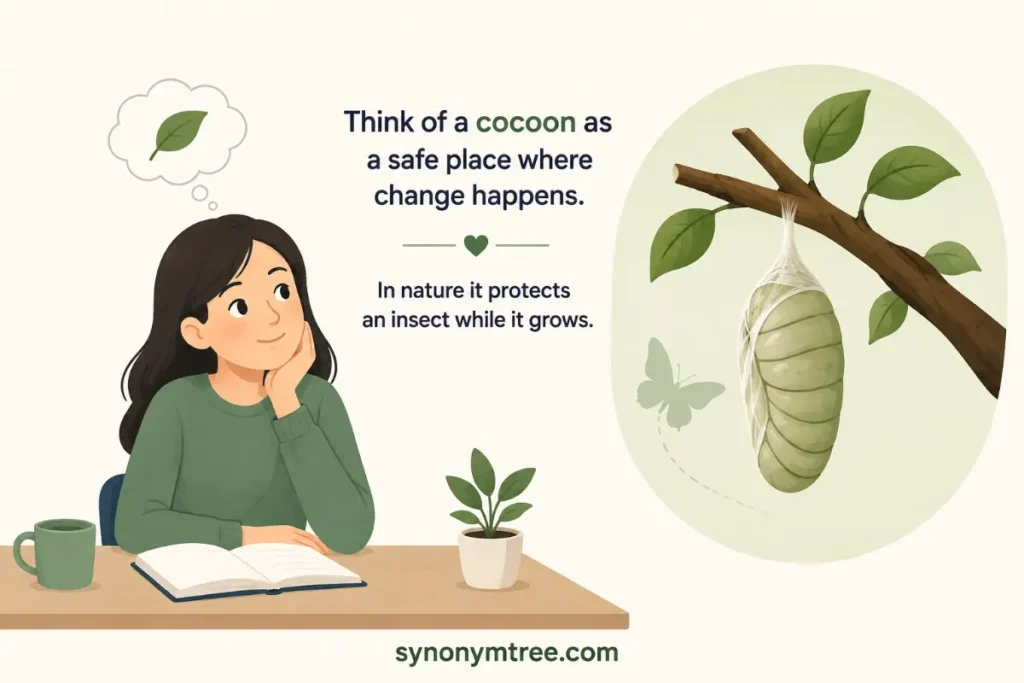
If one of my students asked me about cacoon or cocoon I would give a very simple answer. Always write cocoon. Think of a cocoon as a safe place where change happens. In nature it protects an insect while it grows. In everyday English it can also describe comfort healing or personal growth. The spelling cacoon is simply an error. You do not need to memorize two correct spellings because there is only one. When you read books write essays send emails or post online always choose cocoon. The more you use it the more natural it will feel.Learning English is not about being perfect every time. It is about noticing mistakes learning from them and growing with every new word.
Final Answer Quick Recap
If you are choosing between cacoon or cocoon always use cocoon.
Cocoon is the correct English spelling. Cacoon is a misspelling. Remember this simple rule and you will always choose the right word.
Conclusion
cacoon or cocoon is a common spelling question because the two forms look very similar. The correct spelling is cocoon. The spelling cacoon is incorrect in standard English. A cocoon is the protective covering made by some insects during a stage of development before they emerge in their adult form.
Keep reading good English writing and pay attention to how unfamiliar words appear in books articles and trusted websites. Practice using new words in real sentences instead of only memorizing their spelling. This simple habit helps you remember words naturally and makes it easier to recognize spelling mistakes when they appear.
Every mistake you notice and fix today can make your English stronger tomorrow. Spelling takes practice but you don’t need to master everything at once. Keep learning one word at a time and your confidence will continue to grow. Like a butterfly leaving its cocoon your language skills can develop step by step until you feel ready to use English with greater ease.
Frequently Asked Questions
What does cocoon mean in simple words?
A cocoon is a protective covering made by some insects before they become adults. It can also mean a safe and comfortable place.
Is cocoon or cacoon correct?
Cocoon is correct. Cacoon is a spelling mistake.
Why do people write cacoon?
People often spell the word the way it sounds or type too quickly.
Can I use cacoon in school writing?
No. Always use cocoon in school essays emails and other writing.
Is cocoon used only for insects?
No. It also describes comfort safety healing and personal growth.
Is cocoon a noun?
Yes. Cocoon is a noun that names a thing.
How can I remember the correct spelling?
Read and write the word cocoon often. Regular practice helps you remember it naturally.
What is the difference between cocoon and chrysalis?
A cocoon is a silk covering made by many moths. A chrysalis is the hard outer stage of a butterfly during its transformation.
