
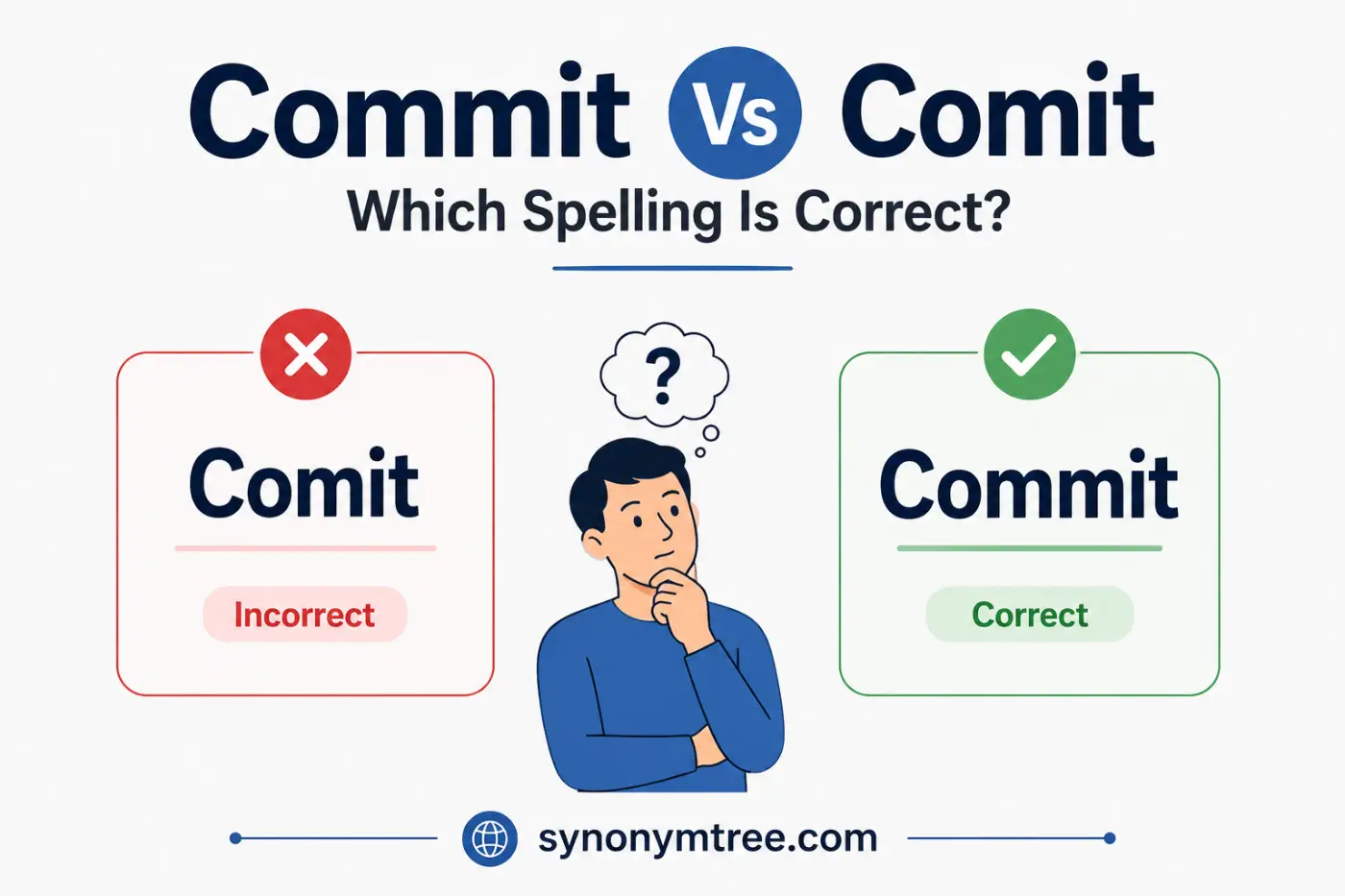
If you are searching for commit vs comit which spelling is correct the answer is simple. Commit is the correct spelling. Comit is a common spelling mistake and is not the standard form used in English. The word commit can mean to make a firm decision or promise to do something. For example you can say I will commit to my study plan.
The confusion happens because people often hear the word before they write it. The second m can be easy to forget. English spelling also has many words that follow different patterns so it is natural for learners to stop and check. The good news is that this word has one simple spelling to remember. Write commit with two m letters.
You will see commit in school writing professional emails everyday conversations and many other types of English. You may also see related words such as committed commitment and committing. Learning this spelling family can make the correct form much easier to remember and use.
Simple Answer In One Look
Commit is the correct spelling. Comit is not the standard English spelling. Use commit when you mean to make a firm choice promise or decision or when you mean to give time effort or support to something.
The easiest spelling rule is simple. Commit has two m letters in the middle. If you are choosing between commit vs comit always choose commit in standard English writing.
What This Means In Simple English
Commit usually means to make a firm decision to do something. It can also mean giving your time effort or support to a person plan goal or responsibility. The word often suggests that you are not just thinking about something but have decided to take it seriously.
For example a student might commit to studying every evening. A worker might commit to completing a project by Friday. A person might commit to helping a friend. In each case the person has made a clear choice to give attention or effort to something.
The word can also describe a serious promise. When someone says I commit to this plan the speaker shows that they intend to support the plan. The meaning is stronger than simply saying I might try this plan.
Commit can also appear in other contexts. In technology people use commit when they save changes to a project or code system. In legal and news writing the word can describe carrying out a wrong or illegal act. The meaning depends on the sentence.
For most English learners the most useful pattern is commit to something. This pattern appears often in conversations about goals plans work study and personal choices. Once you understand this common use the word becomes much easier to recognize.
Why People Mix These Words
People often confuse commit and comit because the two forms look almost the same. The only spelling difference is the second m. When someone types quickly they may remember the sound of the word but forget one of the letters.
Pronunciation can also cause problems. When people hear commit in normal speech they do not always notice both m letters. This can lead someone to write the word based on how it sounds. English does not always give you every spelling clue through pronunciation.
Another reason comes from the way English words change. Learners may know that some words use a double consonant in certain forms while other words do not. They may try to remember several spelling patterns at once and accidentally write comit.
The best solution is not to memorize a complicated rule. Learn commit as a complete word. Remember that the middle contains two m letters. Then practice the word in simple sentences that you might actually use.
For example you can connect commit with a goal. You can say I commit to my goal. You can connect it with work and say I commit to finishing the task. You can connect it with study and say I commit to studying every night. These examples help the spelling stay in your memory.
Clear Difference Explained Simply
The difference between commit and comit is very small on the page but very clear in standard English. Commit is the correct word. Comit is a spelling mistake. The correct form contains two m letters while the incorrect form contains only one.
Think of the two forms like this.
- Commit is correct.
- Comit is incorrect.
- Commit has two m letters.
- Comit has one m letter.
- Commit can mean to make a firm decision or promise.
- Commit is used in school writing professional writing and everyday English.
The meaning does not change into a different English word when you remove one m. Instead you create a spelling error. That means the safest choice is always commit when you need the standard English word.
You can also remember the related forms. Committed uses the double m pattern. Commitment also begins with the same double m spelling. Committing keeps the same spelling family too. Seeing these forms together can make the correct pattern easier to recognize.
Which Form Should You Use
Use commit whenever you need the standard English spelling. You can use it when talking about making a firm decision giving support or promising to take part in something. The word works in both casual and formal English.
If you are writing a sentence such as I want to comit to this project stop and check the middle of the word. The correct sentence is I want to commit to this project. That small correction gives you the standard spelling.
The word is especially common with to. You might commit to a plan a goal a project a routine a team or a responsibility. This makes commit useful in many everyday situations.
You should also remember that commit does not always mean promise. It can have other meanings depending on context. In technology it can refer to saving changes. In legal or news language it can refer to carrying out an act. Always look at the words around commit to understand the exact meaning.
Easy Real Life Sentences You Can Use
The easiest way to learn a spelling is to see it in sentences that sound natural. Commit often appears when someone talks about a plan goal responsibility or decision. These examples show how you can use the correct form in everyday American English.
- I decided to commit to my new study plan.
- She wants to commit to the project.
- He promised to commit more time to training.
- We need to commit to this plan before Friday.
- They committed to helping the local team.
- I am ready to commit to this goal.
- She has committed herself to learning Spanish.
- He finds it hard to commit to long term plans.
These sentences show an important pattern. Commit often connects with something that requires time effort attention or responsibility. It can describe a decision that a person plans to keep.
You can also use commitment when talking about the result of that decision. For example you might say Her commitment to school is strong. Here commitment is the noun while commit is the action. Learning both forms gives you more choices when you write.
Where This Word Comes From
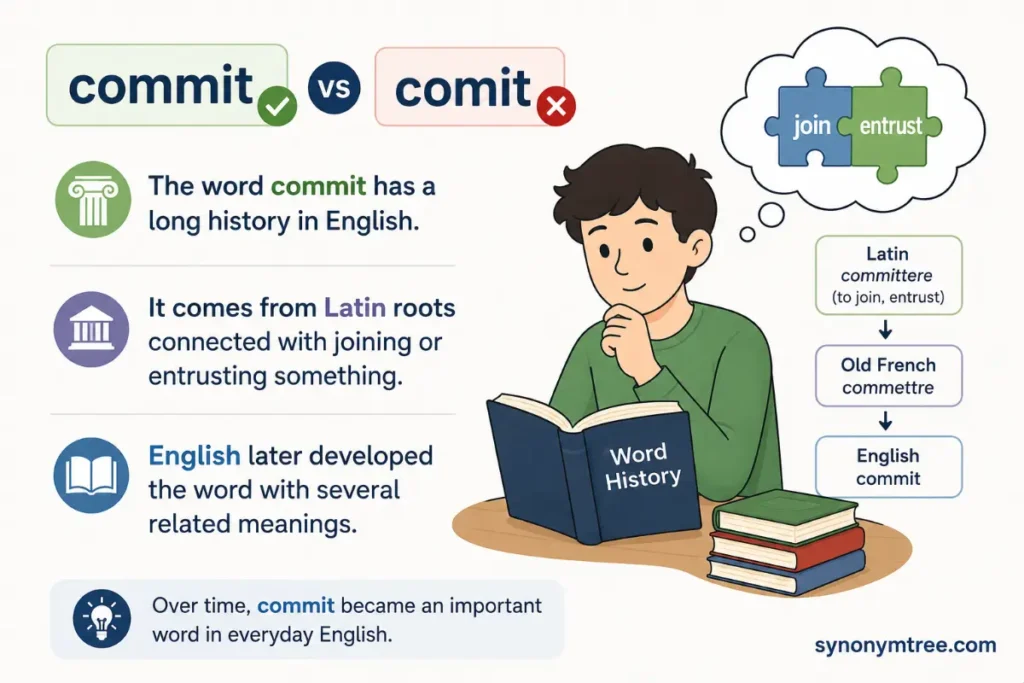
The word commit has a long history in English. It comes from Latin roots connected with joining or entrusting something. English later developed the word with several related meanings.
Over time commit became common in phrases about taking action making a promise giving responsibility and carrying out an act. Modern English still uses these meanings in everyday speech and writing.
You do not need to study the history to spell the word correctly. The most useful lesson for everyday writing is simple. Commit is spelled with two m letters. Comit is not the standard spelling.
The word also gives us several common forms. Commitment refers to a promise or strong decision. Committed describes someone who has made that decision or shows strong dedication. Committing describes the action of making that choice or carrying out an act.
Seeing these related words can help you remember the spelling family. They all connect back to the same basic word. When you recognize the pattern you are less likely to type comit by mistake.
If you are writing quickly and suddenly wonder about commit vs comit pause for a second and check the middle of the word. The correct spelling has two m letters. That one small check can prevent an easy spelling mistake.
The basic rule is clear enough to remember. Write commit when you mean to promise dedicate decide firmly or carry out an act. Write it with two m letters every time.
This basic spelling lesson gives you the foundation. Once you know the correct form you can look at how the word works in culture everyday speech related vocabulary and common writing situations.
How This Word Is Understood In Culture And Stories
The difference between commit vs comit is mainly a spelling issue. Still the word commit appears in many parts of everyday English. People use it when they talk about promises goals plans work relationships and decisions. You may see it in books news stories school writing and daily conversations.
The word commit often shows that a person has decided to give time effort or support to something. For example a student may commit to studying every night. A worker may commit to finishing a project on time. A friend may commit to helping someone with an important task.
In stories the word can also show a strong choice. A character may commit to a difficult goal even when the path becomes hard. This makes commit useful when a writer wants to show action and dedication. The word does not always describe something dramatic. It can simply describe a clear promise or decision.
You may also hear commit in phrases such as commit to a plan and commit to a goal. These phrases are common in American English. They sound natural in school writing professional writing and everyday speech. Learning these common uses can make the correct spelling easier to remember.
In stories and daily conversations commitment often connects with choices. A character may commit to helping a family member. A student may commit to a new goal. A team may commit to working together. These uses all share the same basic idea of making a serious choice and supporting it.
Biblical And Mythological Meaning If Applicable
Commit does appear in religious writing including the Bible. However the spelling question itself does not have a special biblical or mythological meaning. The main issue is still simple English spelling. Commit is the standard spelling and comit is not the standard English form.
In some Bible translations the word commit appears in phrases connected with actions promises responsibilities or trust. The meaning depends on the sentence and the translation. For example the word may describe giving something into another person’s care or taking a serious action.
There is no special mythological meaning that changes how you spell commit. Ancient stories may describe people making promises or taking strong actions but that does not create a different spelling rule. The same standard spelling applies in modern English.
This is useful to remember because some words can have special meanings in religion or mythology. Commit does not need that kind of explanation to solve the spelling problem. If you are writing a normal English sentence use commit with two m letters.
Symbolism Explained In Simple Words
The word commit can suggest a strong choice. It often shows that someone has decided to give time effort or attention to something. That idea can make the word sound stronger than simple words such as try or plan.
For example if someone says I will try to study tonight the plan may still change. If someone says I will commit to studying every night the sentence suggests a stronger decision. The difference comes from the level of dedication behind the action.
The spelling also has a simple visual pattern. Commit has two m letters before the ending. Comit does not. When you learn the correct form as one complete word it becomes easier to recognize the mistake.
What One Version Represents
Commit represents the correct standard spelling. It can describe making a serious decision or giving yourself to a task goal or responsibility. You can commit to a plan. You can commit to learning a skill. You can also commit to helping another person.
The word has two m letters because the correct spelling is commit. This is the form you should use in school assignments emails resumes reports and other formal writing. It is also the form used in normal conversation.
For example if you write I will commit to the project the reader can understand both your meaning and your correct spelling. The same applies to forms such as committed and commitment. Learning the main word helps you recognize its related forms.
What The Other Version Represents
Comit is a common spelling mistake rather than a standard English word. People may write it because they remember the sound of commit but forget the second m. The mistake is easy to make because English spelling does not always match pronunciation perfectly.
If you see comit in a sentence you should normally change it to commit. This applies to schoolwork professional writing messages and published content. The simple correction is to add the second m.
You can remember the difference by looking at the word carefully. Commit has two m letters in the middle. Comit has only one. When you are unsure use the standard spelling commit.
Related Words You Should Know
Learning related words can help you understand commit more clearly. These words appear often in conversations about goals work promises responsibility and personal choices. They can also help you avoid repeating the same word in your writing.
- Commitment means a promise or strong decision to do something. For example a commitment to exercise means you plan to keep doing it.
- Committed describes someone who has given serious effort or support to something. A committed student keeps working toward a goal.
- Commitment to means giving time effort or support to a specific person goal or activity. For example she has a commitment to her team.
- Dedication means steady effort toward something important. A dedicated worker keeps doing the work even when it takes time.
- Promise means saying that you will do something. A promise can be personal or professional.
- Responsibility means something you are expected to handle or complete. A job may come with several responsibilities.
- Decide means to choose something after thinking about it. A decision can lead to a commitment.
- Devote means to give a lot of time or attention to something. You can devote time to study or practice.
- Support means helping a person idea plan or group. You can support a friend without making a formal commitment.
- Dedicate means to give time effort or attention to a purpose. It is close in meaning to commit in some situations.
These words are related but they are not always exact replacements. Commit often focuses on making a clear decision or promise. Commitment focuses on the promise or responsibility that follows. Understanding these small differences can make your writing sound more natural.

How People Actually Use It In Daily English
People use commit in many everyday situations. You may hear it at school at work at home or during a conversation about future plans. The word often appears after to when someone talks about giving time effort or support to something.
The easiest way to learn the word is to see it in real sentences. These examples show how people use commit in natural American English.
- I decided to commit to my new study plan.
- She wants to commit to the project.
- He promised to commit more time to training.
- We need to commit to this plan before Friday.
- They committed to helping the local team.
- I am ready to commit to this goal.
- She has committed herself to learning Spanish.
- He finds it hard to commit to long term plans.
- Our team committed to finishing the work together.
- The company committed to improving customer service.
Notice that commit often connects with a goal plan task or responsibility. The word can sound serious because it shows more than a quick decision. It often suggests that someone intends to keep supporting the choice.
You can also see commit in other meanings. In technology the word can describe saving changes to a project or code system. In law and news writing it can describe doing something wrong or illegal. The meaning comes from the sentence around it.
For everyday learners the most useful pattern is commit to something. This pattern is common and easy to practice. If you remember commit with two m letters and connect it with clear examples you will have a strong base for correct usage.
Common Mistakes People Make
One common mistake is writing comit with one m. The correct spelling is commit with two m letters. This mistake often happens because the word sounds simple when spoken and the second m may not seem obvious.
Another mistake is changing the spelling when adding other forms. The word committed also keeps the double m pattern. Commitment also keeps the same beginning. Learning these related forms can help you recognize the correct spelling faster.
Here are some common examples that show the correction clearly.
- Incorrect: I want to comit to this plan. Correct: I want to commit to this plan.
- Incorrect: She is comited to her goal. Correct: She is committed to her goal.
- Incorrect: His comitment is clear. Correct: His commitment is clear.
- Incorrect: We need to comit more time. Correct: We need to commit more time.
- Incorrect: They are comited to helping us. Correct: They are committed to helping us.
A second mistake is using commit when a simpler word would fit better. Commit can sound strong because it suggests a serious choice. If you only mean that you might try something once you may not need commit. For example I will try the new class is different from I will commit to attending the class every week.
Another useful habit is checking the whole sentence. Ask yourself what you mean. Are you talking about a promise a goal a responsibility or a serious decision. If so commit may be the right word. Then check the spelling and make sure you have written two m letters.
Final Teacher Explanation About Commit Vs Comit
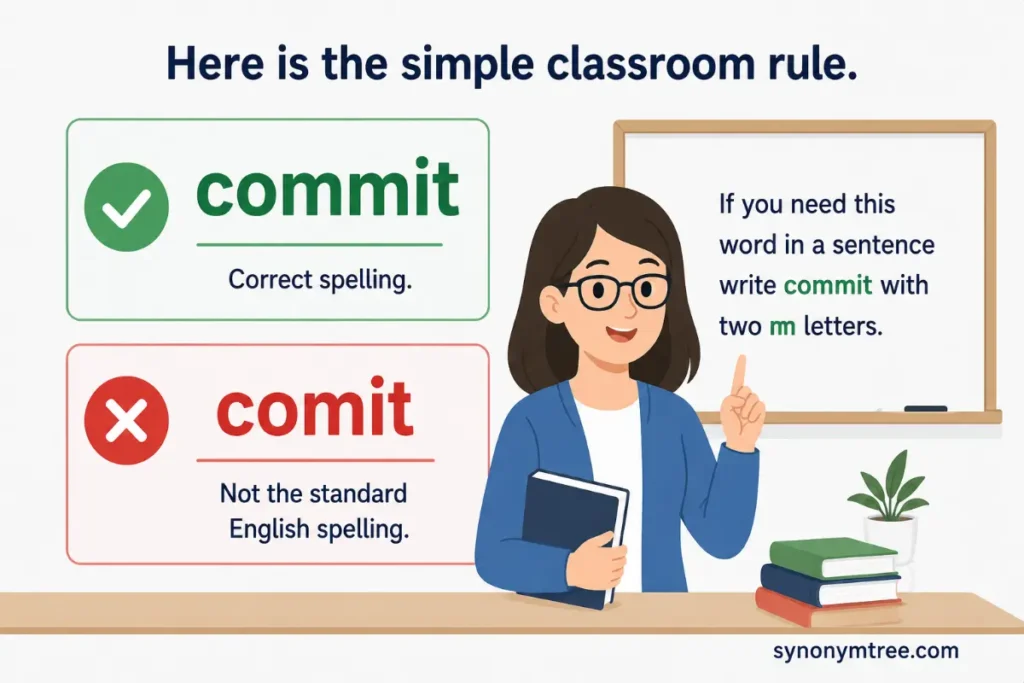
Here is the simple classroom rule. Commit is the correct spelling. Comit is not the standard English spelling. If you need this word in a sentence write commit with two m letters.
The meaning is also easy to understand. Commit often means to decide firmly to do something or to give time effort or support to a person plan goal or responsibility. You can commit to a study plan. You can commit to a job. You can commit to helping someone.
The best way to remember the spelling is to learn the complete word instead of relying only on its sound. Think of commit as c o m m i t. The two m letters are part of the spelling you need to remember.
You should also watch for related forms such as committed and commitment. They keep the same double m pattern. Once this spelling becomes familiar you will be less likely to write comit by mistake.
If you are writing an email or school assignment and you stop to ask commit vs comit you can answer the question quickly. Choose commit. That is the standard spelling used in English.
Final Answer Quick Recap
Commit is the correct spelling and comit is a spelling mistake. Use commit when you mean to make a firm choice or give time effort or support to something. Remember the two m letters in commit and you will have a simple way to avoid this common mistake.
Conclusion
The question of commit vs comit has a very simple answer. Commit is the correct English spelling and comit is not the standard form. The word can describe a firm decision a promise or a strong choice to give time effort or support to something.
When you write commit remember the two m letters. This small spelling detail can help you write more clearly in school assignments emails work documents and everyday messages. You can also connect commit with related words such as committed and commitment to make the pattern easier to remember.
Good spelling often comes from learning small patterns and using them many times. You do not need a complicated rule to remember this one. Just remember that commit has two m letters and use that spelling every time you write the word.
Frequently Asked Questions
Is Commit The Correct Spelling?
Yes. Commit is the correct standard English spelling. Comit is a common spelling mistake and should not be used in standard writing.
What Does Commit Mean In Simple English?
Commit means to decide firmly to do something or to give time effort or support to a person goal or plan. You can commit to a project or a promise.
Why Do People Spell Commit As Comit?
People often write comit because they forget the second m. The pronunciation can also make the spelling less obvious when you only hear the word.
How Do You Remember The Spelling Of Commit?
Remember that commit has two m letters. You can think of the word as c o m m i t and practice it in a simple sentence such as I will commit to the plan.
What Is The Difference Between Commit And Commitment?
Commit is the verb that describes the action of making a firm choice or promise. Commitment is the noun that describes the promise or responsibility that results from that choice.
Is Committed Spelled With Two M Letters?
Yes. Committed keeps the double m pattern. The correct spelling is committed rather than comited.
Can I Use Commit In Formal Writing?
No. Comit is not the standard English spelling of the word. In normal English writing you should use commit with two m letters.
