
If you are searching for comming vs coming which spelling is correct the answer is simple. Coming is the correct spelling. Comming is a common spelling mistake and is not the standard form used in English. Coming is the present form of the verb come. We use it when someone moves toward a place or when something is about to happen.
For example you can say I am coming home soon. You can also use coming when talking about something that will happen soon such as the coming weekend or the coming year. The word is common in everyday English so learning its correct spelling can help you avoid mistakes in messages schoolwork emails and professional writing.
The confusion happens because many English words double the final consonant before adding an ending. That spelling pattern does not work with come in this way. Once you learn the correct spelling of coming you can stop guessing and write it with confidence.
Simple Answer In One Look
Coming is correct. Comming is incorrect. The word coming comes from come so you keep one m and add ing. Write coming when you mean moving toward a place or something that is about to happen.
What This Means In Simple English
The word coming means moving toward a person or place. It can also describe something that will happen soon. It is the ing form of come. The base word is come and the spelling changes slightly when you add ing. For example if your friend says Are you coming to my house the word coming tells us that the person may travel toward the house. You might answer Yes I am coming after dinner. This is a simple everyday use.
The same word can describe an event that will happen soon. You might say The weekend is coming. You could also say A storm is coming. In these examples coming does not mean that a person is walking toward you. It means something is approaching in time. The spelling comming causes trouble because the sound can make some learners expect two m letters. However English spelling does not always match the way a word sounds. The correct form has only one m before ing.
It helps to remember the base word. Start with come. Then add ing. The result is coming. You do not change the m into two letters. The word can appear in many common expressions such as coming home coming soon coming back coming here coming from and coming with us. All of these expressions use the same spelling.
When you write coming in a sentence check the first part of the word. If you see come followed by ing you should have one m. This simple visual check can help you catch the common spelling error before you send or publish your writing.
Why People Mix These Words
People often confuse comming and coming because English has many words that double a final consonant when an ending is added. A learner may remember examples such as running swimming sitting and stopping. Those words contain doubled consonants so it is easy to assume that coming should follow the same pattern. But English spelling rules depend on the word. You cannot simply double the last letter every time you add ing. The spelling of the base word matters.
Think about the difference between run and come. When you add ing to run the word becomes running. The n is doubled. When you add ing to come the word becomes coming. The m is not doubled. Another reason for the confusion is the silent e in come. The base word is written c o m e. When you add ing the final e disappears. This gives you c o m plus ing which becomes coming.
The same pattern appears with some other words. For example make becomes making. Take becomes taking. Give becomes giving. The final e disappears before ing is added. Coming follows this general spelling pattern. The final e in come is removed but the m stays as one letter.
You may also see the wrong spelling in quick messages or informal posts. Someone may type comming because they are writing quickly and do not stop to check the spelling. That does not make the spelling correct. If you are writing an essay resume school assignment email article or business message use coming. Standard English uses coming not comming.
Clear Difference Explained Simply
The difference between comming and coming is easy once you focus on the spelling. Coming is the correct word. Comming is a spelling error. The correct form has one m and ends with ing. You can remember the main points by focusing on the base word and the way it changes when ing is added.
- Coming is the correct spelling.
- Comming is the incorrect spelling.
- Coming comes from the verb come.
- Coming can describe movement toward a person or place.
- Coming can also describe something that will happen soon.
- The word has one m before ing.
- The final e in come is removed before ing is added.
You can use a simple memory trick. Think of the word come first. Then remove the final e and add ing. You get coming. There is no need to add another m. This gives you a quick way to remember the correct form whenever you are writing.
Here are a few simple examples that show the difference clearly.
- I am coming home after work.
- She is coming to the party tonight.
- The bus is coming soon.
- Winter is coming.
- Are you coming with us?
- He is coming back tomorrow.
- The new movie is coming soon.
Each sentence uses coming because the word comes from come. None of these sentences should use comming.
Which Form Should You Use
Use coming every time you need the standard English form of come with ing. You should not use comming in school writing professional writing formal messages or everyday standard English. The easiest rule is to remember that come becomes coming. The final e disappears but the m does not double.
This rule can help you remember the spelling without memorizing a long grammar lesson. Start with the word come. Remove e. Add ing. You now have coming. You can also connect the spelling with common phrases. Coming soon has one m. Coming home has one m. Coming back has one m. Coming tomorrow has one m. Seeing these phrases often can make the correct spelling easier to remember.
If you are unsure while writing pause and look at the base word. Ask yourself which word you started with. If the base word is come the correct form is coming. The same idea can help with other words that end in silent e. For example make becomes making. Take becomes taking. Write becomes writing. These words do not keep the final e when ing is added.
This does not mean every English word follows exactly the same spelling pattern. English has many exceptions and special cases. Still remembering the base word is a useful way to handle coming.
Easy Real Life Sentences You Can Use
Coming appears in everyday English all the time. You can use it when talking about travel plans events time weather family friends and future activities. Here are some natural sentences you can use.
- I am coming home now.
- Are you coming with me?
- She is coming over tonight.
- The train is coming soon.
- We are coming back tomorrow.
- The holidays are coming soon.
- He is coming to school with us.
- A new season is coming next month.
These examples show that coming has more than one use. Sometimes it describes movement. Sometimes it tells us that an event or time is approaching. For example I am coming to your house describes movement toward a place. The summer is coming describes something that will happen soon. The meaning changes with the sentence but the spelling stays the same.
You can also use coming in short everyday replies. If someone calls your name from another room you might say I am coming. This tells the person that you are moving toward them. Another common phrase is coming soon. You may see it on movie posters websites product announcements and event advertisements. It tells people that something will be available or happen in the near future.
You can also use coming in questions. Are you coming? is a very common question. It asks if someone plans to join you. These simple examples make the spelling easier to remember because you probably already hear and use the word often.
Where This Word Comes From
The word coming comes from the older English verb come. The word has been part of English for a very long time and has roots that can be traced through older forms of English and related Germanic languages. The basic idea has stayed connected to movement toward a person or place. Over time English speakers also began using come in wider ways. Today we can use it for movement arrival events time changes and future situations.
For example when we say The new year is coming we are not talking about something physically walking toward us. We mean that the new year will arrive soon. The form coming developed from come with the ending ing. English spelling removes the final e before this ending. That gives us coming rather than comming.
Understanding this small history can make the spelling feel less random. The word is not spelled with two m letters because the base word already gives us the form we need. You do not need to know the full history of the word to spell it correctly. Still knowing that coming comes directly from come can make the spelling easier to remember.
Common Examples With Coming
The best way to build spelling confidence is to see the correct word in natural sentences. Coming appears in many common phrases so learning these phrases can help you recognize the correct form quickly.
- My brother is coming home tonight.
- Are you coming to dinner?
- The teacher is coming back soon.
- The package is coming tomorrow.
- Summer is coming.
- A big change is coming.
- Thanks for coming to my party.
- She is coming from work.
- We are coming with you.
- The bus is coming down the street.
Notice that every example uses one m. This is the spelling you should use in your own writing. The phrase thanks for coming is especially common. You can use it after someone visits your home attends an event or joins a meeting. You can also say thanks for coming today or thanks for coming to the party.
Another useful phrase is coming soon. It works for events products movies shows websites and announcements. For example a store might write New products coming soon. Coming can also appear after words such as is are am was and were. These combinations are common in everyday English. You might write I am coming She is coming They are coming or We were coming home. Seeing the word in these familiar patterns makes the correct spelling easier to remember.
Comming Vs Coming Which Spelling Is Correct In A Sentence
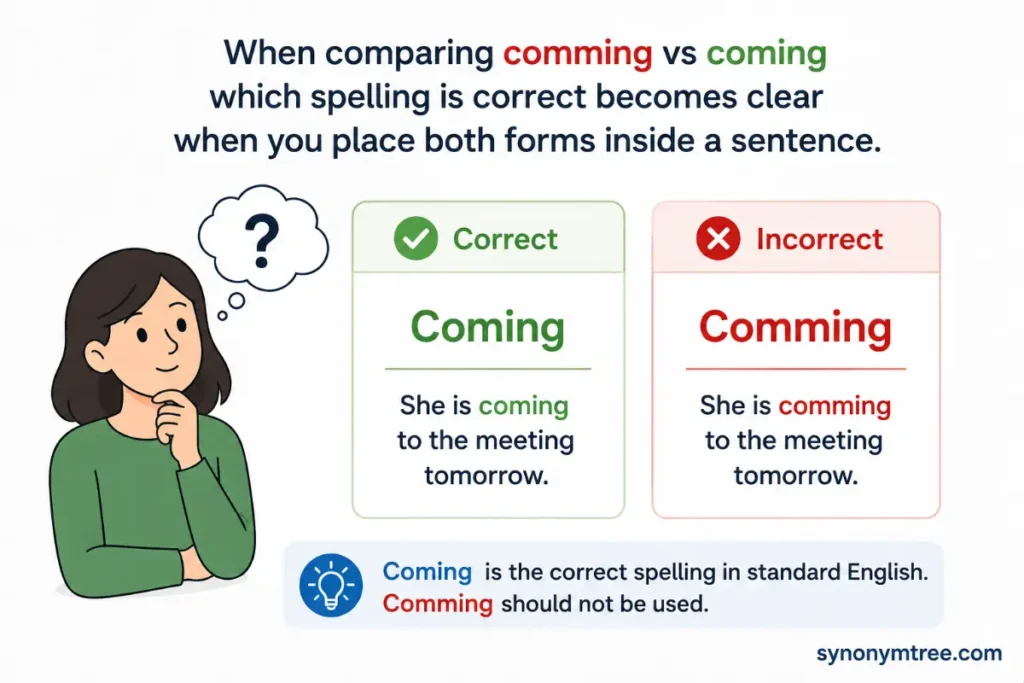
When comparing comming vs coming which spelling is correct becomes clear when you place both forms inside a sentence. Coming is the correct spelling in standard English. Comming should not be used. Consider this example. I am coming home soon. The word coming is correct because it comes from come. Now look at the incorrect version. I am comming home soon. This sentence contains a spelling mistake. The meaning may still be clear to the reader but the spelling is not standard.
Here are more examples that show the correct form.
- She is coming to visit us.
- We are coming after lunch.
- The children are coming home.
- Is your friend coming today?
- The new store is coming soon.
- Winter is coming.
- He is coming back next week.
In every sentence coming has one m. This matters most in writing that other people will read. A small spelling mistake can make an otherwise clear sentence look careless. Using the correct spelling helps your writing look polished and trustworthy.
If you see comming in your draft simply replace it with coming. You do not need to change the rest of the sentence unless there is another problem.
Coming Vs Come In Simple English
It can also help to understand the difference between come and coming. Come is the basic form. Coming is the form we use when we talk about an action that is happening or developing. You might say I will come tomorrow. Here come is used after will. You might also say I am coming tomorrow. Here coming describes an action connected with the present or an arranged plan. Both words are correct. They simply work in different sentence patterns.
For example compare these sentences.
- I will come to your house tomorrow.
- I am coming to your house tomorrow.
The first sentence uses come. The second uses coming. Both can be correct depending on what you want to say. The spelling question only becomes difficult when you try to write comming. That form is not the standard spelling. Remember this simple pair. Come has one m. Coming also has one m. The final e disappears when ing is added.
How To Remember The Correct Spelling
A simple memory trick can save you from the comming spelling mistake. Think of the base word first. The base word is come. Now remove the final e. You are left with com. Add ing. You get coming. The important part is that the m does not double. You do not need to create a new m when adding ing.
You can also remember a short phrase such as coming home. Picture someone walking toward home while you look at the spelling. The phrase has one m. Another useful trick is to connect coming with common words you already know. Coming soon coming back coming home and coming here all use the same spelling.
If you write the word often the correct form will become familiar. Reading helps too. When you see coming in books websites emails and messages your brain starts to recognize the standard spelling. Do not worry if you have written comming before. Many learners make this mistake. What matters is learning the pattern and using the correct form from now on.
A Simple Teacher Rule To Remember
If you are still unsure about comming vs coming which spelling is correct remember one classroom rule. Come becomes coming with one m. The final e goes away before ing. The m stays as it is. That gives you c o m plus ing which forms coming. You can use this rule whenever you write the word. Do not rely only on how the word sounds. Look at the base word and follow the spelling pattern.
Coming is the form you need in sentences such as I am coming home Are you coming with us and The movie is coming soon. Comming is not the correct standard spelling. If you see it in your writing change it to coming. Once this pattern becomes familiar the choice takes only a second. You will no longer need to guess when writing emails school assignments captions texts or professional documents.
The key is simple. Learn the base word. Notice the spelling change. Then use the form that matches the sentence. Now that the basic spelling is clear we can look more closely at how coming works in everyday English common expressions and the mistakes learners often make.
How This Word Is Understood In Culture And Stories
The spelling difference in comming vs coming which spelling is correct is mostly a writing issue rather than a cultural one. The word coming appears often in everyday English. You see it in books. You hear it in conversations. You also see it in messages and online posts. The incorrect spelling comming sometimes appears because people hear the word and try to spell it by adding another m.
Coming has a simple connection with movement and future events. It can describe someone moving toward a place. It can also describe something that will happen soon. For example you might say that your friend is coming to your house. You might also say that summer is coming. In both cases the word points to something moving closer in place or time.
This makes coming a very common word in English. It appears in casual speech as well as school writing and professional communication. Learning the correct spelling can help you avoid a small mistake that readers notice quickly.
Biblical And Mythological Meaning
The spelling question comming vs coming which spelling is correct does not have a special biblical or mythological meaning. Coming is simply the standard English form used to describe movement toward a place or an event that is approaching.
The word can appear in religious writing because people often talk about future events. Phrases such as the coming of a new age or the coming of a leader use coming in its normal English sense. The spelling stays coming. The incorrect form comming does not become correct because of the subject.
Myths and stories also use the idea of something coming. A hero may be coming home. A storm may be coming. A new season may be coming. These examples show how useful the word is across many types of writing.
The key lesson is simple. The subject does not change the spelling. Use coming when you need this word in standard English.
Symbolism Explained In Simple Words
Coming can sometimes suggest more than physical movement. In stories and everyday speech it can point to change. Something that is coming may bring a new situation. That idea gives the word a wider meaning beyond simple movement.
The spelling comming does not carry a different symbolic meaning. It is simply a common spelling error. The correct form coming works in every normal context.
What One Version Represents
The correct spelling coming represents movement toward something. It can describe a person walking toward you. It can describe an event that will happen soon. It can also describe a change that is approaching.
For example you might say that a new school year is coming. You are not saying that the school year is physically walking toward you. You mean that the event will happen soon.
Coming can also suggest progress. When someone says better days are coming they are talking about a future change. The word gives the sentence a sense of something approaching.
What The Other Version Represents
The spelling comming does not represent a different meaning. It is not an alternative spelling of coming in standard English. It usually happens because writers remember the double m sound from words such as running or swimming.
That mistake is easy to understand. The word come has one m. When you add ing the spelling becomes coming. You do not add another m.
Remember this simple pattern. Come becomes coming. The extra m is not needed.
Related Words You Should Know
Several words can help you understand the difference between coming and comming. These words also make it easier to spot the spelling pattern in other English words.
- Come is the base word. It means to move toward a person or place. For example you can say come here.
- Coming is the form used for an action that is happening or approaching. For example you can say I am coming home.
- Came is the past form of come. For example you can say she came to school yesterday.
- Coming soon describes something that will happen or become available soon. You might see this phrase on a movie poster.
- Upcoming means something planned for the near future. For example an upcoming test is a test that will happen soon.
- Go is often used as the opposite direction of come. Come usually points toward the speaker or another place being discussed. Go usually points away from that place.
- Arriving means reaching a place. It can sometimes replace coming when you want to focus on reaching the destination.
- Approaching means getting closer. It can describe a person. It can also describe an event or time.
These related words show why coming appears so often in English. It can connect movement with time and future events.
How People Actually Use It In Daily English
People use coming in many simple ways every day. You may hear it at home. You may see it in text messages. You may use it in school or work. The word is also common in signs and announcements.
The following examples show natural ways to use the correct spelling. Each sentence uses coming with one m before ing.
- I am coming home after school.
- Are you coming to the party tonight?
- She is coming over this afternoon.
- The bus is coming now.
- Winter is coming soon.
- My birthday is coming next month.
- We are coming back tomorrow.
- A new movie is coming this summer.
These examples show that coming can describe people. It can describe transportation. It can describe seasons. It can also describe future events.
You can also use coming in informal messages. Someone might text I am coming in five minutes. Another person might write Are you coming with us? These sentences are short and natural.
In professional writing the same spelling rule applies. You might write that a meeting is coming up. You could also say that an important deadline is coming soon. The context changes but the spelling does not.
Common Mistakes People Make
The most common mistake is writing comming instead of coming. Writers often make this mistake because English has many words that double the final consonant before adding ing.
For example running has two ns. Swimming has two ms. Getting has two ts. These patterns can make coming look unusual. However come follows a different spelling pattern.
The correct form is coming. The incorrect form is comming.
Another common mistake is thinking that come should become commming with three ms. It does not. The word only needs one m in its spelling.
You can remember the answer with a simple sentence. Come keeps one m when you add ing.
There is also a different issue with pronunciation. Some learners may hear the word and focus on the sound rather than the letters. English spelling does not always match pronunciation perfectly. That is why it helps to remember the written form.
Another mistake happens when people type quickly. The extra m can appear during fast typing. Spell check may catch it in some apps. Still it is better to know the rule so you can spot the error yourself.
Here are some simple corrections to remember.
- Wrong: I am comming home. Correct: I am coming home.
- Wrong: Are you comming today? Correct: Are you coming today?
- Wrong: Summer is comming soon. Correct: Summer is coming soon.
- Wrong: She is comming with us. Correct: She is coming with us.
- Wrong: The bus is comming now. Correct: The bus is coming now.
The pattern stays the same every time. Use coming with one m.
Why Does Coming Have Only One M
This is one of the most useful questions to understand. The answer comes from the spelling of the base word come. When you add ing to come the final e is removed and ing is added. The result is coming.
The spelling does not require a doubled m. The word changes from come to coming rather than from comm to comming.
This is different from words such as run. When you add ing to run the spelling becomes running. The final consonant doubles in that word. That pattern does not apply to every English word.
Think of the two words side by side.
- Come becomes coming.
- Run becomes running.
- Swim becomes swimming.
- Sit becomes sitting.
- Make becomes making.
These examples show why you should not use one spelling rule for every word. English has several patterns. Learning common words one at a time can make spelling much easier.
How To Remember Coming Correctly
A simple memory trick can help. Think of the word come first. Then remove the final e and add ing. You get coming.
You can also remember that the word coming has only one m. If you see comming in your writing stop and check it. In standard English writing you almost always need coming.
Another useful trick is to connect coming with common phrases. Think of phrases such as coming soon. Coming home. Coming back. Coming tomorrow. Coming next week. Seeing these phrases often will help the correct spelling become familiar.
You can also type the word slowly when you are unsure. Say come in your mind. Then add ing. This gives you coming.
The more often you read and write the correct form the easier it becomes. You will eventually recognize comming as an error without having to think about the rule.
Is Coming Always About Movement
No. Coming can describe physical movement but it can also describe something that will happen in the future.
When you say my friend is coming you may mean that the person is traveling toward you. When you say the holidays are coming you mean that the holidays will happen soon.
This second use is very common in English. People use coming to talk about future events. That is why you may see the word in advertisements. News stories. School announcements. Movie promotions. Social media posts.
For example you might see a sign that says a new store is coming soon. The store is not physically walking toward the town. The phrase means that the store will open soon.
This flexible meaning makes coming one of the most useful everyday words in English.
Final Teacher Explanation About Comming Vs Coming Which Spelling Is Correct
If you are still wondering about comming vs coming which spelling is correct the answer is very simple. Coming is the correct standard English spelling. Comming is a spelling mistake.
The easiest way to remember it is to start with come. Remove the final e. Add ing. You get coming. There is no second m.
You may see double letters in other words such as running and swimming. That does not mean every word follows the same pattern. Coming is one of the common words that keeps a single m.
When you write an email. A school assignment. A text message. A resume. Or a social media post use coming with one m.
The good news is that you only need to remember one form. Write coming when you mean moving toward something or when you mean that something is approaching in time.
Final Answer Quick Recap
The correct spelling is coming. Comming is incorrect in standard English.
Use coming when talking about movement or something that will happen soon. Remember the simple pattern come plus ing becomes coming.
Once you remember the single m you will not need to guess again.
Conclusion
The difference in comming vs coming which spelling is correct is easy to solve once you know the spelling pattern. Coming is the correct form. It can describe someone moving toward a place or something approaching in time. Comming is simply a common spelling mistake.
When you write coming remember the base word come. Remove the final e and add ing. That gives you coming with one m. This small trick can help you avoid the error in school writing. Work emails. Messages. Social posts. And everyday sentences.
Good spelling often comes from learning small patterns and using them often. Once coming becomes familiar you can spot the incorrect form quickly. Keep the rule simple. Come becomes coming. One m is enough.
Frequently Asked Questions
Is coming the correct spelling?
Yes. Coming is the correct standard English spelling. Comming is incorrect.
Is comming a word?
No. Comming is not the standard spelling of coming. Use coming instead.
Why is coming spelled with one m?
Coming comes from come. Remove the final e and add ing. The result is coming with one m.
Is it coming or comming?
The correct form is coming. The spelling comming is a common mistake.
How do you spell coming correctly?
Spell it c o m i n g. The word has one m before ing.
Can I use coming in formal writing?
Yes. Coming is a normal English word and works in formal and informal writing.
What is the difference between come and coming?
Come is the base word. Coming describes movement or an event that is happening or approaching.
Why do people spell coming as comming?
People often make this mistake because English has words such as running and swimming with doubled consonants. Coming follows a different pattern.
