
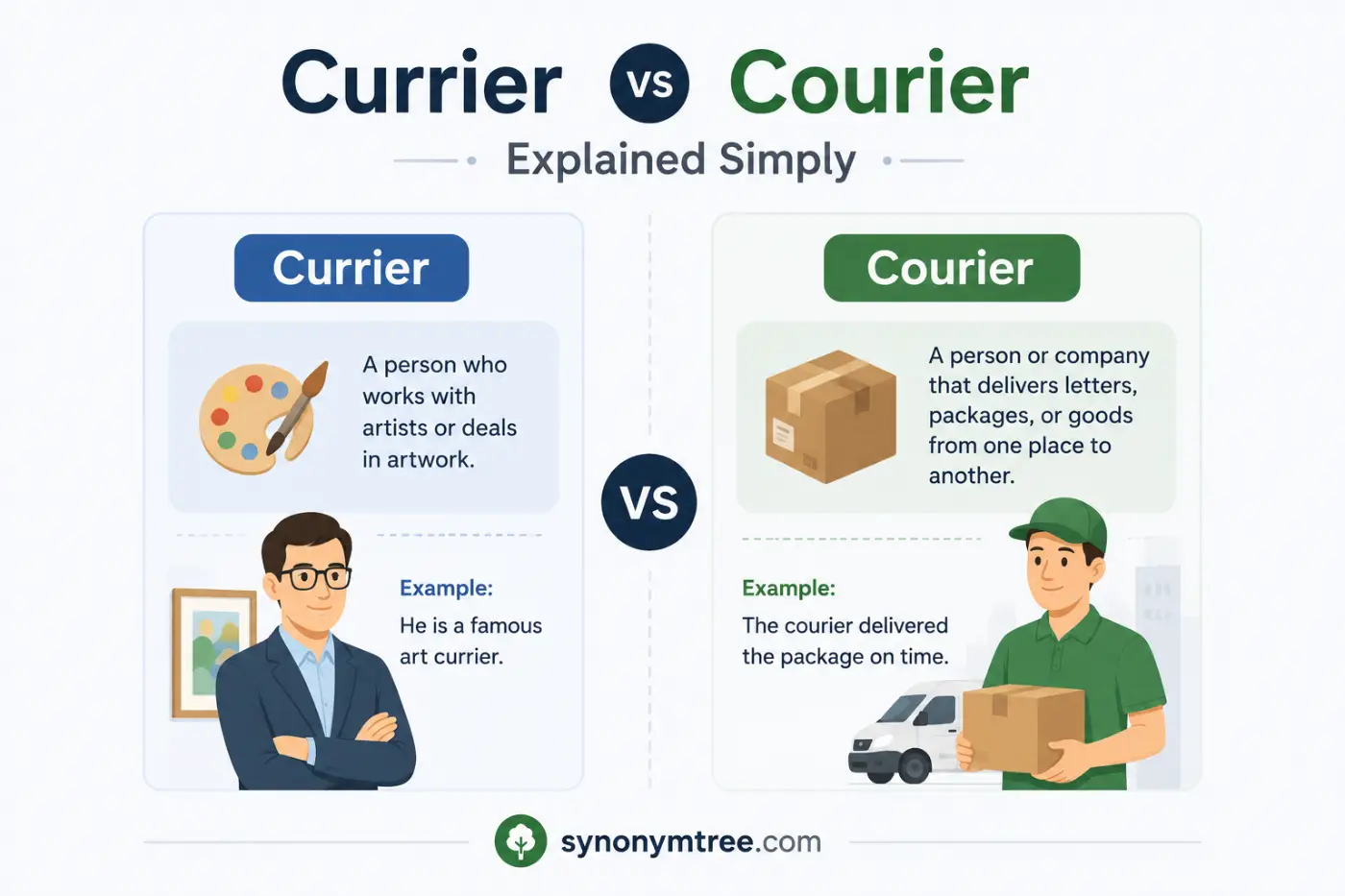
If you are searching for currier vs courier, you may be wondering which word is correct for someone who delivers letters, packages, or documents. The answer is courier for a person or service that carries and delivers things. Currier is a different word with a much less common meaning.
These two words look almost the same, so the spelling mistake is easy to make. The extra r in currier changes the word completely. In modern everyday English, courier is the word you will usually need when talking about package delivery.
Currier does exist as an English word. It traditionally refers to a person who works with leather after it has been tanned. The word can also appear as a surname. That meaning has little to do with modern package delivery.
This guide explains the difference clearly. You will see the meanings, origins, grammar, real examples, common mistakes, related words, and simple ways to remember which spelling belongs in a delivery context.
Quick Definition
A courier is a person or company that carries and delivers letters, documents, packages, or other items. A currier is traditionally a person who prepares and finishes leather after tanning.
Direct Answer
Use courier when you mean someone who delivers packages, documents, or messages. Use currier only when referring to the traditional leather worker or to a name such as a family surname.
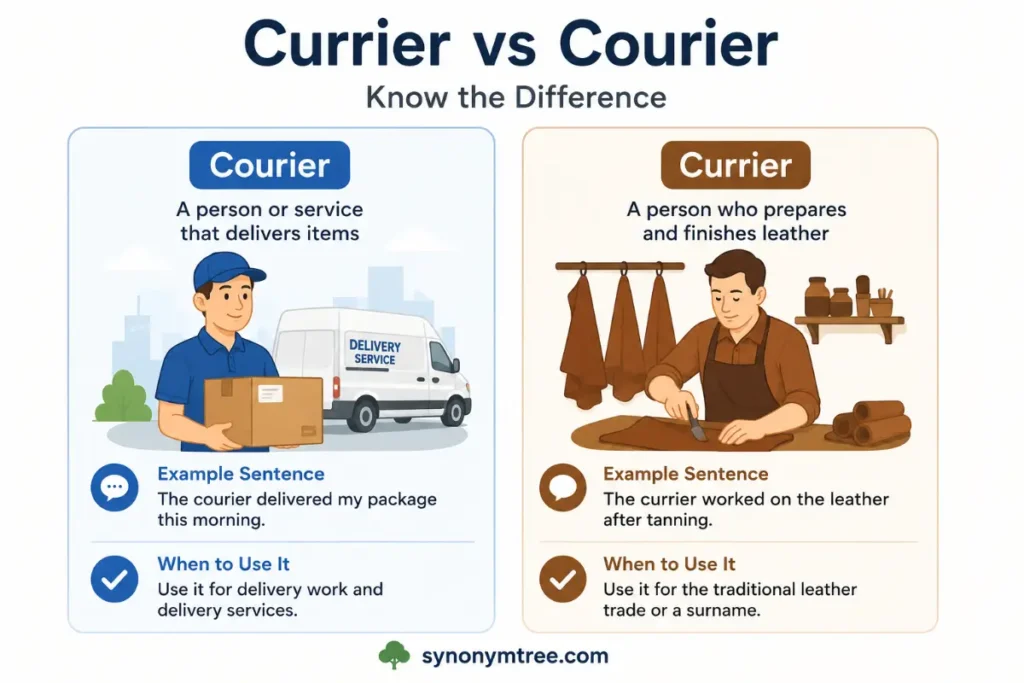
Comparison Table on Currier vs Courier
| Word | Meaning | Example Sentence | When to Use It |
|---|---|---|---|
| Courier | A person or service that delivers items | The courier delivered my package this morning. | Use it for delivery work and delivery services. |
| Currier | A person who prepares and finishes leather | The currier worked on the leather after tanning. | Use it for the traditional leather trade or a surname. |
Why These Words Cause Confusion
The spelling is the first reason people mix up these words.
Courier contains the letters c, o, u, r, i, e, and r.
Currier contains c, u, r, r, i, e, and r.
They share many letters. Both have the sound of the letter r in similar places. When spoken quickly, the difference can be hard to notice. There is also a second problem. Most people know the word courier because delivery services are part of daily life. Far fewer people know currier as the name of an old trade.
That creates a common spelling pattern. Someone knows the meaning they want, but they remember the sound instead of the spelling. They may write currier because it looks like a natural form of the word.
For example, someone might write:
The currier will bring my package at noon. If the person means a delivery worker, the correct word is courier. The correct sentence is: The courier will bring my package at noon. The extra r is not a small spelling detail. It creates a different word.
What Courier Means
Courier is a noun. It refers to a person or service that carries something from one place to another.
In modern American English, courier is most often connected with delivery services.
A courier may deliver:
- Letters.
- Legal documents.
- Business papers.
- Food.
- Medical samples.
- Small packages.
- Large parcels.
- Important records.
- Personal items.
- Other goods that need to move from one location to another.
For example:
The courier picked up the documents at noon.
A courier delivered the package to my office.
Please give the signed form to the courier.
The company uses a local courier for urgent deliveries.
In each sentence, courier refers to the person doing the delivery.
The word can also refer to the company or service itself.
For example:
We hired a courier to deliver the package.
The courier offers same day delivery.
The courier charges extra for urgent service.
Here, the word can describe the delivery service rather than one individual worker.
Courier As A Person
When courier refers to a person, it describes someone whose job involves carrying and delivering things.
For example:
The courier arrived at the front door.
I gave the envelope to the courier.
The courier asked me to sign for the package.
The courier could not find the address.
This use is straightforward. If a person brings something from one place to another as part of a delivery service, courier is usually the right noun.
Courier As A Delivery Service
Courier can also refer to a business that provides delivery.
For example:
The courier lost the package.
We need to contact the courier.
The courier provides overnight delivery.
In these sentences, courier can mean the company or service rather than a particular person.
Context tells you which meaning applies.
If you say the courier knocked on the door, you probably mean the delivery worker.
If you say the courier charged a delivery fee, you may mean the company.
Both uses are normal.
What Currier Means
Currier is a real English word, but it has a very different meaning. A currier is traditionally a person who works with leather after the leather has gone through the tanning process.
Leather production has several stages. Animal hide must be treated so it becomes durable leather. After tanning, the material may need more work to improve its texture, appearance, flexibility, and finish.
A currier performs this type of finishing work.
The word belongs to an older trade vocabulary. You are more likely to see it in historical writing, discussions of traditional crafts, old occupations, or descriptions of leather production than in everyday conversation.
For example:
The currier prepared the leather for the final stage.
The village once had a skilled currier.
The old record lists his occupation as a currier.
These sentences use the word correctly.
A currier is not normally a package delivery worker.
Currier As An Old Occupation
Before modern factories and large industrial supply chains, many trades were handled by skilled workers who had specific jobs.
Leather production was one of those trades.
A tanner treated animal hides and turned them into leather. A currier then worked on the leather to improve its finish and make it suitable for use.
This division of work helps explain why the word still exists.
You may find currier in historical books about towns, crafts, guilds, leather production, or old occupations.
For example:
The town was known for its tanners and curriers.
The currier prepared leather for local shoe makers.
The family had worked as curriers for several generations.
These examples show the older meaning clearly.
The Main Meaning Difference
The easiest way to remember the two words is to connect each one with a different job.
A courier delivers.
A currier works with leather.
That is the central distinction.
If someone brings your package to your home, that person is a courier.
If someone prepares and finishes leather as part of the traditional leather trade, that person is a currier.
You can test the difference with a simple sentence.
The _____ delivered my passport.
The answer is courier.
Now try:
The _____ prepared the leather.
The answer is currier.
The surrounding words make the intended meaning clear.
Courier In Everyday English
Courier is a common word in modern English because delivery services are widely used.
People use courier when talking about shipping, business deliveries, documents, parcels, and urgent items.
You might hear:
The courier is on the way.
The courier delivered my order.
I am waiting for the courier.
The courier needs a signature.
The courier left the package at reception.
These are all ordinary uses.
Courier is especially useful when a delivery needs to be handled directly or quickly.
For example, a business may use a courier to send a contract across town. A hospital may use a courier to move medical materials between facilities. A restaurant may use a courier to deliver food.
The exact item changes, but the basic idea stays the same.
Someone or some service carries something from one place to another.
Courier And Mail Carrier
Courier and mail carrier are related, but they do not always mean exactly the same thing.
A mail carrier usually works for a postal service and delivers mail along a regular route.
A courier often works for a private delivery company or a specialized delivery service.
For example:
The mail carrier delivered my letter.
The courier delivered the legal documents.
The first sentence points to regular postal delivery. The second points to a more specialized delivery service.
The words can overlap in some situations, but courier often suggests direct or specialized delivery.
Courier And Delivery Driver
A courier can be a delivery driver, but the terms are not identical.
Delivery driver is a broad job title. It can refer to someone who delivers food, packages, furniture, supplies, or other goods.
Courier often focuses on carrying items from one location to another.
For example:
The delivery driver brought our furniture.
The courier delivered the signed contract.
The first person may be transporting a large commercial order. The second may be handling a specific document or package.
Still, a courier may drive a car, van, motorcycle, or other vehicle.
The word describes the delivery role more than the type of vehicle.
Courier And Messenger
Courier and messenger have related meanings.
A messenger carries information or items from one person to another.
In older contexts, messengers could carry written messages across long distances.
Today, courier usually has a stronger connection with physical packages and professional delivery services.
For example:
The messenger delivered the letter.
The courier delivered the package.
The words can overlap, especially when discussing documents. However, courier is the more common modern term for professional delivery work.
Courier And Carrier
Carrier is another related word.
A carrier is a person, company, or system that carries something.
In shipping, a carrier may transport packages from one place to another.
Courier usually suggests direct delivery, often to a specific person or address.
For example:
The carrier transported the package across the country.
The courier delivered the package to my office.
Carrier can be broader. Courier often feels more specific.
Courier In Business English
Companies often need to move contracts, invoices, legal papers, samples, and other materials.
For example:
We sent the signed contract by courier.
Please arrange a courier for the documents.
The courier confirmed delivery this afternoon.
The original documents were delivered by courier.
These sentences sound natural in professional English.
If you are writing a business email and need to describe a delivery person or service, courier is usually the word you want.
Courier In Legal Settings
Legal offices often use couriers to move documents.
Some legal papers need to reach another office, court, client, or government agency quickly.
For example:
The courier delivered the court documents.
We sent the original contract by courier.
The legal team asked a courier to deliver the filing.
The word is useful because it clearly describes a professional delivery service.
You may also see phrases such as legal courier and document courier.
These phrases make the purpose of the service clear.
Courier In Medical Settings
Medical organizations can also use couriers.
A medical courier may transport samples, records, medicine, or other materials between hospitals, clinics, laboratories, and other facilities.
For example:
The medical courier picked up the laboratory samples.
The hospital uses a courier to move samples between locations.
The courier delivered the medical records to the clinic.
This is another example of the modern meaning of courier.
The person is responsible for moving something safely from one location to another.
Courier As A Verb
Courier is mainly used as a noun in everyday English.
However, courier can also appear as a verb in some contexts. To courier something means to send or deliver it by courier.
For example:
We couriered the documents to the client.
The company couriered the package to the office.
This verb use exists, but it is less common than simply saying sent by courier or delivered by courier.
For everyday writing, you can often choose the clearer form.
Instead of:
We couriered the documents.
You could write:
We sent the documents by courier.
Both can be correct. The second may sound more natural to many readers.
Currier In Historical Writing
Currier becomes much easier to understand when you see it in historical context.
Many old occupations have names that are not common today.
A currier was part of the leather trade. The work involved preparing and finishing leather after tanning.
Historical records may list people by their occupation.
For example:
John Smith, currier.
That does not mean John Smith delivered letters or packages. It means he worked in the leather trade.
You may also see currier in descriptions of old towns where leather production was an important local industry.
For example:
The town had several tanners, curriers, and leather workers.
This type of sentence uses the word in its traditional sense.
Currier As A Surname
Currier can also be a surname.
This is an important exception because you may see Currier with a capital C.
For example:
Currier was the family name.
The author Mary Currier wrote the article.
In this use, Currier is not describing a leather worker. It is simply a person’s last name.
Many English surnames came from occupations. A surname connected to an old trade can remain in use long after the trade itself becomes uncommon.
That is one reason you may encounter Currier even if you rarely see the word used as an occupation.
The History Behind Courier
Courier has a long history connected with carrying messages and information.
Before modern communication systems, people often depended on messengers to move written messages between places.
A courier could carry important information from one person or location to another.
Over time, the word developed broader uses. It came to describe people who carried messages, documents, and goods.
The modern delivery meaning fits this older idea.
The basic concept is movement from one place to another.
Today, the word is strongly associated with professional delivery.
A courier may carry a letter, a package, a document, or another item.
The History Behind Currier
Currier comes from the traditional leather trade.
The word is connected with the work done on leather after tanning. A currier would prepare and finish the material so it could be used for products such as clothing, footwear, saddles, bags, belts, and other goods.
The occupation was once more common than it is today.
Modern industrial production has replaced many older craft roles or changed how the work is divided.
As a result, currier is now much less familiar to most English speakers.
That difference in frequency explains why people may know courier very well but still encounter currier as an unfamiliar word.
Why The Extra R Matters
It is tempting to think that the spelling difference is minor.
It is not.
English has many word pairs where one extra letter creates a different word. The same thing happens here.
Courier is connected with delivery.
Currier is connected with leather work or a surname.
Changing the spelling changes the meaning.
Consider these sentences:
The courier delivered the parcel.
The currier prepared the leather.
Only a small spelling change separates the words, but the jobs are completely different.
This is why spelling matters in professional writing.
If you write currier in a business email about a package, the reader may understand your meaning from context, but the word is still incorrect.
Common Spelling Mistakes
The most common error is using currier for a delivery worker.
For example:
I am waiting for the currier to deliver my package.
If the person is a delivery worker, the correct sentence is:
I am waiting for the courier to deliver my package.
Another mistake is adding an extra r to courier.
For example:
Please contact the currier.
If you mean the delivery company, write:
Please contact the courier.
The problem often happens because the two spellings look so similar.
Another mistake is assuming that the person who delivers a package is called a currier because the word seems connected to carrying.
That idea sounds logical, but English spelling does not always follow modern word associations.
The correct modern word for a delivery worker is courier.
Common Sentence Corrections
Seeing incorrect and correct examples side by side can make the difference easier to remember.
- Incorrect: The currier delivered my package.Correct: The courier delivered my package.
- Incorrect: I called the currier about the missing parcel.Correct: I called the courier about the missing parcel.
- Incorrect: The currier is waiting outside.Correct: The courier is waiting outside.
- Incorrect: We sent the documents with a currier.Correct: We sent the documents with a courier.
- Incorrect: The currier will bring the order tomorrow.Correct: The courier will bring the order tomorrow.
Now look at examples where currier is correct.
- The currier prepared the leather.
- The old workshop employed a skilled currier.
- Historical records mention several local curriers.
- His family had worked as curriers for generations.
- The museum displays tools once used by curriers.
These sentences all refer to leather work.
How To Remember The Difference
A simple memory trick can save you from this spelling mistake.
Think:
Courier means delivery.
Currier means leather.
The courier brings your package.
The currier works with leather.
You can also connect courier with the word course in your mind. A courier takes something along a route from one place to another.
For currier, think of leather being cured and finished. The words are not exact relatives in meaning, but the association can help you remember the spelling.
The strongest memory trick is still the simplest one.
Courier delivers. Currier works with leather.
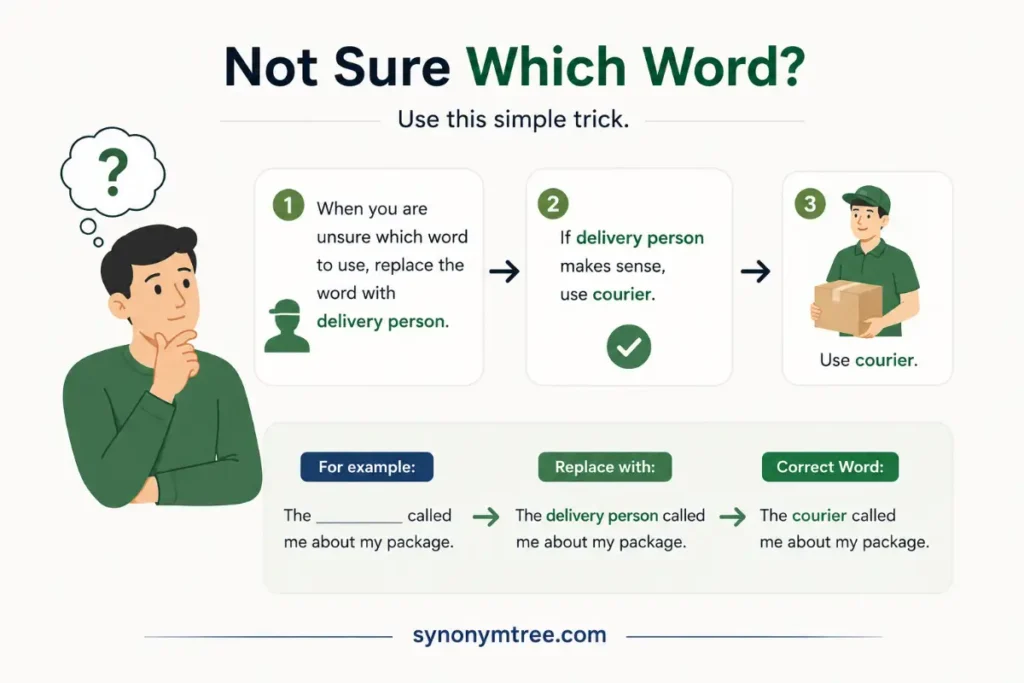
A Quick Sentence Test for Currier vs Courier
When you are unsure which word to use, replace the word with delivery person.
If delivery person makes sense, use courier.
For example:
The _____ called me about my package.
Try delivery person.
The delivery person called me about my package.
That works, so courier is correct.
Now try:
The _____ prepared the leather.
Delivery person does not make sense.
A leather worker makes sense.
So currier is correct.
This test focuses on meaning instead of spelling.
How To Spell Courier
Courier is spelled:
C O U R I E R.
A useful way to see the structure is:
COU + RIER.
The word begins with cou rather than cur.
That first vowel pattern is one of the biggest visual clues.
Currier begins with cur.
Courier begins with cou.
If you are talking about package delivery, look for the ou in the first part of the word.
For example:
courier service.
courier delivery.
These common phrases all use courier.
How To Spell Currier
Currier is spelled:
C U R R I E R.
It contains two rs together after the u.
That gives you:
CUR + RIER.
This spelling belongs to the traditional leather occupation or the surname Currier.
For example:
a leather currier.
an old currier.
the Currier family.
The spelling is less common in modern everyday English, so it may look unfamiliar.
Is Courier Always A Person
No. Courier can refer to a person or a delivery service.
If you say the courier arrived at my house, you probably mean the person.
If you say the courier offers overnight delivery, you may mean the company.
Context provides the meaning.
This flexible use is common with words connected to businesses.
For example, people may say the bank when they mean the institution, its staff, or a branch. The same kind of context based meaning can happen with courier.
Is Currier Still Used Today
Yes, but it is uncommon as an everyday occupation word.
The traditional leather trade still has historical and specialized uses, so the word has not disappeared.
You may encounter currier in books about leather, historical trades, family history, old occupations, or traditional craftsmanship.
You may also see Currier as a surname.
For most everyday conversations about shipping, though, courier is the word you need.
Is Courier A Job Title
Yes. Courier can be used as a job title.
For example:
She works as a courier.
He got a job as a courier.
The company hired three new couriers.
The plural form is couriers.
A courier may work independently or for a delivery company.
The job can involve collecting packages, checking addresses, transporting items, obtaining signatures, and completing deliveries.
The exact duties depend on the employer and type of delivery service.
What Is The Plural Of Courier
The plural of courier is couriers.
For example:
The company employs several couriers.
The couriers arrived early.
We spoke with two couriers.
The plural form simply adds s.
Currier also becomes curriers in the plural.
For example:
The town once had several curriers.
The museum describes the work of traditional curriers.
Again, the meaning remains different.
Can Courier Be Used For Documents
Yes.
Courier is commonly used for document delivery.
For example:
We sent the signed contract by courier.
The courier delivered the documents to the lawyer.
Please give the documents to the courier.
This is one of the most common professional uses of the word.
A courier may handle documents that need fast, direct, or tracked delivery.
Can Courier Be Used For Food
Yes.
A person who delivers food can be described as a courier, especially when the person works for a delivery service.
For example:
The courier brought our dinner.
The restaurant uses couriers for local delivery.
The courier arrived ten minutes early.
In everyday speech, people may also say delivery driver or delivery worker.
The best word depends on the setting.
Can Courier Be Used As A Verb
Yes, although the noun is much more common.
For example:
The company couriered the documents to the office.
This means the company sent the documents using a courier service.
Still, many speakers would choose a phrase such as sent by courier because it sounds more natural in ordinary conversation.
If you are unsure, use the noun.
For example:
We sent the documents by courier.
That sentence is clear and widely understood.
Related Words Worth Knowing
Several words sit close to courier in meaning.
Delivery
Delivery is the act of bringing something to a person or place.
For example:
The delivery arrived this morning.
Deliver
Deliver is the verb that means to take something to its intended destination.
For example:
The driver will deliver the package tomorrow.
Courier
Courier is the person or service that carries and delivers the item.
For example:
The courier delivered the package.
Shipment
A shipment is something that has been sent from one place to another.
For example:
The shipment arrived on Tuesday.
Parcel
Parcel is a common word for a package, especially in British English.
For example:
The courier delivered the parcel.
Package
Package is a very common American English word for an item prepared for shipping.
For example:
My package arrived this morning.
Knowing these related words helps place courier in the larger delivery vocabulary.
Courier And Package
These words name different things.
A package is the item being transported.
A courier is the person or service transporting it.
For example:
The courier delivered the package.
The sentence has two different nouns.
Courier tells us who delivered the item.
Package tells us what was delivered.
This distinction can help you understand the word quickly.
Courier And Delivery
Delivery describes the action or service.
Courier describes the person or service that performs the delivery.
For example:
The delivery arrived at noon.
The courier arrived at noon.
The first sentence focuses on the arrival of the item or service.
The second focuses on the person or company responsible for bringing it.
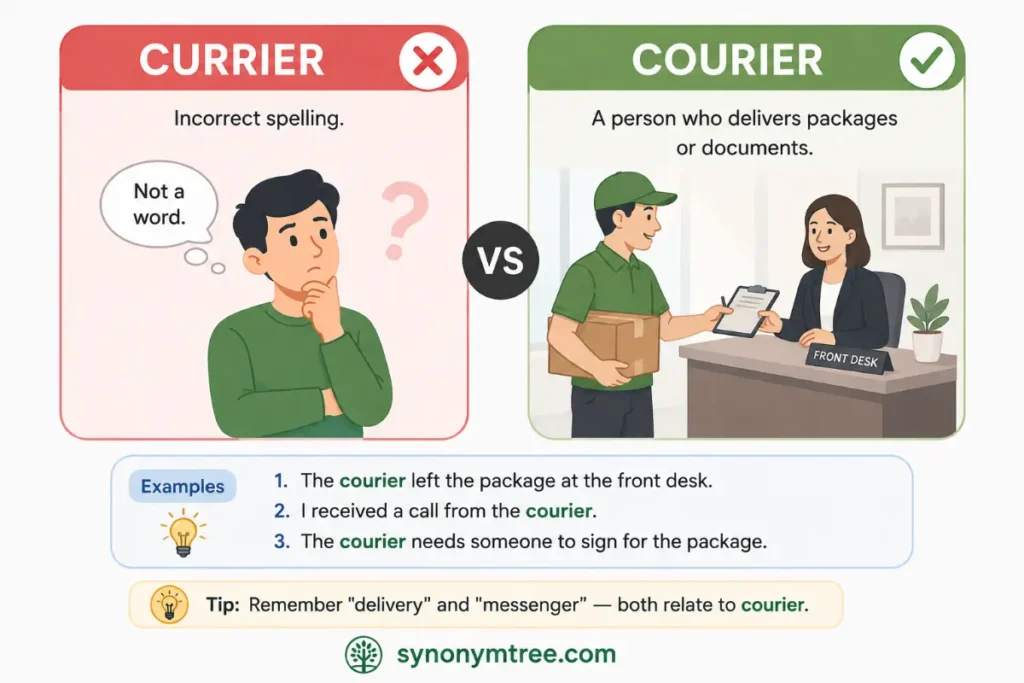
Examples In Everyday English for Currier vs Courier
Here are more natural examples using courier.
- The courier left the package at the front desk.
- I received a call from the courier.
- The courier needs someone to sign for the package.
- We hired a courier to deliver the documents.
- The courier arrived before lunch.
- Please call the courier if the package does not arrive.
- The company sent the order by courier.
- The courier service operates throughout the city.
- A courier picked up the envelope this morning.
- The courier could not access the building.
These sentences reflect common modern usage.
Now compare them with examples using currier.
- The currier prepared the leather.
- The village once employed a skilled currier.
- The historical record lists him as a currier.
- The currier worked beside the tanner.
- The museum explains the work of the currier.
The difference is clear once you connect each word with its meaning.
A Note About Surnames
Capitalization can give you another clue.
If you see Currier with a capital letter, it may be a surname.
For example:
James Currier wrote the book.
In that sentence, Currier is a person’s family name.
English contains many surnames that began as names for occupations. Someone whose ancestors worked in a particular trade may have a surname connected with that occupation.
This does not mean every person named Currier has a connection to leather work today.
A surname is simply a name.
What To Use In A Business Email
If you are writing about a package delivery, use courier.
For example:
The courier delivered the documents this morning.
The courier will arrive at 3 p.m.
Please give the signed form to the courier.
We have arranged a courier for the package.
These sentences are clear and professional.
Avoid currier in this context.
A spelling error in a business message may not stop the reader from understanding you, but using the standard word makes your writing cleaner and more accurate.
What To Use In A Resume
If you are describing delivery work on a resume, courier is the normal word.
For example:
Worked as a courier for a local delivery company.
Managed daily courier routes.
Delivered documents and packages to customers.
Coordinated courier deliveries for business clients.
If you are describing historical leather work, currier could be correct.
For example:
Studied traditional currier techniques.
Worked with leather as a traditional currier.
The subject determines the word.
What To Use In A School Assignment
For most school assignments about delivery, use courier.
For example:
The courier delivered an important message.
The company hired a courier to transport the package.
If your assignment is about historical occupations or leather making, currier may be the correct word.
For example:
The currier prepared the leather after the tanning process.
This is a good example of why spelling questions should be answered through meaning and context.
What To Use In A Text Message
Text messages are usually casual, but the same spelling rule applies.
If you are talking about a package, write:
The courier is here.
Or:
Did the courier deliver it yet.
Do not change the spelling simply because the message is informal.
Clear spelling still helps the reader understand exactly what you mean.
A Simple Rule For Writers
When you see the word in your draft, stop for one second and ask what job the person is doing.
If the person delivers something, write courier.
If Currier is a person’s last name, capitalize it as a proper name.
That is enough for almost every situation.
You do not need to memorize the full history of either word to make the right choice.
Meaning comes first.
Final Takeaway
The difference in currier vs courier comes down to the work each word describes. A courier is connected with delivery. A currier is traditionally connected with leather work. If you are waiting for a package, document, meal, or letter, you are waiting for a courier. If you are reading about an old leather trade, currier may be the word you need.
The easiest memory rule is short and practical. Courier delivers. Currier works with leather. Keep that distinction in mind when writing emails, school assignments, business documents, or everyday messages.
When you are unsure, look at the context around the word. Package, delivery, document, shipping, and address point toward courier. Leather, tanning, hide, craft, and historical trade point toward currier. That quick check will help you choose the correct spelling every time.
FAQs
What is the correct word for someone who delivers packages?
The correct word is courier. A courier is a person or service that carries and delivers packages, documents, letters, and other items. The word currier has a different meaning.
Is currier a real word?
Yes. Currier is a real English word for a person who traditionally prepares and finishes leather after tanning. It is much less common than courier in modern everyday English.
Is courier the correct spelling for a delivery person?
Yes. Courier is the standard spelling for a person who delivers packages, documents, or other items. For example, you can say the courier delivered my package.
What is the difference between a currier and a courier?
A courier delivers items from one place to another. A currier traditionally works with leather after the tanning process. The two words look similar but have different meanings.
Can currier mean a delivery person?
No, not in standard modern English. If you mean a person who delivers packages or documents, use courier. Currier refers to the traditional leather trade or can appear as a surname.
Is Currier a last name?
Yes. Currier can be a surname. In that use, it is simply a family name and does not describe a person’s job.
How do you remember courier and currier?
Remember that courier means delivery. Currier means leather work. The short rule is courier delivers and currier works with leather.
Is courier used in American English?
Yes. Courier is common in American English, especially in business, shipping, package delivery, document delivery, and food delivery. It is also widely understood in other varieties of English.
