
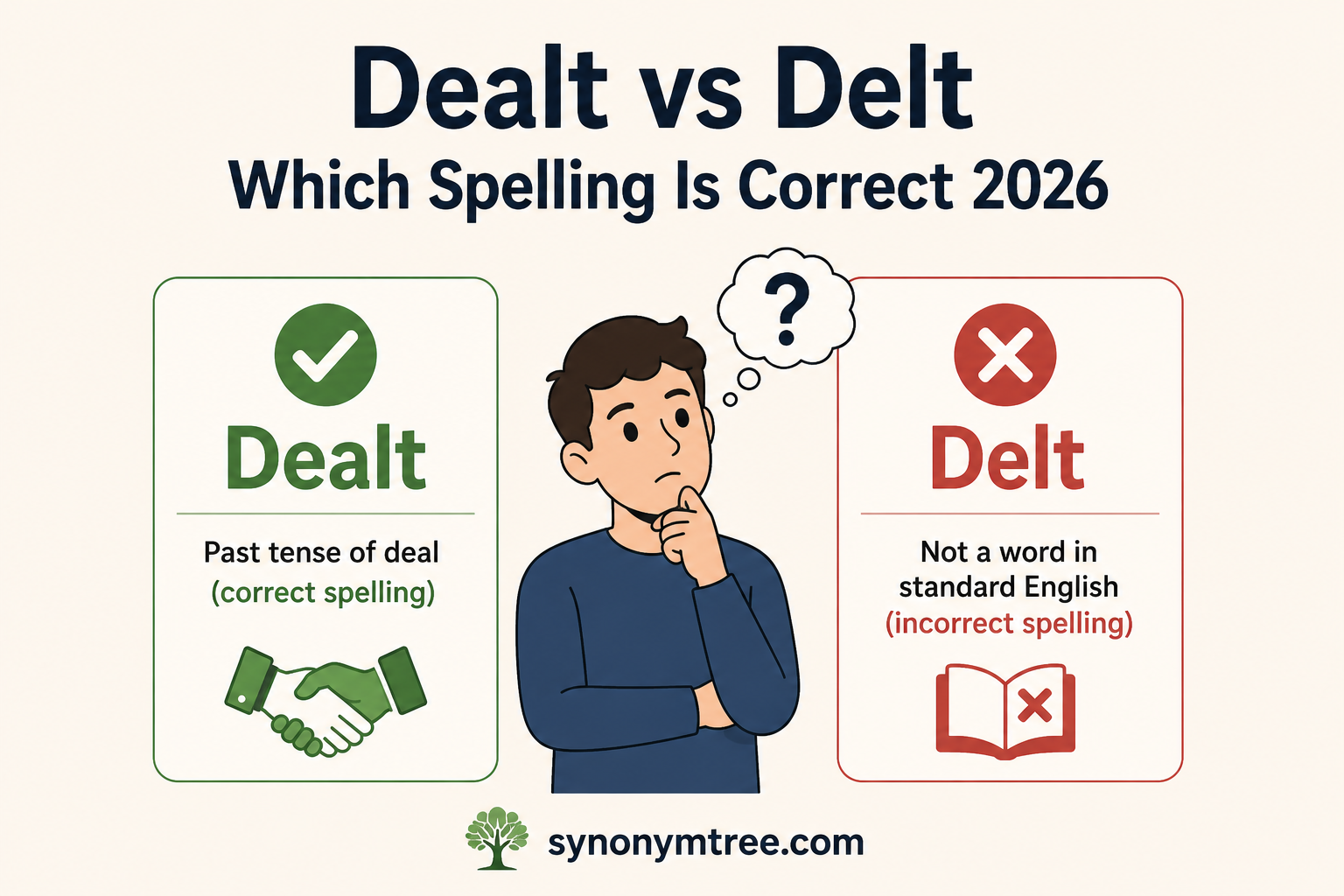
If you’re stuck on dealt vs delt you’re not alone. These two spellings look close enough to cause a quick pause. The good news is that the correct spelling is much easier to remember once you know the rule.
The correct word in standard English is dealt. It is the past tense and past participle of deal. You use it when you mean handled something distributed something or took part in a situation.
Delt is not the standard past tense of deal in modern English. If you’re writing an email school paper work report or social post then dealt is the spelling you want.
This guide explains why the mistake happens how dealt works in a sentence and how to remember the spelling. You’ll also see real examples common mistakes and answers to questions people often ask about this word.
Quick Definition
Dealt is the past tense and past participle of the verb deal. It can mean handled something distributed something or gave someone a particular set of cards.
Delt is not the standard English form of the past tense of deal. In standard American English use dealt.
Direct Answer
The correct spelling is dealt. Delt is not the standard past tense of deal.
Comparison Table
| Word or phrase | Meaning | Example sentence | When to use it |
|---|---|---|---|
| Deal | Handle or distribute something | I deal with customer questions every day. | Present tense |
| Dealt | Handled or distributed something in the past | She dealt with the problem yesterday. | Past tense and past participle |
| Delt | Not the standard past form of deal | Delt is not correct in standard English. | Avoid in normal writing |
Why People Get Dealt Vs Delt Confused
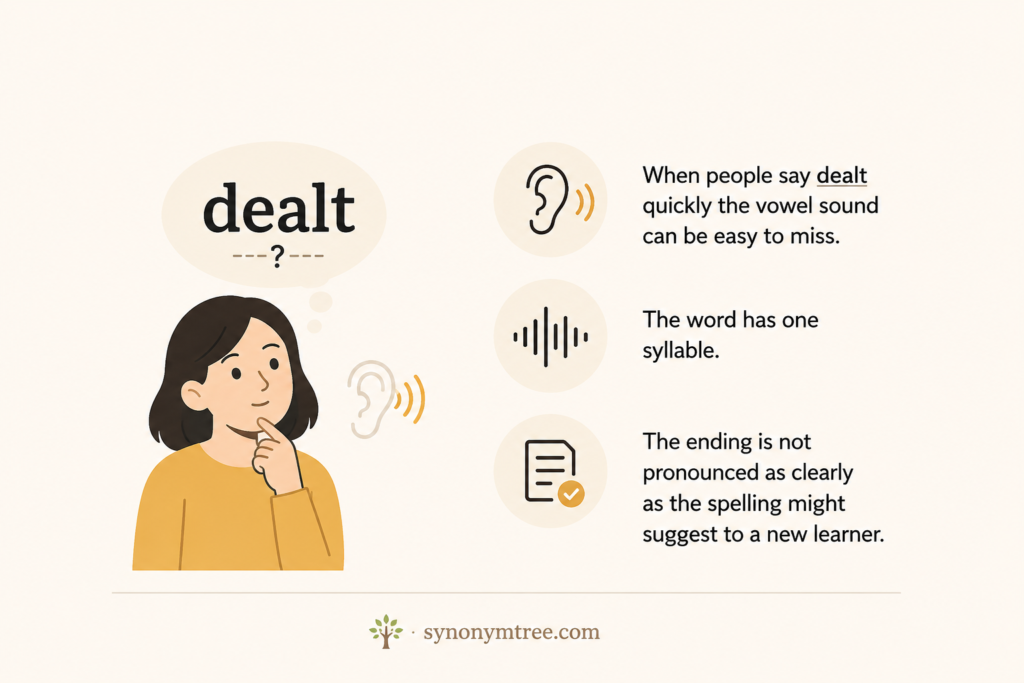
The main reason for the confusion is pronunciation.
When people say dealt quickly the vowel sound can be easy to miss. The word has one syllable and the ending is not pronounced as clearly as the spelling might suggest to a new learner.
English has many verbs that change form in ways that do not follow a simple rule. Deal is one of them.
You might expect the past tense to follow a pattern like this.
- Walk becomes walked.
- Help becomes helped.
- Call becomes called.
- Deal becomes dealt.
The last example follows an irregular pattern. You do not add ed to deal. Instead the spelling changes from deal to dealt.
That small change can make learners wonder if the t at the end should be written after a shortened form such as delt.
It should not.
The extra a is part of the correct spelling. You need it in dealt even though you may not hear it as strongly as you expect.
There is another reason this mistake appears. People often write words from memory based on how they sound. This works for some words but can cause trouble with irregular verbs.
For example you may hear a word and try to spell it exactly as it sounds. That can lead to forms such as delt. Standard spelling does not always match pronunciation letter for letter.
The safest approach is to remember the connection between deal and dealt.
The Correct Past Tense Of Deal
The verb deal has several meanings. It can mean to handle a matter. It can mean to distribute cards.
Its past tense is dealt.
Here are some simple examples.
- I deal with customer complaints every day.
- I dealt with three complaints yesterday.
- She deals with difficult clients calmly.
- She dealt with the difficult client yesterday.
- We deal with these problems as they come.
- We dealt with the problem last week.
Notice the pattern.
The present form is deal. The past form is dealt.
You should not replace dealt with delt.
The same rule applies when dealt works as a past participle.
For example you can say that someone has dealt with a problem.
- I have dealt with this issue before.
- She has dealt with many difficult cases.
- They have dealt with the problem already.
- We have dealt with similar requests in the past.
In each sentence dealt describes an action that happened before now.
What Dealt Means
The word dealt has more than one meaning. Context tells you which meaning applies.
Dealt Can Mean Handled
One of the most common meanings is handled.
If you dealt with something you handled it or took action to manage it.
For example.
- The manager dealt with the complaint quickly.
- I dealt with the issue before lunch.
- She dealt with the mistake in a calm way.
- The team dealt with several problems during the project.
Here dealt means handled.
You’ll often see this form with the word with.
The pattern is simple.
Dealt with + problem person situation or task.
For example.
- He dealt with the angry customer.
- She dealt with the broken machine.
- We dealt with the issue yesterday.
- They dealt with the situation professionally.
This is one of the most useful patterns to remember.
Dealt Can Mean Distributed
Dealt can also refer to cards in a card game.
A person who deals cards distributes them to the players.
For example.
- Sam dealt five cards to each player.
- She dealt the cards around the table.
- The dealer dealt the final card.
- He dealt everyone an equal number of cards.
In these sentences dealt means distributed.
You can also use dealt when talking about the cards someone received.
For example.
- I was dealt three aces.
- She was dealt a strong hand.
- He was dealt a difficult hand in the game.
The phrase dealt a hand has another common use too. It can describe a difficult or unexpected situation in life.
For example.
A serious setback dealt him a hard blow.
The meaning depends on context. In a card game the phrase is literal. In other situations it can be figurative.
Dealt Can Describe What Someone Received
Dealt can also describe something that was given to a person or group.
For example.
- The team was dealt a major setback.
- The company was dealt a difficult challenge.
- The injury dealt a serious blow to his plans.
Here dealt means caused or gave something that had a strong effect.
This use often appears in phrases such as dealt a blow or dealt a setback.
These phrases are common in news writing sports writing and everyday speech.
Dealt In Real Sentences
The easiest way to understand this word is to see it in natural sentences.
Here are examples from several common situations.
At Work
- Maria dealt with the customer complaint before the meeting.
- The manager dealt with the issue quickly.
- Our team has dealt with similar problems before.
- He dealt with the request in a professional way.
- The staff dealt with the delay as calmly as they could.
These examples use dealt to mean handled.
At School
- The teacher dealt with the classroom problem quickly.
- We dealt with the hardest question first.
- The students dealt with several new topics during the lesson.
- She dealt with the mistake and corrected it.
Again the meaning is handled.
In Card Games
- Jake dealt the cards to everyone.
- She dealt five cards to each player.
- I was dealt a great hand.
- He dealt the final card.
- The dealer dealt the cards too quickly.
Here dealt relates to distributing cards.
In Daily Conversation
- I dealt with that problem yesterday.
- She has dealt with worse situations.
- We dealt with the issue and moved on.
- He dealt with the news better than I expected.
- They dealt with the changes very well.
These examples show how common the word is in everyday English.
Why Delt Is Not Correct
Delt may look like a logical spelling because it matches part of the sound of dealt.
However standard English does not use delt as the past tense of deal.
The correct forms are.
- Deal for the present tense.
- Dealt for the past tense.
- Dealt for the past participle.
For example.
- I deal with the problem.
- I dealt with the problem yesterday.
- I have dealt with the problem already.
The form delt does not fit this verb pattern.
If you write delt in a formal document most readers will recognize it as a spelling mistake.
That makes this a useful word to learn carefully. Once you know that deal becomes dealt you can avoid the error every time.
The Verb Forms You Should Remember
A quick look at the main forms makes the pattern easier to see.
| Verb form | Word | Example |
|---|---|---|
| Base form | Deal | I deal with customer questions. |
| Present third person | Deals | She deals with customer questions. |
| Past tense | Dealt | She dealt with the question yesterday. |
| Past participle | Dealt | She has dealt with the question already. |
| Present participle | Dealing | She is dealing with the question now. |
There is no standard form called delt in this verb pattern.
The form dealing may also help you remember the base word.
Deal becomes dealing when you describe an action happening now.
Deal becomes dealt when you describe an action that happened in the past.
That gives you a simple group to remember.
Deal. Dealing. Dealt.
Dealt With Or Dealt
You may also wonder when to use dealt by itself and when to use dealt with.
Both are correct. The choice depends on the meaning and the rest of the sentence.
Use dealt with when you mean handled or managed something.
For example.
- She dealt with the complaint.
- He dealt with the problem.
- We dealt with the customer request.
Use dealt without with when the verb has another meaning.
For example.
- She dealt the cards.
- He dealt five cards to each player.
- The dealer dealt the cards around the table.
You can also see dealt followed by words such as a blow or a setback.
For example.
- The loss dealt the team a major blow.
- The storm dealt the town a serious setback.
So the word itself is not limited to one meaning.
Common Mistakes With Dealt
Spelling mistakes often happen when people rely on sound alone. A few patterns are worth watching.
Writing Delt Instead Of Dealt
This is the main mistake.
Incorrect spelling can appear in casual writing because delt looks close to the way some people hear the word.
In standard English use dealt.
For example.
Incorrect: She delt with the problem.
Correct: She dealt with the problem.
Using Deal For A Past Event
Another mistake is keeping deal in its base form when talking about something that already happened.
For example.
Incorrect: I deal with the complaint yesterday.
Correct: I dealt with the complaint yesterday.
The word yesterday tells you that the action happened in the past.
Adding Ed To Deal
You should not write dealed.
The past tense is not formed by adding ed.
Incorrect: We dealed with the problem.
Correct: We dealt with the problem.
This is a common error among people learning English because many regular verbs use ed.
Deal is an irregular verb. Its past form must be learned as dealt.
Confusing Dealt With And Dealing With
Dealt and dealing have different uses.
Dealt describes a completed past action.
Dealing usually describes an action happening now or around the current time.
Compare these sentences.
- I dealt with the problem yesterday.
- I am dealing with the problem now.
The first sentence describes a completed action.
The second describes an action in progress.
How To Remember The Correct Spelling Of Dealt Vs Delt
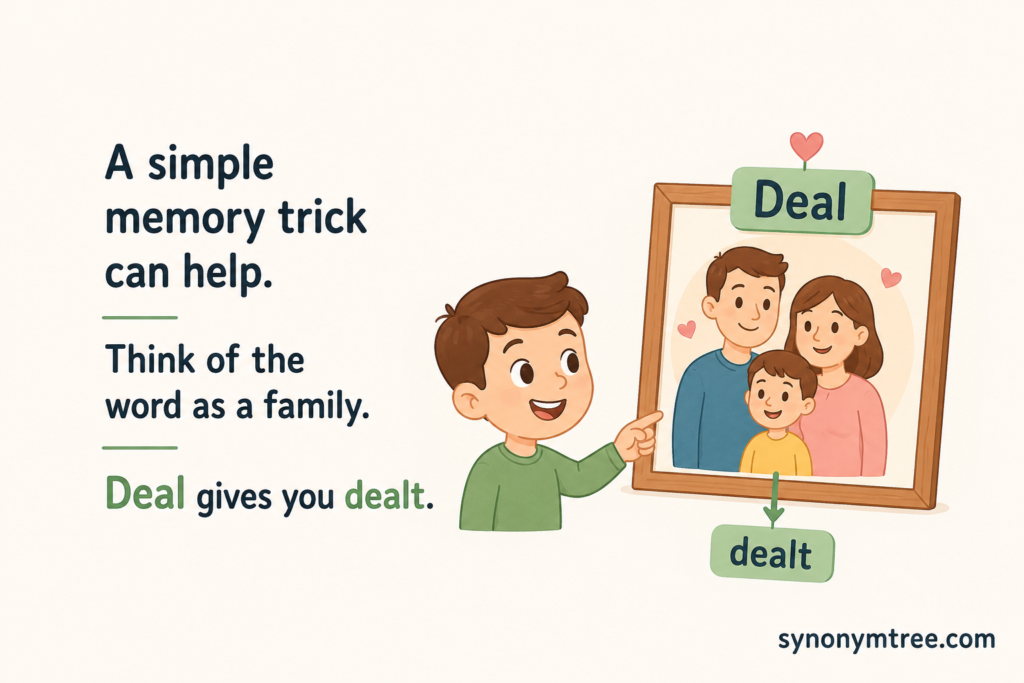
A simple memory trick can help.
Think of the word as a family.
Deal gives you dealt.
Keep the connection between the two words in your mind. The letters ea stay in the spelling.
You can also remember this short sentence.
I deal today and I dealt yesterday.
That sentence gives you the present and past forms side by side.
Another useful trick is to connect dealt with the word deal. If you can see the base word inside the past form then you are less likely to drop the a.
Try writing these pairs together.
- Deal and dealt.
- Feel and felt.
- Keep and kept.
- Sleep and slept.
- Leave and left.
Notice something useful here. English has many irregular verbs that change their spelling in the past.
Deal and dealt fit that larger pattern.
The exact spelling still needs to be memorized but the pattern makes it easier to understand.
Dealt And Other Irregular Verbs
Deal belongs to a large group of irregular English verbs.
Regular verbs often form the past tense with ed.
For example.
- Walk becomes walked.
- Talk becomes talked.
- Open becomes opened.
- Clean becomes cleaned.
Irregular verbs do not follow that basic pattern.
For example.
- Go becomes went.
- See becomes saw.
- Keep becomes kept.
- Feel becomes felt.
- Sleep becomes slept.
- Deal becomes dealt.
These forms can feel unpredictable at first. Over time they become familiar through reading and practice.
This is why seeing dealt in real sentences helps more than memorizing a definition alone.
The Difference Between Deal And Dealt
Deal and dealt are forms of the same verb. The main difference is time and grammar.
Deal is the base form and present form used in many situations.
For example.
I deal with customer questions.
Dealt is the past form.
For example.
I dealt with customer questions yesterday.
Dealt also works after helping verbs such as have and has.
For example.
- I have dealt with this problem before.
- She has dealt with many difficult customers.
- They have dealt with similar issues.
You cannot replace dealt with deal in these sentences.
Incorrect: I have deal with this before.
Correct: I have dealt with this before.
The same principle applies after had.
For example.
- I had dealt with the problem before the meeting.
- She had dealt with the issue before the manager arrived.
Dealt In American English
The spelling dealt is standard in American English.
You will see it in everyday speech and writing. It appears in emails reports books news articles conversations and many other types of communication.
The pronunciation may sound slightly different across accents. That does not change the standard spelling.
This is a useful lesson for English learners. Spoken English can make some letters hard to notice. Written English follows established spelling rules even when every letter is not strongly heard.
The best habit is to learn the written form together with the meaning.
If you learn only the sound you may create a spelling such as delt.
If you learn the word as part of the verb family deal and dealt you are more likely to remember it correctly.
When Dealt Is Used With With
The phrase dealt with deserves special attention because it appears very often.
It can mean handled something.
For example.
- The teacher dealt with the problem.
- The manager dealt with the complaint.
- I dealt with the paperwork this morning.
- She dealt with the situation calmly.
It can also mean discussed or addressed a subject.
For example.
- The book dealt with the history of the town.
- The article dealt with common grammar mistakes.
- The meeting dealt with several important issues.
In these sentences dealt with does not mean physically handling something. It means the person or thing addressed a topic.
This is why context matters.
A manager can deal with a customer.
A book can deal with a subject.
A player can deal cards.
The verb stays the same but the meaning changes based on what follows it.
Dealt A Blow And Other Common Expressions
English often uses dealt in fixed expressions.
One common phrase is dealt a blow.
It means something caused a serious setback or had a strong negative effect.
For example.
- The injury dealt a blow to his career.
- The loss dealt the team a major blow.
- The sudden closure dealt a serious blow to local businesses.
Another phrase is dealt a setback.
For example.
- The delay dealt the project a setback.
- The failed test dealt his plans a major setback.
These expressions are common in news reports and formal writing.
You do not need to memorize every phrase at once. Start with the basic meaning of dealt. Then learn common phrases as you encounter them.
Dealt In Card Games
The card game meaning is one of the easiest ways to remember the word.
A dealer deals cards.
The past tense is dealt.
For example.
- The dealer deals five cards to each player.
- The dealer dealt five cards to each player.
- The dealer has dealt the cards.
This creates a very clear verb pattern.
Deal means distribute.
Dealt means distributed.
The same spelling works in all standard forms of this past action.
You may also hear deal the cards and deal someone a card.
For example.
- Deal the cards to the players.
- She dealt him two cards.
- He dealt each player five cards.
This meaning is separate from dealing with a problem but the grammar comes from the same verb.
Dealt With Problems And Situations
The phrase dealt with is especially common when talking about problems.
You can deal with a problem.
You can deal with a difficult person.
When you move that action into the past you use dealt with.
For example.
- I dealt with the problem this morning.
- She dealt with the customer before lunch.
- We dealt with the delay yesterday.
- They dealt with the issue during the meeting.
This makes dealt one of the most useful past forms to know in everyday English.
A Simple Grammar Test
If you are unsure about the spelling while writing then try changing the sentence to the present tense.
For example.
You write:
She delt with the issue.
Change the sentence to present tense.
She deals with the issue.
Now connect it back to the past.
She dealt with the issue.
This simple test can help you remember the correct form.
You can also ask yourself what the base verb is.
If the base verb is deal then the past form is dealt.
The same method works for many irregular verbs.
Why Pronunciation Can Mislead You
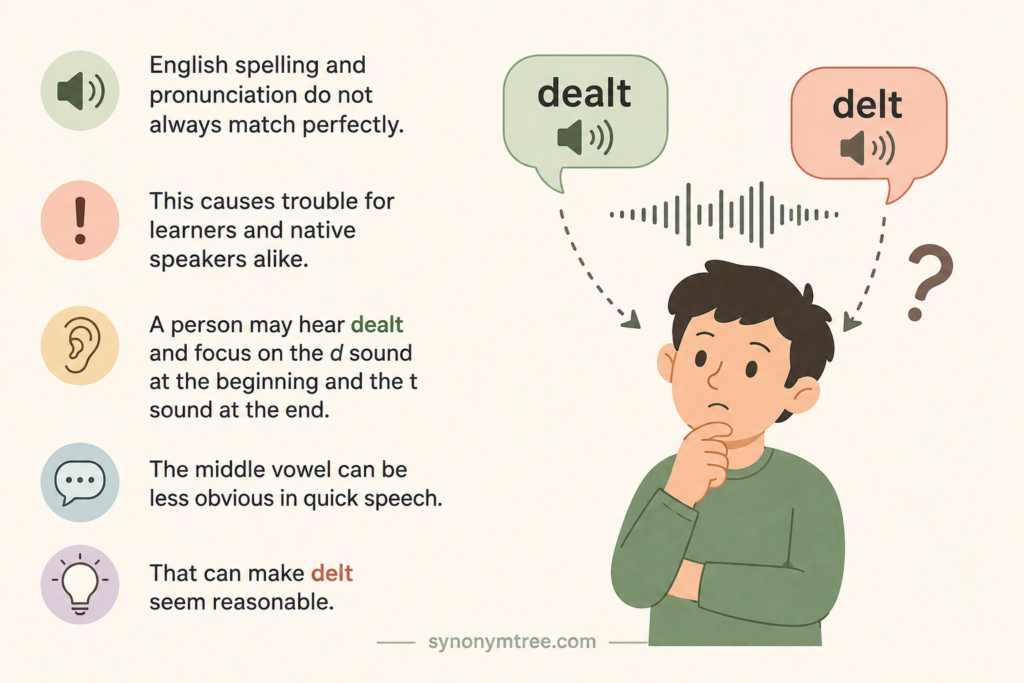
English spelling and pronunciation do not always match perfectly.
This causes trouble for learners and native speakers alike.
A person may hear dealt and focus on the d sound at the beginning and the t sound at the end. The middle vowel can be less obvious in quick speech.
That can make delt seem reasonable.
But spelling should not be based only on sound.
Consider other English words that contain letters that are not strongly heard. English has many examples. The written form often preserves a spelling pattern that pronunciation does not show clearly.
For dealt the best approach is to connect the word to deal.
Once that link becomes familiar the spelling becomes much easier.
A Quick Practice Exercise
Try choosing the correct form in each sentence.
- I have deal with this problem before.
- She delt with the customer yesterday.
- He deal cards every Friday.
- We dealt with the issue last week.
- They have dealt with similar problems.
- The dealer delt five cards to each player.
The correct answers are below.
- I have dealt with this problem before.
- She dealt with the customer yesterday.
- He deals cards every Friday.
- We dealt with the issue last week.
- They have dealt with similar problems.
- The dealer dealt five cards to each player.
The key is not to memorize random sentences. Focus on the verb forms.
Deal.
Deals.
Dealing.
Dealt.
Once you know that group you can build many sentences correctly.
Related Word Confusions
The confusion around dealt is part of a bigger spelling issue. English has many words that sound similar to other forms or contain unexpected letters.
Learning words in related groups can make spelling easier.
Feel And Felt
Feel changes to felt in the past tense.
For example.
I feel tired today.
I felt tired yesterday.
Keep And Kept
Keep changes to kept.
For example.
I keep the receipt.
I kept the receipt.
Sleep And Slept
Sleep changes to slept.
For example.
I sleep well now.
I slept well last night.
Leave And Left
Leave changes to left.
For example.
I leave at six.
I left at six.
Deal And Dealt
Deal changes to dealt.
For example.
I deal with these issues often.
I dealt with this issue yesterday.
Seeing these forms together helps you recognize that irregular verbs often change their vowel sounds or spelling in the past tense.
How To Use Dealt In Formal Writing
Dealt is completely suitable for formal writing.
You can use it in business reports academic writing professional emails and other serious documents.
For example.
- The committee dealt with the issue during its meeting.
- The report dealt with several causes of the problem.
- The team dealt with the customer complaint promptly.
- The study dealt with changes in consumer behavior.
You do not need to replace dealt with a more complicated word to sound professional.
Simple words are often stronger.
If dealt says exactly what you mean then use it.
How To Use Dealt In Casual Writing
Dealt also sounds natural in everyday conversation.
For example.
I dealt with it yesterday.
She dealt with the problem.
We already dealt with that.
He has dealt with worse.
These sentences are short and natural.
You may hear native speakers use them often.
That makes dealt a word worth learning as a complete everyday verb form rather than as a spelling quiz answer.
Conclusion
The answer to dealt vs delt is simple. The correct standard spelling is dealt. It is the past tense and past participle of deal. Use dealt when you mean handled something. You can also use it when you mean distributed cards or caused a strong effect through phrases such as dealt a blow.
The easiest way to remember the spelling is to keep the base word in mind. Deal becomes dealt. The form delt does not serve as the standard past tense of deal.
If you pause over this word while writing then use one quick check. Ask yourself what the base verb is. If the verb is deal and the action happened in the past then write dealt. That small habit will help you get the spelling right every time.
Frequently Asked Questions
Is Dealt The Correct Spelling?
Yes. Dealt is the correct standard spelling for the past tense and past participle of deal. Delt is not the standard English form.
Is Delt A Word In English?
Delt can appear in some specialized names or informal contexts but it is not the standard past tense of deal. For normal English writing use dealt.
Is Dealt The Past Tense Of Deal?
Yes. Dealt is the simple past tense of deal. It is also used as the past participle after words such as have has and had.
Should I Say Dealt With Or Deal With?
Use deal with for the present and dealt with for the past. For example you can say I deal with customer questions and I dealt with a customer question yesterday.
Why Does Dealt Sound Like Delt?
The vowel sound in dealt can be less noticeable in quick speech. That can make the spelling seem like delt. The standard written form still includes the a.
Is Deal A Regular Verb?
No. Deal is an irregular verb. Its past form is dealt rather than dealed.
Can Dealt Mean Handled?
Yes. Dealt often means handled or managed. For example you can say she dealt with the complaint.
Can Dealt Refer To Playing Cards?
Yes. Dealt can mean distributed cards to players. For example the dealer dealt five cards to each player.
