
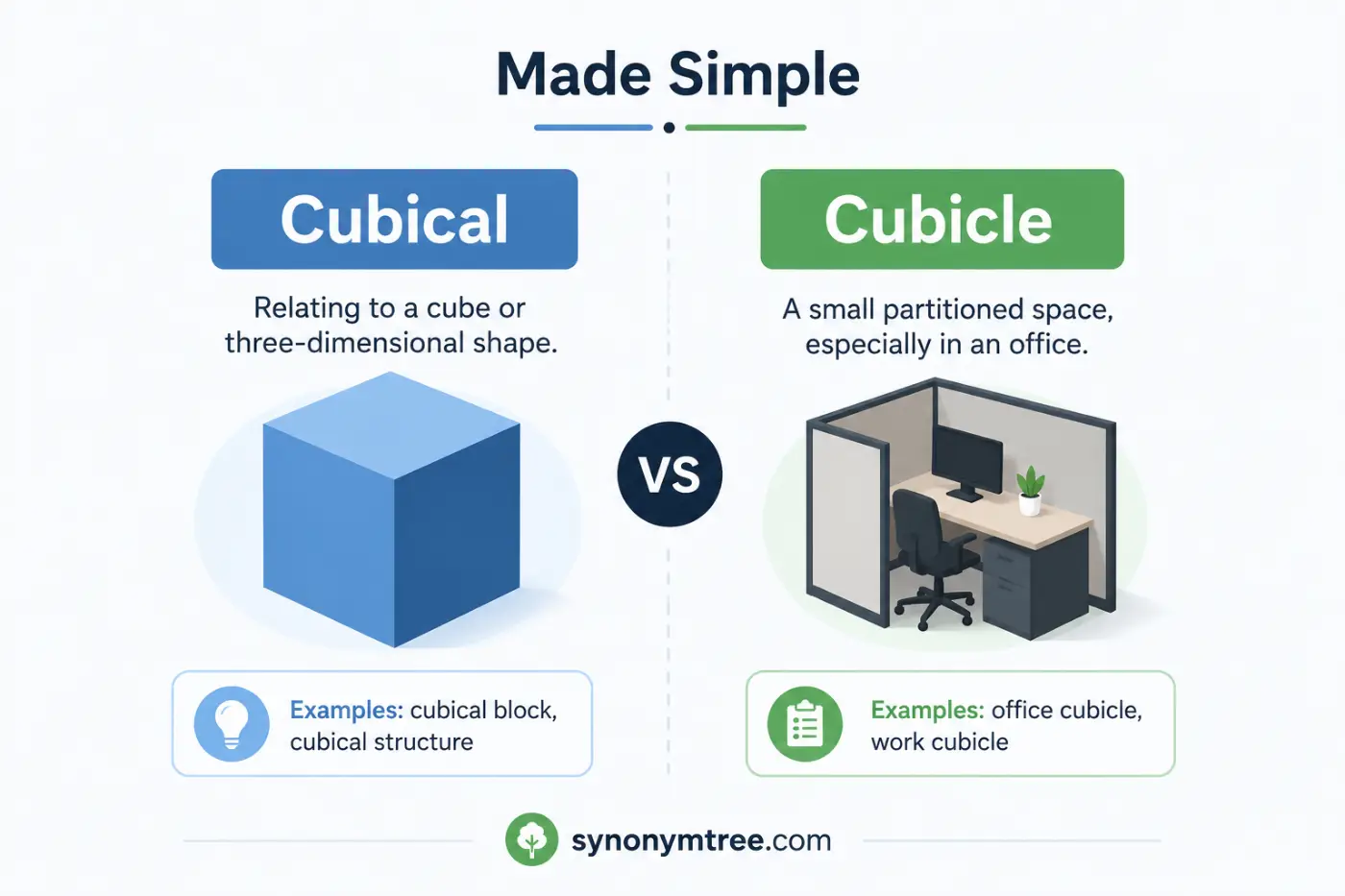
If you are searching for cubical vs cubicle, you are probably trying to decide which word describes a small office space. The correct word for that office space is cubicle. The word cubical is real too, but it has a different meaning.
A cubicle is a small enclosed or partly enclosed space, often found in an office. It can also describe a small compartment in places such as hospitals, schools, or changing rooms. Cubical is an adjective that means something has the shape or form of a cube.
The two words look and sound similar, so the mix up is easy. They also come from the same basic idea of a cube or small enclosed space. The key is to look at the job each word does in a sentence.
This guide explains the difference in plain English. You will learn the meaning of each word, how to use each one, why people confuse them, and how to remember the correct spelling.
Quick Definition
Cubicle is a noun for a small room or sectioned off space, especially an office workspace. Cubical is an adjective that describes something shaped like a cube or having a cube like form.
Direct Answer
Use cubicle when you mean a small office workspace or partitioned space. Use cubical when you mean something that has the shape or appearance of a cube.
Comparison Table on Cubical vs Cubicle
| Word | Meaning | Example Sentence | When to Use It |
|---|---|---|---|
| Cubicle | A small enclosed or divided space | I work in a cubicle near the window. | Use it for an office space or small compartment. |
| Cubical | Having the shape of a cube | The building has a cubical design. | Use it to describe shape or form. |
Where The Confusion Comes From
The confusion starts with the words looking almost identical. Both words contain the letters cub and both connect to the idea of a cube. Only the ending changes, but that small change affects the meaning. Cubicle usually works as a noun. It names a thing. A cubicle can be a workspace, a small compartment, or a private section inside a larger room.
Cubical usually works as an adjective. It describes a thing. If something is cubical, it has a shape that resembles a cube. That difference becomes much easier to see when you place the words in real sentences.
I sat inside a cubicle during my work shift.
The small cubicle gave me enough room for a desk and chair.
The sculpture has a cubical shape.
The designer created a cubical structure from concrete blocks.
In the first two sentences, cubicle names a space. In the last two, cubical describes shape. This is the main rule to remember. One word names a space. The other describes a shape. The words can also appear in different parts of speech. That grammatical difference is one of the best clues when you are unsure which spelling to use.
What Cubicle Means
A cubicle is a small space that is separated from a larger room. The walls may be complete, but they are often only partial walls or panels. The word is strongly connected with office life in American English. Many workplaces use cubicles to divide a large office into smaller work areas. For example, you might hear someone say that they work in a cubicle. This usually means they have a desk in a workspace surrounded by short partitions.
A cubicle does not have to be an office space, though. The word has several uses.
A hospital may have small cubicles for patients.
A public bathroom may contain individual cubicles.
A changing room may have cubicles that give people some privacy.
A school or testing center may use small cubicles to separate students.
A prison may have small spaces that are also called cubicles in certain settings.
The exact meaning depends on the place and context. The common idea is a small section or compartment that is separated from a larger area.
Cubicle In An Office
The office meaning is probably the one most people have in mind.
Imagine a large room with dozens of desks. Short walls or panels divide the desks into separate work areas. Each section can be called a cubicle.
For example:
Maria has a cubicle near the front of the office.
My cubicle is next to the conference room.
He decorated his cubicle with family photos.
The manager moved me to a larger cubicle.
These sentences all use cubicle as a noun. The word refers to the actual space. You can also use common phrases such as office cubicle, cubicle wall, cubicle desk, and cubicle workspace. The word can describe a physical workspace, but people sometimes use it in a broader way. Someone might say that they are tired of cubicle life. In that case, cubicle represents the experience of working in a traditional office environment.
Cubicle In Other Places
Office use is common, but it is not the only use.
A hospital may divide a large treatment area into separate patient spaces. Each space may be called a cubicle.
For example:
The nurse asked me to wait in the next cubicle.
The patient was moved to a private cubicle.
The emergency room has several treatment cubicles.
You can also find the word in public facilities.
For example:
Please leave your bags outside the shower cubicle.
The restroom has several private cubicles.
In these examples, cubicle still names a small divided space. The setting changes, but the basic meaning stays the same.
What Cubical Means
Cubical is an adjective. It describes something that looks like a cube or has the general form of a cube.
A cube is a three dimensional shape with six equal square sides. A perfect cube has the same length, width, and height.
Cubical does not always mean perfectly shaped like a mathematical cube. It can describe something that is roughly cube shaped.
For example:
The artist placed a cubical sculpture in the center of the room.
The machine has a large cubical body.
The old stone building has a cubical design.
The box has a simple cubical form.
In each sentence, cubical describes the shape or appearance of something.
You would not normally use cubical to name an office workspace.
That means this sentence is incorrect if you mean an office space:
I work in a cubical.
The natural sentence is:
I work in a cubicle.
The first sentence says something closer to I work in something cube shaped. That is not normally what an office worker means.
Cubical As A Shape Word
Cubical belongs to a group of words that describe shapes.
You may already know words such as circular, rectangular, triangular, and spherical. Cubical works in a similar way.
A circular object has a circular shape.
A triangular object has a triangular shape.
A spherical object has a spherical shape.
A cubical object has a cube like shape.
This makes the grammar easier to understand. If you are describing how something looks, cubical may be the word you need.
For example:
The container has a cubical shape.
The robot has a cubical body.
The sculpture is almost cubical.
The room has a strange cubical design.
These examples use the word as a description.
The Main Grammar Difference
The easiest way to separate the two words is to look at their grammatical roles.
Cubicle is mainly a noun. A noun names a person, place, thing, or idea.
Cubical is an adjective. An adjective describes a noun.
Consider this sentence:
The employee cleaned her cubicle.
Cubicle is the thing being cleaned. It is a noun.
Now consider this sentence:
The employee noticed the cubical structure.
Cubical describes the structure. It tells us something about its shape.
This simple test can help you choose the right word.
Ask yourself what you are trying to do.
If you are naming the space, use cubicle.
If you are describing a cube like shape, use cubical.
That rule works in most everyday situations.
A Simple Grammar Test
Try putting the word after a form of the verb be.
You can say:
The room is cubical.
This works because cubical is an adjective.
You can also say:
The room has a cubicle.
This works because cubicle is a noun.
You would not normally say:
The room is cubicle.
That sounds wrong in standard English when you are trying to describe a cube like shape.
You would also not normally say:
The object is a cubicle.
That sentence can be correct only if the object itself is actually a cubicle. The grammar is fine, but the meaning is different.
The key is not simply the spelling. The meaning and grammatical role matter together.
Why Cubicle Has The Ending Cle
The spelling of cubicle can look strange if you are expecting the word to follow the pattern of cubical. English has many word endings that change a word into a different grammatical form or meaning.
Cubicle comes from a Latin word connected with a sleeping room or chamber. Over time, English developed its modern use for a small compartment or divided space. The ending helps form the noun. Cubicle is not simply another spelling of cubical. This is similar to other English word pairs where a small spelling change creates a different word.
For example, a word ending in an adjective form can describe a quality, while another ending can name a thing or place.
You do not need to memorize the history to use these words correctly. Still, knowing that the two words developed into different forms can explain why the spelling difference matters.
Why People Spell Cubicle As Cubical
Many people write cubical when they mean cubicle because the words sound very similar.
Speech can make the problem worse. In fast conversation, the final sounds may not be easy to hear clearly.
The meaning is often understood from context, so a listener may not notice the mistake at all.
Writing exposes the difference.
A person might type:
I spent all day working in my cubical.
The intended word is almost certainly cubicle.
This error is especially common when someone has heard the word many times but has not seen it written often.
English has many spelling patterns that do not match exactly how words sound. This is one reason spelling mistakes can happen even when a person knows the meaning.
The good news is that this pair has a simple memory rule.
A Simple Memory Trick
Think about the thing you are talking about.
If you can sit or work inside it, think cubicle.
If you are describing its shape, think cubical.
For example:
I sit in a cubicle.
The object is cubical.
You can make the trick even shorter.
Cubicle is a place.
Cubical is a shape.
That distinction is enough for most everyday writing.
You do not need to remember complicated grammar rules. Just ask yourself if you are naming a small space or describing something that looks like a cube.
Common Sentences With Cubicle
The word cubicle appears in many ordinary workplace sentences. Seeing it in context can make the spelling easier to remember.
Here are some natural examples.
- I moved to a new cubicle last week.
- Her cubicle is close to the break room.
- He keeps a small plant on his cubicle desk.
- My manager asked me to clean my cubicle.
- The office has about fifty cubicles.
- She decorated her cubicle with pictures.
- I could hear the conversation from the next cubicle.
- The company removed several cubicle walls.
- He spends most of his workday in a cubicle.
- The new cubicle gives me more storage space.
Notice that cubicle names the workspace in every example.
You can also make the word plural.
One cubicle.
Two cubicles.
Several cubicles.
The plural form simply adds s.
For example:
The office has twenty cubicles.
The hospital added more patient cubicles.
Common Sentences With Cubical
Cubical appears less often in everyday conversation because people do not constantly describe things as cube shaped. Still, it is a useful adjective.
Here are some examples.
- The artist created a large cubical sculpture.
- The machine has a cubical outer shell.
- The box has a nearly cubical shape.
- The building has a simple cubical form.
- The designer used several cubical blocks.
- The object looks almost cubical from this angle.
- The room has a tall cubical structure in the center.
- The toy consists of several small cubical pieces.
- The container has a compact cubical design.
- The stone was cut into a cubical form.
In these examples, cubical describes shape.
That is the major difference from the office meaning of cubicle.
Cubicle And Office Vocabulary
If you are learning American English, it helps to know the words that often appear with cubicle.
A cubicle can have a desk. The desk is the surface where you work.
It can have a chair. It can have drawers or storage areas.
Common terms include cubicle wall, cubicle panel, cubicle desk, cubicle space, office cubicle, and cubicle neighbor.
For example:
My cubicle neighbor works in accounting.
The office replaced the old cubicle panels.
I need a larger desk for my cubicle.
The company is changing the cubicle layout.
These combinations make the meaning clear because they all refer to an office environment. You may also hear people use the phrase cubicle farm. This informal expression describes a large office filled with many similar workspaces. It can sound negative because it compares the rows of workers to a farm.
Cubical And Shape Vocabulary
Cubical belongs with other words that describe physical form.
You may see it in writing about architecture, art, design, engineering, mathematics, or science.
For example, a designer might describe a building as cubical because its main shape resembles a cube.
An engineer might describe a component as cubical because its dimensions are close to equal.
An artist might create a cubical sculpture.
A teacher might use the word while explaining three dimensional shapes.
In these settings, cubical has a clear descriptive role.
For example:
The model uses three cubical blocks.
The architect designed a cubical structure.
The box is roughly cubical.
The phrase roughly cubical is useful because real objects are not always perfect mathematical cubes.
Is Cubicle An Adjective
In standard everyday use, cubicle is mainly a noun.
For example:
I cleaned my cubicle.
The cubicle is empty.
She moved to another cubicle.
However, English nouns can sometimes be placed before other nouns to describe them. This is called noun modification.
For example, you might see phrases such as cubicle wall or cubicle design.
In cubicle wall, the word cubicle helps identify the kind of wall being discussed. The main noun is wall.
This does not make cubicle and cubical interchangeable.
Cubicle still refers to the noun or concept connected to the small workspace or compartment.
Is Cubical A Noun
Cubical is normally an adjective.
For example:
The object has a cubical shape.
The structure is cubical.
The design is strongly cubical.
In these sentences, cubical describes something.
There are rare or specialized uses of similar forms in older or technical language, but they do not affect ordinary American English. For everyday writing, treat cubical as an adjective.
If you need the noun for a small office space, use cubicle.
Cubicle And Cube
The word cubicle is connected to the idea of a small space, but a cubicle does not have to be cube shaped.
This point causes another common misunderstanding.
A modern office cubicle is often rectangular. It may be much wider than it is tall. It may have three panels and an open front.
So why is it called a cubicle?
The word has a long history connected with small rooms and compartments. Its modern meaning does not require the space to look like a mathematical cube.
That is why this sentence makes sense:
My cubicle is long and narrow.
There is no contradiction. A cubicle does not need to be cube shaped.
By contrast, if you call something cubical, you are talking about its shape.
This gives you another useful test.
A cubicle can be rectangular.
Something described as cubical should have a cube like form.
Cubicle Versus Small Office
A cubicle is not exactly the same as a small private office.
A private office normally has full walls and a door. A cubicle usually has partial walls or panels and an open entrance.
For example:
She works in a private office.
He works in a cubicle.
The difference matters because the words create different mental pictures.
A cubicle usually offers less privacy. People can often see or hear coworkers nearby.
A private office gives more separation.
This is why the word cubicle often appears in conversations about office design, privacy, noise, and workplace culture.
Common Mistakes People Make about Cubical vs Cubicle
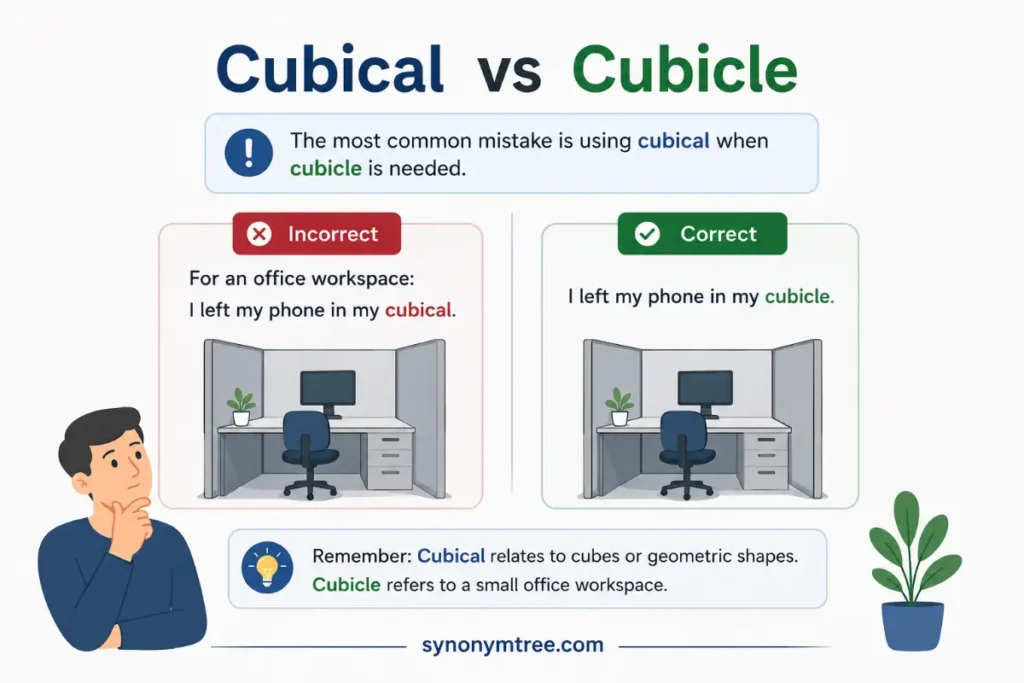
The most common mistake is using cubical when cubicle is needed.
For example:
Incorrect for an office workspace: I left my phone in my cubical.
Correct: I left my phone in my cubicle.
Another mistake is assuming that cubicle means something shaped like a cube.
That is not how the word normally works in modern everyday English.
For example:
The office cubicle is rectangular.
That sentence is perfectly normal.
The office space does not need to look like a cube.
A third mistake is using cubical as a noun.
For example:
I work in a cubical.
This does not work in standard everyday American English when you mean an office workspace.
Use:
I work in a cubicle.
The adjective cubical belongs in sentences such as:
The structure has a cubical shape.
When Cubical Is The Correct Choice
Cubical is the right choice when the sentence focuses on shape.
Look for clues such as shape, form, structure, design, dimensions, or appearance.
For example:
The object has a cubical shape.
The artist built a cubical sculpture.
The building has a cubical form.
The package is almost cubical.
The machine has a cubical body.
In each case, you are describing how something looks.
You are not naming an office space.
This is why replacing cubical with cubicle can also create an error.
For example:
The building has a cubicle shape.
That sounds as if the building has the shape of an office workspace. It is not the normal way to describe a cube like shape.
The natural wording is:
The building has a cubical shape.
When Cubicle Is The Correct Choice
Cubicle is the right choice when you are naming a small divided space.
Look for clues such as office, desk, wall, workspace, room, patient, shower, or privacy.
For example:
I left my notebook in my cubicle.
She has a desk inside the cubicle.
The hospital has several treatment cubicles.
The shower cubicle is very small.
The office added new cubicles.
Here, cubicle names the space.
You can also use it after words that describe the type of cubicle.
For example:
office cubicle.
patient cubicle.
shower cubicle.
work cubicle.
telephone cubicle.
The meaning changes with the first word, but cubicle still names the small space.
The Difference In Real Life
Imagine you walk into an office and see a row of workstations.
You might say:
There are six cubicles in this room.
You would not normally say:
There are six cubicals in this room.
Now imagine you are looking at a large cube shaped sculpture.
You might say:
The sculpture is cubical.
You would not say:
The sculpture is cubicle.
The first example names spaces. The second describes shape.
This contrast is simple, but it covers most situations you will encounter.
Cubicle In American English
Cubicle is a common word in American English, especially in workplace discussions.
Many American offices have used cubicle based layouts for decades. As a result, the word appears often in conversations about jobs and office life.
For example:
I have my own cubicle.
My cubicle is next to the window.
She works in a corner cubicle.
The company is removing the cubicles.
The word can also carry a social meaning. Someone may describe themselves as being stuck in a cubicle. This often suggests that they feel limited by a routine office job.
The basic noun does not itself carry a negative meaning. The emotional meaning comes from the context.
A person can enjoy working in a cubicle. Another person can dislike it.
Cubicle In British English
Cubicle is also used in British English.
The office meaning exists in British English, just as it does in American English. The word can also describe small divided spaces in other settings.
The exact style of office design differs across countries and workplaces, but the core meaning remains stable.
Cubical is also an English word in both varieties. Its main meaning remains connected with a cube like shape.
So this is not mainly an American versus British spelling issue.
It is a meaning issue.
The same basic distinction works in both varieties of English.
Related Words You Should Know
Understanding related words can help strengthen the distinction.
Cube
A cube is a three dimensional shape with six square faces.
For example:
The child built a cube from wooden blocks.
Cubic
Cubic is an adjective connected with a cube or the third power in mathematics.
For example:
The container has a volume of ten cubic feet.
Cubic is not the same as cubical.
Cubical
Cubical describes something that has the form or appearance of a cube.
For example:
The sculpture has a cubical shape.
Cubicle
Cubicle is a noun for a small room, compartment, or divided space.
For example:
She works in a cubicle.
These words are related, but they do different jobs.
Cube names the shape.
Cubic can describe measurements or mathematical relationships connected with a cube.
Cubical describes a cube like form.
Cubicle names a small space or compartment.
Cubical Versus Cubic
Another word pair worth learning is cubical versus cubic.
These words are related, but they are not always interchangeable.
Cubical usually describes shape or form.
For example:
The object has a cubical shape.
Cubic is often used for volume, mathematics, or something related to a cube.
For example:
The box has a volume of three cubic feet.
You would not normally replace cubic with cubical in that sentence.
The phrase cubic feet is a standard measurement. It refers to volume.
This distinction matters because someone who is already confused by cubicle and cubical may also encounter cubic.
The three words have related origins, but their modern uses differ.
Cubicle Versus Compartment
Cubicle and compartment can sometimes refer to similar things.
A compartment is a section of a larger space. It can be separated by walls, panels, doors, or other structures.
A cubicle is usually smaller and often gives some degree of privacy.
For example, a train may have compartments.
An office may have cubicles.
A hospital may have patient cubicles.
A storage unit may contain compartments.
The words overlap in some settings, but they are not always exact substitutes.
If you are talking about the familiar office workspace with short dividing walls, cubicle is the natural word.
Cubicle Versus Booth
Cubicle and booth can also overlap.
A booth is usually a small enclosed or partly enclosed space designed for a particular activity.
A restaurant may have a dining booth.
A trade show may have an exhibition booth.
A voting location may have a voting booth.
An office may have cubicles.
The words create different pictures because their common uses are different.
A cubicle usually suggests a workspace or compartment.
A booth often suggests a space designed for a specific activity.
Is Cubicle The Correct Spelling For An Office
Yes. Cubicle is the standard spelling for the common office workspace.
For example:
I work in a cubicle.
She has a corner cubicle.
The office has new cubicle walls.
He moved to a larger cubicle.
If you are writing a resume, email, report, school assignment, or article, use cubicle when referring to this kind of workspace.
Cubical is not the standard spelling for that noun.
Is Cubical Ever Used For An Office
It can appear as a spelling mistake when someone means cubicle.
A person may write:
My cubical is next to the printer.
The intended meaning is clear, but the spelling is not standard for the office noun.
In careful writing, change it to:
My cubicle is next to the printer.
Cubical should be saved for descriptions of shape.
For example:
The new office has a cubical art display.
Even here, the meaning depends on the rest of the sentence. The word describes the display rather than naming an office workspace.
How To Choose The Right Word Quickly
When you are writing and cannot remember the spelling, do not stare at the two words.
Ask yourself one question.
Am I naming a space or describing a shape.
If you are naming a space, choose cubicle.
If you are describing a shape, choose cubical.
Here are a few quick tests.
- I work in a _____.
The answer is cubicle.
- The sculpture has a _____ shape.
The answer is cubical.
This test works because it focuses on meaning rather than spelling.
A Short Editing Rule
If you see work, office, desk, wall, patient, shower, or room, cubicle is probably the right choice.
If you see shape, form, structure, design, appearance, or dimensions, cubical may be the right choice.
Context usually makes the answer clear.
For example:
The employee returned to her cubicle.
The word returned tells us that cubicle is a place or space.
Now:
The object has a cubical structure.
The word structure is being described by cubical.
This is a useful editing habit for many confusing word pairs. Instead of looking only at spelling, look at the role the word plays in the sentence.
Examples For Work Emails
Work writing often creates situations where this spelling question matters.
Here are some natural examples.
- I will be at my cubicle until five.
- Please leave the documents on my cubicle desk.
- I moved to the cubicle near the entrance.
- The new employee will use the empty cubicle.
- We need to replace one of the cubicle panels.
- The design team created a cubical display for the lobby.
The first five examples refer to a workspace.
The final example describes a shape.
That distinction is exactly what you need to remember.
Examples For School Writing
Students may also encounter these words in writing assignments.
For example:
The model contains several cubical blocks.
The student waited in a small cubicle.
The diagram shows a cubical object.
The testing room gave each student a separate cubicle.
A science assignment might use cubical because it is discussing three dimensional shapes. A school facility description might use cubicle because it is talking about a divided space.
The subject of the sentence gives you the clue.
Examples For Technical Writing of Cubical vs Cubicle
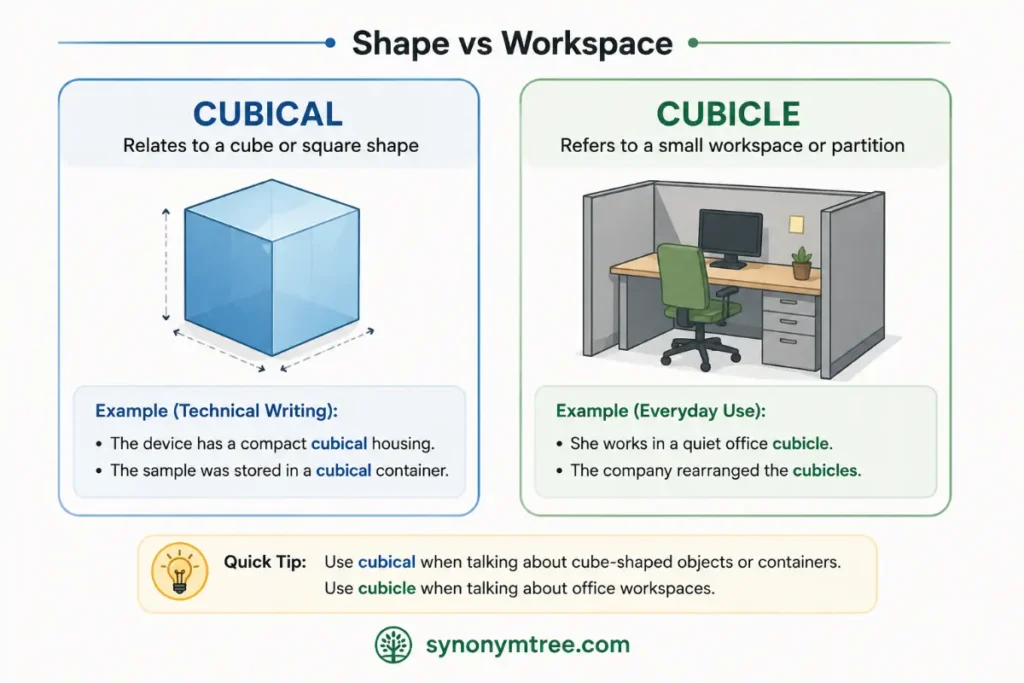
Technical writing can use cubical when shape matters.
For example:
The device has a compact cubical housing.
The sample was stored in a cubical container.
The structure has a nearly cubical form.
Technical writing can also use cubicle when describing a physical compartment.
For example:
The equipment was placed inside a service cubicle.
In specialized fields, cubicle can refer to specific enclosed sections or compartments. The exact meaning may depend on the field.
Still, the basic spelling remains the same.
Why Context Matters More Than Sound
English contains many words that sound similar but have different meanings.
This pair is a good example.
If someone says cubicle quickly, you may hear something close to cubical. The final sound can be easy to miss.
Writing gives you a stronger clue because the endings are visible.
That is why reading helps spelling.
If you regularly see sentences such as I work in a cubicle, the spelling becomes familiar. After enough exposure, the correct form starts to feel natural.
You can also strengthen your memory by connecting the word to an image.
Picture an office desk surrounded by short panels.
Label that image cubicle.
Then picture a perfect cube.
Label that image cubical.
The two mental pictures are very different.
A Practical Memory Method
Use this simple three step method.
- Picture an office desk surrounded by panels. Think cubicle.
- Picture a cube shaped object. Think cubical.
- Say the sentence that matches the picture.
For the office picture:
I sit in a cubicle.
For the shape picture:
The object is cubical.
This method works better than trying to memorize the spelling by itself because it connects each spelling to a meaning.
Final Takeaway
The main point behind cubical vs cubicle is simple. Cubicle is the noun you want for a small office workspace or another divided space. Cubical is an adjective that describes something with a cube like shape.
If you are writing about your desk at work, write I work in a cubicle. If you are describing the shape of a sculpture, box, building, or object, write that it is cubical.
The words look almost the same because they are related, but they do different jobs. Cubicle names a space. Cubical describes a shape.
When you get stuck, use the quickest test of all. Space means cubicle. Shape means cubical. Keep that rule in mind and you will almost always choose the right word.
Frequently Asked Questions
What is the correct spelling for an office workspace?
The correct spelling is cubicle. It is the standard noun for a small office workspace separated from other areas by walls or panels. For example, you can say I work in a cubicle.
Is cubical a real English word?
Yes. Cubical is a real English adjective. It describes something that has the shape or general form of a cube.
Should I say cubicle or cubical for an office?
Use cubicle for an office workspace. Cubical describes shape, so it does not normally name an office workspace.
What is the difference between cubicle and cubical?
Cubicle is mainly a noun that names a small space or compartment. Cubical is an adjective that describes something as cube shaped.
Is a cubicle shaped like a cube?
Not necessarily. An office cubicle is often rectangular and may have only partial walls. The word cubicle refers to the small divided space, not to a perfect cube shape.
Can cubical describe a building?
Yes. Cubical can describe a building that has a cube like shape. For example, you can describe a simple block shaped building as having a cubical design.
Is cubicle an American English word?
Yes. Cubicle is common in American English, especially when people talk about office workspaces. The word is also used in British English.
How can I remember cubicle and cubical?
Remember that cubicle is a place and cubical is a shape. If you can work or sit inside the space, think cubicle. If you are describing something that looks like a cube, think cubical.
