
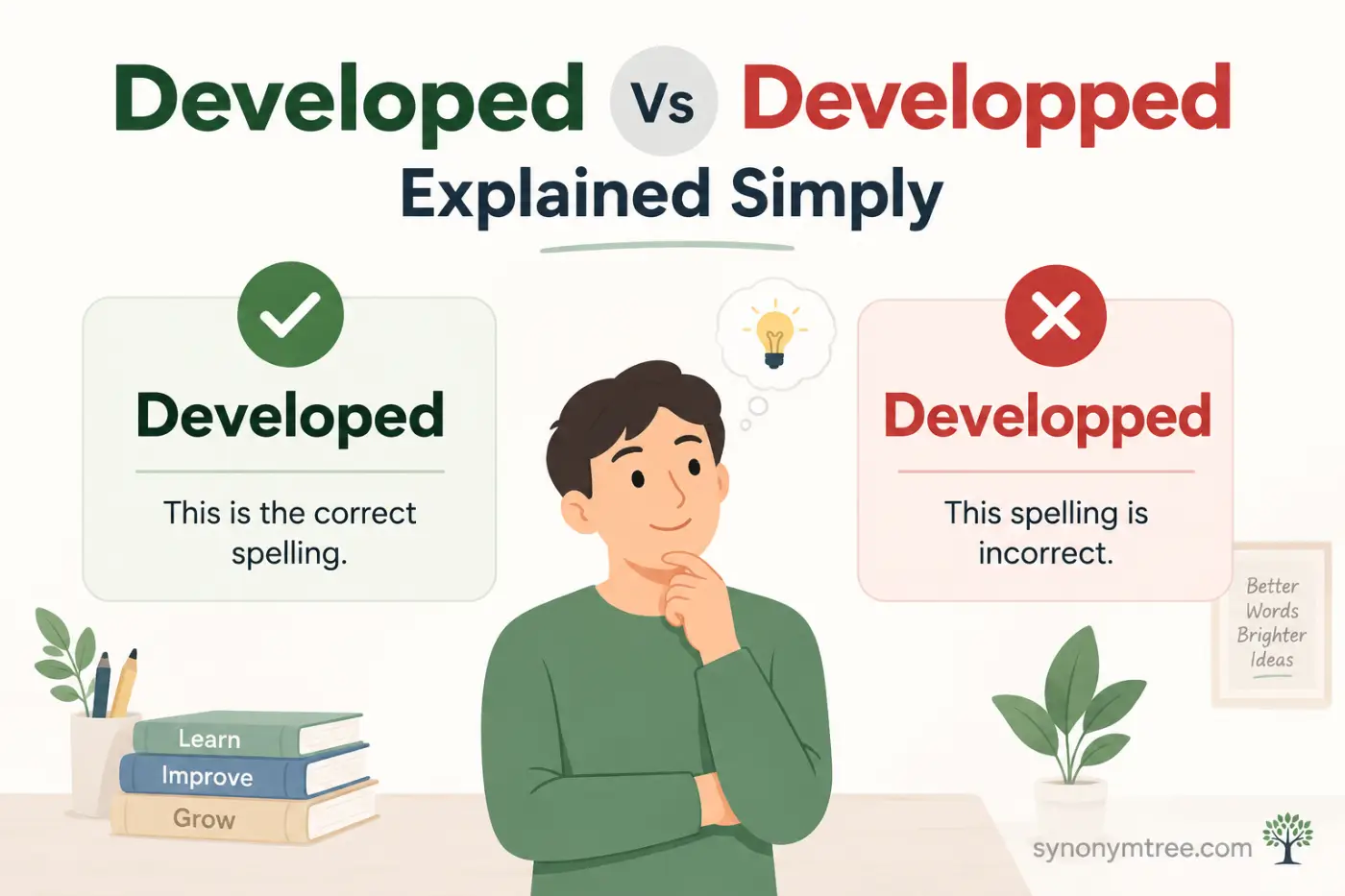
If you are confused about developed vs developped, the answer is simple. Developed is the correct spelling in standard American English. Developped is incorrect in English.
This mistake often happens because the word develop ends with a consonant sound before the final syllable. Writers may think the final consonant should be doubled before adding ed. That pattern is correct for some English verbs, but it does not work with develop. The correct forms are develop, developed, developing, and development. Once you understand the spelling rule behind the word, it becomes much easier to avoid the extra p.
This guide explains the difference between the two spellings, why developed is correct, how to use it in sentences, how the word changes in different forms, and why learners sometimes write developped. You will also see common mistakes, spelling rules, pronunciation tips, and plenty of examples from everyday English.
Quick Definition
Developed is the past tense and past participle of develop. It can mean something grew, changed, improved, was created, or reached a more advanced stage.
Developped is not the standard English spelling. In standard American English, write developed with one p before ed.
Direct Answer
Developed is the correct English spelling. Developped is incorrect in standard English because the final p in develop is not doubled before adding ed.
Comparing The Two Spellings
| Word or Phrase | Meaning | Example Sentence | When to Use It |
|---|---|---|---|
| Developed | Past tense or past participle of develop | The company developed a new product. | Use this spelling in standard English. |
| Developped | Incorrect English spelling | This form is not standard English. | Avoid this spelling in normal English writing. |
Why Developed Is Correct
The key is the base verb develop.
When you form the past tense, you normally add ed.
Develop becomes developed.
You do not double the final p.
The spelling therefore looks like this.
Develop.
Developed.
Not developped.
This may seem like a small difference, but it follows an important spelling pattern in English. Final consonant doubling does happen in English, but writers need to know when that rule applies.
For example, stop becomes stopped.
Plan becomes planned.
Drop becomes dropped.
These words double the final consonant before ed.
Develop does not follow that pattern.
The reason has to do with the stress and structure of the word. Develop has its main stress on the second syllable, not on the final syllable. Because of that, the final p is not doubled when ed is added.
So the correct form is developed.
What Does Developed Mean
Developed is the past form of develop.
The verb develop has several related meanings. It can mean to grow, improve, create, build, form, or change over time.
Because the word has several meanings, developed can appear in many different types of sentences.
For example:
The child developed strong reading skills.
This means the child gained or built those skills over time.
Now consider:
The company developed a new app.
Here, developed means created or designed.
Another example is:
The city developed quickly.
Here, developed means grew or became more advanced.
You can also use developed to describe something that has reached a more advanced stage.
For example:
The country has a highly developed economy.
In this sentence, developed describes the level of advancement.
The meaning depends on the context, but the spelling stays the same.
Why People Write Developped
The incorrect spelling developped usually comes from applying the wrong doubling rule.
English has many verbs that double their final consonant before adding ed.
For example:
Stop becomes stopped.
Shop becomes shopped.
Plan becomes planned.
Prefer becomes preferred.
Control becomes controlled.
Because writers see this pattern often, they may apply it to develop.
That creates developped.
The problem is that English spelling rules depend on the structure of the word. You cannot simply double the last consonant every time a verb ends in a consonant.
Develop keeps one p.
Developed also keeps one p.
The Final Consonant Doubling Rule For Developed Vs Developped
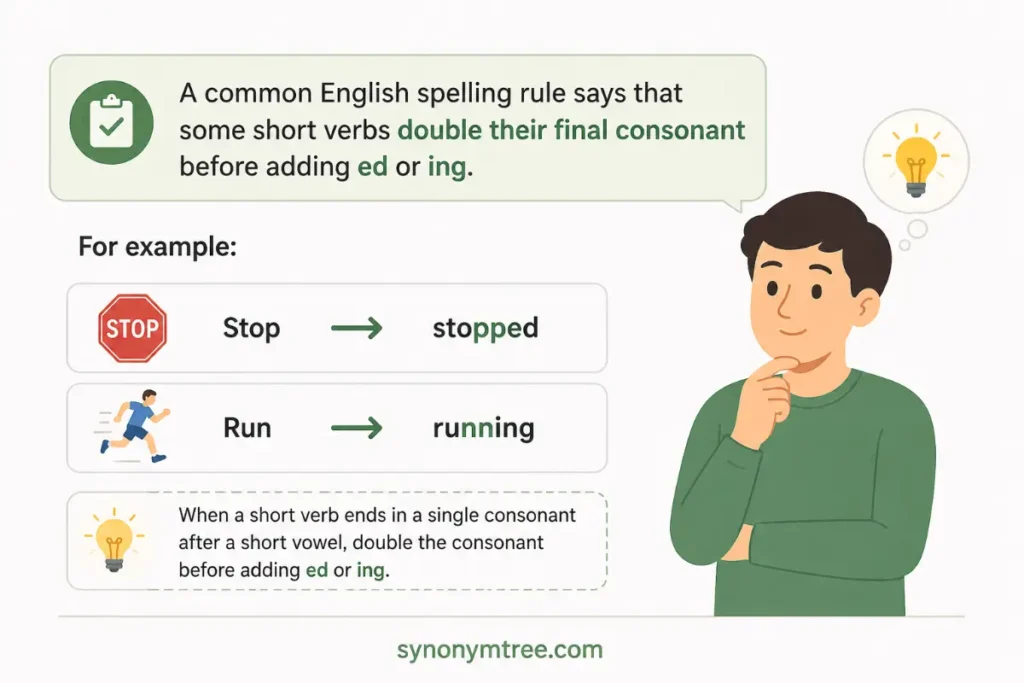
A common English spelling rule says that some short verbs double their final consonant before adding ed or ing.
For example:
Stop becomes stopped.
Run becomes running.
Plan becomes planned.
Admit becomes admitted.
The rule usually applies when the word has a short vowel sound before the final consonant and the final syllable receives the main stress.
Develop does not fit this pattern.
Its main stress falls on the second syllable.
The word is pronounced roughly like dih VEL uhp.
The final syllable is not the stressed part.
That is why the final p stays single.
This gives us:
Develop.
Developed.
Developing.
Development.
Not:
Developp.
Developped.
Developping.
Understanding this pattern can help you avoid similar mistakes with other longer verbs.
Developed And Development
Developed and development come from the same word family, but they serve different grammatical roles.
Development is a noun.
For example:
The team developed a new system.
Here, developed is the past tense of the verb develop.
The new system was an important development.
Here, development is a noun.
The connection between the words can help you understand their meanings.
Develop refers to the process.
Developed refers to something that has gone through that process.
Development refers to the process or result.
These forms appear frequently in school writing, business writing, science, technology, economics, and everyday conversation.
Developed As A Past Tense Verb
Developed often tells us that an action happened in the past.
For example:
The company developed a new website last year.
The researchers developed a new method.
She developed a strong interest in music.
The team developed a plan for the project.
The city developed rapidly after the new highway opened.
In each sentence, developed describes something that happened or began in the past.
The word can refer to physical growth, mental growth, skills, ideas, products, systems, relationships, or many other things.
Developed As A Past Participle
Developed is also the past participle of develop.
A past participle often appears with helping verbs such as has, have, had, is, was, or were.
For example:
The company has developed a new product.
Researchers have developed a better treatment.
She had developed a strong interest in science.
The system was developed by a small team.
A new method has been developed.
In these sentences, developed is not simply acting as a basic past tense verb. It forms part of a larger verb structure.
The spelling remains the same.
Developed As An Adjective
Developed can also work as an adjective.
An adjective describes a noun.
For example:
The country has a developed economy.
The area has a highly developed transportation system.
The child has well developed language skills.
The company has a developed marketing strategy.
Here, developed describes the noun that follows or relates to it.
The word can describe something that has reached a certain level of growth, progress, or complexity.
Developed In Everyday English
Developed is a common word in everyday English.
You might hear someone say:
I developed a new habit.
She developed an interest in photography.
He developed better study skills.
The plant developed quickly.
The plan developed over several weeks.
The meaning changes with the noun or verb around it, but the central idea is often growth or change.
Something that develops moves from one stage to another.
That movement may be physical, mental, social, technical, or abstract.
Developed In Business English
Business writing uses developed frequently.
Companies develop products, services, software, plans, strategies, systems, and ideas.
For example:
The company developed a new payment system.
The marketing team developed a campaign for the new product.
Our engineers developed a faster process.
The business developed a strong relationship with its customers.
The team developed a detailed plan before starting the project.
In these sentences, developed usually means created, built, designed, or improved.
The word is useful because it can describe many stages of business work.
Developed In Technology
Technology writing uses the word developed constantly.
Software developers develop applications.
Engineers develop systems.
Scientists develop new technologies.
Companies develop tools and platforms.
For example:
The team developed a mobile application.
Engineers developed a new battery system.
The company developed software for small businesses.
Researchers developed a faster testing method.
A developer developed the first version of the program.
The spelling does not change because the word is being used in a technical field.
It is still developed.
Developed In Science
Scientists often use developed when describing research and new discoveries.
For example:
Researchers developed a new testing method.
Scientists developed a model to explain the results.
The team developed a process for measuring the material.
The researchers developed a new vaccine candidate.
The laboratory developed a more accurate test.
In scientific writing, developed often means created or designed through research.
It can also describe a process that changed over time.
For example:
The theory developed over several decades.
Here, developed means gradually formed or changed.
Developed In Health And Medicine
The word also appears often in medical and health writing.
For example:
The patient developed a fever.
She developed symptoms after several days.
He developed an allergy later in life.
The researchers developed a new diagnostic method.
In the first three examples, developed means that a condition or symptom appeared.
This use is common in everyday medical communication.
Notice that the word can have different meanings depending on context.
The patient developed a fever means the fever appeared.
The researchers developed a test means the researchers created the test.
The city developed rapidly means the city grew or changed.
One spelling can therefore carry several related meanings.
Developed In Education
Education uses developed to describe skills and abilities that grow over time.
For example:
Students developed stronger writing skills.
She developed better reading habits.
The course helped him develop critical thinking skills.
The children developed confidence through practice.
The program developed students’ communication skills.
Here, the word often suggests progress.
A skill becomes stronger through practice, teaching, experience, or time.
This is another common meaning of develop and developed.
Developed In Personal Growth
People also use developed when talking about habits, interests, opinions, skills, and relationships.
For example:
I developed an interest in photography.
She developed a passion for cooking.
He developed strong leadership skills.
They developed a close friendship.
She developed a habit of reading every night.
These examples show that development does not always involve something physical.
An idea, interest, habit, skill, or relationship can develop too.
Developed In Countries And Economies
Developed can also describe countries and economies.
For example:
The country has a developed economy.
The city has a highly developed transportation network.
The region has a developed industrial sector.
In this context, developed means advanced or having reached a high level of economic or social development.
However, language around countries and economic status can be more complex than simply labeling a country developed or undeveloped. Modern writing often uses terms such as high income economy, advanced economy, emerging economy, or developing economy when a more precise description is needed.
The spelling of developed does not change in these contexts.
Developed And Developing
Developed often describes something that has already reached a particular stage.
Developing usually describes something that is still growing or changing.
Compare these examples.
The company developed a new product.
The company is developing a new product.
The first sentence describes a completed action.
The second describes an action that is still in progress.
Another example:
The city has a developed transportation system.
The city is developing its transportation system.
The first sentence describes the current state.
The second focuses on an ongoing process.
This distinction is useful in business, education, science, and everyday writing.
Developed And Develop
Develop is the base form.
Developed is the past tense and past participle.
Developing is the form used for ongoing action.
Here is the basic pattern.
Develop.
Develops.
Developed.
Developing.
Development.
For example:
I develop new ideas.
She develops new ideas.
She is developing a new idea.
The development took several months.
Learning the whole word family is often more useful than memorizing one spelling in isolation.
Developed And Develops
Develops is the present tense form used with he, she, it, or another singular subject.
For example:
The company develops software.
She develops new skills quickly.
The plant develops strong roots.
The child develops new abilities over time.
Developed refers to the past or a completed stage.
For example:
The company developed the software last year.
She developed new skills during the course.
The plant developed strong roots.
The child developed new abilities over time.
The spelling difference is not just about the final letters. The verb form also tells you when the action happens.
Developed And Developing
Developing usually means that something is still in progress.
For example:
The team is developing a new product.
The child is developing language skills.
The city is developing rapidly.
The researchers are developing a new method.
Developed can describe the result or a completed action.
The team developed a new product.
The child developed strong language skills.
The city developed rapidly.
The researchers developed a new method.
Understanding this contrast can help you choose the right verb form.
Developed And Mature
Developed and mature can sometimes have similar meanings, but they are not always interchangeable.
Mature often means fully grown, fully developed, or emotionally advanced.
Developed can describe something that has grown, improved, or reached a certain stage.
For example:
The company has a mature business model.
The company has a highly developed business model.
These sentences are similar, but mature may suggest experience and stability, while developed may focus more on the level of progress or complexity.
The exact meaning depends on context.
Developed And Advanced
Advanced is another related word.
A developed system may be advanced, but the words do not always mean exactly the same thing.
Advanced usually focuses on a high level of skill, technology, knowledge, or complexity.
Developed can focus on growth or completion.
For example:
The company developed a new system.
The company uses an advanced system.
The first sentence focuses on creation.
The second focuses on the system’s high level of technology or capability.
This difference is useful when writing clearly.
Common Spelling Mistakes in Developed Vs Developped
The most common error is doubling the p.
Incorrect:
Developped.
Correct:
Developed.
Another mistake is writing developt.
That form is also incorrect.
The correct past tense ends with ed.
Develop.
Developed.
Some writers also confuse developed with developing.
For example:
The team developed a new system.
This means the creation happened in the past.
The team is developing a new system.
This means the creation is still happening.
Choosing the right form requires attention to both spelling and meaning.
Why The Extra P Looks Reasonable
The spelling developped looks believable because English has many words that double a final consonant.
For example:
Stop becomes stopped.
Drop becomes dropped.
Shop becomes shopped.
Admit becomes admitted.
Occur becomes occurred.
The pattern is real, but it has limits.
Develop is a longer word with a different stress pattern.
The final syllable is not stressed in the same way as the final syllable of a word such as occur.
That is why English keeps the single p.
The correct form is developed.
Pronunciation Can Help
Pronunciation can give you a small clue, although spelling should not depend entirely on sound.
Develop is commonly pronounced with the stress on the second syllable.
The final syllable is lighter.
Developed adds the ed ending without creating a doubled p.
When you say the word slowly, you can hear the base word first.
Develop.
Developed.
The extra p in developped does not reflect the standard English spelling pattern.
Still, pronunciation alone cannot explain every English spelling rule. English has many words whose sounds and letters do not match perfectly.
Use pronunciation as a reminder, not as the only rule.
A Simple Memory Trick
Here is an easy way to remember the spelling.
Think of the base word first.
Develop.
Then add ed.
Developed.
Do not change the final p.
You can write the pattern several times if you are learning the word.
Develop.
Developed.
Developing.
Development.
Seeing the word family together makes the spelling easier to remember.
Another useful trick is to compare it with stop.
Stop becomes stopped because it follows a consonant doubling pattern.
Develop does not.
So remember:
Stop has two p letters in stopped.
Developed has only one p.
A Useful Editing Test
If you have written developped, go back to the base word.
Ask yourself:
What is the base verb.
The answer is develop.
Now add ed without changing the final p.
Developed.
This method is quick and reliable.
It also helps when you are unsure about other verb forms.
Start with the base word.
Then apply the correct ending.
Do not automatically double the final consonant.
Examples With Developed
Here are natural examples that show the word in different contexts.
- The company developed a new product.
- She developed a strong interest in science.
- The city developed rapidly after the railway opened.
- Researchers developed a new testing method.
- He developed better study habits.
- The team developed a plan for the project.
- The child developed strong reading skills.
- The software was developed by a small team.
- The country has a highly developed economy.
- The plant developed strong roots.
- She developed a close friendship with her classmate.
- The business developed a loyal customer base.
- Scientists developed a new model.
- He developed a useful skill through practice.
- The company has developed several successful products.
- The project developed slowly at first.
- The researchers developed a better way to measure the results.
- The organization developed new training materials.
- The town developed into a busy commercial center.
- She developed confidence after years of practice.
These examples show why developed is such a flexible word.
Examples With The Incorrect Form
It can also help to see the mistake clearly.
Incorrect:
The company developped a new product.
Correct:
The company developed a new product.
Incorrect:
She developped an interest in art.
Correct:
She developed an interest in art.
Incorrect:
The researchers developped a new method.
Correct:
The researchers developed a new method.
Incorrect:
He developped better study habits.
Correct:
He developed better study habits.
The difference is only one letter, but that letter matters in standard English spelling.
Developed In Formal Writing
Developed is perfectly acceptable in formal English.
You can use it in academic papers, reports, business documents, research writing, technical material, and professional communication.
For example:
The researchers developed a new method for analyzing the data.
The company developed a strategy to improve customer service.
The study examined how the policy developed over time.
The team developed a framework for future research.
There is no need to replace developed with a more complicated word just to sound formal.
Simple words are often clearer.
Developed In Informal Writing
The word also works naturally in casual writing.
For example:
I developed a habit of drinking coffee every morning.
She developed a love for hiking.
We developed a good friendship.
He developed a new idea during lunch.
The dog developed a strange habit.
The word is not especially formal or informal. It is a normal part of English vocabulary.
Developed In Passive Sentences
Developed frequently appears in passive constructions.
For example:
The software was developed by a small company.
The product was developed for children.
The new method was developed after years of research.
The program was developed to help students improve their writing.
In passive sentences, the focus is often on the thing that was created rather than the person or group that created it.
This use is common in technical and academic writing.
Developed With Has And Have
Developed commonly follows has or have.
For example:
The company has developed a new product.
Researchers have developed a better method.
She has developed strong communication skills.
The team has developed a useful tool.
These sentences use the present perfect tense.
The action happened in the past but remains connected to the present.
Again, the spelling is developed with one p.
Developed With Had
Had can also appear before developed.
For example:
The company had developed several products before expanding overseas.
She had developed strong skills before starting the new job.
The researchers had developed the method before beginning the trial.
Had developed places the action before another past event.
The grammar changes, but the spelling does not.
Developed In Questions
You can use developed naturally in questions.
For example:
Who developed this software.
When was the product developed.
How did the idea develop.
Why has the company developed a new strategy.
These questions show different meanings of the verb.
Who developed this software asks about the creator.
When was the product developed asks about its creation.
How did the idea develop asks about how the idea changed over time.
The spelling remains the same in each case.
Developed In Negative Sentences
Developed also works in negative sentences.
For example:
The company did not develop the product.
The project did not develop as expected.
She did not develop the skill quickly.
The plan did not develop into a complete proposal.
Notice an important grammar point.
After did not, use the base verb develop, not developed.
Correct:
The company did not develop the product.
Incorrect:
The company did not developed the product.
This is a grammar issue rather than a spelling issue, but it is a common mistake.
Developed With Did
The same rule applies to questions with did.
Correct:
Did the company develop the software.
Incorrect:
Did the company developed the software.
When did appears, use the base form develop.
This rule applies to many English verbs.
The past meaning is already carried by did.
So the main verb stays in its base form.
Developed And The Word Development
The word development appears in many phrases.
For example:
Economic development.
Personal development.
Child development.
Product development.
Software development.
Career development.
Business development.
Skill development.
Urban development.
These phrases all connect to the idea of growth, change, creation, or progress.
Knowing the word family can help you understand new terms.
If you know develop and developed, development becomes easier to recognize.
Product Developed And Product Development
These two phrases are closely related.
Product development refers to the process of creating or improving a product.
A product developed by a company refers to the result of that process.
For example:
The company invested in product development.
The company developed a new product.
The first sentence focuses on the process.
The second focuses on the action and result.
This distinction appears frequently in business and technology writing.
Developed Skills And Skill Development
The same idea appears with skills.
Skill development means the process of improving an ability.
Developed skills are abilities that have grown through practice or experience.
For example:
The course supports skill development.
The course helped students develop strong communication skills.
Students developed better writing skills during the program.
These expressions are common in education and workplace writing.
Developed And Improved
Developed can sometimes mean improved, but the words are not always exact substitutes.
Improved means became better.
Developed can mean became more advanced, grew, formed, or was created.
For example:
She improved her writing.
She developed strong writing skills.
The first sentence focuses on becoming better.
The second focuses on building or gaining a skill.
Likewise:
The company developed a new product.
The company improved an existing product.
The first means created something new.
The second means made something already existing better.
This distinction helps you choose the most precise word.
Developed And Created
Created and developed can also overlap.
Created usually emphasizes bringing something into existence.
Developed can suggest a longer process of planning, building, testing, or improving.
For example:
The team created a simple drawing.
The team developed a new software system.
The second sentence suggests a larger process.
This does not mean developed always takes a long time. Context determines the exact meaning.
Still, developed often carries an idea of growth or progress that created does not necessarily have.
Developed And Built
Built can also overlap with developed.
Engineers might build a machine.
They might also develop a machine.
Built often emphasizes physical construction.
Developed can include planning, research, design, testing, and improvement.
For example:
The engineers built the prototype.
The engineers developed the prototype.
Both can be correct, but the second can suggest a broader process.
Developed And Formed
When talking about ideas, relationships, or habits, developed can sometimes mean formed.
For example:
She developed a strong opinion about the issue.
A close friendship developed between them.
He developed a habit of waking early.
In these cases, something gradually came into existence.
Formed could sometimes work too, but developed often emphasizes gradual change.
Developed In History And Culture
Developed can describe how societies, traditions, languages, and ideas changed over time.
For example:
The tradition developed over many generations.
The language developed through contact with other languages.
The idea developed gradually over time.
The culture developed in response to changing conditions.
These uses show that develop is not limited to business or technology.
Anything that grows or changes through time can potentially develop.
Developed In Nature
Nature provides many examples.
Plants develop roots, leaves, flowers, and seeds.
Animals develop physical and behavioral traits.
Ecosystems develop over time.
For example:
The plant developed strong roots after several weeks.
The young bird developed new feathers.
The ecosystem developed slowly after the disturbance.
These sentences use developed to describe natural growth or change.
Developed In Relationships
Relationships can also develop.
For example:
We developed a strong friendship.
They developed a close working relationship.
The two teams developed trust over time.
A friendship developed between the students.
The word suggests that the relationship formed or became stronger over time.
This is a natural and common use.
Developed In Writing And Ideas
Ideas can develop too.
For example:
The writer developed the main character carefully.
She developed the idea into a full story.
The argument developed throughout the essay.
The author developed a strong theme.
In writing, developed can mean expanded, shaped, or made more complete.
This is especially common when talking about essays, stories, arguments, plans, and creative work.

Common Questions About The Spelling in Developed Vs Developped
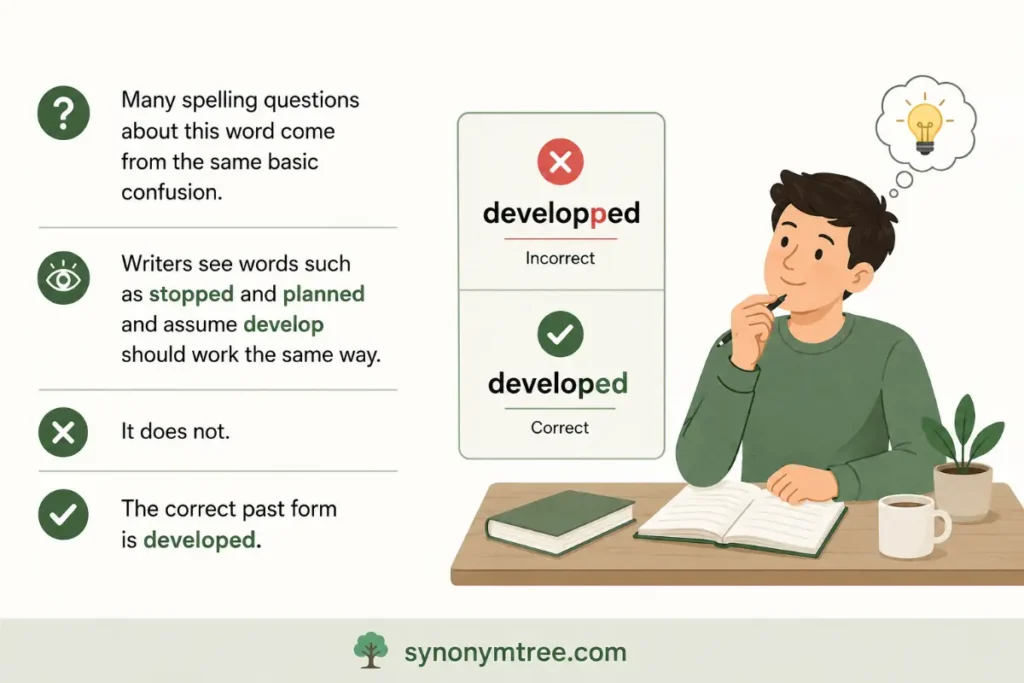
Many spelling questions about this word come from the same basic confusion.
Writers see words such as stopped and planned and assume develop should work the same way.
It does not.
The correct past form is developed.
The correct noun is development.
Once you learn the word family, the extra p becomes much easier to avoid.
A Short Spelling Practice
Try completing these sentences mentally.
The company _____ a new product.
The answer is developed.
She _____ an interest in music.
The answer is developed.
The team is _____ a new plan.
The answer is developing.
The company invested in product _____.
The answer is development.
These forms belong to the same word family.
Practice like this helps you recognize the correct form based on grammar and meaning.
How To Edit Developed In Your Writing
If you are proofreading a document, search for developped.
If you find it, change it to developed when you mean the English past form of develop.
You can also search for other forms of the word.
Check that developed is used for past actions and completed development.
Check that develop follows did and does not become developed after did.
For example:
Did the team develop the product.
Correct.
Did the team developed the product.
Incorrect.
These quick checks can remove several common errors at once.
Why Spelling Matters In Professional Writing
A single spelling error will not always stop a reader from understanding you. However, repeated spelling mistakes can make writing look careless.
This matters in resumes, applications, reports, emails, articles, websites, and business documents.
If you write developed correctly, readers can focus on your message.
If you repeatedly write developped, some readers may question the quality of the rest of the document.
Good spelling is not about trying to impress people. It helps your ideas come across clearly.
A Quick Rule To Remember
Use one p in all the common forms of this word family.
Develop.
Developed.
Developing.
Development.
Do not add a second p.
This rule is simple enough to use during editing.
When you are unsure, go back to the base word develop.
Then build the correct form from there.
Conclusion
When you are deciding between developed vs developped, choose developed. It is the correct spelling in standard American English. The form developped is a common spelling mistake caused by applying a consonant doubling rule where it does not belong.
The best way to remember the word is to start with the base verb develop. Add ed without doubling the final p. This gives you developed. The same pattern appears in developing, which also keeps one p.
Developed can mean created, built, improved, grown, formed, or reached a more advanced stage. Its exact meaning depends on the sentence, but the spelling stays the same.
So when you are writing an email, essay, report, article, resume, or business document, remember the simple rule. Develop becomes developed with one p. If you see developped on the page, remove the extra p.
Frequently Asked Questions
Which spelling is correct in developed vs developped?
Developed is the correct spelling in standard English. Developped is an incorrect spelling caused by doubling the final p when it should remain single.
Why is developped wrong?
Developped is wrong because develop does not double its final p when the ed ending is added. The correct form is developed.
Is developed the past tense of develop?
Yes. Developed is the simple past tense of develop. For example, The company developed a new product last year.
Is developed also a past participle?
Yes. Developed is both the simple past form and the past participle of develop. You can use it with helping verbs such as has, have, had, is, and was.
Why does stopped have two p letters but developed has one?
Stopped follows a consonant doubling pattern that applies to certain short stressed verbs. Develop has a different stress pattern, so its final p stays single when ed is added.
Is developping also incorrect?
Yes. The standard form is developing with one p. The final p in develop is not doubled before the ing ending.
How do you remember the spelling of developed?
Start with the base verb develop and add ed. Remember that the final p stays single, giving you developed.
What is the difference between developed and developing?
Developed usually describes a completed action or a state that has already reached a certain stage. Developing describes something that is still growing, changing, or being created.
