
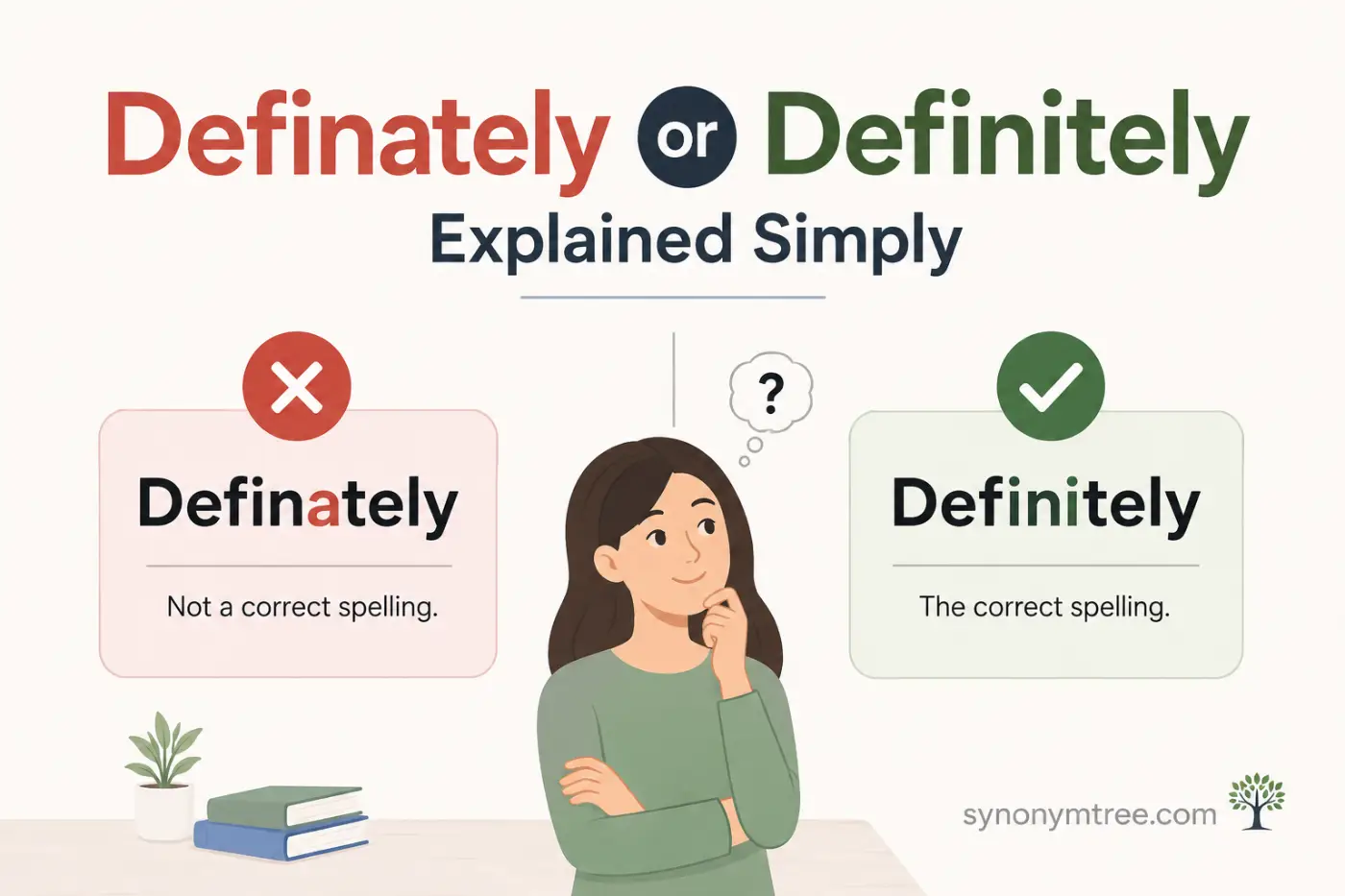
If you are stuck on definately or definitely, you are not alone. This is one of those spelling mistakes that can happen even when you know exactly what you want to say. The correct spelling is definitely. The spelling definately is incorrect in standard English.
The confusion usually comes from pronunciation. When people say definitely, the middle sounds can blend together. That makes it easy to forget the second i or place the letters in the wrong order. The word also looks more complicated than it sounds.
This guide explains the correct spelling, meaning, pronunciation, word history, common mistakes, and easy ways to remember the right form. You will also see examples from everyday writing, school work, emails, texts, business communication, and formal English.
Quick Definition
Definitely is an adverb that means certainly, without doubt, or surely. It shows that the speaker or writer feels sure about something.
Definately is a common misspelling. It is not the standard spelling used in correct English.
Direct Answer
Definitely is the correct spelling. Definately is incorrect and should be avoided in standard English writing.
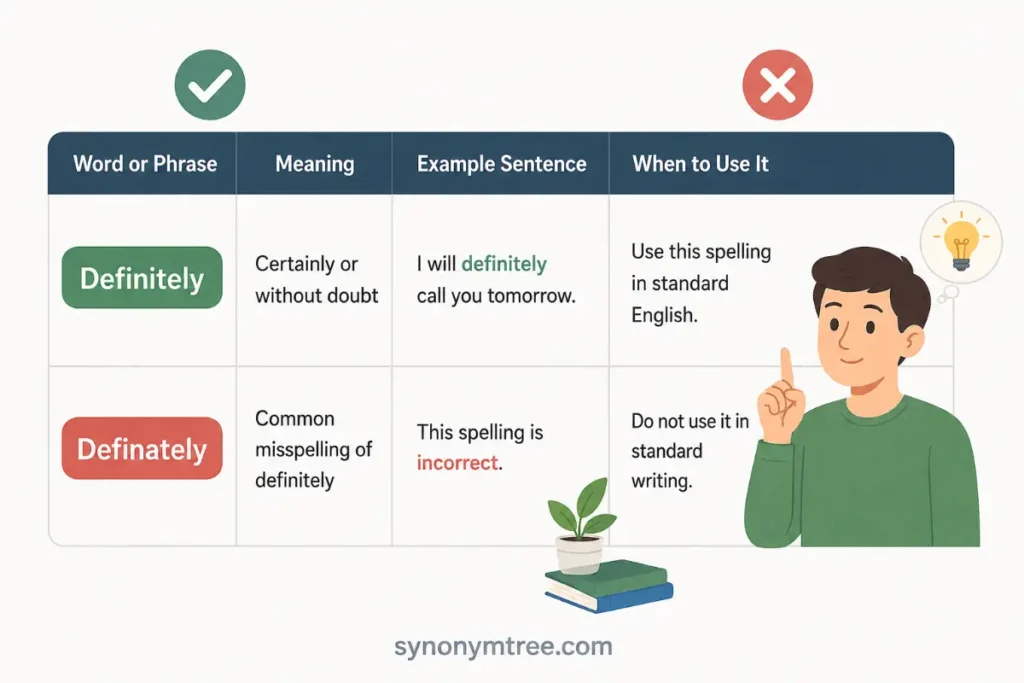
Comparing The Two Spellings for Definately Or Definitely
| Word or Phrase | Meaning | Example Sentence | When to Use It |
|---|---|---|---|
| Definitely | Certainly or without doubt | I will definitely call you tomorrow. | Use this spelling in standard English. |
| Definately | Common misspelling of definitely | This spelling is incorrect. | Do not use it in standard writing. |
Why Definitely Is The Correct Spelling
The correct form is definitely.
The word comes from definite, which means clear, certain, or fixed. When you turn definite into an adverb, you add ly.
Definite becomes definitely.
The spelling keeps the i from definite. That is one of the most useful clues for remembering the word.
Look at the connection.
Definite.
Definitely.
The first word is the base word. The second word is the adverb form.
This connection explains why definately is incorrect. It drops the i that belongs to the base word.
For example, you can write:
I am definite about my decision.
I will definitely make the decision today.
The two words are related. Seeing them together can make the spelling easier to remember.
What Does Definitely Mean
Definitely means certainly or without doubt.
When you use this word, you show strong confidence in what you are saying. It can describe a future action, a present opinion, a past event, or a fact you believe is certain.
For example:
I will definitely be there.
This means the speaker is very sure about attending.
Another example is:
She definitely knows the answer.
This tells the reader that the speaker has strong confidence in that statement.
You can also use definitely to agree with someone.
Person A says that the movie was great.
Person B says definitely.
Here, definitely means certainly or I agree.
The word is common in both speech and writing. It can sound casual in conversation, but it also works in professional and formal writing.
How Definitely Is Used In Everyday English
Definitely is a flexible word. You can use it in many normal situations.
Someone might ask:
Are you coming to the party.
You could answer:
Definitely.
That short answer means yes, certainly.
You could also say:
I definitely want to go.
Here, the word strengthens your statement.
Another example:
We definitely need more time.
The speaker is certain about the need for more time.
You might hear:
That is definitely the best choice.
This shows strong confidence in an opinion.
You can also use the word with future plans.
I will definitely finish it tonight.
She will definitely visit next week.
They will definitely join us later.
These sentences all show confidence about something that has not happened yet.
Definitely Is An Adverb
Definitely is an adverb.
An adverb can modify a verb, adjective, or another adverb. In simple terms, definitely tells us how certain someone feels about a statement or action.
Consider this sentence:
I definitely agree.
The word definitely adds strength to the verb agree.
Now look at:
That is definitely correct.
Here, definitely adds certainty to the adjective correct.
You can also place the word in different parts of a sentence.
I will definitely go.
I definitely will go.
Both can be understood, although the first sounds more natural in many everyday situations.
Definitely should usually sit close to the part of the sentence it strengthens.
The Connection Between Definite And Definitely
One of the best spelling clues is the word definite.
Definite means clear, certain, or fixed.
For example:
We need a definite answer.
The word definitely comes from the same root.
You can remember the spelling by connecting the two.
Definite.
Definitely.
Notice the i after the n.
That i stays in definitely.
This is much easier than trying to memorize every letter separately.
If you know how to spell definite, you have already learned most of the spelling of definitely.
Why People Often Spell It Definately
There are several reasons this mistake is common.
The first reason is pronunciation. The word is often pronounced quickly in normal speech. Some sounds become less clear, especially in the middle.
The second reason is visual memory. People may remember the general shape of the word without remembering every letter.
The third reason is the word definitely contains several letters that appear close together. The sequence can be hard to recall when you are writing quickly.
The fourth reason is that the incorrect spelling appears frequently online. Seeing a misspelling again and again can make it look familiar.
Familiarity does not make a spelling correct.
This is why it helps to learn the structure of the word instead of memorizing its appearance alone.
The Most Common Spelling Mistake
The most common mistake is writing definately.
People often remove the i from the middle.
The correct form is definitely.
The incorrect form is definately.
The missing i is the key problem.
Try breaking the word into parts.
De.
Finite.
Ly.
The spelling is connected to definite and finite.
You do not need to pronounce these parts separately when speaking. This trick simply gives your brain a spelling pattern to remember.
A Simple Memory Trick
Here is an easy memory trick.
Remember that definitely contains the word finite.
Definite.
Finite.
Definitely.
You can also remember the phrase definite plus ly.
Definite plus ly gives definitely.
The important part is that definite contains an i. That i stays when you form the adverb.
Another useful trick is to think:
There is no need to remove the i.
When you write definitely, check the middle before moving on.
If you see definately, something is missing.
Definitely And Certainly
Definitely and certainly are close in meaning.
Both can show strong confidence.
For example:
I will definitely attend the meeting.
I will certainly attend the meeting.
Both sentences tell the reader that the speaker feels sure about attending.
The tone can differ slightly depending on context.
Definitely often sounds more natural and conversational. Certainly can sound a little more formal in some situations.
For everyday writing, definitely is very common.
You can use either word when the meaning calls for strong certainty.
Definitely And Surely
Surely is another related word.
It can mean certainly, but it can also express surprise, doubt, or an expectation depending on the sentence.
For example:
Surely you remember him.
This may express surprise that someone does not remember.
Definitely is more direct.
I definitely remember him.
This simply shows certainty.
The difference is small but useful. Definitely usually gives a clear sense of confidence. Surely can carry an extra emotional meaning.
Definitely And Absolutely
Absolutely can also mean completely or certainly.
For example:
I definitely agree.
I absolutely agree.
Both sentences show strong agreement.
Absolutely can sound stronger or more enthusiastic. Definitely often sounds more neutral.
The right choice depends on the tone you want.
For a simple statement of certainty, definitely is often the safest choice.
Definitely And Definite
Definite and definitely are related but they do different jobs.
Definite is usually an adjective.
Definitely is an adverb.
Compare these sentences.
We need a definite answer.
We definitely need an answer.
In the first sentence, definite describes answer.
In the second sentence, definitely strengthens need.
This difference can help you remember the spelling and meaning.
If you need a word to describe a noun, definite may be the right choice.
If you need a word that shows certainty about an action or statement, definitely may be the right choice.
Examples With Definitely
The best way to learn a spelling is to see it used naturally.
Here are examples from common situations.
- I will definitely call you later.
- She definitely wants to join us.
- We definitely need another chair.
- That was definitely the right decision.
- He definitely knows what happened.
- I definitely remember meeting her.
- They will definitely enjoy the trip.
- You should definitely try this restaurant.
- This is definitely worth your time.
- I definitely agree with your point.
- She is definitely ready for the test.
- We definitely have enough food.
- He definitely made a mistake.
- I would definitely recommend this book.
- They definitely need more practice.
- That is definitely not what I expected.
- I definitely want to learn more.
- She definitely deserves the award.
- We will definitely see them again.
- You definitely made the right choice.
Each sentence uses definitely to express confidence or certainty.
Definitely In Questions
Definitely can also appear in questions.
For example:
Are you definitely coming tomorrow.
This question asks for certainty.
It is different from simply asking:
Are you coming tomorrow.
The word definitely adds a stronger focus on the person’s certainty.
You might also ask:
Is this definitely the correct address.
Here, the speaker wants confirmation.
Another example is:
Do you definitely want to leave now.
This asks the listener to confirm a firm decision.
The word works naturally in questions because it focuses attention on certainty.
Definitely As A One Word Answer
In conversation, definitely can stand alone.
Someone might ask:
Do you want to come with us.
You can answer:
Definitely.
This means yes, certainly.
The one word answer can sound friendly and confident.
You might also use it in a short online message.
Person A asks if you can help tomorrow.
Person B replies:
Definitely.
This is common in casual communication.
In formal writing, you may want to use a complete sentence instead.
For example:
I will definitely be available tomorrow.
That gives the reader more information.
Definitely In School Writing
Definitely is perfectly acceptable in school writing when the meaning fits.
Students often use it to express certainty.
For example:
The evidence definitely supports this idea.
The character definitely changes throughout the story.
The experiment definitely shows a clear result.
However, students should avoid using definitely too often. Repeating the same certainty word can make an essay sound less precise.
Instead, choose language that matches the strength of your claim.
If something is proven, you may state the fact directly.
If you are making a strong opinion, definitely may be appropriate.
Good writing is not just about correct spelling. It is also about choosing words that accurately express your meaning.
Definitely In Professional Writing
Definitely can also appear in emails, reports, workplace messages, and business communication.
For example:
I will definitely send the document this afternoon.
We should definitely review the numbers again.
This option is definitely worth considering.
I definitely recommend contacting the client first.
The word gives a clear sense of confidence.
However, professional writing often benefits from specific information. Instead of saying something is definitely going to happen, give details when you can.
For example:
I will definitely send the report today.
This is clear.
I will send the report by 3 p.m.
This is even more specific.
Definitely is useful, but precise information can make professional writing stronger.
Definitely In Text Messages
Text messages often use definitely because the word can express strong agreement quickly.
For example:
Definitely.
Yes definitely.
I definitely will.
That is definitely true.
You can also use it to show enthusiasm.
I definitely want to go.
That sounds more energetic than a simple yes.
The spelling stays the same in casual writing.
Even when the message is short, write definitely correctly.
Definitely In Formal English
Definitely is not limited to casual speech. It is a standard English word and works in formal contexts.
For example:
The findings definitely support the proposed explanation.
The company will definitely need additional resources.
The evidence definitely points to the same conclusion.
Still, formal writing often favors exact claims over vague expressions of certainty. Use definitely when you genuinely mean that something is certain.
Do not add it simply to make a sentence sound stronger.
Common Mistakes With Definitely
The spelling mistake is the biggest problem, but there are other errors worth knowing.
Dropping The I
This creates definately.
The correct spelling keeps the i.
Definitely.
Adding Extra Letters
Some people write definatelly or definitley.
These forms are also incorrect.
The standard spelling is definitely.
Confusing Definitely With Defiantly
Definitely and defiantly are completely different words.
Definitely means certainly.
Defiantly means in a way that shows resistance or refusal to obey.
Compare these examples.
She definitely agreed.
She defiantly refused.
The first sentence shows certainty.
The second describes an attitude of resistance.
The words look similar, but their meanings are very different.
Confusing Definite And Definitely
Some writers use definite when they need an adverb.
For example:
I definite want to go.
This is incorrect.
The correct sentence is:
I definitely want to go.
The word definite describes a noun. Definitely usually modifies a verb or statement.
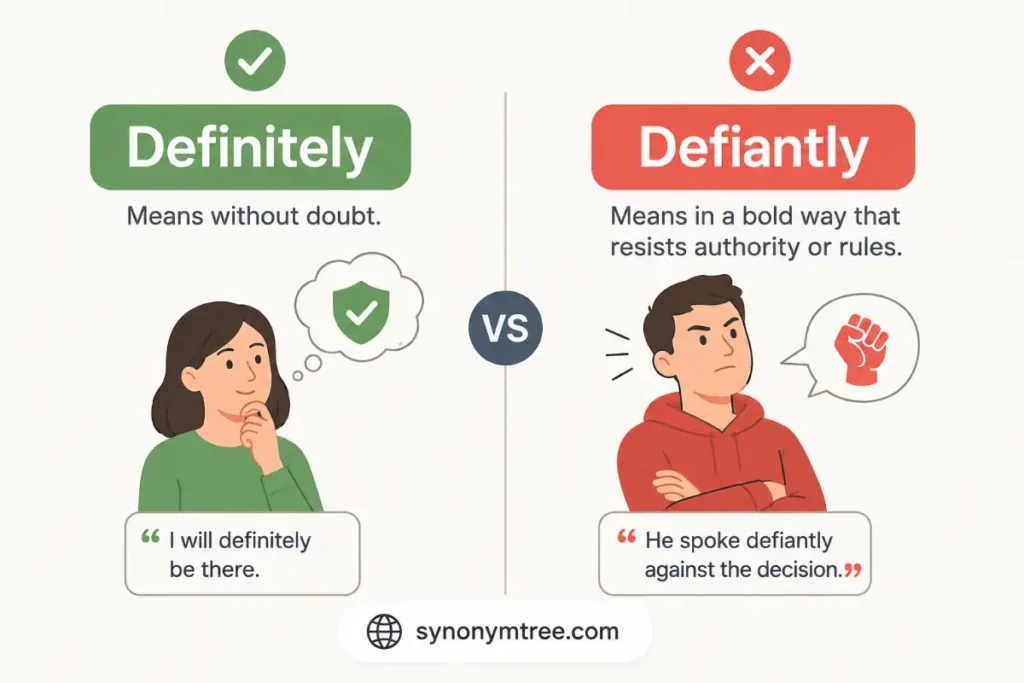
Definately Or Definitely
This pair deserves extra attention because the words are easy to confuse.
Definitely means without doubt.
Defiantly means in a bold way that resists authority or rules.
Consider:
He definitely broke the rule.
This means the speaker is certain that he broke it.
Now consider:
He defiantly broke the rule.
This means he broke the rule in a way that showed resistance or disregard.
One word describes certainty.
The other describes behavior.
Mixing them up can completely change your sentence.
How Pronunciation Causes Problems
English spelling does not always match pronunciation perfectly.
Definitely is a good example.
When people speak quickly, the middle of the word may not sound as clear as it looks on the page. This can cause learners and native speakers alike to forget a letter.
The best solution is not to depend only on pronunciation.
Connect the word to its base form.
Definite.
Definitely.
Once you recognize that relationship, the spelling becomes easier to reproduce.
This is a useful strategy for many English words. Instead of memorizing a difficult word as a random collection of letters, look for a smaller word inside it or a related word that explains its structure.
The Word History Behind Definitely
Definitely comes from definite.
Definite traces back through French to Latin roots connected with the idea of setting limits or defining something clearly.
The basic meaning developed around something that is fixed, clear, or determined.
English later formed the adverb definitely from definite.
That history helps explain the modern meaning.
If something is definite, it is clear or certain.
If you say something definitely happens, you are saying it happens with certainty.
You do not need to know the Latin history to spell the word correctly. Still, understanding the connection can make the word easier to remember.
Is Definitely One Word
Yes.
Definitely is written as one word.
Do not separate it into definite ly in normal writing.
The suffix ly is attached to the base word.
For example:
definite
definitely
This is similar to many other adverbs.
Complete becomes completely.
Final becomes finally.
Exact becomes exactly.
Definite becomes definitely.
The spelling changes slightly in some words when ly is added, but the basic relationship remains useful.
Can Definitely Start A Sentence
Yes.
Definitely can appear at the beginning of a sentence.
For example:
Definitely, we should check the information again.
Definitely, this is the best option.
However, the word is often more natural in the middle of a sentence.
We should definitely check the information again.
She definitely deserves another chance.
This is definitely the best option.
Both positions can work. The best choice depends on the rhythm and emphasis of the sentence.
Can Definitely End A Sentence
Yes.
Definitely can sometimes appear at the end of a sentence, especially in casual speech.
For example:
I want to go, definitely.
That use sounds conversational and adds emphasis.
In most standard writing, placing the word earlier will sound smoother.
I definitely want to go.
The second version is clearer and more natural for most situations.
Can Definitely Be Used For Future Events
Yes.
Definitely can describe something you feel certain will happen in the future.
For example:
I will definitely finish the project tomorrow.
She will definitely call you later.
They will definitely arrive before dinner.
The word does not guarantee that the event will actually happen. It shows the speaker’s confidence.
This distinction matters.
If you say I will definitely finish the project tomorrow, you are making a strong statement about your intention or expectation.
The word expresses certainty from the speaker’s point of view.
Can Definitely Be Used For Opinions
Yes.
People often use definitely to make an opinion sound firm.
For example:
This is definitely the best restaurant in town.
That was definitely the funniest part of the movie.
She is definitely the strongest player on the team.
These statements express strong personal judgments.
If the statement is an opinion, definitely does not turn it into an objective fact. It simply shows that the speaker feels strongly about the opinion.
This is useful to remember in essays and professional writing.
Strong confidence is not the same thing as proof.
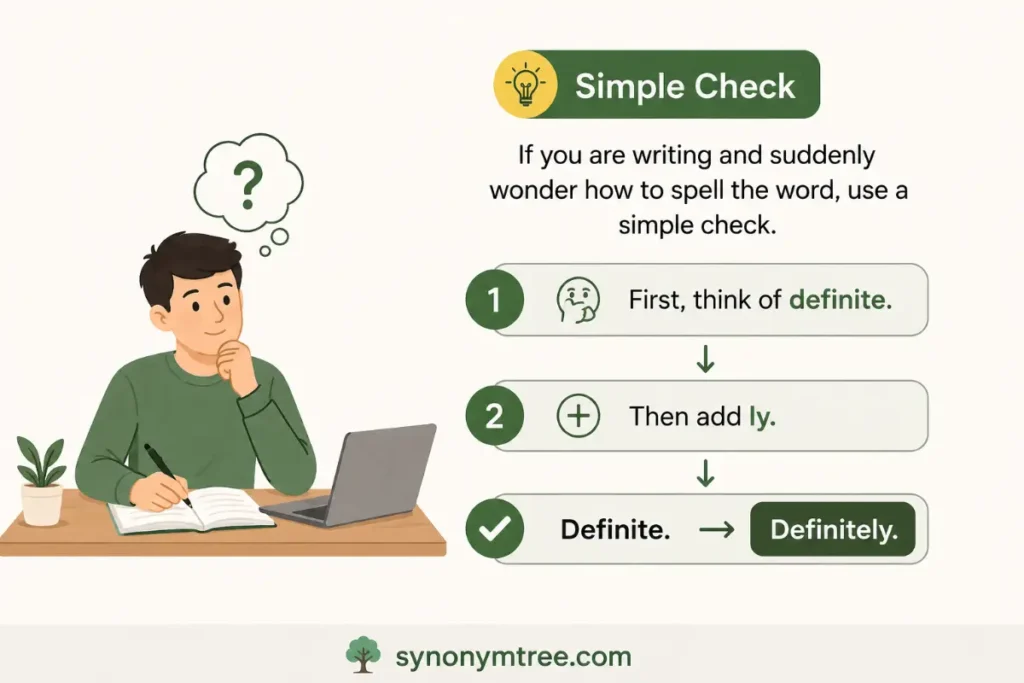
How To Check The Spelling Quickly for Definately Or Definitely
If you are writing and suddenly wonder how to spell the word, use a simple check.
First, think of definite.
Then add ly.
Definite.
Definitely.
Next, look at the middle.
Make sure the i is there.
Finally, remember that the word does not contain an a after the n.
This takes only a few seconds.
With practice, you will stop needing to think about it.
A Quick Editing Test
Suppose you have written:
I definately want to attend.
Stop at the spelling.
Ask yourself which base word belongs here.
The base word is definite.
Now form the adverb.
Definitely.
So the corrected sentence is:
I definitely want to attend.
This method is better than simply asking which version looks familiar. Familiarity can be misleading when you have seen the wrong spelling many times.
Other Commonly Misspelled Words
Definitely belongs to a larger group of English words that people often spell incorrectly.
Some examples include separate, necessary, receive, accommodate, occurrence, and recommend.
These words can be difficult because pronunciation, spelling patterns, and memory do not always line up neatly.
The best approach is to learn each word through its structure and use.
For definitely, the strongest connection is definite.
Once you remember that definite contains an i, you have a reliable clue for the adverb.
A Useful Pattern For English Learners
English learners can use word families to improve spelling.
A word family contains related forms that share a base.
For this word, the family includes:
Definite.
Definitely.
Definition.
Define.
Defined.
These words are connected through meaning and word history.
Knowing one word can help you remember another.
For example, if you know how to spell definite, definitely becomes easier.
If you know define and definition, you can also recognize the same basic spelling family.
This strategy works well because it gives your memory a pattern instead of a single isolated word.
Definitely In Different Tones
The word can fit several tones.
In casual speech:
Definitely.
In a friendly message:
I definitely want to come.
In a workplace email:
I will definitely send the updated file today.
In an academic sentence:
The evidence definitely supports the main argument.
The word itself does not force one particular tone. The surrounding sentence controls how formal or casual the message feels.
When You Should Use Another Word
Definitely is useful, but it is not always the best choice.
If you have direct evidence, you may be better off stating the fact.
For example:
The meeting starts at 10 a.m.
This is stronger and more useful than:
The meeting will definitely start at 10 a.m.
If you are making a personal judgment, definitely can be useful.
I definitely prefer the first option.
If you are making a promise or strong commitment, it can also work.
I will definitely finish the work today.
Good writers choose words based on meaning, not just strength.
Practice Sentences
Try reading these sentences aloud and paying attention to the spelling when you see the word.
- I definitely remember his name.
- She definitely wants to come.
- We will definitely need more time.
- That is definitely the correct answer.
- He definitely knows the truth.
- I definitely agree with you.
- They will definitely arrive soon.
- You should definitely read this book.
- This is definitely a better option.
- I would definitely choose the blue one.
- She definitely worked hard for the result.
- We definitely need to talk about this.
- He is definitely ready for the challenge.
- I definitely saw her at the store.
- They definitely made the right decision.
When you read these examples, notice the i in the middle of definitely.
That small detail is the spelling feature you need to remember.
A Final Spelling Check
Before you finish writing, look at the word one more time.
Is it definitely.
Or is it definately.
If you see the second form, fix it.
The correct word contains the sequence definitely.
A useful visual reminder is:
Definite.
Definitely.
The first word gives you the spelling clue for the second.
You do not need a complicated rule. You just need to remember the connection.
Conclusion
When you are choosing between definately or definitely, always choose definitely. The spelling definately is incorrect in standard English. The correct word means certainly, surely, or without doubt.
The easiest way to remember the spelling is to connect it with definite. The word definite contains an i, and that i remains in definitely. This simple connection is more reliable than trying to remember the whole word letter by letter.
Definitely works in everyday conversation, text messages, school assignments, professional emails, reports, and formal writing. You can use it to show certainty about an action, opinion, plan, or statement.
The next time you type the word, pause for one quick check. Look for the i in the middle and remember definite plus ly. If that i is missing, the spelling needs fixing.
FAQs
Is definately or definitely correct?
Definitely is correct. Definately is a common misspelling and should not be used in standard English writing.
Why do people spell definitely as definately?
The mistake often happens because the word is pronounced quickly and the middle sounds are not easy to hear. People may also forget the i that comes from the base word definite.
What does definitely mean?
Definitely means certainly, surely, or without doubt. It shows that the speaker feels very confident about a statement or action.
How can I remember the spelling of definitely?
Connect definitely with definite. Remember that definite contains an i, and that i stays when you form definitely.
Is definitely a formal word?
Yes. Definitely is a standard English word that works in casual conversation, school writing, business communication, and formal writing.
Is definitely the same as certainly?
They are very similar. Both words can express strong confidence, although certainly can sound slightly more formal in some contexts.
What is the difference between definitely and defiantly?
Definitely means with certainty. Defiantly means in a way that shows resistance or refusal to obey.
Can definitely be used as a one word answer?
Yes. Someone can answer definitely to show strong agreement or certainty. It is especially common in casual conversation and messages.
