
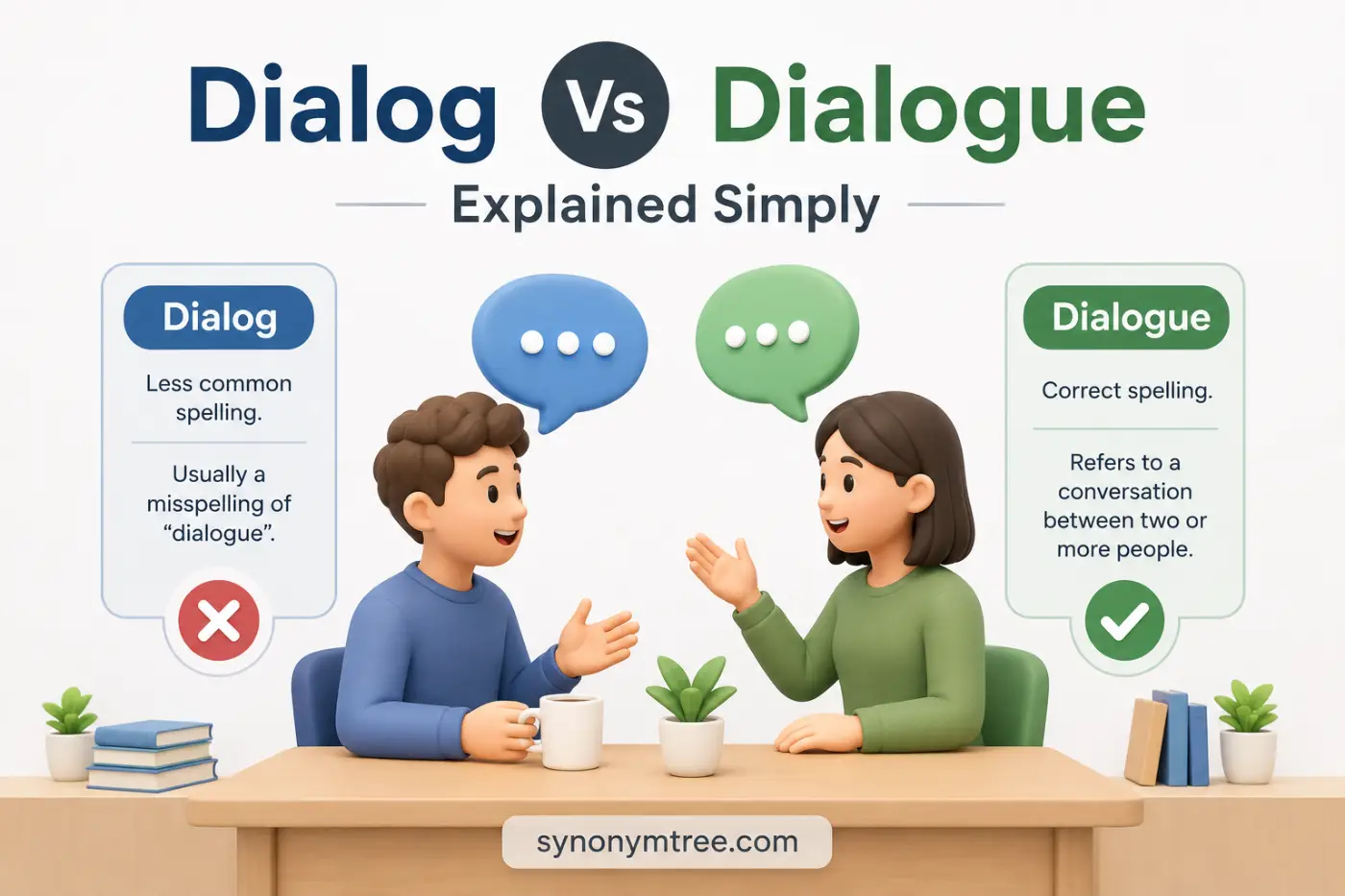
If you have ever stopped while writing and wondered about dialog vs dialogue, you are not alone. Both forms are real English words, and both can refer to the same basic idea. The main difference comes down to American English and British English usage.
In American English, dialog and dialogue can both be used when talking about a conversation. However, dialogue is much more common in general writing. The shorter form dialog appears often in computing and software, especially when referring to a dialog box or dialog window.
In British English, dialogue is the standard spelling for a conversation or exchange of ideas. The shorter spelling is less common outside technical contexts. This difference can make the two forms look like a right and wrong spelling when the real issue is often style, region, and context.
This guide explains the difference clearly. You will learn what each word means, when to use each spelling, how the words work in literature and film, why software uses dialog, and how to avoid common mistakes.
Quick Definition
Dialogue usually means a conversation between two or more people. It can also mean an exchange of ideas between groups or sides. Dialog is a shorter spelling that has the same basic meaning in some forms of English, but it is especially common in American computing and software terms.
Direct Answer
Dialogue is the safest choice for general writing about conversations, stories, books, plays, and discussions. Dialog is also accepted in American English, but it appears much more often in technical terms such as dialog box and dialog window.
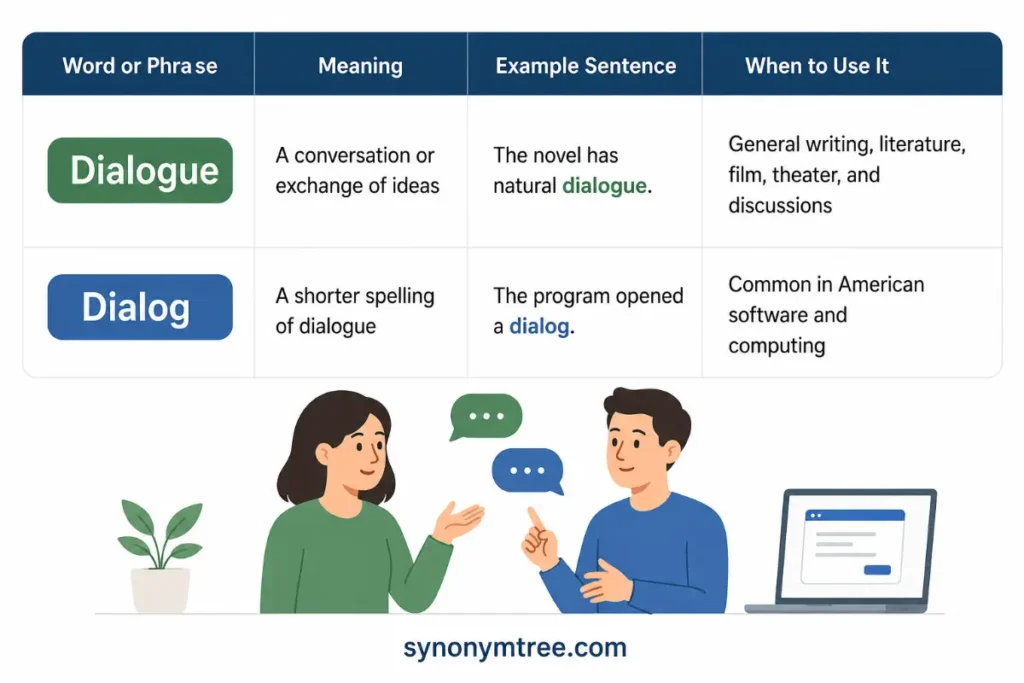
Comparison Table for Dialog Vs Dialogue
| Word or Phrase | Meaning | Example Sentence | When to Use It |
|---|---|---|---|
| Dialogue | A conversation or exchange of ideas | The novel has natural dialogue. | General writing, literature, film, theater, and discussions |
| Dialog | A shorter spelling of dialogue | The program opened a dialog. | Common in American software and computing |
| Dialogue box | A box that displays information or asks for input | A dialogue box appeared on the screen. | General English and some software documentation |
| Dialog box | A software window that asks for information or gives choices | Click OK in the dialog box. | Very common in American computing |
| Dialogue between people | An exchange of ideas or words | The dialogue between the two leaders continued. | Formal and general writing |
| Dialog between people | An alternative American spelling | The article describes a useful dialog between experts. | Possible in American English but less common |
What Dialogue Means
The word dialogue has several connected meanings. The most common meaning is a conversation between people.
When two friends talk, they are having a dialogue. When characters speak to each other in a novel, that conversation is dialogue. When actors speak in a movie or play, their spoken lines are also called dialogue.
The word can describe both ordinary conversation and planned or written conversation.
For example, you might say that two neighbors had a short dialogue about a parking problem. A teacher might ask students to write dialogue between two characters. A film critic might praise a movie for its sharp dialogue.
Dialogue can also describe an exchange of ideas.
A company may have dialogue with its customers. Two groups may enter into dialogue to solve a problem. Governments may hold dialogue to discuss an issue.
So the meaning is broader than simple talking. The central idea is an exchange between people or groups.
Dialogue In Everyday Conversation
People do not usually use the word dialogue for every casual conversation.
You might say, I had a conversation with my brother.
You could also say, The dialogue between the two speakers was friendly.
The second sentence sounds more formal. It focuses on the exchange itself rather than simply saying that two people talked.
This distinction matters in writing. Conversation is often the more natural word for everyday speech. Dialogue is common when you are discussing communication as a whole or describing speech in a story, movie, play, or formal setting.
Dialogue In Books
Dialogue plays a major role in fiction.
Authors use dialogue to show what characters say to one another. Good dialogue can reveal personality, emotions, relationships, goals, and conflict.
Consider this simple example.
Maya looked at the clock.
We need to leave now, she said.
I know, Ben replied. I just need my keys.
The spoken lines are dialogue. The surrounding sentences describe actions and help the reader understand the scene.
Writers often use dialogue to make stories feel more natural. It can also move the plot forward without explaining everything directly.
Dialogue In Movies And Plays
In a movie or play, dialogue refers to the words spoken by the characters.
A script may contain dialogue, stage directions, scene descriptions, and other information. Actors then perform the spoken lines.
For example, a film review might say that the movie has strong dialogue. That means the spoken exchanges between the characters work well.
A play can also depend heavily on dialogue. Some plays contain long conversations with very little action. The characters reveal the story through what they say and how they respond to each other.
What Dialog Means
Dialog has the same basic meaning as dialogue when it refers to an exchange or conversation. It is a shorter spelling that has been accepted in American English.
Still, context matters.
If you are writing a school essay about a novel, dialogue will usually be the better choice. If you are writing software instructions, dialog may be the more natural choice.
This is one reason the spelling can confuse people. The shorter form is not simply a careless version of the longer word. It has an established place in American English, especially in technology.
Dialog In Computing
Computing is the area where you will see dialog most often.
A dialog box is a small window that appears on a computer or device and asks you to make a choice, enter information, confirm an action, or read a message.
For example, you might see a dialog box asking you to save a file.
The window may contain buttons such as OK, Cancel, Save, or Close.
You may also see terms such as dialog window, dialog control, dialog screen, or modal dialog.
In technical writing, dialog has become a common term for these interface elements.
That does not mean dialogue is always wrong in software. Some companies and style guides use dialogue instead. However, dialog is extremely common in American computing language.
Why Software Uses Dialog
The technical use of dialog developed from the idea of a computer having an exchange with the user.
A computer program asks for information. The user responds. The program then performs an action.
That interaction resembles a simple conversation.
For example, a program might ask you to choose a file. You select the file and click Open. The program then continues.
The word dialog became useful for describing this type of interaction.
Today, the term is familiar to software developers, designers, technical writers, and everyday computer users.
Is Dialog Or Dialogue Correct
Both spellings can be correct, but they are not equally common in every situation.
Dialogue is the standard and widely recognized spelling for conversation in general English. It works well in American English and British English.
Dialog is also an accepted spelling in American English. It is especially common in technical and computing contexts.
If you need one spelling for general writing, choose dialogue. It is clear, familiar, and widely accepted.
If you are writing software documentation for an American audience, dialog may fit the technical vocabulary better.
The key is consistency. If your document uses one style throughout, keep using it.
Why The Two Spellings Exist
English has many pairs of words with shorter and longer forms. Dialogue comes from a word with roots in Greek. Over time, English developed the spelling dialogue. The shorter form dialog later became established in American usage. American English often has a history of shortening or simplifying some spellings. This does not mean every shorter spelling is automatically preferred. It means English changes over time, and different regions develop different conventions.
You can see similar patterns in other English words. Some American spellings differ from British spellings because of changes in spelling, pronunciation, printing, or common usage. The story of dialog and dialogue is partly connected to this larger pattern. However, the important point for everyday writers is simple. Both forms exist, but they have different levels of popularity depending on the context.
How American English Uses Dialogue
American English generally favors dialogue when referring to spoken exchanges.
You would commonly see phrases such as dialogue in a novel, dialogue between characters, political dialogue, and open dialogue.
For example.
The author writes realistic dialogue between the main characters.
The two groups began a dialogue about the new policy.
The movie has some of the best dialogue in recent years.
These sentences sound natural to most American readers.
You may also see dialog in the same broad sense.
The author writes realistic dialog between the main characters.
That sentence is possible in American English, but many readers would still expect dialogue.
This makes dialogue the safer general choice.
How British English Uses Dialogue
British English strongly favors dialogue for general writing.
A British reader would normally expect to see dialogue in a novel, play, film review, article, or formal discussion.
The shorter form dialog can appear in technical settings, especially when American software terminology has influenced the writing. Still, dialogue remains the normal general spelling.
If you are writing for an international audience, dialogue is usually the better choice because readers across English speaking regions recognize it easily.
Dialog Vs Dialogue In Literature
When you are writing about literature, dialogue is usually the preferred spelling.
This includes novels, short stories, plays, scripts, and literary criticism.
For example.
The author uses dialogue to show the growing tension between the two brothers.
The dialogue in the final chapter reveals the character’s true feelings.
The play depends on fast and clever dialogue.
You can technically find dialog in some American publications, but dialogue remains the more familiar literary form.
If you are a student writing an essay, dialogue is the safest option.
Dialog Vs Dialogue In Film
Film writing normally uses dialogue.
A movie has dialogue when characters speak to one another. A screenplay contains dialogue for the actors to perform.
You might write.
The film has very little dialogue.
The dialogue between the two characters feels natural.
The director uses silence instead of dialogue during the final scene.
In film criticism, dialogue can also refer to the quality or style of the spoken lines.
Good dialogue sounds believable. It fits the character. It also gives the audience useful information without sounding like an explanation written for the reader.
Dialog Vs Dialogue In Theater
Theater uses the term dialogue in much the same way as film and fiction.
Actors deliver dialogue as part of a performance.
A play may have several characters who speak in long conversations. It may also contain short exchanges.
Dialogue can establish a relationship, reveal a secret, create conflict, or move the story to its next stage.
Students studying drama will usually see dialogue as the standard spelling.
Dialog Vs Dialogue In Business
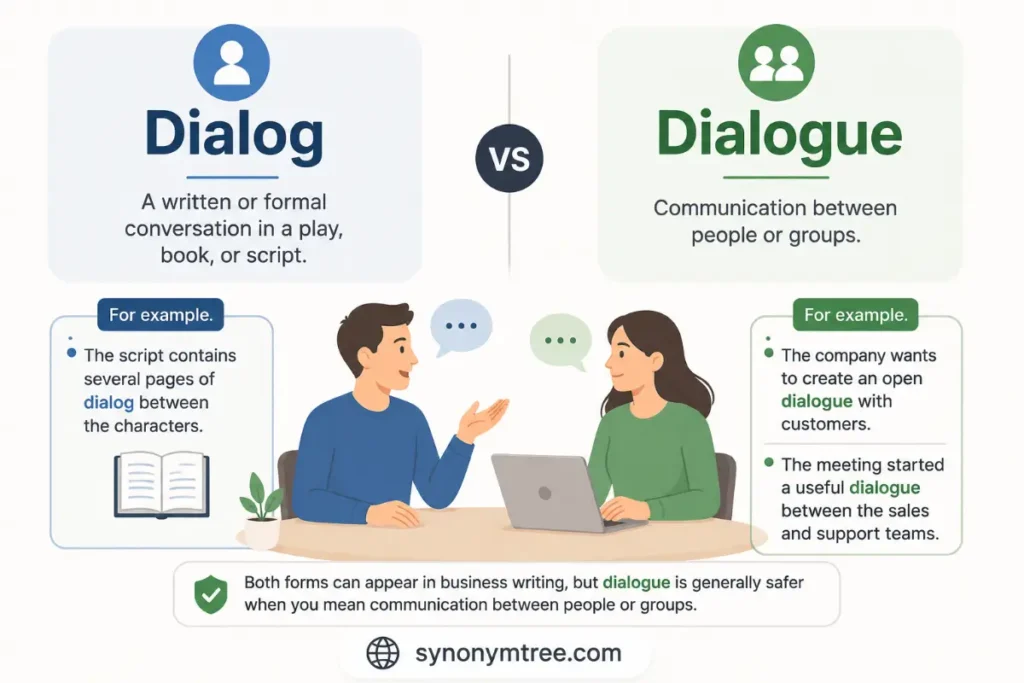
Both forms can appear in business writing, but dialogue is generally safer when you mean communication between people or groups.
For example.
The company wants to create an open dialogue with customers.
The meeting started a useful dialogue between the sales and support teams.
The manager encouraged dialogue between employees and leadership.
Here, dialogue sounds natural and professional.
Dialog may appear in American business writing when the writer uses a technical or specialized style. Still, there is rarely a strong reason to choose it for an ordinary discussion between people.
If your goal is clear business communication, dialogue is usually the better choice.
Dialogue As An Exchange Of Ideas
One useful meaning of dialogue goes beyond spoken lines.
Dialogue can describe a serious exchange of ideas between groups, communities, organizations, or individuals.
For example, two companies may begin dialogue about a partnership. Two communities may enter dialogue to solve a local issue. Researchers may have an ongoing dialogue about a difficult question.
In these examples, dialogue does not mean a script or a series of lines in a story.
It means communication.
This broader meaning is common in academic, business, social, and political writing.
Dialogue Does Not Always Mean Agreement
An important point is that dialogue does not mean everyone agrees.
Two people can have a dialogue because they disagree.
The purpose may be to understand another point of view, share information, solve a problem, or find common ground.
For example.
The two groups opened a dialogue after months of disagreement.
The sentence does not say that the groups solved the problem. It only says they started communicating.
That distinction can help you understand the word more clearly.
Common Phrases With Dialogue
Learning common phrases can make the word easier to use naturally.
Open Dialogue
Open dialogue means honest and free communication.
The manager encouraged open dialogue among team members.
Ongoing Dialogue
Ongoing dialogue means communication that continues over time.
The two organizations remain in ongoing dialogue about the project.
Dialogue Between
This phrase describes communication between people or groups.
The dialogue between the teacher and students became more productive.
Dialogue With
This phrase focuses on communication with another person or group.
The company wants more dialogue with its customers.
Enter Into Dialogue
This is a more formal phrase that means to begin a serious exchange of ideas.
The two sides agreed to enter into dialogue.
Political Dialogue
Political dialogue refers to discussion between political groups, leaders, or governments.
The leaders called for political dialogue.
These phrases are far more common with dialogue than dialog.
Common Phrases With Dialog
The shorter spelling has a strong connection with software.
Dialog Box
A dialog box is a window that asks the user to provide information or select an option.
The dialog box asks you to choose a folder.
Dialog Window
A dialog window is a software window that appears for a specific interaction.
The dialog window opened after I clicked Settings.
Dialog Control
A dialog control is an interface element used within a dialog.
The developer added a new dialog control to the application.
Modal Dialog
A modal dialog requires the user to respond before continuing with another part of the program.
A modal dialog appeared before the file could be deleted.
Technical terms like these explain why American readers often see dialog without the final ue.
Is Dialogue More Formal Than Dialog
The difference is not simply formal versus informal.
Dialogue is the standard general form and works across many types of writing.
Dialog has a strong technical association, especially with software and computing.
So you should not assume that dialog is informal and dialogue is formal. Context matters more than formality.
For example, dialog box is a normal technical term. It is not an informal version of dialogue box.
At the same time, dialogue between two leaders is a normal formal phrase. Replacing dialogue with dialog would sound unusual to many readers.
Common Mistakes People Make
The biggest mistake is treating the two spellings as completely unrelated words.
They are closely related. Both can refer to an exchange or conversation.
Another mistake is assuming that dialog is always incorrect.
That is not true in American English. The shorter form has a recognized use, especially in technology.
A third mistake is assuming that dialogue is only used for fiction.
Dialogue can describe real conversations and exchanges of ideas too.
A fourth mistake is choosing dialog simply because it is shorter.
Shorter does not always mean better. If you are writing about a conversation in a book, dialogue will usually look more natural to your readers.
Mistake One
Writing dialog in a literary essay because you think the shorter form is more modern.
Better choice.
The author uses dialogue to reveal the character’s feelings.
Mistake Two
Calling every computer window a dialogue.
Not every window is a dialog box.
A dialog usually appears for a specific interaction. It may ask for information, require a choice, or request confirmation.
Mistake Three
Thinking dialogue always means friendly communication.
Dialogue can involve disagreement, conflict, or tension.
The important idea is an exchange of words or ideas.
Mistake Four
Switching between spellings without a reason.
A document can look inconsistent if one paragraph uses dialogue and another uses dialog for the same meaning.
Pick the spelling that fits your audience and subject. Then use it consistently.
How To Choose The Right Spelling
You can make the choice quickly by asking what you are writing about.
If you are talking about characters speaking in a story, use dialogue.
If you are discussing lines spoken in a movie, use dialogue.
If you are writing about a conversation between real people, use dialogue.
If you are describing an exchange of ideas, use dialogue.
If you are writing American software documentation, dialog may be the preferred technical term.
If you are unsure and need a general English spelling, choose dialogue.
This simple rule works for most writing situations.
When Dialog Is The Better Choice
There are cases where dialog is the more natural option.
The clearest example is software.
Imagine you are writing instructions for an American application.
Click File and select Save. A dialog box will appear.
Using dialog sounds natural because the term is part of computing vocabulary.
A developer may also write about opening a dialog, closing a dialog, or passing data to a dialog.
In that setting, dialog is not a spelling mistake. It is a common technical convention.
Follow The Style Of Your Software
If you are writing documentation for a specific software product, follow the product’s own terminology.
If the interface calls something a dialog, use dialog in your documentation.
If the product documentation uses dialogue, follow that style.
Consistency helps users understand the instructions.
This is especially useful in technical writing because readers often need to match the words in the documentation with labels they see on their screen.
When Dialogue Is The Better Choice
For almost every general writing situation, dialogue is a strong choice.
Use it for books, stories, movies, plays, essays, articles, discussions, communication, and exchanges of ideas.
For example.
The dialogue in the story feels realistic.
The teacher encouraged dialogue among the students.
The two teams began a dialogue about the project.
The script contains very little dialogue.
The author writes witty dialogue.
These uses are clear and natural.
Dialogue And Conversation
Dialogue and conversation overlap, but they are not always interchangeable.
Conversation usually means an informal or ordinary talk between people.
Dialogue can have a broader meaning. It can describe spoken exchanges in fiction, formal communication, or an exchange of ideas.
Compare these sentences.
I had a conversation with my neighbor.
The two communities began a dialogue.
Both sentences describe communication, but the second sounds more formal and purposeful.
You can also say.
The characters have a conversation.
The characters have dialogue.
Both can make sense, but dialogue is the normal literary term for the spoken parts of a story.
Dialogue And Discussion
Dialogue and discussion are also related.
A discussion usually focuses on a topic. People share thoughts, facts, questions, or opinions about that subject.
Dialogue focuses more broadly on the exchange between people.
For example.
The students had a discussion about climate change.
The students had a dialogue about their different views.
The first sentence emphasizes the topic. The second emphasizes the communication between the students.
The words can overlap, but they are not perfect replacements for one another.
Dialogue And Debate
A debate involves opposing positions.
People in a debate usually argue for different sides of an issue.
Dialogue does not require opposing sides.
People can have dialogue even when they agree.
For example.
The two scientists entered into dialogue about the research.
This does not tell us that they disagreed.
Now consider this sentence.
The two candidates debated the proposal.
Here, the idea of opposing positions is stronger.
Knowing this difference can help you choose the right word in essays and professional writing.
Dialogue And Monologue
Dialogue involves two or more participants in an exchange.
A monologue involves one person speaking for an extended period.
In a play, one character may give a long monologue while another character listens.
If two characters respond to each other, their exchange can be described as dialogue.
This distinction matters in literature, theater, film, and public speaking.
A character speaking alone is not normally described as dialogue.
Dialogue In Creative Writing
Writers often spend a lot of time improving dialogue because weak speech can make a story feel unnatural.
Good dialogue usually sounds like something a real character might say. It also serves a purpose.
A character might use dialogue to reveal a secret. Another character might use it to hide information. A short exchange can show anger, fear, friendship, humor, or trust.
For example.
You came back.
I said I would.
The exchange is short, but the reader can sense a relationship and some history behind the words.
Good dialogue does not need to explain everything directly.
Dialogue Should Fit The Character
Different characters should not all sound exactly the same.
A young child may use simple words. A lawyer may use more formal language. A scientist may use technical terms when the context calls for them.
However, writers should avoid making every character speak in an exaggerated way.
Natural dialogue depends on the character, situation, and purpose of the scene.
Dialogue Can Move A Story
Dialogue should do more than fill space.
It can reveal information that changes the story.
It can create conflict.
It can show a relationship changing.
It can give the reader a clue.
It can also provide humor.
For example, a character might learn something important through a short conversation. The reader then understands why the character makes a major decision later.
That is much more useful than dialogue that simply repeats information the reader already knows.
How Punctuation Works With Dialogue
The spelling question often leads writers to another issue. They also want to know how to punctuate dialogue correctly.
In American English, spoken dialogue in fiction is usually placed inside quotation marks.
For example.
Sarah said, I need to leave now.
The exact punctuation rules depend on the sentence and style guide. Dialogue tags such as said, asked, replied, and shouted can also affect punctuation.
If you are writing fiction, pay attention to both spelling and punctuation.
The word itself is dialogue. The punctuation around it is a separate grammar issue.
Dialogue Tags
A dialogue tag identifies the speaker.
Common examples include said, asked, replied, and whispered.
For example.
I cannot find my phone, Maria said.
Where did you last see it, Tom asked.
Writers do not need a different dramatic verb for every line. Simple tags often keep dialogue easy to read.
Dialogue And Paragraphs
In fiction, a new speaker usually gets a new paragraph.
This helps readers know who is talking.
For example, one character speaks in one paragraph. When another character responds, the response begins in a new paragraph.
This simple rule makes longer conversations much easier to follow.
Does Dialog Have A Different Pronunciation
In most uses, dialog and dialogue are pronounced the same or very similarly.
The shorter spelling does not normally represent a completely different spoken word.
The final ue in dialogue does not create a separate sound.
This is another reason the spelling difference can seem strange. The words look different on the page, but their pronunciation is closely related.
If you are unsure how to pronounce dialogue, think of it as sounding like die uh log.
The exact pronunciation can vary slightly by speaker and accent, but the main point is that the two spellings do not normally create a major pronunciation difference.
The Plural Form
The plural of dialogue is usually dialogues.
For example.
The book contains several dialogues between the main characters.
The teacher asked students to write short dialogues.
However, dialogue can also be treated as an uncountable noun when you mean communication in a general sense.
For example.
The two sides need more dialogue.
Here, dialogue is not being counted as separate conversations.
This difference is useful in formal writing.
Can You Use Dialogues
Yes.
Dialogues is a valid plural form when you mean separate conversations or exchanges.
For example.
The textbook contains short dialogues for students to practice.
The actor studied several dialogues before the rehearsal.
In some contexts, especially when discussing communication as a general process, writers prefer the uncountable form dialogue.
The choice depends on what you mean.
If you are counting separate exchanges, dialogues can work.
If you mean communication in general, dialogue often sounds more natural.
Can Dialog Be A Verb
In American English, dialog can also appear as a verb in technical or specialized writing.
It can mean to communicate or interact through dialogue.
However, this use is much less common in everyday English.
Most readers will find phrases such as communicate, discuss, talk, or engage in dialogue more natural.
For general writing, there is usually no need to use dialog as a verb.
For technical writing, you may encounter it depending on the field and style guide.
A Simple Memory Trick To Remember Dialog Vs Dialogue
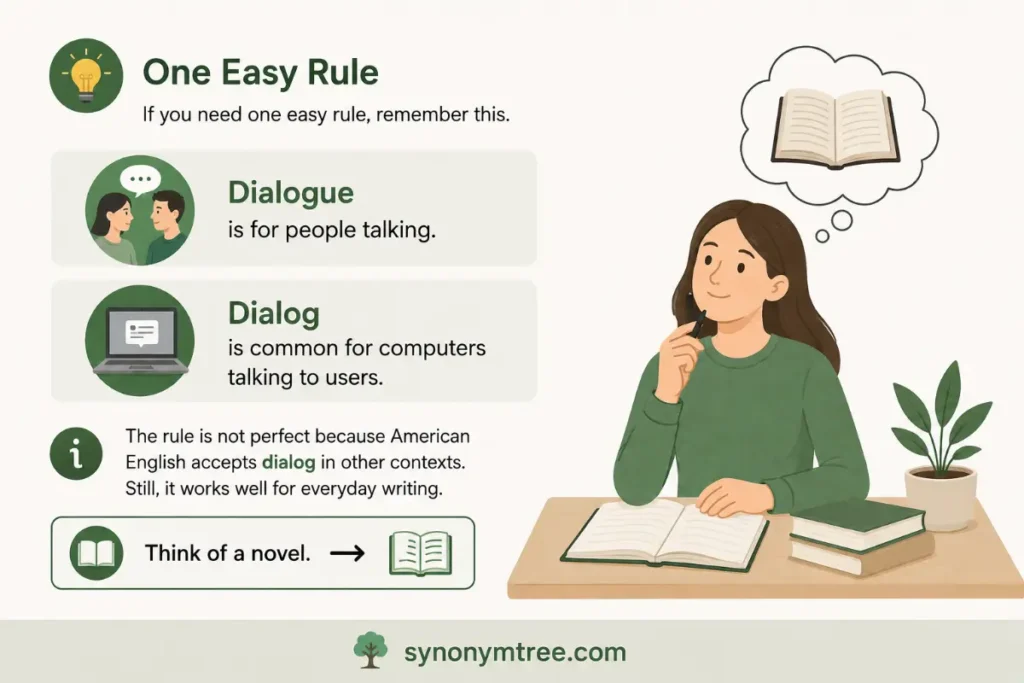
If you need one easy rule, remember this.
Dialogue is for people talking. Dialog is common for computers talking to users.
The rule is not perfect because American English accepts dialog in other contexts. Still, it works well for everyday writing.
Think of a novel.
Characters have dialogue.
Think of a computer.
The program opens a dialog.
That mental picture makes the spelling easier to remember.
Examples You Can Copy And Adapt
Here are natural examples showing how the words work in different settings.
- The dialogue between the two friends felt honest and natural.
- The author uses dialogue to reveal the main character’s personality.
- The movie has strong dialogue but a weak story.
- The teacher asked students to write a short dialogue between two characters.
- The two groups began a dialogue after the meeting.
- The company wants to improve dialogue with its customers.
- A dialog box appeared when I tried to close the program.
- Click Save in the dialog window.
- The application opens a new dialog when you select Print.
- The play contains long sections of dialogue.
- The novel has very little dialogue in its opening chapter.
- The two leaders continued their dialogue after the meeting.
- The software displays a dialog asking you to confirm the action.
- The writer created realistic dialogue for each character.
- The students studied several dialogues in their English class.
These examples show why context matters. The longer form works naturally in general English. The shorter form becomes especially useful in software and computing.
A Quick Test For Writers
Before choosing the spelling, ask yourself one simple question.
Am I talking about a conversation or exchange between people, or am I naming a software feature.
If you are writing about people, books, movies, plays, or ideas, dialogue is usually the best choice.
If you are naming a software interface element, dialog may be the better choice, especially in American technical writing.
This test takes only a few seconds.
It also prevents one of the most common mistakes. Writers sometimes replace every use of dialogue with dialog because they think the shorter spelling is preferred in American English. It is not.
American English accepts both forms, but usage still depends on context.
What Style Guides Usually Want
Different publishers, organizations, and software teams can have their own style rules.
A general publication may prefer dialogue because it is the most familiar spelling for conversations.
A technical company may prefer dialog because that is the term used throughout its software and documentation.
Neither choice automatically makes the entire document wrong.
The most useful approach is to follow the style guide that applies to your project.
If you do not have a style guide, use dialogue for general writing.
For technical software writing, check the product terminology and use the same spelling consistently.
Why Context Matters More Than Length
Some writers assume the shorter word must be simpler or more correct.
That is not how English works.
English contains many words with different accepted forms. Usage depends on history, region, field, audience, and context.
Dialog is a good example.
The shorter spelling has a strong technical identity in American English. That gives it a useful role.
Dialogue remains the broader and more familiar spelling.
So do not choose based only on letter count.
Choose based on meaning and audience.
What Students Should Use
Students writing essays, reports, book reviews, or literary assignments should generally use dialogue.
It is the safest choice for academic writing about conversations and literature.
For example.
The author uses dialogue to show the conflict between the two characters.
This sentence is clear and standard.
If a teacher or school style guide gives a different rule, follow that instruction. Otherwise, dialogue is the sensible choice.
Students should also avoid using dialog simply because they see it in computer software.
A word can have a special technical form without making that form the best choice in every subject.
What Editors Should Use
Editors should consider audience, publication style, and subject.
For a general audience, dialogue is usually the better default.
For technical documentation, dialog may be the preferred term.
Editors should also check consistency within the same document.
If a software manual calls a feature a dialog box, changing it to dialogue box in some sections can create confusion. Product terminology should remain consistent.
For a literary article, changing dialogue to dialog without a clear reason can make the writing look unusual.
Good editing is not only about finding one correct spelling. It is also about choosing the form that fits the context.
What Searchers Usually Mean
When someone searches dialog vs dialogue, they usually want to know one of three things.
They may wonder which spelling is correct.
They may want to know why software uses dialog.
Or they may be writing about a conversation and want to avoid a spelling mistake.
The answer is straightforward.
Dialogue is the safest general spelling. Dialog is an accepted American form and is especially common in computing.
That covers most situations.
Conclusion
The difference between dialog vs dialogue is mainly about usage and context, not a simple correct versus incorrect rule. Dialogue is the standard choice for conversations, literature, movies, plays, and exchanges of ideas. Dialog is an accepted American spelling that appears especially often in computing and software.
If you are writing a story, essay, article, review, or general business document, dialogue is usually the safest choice. It is familiar to American and British readers and works across many types of writing.
If you are writing about software, pay attention to the terminology used by the product. A dialog box, dialog window, or modal dialog is common technical language, especially in American English. In that setting, the shorter spelling is perfectly reasonable.
The practical rule is simple. Use dialogue for general English and use dialog when it fits established technical usage. When you are unsure, choose dialogue. It is the broadest and safest spelling for most readers.
Frequently Asked Questions
Is dialog or dialogue correct in American English?
Both spellings can be correct in American English. Dialogue is much more common for general conversations, literature, movies, and exchanges of ideas. Dialog is especially common in computing and software.
Is dialogue the British spelling?
Dialogue is the standard spelling in British English for a conversation or exchange of ideas. American English also uses dialogue widely. The shorter form dialog has a stronger presence in American technical writing.
Is dialog a misspelling of dialogue?
No. Dialog is an accepted spelling in American English. It is especially common in software and computing, so it should not automatically be treated as an error.
Should I use dialog or dialogue in an essay?
Use dialogue in most essays. It is the standard and widely recognized spelling for conversations and literary speech. This is especially true when you are writing about a novel, play, movie, or discussion.
Why do computers use the word dialog?
A software dialog represents an exchange between a program and a user. The program may ask for information or a choice, and the user responds. This is why terms such as dialog box and dialog window became common in computing.
Is dialogue only used for fictional characters?
No. Dialogue can describe real communication between people or groups. It can also describe an exchange of ideas in business, education, politics, and other settings.
Can dialog be used outside computers?
Yes. American English allows dialog as a shorter spelling of dialogue. However, dialogue is usually the more natural choice for general writing outside technical contexts.
What is the easiest way to remember the difference?
Use dialogue as your general spelling for people talking or exchanging ideas. Think of dialog as the spelling you are likely to see in American software terms such as dialog box. This simple rule will work for most everyday writing.
