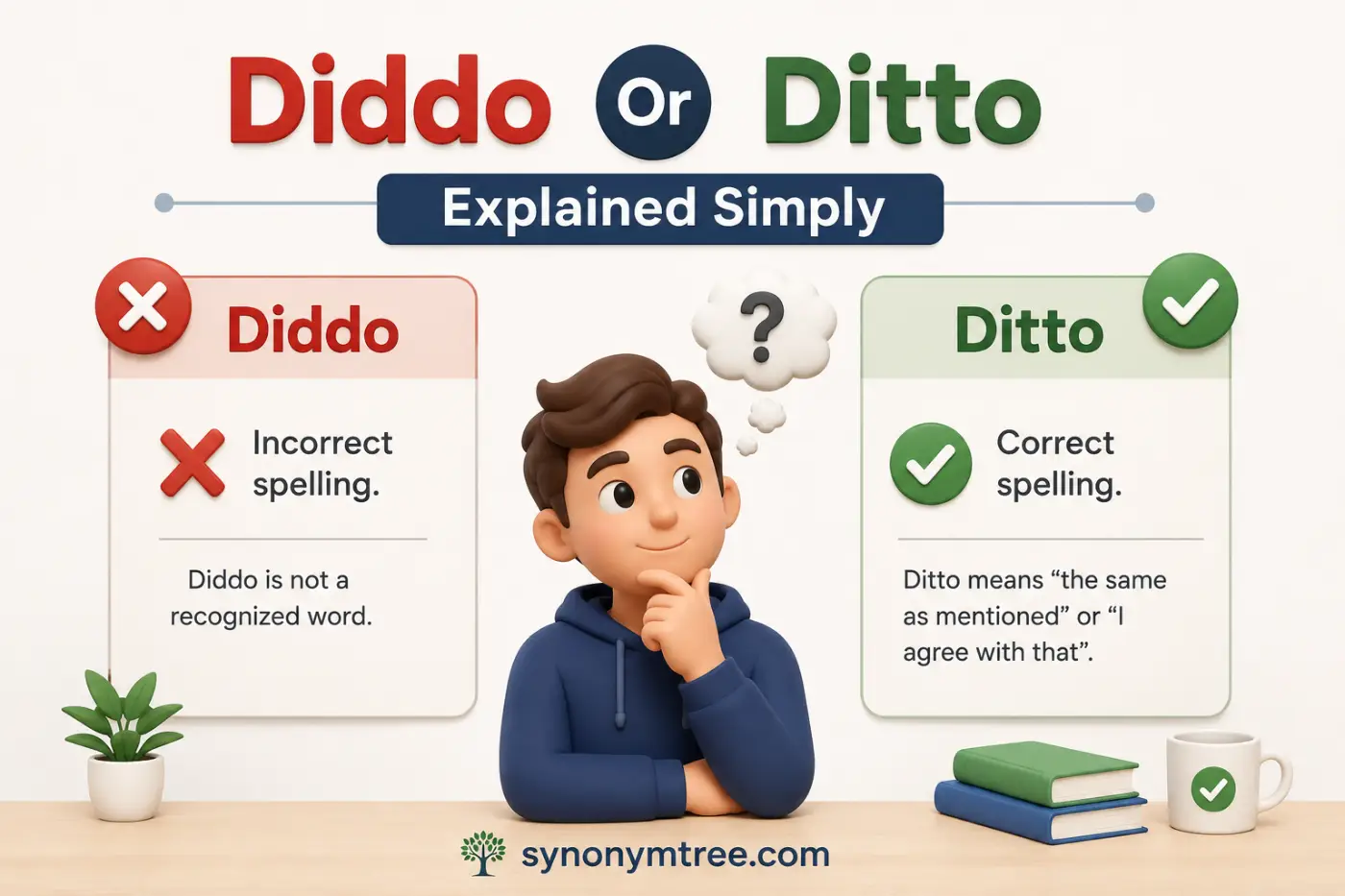
If you are wondering about diddo or ditto, the correct spelling is ditto. Diddo is a common misspelling that happens because some people hear the word as if it has a second d sound. Ditto is a short and useful word. It can mean that you agree with something someone just said. It can also mean the same thing again or the same as what was already mentioned. You may hear it in casual conversation, see it in writing, or find it used as a mark in older lists and records.
The confusion usually comes from pronunciation. When people say ditto quickly, the sound can be easy to mishear. That can lead someone to write diddo even though that spelling is not the standard English word.
This guide explains the correct spelling, what ditto means, how to use it in a sentence, where it came from, and why people sometimes spell it incorrectly. You will also see natural examples that show how the word works in everyday English.
Quick Definition
Ditto is a word that means the same as something already said or written. People often use it to show agreement with a previous statement, and they can also use it to avoid repeating the same information.
Direct Answer
Ditto is the correct standard spelling. Diddo is a misspelling and should not be used in standard English writing.
Comparison Of Diddo And Ditto
Why Ditto Is The Correct Spelling
The correct word is ditto. It has two t letters in the middle and one d at the beginning.
The spelling is simple once you connect it with the word’s sound and meaning. It is pronounced with a clear t sound in the middle. The word does not contain a second d.
A common mistake happens when someone hears the word in fast speech. The first d and the following t can blend together slightly. A listener may then remember a sound that seems closer to diddo.
That is a spelling problem caused by sound, not meaning.
You may see diddo in text messages, social media posts, informal comments, or other places where people write words from memory. Seeing the misspelling does not make it a standard spelling.
If you are writing an essay, email, article, report, school assignment, or professional message, use ditto.
What Diddo or Ditto Means
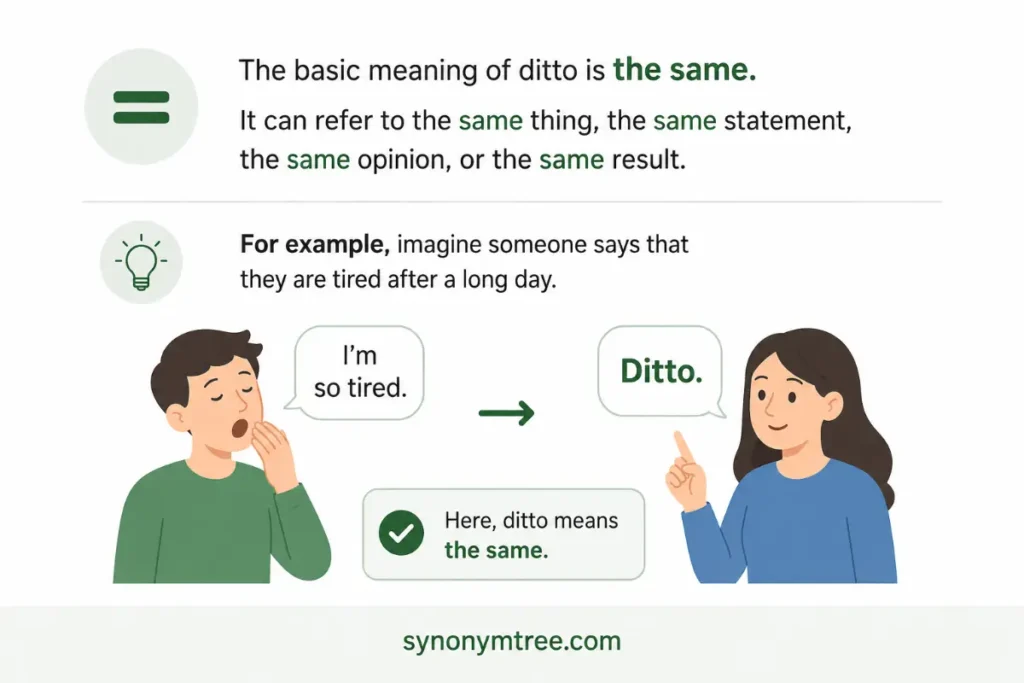
The basic meaning of ditto is the same.
It can refer to the same thing, the same statement, the same opinion, or the same result.
For example, imagine someone says that they are tired after a long day.
You might answer, Ditto.
You are saying that you feel the same way.
The word can also mean that something listed again is the same as something above it.
For example, a list might show the same address for several people. In older writing and record keeping, ditto could be used to show that the information in the line above should be repeated.
The word therefore has a simple central idea.
It tells the reader or listener that something is the same as what came before.
How People Use Ditto In Conversation
One of the most common uses today is as a quick way to agree with someone.
Imagine two friends talking about a restaurant.
The first friend says, I think the food was excellent.
The second friend says, Ditto.
The second person means, I think the same thing.
This use is short and casual. It can save you from repeating a full sentence.
Here are some natural examples.
I am ready to go. Ditto.
I love this song. Ditto.
That movie was better than I expected. Ditto.
I need some coffee. Ditto.
You can also use it after a longer statement.
I think we should leave before the traffic gets worse.
Ditto. I do not want to sit in traffic for an hour.
In each example, the speaker uses the word to show agreement.
Ditto Can Mean The Same Thing
The word does not always mean agreement.
Sometimes it simply means the same thing.
For example, someone might say that one product has a certain feature and another product has the same feature.
The second item could be described as ditto in an informal context.
The word can also refer to repeated information.
Suppose a list contains several entries with the same city. A writer might use ditto instead of writing the city again, especially in older styles of record keeping.
This use is less common in everyday modern writing, but it helps explain the full meaning of the word.
The core idea remains the same.
Something matches what was already stated.
Ditto As A Way To Show Agreement
The agreement use is probably the one most people recognize today.
If someone says something you strongly agree with, you can respond with ditto.
For example.
I think we need more time to finish this project.
Ditto.
That means the second speaker has the same opinion.
The word can make a response sound relaxed and conversational. It is usually more casual than saying I agree.
Compare these responses.
I agree.
Ditto.
Both communicate agreement, but they have a different feel.
I agree is direct and neutral. Ditto is shorter and more informal.
Is Ditto A Formal Word
Ditto is a real English word, but its tone depends on how you use it.
As a one word response, it often sounds casual.
For example.
I am exhausted.
Ditto.
That sounds like ordinary conversation.
In formal writing, you may want to say I agree, the same applies, or the same is true instead.
This does not mean ditto is incorrect in formal writing. It simply may not be the best fit for a serious or highly formal document.
Good word choice depends on your audience and purpose.
If you are chatting with a friend, ditto can sound natural. If you are writing a legal report, a formal business proposal, or an academic paper, a clearer phrase may work better.
Ditto In Everyday Text Messages
Texting has made short words like ditto useful.
People often want to respond quickly without repeating an entire thought.
Imagine this text exchange.
I cannot wait for the weekend.
Ditto.
The second person agrees.
Another example could look like this.
I am ordering pizza tonight.
Ditto. I have not eaten all day.
The word works well because the meaning is easy to understand from context.
It can also be playful.
I need a vacation.
Ditto.
That short reply communicates a full idea without repeating the original sentence.
Why People Write Diddo
The spelling diddo is usually caused by pronunciation.
English spelling can be tricky because the letters do not always match the sounds people expect. When someone first hears an unfamiliar word, they may write the version that seems to match what they heard.
Ditto is particularly easy to mishear because it is short.
The first sound is d. The next sound contains t. When the word is spoken quickly, the transition can be less clear to an inexperienced listener.
A person may then remember something like diddo.
That memory can become stronger after seeing other people make the same mistake online.
Still, the standard spelling remains ditto.
The Pronunciation Of Ditto
Ditto is pronounced roughly like dit oh.
The first syllable sounds like dit.
The second syllable sounds like oh.
The important spelling point is the t in the middle.
You can remember the word by breaking it into two parts.
Dit plus oh gives you ditto.
The word does not start with did and it does not contain a second d.
This pronunciation can help prevent the spelling mistake.
The History Of Ditto
Ditto has an interesting history.
The word came into English from Italian. It is related to an Italian word meaning said or stated.
The word became useful in English because people needed a short way to indicate that something should be repeated.
It was especially useful in lists, records, accounts, and other written material.
Over time, ditto developed a wider meaning. It could refer to something repeated or something that was the same as what had already been mentioned.
The modern conversational use grew from this basic idea of sameness.
So when someone says ditto after your statement, they are essentially saying the same applies to me.
Ditto In Old Records
Before modern computers and spreadsheets, people had to write information by hand or use printed forms.
Repeating the same information over and over took time.
A word such as ditto could make the process easier.
For example, imagine a handwritten list with several entries from the same month.
A writer could write the month once and use ditto for the next entries instead of writing the same month repeatedly.
This use helped make the word practical in business records and other documents.
Today, computers can copy information instantly. As a result, this older written use is less important in everyday life.
Still, you may see ditto in historical records or discussions about older writing practices.
The Ditto Mark
There is also a symbol called a ditto mark.
A ditto mark tells the reader that the information should be understood as the same as the information above.
These marks were useful in lists and tables before digital tools made copying much easier.
For example, if several rows had the same location, a writer could use a mark instead of writing the location again.
The exact form of the mark has varied by time and writing system.
The idea is simple.
The information is the same as what appears above.
This meaning connects directly to the modern word.
Ditto In Lists And Tables
You may encounter the word when reading about old records, catalogs, forms, or tables.
Suppose a historical document lists several people and their place of residence. If many people live in the same place, a writer may use ditto to avoid repeating the location.
The word then acts as a replacement for repeated information.
Modern spreadsheets and databases make this less necessary. A person can copy a cell or use a formula instead.
Still, the concept remains familiar.
If someone says ditto in conversation, they are using the same basic idea. They are saying that their statement is the same as the one that came before.
Ditto And I Agree
Ditto and I agree can have nearly the same meaning in conversation.
However, they are not identical in tone.
I agree is clearer and more direct.
Ditto is shorter and more casual.
For example.
I think this is the best option.
I agree.
This sounds neutral.
Now consider.
I think this is the best option.
Ditto.
This sounds more relaxed.
The choice depends on the situation.
If you are unsure, I agree is the safer option. If you are having a casual conversation, ditto can be a natural response.
Ditto And Same
The word same is another close comparison.
People often use same in casual speech and online communication to show that they have the same feeling or opinion.
For example.
I am tired today.
Same.
Ditto can work in the same situation.
I am tired today.
Ditto.
Both responses communicate similarity or agreement.
Same is especially common in modern informal communication. Ditto has a slightly different feel because it has a long history as a word meaning the same thing.
Neither word needs to be used in every situation.
Choose the one that fits your tone.
Ditto And Likewise
Likewise is another word that can overlap with ditto.
Likewise means in the same way or similarly.
For example.
It was nice meeting you.
Likewise.
The second person means that it was nice meeting the first person too.
Ditto could sometimes communicate a similar idea, but it is more casual.
For formal writing, likewise may be more suitable.
For relaxed conversation, ditto can work well.
Ditto And Me Too
Me too is one of the most common alternatives to ditto.
If someone says, I love chocolate, you can say, Me too.
You can also say, Ditto.
The meaning is similar.
However, me too often sounds warmer and more personal. Ditto can sound more playful or concise.
Neither one is wrong.
They simply have different styles.
Ditto And Same Here
Same here means that the speaker shares the same situation or feeling.
For example.
I am really tired.
Same here.
Ditto could replace the response.
I am really tired.
Ditto.
Same here is often clearer for learners because the meaning is obvious. Ditto is shorter but may be less familiar to people who are still learning English.
If you are teaching English, it can help to explain ditto by connecting it with phrases such as same, me too, and I agree.
Common Mistakes With Ditto
The spelling mistake is the biggest problem, but there are other errors worth knowing.
Mistake One
Writing diddo instead of ditto.
The correct spelling has two t letters.
Mistake Two
Thinking ditto only means I agree.
It can also mean the same thing or the same as something already mentioned.
Mistake Three
Using ditto in every type of writing.
The word is fine, but a formal document may benefit from a clearer phrase such as the same applies.
Mistake Four
Assuming ditto always refers to a personal opinion.
It can refer to repeated information in a list or record.
Mistake Five
Thinking the word is only modern slang.
Ditto has a long history in English and was used for repeated information long before modern texting and social media.
How To Remember The Spelling Of diddo or ditto
A simple memory trick can make the correct spelling easy.
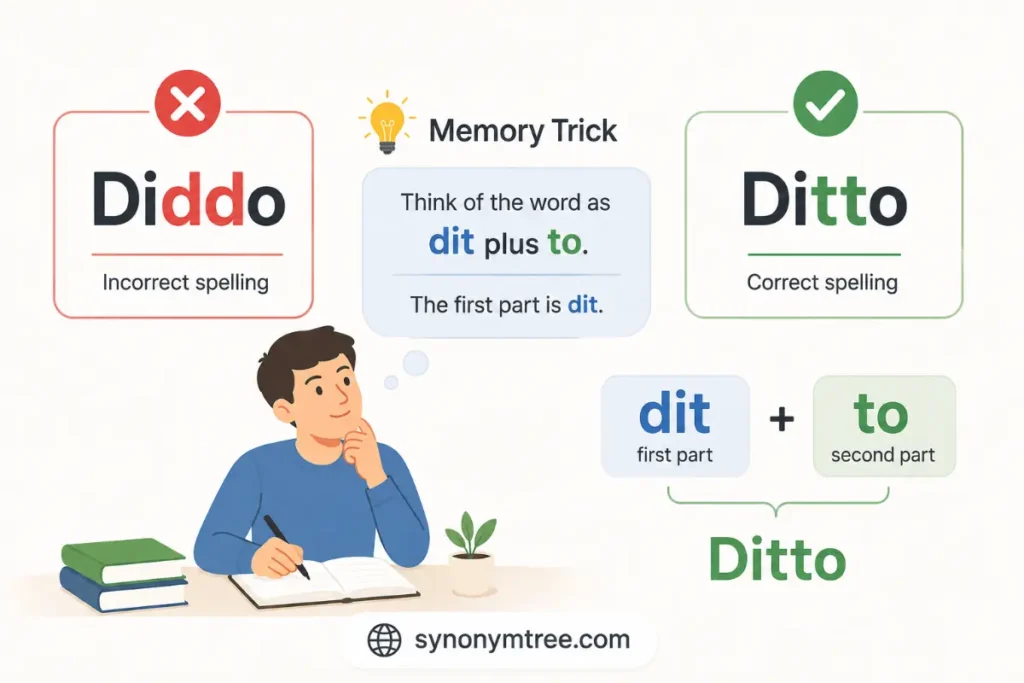
Think of the word as dit plus to.
The first part is dit.
The second part begins with t.
So you get ditto with two t letters in the middle.
Another useful trick is to connect the spelling with the phrase same thing.
When you think same thing, think ditto.
Do not try to spell it from the way you think it sounds after hearing fast speech.
Remember the written form.
Ditto.
That is the standard spelling.
Examples Of Ditto In Sentences
Seeing the word in real sentences is one of the easiest ways to understand it.
- I am ready to leave. Ditto.
- She said she loved the new restaurant, and I said ditto.
- I feel the same way. Ditto.
- He wants to spend the weekend at home, and I ditto that opinion.
- The first group chose the blue option, and the second group did ditto.
- I am tired after that long meeting. Ditto.
- My brother loves basketball. Ditto for me.
- She said the book was worth reading. Ditto.
- I need a break from work. Ditto.
- The record used ditto to show that the same information applied to the next entry.
- The clerk used a ditto mark for the repeated address.
- I agree with your point. Ditto.
- They ordered coffee, and we did ditto.
- He wants to visit the museum. Ditto.
- I had the same reaction. Ditto.
These examples show that the word can work in several ways. In casual conversation, it often expresses agreement. In older written records, it can indicate repeated information.
How To Use Ditto Naturally
The easiest modern use is as a short response.
Someone says something you also feel or believe.
You say ditto.
That is enough.
You can also place the word inside a sentence.
For example.
The second group made a ditto request.
However, this style is less common than simply using the word to indicate sameness.
In general writing, clarity should come first. If your reader may not know the word, use a clearer phrase such as the same thing or I agree.
The best word is not always the shortest word.
Can Ditto Be Used As A Verb
Yes, but this use is less common.
People sometimes use ditto as a verb to mean repeat or copy the same thing.
For example, someone might say that one person did ditto.
This use can sound informal or playful.
In standard everyday writing, it is usually clearer to say repeated, copied, or did the same thing.
For example, instead of writing, She dittoed the answer, you could write, She copied the same answer.
That version is easier for most readers.
The noun and response use of ditto are much more familiar.
Can Ditto Be Used In Formal Writing
Yes, but think about your audience.
Ditto is a standard word, so using it is not automatically wrong in formal writing.
Still, some formal documents need exact and direct language.
Instead of writing ditto, you may want to write the same, the same applies, or likewise.
For example, a formal report might say, The same applies to the second group.
A casual message might simply say, Ditto.
The difference is mainly about tone and clarity.
If you are writing for a school assignment, professional report, legal document, or academic paper, choose the clearest wording for your audience.
Ditto In Business Writing
Business writing sometimes uses ditto when the tone is informal.
For example, two coworkers may exchange messages.
I think we should move the meeting to Friday.
Ditto. Friday works for me.
That sounds natural in a casual workplace conversation.
In a formal report, you might write, The same recommendation applies to the second department.
The second version is more precise.
Business writers should think about the relationship with the reader and the purpose of the document.
A quick internal message can be relaxed. A customer facing report may need more direct wording.
Ditto In School Writing
Students may encounter ditto in books, conversations, or examples.
It is a real word, but that does not mean it belongs in every essay.
If you are writing a personal reflection, dialogue, or informal response, ditto may fit.
If you are writing a formal research paper, a phrase such as I agree or the same applies may be clearer.
Teachers may also mark diddo as a spelling error because diddo is not the standard spelling for this word.
If you are unsure, remember the two t letters.
Ditto is the form you want.
Ditto In Social Media
Social media has made short agreement words even more common.
People often reply to a post with words such as same, exactly, agreed, or ditto.
For example, someone might post, I could sleep all weekend.
A reply might simply say, Ditto.
This style is informal and conversational.
It works because the reader already understands the statement being referenced.
The context supplies the missing information.
That is one reason short words like ditto can be useful. They allow people to respond without repeating something everyone already understands.
Is Diddo Ever Correct
If you mean the standard English word that means the same, diddo is not the correct spelling.
You should write ditto.
There may be names, usernames, brand names, or other special uses of diddo in the world. A proper name can have its own spelling.
That does not change the standard English spelling of the word.
So if you are trying to say the same thing or show agreement, use ditto.
Why The Mistake Is So Common
Many English spelling mistakes come from pronunciation.
People often spell a word based on how they hear it instead of how it is traditionally written.
Ditto is short enough that a small sound difference can cause confusion.
The first d is clear. The t that follows can be less noticeable in quick speech. A listener may hear a sound that seems closer to another d.
Once someone writes diddo, the mistake can look believable.
Online communication can make this worse because people often see informal spelling errors repeated by other users.
The important lesson is simple.
A word appearing often online does not automatically make its spelling standard.
The Difference Between Sound And Spelling
English has many words where spelling cannot be guessed perfectly from pronunciation.
This happens because English developed from several languages and has changed over hundreds of years.
Words can also change pronunciation over time while keeping older spelling patterns.
Ditto is a fairly simple example. The spoken form can be misunderstood even though the written form is short.
This is why spelling memory matters.
If you only rely on sound, you may create a spelling that looks logical but is not standard.
When you learn a new word, it helps to remember both its pronunciation and its written form.
A Simple Rule For Writers
If you want a quick rule, use this.
When you mean the same thing, write ditto with two t letters.
Do not write diddo.
If you are responding to someone casually, ditto can mean I agree, same here, or me too.
If you are referring to repeated information, it can mean the same as above.
If you are writing formally, consider using a clearer phrase such as the same applies or I agree.
This rule covers almost every situation most readers will face.
How Dictionaries Treat Ditto
Standard English dictionaries recognize ditto as a real word.
It can function as a noun, adverb, or verb depending on the context and dictionary.
As a noun, it can refer to a duplicate or the same thing.
As an adverb, it can mean the same as stated before.
It can also be used informally to mean I agree or the same applies to me.
The exact grammatical label can vary by dictionary, but the central meaning stays the same.
Diddo does not replace the standard word.
Why Diddo OR Ditto Is Useful
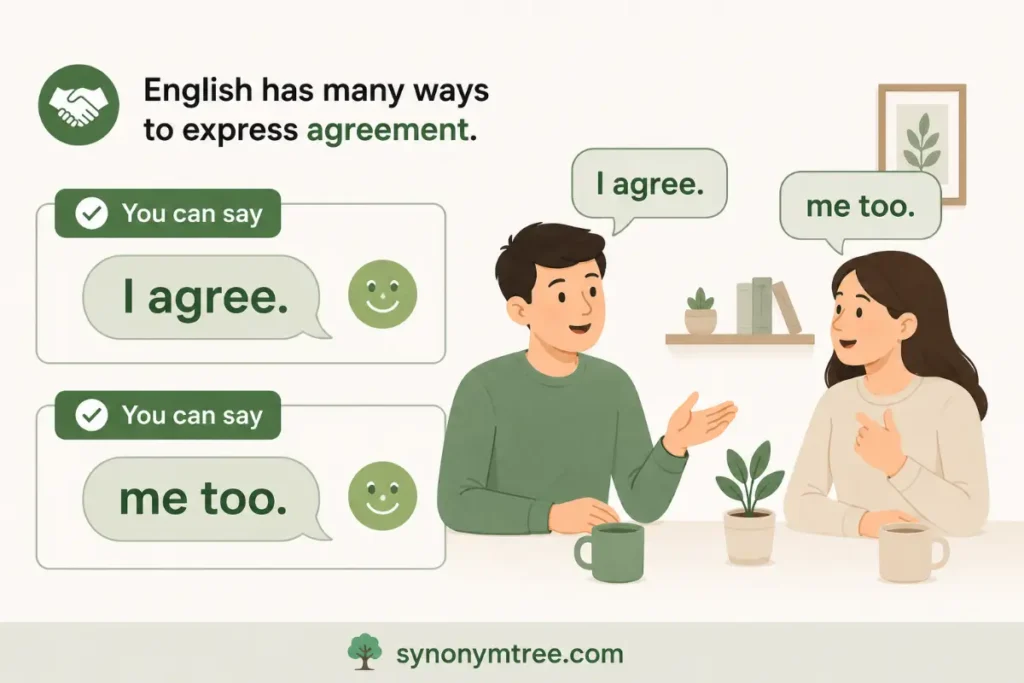
English has many ways to express agreement.
You can say I agree.
You can say me too.
You can say same here.
You can say exactly.
You can say likewise.
You can also say ditto.
The advantage of ditto is its ability to cover several forms of repetition and agreement in one short word.
It is especially useful when the previous statement is already clear.
For example.
I think the new plan will save us money.
Ditto.
There is no need to repeat the entire thought.
The context does the work.
Choosing The Best Alternative
Sometimes another word will fit better than ditto.
Use I agree when you want a clear and direct response.
Use me too when you share someone’s feeling or experience.
Use same here when you want to say that your situation matches theirs.
Use likewise when you mean similarly or in the same way.
Use the same applies when writing something more formal.
Use ditto when you want a short and casual way to show sameness or agreement.
Knowing these alternatives helps you avoid repeating the same word too often.
A Quick Editing Check
If you are editing your own writing and see diddo, stop and check the meaning.
If you meant the word that means the same, change it to ditto.
Then check the context.
If the writing is casual, ditto may be fine.
If the writing is formal, consider replacing it with a clearer phrase.
For example.
Diddo. I agree.
Change it to.
Ditto. I agree.
Or, in a formal context.
I agree with the same point.
This small check can remove an easy spelling mistake.
Common Questions
Is diddo or ditto the correct spelling?
Ditto is the correct spelling for the standard English word. Diddo is a common misspelling caused by the way the word can sound in fast speech.
What does ditto mean?
Ditto means the same thing or the same as something already stated. In casual conversation, people often use it to mean I agree, me too, or same here.
Is diddo a real English word?
Diddo is not the standard spelling of the word meaning the same. You should use ditto in normal English writing.
Why do people spell ditto as diddo?
The mistake usually comes from pronunciation. When people hear ditto spoken quickly, the middle t sound can be easy to miss, so they may remember the word as diddo.
Can I use ditto to mean I agree?
Yes. In casual conversation, ditto can be a short way to show that you agree with a statement. It can also mean that you have the same feeling, opinion, or experience.
Is ditto formal or informal?
Ditto is a standard English word, but using it as a one word response usually sounds casual. In formal writing, phrases such as I agree or the same applies may be clearer.
What is the difference between ditto and same?
Both can show that something is the same. Same is especially common in modern casual speech and online messages, while ditto has a longer history and can also refer to repeated written information.
How do I remember the spelling of ditto?
Remember that ditto has two t letters in the middle. You can think of it as dit plus to, which helps you avoid writing the incorrect form diddo.
Conclusion
The spelling question diddo or ditto has a simple answer. The correct standard English word is ditto. It means the same thing, the same as something already stated, or, in casual conversation, I agree or me too.
The spelling mistake diddo usually comes from hearing the word incorrectly. The middle t sound can be easy to miss when someone says the word quickly. Once you remember that ditto has two t letters, the spelling becomes much easier.
Ditto also has a useful history. It has been used to show repeated information in lists and records, and the same basic idea remains in modern conversation. When you say ditto after another person’s statement, you are saying that the same idea applies to you.
For everyday writing, remember one simple rule. If you mean the same thing, write ditto with two t letters. If you are writing something formal, use a clearer phrase such as I agree or the same applies when that fits your sentence better.
