
If you are searching dysregulated vs disregulated, you may be wondering which spelling is correct. The standard form in modern English is dysregulated. The word disregulated does appear in some writing, but it is much less common and is generally not the preferred form when describing a system that has lost normal regulation.
The confusion comes from the prefixes and the base word regulate. Both forms seem logical at first. If something is not regulated, disregulated may look like the natural choice. However, dysregulated has become the established term in fields such as psychology, medicine, biology, and neuroscience.
The difference matters most when you are writing about emotional regulation, nervous system regulation, behavior, hormones, immune responses, or other systems that normally maintain balance. This guide explains what dysregulated means, how it differs from disregulated, why the spelling causes confusion, and how to use the terms naturally. You will also see examples from everyday writing and professional contexts. By the end, you should know which form to choose and why.
Quick Definition
Dysregulated describes something that is not being controlled or balanced in its usual way. It is commonly used when a biological, emotional, behavioral, or other system has trouble maintaining normal regulation. Disregulated exists in some usage, but dysregulated is the much more established form in modern professional and general writing.
Direct Answer
Dysregulated is the preferred and widely accepted term. Use it when describing a system, process, or response that has lost normal regulation or is functioning outside its usual pattern.
Comparison Table for Dysregulated Vs Disregulated
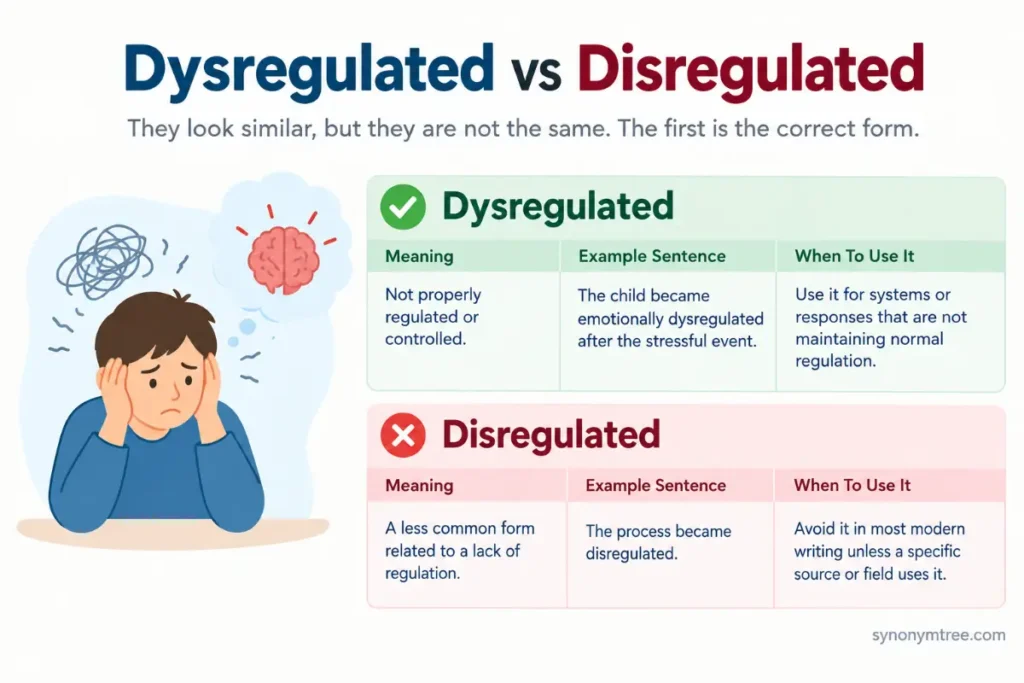
| Word | Meaning | Example Sentence | When To Use It |
|---|---|---|---|
| Dysregulated | Not properly regulated or controlled | The child became emotionally dysregulated after the stressful event. | Use it for systems or responses that are not maintaining normal regulation. |
| Disregulated | A less common form related to a lack of regulation | The process became disregulated. | Avoid it in most modern writing unless a specific source or field uses it. |
Why These Words Cause Confusion
The main reason for the confusion is the difference between the prefixes dys and dis.
English uses both prefixes in many words. They can both suggest something negative or abnormal. That makes it easy to assume that either prefix could be added to regulate.
For example, English has words such as disorder, disagree, disconnect, and disapprove. The prefix dis is common and often expresses separation, reversal, removal, or negation.
The prefix dys also appears in English, especially in medical and scientific vocabulary. It often relates to something functioning abnormally, poorly, or with difficulty.
Examples include dysfunction, dyslexia, dysphagia, and dysregulated.
Because regulate means to control or maintain something within a normal range, dysregulated developed as a useful term for a system that is not regulating itself normally.
The Role Of The Prefix Dys
The prefix dys comes from Greek and has long been used in medical and scientific vocabulary. It can suggest difficulty, abnormal function, impairment, or poor functioning.
That meaning fits naturally with regulation.
A regulated system is functioning within an expected pattern.
A dysregulated system is having trouble maintaining that pattern.
This does not always mean that the system has stopped working completely. It may still regulate itself, but the process may be less stable, less effective, too strong, too weak, or poorly timed.
That detail is important.
Dysregulated does not simply mean completely uncontrolled. It can describe a system that still has some regulatory function but is not maintaining the expected balance.
The Role Of The Prefix Dis
Dis is also a very common English prefix. It often means apart, away, opposite, or not, depending on the word.
That makes disregulated look reasonable.
A reader might think that regulate means control and disregulated means not controlled. The logic seems simple.
However, English vocabulary does not always work by adding any negative prefix that seems logical. Established usage determines which form becomes standard.
In modern professional writing, dysregulated is the form readers are much more likely to recognize.
What Dysregulated Means
Dysregulated means that a system is not regulating itself in a typical or effective way.
The word is broad. Its exact meaning depends on the system being discussed.
For example, emotional dysregulation refers to difficulty managing or adjusting emotional responses. A person may experience emotions that feel unusually intense, last longer than expected, or become difficult to bring back to a manageable level.
In biology, dysregulation can describe a biological process that is not being controlled normally.
In neuroscience, researchers may discuss dysregulation involving brain systems or processes.
In medicine, dysregulation can refer to problems with processes that normally maintain balance.
The shared idea is abnormal regulation.
Regulation Means Control And Balance
To understand dysregulated, start with regulation.
Regulation is the process of controlling something so that it stays within a useful or expected range.
Your body regulates many processes.
Body temperature is regulated.
Blood sugar is regulated.
Heart rate is regulated.
Hormone levels are regulated.
The immune system is regulated.
Emotional responses can also be regulated.
When regulation works properly, the system can adjust as conditions change.
For example, your body responds to changes in temperature. It uses several processes to help maintain a stable internal environment.
When a regulatory process does not work normally, a writer may describe the process as dysregulated.
Dysregulated In Psychology
One of the most common places you will see this word is psychology and mental health writing.
Emotional dysregulation describes difficulty managing emotional responses.
This does not mean that a person has no emotions or that every strong emotion is a problem.
Strong emotions are normal. Everyone becomes angry, excited, sad, afraid, or frustrated.
The term becomes useful when the intensity, duration, or control of an emotional response creates a significant difficulty in a particular situation.
For example:
The child became emotionally dysregulated after a major change in routine.
The teenager struggled with emotional regulation during stressful situations.
The therapist discussed strategies for managing emotional dysregulation.
These sentences use dysregulated to describe difficulty with emotional control or adjustment.
Emotional Regulation
Emotional regulation is the ability to respond to feelings in ways that fit the situation and allow a person to function.
It does not mean suppressing emotions.
A person can feel angry and still regulate the way they respond.
A person can feel nervous and still continue with an important task.
A person can feel disappointed and still recover after some time.
Regulation involves recognizing emotions, responding to them, and adjusting as circumstances change.
When that process becomes difficult, the term dysregulation may be used.
Emotional Dysregulation
Emotional dysregulation can involve reactions that are unusually intense, difficult to manage, or slow to settle.
For example, someone might become extremely upset by a small change and have trouble calming down.
Another person might move quickly from calm to intense anger.
Someone else might struggle to recover after a stressful event.
The word itself does not tell you the cause.
That point matters.
Dysregulated is a description of how a process is functioning. It does not automatically identify why the process is functioning that way.
Dysregulated In Biology
The word is also common in biology.
Biological systems depend on regulation. Cells, organs, hormones, immune responses, and other processes must respond to changing conditions.
When a biological process does not operate within its usual pattern, researchers may describe it as dysregulated.
For example:
The study examined dysregulated immune activity.
Researchers found signs of dysregulated gene expression.
The condition may involve dysregulated hormone signaling.
These examples use the word to describe a biological process that is not being regulated in its expected way.
The word does not necessarily mean that the entire body is out of control. It usually points to a particular process.
Dysregulated Immune Responses
The immune system needs careful regulation.
It must respond strongly enough to protect the body while also avoiding unnecessary or excessive responses.
When immune activity is poorly regulated, researchers may describe it as dysregulated immune activity or an immune response.
This term appears often in scientific and medical writing.
The exact cause and effects depend on the condition or research question being discussed.
Dysregulated Hormones
Hormone systems also depend on regulation.
Hormones act as chemical signals and help coordinate many body processes.
If hormone production, release, signaling, or response does not follow its normal pattern, scientific or medical writing may describe the system as dysregulated.
For example:
The researchers studied dysregulated hormone signaling.
Again, the word describes a problem with regulation. It does not by itself identify a diagnosis or a specific disease.
Dysregulated In Neuroscience
Neuroscience also uses the word frequently.
The brain contains many systems that regulate attention, emotion, stress responses, movement, sleep, learning, and other functions.
Researchers may describe a process as dysregulated when it does not operate within the expected pattern.
For example:
The researchers examined dysregulated stress responses.
The study focused on changes in emotional regulation.
The findings may help explain how certain brain systems become dysregulated.
The term is useful because it describes a functional problem without claiming that one specific cause explains it.
That makes it common in research writing.
Is Dysregulated A Medical Word
Dysregulated is strongly associated with medical and scientific writing, but it is not limited to medicine.
You can use it in any context where a system has a normal regulatory process that is not working properly.
Still, the word is especially common in health, psychology, biology, and neuroscience.
In everyday conversation, people may use simpler phrases such as not well regulated, difficult to control, out of balance, or hard to manage.
For example:
Professional wording:
The patient showed signs of emotional dysregulation.
Simpler wording:
The person had trouble managing strong emotions.
Both can communicate a similar idea, but the second is easier for a general audience.
When writing for the public, consider your readers. If your audience may not know the term, explain it the first time you use it.
Dysregulated Vs Disregulated In Standard Usage
The question of dysregulated vs disregulated is mainly a question of established usage.
Dysregulated is the dominant form in contemporary English, especially in medical, psychological, biological, and scientific contexts.
Disregulated can be found in some sources, but it is far less common.
That does not mean every use of disregulated is automatically meaningless. Language can contain competing forms, and specialized fields sometimes develop their own terminology.
Still, if you are writing a general article, school paper, report, educational resource, or professional document, dysregulated is the safer choice.
It is familiar to the intended readers in fields where regulation is an important concept.
Why Dysregulated Became Common
Scientific vocabulary often uses Greek and Latin roots.
Dys is especially common in medical terminology because it can describe abnormal or difficult functioning.
The word dysregulated fits that pattern.
It became widely used in discussions of biological and psychological regulation. As researchers and clinicians used the term more often, it became familiar across related fields.
Modern usage then reinforced the spelling.
This is a useful lesson about English vocabulary. A word can become standard because a particular form becomes established among speakers and writers. Logical construction alone does not determine the standard form.
Common Mistakes With Dysregulated
Knowing the correct spelling is only the first step. Writers also need to use the word accurately.
Mistake One
Using disregulated simply because it looks logical.
A writer may think:
Regulate means control.
Dis means not.
Therefore disregulated must be correct.
That reasoning is understandable, but English does not always build words in that direct way.
The established term is dysregulated.
Mistake Two
Treating dysregulated as a synonym for completely uncontrolled.
That can make a sentence too strong.
Dysregulation can involve poor control, imbalance, excessive activity, reduced activity, or an unusual response pattern.
The exact meaning depends on context.
Mistake Three
Using the word without explaining it to general readers.
A scientific reader may understand dysregulated immediately.
A general reader may not.
If your audience is broad, give a simple explanation the first time.
For example:
The study examined dysregulated stress responses, meaning stress responses that were not being controlled in the usual way.
That short explanation makes the term easier to understand.
Mistake Four
Assuming dysregulated identifies a cause.
It does not.
The word describes a regulatory problem. It does not automatically tell you why the problem exists.
For example, saying that a process is dysregulated does not by itself explain what caused the change.
Mistake Five
Using the word for ordinary strong feelings.
A person being angry, sad, excited, or nervous does not automatically mean that the person is emotionally dysregulated.
Normal emotional responses can be strong.
Context, duration, intensity, and functioning matter when professionals use the term.
How To Use Dysregulated In A Sentence
The word is usually used as an adjective.
It can come before a noun.
For example:
The researchers studied a dysregulated stress response.
It can also come after a linking verb.
For example:
The system appears dysregulated.
Here are more examples.
- The child became emotionally dysregulated after the unexpected change.
- The researchers examined dysregulated immune activity.
- The study explored how stress can affect emotional regulation.
- The patient showed signs of difficulty with emotional regulation.
- The researchers investigated dysregulated hormone signaling.
- The report described changes in a normally regulated process.
- The team studied how chronic stress may affect regulatory systems.
- The paper discussed dysregulated responses to environmental stress.
- The researcher explained that the system was not regulating itself normally.
- The article uses dysregulated to describe an altered regulatory process.
These examples show how the term works in different settings.
Related Words You Should Know With The Regard Of Dysregulated Vs Disregulated
Understanding related vocabulary makes the meaning much clearer.
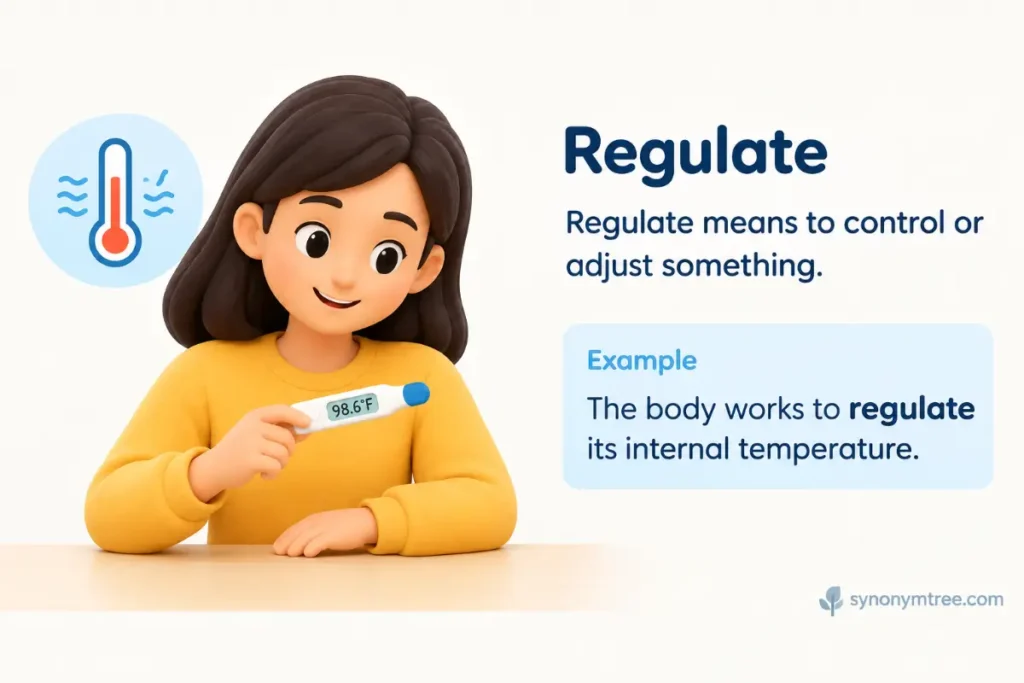
Regulate
Regulate means to control or adjust something.
Example:
The body works to regulate its internal temperature.
Regulation
Regulation is the process of controlling or adjusting something.
Example:
Emotional regulation can help a person respond to stress.
Regulated
Regulated means controlled or maintained within an expected range.
Example:
The system is carefully regulated.
Dysregulation
Dysregulation is the noun form. It refers to a problem or change in normal regulation.
Example:
The researchers studied emotional dysregulation.
Dysregulated
Dysregulated is the adjective.
Example:
The study examined dysregulated emotional responses.
Regulatory
Regulatory is an adjective that relates to regulation.
Example:
The brain has many regulatory systems.
Learning these forms together can make the vocabulary much easier.
Dysregulation And Emotional Control
The phrase emotional regulation is especially common, so it helps to understand how it works.
People constantly adjust their emotional responses.
A stressful event may cause fear or anger.
A disappointing event may cause sadness.
A pleasant event may cause excitement.
Regulation allows a person to respond and then adjust as the situation changes.
For example, a person may feel nervous before a speech. That nervousness can be normal. After the speech begins, the person may gradually become calmer.
If someone has difficulty adjusting emotional responses across situations, a professional may discuss emotional dysregulation.
The term is descriptive. It should not be treated as a diagnosis by itself.
Dysregulated Does Not Mean Bad
The word can sound negative because it describes a problem with regulation. Still, it is better to think of it as a description rather than a judgment.
For example, saying that a stress response is dysregulated does not mean that the person is bad or weak.
It means that the response is not being regulated in the expected way.
This distinction is useful when writing about people.
Instead of using labels, describe the process clearly.
For example:
The person had difficulty regulating strong emotions.
This may be clearer and more respectful for a general audience than using a technical term without explanation.
When To Use A Simpler Phrase
Dysregulated is useful when you need a precise technical term.
It may not be the best choice in every sentence.
If your readers are not familiar with scientific or psychological vocabulary, simpler wording may work better.
Instead of:
The child became dysregulated.
You might write:
The child had trouble managing strong emotions.
Instead of:
The system was dysregulated.
You might write:
The system was not regulating itself normally.
The best choice depends on your audience and purpose.
For a research paper, dysregulated may be exactly right.
For a public information article, define the word before using it repeatedly.
How To Explain Dysregulated To A Child
The basic idea can be explained very simply.
Imagine a thermostat that helps keep a room comfortable.
If the thermostat works normally, it adjusts the temperature as needed.
If the system stops adjusting properly, the room may become too hot or too cold.
A dysregulated system is somewhat like that. The system still has a job to do, but its normal control process is not working as expected.
This example is only an analogy. Human and biological regulation is much more complex than a thermostat.
Still, it gives readers a simple starting point.
Is Disregulated Always Wrong
Not necessarily in every historical or specialized context.
English contains uncommon forms that appear in particular texts, fields, or periods. You may find disregulated in published material.
However, frequency and established usage matter when choosing a word for modern writing.
If you are deciding between the two forms for ordinary contemporary English, dysregulated is the better choice.
If you are editing a technical document, follow the terminology used consistently by the relevant field or source. Consistency matters, especially in specialized writing.
For general readers, though, dysregulated will usually be the clearest and most recognizable form.
Why English Has Similar Prefix Problems
English has borrowed words from many languages. As a result, prefixes do not always behave in perfectly predictable ways.
A learner may know that dis can mean not and assume that it can be added to any word.
That is not how English works.
You cannot always create a standard word simply by combining familiar pieces.
For example, a form may look logical but still sound unusual to native speakers because another form has already become established.
Dysregulated is a good example.
The lesson is simple: learn common word families and established usage rather than building new words from prefixes whenever the logic seems to work.
A Simple Memory Trick
The easiest way to remember the correct form is to connect it with dysfunction.
Dysfunction means that something is not functioning normally.
Dysregulated means that something is not being regulated normally.
Both use dys.
You can also remember the word family:
Regulate.
Regulation.
Dysregulation.
Dysregulated.
This connection helps you remember both the meaning and spelling.
If you see a sentence about a system having trouble with normal regulation, dysregulated is likely the word you need.
A Second Memory Trick
Think of the phrase normal regulation.
Now imagine the opposite.
Normal regulation.
Dysregulation.
The adjective becomes dysregulated.
This keeps the focus on regulation rather than on the negative prefix alone.
That can prevent the common mistake of choosing dis simply because it often means not.
How To Choose Between The Two Forms
When you come across the two spellings, follow three steps.
Check The Meaning
Ask what the sentence is describing.
If it refers to a system that is not regulating normally, dysregulated is the standard choice.
Check The Field
If the sentence is about psychology, neuroscience, biology, medicine, or another scientific field, dysregulated is especially likely to be the expected term.
Check The Audience
If you are writing for general readers, consider explaining the word.
For example:
Emotional dysregulation means having difficulty managing and adjusting emotional responses.
That sentence gives readers the technical term and its plain meaning at the same time.
Examples Of Correct Usage
Here are several examples that show different contexts.
Psychology
The therapist discussed emotional regulation strategies with the client.
Child Development
The child became emotionally dysregulated after several stressful events.
Biology
The researchers examined dysregulated immune activity.
Neuroscience
The paper explored changes in systems involved in emotional regulation.
Medicine
The study described dysregulated biological processes.
Research
The researchers wanted to understand why the regulatory system became dysregulated.
Public Education
The article explains how a dysregulated stress response can affect daily functioning.
General Writing
The system became dysregulated after the normal control process was disrupted.
Each example keeps the basic meaning intact while allowing the surrounding context to explain the exact process.
When Dysregulated Is Not The Best Word
Sometimes writers use technical language when a simple word would be clearer.
For example:
The machine became dysregulated.
This may sound unusual if the machine does not have a biological or regulatory system that the audience recognizes.
A simpler phrase might be:
The machine stopped maintaining the correct temperature.
That sentence tells the reader exactly what happened.
Good writing is not about choosing the most technical word available. It is about choosing the clearest accurate word for the situation.
Dysregulated is valuable when the concept of regulation itself matters.
If you can explain the specific problem more clearly, that may be the better choice.
Dysregulated And Out Of Control
These phrases overlap in some contexts, but they are not identical.
Out of control is informal and broad.
Dysregulated is more precise and usually describes a failure or change in a regulatory process.
For example:
The crowd became difficult to control.
This is a normal everyday statement.
The stress response became dysregulated.
This is a more technical statement about a biological or psychological process.
The second sentence does not simply mean out of control. It suggests that the normal regulatory pattern has changed.
Dysregulated And Imbalanced
Imbalanced is another related word.
It means that something is not in the right balance.
Dysregulated focuses more specifically on the process that controls or maintains that balance.
For example:
Hormone levels may become imbalanced.
Hormone regulation may become dysregulated.
The first sentence focuses on the result.
The second focuses on the regulatory process.
That distinction can make scientific writing more precise.
Dysregulated And Disordered
Disordered is also different.
Something described as disordered may lack normal organization or structure.
Dysregulated describes a problem with regulation.
The words can appear together in scientific or medical writing, but they are not interchangeable.
For example:
A disorder may involve dysregulated emotional responses.
Here, disorder refers to a broader condition or pattern, while dysregulated describes a particular process.
Do not automatically replace one word with the other.
Tips For Writers And Editors
If you regularly write about health, psychology, science, or education, it helps to keep a few rules in mind.
First, use dysregulated as the standard spelling.
Second, explain the term when writing for general readers.
Third, avoid treating dysregulation as a diagnosis by itself.
Fourth, describe the specific system when possible.
For example:
The study found dysregulated stress responses.
This is more informative than simply saying:
The study found dysregulation.
The first sentence tells the reader what process is involved.
Keep The Meaning Specific
Dysregulated is a broad adjective. The noun it modifies gives the reader important information.
Compare:
The system was dysregulated.
The stress response was dysregulated.
The immune response was dysregulated.
The second and third sentences are more specific.
Good technical writing usually gives readers enough context to understand what changed.
A Quick Editing Test for Dysregulated Vs Disregulated
If you are proofreading a sentence, ask yourself these questions.
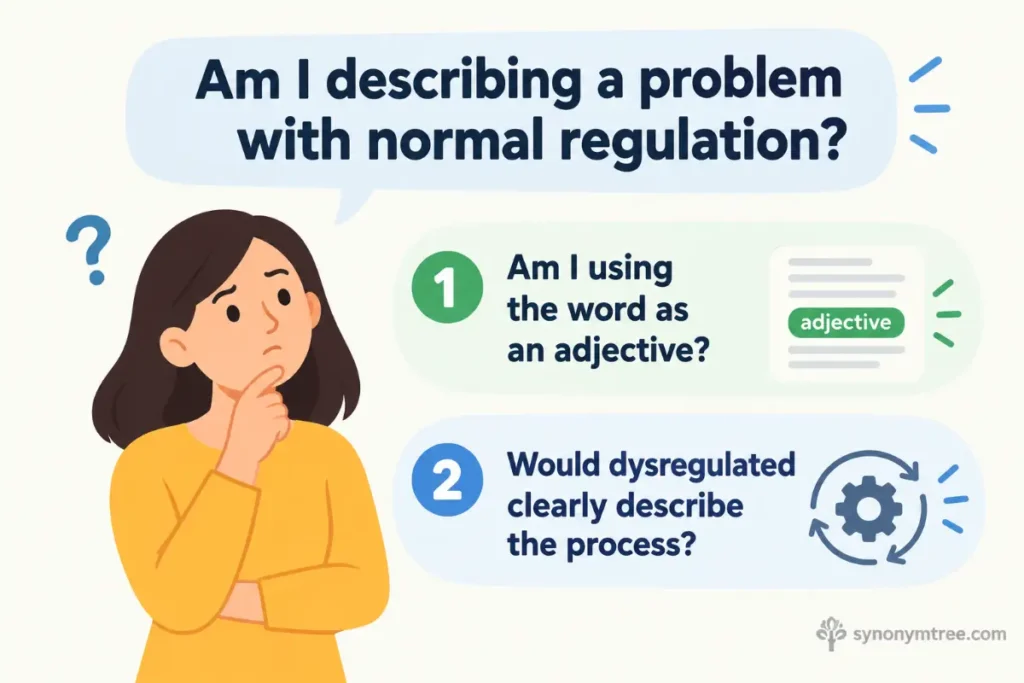
- Am I describing a problem with normal regulation.
- Am I using the word as an adjective.
- Would dysregulated clearly describe the process.
- Does my audience understand the term.
- Would a short explanation make the sentence clearer.
If the answer to the first three questions is yes, dysregulated is probably the right choice.
If your readers are unfamiliar with the word, add a plain explanation.
Practice Sentences
Try completing each sentence with the best form.
- The researchers studied a ______ stress response.
- The article explains emotional ______.
- The body uses several systems to ______ important processes.
- The team examined changes in ______ immune activity.
The answers are dysregulated, dysregulation, regulate, and dysregulated.
Now compare these sentences.
The system is dysregulated.
The system is regulated.
The first says the normal regulatory process is not working as expected.
The second says the system is being controlled normally.
The contrast makes the meaning easier to understand.
Final Teacher Explanation
The question of dysregulated vs disregulated becomes much easier once you focus on established usage instead of simply looking at the prefixes.
Dysregulated is the standard and widely preferred form in modern English. It describes something that is not regulating normally or effectively.
You will see it often in psychology, medicine, neuroscience, biology, and other fields that discuss systems and their control processes.
Disregulated can appear in some sources, but it is much less common. If you are writing for a general audience or preparing professional content, dysregulated is the better choice.
The word also has an important meaning beyond spelling. Dysregulated does not automatically mean completely uncontrolled. It describes a system whose normal regulatory process has changed or is not working as expected.
Conclusion
The answer to dysregulated vs disregulated is straightforward. Dysregulated is the standard and preferred form in modern English. It describes a system or process that is not regulating itself in its normal or expected way.
The word is especially common in psychology, neuroscience, medicine, and biology. You may see it in phrases such as emotional dysregulation, dysregulated stress responses, dysregulated immune activity, and dysregulated hormone signaling.
Disregulated may appear in some sources, but it is far less common. The fact that dis can suggest not does not make disregulated the preferred form. English vocabulary depends on established usage as well as logical word building.
For your own writing, remember the word family: regulate, regulation, dysregulation, and dysregulated. If you are describing a problem with normal regulation, choose dysregulated. If your readers may not know the term, explain it in simple words the first time you use it.
FAQs
Is Dysregulated Or Disregulated Correct?
Dysregulated is the standard and much more common form in modern English. It is especially common in psychology, medicine, biology, and neuroscience.
What Does Dysregulated Mean?
Dysregulated means that a system or process is not regulating itself in its usual or expected way. The word can describe emotional, biological, behavioral, or other regulatory processes.
Is Disregulated A Real Word?
Disregulated appears in some English sources, but it is much less common than dysregulated. For most modern writing, dysregulated is the preferred form.
What Is Emotional Dysregulation?
Emotional dysregulation refers to difficulty managing or adjusting emotional responses. It can involve emotions that feel unusually intense, last a long time, or are difficult to bring back to a manageable level.
Is Dysregulated A Medical Term?
Dysregulated is widely used in medical and scientific writing, but it is not limited to medicine. It can describe any system or process that is not being regulated normally.
Does Dysregulated Mean Out Of Control?
Not always. Dysregulated usually means that normal regulation is not working as expected, but the system may still have some ability to regulate itself.
What Is The Difference Between Dysregulation And Dysregulated?
Dysregulation is a noun that describes a problem or change in regulation. Dysregulated is an adjective that describes a system or process affected by that change.
How Can I Remember The Spelling Of Dysregulated?
Connect dysregulated with dysregulation and dysfunction. Both use the prefix dys, which can describe abnormal or impaired functioning.
