
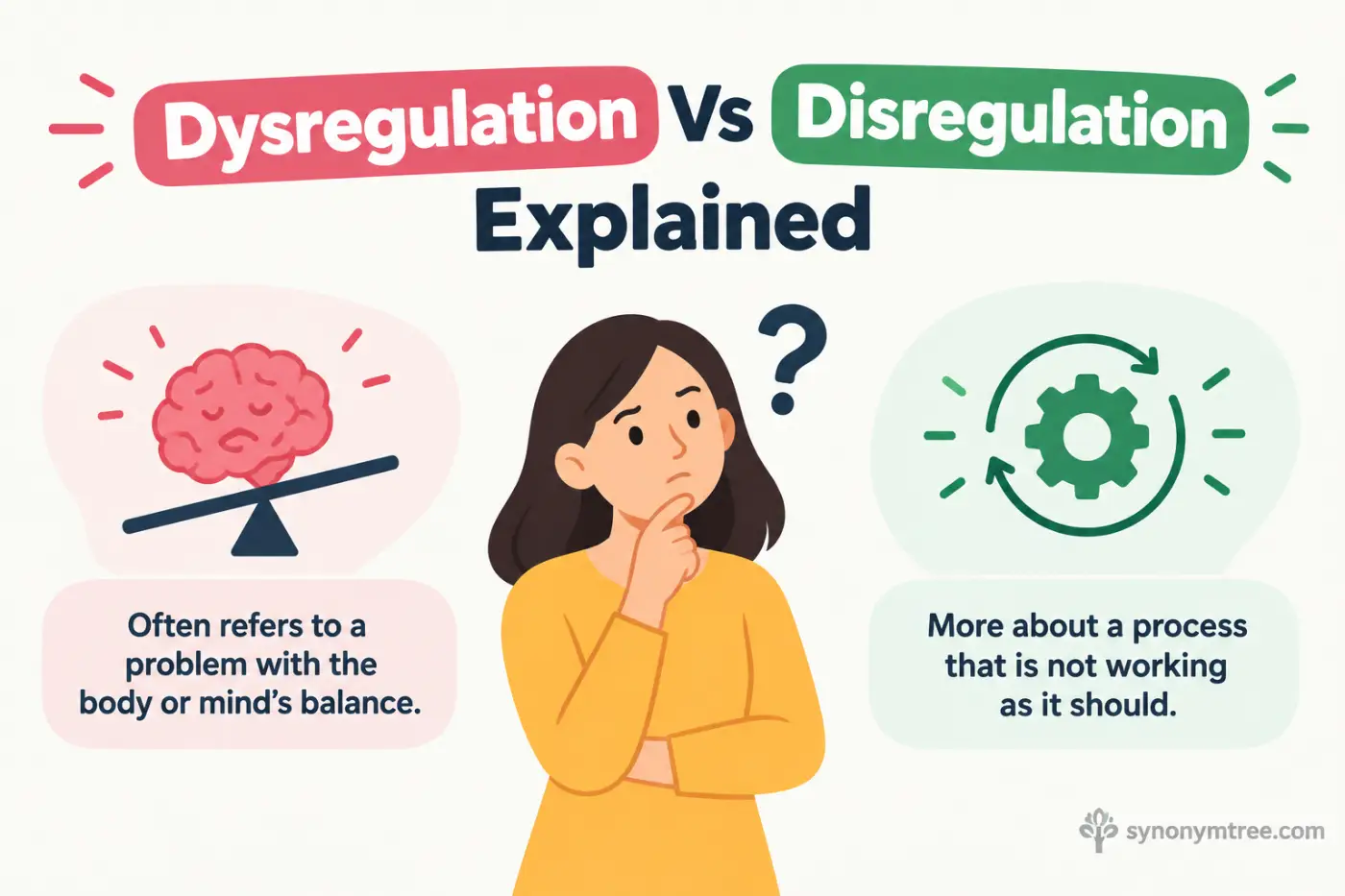
If you have seen the terms dysregulation and disregulation and wondered which one is correct, you are not alone. The difference can look small, but the two forms are not used in the same way. When you search for dysregulation vs disregulation, you will often find both forms, especially in writing about psychology, medicine, biology, and behavior.
The short answer is simple. Dysregulation is the standard and much more common term in modern English. Disregulation does appear in some sources, but it is far less common and is often treated as a nonstandard or less preferred form.
This guide explains why the confusion happens, what dysregulation means, where you will see it, and how it differs from related words such as regulation, deregulation, and disregulated. You will also see clear examples that show how these terms work in real sentences.
Quick Definition
Dysregulation means a failure or disruption in the normal control of a process. It is commonly used for emotional processes, body systems, biological functions, and other systems that normally stay within a controlled range.
Disregulation can be found in some writing, but dysregulation is the established form in most modern professional and academic use.
Direct Answer
Dysregulation is the preferred standard term in most modern English. Disregulation exists in some sources, but it is much less common and usually should not be your first choice.
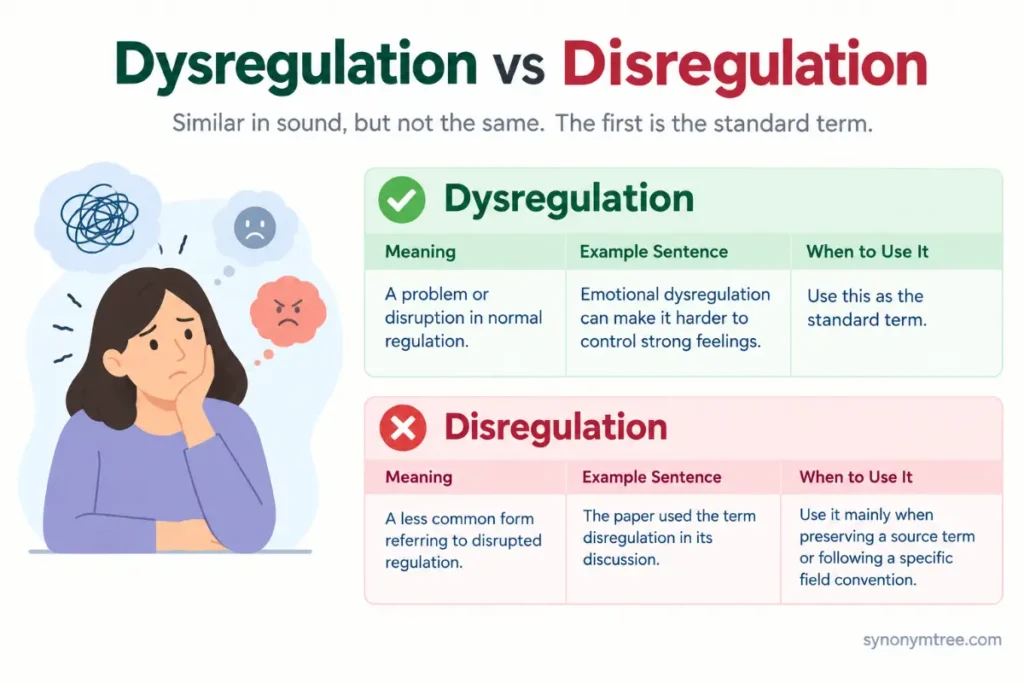
Comparison Table Dysregulation Vs Disregulation
| Word or Phrase | Meaning | Example Sentence | When to Use It |
|---|---|---|---|
| Dysregulation | A problem or disruption in normal regulation | Emotional dysregulation can make it harder to control strong feelings. | Use this as the standard term. |
| Disregulation | A less common form referring to disrupted regulation | The paper used the term disregulation in its discussion. | Use it mainly when preserving a source term or following a specific field convention. |
| Regulation | The process of controlling or managing something | The body uses several systems for temperature regulation. | Use it when the control process itself is meant. |
| Deregulation | Removal or reduction of rules or controls | The industry changed after government deregulation. | Use it when rules or controls are deliberately reduced or removed. |
Why These Words Cause Confusion
The main reason for the confusion is the prefix.
English uses many words that begin with dis. The prefix can suggest separation, reversal, removal, or a lack of something. This makes disregulation look perfectly logical at first glance.
Dysregulation looks less familiar because dys is not a common everyday prefix. It comes from Greek and is used in many scientific and medical terms. It generally points to something that is abnormal, difficult, impaired, or not working as expected.
That difference matters because English does not always build new words by simply attaching a familiar prefix to an existing word.
A person may see the word regulation and think that adding dis creates disregulation. From a basic spelling point of view, that seems reasonable. However, established vocabulary does not always follow the simplest pattern.
The form dysregulation became established in many professional fields. It now appears frequently in discussions of emotional control, biological systems, immune responses, hormones, metabolism, and other regulated processes.
That is why a person can encounter both spellings and still need help choosing the right one.
Another reason for the confusion is that dysregulation and deregulation look related. They are related in form, but they describe very different ideas.
Deregulation usually involves reducing or removing rules or controls. Dysregulation refers to a system failing to regulate itself properly.
That distinction becomes especially useful when you are editing professional writing.
What Dysregulation Means
Dysregulation describes a problem with normal regulation.
The word regulation refers to the act of controlling something. A regulated system keeps a process within a suitable range or follows a controlled pattern.
When that process stops working properly, dysregulation can occur.
Think about body temperature. The human body normally works to keep its internal temperature within a narrow range. That process involves several systems working together.
If that control system becomes disrupted, the body may have trouble maintaining its normal temperature. In a broad scientific sense, that kind of problem can be described as dysregulation.
The same basic idea applies to many other systems.
A person may experience emotional dysregulation when emotional responses become unusually difficult to manage. A biological system may show dysregulation when its normal control process becomes disturbed. A cellular process can also become dysregulated when its usual controls stop working as expected.
The key idea is not simply that something is active or inactive. The key idea is that the normal control process has been disrupted.
Dysregulation In Everyday Language
You are most likely to see dysregulation in professional or specialized writing. However, the basic meaning is easy to understand.
It means something is not regulating itself in the expected way.
For example:
- The child showed signs of emotional dysregulation after the stressful event.
- Sleep problems can sometimes affect emotional regulation.
- The researchers studied hormone dysregulation in the participants.
- The illness was linked to dysregulation of the immune response.
- The team examined changes in metabolic regulation.
These sentences all focus on a control system that is not working normally.
Dysregulation In Psychology
One of the most common uses of the term appears in psychology and mental health writing.
Emotional dysregulation refers to difficulty managing emotional responses. The issue can involve emotions that become very intense, last longer than expected, or are difficult to bring back to a calmer level.
For example, someone may become extremely upset after a relatively small event and struggle to calm down. A writer may describe that pattern as emotional dysregulation.
The word does not mean that a person is bad, weak, dramatic, or unable to control themselves in every situation. It describes a difficulty with emotional regulation.
This distinction is important.
A strong emotional reaction does not automatically mean dysregulation. People naturally experience anger, sadness, fear, excitement, and frustration. The term becomes useful when the focus is on a broader pattern involving difficulty with emotional control or regulation.
Dysregulation In Biology
Scientists also use dysregulation when discussing biological systems.
The body contains many systems that constantly regulate processes. These systems control things such as hormones, immune responses, metabolism, blood sugar, inflammation, and cell activity.
When a normal regulatory process becomes disrupted, researchers may describe the process as dysregulated.
For example, a scientific paper might discuss immune dysregulation. This means that the normal regulation of immune activity has been disturbed.
The same structure appears in many technical terms.
You may see phrases such as:
- Hormonal dysregulation.
- Immune dysregulation.
- Metabolic dysregulation.
- Inflammatory dysregulation.
- Emotional dysregulation.
The exact meaning depends on the system being discussed, but the central idea stays the same. Normal regulation has been disrupted.
Dysregulation Vs Disregulation In Standard Usage
When comparing dysregulation vs disregulation, frequency and established usage matter.
Dysregulation is the form most readers will recognize in modern professional writing. It is widely used in scientific, medical, psychological, and academic contexts.
Disregulation appears much less often. Some writers and sources use it as a logical formation from regulation, but it has not achieved the same level of standard use.
This does not mean that every appearance of disregulation is automatically an error. Language develops through actual use, and specialized fields sometimes develop their own vocabulary.
Still, if you are writing a general article, report, essay, website page, or professional document, dysregulation is normally the safer choice.
A useful editing rule is simple.
If you mean a disruption in normal regulation, choose dysregulation unless a specific source or field requires another form.
What The Prefix Dys Means
Understanding dys can make the spelling much easier to remember.
The prefix dys comes from Greek. In English, it appears in words connected with abnormal, impaired, difficult, or faulty function.
You can see the same pattern in several familiar terms.
Dysfunction refers to a problem with normal function.
Dyslexia refers to a specific difficulty involving reading and language processing.
Dyspnea refers to difficult or uncomfortable breathing.
Dysphagia refers to difficulty swallowing.
Dysregulation follows the same broad word building pattern.
Regulation means control or management of a process. Dysregulation refers to a problem with that normal regulation.
This does not mean that every word beginning with dys has exactly the same meaning. Prefixes can develop slightly different meanings in different words. Still, the general idea of difficulty or abnormal function helps explain why dysregulation became the established term.
What The Prefix Dis Means
Dis is one of the most common prefixes in English.
It can express ideas such as separation, opposition, reversal, removal, or lack of something.
Consider words such as disagree, disconnect, dislike, and distrust.
Because dis is so common, disregulation may look natural to an English speaker.
That is one of the main reasons people spell the word that way.
The problem is that established vocabulary does not always follow a simple rule where the most familiar prefix automatically creates the correct word.
English contains many words that have developed through different historical paths. The form that becomes standard depends on usage, history, and convention.
So the fact that disregulation looks logical does not make it the preferred spelling.
The Difference Between Dysregulation And Deregulation
This is another important distinction.
Dysregulation and deregulation are not interchangeable.
Dysregulation describes a failure or disruption in normal regulation.
Deregulation usually describes the deliberate removal or reduction of rules, controls, or restrictions.
For example, a scientific article might discuss dysregulation of a biological process.
A business article might discuss deregulation of an industry.
The first term focuses on a system that is not being regulated properly. The second focuses on rules or controls being reduced or removed.
Consider these examples:
- Researchers examined immune dysregulation in the study group.
- The government introduced economic deregulation.
The words may look similar, but the ideas are very different.
A Simple Way To Remember The Difference
Think of dysregulation as a problem with the system.
Think of deregulation as less regulation by design or policy.
That simple distinction can prevent many writing mistakes.
Dysregulation And Emotional Regulation
Emotional regulation is the ability to manage emotional responses in ways that fit the situation.
Everyone has emotions. Everyone has moments when feelings become intense. Emotional regulation does not mean staying calm all the time.
It means having ways to respond to emotions and return to a manageable state.
Emotional dysregulation describes a disruption in that process.
For example, a person may become intensely angry and find it very hard to calm down. Another person may become deeply upset by a small change and remain distressed for a long time.
A writer may describe these patterns as emotional dysregulation when the term fits the context.
Still, writers should avoid using the word as a casual label for every strong emotional reaction.
A person crying after receiving bad news is not automatically experiencing dysregulation. A person becoming angry after being treated unfairly is not automatically dysregulated.
Good writing uses the term when the context supports it.
Dysregulated And Dysregulation
These two forms are closely related, but they play different grammatical roles.
Dysregulation is a noun.
Dysregulated is an adjective.
Compare these examples:
- The study examined emotional dysregulation.
- The researchers described the participants as having dysregulated emotional responses.
In the first sentence, dysregulation names the problem or process.
In the second sentence, dysregulated describes the emotional responses.
You can also see the difference in scientific writing.
A researcher might study hormone dysregulation.
The researcher might then describe a hormone system as dysregulated.
The same word family works across many fields.
More Examples
- The article discusses emotional dysregulation in children.
- The researchers found evidence of immune dysregulation.
- The report described a dysregulated biological pathway.
- The team investigated dysregulation of the stress response.
- The paper focused on dysregulated immune activity.
These examples show how the noun and adjective forms work naturally.
Common Mistakes People Make about Dysregulation Vs Disregulation
Several mistakes appear again and again when people write these words.
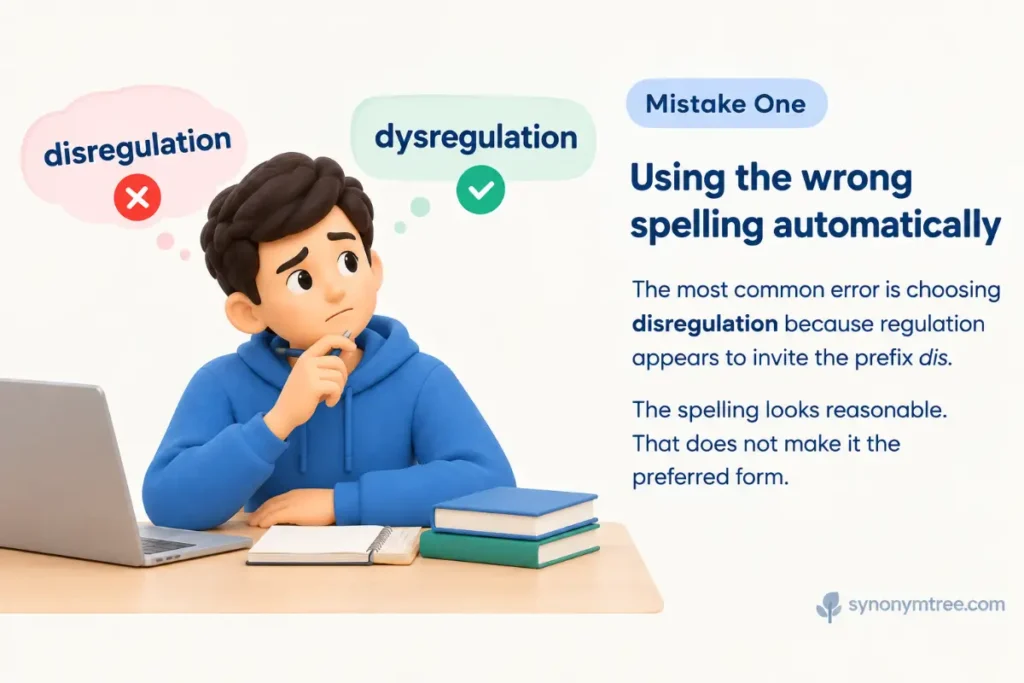
Mistake One Using Disregulation Automatically
The most common error is choosing disregulation because regulation appears to invite the prefix dis.
The spelling looks reasonable. That does not make it the preferred form.
If you are writing standard modern English, dysregulation is normally the better choice.
Mistake Two Confusing Dysregulation With Deregulation
These words describe different concepts.
Dysregulation refers to disrupted control.
Deregulation refers to reduced or removed rules or controls.
Using one in place of the other can change the meaning of a sentence.
Mistake Three Treating Dysregulation As A Synonym For Chaos
Dysregulation does not simply mean chaos.
A system can be dysregulated while still functioning in many ways. The term points specifically to a problem with regulation.
That makes it more precise than words such as messy, chaotic, unstable, or uncontrolled.
Mistake Four Using The Word Without Context
Dysregulation is useful, but it is not always the clearest word for a general reader.
A scientific paper may need the technical term. A general audience article may benefit from a plain explanation.
For example, instead of writing that a process shows dysregulation without explanation, you might explain that the process is not being controlled in its usual way.
That gives readers both the technical term and its meaning.
Mistake Five Assuming Every Strong Reaction Is Dysregulation
This mistake is especially common in casual writing about emotions.
Strong emotions are normal. Anger, fear, sadness, excitement, and frustration can all be intense without indicating a regulation problem.
Use the term carefully and avoid turning a technical description into a casual judgment about a person.
How To Use Dysregulation In A Sentence
The easiest way to learn a word is to see how it behaves in real sentences.
Here are several natural examples.
- Emotional dysregulation can affect how a person responds to stress.
- The researchers examined dysregulation of the immune system.
- The study explored the relationship between sleep and emotional regulation.
- The report described hormone dysregulation in the patient group.
- Scientists are studying how inflammation may involve immune dysregulation.
- The article explains how dysregulation can affect normal biological processes.
- The therapist discussed strategies for improving emotional regulation.
- The research team focused on dysregulated activity within the system.
- The paper described several possible causes of regulatory problems.
- The findings suggested that normal regulation had been disrupted.
Notice that not every sentence needs the technical word. Sometimes a plain phrase such as disrupted regulation or difficulty with emotional control is easier for readers.
Good writing chooses the clearest term for the audience.
When A Simpler Word Works Better
Technical vocabulary can make writing more precise, but it can also make simple ideas harder to understand.
If your readers already understand scientific or psychological language, dysregulation may fit naturally.
If your readers are general consumers, students, parents, or new learners, you may want to explain the term the first time you use it.
For example, you could write that emotional dysregulation means difficulty managing emotional responses.
After that explanation, you can use dysregulation naturally.
This approach works well because it keeps the technical term while making the meaning clear.
You do not need to replace every technical word with a simple word. You simply need to give readers enough context to understand it.
Is Disregulation Always Wrong
No simple spelling rule makes every use of disregulation impossible.
The word can be found in published material, including specialized writing. Some authors may use it as a direct formation from regulation.
However, uncommon does not always mean impossible.
If you are choosing a term for your own general English writing, dysregulation remains the stronger choice.
If you are quoting or closely discussing a source that uses disregulation, you may need to preserve the original form. In an academic setting, you should also follow the terminology preferred by the field, journal, organization, or style guide you are working with.
The important point is to understand the difference between a word that exists in some usage and a word that is the normal choice in standard usage.
Dysregulation is the normal choice for most readers.
Related Words You Should Know
Understanding related words can make the whole topic easier.
Regulation
Regulation is the process of controlling or managing something.
For example, temperature regulation helps keep body temperature within a suitable range.
Regulate
Regulate is the verb form.
You regulate something when you control or adjust it.
For example, the body regulates several important processes.
Regulatory
Regulatory is an adjective.
It describes something related to regulation.
For example, a regulatory system controls a biological process.
Dysregulate
Dysregulate is a verb.
It means to disrupt normal regulation.
For example, certain conditions can dysregulate a biological process.
Dysregulated
Dysregulated is an adjective or participial form.
It describes something that has experienced disrupted regulation.
For example, the researchers observed dysregulated activity.
Dysregulation
Dysregulation is the noun.
It refers to the disruption itself.
These words form a useful word family. Learning the family makes it easier to recognize the meaning of each form.
A Word Family Comparison
Consider this simple pattern:
Regulate means to control.
Regulation means the process of controlling.
Regulatory means related to control.
Dysregulate means to disrupt normal control.
Dysregulated means affected by disrupted control.
Dysregulation means the disruption of normal control.
Once you understand this pattern, many sentences become easier to read.
You can also see why dysregulation is not simply another way to say no regulation.
The word describes disrupted or abnormal regulation. It does not necessarily mean that regulation has completely disappeared.
How Writers Should Choose The Right Form
If you are writing an article, essay, report, or professional document, start with the meaning.
Ask yourself what you are trying to describe.
If you mean that a biological, emotional, or other controlled process is not functioning normally, dysregulation is usually the right choice.
If you mean that rules or controls have been deliberately reduced or removed, deregulation may be the correct word.
If you simply mean control or management, regulation is probably enough.
This three way distinction solves many problems.
Regulation means normal control.
Dysregulation means disrupted control.
Deregulation means reduced or removed control.
That is much easier to remember than trying to memorize isolated spellings.
A Practical Editing Test
Here is a quick test you can use when editing your own writing.
First, find the word that describes the regulation problem.
Second, ask if you mean a system is failing to regulate normally.
If the answer is yes, dysregulation is probably the word you need.
Third, ask if you instead mean that someone removed or reduced rules or controls.
If that is your meaning, check if deregulation fits better.
Finally, consider your audience.
If the readers may not know the technical term, explain it in plain English the first time you use it.
This test takes only a few seconds and can prevent several common vocabulary mistakes.
Why Established Usage Matters
English spelling is not always based on perfect logic.
Many words became standard because speakers and writers used them repeatedly over time. Once a particular form becomes established, another form that looks equally logical may remain uncommon.
That is why spelling decisions cannot always be solved by looking at prefixes alone.
Disregulation makes sense as a possible word formation. Dysregulation became the established term in many fields.
For writers, this is a useful lesson beyond this one word.
When two forms seem possible, look at established usage instead of relying only on what looks logical.
This is especially useful with technical vocabulary. Scientific and professional terms often follow historical patterns that may not be obvious from modern everyday English.
How Dictionaries And Professional Writing Can Differ
You may sometimes find both forms in dictionaries, databases, articles, or books.
That does not mean they have equal status or equal frequency.
A dictionary can record a word because people use it. It does not necessarily mean that the word is the most common or preferred choice in every setting.
Professional writing also varies by field.
A medical researcher may use terminology differently from a general journalist. A psychology paper may favor a term that is less common in everyday speech.
For this reason, context matters.
Still, for a general English question about the two spellings, dysregulation is the best default.
Dysregulation In Academic Writing
Academic writing often needs precise terms.
Dysregulation can be useful when a paper examines a system whose normal control has been disrupted.
For example, a research paper might discuss the dysregulation of immune activity.
Another paper might study emotional dysregulation and its relationship to stress.
The term allows researchers to describe a specific concept without using a long phrase every time.
However, academic writing should not become difficult simply because the topic is technical.
A strong writer introduces specialized vocabulary clearly and then uses it consistently.
For example, the first sentence might explain that emotional dysregulation refers to difficulty managing emotional responses. Later paragraphs can use the shorter term without repeating the full explanation.
That approach improves clarity without losing precision.
Dysregulation In Professional Communication
The same principle applies to workplace reports and professional documents.
If the audience knows the field, dysregulation may be perfectly natural.
If the audience includes people from outside the field, a short explanation can help.
For example, a report might state that the findings suggest dysregulation in the system, meaning that the normal control process may not be working as expected.
That sentence gives readers the technical term and the plain meaning at the same time.
It also reduces the chance that readers will misunderstand the word.
When To Avoid The Technical Term
Sometimes the best writing choice is not the most technical word.
If you are writing for children, new English learners, or a general audience, phrases such as disrupted regulation, poor control, or difficulty managing emotions may be easier.
The choice depends on the purpose of the sentence.
Technical vocabulary is useful when precision matters. Plain English is useful when quick understanding matters.
You can often use both.
For example, you can introduce dysregulation and immediately explain it in simple words. After that, you can use the technical term without making the reader stop and search for its meaning.
That is a good balance between accuracy and readability.
Memory Tricks For The Spelling
A simple memory trick can help.
Think of dysregulation as disrupted regulation.
Both words point to something that is not working normally.
You can also connect dys to other familiar words that describe problems with normal function.
Dysfunction means abnormal function.
Dysregulation means abnormal or disrupted regulation.
The shared dys pattern can make the spelling easier to remember.
Another useful trick is to separate the word mentally.
Dys plus regulation.
Dysregulation.
That is the form you will usually want in modern professional English.
Practice The Difference
Try reading these examples and notice the meaning.
- The study examined emotional dysregulation.
This sentence focuses on disrupted emotional control.
- The government introduced economic deregulation.
This sentence focuses on reducing rules or controls.
- The body regulates its internal temperature.
This sentence describes normal control.
- The researchers observed dysregulated immune activity.
This sentence describes immune activity that is not being regulated normally.
- The article explains regulation of blood sugar.
This sentence focuses on the control process itself.
These examples show how a small change in the word can change the meaning of the sentence.

A Quick Rule For Students about Dysregulation Vs Disregulation
If you are a student and only need one rule to remember, use this:
Use dysregulation for disrupted or abnormal regulation.
Use regulation for normal control.
Use deregulation for the reduction or removal of rules or controls.
Treat disregulation as an uncommon form that you generally should not choose in ordinary standard writing.
This rule will handle most situations you are likely to encounter.
A Quick Rule For Editors
Editors need a slightly more flexible rule.
Do not automatically change every occurrence of disregulation without checking the source and context.
First, determine what the writer means.
If the intended meaning is disrupted regulation, dysregulation will usually be the preferred form.
If the term comes from a quoted source, preserve the source wording when appropriate.
If the text follows a specific technical field or publication style, check the terminology used by that field.
Good editing is not just about replacing uncommon words. It is about preserving meaning while improving clarity and consistency.
Final Teacher Explanation
The confusion between these forms comes from the fact that disregulation looks like a logical English construction. The prefix dis is familiar, so it feels natural to place it before regulation.
But standard usage does not always follow the form that looks most logical.
Dysregulation became the established term for disrupted or abnormal regulation. It is common in psychology, biology, medicine, neuroscience, and other areas that discuss systems and their control processes.
Disregulation does appear, but it is much less common. That makes it a poor default choice for general writing.
The safest approach is to remember the meaning rather than the spelling alone.
If something normally regulates itself but that regulation becomes disrupted, think dysregulation.
If rules or controls are intentionally reduced or removed, think deregulation.
If you simply mean the normal process of control, think regulation.
That three word distinction gives you a reliable way to choose the right term.
Conclusion
The main point in dysregulation vs disregulation is simple. Dysregulation is the standard form you should normally use when you mean disrupted or abnormal regulation. Disregulation appears in some sources, but it is much less common.
It also helps to keep dysregulation separate from deregulation. Dysregulation describes a problem with normal control. Deregulation describes a reduction or removal of rules or controls. Regulation simply describes the process of control.
Once you understand that difference, the spelling becomes much easier. When a system is not regulating normally, choose dysregulation. When rules are being reduced or removed, choose deregulation. When you mean normal control, use regulation.
For everyday writing, professional documents, and most academic work, dysregulation is the safe default. If you remember only one thing, remember that dysregulation means disrupted regulation.
Frequently Asked Questions
Is dysregulation the correct spelling?
Yes. Dysregulation is the standard and much more common form in modern professional English. It is widely used for disrupted or abnormal regulation.
Is disregulation a real word?
Disregulation does appear in published writing, but it is much less common than dysregulation. For most general and professional writing, dysregulation is the better choice.
What does dysregulation mean in simple terms?
Dysregulation means that a normal control process is not working as expected. It can describe emotional, biological, physical, or other systems.
What is the difference between dysregulation and deregulation?
Dysregulation means disrupted or abnormal regulation. Deregulation usually means that rules or controls have been reduced or removed.
What is emotional dysregulation?
Emotional dysregulation refers to difficulty managing emotional responses. It can involve emotions that become very intense, last a long time, or are difficult to bring back to a manageable level.
Can I use disregulation in academic writing?
You may encounter disregulation in academic sources, but dysregulation is normally the safer choice. If a particular field, source, or publication uses disregulation, follow the relevant terminology when needed.
Is dysregulation the same as being out of control?
Not exactly. Dysregulation specifically refers to disrupted regulation, while out of control is a broader everyday phrase that can describe many different situations.
What is the easiest way to remember dysregulation?
Think of dysregulation as disrupted regulation. The dys form is the established choice when a normal regulation process becomes abnormal or impaired.
