
If you are confused about dought vs doubt, the answer is simple. Doubt is the correct English word when you mean uncertainty or a lack of confidence. Dought is not the standard spelling of this word.
This mistake is easy to make because the two forms look almost the same. The letters are arranged in a similar way, and the pronunciation can make the spelling harder to remember. If you have only heard the word in conversation, you may not know which letters belong in the written form.
The two forms also cause confusion because doubt has a silent b. That means the word does not sound the way it looks. Once you understand its meaning, pronunciation, spelling, and word family, the correct form becomes much easier to remember.
This guide explains the difference, shows how to use the correct word in everyday sentences, covers common mistakes, and gives you simple memory tricks. You will also learn related words such as doubtful, undoubtedly, and doubtless.
Quick Definition
Doubt means uncertainty about something or a lack of confidence that something is true, correct, or likely to happen. It can work as a noun or a verb. Dought is not the standard English spelling for this meaning.
Direct Answer
Doubt is the correct spelling when you mean uncertainty or a lack of belief. Dought is a misspelling in standard modern English.
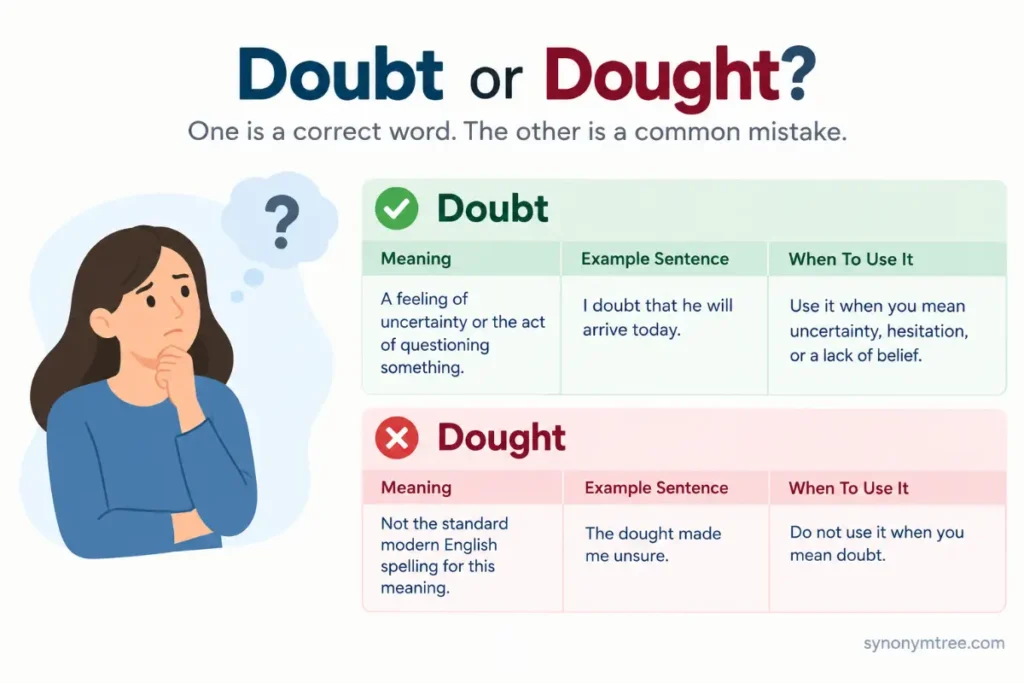
Comparison Table Dought Vs Doubt
| Word | Meaning | Example Sentence | When To Use It |
|---|---|---|---|
| Doubt | A feeling of uncertainty or the act of questioning something | I doubt that he will arrive today. | Use it when you mean uncertainty, hesitation, or a lack of belief. |
| Dought | Not the standard modern English spelling for this meaning | The dought made me unsure. | Do not use it when you mean doubt. |
What Doubt Means
Doubt is a common English word that describes uncertainty. When you doubt something, you are not fully convinced that it is true, correct, or going to happen.
For example:
I doubt his story.
This means I am not sure that his story is true.
You can also use doubt as a noun:
I have some doubt about his story.
Here, doubt refers to the feeling of uncertainty.
The word can describe a small amount of uncertainty or a strong lack of confidence. Context tells the reader how serious the uncertainty is.
For example:
I have some doubt about the plan.
This suggests mild uncertainty.
I have serious doubts about the plan.
This suggests a much stronger concern.
The word appears in everyday conversations, school writing, business communication, news reports, books, and many other types of English.
Doubt As A Noun
As a noun, doubt refers to a feeling or state of uncertainty.
For example:
She had doubts about the decision.
His answer left me with some doubt.
There is no doubt that she worked hard.
I have no doubt about his ability.
In these examples, doubt names a feeling or state of uncertainty.
You will often see the word with expressions such as some doubt, serious doubt, little doubt, no doubt, and reasonable doubt.
Each expression gives the reader more information about the level or type of uncertainty.
Doubt As A Verb
Doubt can also work as a verb. As a verb, it means to feel uncertain about something or to believe that something may not be true.
For example:
I doubt his explanation.
She doubts that the plan will work.
They doubt his ability to finish the job.
We doubt the story is accurate.
The verb can describe uncertainty about a fact, statement, person, plan, result, or future event.
It does not always mean that you believe the opposite is true. Sometimes it simply means you are not convinced.
For example:
I doubt that it will rain today.
This does not necessarily mean I know that it will not rain. It means I do not think rain is likely or I am not convinced that it will happen.
Why The Spelling Causes Confusion
The spelling problem comes partly from pronunciation. Doubt is usually pronounced like dowt. The b is silent.
That silent letter makes the written form less obvious. Someone who hears the word for the first time might try to spell it based on its sound.
This can lead to forms such as dought.
English has many words with silent letters. These letters often come from the history of the language rather than from the way modern speakers pronounce the word.
Doubt is one of those words.
The spelling contains b, but you do not pronounce that b in normal modern English.
This is why learning the word visually can help. If you have seen doubt many times in books and articles, the correct spelling starts to look natural.
The Silent B In Doubt
The b in doubt is silent.
You pronounce the word without saying a b sound.
The same silent letter appears in related words such as doubtful and undoubtedly.
For example:
I doubt his answer.
She is doubtful about the result.
There is undoubtedly a problem.
The spelling keeps the b even though the sound does not.
This is one reason spelling by pronunciation can cause trouble.
Why You Should Not Write The Word As It Sounds
English spelling does not always give you a perfect guide to pronunciation. If you wrote every word exactly as it sounded, many standard English spellings would become incorrect.
Doubt is a good example.
The pronunciation does not clearly tell you that the word contains b. You have to learn the spelling.
The same idea applies to many other English words with silent letters. Knowing that silent letters exist can help you stay alert when spelling difficult words.
The Difference Between Doubt And Dought
The main difference is simple. Doubt is a standard English word. Dought is not the standard modern English spelling for uncertainty.
If you are writing a sentence about uncertainty, use doubt.
For example:
I doubt that she knows the answer.
Do not write:
I dought that she knows the answer.
The first version is correct.
This applies to the related forms too. When you change the word into another grammatical form, the b remains part of the spelling.
For example:
doubt
doubts
doubted
doubting
doubtful
undoubtedly
The spelling changes slightly because of grammar, but the core letters remain.
How To Use Doubt In Real Sentences
Seeing the word in natural sentences is one of the best ways to understand it.
Here are some common examples.
- I doubt that he will change his mind.
- She had doubts about moving to another city.
- There is no doubt that he worked hard.
- His strange answer created doubt in my mind.
- We began to doubt the accuracy of the report.
- I have no doubt that you can finish the project.
- They doubted his ability to solve the problem.
- She is doubtful about the final result.
- The evidence raised serious doubts about the claim.
- I doubt anyone will complain about the change.
Notice how the meaning stays connected in every sentence. The word expresses uncertainty, questioning, or a lack of confidence.
Common Expressions With Doubt
Doubt appears in many common English expressions. Learning these phrases can help you use the word naturally.
No Doubt
No doubt means that something is considered certain or very likely.
For example:
There is no doubt that she is talented.
This means the speaker feels certain about her talent.
You can also use no doubt to mean probably or certainly in some contexts.
For example:
He will no doubt be happy to hear the news.
The phrase is common in both speech and writing.
In Doubt
In doubt means uncertain or not decided.
For example:
The final result is still in doubt.
This means the result is not certain yet.
You can also say:
If you are in doubt, ask your teacher.
Here, the phrase means that you are unsure about something.
Without A Doubt
Without a doubt means with complete confidence.
For example:
She is without a doubt one of the best players on the team.
The speaker feels very confident about the statement.
Beyond Doubt
Beyond doubt means completely certain.
For example:
The evidence proved his identity beyond doubt.
The phrase is often used in formal writing.
Doubt About Something
You can use doubt with about when you are uncertain about a subject.
For example:
I have doubts about the plan.
She expressed doubt about the decision.
The manager had doubts about the proposal.
This structure is common and natural.
Doubt And Believe
Doubt and believe express different levels of confidence.
To believe something means you accept it as true or likely.
To doubt something means you are not convinced that it is true or likely.
Compare these examples:
I believe his story.
I doubt his story.
The first sentence shows confidence.
The second shows uncertainty.
You can also use both ideas in one sentence.
For example:
I believe she is honest, but I still have some doubts about the plan.
This tells the reader that you trust the person but are not fully confident in the plan.
That kind of distinction is common in natural English.
Doubt And Suspect
Doubt and suspect are related, but they do not mean exactly the same thing.
To doubt something means you are not convinced that it is true.
To suspect something means you think it may be true, often because you have some reason to think so.
Compare:
I doubt that he took the money.
I suspect that he took the money.
The first sentence expresses disbelief or uncertainty.
The second suggests that the speaker thinks he may have taken it.
This difference matters in careful writing because the two words can point in different directions.
Doubt often reduces confidence.
Suspect often introduces a possible explanation.
Doubt And Uncertainty
Uncertainty is a broader word. It means a lack of certainty or knowledge.
Doubt is one type of uncertainty.
For example:
There is uncertainty about the final cost.
There is doubt about the accuracy of the report.
Both sentences show that something is not certain. The exact meaning depends on context.
Uncertainty can come from missing information. Doubt can also come from questioning the truth or reliability of something.
In everyday English, the two words can sometimes overlap.

Dought Vs Doubt In Questions
Doubt can appear in questions when someone wants to ask about confidence or uncertainty.
For example:
Do you doubt his story?
Why do you doubt me?
Do you have any doubts about the plan?
These questions ask about someone’s level of belief.
You can also use phrases such as:
Is there any doubt?
Do you have any doubt?
These forms are common in conversations.
For example:
Do you have any doubt that she can do it?
The question asks if the person feels uncertain about her ability.
Doubt In Negative Sentences
Doubt often appears with negative words. This can sometimes confuse learners because the meaning can become stronger.
Consider:
I do not doubt him.
This means I believe him or have no reason to question him.
Now compare:
I doubt him.
This means I am not confident in him or his statement.
The small word not changes the meaning significantly.
Another common expression is:
I have no doubt.
This means I am completely confident.
For example:
I have no doubt that you will succeed.
That sentence expresses strong belief.
Doubt In Formal Writing
Doubt is useful in formal writing because it allows you to express uncertainty without making an overly strong claim.
For example:
There is some doubt about the accuracy of the data.
This sounds careful and reasonable.
You can also write:
The evidence raises doubts about the original conclusion.
This tells the reader that the evidence creates a reason to question the conclusion.
Careful use of doubt can make writing more precise. It allows you to show that a claim is uncertain without saying that it is definitely false.
This is useful in research, reports, essays, news writing, and professional communication.
Reasonable Doubt
Reasonable doubt is a legal phrase. It refers to a level of uncertainty used in criminal trials.
In the United States, a criminal conviction generally requires the prosecution to prove the defendant’s guilt beyond a reasonable doubt.
This is a specific legal concept. It is different from simply saying that you have doubts about something in everyday conversation.
For example:
The jury must decide the case using the legal standard of proof beyond a reasonable doubt.
The phrase should be understood in its legal context when it appears in court related writing.
Common Mistakes People Make
Spelling is only one part of using doubt correctly. Writers can also make mistakes with grammar, word choice, and sentence structure.
Mistake One
Writing dought instead of doubt.
Incorrect:
I dought that he is telling the truth.
Correct:
I doubt that he is telling the truth.
The correct form contains b.
Mistake Two
Using doubt when you mean donation.
Doubt has nothing to do with giving money or resources. If you mean uncertainty, use doubt. If you mean money or something given to a person or organization, you may need donation.
The meanings are completely different.
Mistake Three
Confusing doubt with suspect.
If you doubt a statement, you are not convinced by it.
If you suspect something, you think it may be true.
Choosing the wrong word can change the meaning of your sentence.
Mistake Four
Forgetting The Silent B
Some writers know the word but forget the b because they do not hear it.
If you are unsure, remember that doubt is related to doubtful. Both forms keep the b.
Mistake Five
Using A Doubt When No Doubt Is More Natural
Some expressions have established patterns.
For example:
There is no doubt about it.
This sounds natural.
You would not normally replace no doubt with an invented phrase simply because you want to change the wording.
Learning common expressions can help you sound more natural.
A Simple Memory Trick
One easy way to remember the spelling is to connect doubt with doubtful.
Both words contain the silent b.
Think:
Doubt.
Doubtful.
The b stays in both.
You can also remember the word through its related forms.
Doubt.
Doubted.
Doubtful.
Undoubtedly.
The pronunciation may hide the b, but the spelling keeps it.
Another useful trick is to remember that doubt is related to the idea of two possible answers. When you are in doubt, you are unsure which answer is correct.
You do not need to create a complicated spelling rule. The best approach is to remember the word as a complete spelling pattern.
The Word Family
Understanding related words can make the spelling easier and improve your vocabulary at the same time.
Doubt
Doubt can be a noun or verb.
Example:
I doubt his explanation.
Example:
I have some doubt about the result.
Doubts
Doubts is the plural noun or third person singular form of the verb.
Example:
She has doubts about the plan.
Example:
He doubts that the story is true.
Doubted
Doubted is the past form.
Example:
I doubted his answer at first.
Doubting
Doubting is the form used for an action in progress or as a noun form.
Example:
She is doubting her decision.
Doubtful
Doubtful is an adjective. It means uncertain or unlikely.
Example:
I am doubtful about the plan.
It can also mean unlikely.
Example:
It is doubtful that the team will finish today.
Undoubtedly
Undoubtedly is an adverb. It means certainly or without doubt.
Example:
She is undoubtedly one of the strongest players on the team.
The word family gives you several ways to express different levels of confidence.
Doubt In Everyday Conversation
People use doubt naturally when they are unsure about plans, information, promises, and predictions.
For example:
I doubt he will be here on time.
I doubt that will work.
I have my doubts.
Do not doubt yourself.
There is no doubt about it.
These phrases are common because uncertainty is part of everyday communication.
You might use doubt when discussing the weather, a friend’s promise, a school assignment, a business plan, or a future event.
For example:
I doubt we will finish before lunch.
That sentence simply means the speaker does not think finishing before lunch is likely.
Doubt In School And Academic Writing
Students often need to express uncertainty carefully.
Instead of making an absolute claim, a writer can explain that the evidence creates doubt.
For example:
The new evidence raises doubts about the original theory.
Another example is:
There is some doubt about the reliability of the results.
These sentences are useful because they do not claim that the theory or results are definitely wrong. They simply explain that there is a reason to question them.
This is an important skill in academic writing. Good writers distinguish between what they know, what they believe, and what remains uncertain.
Doubt In Business Writing
The word also appears in emails, reports, proposals, and workplace discussions.
For example:
I have some doubts about the proposed schedule.
The manager expressed doubts about the cost.
There is no doubt that the project needs more time.
These sentences can sound professional without being overly complicated.
If you need to disagree with an idea politely, doubt can be useful.
For example:
I have some doubts about the current approach.
This sounds less direct than:
The current approach is wrong.
The first sentence leaves room for discussion. The second makes a stronger claim.
How To Choose The Right Word
When you are writing and cannot remember the spelling, first identify the meaning.
If you mean uncertainty, think of doubt.
If you mean a person who gives something, you need donor.
If you mean something given to support a person or cause, you may need donation.
If you mean an action of giving, use donate.
Meaning should come before spelling.
Once you know what you want to say, the correct word becomes easier to choose.
For doubt specifically, remember the silent b.
A Three Word Check
Ask yourself three questions.
- Am I talking about uncertainty?
If yes, use doubt.
- Am I describing someone who gives something?
If yes, use donor.
- Am I describing something that was given?
If yes, use donation.
This quick check can prevent several common English mistakes.
Examples With Different Meanings
Doubt can express several related ideas.
Uncertainty About A Fact
I doubt that the information is correct.
The speaker is not convinced that the information is accurate.
Uncertainty About A Person
I doubt his honesty.
The speaker does not fully trust the person.
Uncertainty About A Future Event
I doubt that they will arrive tonight.
The speaker does not think the event is likely.
Questioning A Decision
She began to doubt her decision.
She became less confident that her decision was right.
Strong Confidence
There is no doubt that he worked hard.
The speaker feels completely certain.
These examples show how flexible the word can be.
Is Dought Ever Used In English
In standard modern English, dought is not the normal spelling for uncertainty.
You may encounter the form in historical texts, names, unusual language contexts, or writing that contains spelling errors. That does not make it the standard modern spelling.
For ordinary English writing, use doubt.
If you are writing an essay, email, article, school assignment, report, or social media post and you mean uncertainty, doubt is the form you want.
How Pronunciation Can Help
Pronunciation can sometimes help you recognize the word, but it cannot fully explain its spelling.
Doubt sounds like dowt.
The b is silent.
This means you should not try to spell the word only from its sound.
Instead, learn the visual pattern:
D O U B T.
Once you recognize the shape of the word, it becomes easier to reproduce correctly.
Reading also helps. Every time you see doubt in a sentence, your brain gets another chance to store the correct spelling.
A Short Practice Test
Try choosing the correct word in each sentence.
- I ___ that he knows the answer.
- She had serious ___ about the decision.
- There is no ___ that the team worked hard.
- They began to ___ the accuracy of the report.
- His actions created ___ about his intentions.
The correct answers are doubt, doubts, doubt, doubt, and doubt.
Now try identifying the correct word family.
- The person who gives money is a ___.
- The act of giving money is a ___.
- To give money is to ___.
- Feeling uncertain is to ___.
The answers are donor, donation, donate, and doubt.
These words may look or sound confusing when you study them together, but their meanings are very different.
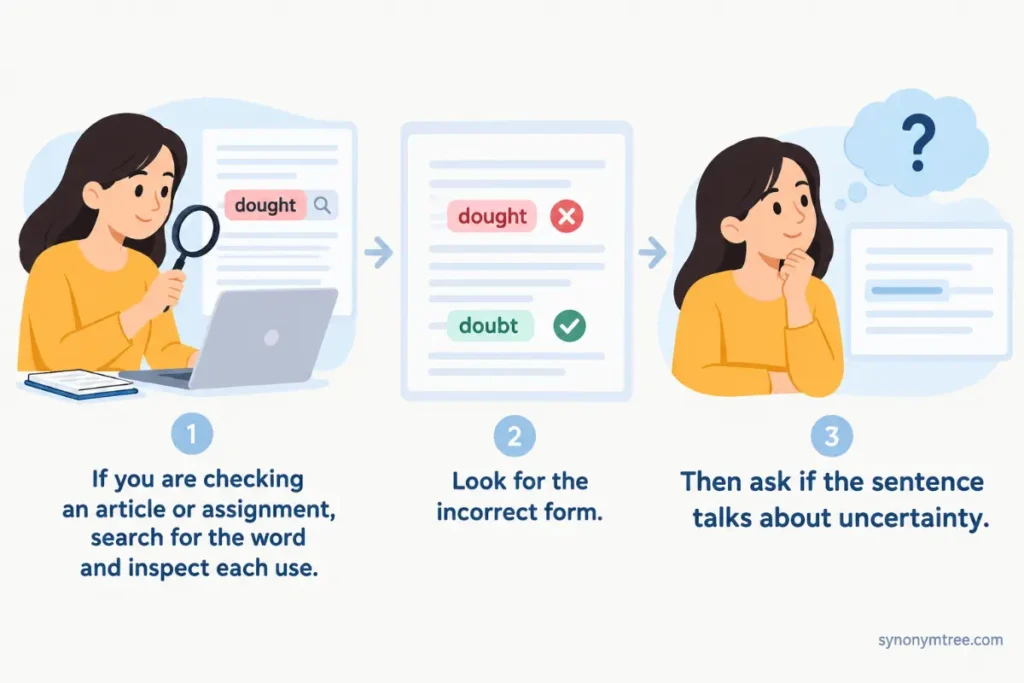
How To Proofread The Word Dought Vs Doubt
If you are checking an article or assignment, search for the word and inspect each use.
Look for the incorrect form.
Then ask if the sentence talks about uncertainty.
If it does, the standard spelling is doubt.
Next, check the grammar.
If doubt is used as a noun, it may follow words such as some, serious, little, or no.
For example:
She has some doubt about the plan.
If it is used as a verb, it can describe what someone questions.
For example:
She doubts the plan will work.
Checking both spelling and grammar will give you a stronger final sentence.
Why Learning Word Families Helps
Memorizing one spelling can be difficult. Learning a small family of related words gives your brain more connections.
When you learn doubt, also learn doubtful and undoubtedly.
When you see these words repeatedly, the silent b becomes familiar.
The same approach works with many difficult English words. Instead of memorizing a single isolated spelling, connect it to related words.
For example:
Doubt.
Doubted.
Doubtful.
Undoubtedly.
These forms reinforce the same spelling pattern.
Final Teacher Explanation
If you remember only one thing, remember this: doubt is the standard English word for uncertainty.
The spelling includes b even though you do not pronounce it.
That silent letter is the main reason people make spelling mistakes with this word. The incorrect form can seem logical if you are spelling from sound, but English spelling often keeps letters that are not pronounced.
Doubt can be a noun or a verb. As a noun, it describes uncertainty. As a verb, it means to question something or lack confidence in its truth or success.
For example:
I have some doubt about the plan.
I doubt that the plan will work.
Both sentences use the same word, but the grammar is different.
The easiest memory trick is to connect doubt with doubtful. Both words keep the silent b.
Conclusion
The answer to dought vs doubt is clear. Doubt is the correct spelling when you mean uncertainty, hesitation, or a lack of confidence. Dought is not the standard modern English form for this meaning. The main spelling challenge is the silent b. You hear the word as dowt, but you write doubt. Remembering the related word doubtful can make the spelling easier because it keeps the same silent letter.
Doubt can work as both a noun and a verb. You can have doubts about a plan, or you can doubt that something is true. Common phrases such as no doubt, in doubt, without a doubt, and beyond doubt are also useful to learn.
When you are unsure how to spell the word, connect it with doubtful and remember the b. If the sentence is about uncertainty, write doubt.
FAQs
Is Dought Or Doubt The Correct Spelling?
Doubt is the correct standard English spelling when you mean uncertainty or a lack of confidence. Dought is not the standard modern spelling for this meaning.
Why Is The B Silent In Doubt?
The b in doubt is not pronounced in modern English. The spelling comes from the history of the word, so the written form keeps the b even though modern pronunciation does not.
What Does Doubt Mean?
Doubt means uncertainty or a lack of confidence that something is true, correct, or likely. It can also mean questioning a person, statement, decision, or prediction.
Is Doubt A Noun Or A Verb?
Doubt can be both a noun and a verb. As a noun, it describes uncertainty, while as a verb, it describes the act of questioning or lacking confidence.
What Is The Difference Between Doubt And Doubtful?
Doubt can function as a noun or verb. Doubtful is an adjective that describes someone who feels uncertain or something that seems unlikely.
What Is The Past Tense Of Doubt?
The past tense is doubted. For example, you can say that she doubted his explanation.
How Do You Remember The Spelling Of Doubt?
Remember the silent b in doubt and connect it with doubtful. Both words keep the same b even though you do not pronounce it.
Can Dought Be Used In Modern English?
Dought is not the standard spelling when you mean uncertainty. For normal modern English writing, use doubt.
