
If you have ever confused eccentric and eclectic, you are not alone. The words look and sound somewhat alike, but they describe very different things. When people search for eccentric vs eclectic, they usually want to know which word describes a person, style, taste, idea, or collection.
The simplest answer is this. Eccentric describes something unusual or different from what most people consider normal. Eclectic describes something that draws ideas, styles, or choices from many different sources.
That small difference can completely change a sentence. An eccentric person may behave in an unusual way. An eclectic person may have many different interests. An eccentric outfit may look strange or unexpected. An eclectic outfit may combine pieces from several styles.
This guide explains both words in plain English. You will learn what each word means, how to use them in sentences, how they differ from similar words, and how to remember the difference without memorizing a complicated rule.
Quick Definition
Eccentric means unusual, unconventional, or noticeably different from what most people expect. It often describes a person, behavior, style, idea, or habit.
Eclectic means choosing or combining things from many different sources, styles, or ideas. It often describes tastes, collections, designs, interests, or approaches.
Direct Answer
Eccentric means unusual or unconventional. Eclectic means made from a wide mix of different sources or styles.
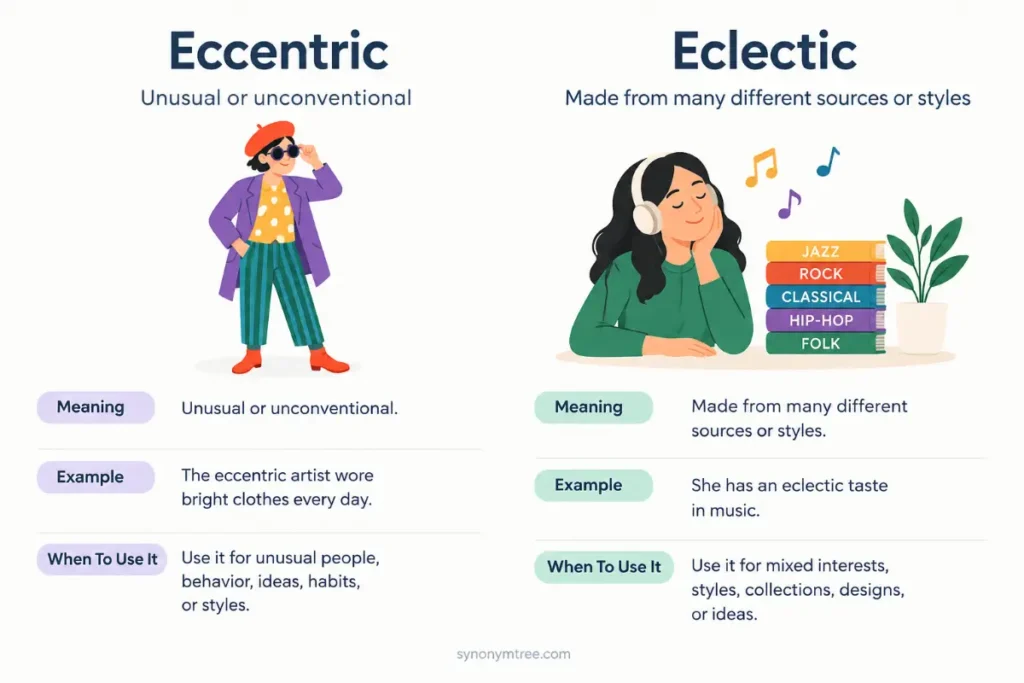
Comparison Table For Eccentric Vs Eclectic
| Word | Meaning | Example Sentence | When To Use It |
|---|---|---|---|
| Eccentric | Unusual or unconventional | The eccentric artist wore bright clothes every day. | Use it for unusual people, behavior, ideas, habits, or styles. |
| Eclectic | Made from many different sources or styles | She has an eclectic taste in music. | Use it for mixed interests, styles, collections, designs, or ideas. |
Why These Words Cause Confusion
The biggest reason for the confusion is their appearance.
Eccentric and eclectic both begin with ec and contain similar letters. They also tend to appear in descriptions of people, art, fashion, homes, and personal tastes. That overlap can make it easy to pick the wrong word.
Their meanings are different, though.
Eccentric focuses on being unusual.
Eclectic focuses on variety.
That is the key distinction.
Imagine two people named Alex and Jordan.
Alex dresses in a way that surprises everyone. Alex wears a formal suit with bright green shoes and a large vintage hat.
You could describe Alex as eccentric because the focus is on unusual behavior and choices.
Jordan has a completely different style. Jordan enjoys jazz, country music, classical music, hip hop, and electronic music.
You could describe Jordan as eclectic because the focus is on variety.
Neither word means simply good or bad. The meaning depends on the context and the writer’s attitude.
What Eccentric Means
Eccentric describes someone or something that does not follow the usual pattern.
When you call a person eccentric, you usually mean that the person behaves, dresses, thinks, or lives in a way that seems unusual.
The word can describe harmless personal quirks. It can also describe ideas or styles that stand far outside common expectations.
For example:
- My uncle has an eccentric habit of collecting old keys.
- The eccentric painter wore a different colored sock on each foot.
- Her eccentric style makes her easy to recognize.
- The professor was known for his eccentric teaching methods.
- The author created an eccentric character who lived in a house full of clocks.
In each sentence, the main idea is unusual behavior or appearance.
Eccentric As A Description Of A Person
Eccentric is often used to describe people.
An eccentric person may have unusual habits, interests, clothing, opinions, or ways of doing things.
The word does not automatically mean strange in a negative way. In many contexts, it can sound affectionate or even admiring.
For example, a writer might describe a famous artist as eccentric because the artist had unusual habits and a very distinctive personality.
That description can suggest creativity and individuality rather than something harmful.
Still, context matters. If someone says that a person has an eccentric habit of talking to empty chairs, the word may sound more strongly negative or critical.
The meaning depends on the surrounding words.
Eccentric As A Description Of Behavior
Eccentric can also describe an action or habit.
An eccentric habit is unusual enough to stand out.
For example, imagine someone who refuses to use chairs and always sits on the floor. That could be called an eccentric habit if the writer wants to emphasize how unusual it is.
Other examples include:
- He has an eccentric morning routine that includes reading three newspapers at once.
- Her eccentric habit of naming every plant makes visitors smile.
- The artist had an eccentric way of organizing his studio.
- The writer was famous for his eccentric working hours.
The word focuses on the unusual nature of the behavior.
Eccentric As A Description Of Style
Eccentric can describe clothing, interior design, art, architecture, and other forms of personal expression.
An eccentric style often breaks common expectations.
For example, someone might decorate a living room with bright purple walls, antique furniture, oversized clocks, and unusual sculptures. The overall design could be called eccentric because it is highly unusual.
The important idea is not simply that the room contains many styles.
The focus is that the result looks unusual or unconventional.
That difference becomes clearer when you compare eccentric with eclectic.
What Eclectic Means
Eclectic describes something that combines ideas, styles, tastes, or items from different sources.
The word is strongly connected with variety.
An eclectic person may enjoy many different kinds of music, books, food, art, or hobbies. An eclectic room may combine furniture from different periods.
For example:
- She has an eclectic taste in music.
- His bookshelf contains an eclectic mix of novels, biographies, and science books.
- The restaurant has an eclectic menu with dishes inspired by several cultures.
- Their home has an eclectic design that combines old and new furniture.
- The museum has an eclectic collection of paintings.
The focus in these examples is variety and combination.
Eclectic As A Description Of Taste
One of the most common uses of eclectic is to describe personal taste.
You might hear someone say that a person has eclectic taste in music.
That means the person does not stick to one type of music. They may enjoy classical music in the morning, rock in the afternoon, jazz at night, and country music on the weekend.
The person’s taste is broad and varied.
The person does not have to be unusual in behavior. The word simply tells you that their interests come from many different sources.
Eclectic As A Description Of Design
Interior design is another common area where you will see eclectic.
An eclectic room can bring together furniture, colors, patterns, and objects from different styles.
For example, a room might contain a modern sofa, an antique table, a handmade rug, a vintage lamp, and contemporary artwork.
The room has variety because the objects come from different styles and periods.
That is what makes the design eclectic.
It does not have to look strange.
It can be warm, balanced, and attractive while still combining many different influences.
Eclectic As A Description Of Ideas
Eclectic can also describe an approach to ideas.
A person may have an eclectic approach to learning because they use ideas from history, science, literature, psychology, and art.
A writer may have an eclectic reading list because it includes many different genres.
A teacher may use an eclectic teaching approach by drawing useful methods from several educational traditions.
Again, variety is the central idea.
Eccentric Vs Eclectic In Simple Terms
The easiest way to separate the two words is to ask one question.
Is the main idea unusualness or variety?
If the main idea is unusualness, eccentric probably fits.
If the main idea is variety from different sources, eclectic probably fits.
Consider these two examples.
She has an eccentric personality.
This tells you that her personality is unusual.
She has eclectic interests.
This tells you that her interests cover many different areas.
The person could be both.
Someone can have an eccentric personality and eclectic interests.
For example, a person might collect unusual objects, dress in a very strange way, and enjoy everything from opera to heavy metal. The person could be eccentric because of their unusual behavior and eclectic because of their wide range of interests.
The words describe different qualities.
The Difference Between Eccentric And Strange
Eccentric and strange are related, but they are not exact synonyms.
Strange is a broad everyday word. It means unusual or unfamiliar.
Eccentric is more specific. It often describes a person or style that is noticeably unconventional.
Compare these examples:
- That was a strange noise.
- He has an eccentric personality.
You can use strange for many things. You can use eccentric when you want to emphasize unusual behavior, personal style, or unconventional choices.
Eccentric can also sound more colorful and descriptive than strange.
The Difference Between Eclectic And Diverse
Eclectic and diverse both involve variety, but they are not identical.
Diverse means containing many different types of people, things, ideas, or qualities.
Eclectic usually suggests that someone has selected or combined things from different sources.
For example, a diverse group may contain people from many backgrounds.
An eclectic collection may contain objects chosen from many different periods or styles.
The word diverse focuses on difference within a group.
The word eclectic often focuses on the act or result of bringing different influences together.
That is why eclectic is especially common when talking about taste, art, design, collections, and ideas.
The Difference Between Eclectic And Varied
Varied is another related word.
A varied collection contains different kinds of things.
An eclectic collection goes a step further by suggesting that the items come from a range of different sources, styles, traditions, or influences.
For example, a bookstore may have a varied selection of books.
A person’s reading taste may be described as eclectic if they read mystery novels, poetry, history, science fiction, biographies, and ancient literature.
The two words can overlap.
Eclectic simply gives a stronger sense of mixed influences.
The Difference Between Eccentric And Unconventional
Eccentric and unconventional are close in meaning.
Unconventional means not following the usual way of doing something.
Eccentric often adds the idea of personal oddness or unusual character.
For example, an unconventional business owner might allow employees to choose their own working hours.
An eccentric business owner might hold meetings in a treehouse while wearing a bright costume.
The first example breaks a normal rule.
The second example feels personally unusual.
The distinction is not absolute. In many sentences, the two words can overlap.
Still, eccentric often sounds more vivid.
How To Use Eccentric In Real Sentences
Learning a word becomes easier when you see it in natural situations.
Here are several examples.
- The eccentric inventor built a tiny house in his backyard.
- Her eccentric fashion choices became part of her public image.
- The old man had an eccentric habit of speaking to his garden.
- The artist was known for her eccentric personality.
- The character has an eccentric sense of humor.
- His eccentric ideas made the discussion more interesting.
- The professor had an eccentric teaching style.
- The writer created an eccentric hero who never followed ordinary rules.
- Her eccentric behavior surprised everyone at the party.
- The shop owner is famous for his eccentric decorations.
In all these examples, the word points toward something unusual or unconventional.
How To Use Eclectic In Real Sentences
Now compare examples using eclectic.
- She has an eclectic taste in music.
- His library has an eclectic collection of books.
- The house combines several styles in an eclectic design.
- The artist draws from an eclectic range of influences.
- The restaurant offers an eclectic mix of dishes.
- Her wardrobe is eclectic and full of unexpected combinations.
- The course uses an eclectic group of readings.
- He has eclectic interests that include astronomy, cooking, history, and theater.
- The gallery displayed an eclectic collection of artwork.
- Their playlist is wonderfully eclectic.
Notice the pattern.
The word usually appears when several different sources, styles, interests, or influences come together.
Common Mistakes With These Words
Because the words look similar, writers sometimes swap them.
That can create an unclear or incorrect sentence.
Mistake One Calling A Mixed Collection Eccentric
Suppose you write:
She has an eccentric collection of books.
This could mean her collection is unusual or strange.
If you mean that she has books from many different subjects and genres, eclectic is better.
She has an eclectic collection of books.
Now the reader knows that the collection contains a broad mix.
Mistake Two Calling An Unusual Person Eclectic
Suppose you write:
He is an eclectic man.
That sentence may confuse readers because eclectic usually describes the variety of someone’s tastes or interests rather than simply saying that the person behaves strangely.
If you mean that he has unusual behavior, eccentric is clearer.
He is an eccentric man.
If you mean that he enjoys many different subjects, you could write:
He has eclectic interests.
Mistake Three Thinking Eclectic Means Random
Eclectic does not simply mean random.
An eclectic collection may contain very different items, but they are often connected by someone’s choices or interests.
A person may deliberately combine several styles.
For example, an eclectic room may include modern furniture and antique objects because the owner likes both.
The combination may be carefully chosen.
Mistake Four Thinking Eccentric Means Bad
Eccentric does not automatically mean bad.
An eccentric person may be creative, funny, independent, or simply unusual.
The word can be positive, neutral, or negative depending on context.
For example, calling an artist eccentric may suggest originality.
Calling someone’s behavior eccentric during a serious event may sound critical.
Context gives the word its tone.
Eccentric Vs Eclectic In Art
Art is one area where both words appear often.
An eccentric artist may have unusual habits, a strange personal style, or unconventional ideas.
An eclectic artist may draw inspiration from many different artistic traditions.
These are not the same thing.
Imagine a painter who creates huge portraits while wearing a different costume every day. The artist could be called eccentric.
Now imagine a painter who combines elements from classical painting, pop art, street art, and traditional folk art. The artist could be called eclectic.
The first description focuses on the artist’s unusual character.
The second focuses on the range of influences in the artwork.
An artist can also be both.
A highly unusual artist may have an eccentric personality and an eclectic artistic style.
Eccentric And Eclectic In Fashion
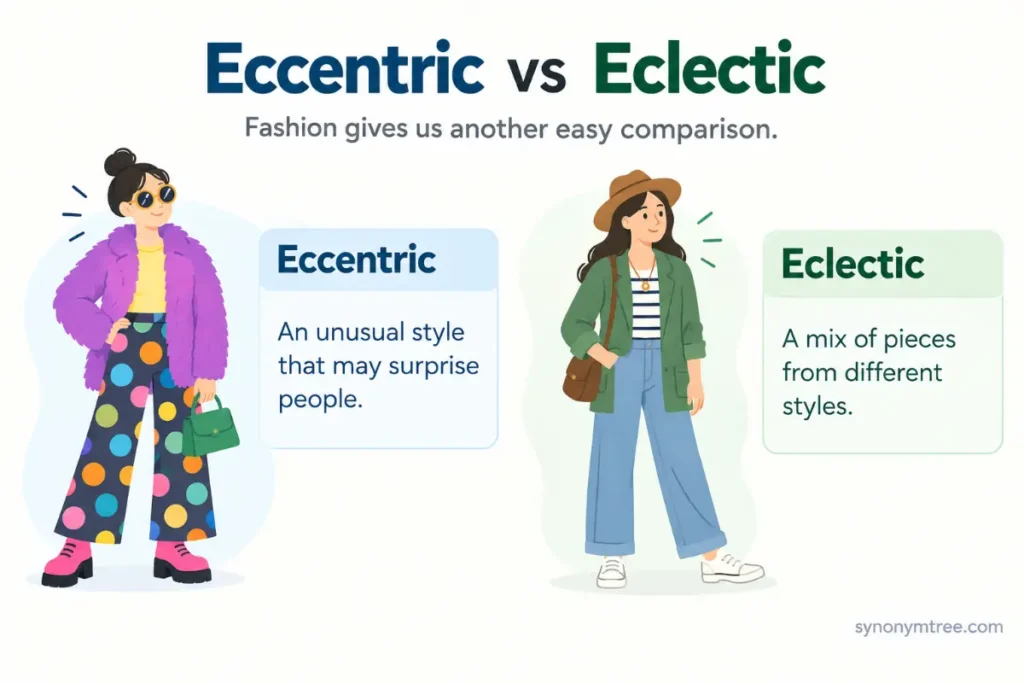
Fashion gives us another easy comparison.
An eccentric outfit is unusual and may surprise people.
An eclectic outfit combines pieces from different styles.
Imagine someone wearing a bright yellow jacket with a large feathered hat and unusual boots. The outfit may be eccentric because it stands out strongly.
Now imagine someone wearing vintage jeans, a modern jacket, a traditional scarf, and handmade jewelry. That outfit may be eclectic because it combines several styles.
Again, the words can overlap.
An eclectic outfit may look eccentric.
But eclectic describes the mixture. Eccentric describes the unusual result.
Eccentric And Eclectic In Interior Design
These words are especially useful when describing homes.
An eccentric room might have an unusual layout, strange furniture, bold decorations, or unexpected objects.
An eclectic room might combine modern, vintage, traditional, and handmade pieces.
For example, a living room with a sofa shaped like a giant cloud could be called eccentric.
A living room with a modern sofa, antique cabinet, woven rug, industrial lamp, and classic paintings could be called eclectic.
The difference becomes clear when you ask what stands out.
Eccentric asks you to notice what is unusual.
Eclectic asks you to notice what has been brought together from different styles.
Eccentric And Eclectic In Music
Music also provides useful examples.
A musician can be eccentric because of unusual behavior, appearance, or performance choices.
A musician can be eclectic because their music draws from many genres.
For example, a singer who performs every concert in a completely different costume may be described as eccentric.
A singer who combines jazz, folk, rock, soul, and classical influences may be described as eclectic.
The music itself can also be eclectic.
An eclectic playlist may contain songs from many genres, decades, and cultures.
The playlist does not have to be strange. It simply has variety.
Eccentric And Eclectic In Personality
Personality is another area where the distinction matters.
An eccentric personality is unusual.
An eclectic personality can suggest a person with many different interests or influences, but writers often use eclectic to describe someone’s taste rather than their basic personality.
For example:
She has an eccentric personality and an eclectic taste in music.
This sentence works well because each word has a separate job.
Eccentric describes her unusual personality.
Eclectic describes the wide range of her musical preferences.
This is a good example of how the two words can appear together without meaning the same thing.
Can A Person Be Both Eccentric And Eclectic
Yes.
A person can be eccentric and eclectic at the same time.
Imagine a designer who wears unusual clothes, collects rare objects, listens to many kinds of music, and mixes several design traditions in every project.
The person may be eccentric because their personal behavior and style are unusual.
Their tastes may be eclectic because they draw from many different sources.
The two words describe different features.
This is an important point because the words are not opposites.
You do not have to choose one word for a person in every situation.
Choose the word that matches the quality you want to describe.
Word Origins Made Simple
The history of these words also helps explain why they look different despite having similar meanings in some contexts.
Eccentric comes from Greek roots connected with the idea of being outside the center.
The word originally had a more technical meaning. It was used in areas such as astronomy and mathematics to describe something that was not centered in the usual way.
Over time, eccentric developed a broader meaning. It came to describe people and behavior that seemed to be outside normal patterns.
Eclectic also comes from Greek.
It is connected with a Greek word meaning to choose or select.
That history fits the modern meaning well.
An eclectic person or style selects from different sources.
So you can connect the two words with two simple ideas.
Eccentric points away from the usual center.
Eclectic selects from many sources.
These are useful memory ideas even if you never study the historical details.
A Simple Memory Trick
Here is the easiest memory trick.
Think of eccentric as unusual.
Think of eclectic as a collection.
The first letters can also help.
Eccentric has an unusual feel.
Eclectic contains the idea of collecting different things.
That second trick is not a strict language rule. It is simply a way to help you remember the difference.
If you see many different styles, tastes, or sources coming together, think eclectic.
If you see unusual behavior or something that stands outside normal expectations, think eccentric.
A Second Memory Trick
Ask yourself what the sentence is focusing on.
If it focuses on something being odd or unconventional, use eccentric.
If it focuses on a mixture of different influences, use eclectic.
Consider these examples:
His personality is eccentric.
His taste in music is eclectic.
The first sentence describes unusual personality traits.
The second describes a broad range of musical interests.
This question can help you choose quickly when you are writing.
When Eccentric Has A Positive Meaning
Eccentric can have a positive meaning.
Writers sometimes use it to describe creative people who do not follow normal patterns.
An eccentric artist may be admired for originality.
An eccentric character can make a story more interesting.
For example:
The eccentric inventor came up with ideas that nobody else had considered.
Here, eccentric does not mean foolish. It suggests that the inventor behaves and thinks differently.
The word can still carry a mild sense of oddness, but the overall tone can be positive.
When Eccentric Has A Negative Meaning
Eccentric can also sound negative.
The difference comes from context.
Consider this sentence:
His eccentric behavior made the meeting uncomfortable.
Here, the writer clearly does not admire the behavior.
The word itself has not changed. The surrounding sentence creates the tone.
This is common with words that describe unusual people.
A writer can use eccentric warmly, humorously, neutrally, or critically.
Good readers look at the whole sentence rather than assuming the word is always positive or negative.
When Eclectic Has A Positive Meaning
Eclectic is usually neutral or positive.
It often suggests broad interests, creativity, knowledge, or good taste.
For example:
She has an eclectic taste in literature.
That sentence normally sounds positive. It suggests that she reads many kinds of books.
An eclectic design can also sound creative and interesting.
An eclectic collection may suggest that someone has explored many cultures, periods, or artistic styles.
Still, eclectic does not automatically mean excellent.
It simply describes variety and mixed influences.
Can Eclectic Describe A Person
Yes, but the context matters.
You can describe someone’s tastes, interests, knowledge, or style as eclectic.
For example:
- He has eclectic interests.
- She has an eclectic taste in art.
- The designer has an eclectic style.
- His reading habits are eclectic.
Simply calling someone an eclectic person is possible, but it is less precise than explaining what is eclectic about them.
For clear writing, say what the person has that is varied.
Can Eccentric Describe A Collection
Yes, but it changes the meaning.
An eccentric collection would be a collection that is unusual, strange, or unexpected.
An eclectic collection would be a collection that brings together items from many different sources, styles, or categories.
For example, a collection of antique spoons from many countries could be eclectic.
A collection containing a giant rubber duck, an old typewriter, a broken traffic sign, and a life size wooden statue could be called eccentric if the focus is on how unusual the objects are.
The distinction is subtle but useful.
Common Word Pairs To Know
Learning related pairs can strengthen your vocabulary.
Eccentric And Conventional
Eccentric means unusual.
Conventional means following common or accepted ways.
These words often work as contrasts.
An eccentric style breaks from convention.
A conventional style follows familiar patterns.
Eclectic And Uniform
Eclectic suggests variety.
Uniform suggests sameness or consistency.
An eclectic collection contains different kinds of items.
A uniform collection follows one consistent style.
Eclectic And Specialized
Eclectic suggests a broad range.
Specialized suggests a narrow focus.
A person with eclectic interests may enjoy many subjects.
A specialist may focus deeply on one subject.
These comparisons make the core meanings easier to remember.
Examples That Show The Difference
Here are paired examples where changing the word changes the meaning.
- She has an eccentric style.
This means her style is unusual or unconventional.
- She has an eclectic style.
This means her style combines influences from several sources.
- The gallery has an eccentric display.
This suggests that the display is strange or unusual.
- The gallery has an eclectic display.
This suggests that the display contains works from different styles or sources.
These pairs are worth studying because they show that neither word is simply a fancier version of the other.
How To Edit A Sentence With These Words
Suppose you find this sentence in your draft:
She has an eccentric taste in music.
Ask what the writer means.
If she listens to many genres, change the word to eclectic.
She has an eclectic taste in music.
If her musical choices are unusual or surprising, eccentric might work.
The same editing process works in reverse.
Suppose you read:
He has an eclectic personality.
Ask if the writer means that his personality is unusual.
If so, eccentric may be clearer.
If the writer means that he has many different interests, rewrite the sentence to name those interests.
Clear writing is often better than simply choosing a more complicated word.
Why Context Matters
Words rarely work in isolation.
Eccentric and eclectic are good examples.
You cannot always decide the correct word by looking only at the noun that follows it.
For example, both eccentric style and eclectic style are possible.
The correct choice depends on what the writer means.
An eccentric style is unusual.
An eclectic style combines different influences.
The same applies to collection, personality, taste, design, art, and interests.
Before choosing the word, identify the main idea.
That habit will improve your vocabulary choices far beyond these two words.
A Quick Test For Writers
Use this three step test.
- Ask if the subject is unusual or unconventional.
If yes, eccentric may be right.
- Ask if the subject combines different sources, styles, or influences.
If yes, eclectic may be right.
For example:
The eccentric designer has an eclectic taste in furniture.
This sentence is clear because eccentric describes the designer and eclectic describes the taste.
A Quick Test For Students With The Regard of eccentric vs eclectic
If you need a very short rule for an exam or writing assignment, remember this:
Eccentric means unusual.
Eclectic means varied and drawn from different sources.
Then look at the noun.
If you are describing someone’s unusual behavior, eccentric fits.
If you are describing someone’s broad taste in music, books, art, or design, eclectic usually fits.
If you are describing a mixture of styles, eclectic is usually the better choice.
Why Eclectic Is Common In Descriptions Of Taste
Taste is about personal choices.
People often choose things from many different sources.
That makes eclectic a natural word for music, books, art, fashion, food, and design.
Someone can enjoy classical music and punk rock.
Someone can love modern furniture and antique paintings.
Someone can read detective novels and ancient history.
Someone can decorate a home with traditional rugs and modern lamps.
All of these examples involve variety.
That is why you will often see eclectic next to words such as taste, style, collection, interests, mix, range, and influences.
Why Eccentric Is Common In Descriptions Of People
Eccentric is strongly connected with individual behavior.
People can have unusual habits.
They can dress in unexpected ways.
They can follow strange routines.
They can express unconventional ideas.
That makes eccentric especially useful when describing personalities and characters.
You will often see it near words such as person, personality, character, behavior, habit, style, artist, inventor, professor, and neighbor.
These common word pairings can help you recognize the intended meaning when reading.
Final Teacher Explanation
The difference between these words becomes easy once you stop focusing on their similar spelling.
Eccentric is about being unusual.
Eclectic is about variety.
An eccentric person stands out because their behavior, appearance, ideas, or habits are unusual.
An eclectic person may have a wide range of tastes and interests. Their choices may come from many different sources.
Think about a room.
If the room has an unusual giant chair shaped like a mushroom, you might call the room eccentric.
If the room combines a modern sofa, antique cabinet, handmade rug, traditional painting, and industrial lamp, you might call it eclectic.
Now think about a person.
If someone has unusual habits, you can call them eccentric.
If someone enjoys many different subjects, you can describe their interests as eclectic.
The two words can overlap, but they are not interchangeable.
Conclusion
The easiest way to remember eccentric vs eclectic is to connect each word with one main idea. Eccentric means unusual. Eclectic means varied and drawn from different sources.
Use eccentric when you want to describe someone or something that stands outside the normal pattern. It works well for unusual people, habits, personalities, behavior, styles, ideas, and characters.
Use eclectic when you want to describe a broad mixture of styles, interests, tastes, or influences. It works especially well with music, art, books, fashion, design, collections, and personal interests.
When you are unsure, ask yourself one simple question. Am I describing something unusual, or am I describing a mixture of different influences? Unusual points to eccentric. A mixture points to eclectic. That quick test will help you choose the right word in everyday writing.
Frequently Asked Questions
What is the difference between eccentric vs eclectic?
Eccentric means unusual or unconventional. Eclectic means combining or choosing things from many different sources, styles, or areas.
Is an eccentric person strange?
An eccentric person is usually unusual or unconventional. The word can sound positive, neutral, or negative depending on the context.
Does eclectic mean unusual?
Not usually. Eclectic mainly means varied or made from different sources, although an eclectic combination can sometimes look unusual.
Can a person be both eccentric and eclectic?
Yes. Someone can have an eccentric personality and eclectic interests at the same time. One word describes unusual character or behavior, while the other describes variety in tastes or influences.
Is eclectic a positive word?
Eclectic is usually neutral or positive. It often suggests broad interests, creativity, and a mix of different influences.
Is eccentric a negative word?
Not always. Eccentric can describe someone in an affectionate or admiring way, especially when unusual behavior is connected with creativity or originality.
What is an eclectic style?
An eclectic style combines elements from different styles, periods, cultures, or sources. Interior design, fashion, art, and music can all have an eclectic style.
What is an eccentric style?
An eccentric style is unusual and different from what most people normally expect. It often stands out because of unusual colors, shapes, clothing, ideas, or choices.
