
If you have ever stopped while writing because you could not remember the difference between eg vs ie, you are not alone. These two short abbreviations look almost identical, but they serve different purposes. One introduces examples. The other clarifies or restates something more specifically.
The basic rule is easy once you know what each abbreviation comes from. Eg means for example. Ie means that is or in other words. They are not interchangeable, even though writers often use them in similar sentences.
The confusion usually starts because both abbreviations appear in parentheses and both can add information to a sentence. The punctuation can also cause trouble. Some writers are unsure about periods, commas, capitalization, and how to use these forms in formal writing.
This guide explains the difference in plain English. You will learn what each abbreviation means, where it comes from, how to punctuate it, when to use it, and how to avoid the most common mistakes.
Quick Definition
Eg introduces one or more examples. It comes from the Latin phrase exempli gratia, which means for example.
Ie introduces a clarification or restatement. It comes from the Latin phrase id est, which means that is or in other words.
Direct Answer
Use eg when you want to give examples. Use ie when you want to explain exactly what you mean or restate the same idea more clearly.
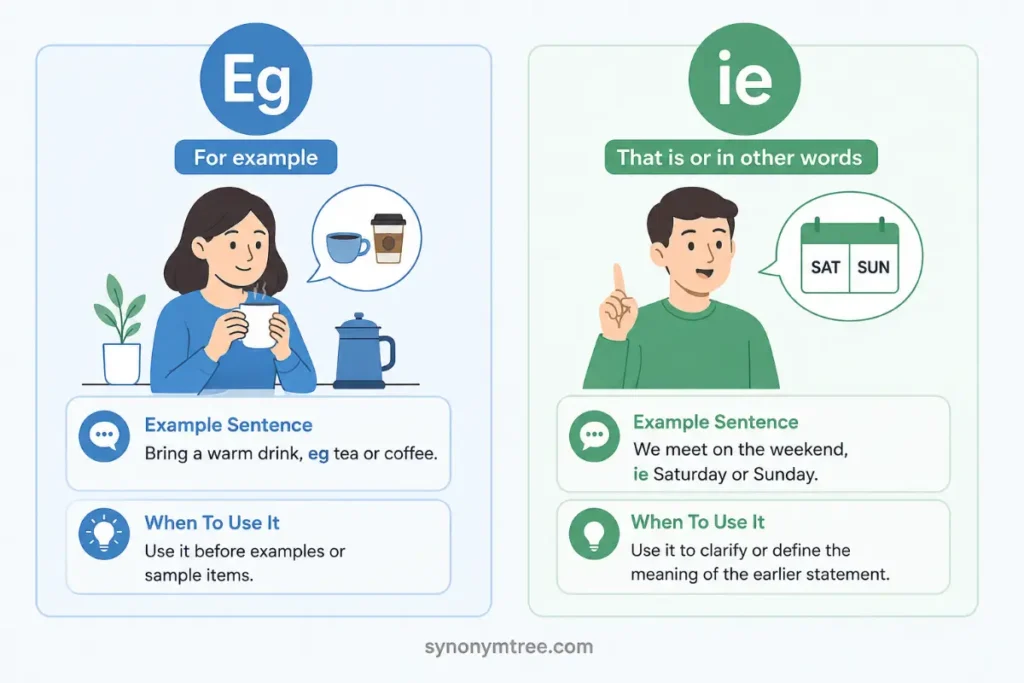
Comparison Table For eg vs ie
| Abbreviation | Meaning | Example Sentence | When To Use It |
|---|---|---|---|
| Eg | For example | Bring a warm drink, eg tea or coffee. | Use it before examples or sample items. |
| Ie | That is or in other words | We meet on the weekend, ie Saturday or Sunday. | Use it to clarify or define the meaning of the earlier statement. |
| For example | Gives an example | Bring a warm drink, for example, tea or coffee. | Use it when you want a clear and natural alternative to eg. |
| That is | Clarifies a statement | We meet on the weekend, that is, Saturday or Sunday. | Use it when you want to explain the exact meaning. |
Why These Abbreviations Cause Confusion
The main problem is that eg and ie are both very short. A reader can easily overlook the difference.
They also have similar functions on the page. Both can appear in parentheses. Both can appear after a comma. Both can introduce extra information. Both are common in academic, professional, technical, and general writing.
There is another reason for the confusion. Many people learn the abbreviations without learning the Latin phrases behind them. When the original meaning is forgotten, the two forms can feel random.
You do not need to know Latin to use them correctly. You only need to remember the English meanings.
Eg means for example.
Ie means that is.
That simple distinction solves most usage problems.
Consider these two sentences.
I enjoy outdoor activities, eg hiking and swimming.
This sentence gives examples of outdoor activities.
I enjoy one type of outdoor activity, ie hiking.
This sentence identifies exactly what the writer means.
The first sentence opens the door to several possible examples. The second sentence narrows the meaning.
That difference is the heart of the rule.
What Eg Means
Eg is an abbreviation that means for example.
It comes from the Latin phrase exempli gratia. The Latin phrase literally refers to something given as an example.
In modern English, writers use eg when they want to provide one or more examples of the idea they just mentioned.
For example:
- I enjoy several sports, eg tennis, soccer, and swimming.
- Bring some fruit, eg apples or oranges.
- Many forms of transportation, eg buses and trains, use this road.
- You can study a language through several methods, eg reading and listening.
- Some animals, eg dogs and cats, live comfortably with people.
In each sentence, the writer does not mean that the listed items are the only possible choices.
They are examples.
That is an important point.
If you say that you enjoy several sports, then give tennis and swimming as examples, you are not saying those are the only sports you enjoy. You are showing the reader what you mean by several sports.
Eg Gives Examples
The easiest way to understand eg is to replace it with for example.
If the sentence still makes sense, eg may be appropriate.
For example:
Some vegetables, eg carrots and peas, are easy to grow.
Replace the abbreviation:
Some vegetables, for example, carrots and peas, are easy to grow.
The meaning stays the same.
The abbreviation simply makes the sentence shorter.
Eg Does Not Usually Mean Only These Items
This point is easy to miss.
Suppose someone writes:
You can bring a snack, eg fruit, nuts, or crackers.
The writer is giving examples.
The sentence does not necessarily mean that only fruit, nuts, or crackers are allowed. Other snacks may also work.
If the writer wants to identify an exact and complete list, a different construction may be better.
For example:
You can bring two snacks, namely fruit and crackers.
The word namely tells the reader that the following items identify the specific things being discussed.
This distinction helps you understand why eg and ie are different.
What Ie Means
Ie is an abbreviation that means that is or in other words.
It comes from the Latin phrase id est.
Writers use ie when they want to clarify the meaning of something that came before it.
For example:
The store is closed on the weekend, ie Saturday and Sunday.
The writer is not simply giving random examples of weekends.
The writer is explaining exactly what weekend means in this context.
Another example is:
The meeting will happen later this week, ie Thursday.
Here, the writer is clarifying what later this week means.
The second part narrows or explains the first part.
Ie Restates An Idea
A useful way to think about ie is that it means the writer is saying the same basic idea again in a clearer or more exact way.
For example:
He is a vegetarian, ie he does not eat meat.
The second part explains the first statement.
Another example:
The project needs immediate attention, ie we need to work on it today.
The second part gives a clearer explanation of immediate attention.
The writer is not merely offering an unrelated example. The writer is explaining the original idea.
Ie Can Introduce A More Exact Meaning
Ie can also introduce a specific interpretation.
Consider this sentence:
I work during the first part of the week, ie Monday through Wednesday.
The phrase Monday through Wednesday gives the exact meaning of first part of the week for this writer.
That makes ie appropriate.
If the writer said:
I work during the first part of the week, eg Monday and Tuesday.
The meaning would be different. Monday and Tuesday would simply be examples. The writer might also work on Wednesday, Thursday, or another day.
The choice between the two abbreviations changes the meaning.
Eg Vs Ie In Simple Terms
When comparing eg vs ie, remember two short phrases.
Eg means for example.
Ie means that is.
You can also think of them as two different questions.
Eg answers this question:
Can you give me an example?
Ie answers this question:
What exactly do you mean?
That is one of the easiest ways to remember the difference.
Consider this example:
I like warm drinks, eg tea and coffee.
The writer is giving examples.
Now compare:
I only want one warm drink, ie tea.
The writer is clarifying exactly which drink is meant.
The first sentence leaves room for other options.
The second sentence gives a specific meaning.
How To Remember Eg
The abbreviation eg can be connected to the phrase example given.
That is not the actual Latin origin, but it is a useful memory trick.
Think:
Eg equals example.
Whenever you want to provide an example, think of eg.
For example:
There are many ways to exercise, eg walking, swimming, or cycling.
The phrase for example could replace eg without changing the basic meaning.
Another useful trick is to remember that eg gives you a sample.
You are showing the reader one or more members of a larger group.
How To Remember Ie
Ie can be remembered as meaning in explanation.
Again, this is only a memory aid, not the historical origin of the abbreviation.
Think:
Ie explains.
When you use ie, you are telling the reader what you mean more exactly.
For example:
The trip will happen soon, ie this Friday.
The second part explains what soon means in this sentence.
You can also remember ie by connecting it with in other words.
If you could naturally say in other words, ie may be the right choice.
The Latin Origins
You do not need Latin knowledge to use these abbreviations, but their origins make the difference easier to understand.
Eg comes from exempli gratia.
The phrase means for example.
Ie comes from id est.
The phrase means that is.
These expressions entered English writing as convenient abbreviations. They are especially common in academic, legal, scientific, business, and professional writing.
English uses many Latin abbreviations. Some have become so common that writers use them without thinking about their original language.
The important point is not to memorize the Latin.
Remember the English meaning.
Eg gives an example.
Ie gives clarification.
Common Mistake With Eg
One common mistake is using eg when the writer actually means that the following information is complete.
For example:
The office is open on weekdays, eg Monday through Friday.
This sentence may suggest that Monday through Friday are examples of weekdays.
If the writer means that the office is open on exactly those five days, a clearer sentence would be:
The office is open on weekdays, ie Monday through Friday.
The choice matters because the second version identifies the specific meaning.
The first version only gives examples.
Another Eg Mistake
Some writers use eg before an explanation instead of an example.
For example:
The machine needs regular care, eg you should clean it every day.
The second part is not really an example of regular care. It explains what regular care means in this situation.
Ie may work better:
The machine needs regular care, ie you should clean it every day.
Even better, many writers would simply write the sentence without an abbreviation:
The machine needs regular care. You should clean it every day.
Plain English is often the clearest option.
Common Mistake With Ie
The most common mistake with ie is using it before examples.
For example:
I enjoy outdoor activities, ie hiking, camping, and fishing.
If the writer enjoys many outdoor activities and is simply naming three examples, eg would be more accurate.
I enjoy outdoor activities, eg hiking, camping, and fishing.
The difference is small on the page but meaningful.
Ie says the second part defines or clarifies the first.
Eg says the second part gives examples.
Another Ie Mistake
Writers sometimes use ie when they mean such as.
For example:
I enjoy several fruits, ie apples and oranges.
If the writer enjoys other fruits too, the sentence should use eg.
I enjoy several fruits, eg apples and oranges.
If apples and oranges are the exact fruits being discussed, then ie could work.
The context determines the correct choice.
Punctuation With Eg And Ie
Punctuation can make these abbreviations look more confusing than they really are.
In American English, many style guides commonly use periods in both abbreviations.
Eg is often written as e.g.
Ie is often written as i.e.
The periods show that the forms are abbreviations.
Some modern writing styles also allow forms without periods. Style preferences can vary by publication, organization, academic field, and house style.
The safest approach in formal writing is to follow the style guide you have been given.
Consistency matters.
If your document uses e.g. and i.e., keep that form throughout the document.
If your publication prefers eg and ie, follow that preference.
The meaning does not change because of the periods.
Commas After The Abbreviations
In American English, writers often place a comma after e.g. or i.e. when the abbreviation introduces a phrase within a sentence.
For example:
You can choose a warm drink, e.g., tea or coffee.
The same pattern can appear with i.e.:
The store closes early, i.e., at five o’clock.
However, punctuation styles vary. Some style guides do not require the comma after the abbreviation.
For professional writing, use the punctuation style required by your publication or organization.
The key point is to avoid mixing styles without a reason.
Should You Capitalize Eg Or Ie
These abbreviations are usually written in lowercase.
You will commonly see e.g. and i.e. in lowercase even when they appear in the middle of a sentence.
At the beginning of a sentence, many editors prefer rewriting the sentence instead of starting with an abbreviation.
For example, instead of:
E.g., you could use a notebook.
A smoother version is:
For example, you could use a notebook.
This is easier for most readers.
The same idea applies to i.e.
Instead of starting a sentence with i.e., write the full phrase such as that is or in other words.
Eg And Ie In Formal Writing
Both abbreviations are common in formal writing, but they are not always the best choice.
Academic and professional readers may understand them immediately. General readers may find the full English phrases easier.
For example:
The course covers several topics, e.g., grammar, vocabulary, and pronunciation.
This is acceptable in many formal settings.
A more conversational version would be:
The course covers several topics, such as grammar, vocabulary, and pronunciation.
The second sentence may be easier for a general audience.
The same principle applies to ie.
If a sentence becomes clearer when you write that is or in other words, use the full phrase.
Good writing is not about using as many abbreviations as possible.
It is about making the meaning easy to understand.
When To Use For Example Instead
For example is often better than eg when you are writing for a broad audience.
It is instantly clear.
Compare:
You can use several tools, e.g., a calculator or spreadsheet.
You can use several tools, for example, a calculator or spreadsheet.
Both are correct.
The second version sounds more natural in many everyday contexts.
The abbreviation can be useful when space is limited or when the writing follows a formal style.
The full phrase is often better for websites, educational material, and general readers.
When To Use That Is Instead
The same principle applies to ie.
If your reader may not know the abbreviation, write that is.
For example:
The final step is simple, that is, check the information one more time.
This may be easier to understand than:
The final step is simple, i.e., check the information one more time.
The full phrase also makes the sentence sound more conversational.
This is especially helpful when writing for students, customers, or general readers.
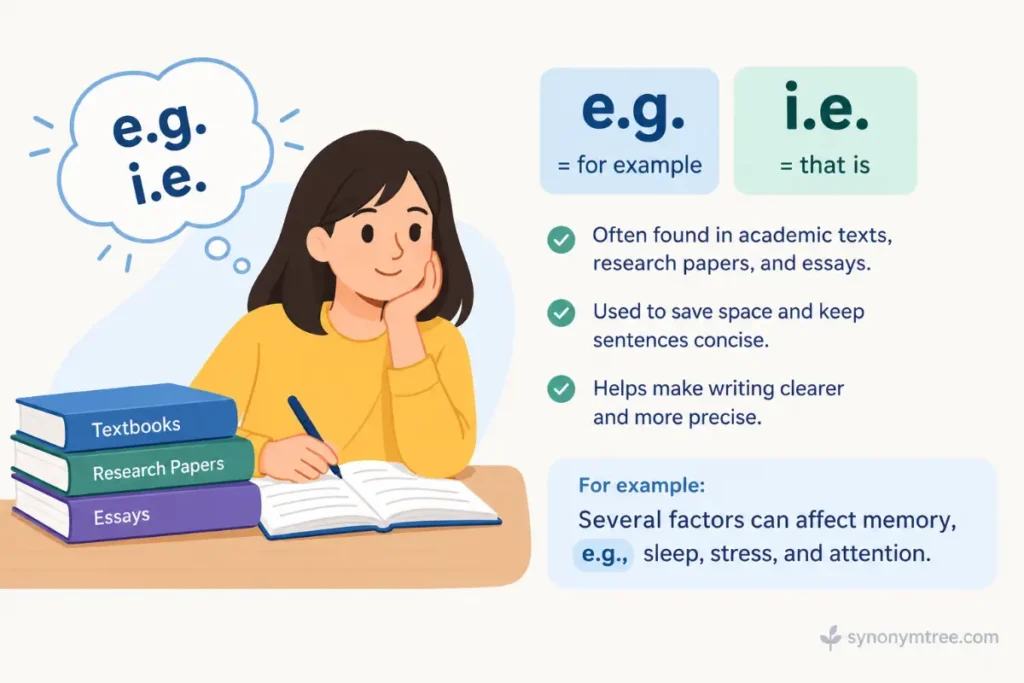
Eg Vs Ie In Academic Writing
Students often encounter these abbreviations in textbooks, research papers, essays, and class instructions.
Academic writing may use them to save space and keep sentences concise.
For example:
Several factors can affect memory, e.g., sleep, stress, and attention.
Here, the writer provides examples.
Another sentence might say:
The study examined one age group, i.e., adults over the age of sixty.
Here, the writer identifies the specific group.
The distinction remains the same in academic writing.
Eg provides examples.
Ie provides clarification.
Students should also follow the style requirements given by their school, instructor, journal, or publication.
Some styles prefer the full phrases.
Others allow or encourage the abbreviations.
Eg And Ie In Business Writing
Business writing uses these forms too.
A report might say:
We sell several products, e.g., notebooks, planners, and calendars.
This gives examples of products.
A policy might say:
The deadline is the end of the business day, i.e., 5 p.m.
This clarifies exactly what the phrase means.
Still, business communication often benefits from plain English.
If the audience is broad, writing for example or that is may be easier.
The best choice depends on the document and the readers.
Eg And Ie In Legal Writing
Legal writing sometimes uses Latin abbreviations because legal language has a long history of Latin influence.
However, legal writing also demands precision.
A small difference between an example and an exact definition can matter.
If a legal document says that certain items are covered, then examples may not establish a complete list.
That is why writers need to think carefully before choosing eg or ie.
A writer should not use eg when the reader needs an exact and complete meaning.
In legal documents, the safest wording may often be a full phrase rather than an abbreviation.
The goal is precision.
Examples That Make The Difference Clear
Paired examples are one of the best ways to understand these abbreviations.
Example One
Bring something to read, e.g., a novel or magazine.
The writer gives examples of reading material.
Other choices may also be acceptable.
Now compare:
Bring the book I mentioned earlier, i.e., the novel on the kitchen table.
The second part identifies the exact book.
Example Two
I enjoy several sports, e.g., tennis and basketball.
These are examples.
Now compare:
I play one sport, i.e., tennis.
Tennis identifies the exact sport.
Example Three
We sell breakfast foods, e.g., eggs, toast, and cereal.
The writer lists examples.
Now compare:
Breakfast is served during the early part of the day, i.e., before noon.
The second part clarifies the meaning of early part of the day.
Example Four
You can contact me through several methods, e.g., email or phone.
The writer gives examples.
Now compare:
Contact me directly, i.e., do not send the message through another person.
The second part explains what directly means.
How The Meaning Changes
One of the best ways to learn the difference is to look at what happens when you replace the abbreviation.
Replace eg with for example.
If the meaning still works, you are probably giving examples.
Replace ie with that is.
If the meaning still works, you are probably clarifying or restating the idea.
This simple replacement test works in most situations.
Consider:
I enjoy many desserts, eg cake and pie.
Replace eg:
I enjoy many desserts, for example, cake and pie.
The sentence works.
Now:
The event is local, ie it takes place within the city.
Replace ie:
The event is local, that is, it takes place within the city.
The sentence works.
This is a quick editing tool that you can use whenever you are unsure.
The Difference Between Examples And Definitions
The deepest difference between these abbreviations is the difference between an example and a definition.
An example shows one possible member of a larger group.
A definition or clarification tells you what the writer means.
Suppose someone says:
I like large animals, eg elephants and horses.
Elephants and horses are examples of large animals.
The writer may like other large animals too.
Now consider:
I like one large animal, ie the elephant.
The second part identifies the specific animal being discussed.
The first sentence expands your understanding through examples.
The second sentence narrows the meaning through clarification.
How To Use Eg In A List
Eg can introduce a short list of examples.
For example:
You can improve your writing by practicing several skills, e.g., grammar, spelling, and vocabulary.
The list shows examples.
You could also write:
You can improve your writing by practicing several skills, such as grammar, spelling, and vocabulary.
The second version is often more natural for general readers.
Remember that an eg list does not normally mean the list is complete.
That is one of its most useful features.
How To Use Ie With A List
Ie can introduce a specific list when the list explains exactly what the earlier phrase means.
For example:
The store is open on weekdays, i.e., Monday through Friday.
The list clarifies weekdays in this context.
However, be careful with exactness.
If the store is also open on Saturday and the writer is simply naming several days, eg would be more appropriate.
The abbreviation should match the intended meaning.
Eg And Ie With Parentheses
Both forms can appear inside parentheses.
For example:
Choose a simple color (e.g., blue or green).
This gives examples.
Now compare:
Choose the primary color (i.e., the color used for the main design).
This gives a clarification.
Parentheses do not change the rule.
The question is still the same.
Are you giving an example or explaining exactly what you mean?
Common Alternatives To Eg
You do not have to use an abbreviation.
Several alternatives are available.
For example is the most direct replacement.
Such as is also common when introducing examples.
Including can work when listing examples.
Among others can work when you want to show that the list is not complete.
Consider these examples:
I enjoy outdoor sports, such as hiking and cycling.
I enjoy outdoor sports, including hiking and cycling.
I enjoy outdoor sports, for example, hiking and cycling.
All three can introduce examples.
The best choice depends on sentence structure and style.
Common Alternatives To Ie
Ie also has several natural alternatives.
That is is the closest direct replacement.
In other words works when you are restating an idea.
Specifically can work when you want to make the meaning more exact.
Namely can introduce specific items that identify what you just mentioned.
For example:
The meeting is later in the week, that is, Thursday.
The meeting is later in the week, specifically, Thursday.
The meeting is later in the week, namely Thursday.
These sentences have similar purposes, but the exact nuance can vary.
Common Mistakes In Everyday Writing
Writers make several predictable mistakes with these abbreviations.
Mistake One Using Ie For Examples
This is probably the biggest mistake.
If you mean for example, use eg.
If you mean that is, use ie.
Mistake Two Thinking Eg Means Such As In Every Case
Eg often works like such as, but sentence structure matters.
It introduces examples rather than creating a fixed grammatical category.
Always read the whole sentence before choosing the abbreviation.
Mistake Three Using Both Abbreviations Together
There is rarely a good reason to write eg and ie together.
They perform different jobs.
Choose the one that matches your meaning.
Mistake Four Using Abbreviations With No Need
Some writers use abbreviations simply because they seem more formal.
That can make writing harder to read.
If for example is clearer, use for example.
If that is is clearer, use that is.
Shorter does not always mean better.
Mistake Five Forgetting The Reader
A specialist audience may understand eg and ie immediately.
A general audience may not.
Always consider who will read the sentence.
Clear writing starts with the reader.
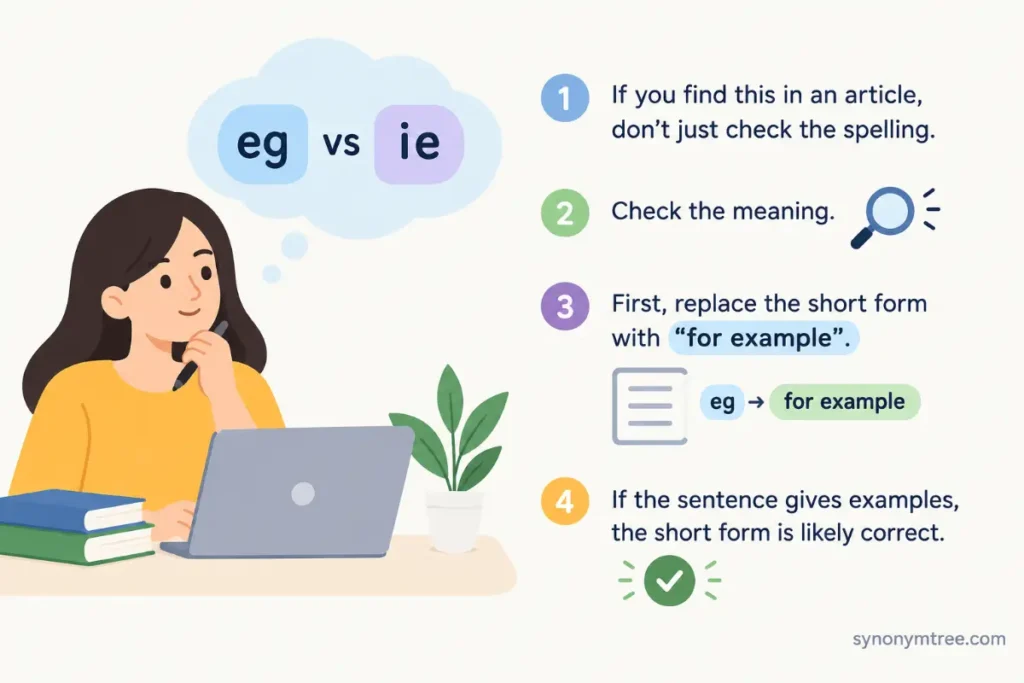
A Simple Editing Method For eg vs ie
If you are editing an article and find eg or ie, do not simply check the spelling.
Check the meaning.
First, replace eg with for example.
If the sentence gives examples, eg is likely correct.
Next, replace ie with that is.
If the sentence clarifies the previous idea, ie is likely correct.
If neither replacement sounds natural, rewrite the sentence.
Sometimes the best edit is to remove the abbreviation entirely.
For example:
I enjoy many sports, e.g., tennis and swimming.
Can become:
I enjoy many sports, such as tennis and swimming.
That may be easier for readers.
A Simple Test For Students
Students can use one question.
Am I giving an example or explaining exactly what I mean?
If you are giving an example, use eg.
If you are explaining exactly what you mean, use ie.
For example:
I like warm drinks, eg tea.
This gives an example.
I like one warm drink, ie tea.
This identifies the exact choice.
Once you learn that difference, most questions become easy.
A Simple Test For Editors
Editors can use the replacement test.
Change eg to for example.
Change ie to that is.
Then read the sentence again.
If the meaning is still correct, you have probably made the right choice.
If the meaning changes, check the sentence carefully.
This method is better than relying on memory alone because it tests the actual meaning of the sentence.
Why The Difference Matters
These abbreviations may look tiny, but they can affect meaning.
Imagine a workplace policy that says:
Employees may submit several forms of identification, e.g., a passport or driver’s license.
That gives examples.
Now imagine:
Employees must provide one approved form of identification, i.e., a passport or driver’s license.
The second sentence can be read as identifying the exact approved options.
In situations where precision matters, that difference can be important.
The same issue appears in academic writing, instructions, contracts, technical documents, and professional communication.
A small abbreviation can tell readers how to interpret the information that follows.
When Plain English Is Better
Even when eg or ie is correct, the full English phrase may be better.
This is especially true for public websites, educational content, instructions, and writing for people who may not know Latin abbreviations.
Compare:
You can use several resources, e.g., books and online courses.
You can use several resources, such as books and online courses.
The second sentence is immediately clear.
Now compare:
The final review is required, i.e., the document must be checked before submission.
The final review is required, that is, the document must be checked before submission.
Again, the full phrase may feel more natural.
Abbreviations save space, but clarity should come first.
A Practical Style Rule
If your workplace, school, journal, or publication has a style guide, follow it.
Some style guides prefer e.g. and i.e.
Some prefer eg and ie.
Some prefer the full phrases for example and that is.
There is no need to fight over periods if the style guide already gives you an answer.
The bigger issue is meaning.
Use the example abbreviation when giving examples.
Use the clarification abbreviation when restating or defining an idea.
Then keep your punctuation and formatting consistent.
Final Teacher Explanation
The difference between these abbreviations is easier than it first appears.
Eg means for example.
Ie means that is or in other words.
Use eg when you are giving one or more examples of a larger group.
Use ie when you are explaining exactly what the earlier statement means.
Think about the difference between these sentences:
I enjoy several kinds of music, eg jazz and rock.
This gives examples.
I enjoy one kind of music, ie jazz.
This gives a specific meaning.
The first sentence leaves room for other possibilities.
The second sentence narrows the meaning.
That is the rule worth remembering.
You also do not have to use the abbreviations at all. For example and that is are often clearer, especially for general readers.
When you are editing your own writing, replace eg with for example and ie with that is. If the sentence still means what you intended, you have a useful clue that you chose the right abbreviation.
Conclusion
The difference between eg vs ie comes down to one simple idea. Eg gives examples, while ie gives clarification. If you can replace the abbreviation with for example, eg is probably the right choice. If you can replace it with that is or in other words, ie is probably the better choice.
Remember that examples and exact explanations are not the same thing. When you say you like several fruits, then list apples and oranges, you are giving examples. When you identify exactly which fruits you mean, you are clarifying the statement.
You should also think about your readers. Eg and ie are useful abbreviations, but for example and that is can be easier to understand. In general writing, clear words often work better than short Latin forms.
The next time you pause over these two abbreviations, ask one quick question. Am I giving an example or explaining exactly what I mean? Examples point to eg. Exact clarification points to ie.
FAQs
What is the difference between eg vs ie?
Eg means for example and introduces examples. Ie means that is or in other words and introduces a clarification or more exact explanation.
Does eg mean for example?
Yes. Eg is an abbreviation of the Latin phrase exempli gratia, which means for example. Use it when you want to provide one or more examples.
Does ie mean that is?
Yes. Ie comes from the Latin phrase id est, which means that is. It is used to clarify or restate the meaning of something.
Should I use eg or ie before examples?
Use eg before examples. If the information that follows explains exactly what you mean, use ie instead.
Is it better to write eg or for example?
Both can be correct. For example is often clearer for general readers, while eg can be useful in formal writing or places where a shorter form fits the style.
Is ie the same as in other words?
Ie can often be replaced with in other words. Both forms can introduce a restatement or clarification of the idea that came before.
Do eg and ie need periods?
Many American English styles write them as e.g. and i.e. Other styles allow eg and ie without periods. Follow the style guide used for your document and stay consistent.
Can I use eg and ie in academic writing?
Yes. Both abbreviations appear in academic writing, but requirements vary by style guide. Check the rules for your school, journal, or publication before choosing the format.
