
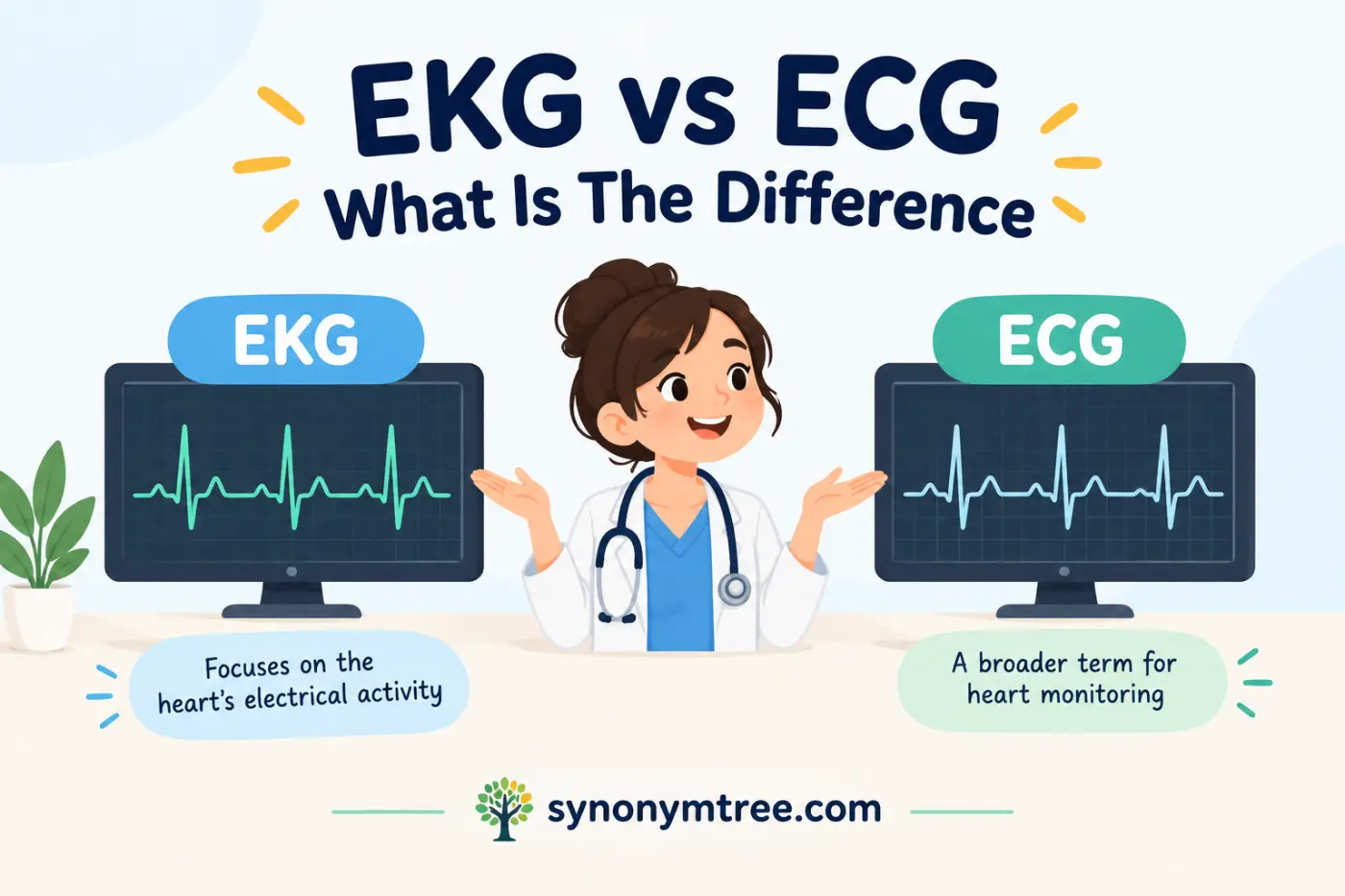
If you searched for ekg vs ecg, you may be wondering if these are two different heart tests. The short answer is no. EKG and ECG are two names for the same test. Both record the electrical activity of your heart.
The confusion comes from the letters. ECG stands for electrocardiogram. EKG comes from the German spelling of the same term, elektrokardiogramm. The letter K helps keep the abbreviation distinct from other medical terms.
The test itself does not change because a doctor calls it an EKG instead of an ECG. The same type of electrodes are placed on your skin. The same basic heart signals are recorded. Doctors use the results to look for problems with heart rate, rhythm, and electrical activity.
If you enjoy learning about confusing words and commonly mixed up terms, you can also explore our guide to commonly confused words for another useful grammar explanation.
This guide explains the difference between EKG and ECG, why both names exist, what the test can show, how it works, and what common results can mean. You will also learn why a normal result does not always rule out a heart problem.
Quick Definition
An EKG and an ECG are the same medical test. The test records the electrical signals produced by your heart as it beats. ECG comes from the English term electrocardiogram, while EKG comes from the German spelling elektrokardiogramm.
Direct Answer
EKG and ECG mean the same thing. There is no medical difference between an EKG test and an ECG test.
EKG vs ECG Comparison
| Word or phrase | Meaning | Example sentence | When to use it |
|---|---|---|---|
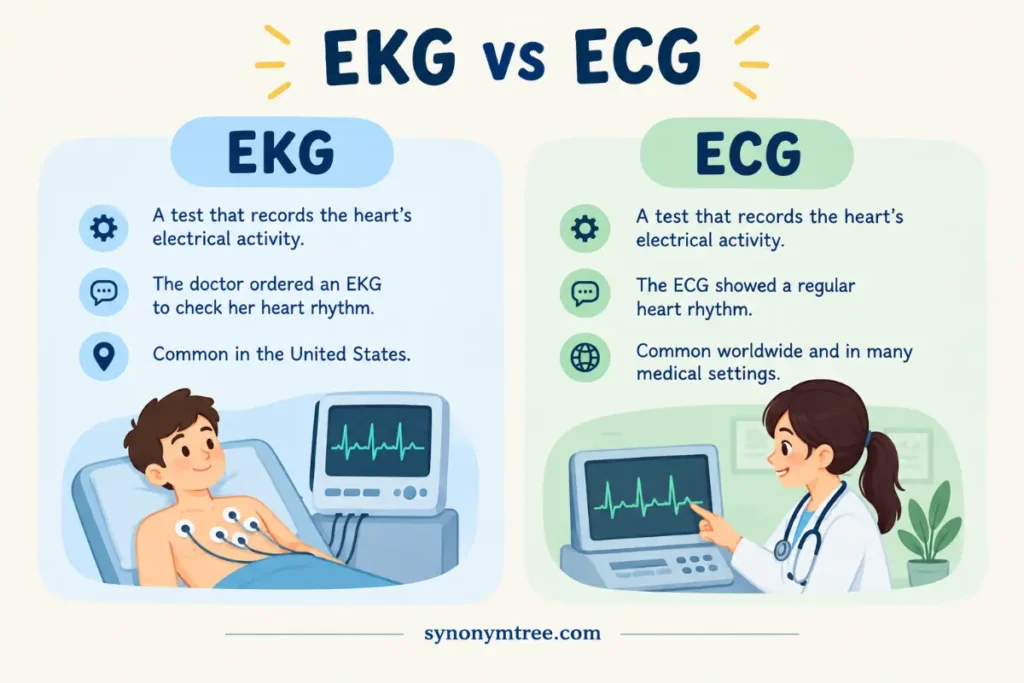
| EKG | A test that records the heart’s electrical activity | The doctor ordered an EKG to check her heart rhythm. | Common in the United States |
| ECG | A test that records the heart’s electrical activity | The ECG showed a regular heart rhythm. | Common worldwide and in many medical settings |
| Electrocardiogram | The full name of the test | The electrocardiogram took only a few minutes. | Useful in formal medical writing |
| Electrocardiograph | The machine used to record the heart’s electrical signals | The technician connected the patient to the electrocardiograph. | Refers to the recording device rather than the test result |
Why Are EKG And ECG Different Names
The two abbreviations come from different spellings of the same medical word.
The English term is electrocardiogram. Its abbreviation naturally becomes ECG.
The German term is elektrokardiogramm. Its abbreviation becomes EKG.
The German spelling uses a K where English uses a C. That difference explains most of the confusion.
The test itself is not different. Doctors in different countries and medical systems may simply prefer one abbreviation over the other.
In the United States, EKG is very common. You may see it on hospital forms, medical records, appointment instructions, and patient education materials.
ECG is also widely understood in the United States. It is especially common in scientific research, international medical writing, and many countries outside the US.
What Does ECG Stand For
ECG stands for electrocardiogram.
The word can look complicated, but its parts are fairly simple.
Electro refers to electricity. Cardio refers to the heart. Gram refers to a recording.
An electrocardiogram is therefore a recording of the heart’s electrical activity.
The heart uses electrical signals to control each heartbeat. An ECG records those signals from the surface of the body.
What Does EKG Stand For
EKG refers to the same test.
The abbreviation comes from the German word elektrokardiogramm. German uses the letter K in that word.
Doctors began using EKG as an abbreviation to avoid confusion with other terms and because the abbreviation became established in medical practice.
So the K does not describe a different type of heart test. It simply reflects the word’s German origin.
What Does An EKG Or ECG Measure
Your heart does more than pump blood. It also produces electrical signals that help control each heartbeat.
These signals travel through specialized parts of the heart. They tell the heart muscle when to contract.
An ECG detects these electrical signals through electrodes placed on your skin.
The machine then turns the signals into a tracing. This tracing contains waves and intervals that a trained medical professional can interpret.
Doctors can use this information to assess several parts of heart function.
Heart Rate
An ECG can show how fast your heart is beating.
A heart rate that is faster than expected may be called tachycardia. A heart rate that is slower than expected may be called bradycardia.
A fast or slow rate is not automatically dangerous. Your heart rate can change because of exercise, stress, fever, medications, sleep, fitness level, and many other factors.
That is why doctors look at the complete ECG rather than focusing on one number.
Heart Rhythm
An ECG can help show if your heartbeat follows a regular pattern.
A normal rhythm usually follows an organized electrical pattern.
An abnormal rhythm is called an arrhythmia.
Some arrhythmias are harmless. Others can require treatment.
One example is atrial fibrillation. This condition causes an irregular heart rhythm and can increase the risk of blood clots and stroke.
An ECG can help identify atrial fibrillation when it occurs during the recording.
Electrical Conduction
The heart has an electrical system that moves signals through different areas.
An ECG can show signs that these signals are moving too slowly, too quickly, or along an unusual path.
Doctors can use this information to look for conduction problems such as certain heart blocks.
Signs Of A Heart Attack
An ECG can show patterns that may suggest a current or previous heart attack.
For example, certain changes in the ST segment or T waves can provide important clues.
However, an ECG is only one part of a heart attack evaluation. Doctors may also use symptoms, blood tests, imaging, medical history, and other tests.
A normal ECG does not always rule out a heart attack.
If someone has symptoms such as severe chest pressure, trouble breathing, fainting, or sudden sweating, they need urgent medical evaluation.
Effects Of Some Medicines
Some medicines can affect the electrical activity of the heart.
An ECG can help doctors monitor these effects.
Certain medications can change the QT interval or other parts of the tracing. In some situations, doctors use ECG testing before and during treatment to help manage these risks.
Signs Of Heart Enlargement
An ECG may sometimes suggest that certain chambers of the heart are larger than expected.
However, an ECG cannot directly measure the size of the heart chambers.
Doctors may use an echocardiogram or another imaging test to get a clearer picture of heart structure.
This difference matters because an ECG mainly looks at electrical activity. An echocardiogram uses ultrasound to create images of the heart.
How Does An EKG Or ECG Work
The test is usually simple and quick.
A healthcare professional places small sticky electrodes on your chest and sometimes on your arms and legs.
The electrodes detect tiny electrical signals produced by your heart.
The machine records those signals and creates a tracing.
You normally need to lie still during the recording. You may also be asked to breathe normally and avoid talking for a short time.
The test itself does not send electricity into your body. The electrodes only detect electrical activity.
Does An ECG Hurt
A standard ECG should not hurt.
The electrodes stick to your skin. Removing them can cause a little discomfort, especially if you have sensitive skin or body hair.
The recording itself is painless.
You may feel some pressure if a healthcare professional needs to prepare the skin or remove adhesive electrodes.
How Long Does An ECG Take
A standard resting ECG usually takes only a few minutes to record.
The entire appointment can take longer because the healthcare professional needs to position the electrodes and prepare the skin.
The actual recording is generally very short.
Do You Need To Prepare For An ECG
A standard resting ECG usually requires little preparation.
Your healthcare provider may give you specific instructions based on the reason for the test.
It can help to wear clothing that allows easy access to your chest, arms, and legs.
Tell the healthcare professional about medicines you take. Do not stop taking a prescribed medicine just because you have an upcoming ECG unless your healthcare provider tells you to do so.
What Are The Electrodes Used For
Electrodes are small sensors that attach to the skin.
They detect electrical signals from the heart and send those signals to the ECG machine.
A standard diagnostic ECG commonly uses 10 electrodes. These electrodes create 12 views of the heart’s electrical activity.
You may hear this called a 12 lead ECG.
The word lead can cause confusion. In this setting, a lead is not the same thing as an electrode.
An electrode is a physical sensor attached to your body.
A lead is a particular electrical view calculated from the signals detected by the electrodes.
This system gives clinicians a broader picture of the heart’s electrical activity.
What Do The Lines On An ECG Mean
The tracing contains several waves and intervals.
Each part represents a different part of the heart’s electrical cycle.
You do not need to memorize the details to understand the basic idea.
The P Wave
The P wave is linked to electrical activation of the atria.
The atria are the two upper chambers of the heart.
Their electrical activation helps prepare them to contract and move blood into the lower chambers.
The QRS Complex
The QRS complex represents electrical activation of the ventricles.
The ventricles are the heart’s two lower chambers.
They pump blood out of the heart.
The QRS complex normally appears as a group of sharp movements on the tracing.
The T Wave
The T wave represents ventricular recovery after electrical activation.
This process is called repolarization.
Doctors examine the shape and timing of the T wave as part of the overall ECG interpretation.
The PR Interval
The PR interval reflects the time it takes for an electrical signal to travel from the atria through the conduction system toward the ventricles.
An unusually short or long interval can provide useful clues.
The QT Interval
The QT interval covers part of the electrical activity of the ventricles.
Doctors may pay close attention to the QT interval because an unusually prolonged QT can increase the risk of certain abnormal heart rhythms.
The QT interval changes with heart rate, so clinicians often consider a corrected QT value.
What Can An ECG Detect
An ECG can provide useful information about several heart conditions.
It can help identify or support the evaluation of:
- Abnormal heart rhythms.
- Atrial fibrillation.
- Certain conduction problems.
- Some signs of a current or previous heart attack.
- Some signs of reduced blood flow to the heart.
- Abnormal heart rates.
- Certain effects of electrolyte problems.
- Some medication related electrical changes.
- Certain patterns linked to an enlarged heart.
- Some inherited electrical heart conditions.
An ECG cannot diagnose every heart problem.
For example, some structural heart problems may require an echocardiogram or another imaging test.
Some symptoms may also come and go. A short ECG may miss an abnormal rhythm that happens only at certain times.
Can An ECG Be Normal Even If You Have A Heart Problem
Yes.
A normal ECG is useful information, but it does not prove that the heart is completely healthy.
Some heart conditions do not cause visible changes during a short resting recording.
An abnormal rhythm that happens only occasionally may not appear during the test.
Some blockages in the coronary arteries may also produce a normal resting ECG.
Doctors therefore consider your symptoms, health history, physical examination, and other test results.
This is one reason you should not try to interpret an ECG result by itself.
What Is A Resting ECG
A resting ECG records your heart while you are relaxed.
You normally lie down while the electrodes record your heart’s electrical activity.
This is the most familiar type of ECG.
Doctors may order one during a routine evaluation or when symptoms suggest a possible heart problem.
A resting ECG can provide a useful snapshot of your heart’s electrical activity at that moment.
What Is A Stress ECG
A stress ECG records heart activity while your heart works harder.
You may exercise on a treadmill or stationary bicycle.
Your heart rate rises during the test. Healthcare professionals monitor the ECG and other vital signs.
This type of test can help doctors assess how your heart responds to exercise.
It may be used when a healthcare provider suspects certain types of reduced blood flow to the heart or wants to assess exercise related symptoms.
A stress ECG is different from a standard resting ECG because the heart is being tested under increased demand.
What Is A Holter Monitor
A Holter monitor is a portable device that records heart activity for a longer period.
Instead of recording only a brief snapshot, it can monitor your heart for a day or longer depending on the device and medical plan.
Doctors may use longer monitoring when symptoms come and go.
For example, someone might feel occasional racing or skipped beats but have a normal rhythm during a short office ECG.
Longer monitoring increases the chance of recording an abnormal rhythm when it happens.
Other wearable heart monitors can also record electrical activity for longer periods.
The right device depends on the symptoms and what the healthcare provider needs to learn.
ECG And Echocardiogram Are Not The Same
Another common mix up involves the ECG and echocardiogram.
They are different tests.
An ECG records electrical activity.
An echocardiogram uses ultrasound to create images of the heart.
An ECG can show how the electrical system is behaving.
An echocardiogram can show heart chambers, valves, muscle movement, and blood flow.
Doctors may use both tests because they answer different questions.
For example, an ECG may show an abnormal rhythm while an echocardiogram helps assess the structure and pumping function of the heart.
EKG vs ECG In The United States
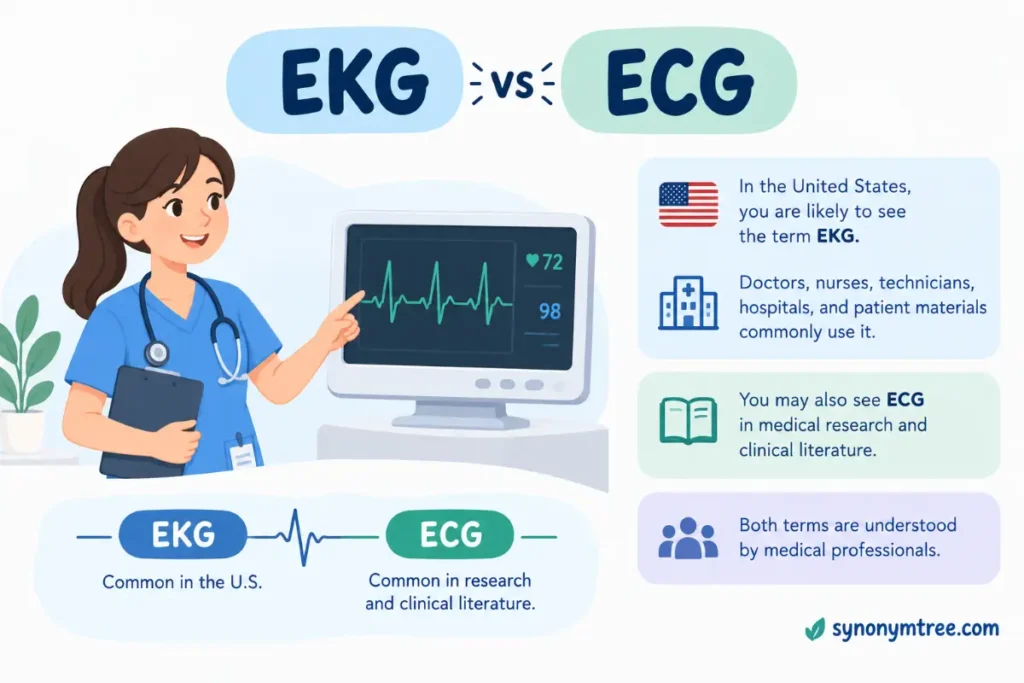
In the United States, you are likely to see the term EKG.
Doctors, nurses, technicians, hospitals, and patient materials commonly use it.
You may also see ECG in medical research and clinical literature.
Both terms are understood by medical professionals.
If your doctor says you need an EKG and another healthcare provider calls the same test an ECG, they are talking about the same basic procedure.
The difference is mainly the abbreviation.
ECG In Other Countries
ECG is widely used around the world.
It is especially common in English language medical writing outside the United States.
You may see ECG on medical websites, hospital pages, textbooks, research papers, and international guidelines.
EKG is also understood in many places because the abbreviation is well established.
The important point is that the name does not change the test.
Common Mistakes People Make
The biggest mistake is thinking that EKG and ECG are two different heart tests.
They are not.
Another mistake is confusing an ECG with an echocardiogram.
The names sound similar, but the tests work differently.
A third mistake is assuming that an ECG gives a complete picture of heart health.
It does not.
An ECG focuses on electrical activity. Other tests may be needed to examine the heart’s structure, blood flow, valves, or pumping strength.
Mistake One
Some people think the K in EKG means the test uses a different machine.
It does not.
The abbreviation simply comes from the German spelling of the word.
Mistake Two
Some people believe ECG is used only outside the United States.
That is not true.
US healthcare professionals also use ECG.
Mistake Three
Some people think a normal ECG means they cannot have heart disease.
That conclusion goes too far.
A normal test result can be reassuring, but doctors use the result along with symptoms and other information.
Mistake Four
Some people confuse an ECG with an echocardiogram.
An ECG records electrical signals.
An echocardiogram creates ultrasound images.
They provide different kinds of information.
Mistake Five
Some people assume an abnormal ECG automatically means something is seriously wrong.
An abnormal result does not always mean a dangerous condition.
ECG patterns can vary for many reasons.
A healthcare professional needs to interpret the result in context.
When Might A Doctor Order An ECG
A doctor may order an ECG for many reasons.
You may need one if you have symptoms such as:
- Chest discomfort.
- A racing heartbeat.
- A fluttering feeling in the chest.
- An irregular heartbeat.
- Fainting or near fainting.
- Shortness of breath.
- Unexplained weakness.
- Dizziness.
An ECG may also be used before certain surgeries or treatments.
Doctors may use it to monitor known heart conditions or check the effects of certain medicines.
The reason for the test matters because the same ECG finding can have different meanings in different situations.
What Happens After An ECG
A healthcare professional reviews the tracing and considers it along with your medical information.
The ECG machine may produce an automated interpretation.
That computer generated reading can be helpful, but it should not replace professional review.
Automated ECG interpretations can be wrong.
A trained clinician considers the tracing, symptoms, medical history, and other findings before making a diagnosis.
Your healthcare provider may order additional tests if the ECG raises a concern.
Those tests could include blood work, an echocardiogram, stress testing, longer heart monitoring, or other cardiac tests.
What Does A Normal ECG Mean
A normal ECG means the electrical activity recorded during the test did not show certain abnormal patterns.
That can be reassuring.
Still, it does not guarantee that every part of your cardiovascular system is normal.
Think of a standard ECG as a snapshot.
It shows what your heart’s electrical activity looked like during that recording.
If a problem happens only sometimes, the test may not capture it.
That is why doctors sometimes use longer monitoring.
If you enjoy improving your English, you can also explore our guide to commonly confused words to avoid common mistakes in writing.
What Does An Abnormal ECG Mean
An abnormal ECG means the tracing contains a pattern that falls outside the expected range.
That does not automatically tell you the cause.
An abnormal reading can result from an arrhythmia, conduction problem, previous heart damage, medication effects, electrolyte changes, or other factors.
Some findings are minor.
Some need further testing.
The right next step depends on the specific ECG pattern and your symptoms.
A healthcare provider should explain what an abnormal result means in your particular case.
Why Does The Name Matter So Little
For patients, the most useful thing to remember is simple.
EKG and ECG describe the same basic test.
The spelling can change depending on the country, medical system, or person using the term.
The equipment and purpose do not change just because someone uses EKG instead of ECG.
If you see either abbreviation on a medical form, you can think of it as a heart electrical activity test.
That simple idea removes most of the confusion.
A Simple Memory Trick
Use the C in ECG to remember the English word electrocardiogram.
Use the K in EKG to remember the German spelling elektrokardiogramm.
You can also remember this sentence.
EKG and ECG are two names for one test.
The K does not mean a different procedure.
EKG vs ECG And Other Heart Tests
Understanding related tests makes the distinction even easier.
| Test | Main purpose | What it records or shows |
|---|---|---|
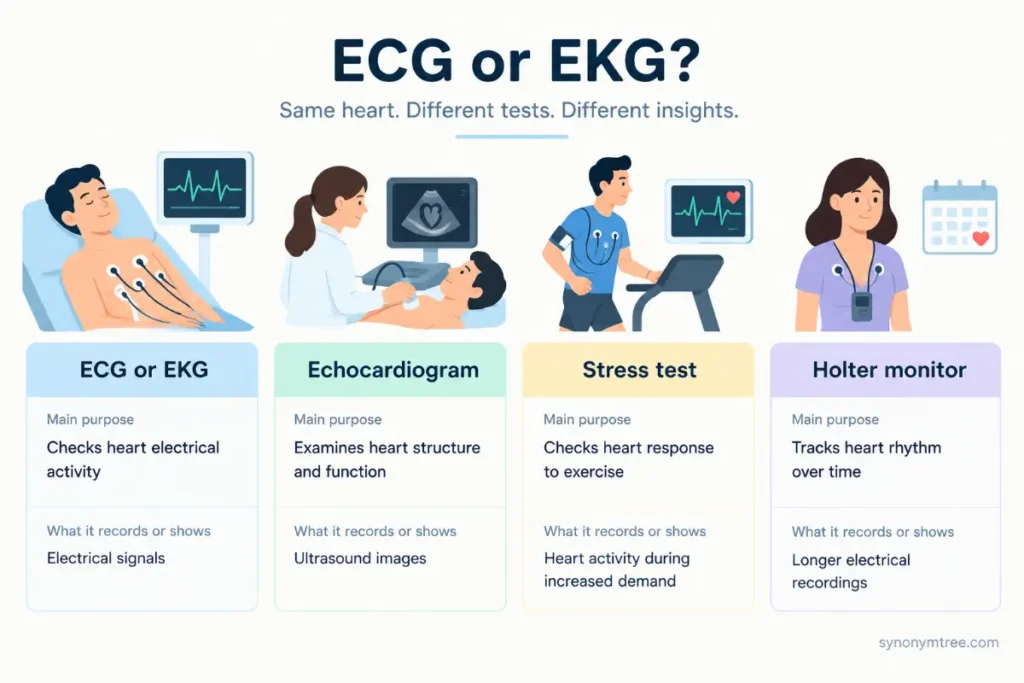
| ECG or EKG | Checks heart electrical activity | Electrical signals |
| Echocardiogram | Examines heart structure and function | Ultrasound images |
| Stress test | Checks heart response to exercise | Heart activity during increased demand |
| Holter monitor | Tracks heart rhythm over time | Longer electrical recordings |
| Event monitor | Looks for intermittent rhythm problems | Heart rhythm over an extended period |
| Cardiac MRI | Creates detailed heart images | Structure and tissue features |
| Cardiac CT | Creates detailed images of the heart and vessels | Anatomy and blood vessels |
These tests are not interchangeable.
A doctor chooses a test based on the question they need to answer.
For example, an ECG may be the best first step for a suspected rhythm problem.
An echocardiogram may be more useful when a doctor needs to examine heart valves or pumping function.
Long term monitoring may make more sense when symptoms happen only once in a while.
How To Talk About The Test Correctly
In everyday conversation, both EKG and ECG are correct.
You can say:
I had an EKG at the clinic.
The doctor reviewed my ECG.
The nurse performed an ECG before the procedure.
My doctor wants me to have an EKG.
All of these sentences can describe the same basic test.
In formal writing, use the abbreviation that matches your audience and the style of the medical source you are following.
If you are writing for a US audience, EKG is very familiar.
If you are writing for an international medical audience, ECG may be more widely recognized.
When To Seek Urgent Help
An ECG question can sometimes come up because someone has heart symptoms.
Do not wait for an ECG appointment if you have signs of a possible medical emergency.
Seek emergency medical care for severe or persistent chest pressure or pain, serious trouble breathing, fainting, or other sudden severe symptoms.
Heart attack symptoms can vary.
Some people experience chest discomfort. Others may have shortness of breath, sweating, nausea, weakness, or pain that spreads to the arm, back, neck, jaw, or upper abdomen.
If you think you may be having a heart attack, seek emergency help right away.
An ECG is an important tool, but getting timely medical care matters more than trying to decide which abbreviation applies.
Conclusion
The answer to ekg vs ecg is simple. EKG and ECG are two names for the same test. Both record the electrical activity of your heart and can help doctors assess heart rate, rhythm, conduction, and certain signs of heart disease.
The difference comes from language rather than medicine. ECG follows the English term electrocardiogram. EKG comes from the German spelling elektrokardiogramm. If you see EKG or ECG on a medical form, you do not need to worry about choosing between two different tests. They refer to the same basic procedure.
If you need more options for your writing, explore our guide to similar spellings and find the right word for different types of support.
The practical takeaway is easy to remember. EKG and ECG mean the same thing. If you have symptoms or an unusual test result, focus less on the abbreviation and more on what your healthcare professional says the tracing shows.
Frequently Asked Questions
Is EKG the same as ECG?
Yes. EKG and ECG are two abbreviations for the same heart test. Both record the electrical activity of the heart.
Why is it called EKG instead of ECG?
EKG comes from the German spelling elektrokardiogramm. The K reflects the German spelling of the word.
Which is more correct EKG or ECG?
Both are correct. ECG comes from the English term electrocardiogram, while EKG comes from the German term.
Is an EKG or ECG painful?
No. A standard recording is painless because the electrodes detect electrical signals rather than send electricity into your body. Removing the sticky electrodes may cause minor skin discomfort.
How long does an ECG take?
The actual recording usually takes only a few minutes. The full appointment may take longer because the healthcare professional needs to prepare your skin and position the electrodes.
Can an ECG detect a heart attack?
An ECG can show patterns that may suggest a heart attack. Doctors usually combine the ECG with symptoms, blood tests, and other findings to make a diagnosis.
Can you have a heart problem with a normal ECG?
Yes. Some heart problems may not appear during a short resting ECG. Doctors may use longer monitoring or other tests when symptoms continue despite a normal result.
What is the difference between an ECG and an echocardiogram?
An ECG records electrical activity in the heart. An echocardiogram uses ultrasound to create images of the heart and assess its structure and function.
