
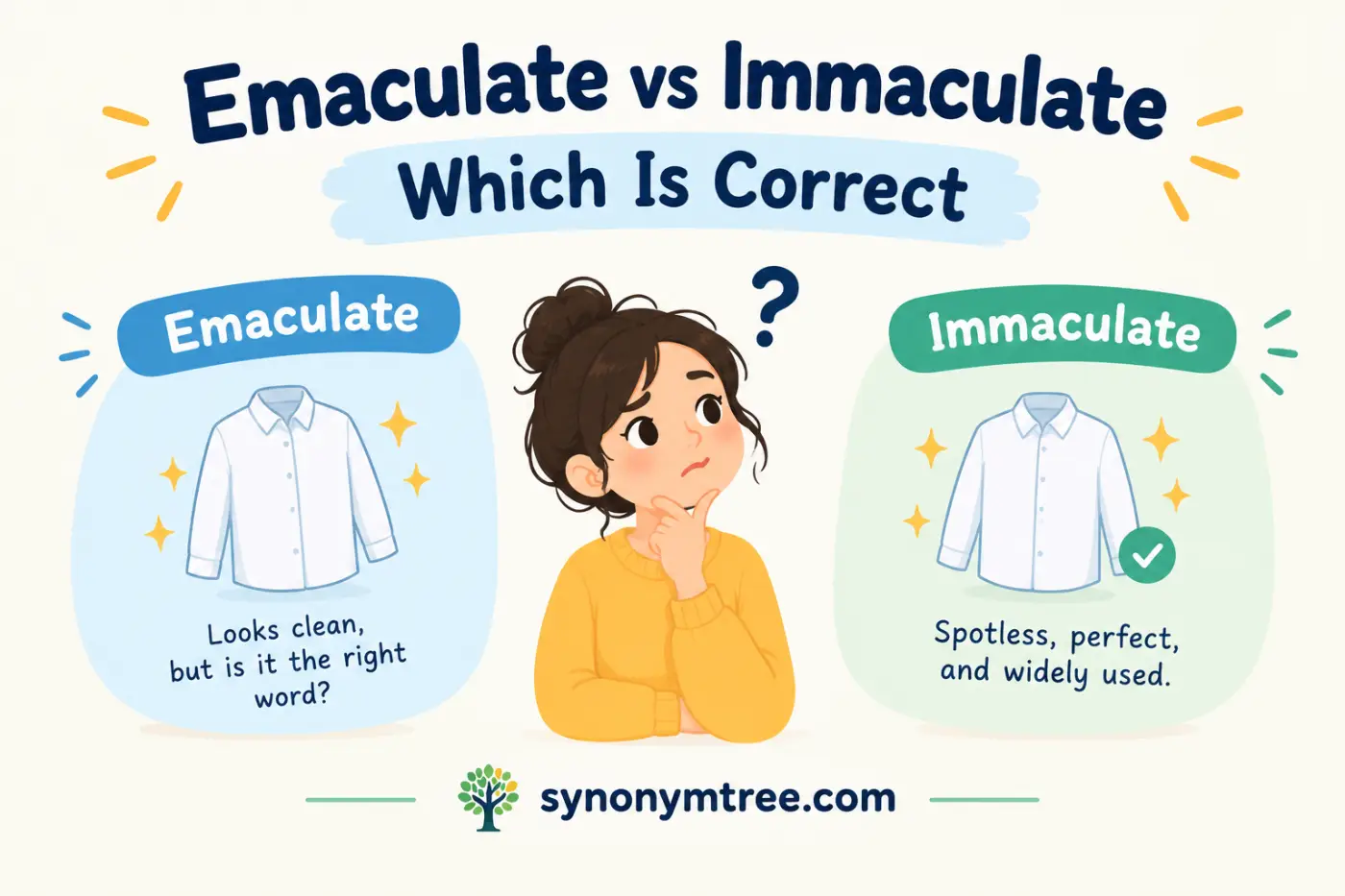
If you are searching emaculate vs immaculate, the correct spelling is immaculate. Emaculate is a common spelling mistake, but it is not the standard English form of the word.
The word immaculate means perfectly clean, neat, or free from flaws. You can use it to describe a spotless room, a perfectly maintained car, a person’s appearance, or work that contains no mistakes.
The confusion usually comes from the sound of the word. When people hear immaculate, they may leave out one of the m letters and write emaculate. That small spelling error changes the word from correct English to a misspelling.
This guide explains the correct spelling, meaning, pronunciation, origin, grammar, common uses, related words, and mistakes to avoid. You will also see many natural examples that show how Americans use immaculate in everyday writing and speech.
Quick Definition
Immaculate is the correct English spelling. It means perfectly clean, neat, pure, or free from mistakes or flaws. Emaculate is a misspelling and should not be used in standard English.
Direct Answer
The correct spelling is immaculate. Emaculate is incorrect in standard English.
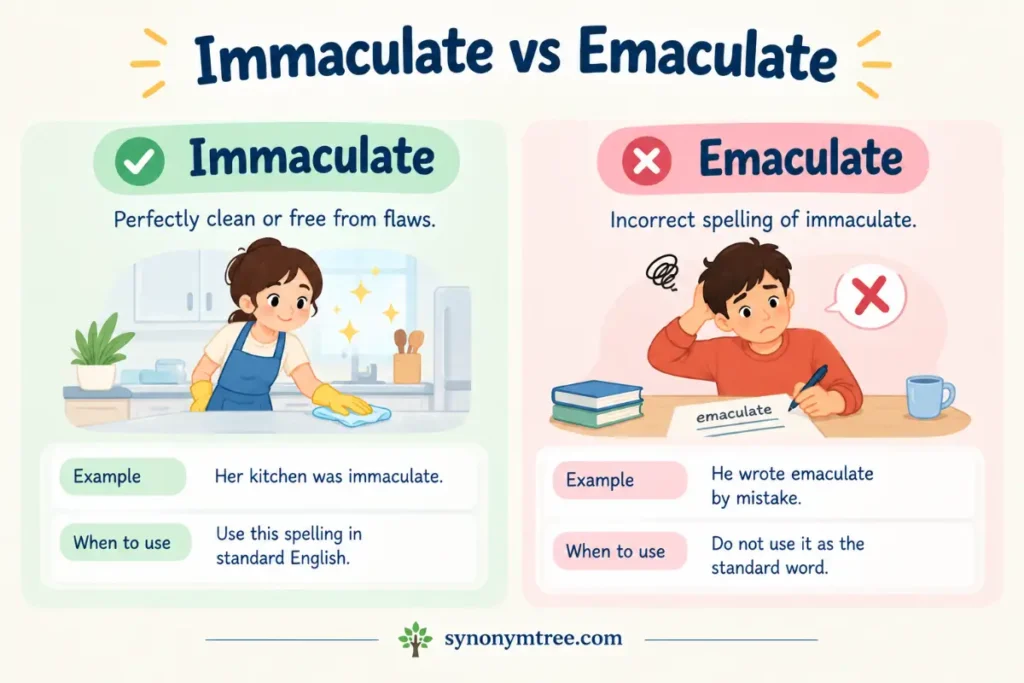
Emaculate vs Immaculate Comparison
| Word or phrase | Meaning | Example sentence | When to use it |
|---|---|---|---|
| Immaculate | Perfectly clean or free from flaws | Her kitchen was immaculate. | Use this spelling in standard English |
| Emaculate | Incorrect spelling of immaculate | He wrote emaculate by mistake. | Do not use it as the standard word |
Why Is Immaculate The Correct Spelling
Immaculate has two m letters near the beginning.
The correct spelling is:
I M M A C U L A T E
Many people accidentally write:
E M A C U L A T E
The second version drops one m and also starts with e instead of i.
That makes it incorrect.
A useful way to see the correct spelling is to break it into parts.
Immaculate.
The word begins with imm.
That double m is easy to miss because the word is often pronounced quickly in normal speech.
The first syllable can sound softer than the spelling suggests. As a result, some writers spell the word based on how they hear it rather than how it is correctly written.
This is a common problem with English spelling.
The safest choice is simple. If you mean perfectly clean, pure, or free from flaws, write immaculate.
What Does Immaculate Mean
Immaculate has several closely related meanings.
Its most common meaning is extremely clean or spotless.
For example:
The hotel room was immaculate.
This tells us that the room was exceptionally clean and tidy.
The word can also describe something that is free from mistakes or flaws.
For example:
She submitted an immaculate report.
Here, immaculate does not mean that the paper was physically clean. It means the report was extremely well done and contained no noticeable errors.
The word can also describe someone’s appearance.
For example:
He arrived at the interview in an immaculate suit.
In this sentence, immaculate suggests that the suit looked perfectly clean, neat, and well cared for.
So the word has a wider meaning than simply clean.
It can describe physical condition, appearance, quality, accuracy, and even moral or religious purity in certain contexts.
What Does Immaculate Mean In Simple English
In simple English, immaculate means perfectly clean or without any flaws.
You can think of it as stronger than clean.
A clean room has been cleaned.
An immaculate room looks almost perfect.
A good report may contain a few small errors.
An immaculate report has no noticeable errors.
This difference makes immaculate a strong descriptive word.
It often suggests a very high standard.
Immaculate Means Spotless
When immaculate describes a physical place or object, it often means spotless.
For example:
The bathroom was immaculate.
The hotel kept its rooms immaculate.
Her white shoes remained immaculate.
The kitchen looked immaculate after the cleaning.
In these sentences, the word focuses on cleanliness and neatness.
Immaculate Means Perfectly Maintained
Immaculate can also describe something that is kept in excellent condition.
For example:
He owns an immaculate vintage car.
The phrase suggests that the car is not only clean but also extremely well maintained.
You might also say:
The old house has an immaculate interior.
The garden was immaculate.
The showroom floor looked immaculate.
The word can suggest care, order, and attention to detail.
Immaculate Means Free From Mistakes
The word can describe work that is extremely accurate.
For example:
Her performance was immaculate.
His record remains immaculate.
The editor produced an immaculate final copy.
In these examples, the meaning moves away from physical cleanliness.
The idea is perfection or freedom from flaws.
Why Do People Write Emaculate
The spelling error is easy to understand.
People often spell unfamiliar words according to sound.
Immaculate has several syllables, and the middle sounds can blend together when spoken quickly.
A person may hear something closer to emaculate and write it that way.
Another reason is that the double m is not visually obvious when you say the word.
English contains many words where spelling and pronunciation do not match perfectly.
For example, people may struggle with necessary, definitely, separate, and accommodation.
Immaculate can cause the same kind of problem.
The best solution is to connect the word with a familiar meaning and spelling.
If you mean perfectly clean or free from flaws, remember:
Immaculate begins with imm.
That small memory trick can prevent the mistake.
How Do You Spell Immaculate
The correct spelling is:
Immaculate.
It contains ten letters.
I M M A C U L A T E.
A helpful way to remember it is to focus on the beginning.
Write imm before aculate.
That gives you:
imm + aculate = immaculate.
The most common spelling mistake is removing one of the m letters.
Do not write emaculate.
Do not write immacualte.
The standard spelling is immaculate.
How Do You Pronounce Immaculate
In American English, immaculate is commonly pronounced roughly like:
ih MAK yuh lit.
The exact pronunciation can vary slightly depending on the speaker.
The first sound is short and unstressed.
The middle part carries the main stress.
This pronunciation helps explain the spelling problem.
The word does not sound like each letter is being spoken clearly.
The two m letters are part of the written form, but they do not create two separate m sounds in normal speech.
That is why listening alone may not help you spell it.
When learning the word, connect its pronunciation to its written form.
Where Does Immaculate Come From
Immaculate comes from Latin.
It traces back to the Latin word immaculatus, which means spotless or undefiled.
The Latin root is connected with macula, meaning spot or stain.
The prefix im adds a negative sense.
So the original idea is something without a spot or stain.
That history fits the modern meaning very well.
When you call a room immaculate, you are saying it has no visible dirt or disorder.
When you describe work as immaculate, you extend the same idea from physical spots to flaws or mistakes.
The word has been part of English for centuries.
Its older religious meaning also influenced how English speakers use it today.
What Does The Prefix Im Mean
The beginning im in immaculate is meaningful.
In many words, im can work as a form of a negative prefix.
It can express the idea of not or without.
For example:
Impossible means not possible.
Impatient means not patient.
Immature means not mature.
Imperfect means not perfect.
Immaculate has a related historical idea of being without a stain or spot.
This does not mean you can create a word by putting im before any adjective.
English does not work that way.
Still, understanding the word’s history can make its spelling easier to remember.
Immaculate As An Adjective
Immaculate is an adjective.
An adjective describes a person, place, thing, or idea.
For example:
The room is immaculate.
Immaculate describes the room.
She wore an immaculate dress.
Immaculate describes the dress.
His work was immaculate.
Immaculate describes the quality of his work.
You can place the adjective before a noun or after a linking verb.
Both patterns are common.
Before A Noun
You can put immaculate directly before a noun.
Examples include:
An immaculate record.
An immaculate performance.
The adjective gives the reader a strong picture of the noun.
After A Linking Verb
You can also use immaculate after verbs such as is, was, looks, seems, and remained.
For example:
The room was immaculate.
Her desk looks immaculate.
The car remained immaculate.
His record is immaculate.
The garden seemed immaculate.
This structure is very common in everyday English.
How To Use Immaculate In A Sentence
Immaculate works best when you want to show an unusually high level of cleanliness, order, quality, or perfection.
Consider these examples.
The hotel room was immaculate.
Her apartment is always immaculate.
The chef keeps the kitchen immaculate.
His white shirt looked immaculate.
The car was in immaculate condition.
She gave an immaculate performance.
The team had an immaculate record.
The final report was immaculate.
The garden looked immaculate after the work was finished.
The museum keeps its exhibits in immaculate condition.
Each sentence uses the word naturally.
Immaculate For Cleanliness
This is one of the most common uses.
You can use immaculate for rooms, buildings, clothing, vehicles, kitchens, bathrooms, gardens, and other physical spaces or objects.
For example:
The bathroom was immaculate.
The hotel lobby looked immaculate.
Her kitchen is always immaculate.
The mechanic returned the car in immaculate condition.
His shoes were immaculate.
The office was kept immaculate.
The word gives a stronger impression than clean.
It suggests that the subject has been cleaned or maintained to a very high standard.
Immaculate For Appearance
Immaculate can describe someone who looks extremely neat and well dressed.
For example:
She arrived in an immaculate outfit.
He looked immaculate at the wedding.
The actor appeared in an immaculate suit.
The candidate looked immaculate during the interview.
Here, the word can suggest polished appearance, careful grooming, and attention to detail.
It does not simply mean attractive.
Someone can look attractive without looking immaculate.
Immaculate For Work Quality
Immaculate can describe work that contains no noticeable flaws.
For example:
The designer created an immaculate layout.
The surgeon performed an immaculate procedure.
The editor produced an immaculate copy.
Her calculations were immaculate.
His presentation was immaculate.
This use is stronger and more figurative than the cleanliness meaning.
The work is being described as if it has no spots or imperfections.
Still, be careful with the word.
Immaculate is a very strong compliment.
If the work has several mistakes, calling it immaculate would be inaccurate.
Immaculate For A Record
Immaculate can describe a record with no losses, failures, violations, or other negative marks.
For example:
The team finished the season with an immaculate record.
The athlete maintained an immaculate record.
The company has an immaculate safety record.
The phrase immaculate record can be used in sports, business, law, and other areas.
The exact meaning depends on the type of record.
In sports, it may suggest no losses.
In another setting, it may mean there are no negative marks on the record.
Immaculate In Religious Contexts
Immaculate also has an important religious meaning.
It can mean free from sin or moral stain.
This meaning is especially associated with Christian theology.
The best known example is the phrase Immaculate Conception.
The Immaculate Conception is a Catholic doctrine about Mary.
It refers to Mary being conceived without original sin.
The term does not mean the conception of Jesus.
That is a common misunderstanding.
The word immaculate in this phrase carries the sense of being free from sin or stain.
This religious use is more specific than the everyday meaning of spotless.
Immaculate Conception Explained Simply
The Immaculate Conception is a Catholic teaching concerning Mary.
According to the doctrine, Mary was preserved from original sin from the moment of her conception.
The term is sometimes misunderstood because people assume it refers to the conception of Jesus.
That is not what the doctrine means.
The distinction matters when writing about religion because the phrase has a specific theological meaning.
The word immaculate itself still carries the basic idea of being without stain.
Immaculate And Impeccable
Immaculate and impeccable are close in meaning, but they are not always interchangeable.
Impeccable usually means without faults or mistakes.
Immaculate often emphasizes cleanliness, purity, or a flawless condition.
Compare these sentences:
Her apartment was immaculate.
Her grammar was impeccable.
The first sentence focuses on cleanliness and order.
The second focuses on correctness and quality.
You can sometimes use either word for excellent work.
For example:
His performance was immaculate.
His performance was impeccable.
Both sentences praise the performance strongly.
However, impeccable often sounds more natural when talking about behavior, judgment, taste, manners, or quality.
Immaculate often sounds more natural when talking about cleanliness or physical condition.
Immaculate And Spotless
Spotless is one of the closest everyday synonyms for immaculate.
Both can describe something extremely clean.
For example:
The kitchen was spotless.
The kitchen was immaculate.
Both sentences work.
Spotless is more common in casual speech.
Immaculate can sound slightly stronger or more polished.
Spotless can also focus very directly on the absence of dirt or marks.
Immaculate can suggest cleanliness plus order and perfect condition.
The best choice depends on the tone you want.
Immaculate And Perfect
Perfect is a broader word.
It can describe almost anything that has no flaws or meets an ideal standard.
Immaculate is more specific.
For example:
The room was perfect.
This could mean the room was clean, attractive, comfortable, or exactly what the speaker wanted.
The room was immaculate.
This strongly suggests that the room was exceptionally clean and neat.
So immaculate often gives the reader a clearer picture.
It is a more specific compliment.
Immaculate And Pristine
Pristine is another close synonym.
Pristine means extremely clean, fresh, or in its original condition.
For example:
The beach looked pristine.
The car was in pristine condition.
The room was pristine.
Immaculate and pristine overlap, but they can carry different shades of meaning.
Pristine often suggests something untouched, fresh, or almost new.
Immaculate often emphasizes perfect cleanliness, order, or condition.
You might describe an old but perfectly cleaned room as immaculate.
You might describe a natural lake with almost no signs of human activity as pristine.
Immaculate And Flawless
Flawless means without flaws.
It is often used for work, performance, appearance, or results.
For example:
She gave a flawless performance.
The design was flawless.
His technique was flawless.
Immaculate can work in some of these situations, but it often has a stronger association with cleanliness and purity.
Flawless is usually the better choice when the main idea is the absence of mistakes.
Immaculate And Neat
Neat is much weaker than immaculate.
A neat room is organized and tidy.
An immaculate room is exceptionally clean and well maintained.
For example:
My desk is neat.
My desk is immaculate.
The second sentence makes a much stronger claim.
If you are writing about ordinary cleanliness, neat may sound more natural.
If you want to stress an extremely high standard, immaculate works well.
Common Mistakes With Immaculate
The spelling mistake is the biggest issue.
However, writers can also misuse the word because it sounds stronger than ordinary adjectives.
Mistake One
Writing emaculate instead of immaculate.
Incorrect:
The house was emaculate.
Correct:
The house was immaculate.
Mistake Two
Writing immacculate.
The word does not contain c after the double m.
Correct:
Immaculate.
Not:
Immacculate.
Mistake Three
Writing immacualte.
The letters need to stay in the correct order.
Correct:
Immaculate.
Not:
Immacualte.
Mistake Four
Using immaculate for something that is only fairly clean.
If a room has dirty dishes, clothes on the floor, and dust on the furniture, calling it immaculate creates the wrong impression.
Choose a word that matches the actual condition.
Clean may be enough.
Very clean may work in casual writing.
Spotless or immaculate works when the standard is exceptionally high.
Mistake Five
Using immaculate as if it always means beautiful.
The word can describe appearance, but beauty is not its main meaning.
An object can be immaculate without being beautiful.
For example:
The old truck was immaculate but plain.
Here, the truck is extremely clean and well maintained, but the writer is not saying it is attractive.
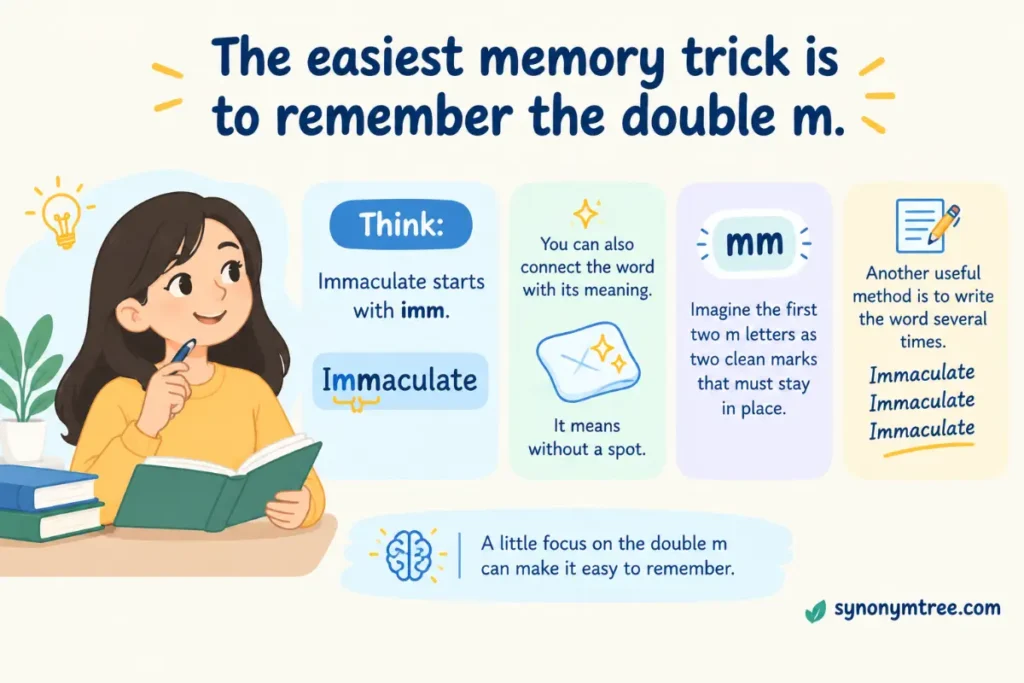
How To Remember The Spellings Of Emaculate Vs Immaculate
The easiest memory trick is to remember the double m.
Think:
Immaculate starts with imm.
You can also connect the word with its meaning.
Immaculate means without a spot.
Imagine the first two m letters as two clean marks that must stay in place.
Another useful method is to write the word several times.
Immaculate.
Immaculate.
Then use it in a sentence.
The room was immaculate.
Seeing the correct form in context helps your memory more than looking at the spelling alone.
A Simple Spelling Test
If you are unsure, look at the first four letters.
The correct beginning is:
imma
Not:
emac
The word continues:
culate
Put the pieces together.
Imma + culate.
Immaculate.
This method is useful because the beginning is where most spelling errors happen.
Natural Examples With Immaculate
Here are examples across different situations.
Home
Her kitchen is immaculate.
The living room looked immaculate after cleaning.
He keeps his apartment immaculate.
Work
Her desk was immaculate.
The office looked immaculate before the meeting.
His work area remained immaculate.
Clothing
She wore an immaculate white dress.
His suit looked immaculate.
The uniform was immaculate.
Vehicles
The car was in immaculate condition.
He keeps his classic truck immaculate.
The showroom displayed several immaculate vehicles.
Nature
The lake looked immaculate in the early morning.
The garden was immaculate after weeks of careful work.
Performance
The pianist gave an immaculate performance.
The team’s execution was immaculate.
Her presentation was immaculate.
Writing
The final manuscript was immaculate.
His grammar was nearly immaculate.
The editor delivered an immaculate final copy.
These examples show how the word can move from physical cleanliness to figurative perfection.
Immaculate In Everyday American English
Americans use immaculate in both casual and formal English.
It often appears when someone wants to give strong praise.
For example:
Your kitchen is immaculate.
That car is immaculate.
His office is immaculate.
She always looks immaculate.
The hotel was immaculate.
These sentences sound natural in everyday conversation.
The word can also appear in professional writing.
For example:
The facility was maintained in immaculate condition.
The report was presented in immaculate form.
The property was kept immaculate throughout the inspection period.
The context determines how formal the word sounds.
Is Immaculate A Positive Word
Yes.
Immaculate is normally strongly positive.
It praises something for being clean, pure, accurate, or free from flaws.
For example:
The room was immaculate.
That is a clear compliment.
The word can also sound very strong.
If you tell someone their work is immaculate, you are giving them a high level of praise.
Use it when the situation supports that level of praise.
Otherwise, words such as clean, neat, good, polished, or excellent may sound more natural.
Can Immaculate Describe A Person
Yes.
You can use immaculate to describe someone’s appearance.
For example:
She looked immaculate.
He arrived looking immaculate.
The bride looked immaculate.
The phrase usually means the person looked extremely neat, clean, polished, and well dressed.
It does not normally mean the person’s personality is perfect.
For that idea, you would need different words.
Can Immaculate Describe A Place
Yes.
This is one of the most common uses.
For example:
The hotel room was immaculate.
The restaurant was immaculate.
The office was immaculate.
The bathroom was immaculate.
The store was immaculate.
The word works especially well when cleanliness and order matter.
Can Immaculate Describe Food
It can, but this use is less common.
You might describe food presentation as immaculate.
For example:
The chef created an immaculate presentation.
Here, immaculate describes the careful appearance of the dish rather than its taste.
You would usually choose words such as delicious, fresh, flavorful, or excellent to describe the food itself.
Can Immaculate Describe Writing
Yes.
Immaculate can describe writing that is exceptionally clean or error free.
For example:
Her final draft was immaculate.
His punctuation was immaculate.
The editor produced an immaculate copy.
Still, impeccable may be a more natural choice when you specifically mean that the writing contains no errors.
Immaculate can work when you want a stronger or more polished tone.
Can Immaculate Describe A Record
Yes.
This is a figurative use.
An immaculate record is one with no negative marks.
For example:
The athlete has an immaculate record.
The company has maintained an immaculate safety record.
The phrase is especially useful when the record represents repeated success or a lack of problems.
The exact meaning depends on context.
Is Immaculate Too Strong For Casual Writing
Not always.
You can use it in casual conversation when something is exceptionally clean or well maintained.
For example:
Your car is immaculate.
That room is immaculate.
The house looks immaculate.
These sentences sound natural.
The word becomes less suitable when the thing is only reasonably clean.
Calling a slightly tidy desk immaculate may sound exaggerated.
Good writing matches the strength of the adjective to the situation.
Related Words To Learn
Learning related words can help you understand the full meaning of immaculate.
| Word | Meaning | Example |
|---|---|---|
| Immaculate | Perfectly clean or without flaws | The room was immaculate. |
| Impeccable | Without faults or mistakes | Her manners were impeccable. |
| Spotless | Completely free from dirt or marks | The kitchen was spotless. |
| Pristine | Very clean or in original condition | The beach looked pristine. |
| Flawless | Without defects or errors | His performance was flawless. |
| Perfect | Without faults or exactly right | The result was perfect. |
| Tidy | Neat and organized | Her desk was tidy. |
| Clean | Free from dirt | The floor was clean. |
| Pure | Free from unwanted material or moral stain | The water was pure. |
| Polished | Refined and carefully presented | His presentation was polished. |
These words overlap, but they are not identical.
Choosing the right one makes your writing more precise.
Antonyms Of Immaculate
An antonym is a word with an opposite meaning.
Depending on the context, possible opposites of immaculate include:
- Dirty.
- Messy.
- Untidy.
- Stained.
- Flawed.
- Imperfect.
- Damaged.
- Unkempt.
- Defective.
- Tainted.
The best antonym depends on what immaculate describes.
For a room, messy or dirty may work.
For moral purity, tainted may fit better.
How To Choose Between Clean And Immaculate
Use clean when you simply want to say that something has no dirt.
Use immaculate when you want to show an exceptionally high level of cleanliness or perfection.
Compare:
The kitchen is clean.
The kitchen is immaculate.
The first statement is neutral.
The second statement gives stronger praise.
This difference is useful in reviews and descriptions.
For example, a hotel review might say:
The room was clean.
That gives a basic positive assessment.
The room was immaculate.
That tells the reader the cleanliness was outstanding.
How To Choose Between Perfect And Immaculate
Use perfect when you mean that something meets an ideal standard.
Use immaculate when the idea is mainly cleanliness, purity, excellent condition, or freedom from flaws.
For example:
The timing was perfect.
The timing was immaculate.
Perfect sounds natural.
Immaculate sounds unusual because timing is not normally described in terms of cleanliness.
However:
The room was perfect.
The room was immaculate.
Both work, but they communicate slightly different ideas.
Perfect is broader.
Immaculate focuses more strongly on cleanliness and flawless condition.
How To Choose Between Immaculate And Impeccable
Use immaculate for exceptional cleanliness, neatness, purity, or condition.
Use impeccable for behavior, judgment, manners, quality, or work that has no faults.
For example:
Her house was immaculate.
His manners were impeccable.
The car was immaculate.
Her judgment was impeccable.
These pairings sound natural because each adjective fits the main idea.
You can use both words for some types of performance.
The best choice depends on the shade of meaning you want.
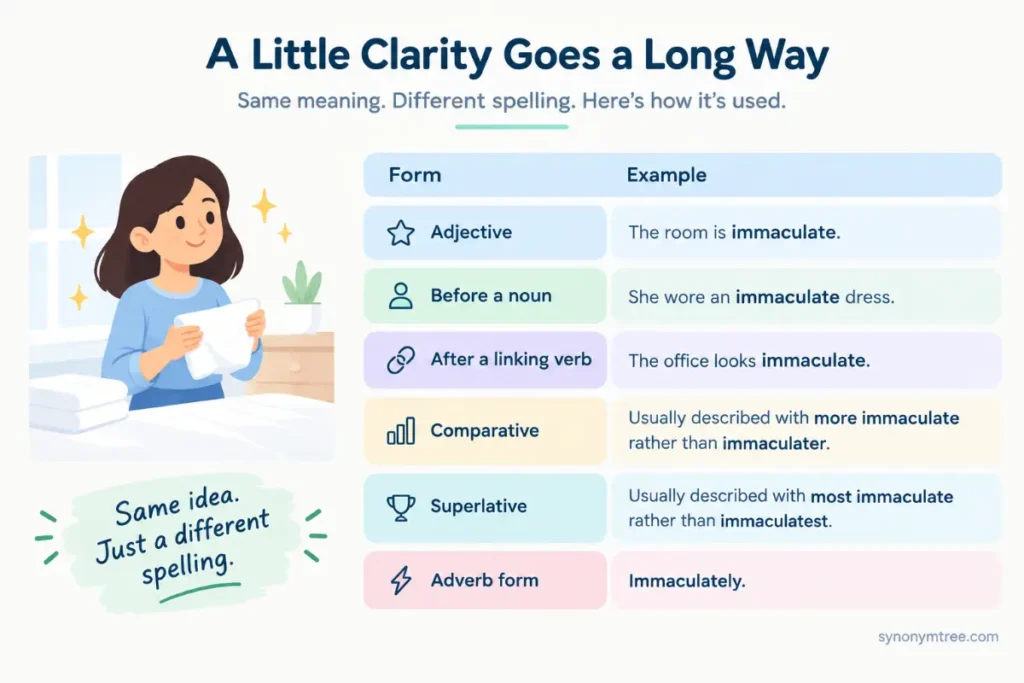
Quick Grammar Guide About Emaculate Vs Immaculate
| Form | Example |
|---|---|
| Adjective | The room is immaculate. |
| Before a noun | She wore an immaculate dress. |
| After a linking verb | The office looks immaculate. |
| Comparative | Usually described with more immaculate rather than immaculater. |
| Superlative | Usually described with most immaculate rather than immaculatest. |
| Adverb form | Immaculately |
The adjective is the form you will use most often.
The adverb immaculately means in a perfectly clean or flawless way.
For example:
The room was immaculately maintained.
She was immaculately dressed.
The garden was immaculately designed.
What Does Immaculately Mean
Immaculately is the adverb form of immaculate.
It describes how an action is performed.
For example:
The room was immaculately cleaned.
The house was immaculately maintained.
She was immaculately dressed.
The property was immaculately presented.
The word still carries the idea of exceptional cleanliness, care, or perfection.
Common Search Questions About The Word
People often search for the spelling because they have heard the word but have not seen it written.
The main question is simple.
If you mean perfectly clean or free from flaws, use immaculate.
The spelling begins with i and contains two m letters.
That is the form you should use in standard English.
The incorrect form often appears because the word is pronounced quickly.
Reading the word regularly can help build a stronger spelling memory.
A Quick Editing Checklist
Before publishing a sentence that uses this word, check three things.
- Make sure the word begins with im.
- Make sure it contains two m letters.
- Make sure the meaning fits the sentence.
For example:
The hotel room was immaculate.
The spelling is correct.
The meaning fits.
The adjective clearly describes the room’s condition.
That makes the sentence natural and precise.
Conclusion
The answer to emaculate vs immaculate is straightforward. Immaculate is the correct spelling. Emaculate is a spelling mistake and should not be used in standard English.
Immaculate is an adjective that means perfectly clean, spotless, pure, or free from flaws. You can use it for a room, car, outfit, garden, performance, record, or piece of work. Its meaning changes slightly with the context, but the central idea is a very high standard with little or no imperfection.
The easiest spelling trick is to remember the double m. Write immaculate with i at the beginning and two m letters after it. Think of the opening as imma.
When you need a strong word for something exceptionally clean or flawless, immaculate is a good choice. Just make sure the situation deserves that strong description. If it does, you can use the word confidently and spell it correctly every time.
FAQs
Is emaculate vs immaculate the correct spelling?
Immaculate is the correct spelling. Emaculate is a misspelling that should be avoided in standard English.
How do you spell immaculate correctly?
Spell it I M M A C U L A T E. The word begins with imma and contains two m letters.
What does immaculate mean?
Immaculate means perfectly clean, neat, pure, or free from flaws. The exact meaning depends on the context.
Is immaculate a compliment?
Yes. Immaculate is usually a strong compliment. It can praise exceptional cleanliness, appearance, condition, or quality.
What is the difference between immaculate and impeccable?
Immaculate often focuses on cleanliness, purity, or perfect condition. Impeccable usually focuses on behavior, judgment, quality, or freedom from mistakes.
What is the opposite of immaculate?
The opposite depends on context. Dirty, messy, untidy, stained, flawed, and imperfect can all work in different situations.
Can you use immaculate to describe a person?
Yes. You can say someone looks immaculate when they look extremely neat, clean, polished, and well dressed.
Is immaculate the same as spotless?
The words are close. Spotless focuses strongly on being free from dirt or marks, while immaculate can also suggest perfect order, condition, purity, or freedom from flaws.
