
If you are unsure about elfs or elves, the correct plural form of elf is elves. The word elfs is generally not used in standard English when you mean more than one elf.
This small spelling change follows a common English pattern. Some nouns that end in f or fe change to ves when they become plural. Elf follows that pattern, just like half becomes halves and wolf becomes wolves.
You may still see elfs in some older writing, fictional works, names, or unusual contexts. However, elves is the normal plural form in modern standard English.
This guide explains why elves is correct, how the spelling rule works, where the word comes from, how to use it in real sentences, and why some other words ending in f do not follow the same pattern. You will also see examples from everyday English, fantasy stories, Christmas writing, literature, and common grammar questions.
Quick Definition
An elf is a mythical or fictional creature often shown as small and magical. The standard plural form is elves. Elfs is generally not the standard plural spelling when you are talking about more than one elf.
Direct Answer
The correct plural form is elves. Use elves when you mean two or more elves.
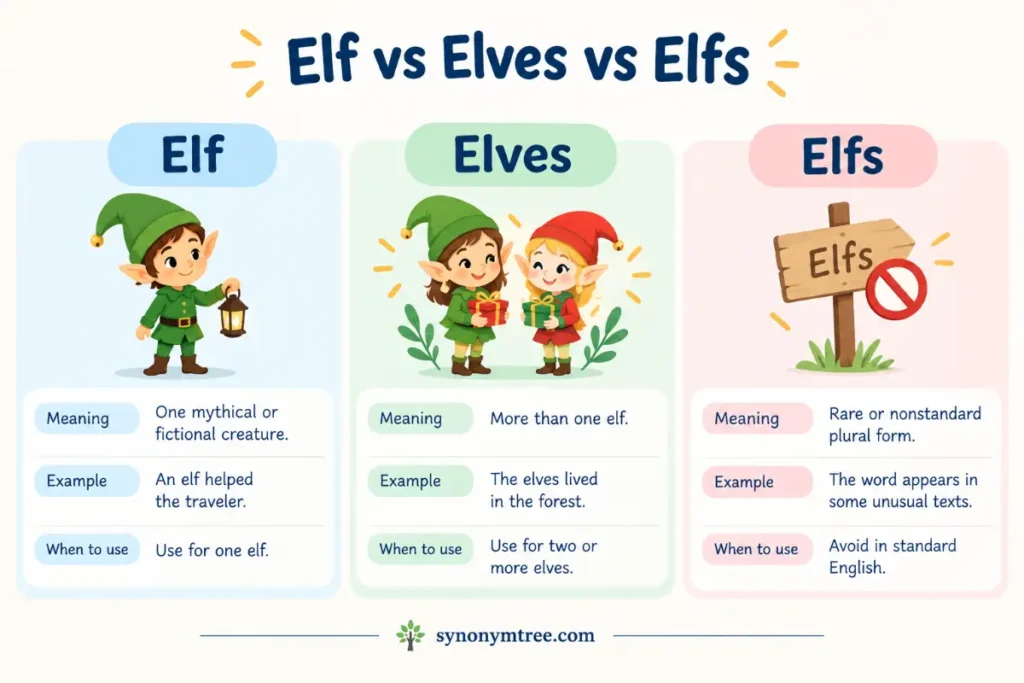
Elfs Or Elves Comparison
| Word or phrase | Meaning | Example sentence | When to use it |
|---|---|---|---|
| Elf | One mythical or fictional creature | An elf helped the traveler. | Use for one elf |
| Elves | More than one elf | The elves lived in the forest. | Use for two or more elves |
| Elfs | Rare or nonstandard plural form | The word appears in some unusual texts. | Avoid in standard English |
Why Is Elves The Correct Plural
The word elf is one of several English nouns that change their spelling when they become plural.
Instead of simply adding s to elf, English changes the f to v and adds es.
So we get:
Elf becomes elves.
This may look strange if you are learning English because many nouns form plurals by simply adding s.
For example:
Cat becomes cats.
Book becomes books.
Tree becomes trees.
House becomes houses.
Elf works differently.
The spelling changes from f to v before the plural ending.
This pattern also appears in several other familiar words.
Wolf becomes wolves.
Calf becomes calves.
Half becomes halves.
Loaf becomes loaves.
Leaf becomes leaves.
Knife becomes knives.
Life becomes lives.
Wife becomes wives.
Shelf becomes shelves.
These words can help you remember the spelling of elves.
However, English has many exceptions. Not every word ending in f changes to ves. That is one reason plural spelling can feel confusing.
Where Does The Word Elf Come From
Elf is a very old English word.
It comes from older Germanic languages and has been used for centuries to describe supernatural beings.
In Old English, related forms included ælf.
The idea of an elf existed in Germanic traditions long before modern fantasy stories became popular.
Early ideas about elves were not always the same as the cheerful small creatures many people know today.
Folklore from Northern Europe often described elves as supernatural beings connected with nature, magic, hidden places, or unusual events.
Over time, stories changed.
Different writers and cultures gave elves different appearances, personalities, powers, and roles.
Modern fantasy has added even more versions of elves.
Today, an elf might be a magical forest creature, a Christmas helper, a tall immortal being, or a character in a fantasy game.
The plural spelling stayed simple.
One elf.
Two elves.
Why Does Elf Become Elves
The spelling change comes from the history of English.
English has inherited many plural patterns from older forms of the language.
Some nouns once had different endings or sounds when they referred to more than one thing. Over time, those forms changed as English developed.
The f to v pattern remained in several common words.
That is why we now write:
Elf becomes elves.
Wolf becomes wolves.
Leaf becomes leaves.
Knife becomes knives.
The spelling is not based on a rule that works perfectly for every noun ending in f.
Instead, it is a pattern that applies to a group of common words.
That distinction matters.
You should not assume that every word ending in f must change to ves.
For example:
Roof becomes roofs.
Chief becomes chiefs.
Belief becomes beliefs.
Proof becomes proofs.
Chef becomes chefs.
These words normally keep the f and add s.
English plural spelling depends on the individual word and its history.
When Should You Use Elves
Use elves when you are talking about more than one elf.
The word works in everyday writing, stories, school assignments, articles, books, games, and conversations.
Here are some natural examples.
The elves worked late into the night.
Several elves gathered near the old tree.
The children dressed as elves for the holiday play.
The fantasy novel features a kingdom ruled by elves.
The elves helped protect the forest.
The shop sells decorations shaped like elves.
In each sentence, elves refers to multiple creatures.
Use Elf For One
Use elf when you are talking about a single creature.
An elf stood beside the door.
The story follows an elf who leaves the forest.
She dressed as an elf for the Christmas party.
The game lets you create an elf character.
One elf can be friendly.
One elf can also be dangerous in a fantasy story.
The singular form stays elf.
Use Elves For Two Or More
Once you have more than one, use elves.
Two elves walked through the forest.
Three elves joined the celebration.
The elves built a small village.
The children saw several elves at the holiday event.
The word does not change based on the exact number.
You use elves for two, five, ten, or hundreds.
Elves In Christmas Writing
Many people first learn the word elves through Christmas stories.
Santa Claus is often described as having elves who help make toys.
You might read sentences such as:
Santa’s elves are busy making toys.
The elves helped prepare the presents.
Children dressed like elves at the school party.
The Christmas story included a group of cheerful elves.
In this context, elves is still simply the plural of elf.
The holiday meaning does not change the grammar.
One Christmas helper is an elf.
Several Christmas helpers are elves.
Elves In Fantasy Stories
Fantasy writing uses the word elves in many different ways.
Some fantasy worlds portray elves as ancient beings with long lives and strong connections to nature.
Other stories show elves as skilled warriors, archers, healers, or magic users.
Some games let players choose an elf as a character type.
The spelling remains the same in all these settings.
For example:
The elves guarded the mountain pass.
The young elf trained with the royal archers.
An army of elves entered the valley.
The queen ruled over several elven kingdoms.
Notice that elven is another useful word related to elf.
Elven is usually an adjective.
It describes something connected with elves.
For example:
The warrior carried an elven sword.
They entered an ancient elven city.
The story describes an elven king.
So the basic forms are:
Elf for one.
Elves for more than one.
Elven for something related to elves.
Is Elfs Ever Correct
In standard modern English, elves is the normal plural of elf.
Elfs may appear in rare situations, but it is not the spelling you should normally choose.
You might encounter unusual plural forms in historical texts, specialized fictional settings, names, or creative writing.
An author may intentionally use an unusual form to create a certain style.
A fantasy game could also invent its own language rules.
That does not make elfs the standard English plural.
If you are writing an essay, article, email, story, school assignment, or general piece of content, use elves.
Common Mistakes With The Plural Of Elf
The most common mistake is adding s directly to elf.
A learner may think:
Elf plus s equals elfs.
That approach works for many English nouns.
But it does not give the standard plural of elf.
The correct form is elves.
Mistake One
Writing elfs when you mean several elves.
Incorrect:
The elfs live in the forest.
Correct:
The elves live in the forest.
Mistake Two
Using elves for one creature.
Incorrect:
An elves helped the child.
Correct:
An elf helped the child.
Elves is plural.
Elf is singular.
Mistake Three
Confusing elves with elven.
These words have different jobs.
Elves is a plural noun.
Elven is an adjective.
For example:
The elves entered the city.
The elves carried elven weapons.
The first sentence uses elves as the subject.
The second sentence uses elven to describe the weapons.
Elves In Real Sentences
Seeing the word in different situations makes the spelling easier to remember.
Here are natural examples from several contexts.
Everyday Examples
The children were excited to see the elves.
We bought small elf decorations for the party.
Several elves appeared in the school play.
The store displayed rows of elf costumes.
The book has colorful pictures of elves.
Fantasy Examples
The elves lived deep inside the forest.
The king asked the elves to defend the village.
Ancient elves once ruled the northern lands.
The hero traveled with a group of elves.
The elves used magic to protect their home.
Christmas Examples
The elves helped Santa prepare the gifts.
The children wore green hats and dressed as elves.
A group of elves greeted the visitors.
The Christmas movie featured singing elves.
The elves worked in Santa’s workshop.
School Examples
The teacher asked students to write a story about elves.
The class read a folktale about an elf.
The students drew pictures of elves.
The assignment included a question about the plural of elf.
These examples all use the same standard plural form.
Elfs Or Elves In A Sentence
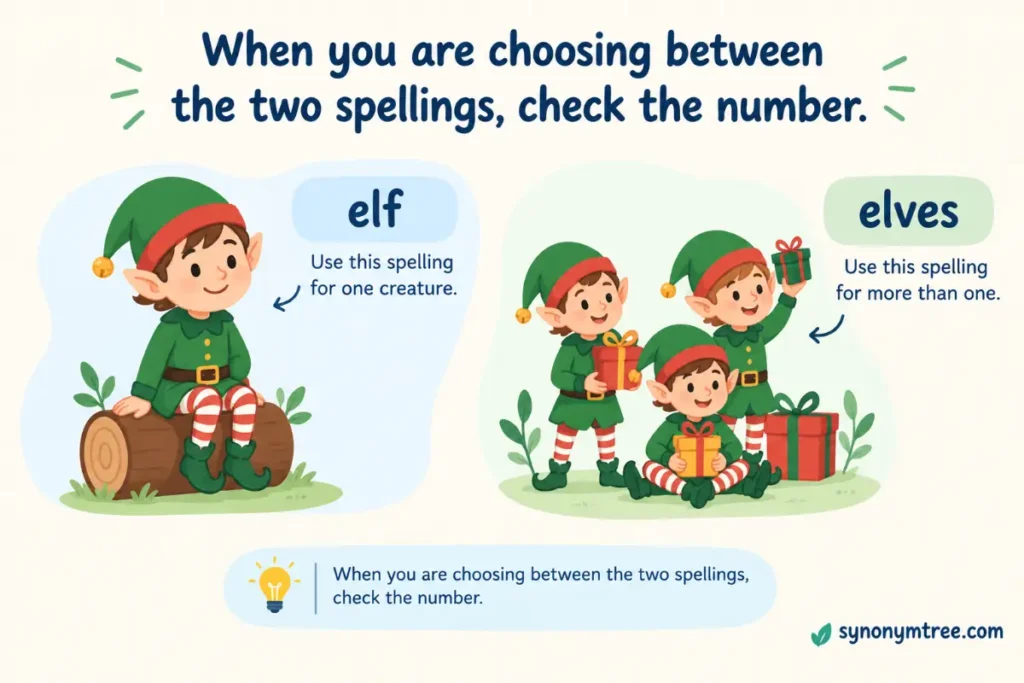
When you are choosing between the two spellings, check the number.
If you mean one creature, use elf.
If you mean more than one, use elves.
For example:
One elf is hiding behind the tree.
Two elves are hiding behind the tree.
An elf entered the room.
Several elves entered the room.
This simple number test works every time for normal modern English.
How The F To V Pattern Works
The plural of elf belongs to a larger group of English words.
Some words ending in f or fe change that sound to v when they form their plural.
Here are common examples.
| Singular | Plural |
|---|---|
| Elf | Elves |
| Wolf | Wolves |
| Leaf | Leaves |
| Calf | Calves |
| Half | Halves |
| Loaf | Loaves |
| Knife | Knives |
| Life | Lives |
| Wife | Wives |
| Shelf | Shelves |
| Thief | Thieves |
| Self | Selves |
This list is useful, but do not treat it as a perfect rule for every English word.
English has exceptions.
Words That Keep The F
Some words ending in f simply add s.
Roof becomes roofs.
Chief becomes chiefs.
Chef becomes chefs.
Proof becomes proofs.
Belief becomes beliefs.
Cliff becomes cliffs.
Safe becomes safes when used as a noun.
Gulf becomes gulfs.
These forms show why you cannot create a universal rule that says every f must become v.
You need to learn the common plural form of each word.
Why English Has So Many Plural Patterns
English developed from several older languages.
Its vocabulary includes words with different histories.
As a result, English has several plural patterns.
The most common pattern is adding s.
Book becomes books.
Car becomes cars.
Dog becomes dogs.
Another common pattern adds es.
Box becomes boxes.
Bus becomes buses.
Watch becomes watches.
Some words change their spelling.
Child becomes children.
Man becomes men.
Woman becomes women.
Mouse becomes mice.
Elf belongs to this group of words with a spelling change.
This variety can seem difficult at first, but common words become easy with practice.
Elves And Other Irregular Plurals
Elves is sometimes called an irregular plural because it does not simply add s to the singular form.
However, it is part of a recognizable pattern.
Compare:
Elf becomes elves.
Wolf becomes wolves.
Leaf becomes leaves.
The spelling change is not completely random.
Still, some teachers may simply tell students to memorize elves as the plural form of elf.
That advice is useful because English has exceptions to nearly every broad plural rule.
Is Elves A Noun
Yes.
Elves is the plural noun form of elf.
A noun names a person, place, thing, animal, idea, or creature.
In this case, elf names a mythical or fictional creature.
Elves names more than one such creature.
For example:
The elves danced around the fire.
The word elves acts as the subject of the sentence.
You can also use it as an object.
The wizard helped the elves.
Here, elves receives the action.
What Is The Adjective Form Of Elf
The common adjective form is elven.
Elven means related to elves.
For example:
The warrior wore an elven cloak.
They discovered an ancient elven city.
The story describes an elven language.
In fantasy writing, elven is especially common.
Some writers may use elf as a noun modifier instead.
For example:
Elf costumes are popular during the holiday season.
Here, elf describes the type of costumes.
Both elf and elven can appear before another noun, but they do not always have exactly the same style or meaning.
Elven often has a stronger fantasy or literary feel.
Elves And Elfish
Elfish is an adjective that means like an elf or related to elves.
You may see it in descriptive writing.
For example:
She had an elfish smile.
The character had an elfish appearance.
Elfish is less common than elven in many fantasy settings.
The two words can overlap in meaning, but writers often choose based on style.
Elven usually sounds more connected to the world or culture of elves.
Elfish often describes something that resembles an elf.
Elves And Elf Like
Elf like is another descriptive form.
It can mean similar to an elf.
For example:
The character had an elf like appearance.
However, standard style guides may vary in how they write compounds such as this.
In polished writing, check the style guide you are following.
The main plural question remains simple.
Elf becomes elves.
Why Does The Spelling Sound Different
The pronunciation changes slightly when elf becomes elves.
Elf ends with an f sound.
Elves ends with a v sound.
The final sound in elves is voiced.
You can feel your throat vibrate when you say the v in elves.
This sound change is part of the historical pattern found in several English plurals.
It also explains why simply adding an s to elf does not produce the standard form.
The standard pronunciation and spelling work together.
How To Remember The Correct Spelling
A simple memory trick can help.
Think of elf and wolf together.
Elf becomes elves.
Wolf becomes wolves.
Both words change f to v before the plural ending.
You can also connect elf with leaf.
Leaf becomes leaves.
Elf becomes elves.
The shared spelling pattern makes the plural easier to remember.
Another useful trick is to remember the phrase:
One elf.
Two elves.
Say it aloud a few times.
The contrast makes the spelling feel natural.
What About Santa’s Elves
The correct form is elves.
For example:
Santa’s elves are preparing the gifts.
The apostrophe in Santa’s shows possession.
The word elves remains the plural form.
You do not need to change the plural because the elves belong to Santa in the sentence.
Compare these examples:
Santa has many elves.
Santa’s elves are working.
The first sentence uses elves as the subject of the phrase many elves.
The second uses elves as a possessive noun phrase with Santa’s.
The plural spelling stays the same.
Elves In Titles And Names
You may see unusual spellings in creative titles or fictional names.
An author may deliberately write a word differently to create a unique world.
A game developer may also create fictional groups with special naming rules.
If a fictional work officially uses a special spelling, preserve that spelling when referring to the fictional name.
However, when you are simply asking about standard English grammar, elves is the correct plural.
This distinction helps prevent confusion between creative language and standard language.
How Editors Handle The Word
An English editor would normally change elfs to elves when the writer means the plural of elf.
For example:
Original:
The elfs gathered near the castle.
Edited:
The elves gathered near the castle.
The change is simple.
The meaning stays the same.
The sentence follows standard English spelling.
Editors may leave elfs alone only if it is part of a proper name, intentional fictional language, historical quotation, or another special use.
Elfs Or Elves In Formal Writing
Use elves in formal writing.
That includes:
- School assignments.
- Essays.
- Articles.
- Reports.
- Blog posts.
- Books.
- Business content.
- Educational materials.
- General correspondence.
- Standard fiction.
The spelling elves is familiar and accepted across normal English writing.
Using elfs can make your writing look like it contains a spelling mistake.
That is especially true in academic or professional work.
Elfs Or Elves In American English
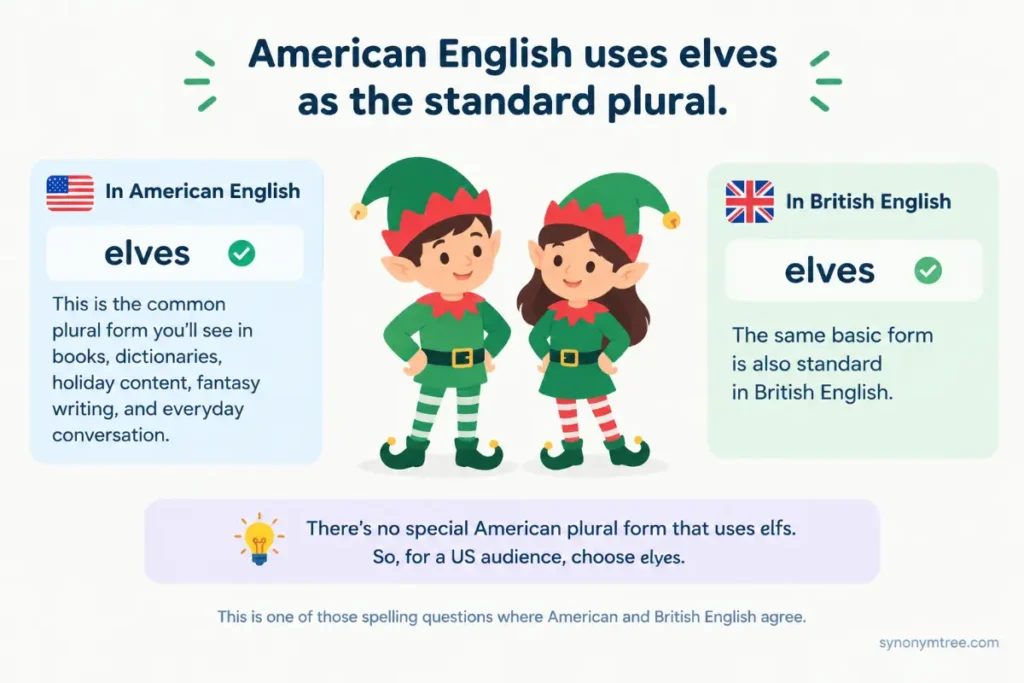
American English uses elves as the standard plural.
You will see it in American books, dictionaries, holiday content, fantasy writing, and general conversation.
There is no special American plural form that uses elfs.
So if you are writing for a US audience, choose elves.
The same basic form is also standard in British English.
This is one of those spelling questions where American and British English agree.
Elves In British English
British English also uses elves as the normal plural.
For example:
The elves lived beyond the hills.
The children dressed as elves.
The story was about a group of elves.
You do not need to change the spelling based on the variety of English.
That makes this word easier than some other spelling differences between American and British English.
Related Words You Should Know
Learning a few related words can make the topic clearer.
| Word | Meaning |
|---|---|
| Elf | One mythical or fictional creature |
| Elves | More than one elf |
| Elven | Related to elves |
| Elfish | Like an elf or related to an elf |
| Elfhood | The state or condition of being an elf |
| Elflike | Resembling an elf |
Not every word in this group is common in everyday conversation.
Elf and elves are by far the most familiar.
Elven is common in fantasy writing.
Elfish and elflike are more descriptive.
Why Do Some People Write Elfs
People may write elfs because they apply the most common English plural pattern.
They see elf and think that adding s should produce elfs.
That logic is understandable.
English often works that way.
Dog becomes dogs.
Tree becomes trees.
Book becomes books.
But elf belongs to a group that uses a different historical plural pattern.
Another reason is simple typing or spelling error.
Someone may know the word but forget its irregular plural.
The good news is that the correct form is easy to learn.
Elf means one.
Elves means more than one.
How To Choose The Right Form Quickly
You can solve the problem in a few seconds.
Ask yourself how many you mean.
If the answer is one, write elf.
If the answer is two or more, write elves.
For example:
One elf.
Five elves.
An elf.
Several elves.
The elf.
The elves.
This works for normal English sentences.
You do not need to think about the history of the language every time you write the word.
Quick Practice
Try choosing the correct word in each sentence.
The answer appears after each example.
Example One
One ___ opened the door.
Answer: elf.
Example Two
Three ___ opened the door.
Answer: elves.
Example Three
The children saw several ___ in the story.
Answer: elves.
Example Four
An ___ appeared beside the river.
Answer: elf.
Example Five
The ___ worked together to protect the village.
Answer: elves.
Example Six
The story follows one young ___.
Answer: elf.
These examples show the basic rule clearly.
A Simple Rule For Writers
When you need the plural of elf, do not add s directly.
Change elf to elves.
That is the form readers expect.
You can remember the pattern with other familiar words:
Wolf becomes wolves.
Leaf becomes leaves.
Shelf becomes shelves.
Elf becomes elves.
At the same time, remember that not every f word follows this pattern.
Roof becomes roofs.
Chief becomes chiefs.
Proof becomes proofs.
So treat elves as a standard plural form that you learn with the word elf.
Conclusion
The answer to elfs or elves is clear. Elves is the standard plural of elf. Use elf for one creature and elves for two or more.
The spelling change from f to v may seem unusual, but it follows a pattern found in several common English words. Wolf becomes wolves. Leaf becomes leaves. Knife becomes knives. Elf follows the same general pattern and becomes elves.
Still, English has exceptions. Words such as roof, chief, proof, and chef normally keep the f when they become plural. So do not assume every word ending in f changes to ves.
For everyday writing, the practical rule is easy. Write one elf and two elves. If you remember that simple pair, you will almost always choose the correct form.
Frequently Asked Questions
Is elfs or elves correct?
Elves is the standard plural form of elf. Use elves when you mean two or more elves.
Why does elf change to elves?
Elf follows a historical English spelling pattern in which the f changes to v before the plural ending. Similar forms include wolf and wolves and leaf and leaves.
Is elfs ever used in English?
Elfs can appear in unusual or creative contexts, but it is not the normal standard plural form. Use elves in regular modern English writing.
What is the plural of elf?
The plural of elf is elves. For example, you can write one elf but several elves.
Is elves singular or plural?
Elves is plural. The singular form is elf.
Is elven the plural of elf?
No. Elven is an adjective that means related to elves. Elves is the plural noun form.
Do Americans say elves or elfs?
Americans normally use elves. The same spelling is also standard in British English.
Why do some words ending in f become ves?
Some English nouns have a historical spelling pattern that changes f or fe to v before the plural ending. This pattern applies to words such as elf, wolf, knife, and wife, but many f words keep the f.
