
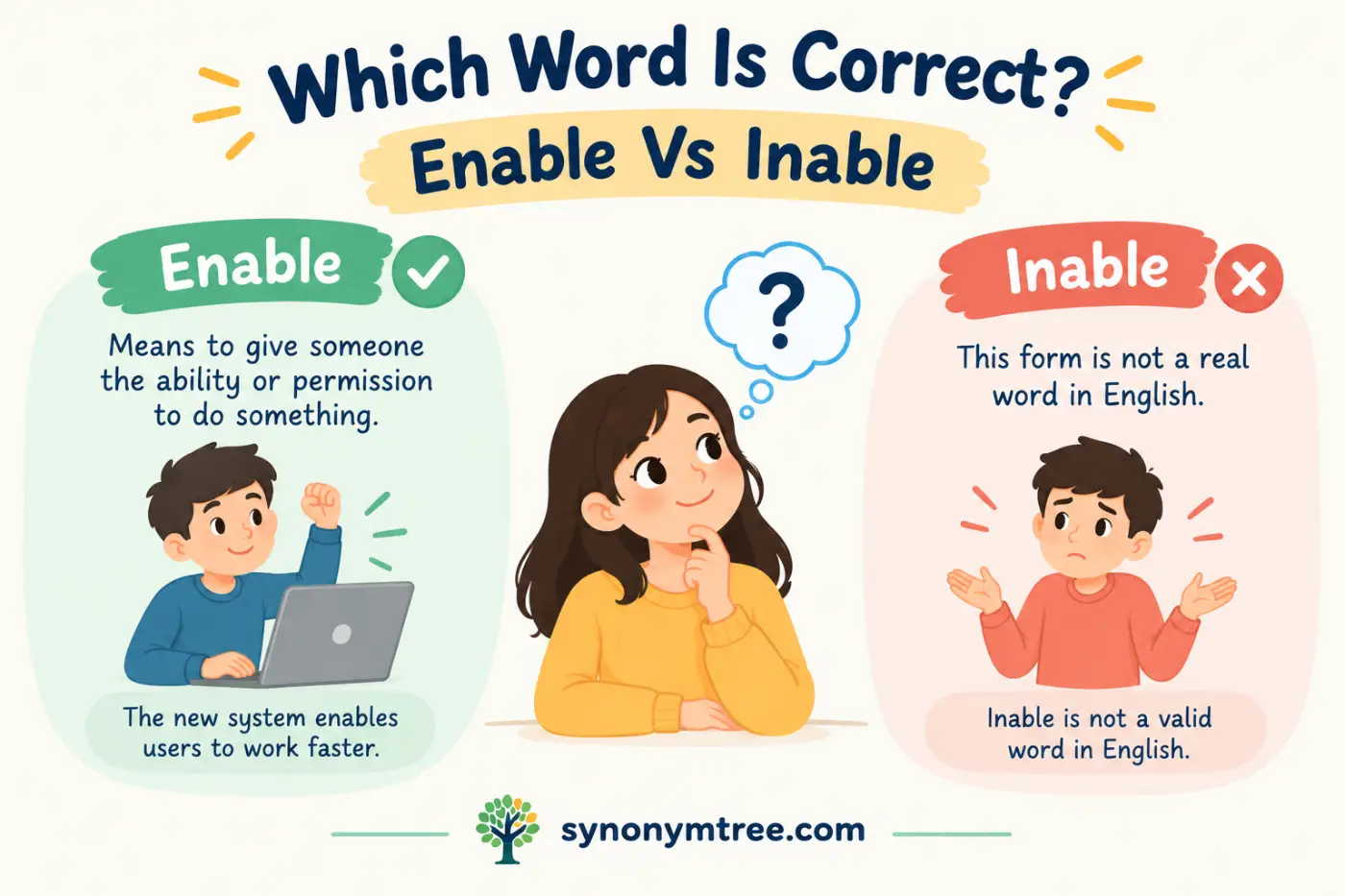
If you are searching for enable vs inable, the correct word in modern standard English is enable when you mean make something possible or give someone the ability to do something. If you mean that someone cannot do something, the correct word is unable, not inable.
The confusion is understandable because English often uses prefixes to change the meaning of words. Since able means having the power or skill to do something, inable may look like a logical opposite. However, modern English does not normally use inable this way.
The good news is that the rule is simple once you separate the words by meaning and grammar. This guide explains enable, unable, and disable, shows how each word works in real sentences, and covers the common mistakes that cause confusion.
Quick Definition
Enable is a verb that means to make something possible, give someone the ability to do something, or activate a feature. Unable is an adjective that means not capable of doing something.
Inable is not the standard modern form used to mean not able. In normal writing, use unable instead.
Direct Answer
Enable is the correct modern word when you mean make something possible or give someone an ability. If you mean not able to do something, use unable, not inable.
Comparison Table
| Word or Phrase | Meaning | Example Sentence | When to Use It |
|---|---|---|---|
| Enable | Make something possible or give someone an ability | The training enabled her to use the machine. | Use it when something creates an ability or makes an action possible. |
| Inable | Rare or obsolete form that is not normally used today | Avoid this form in modern writing. | Do not use it as the normal opposite of able. |
| Unable | Not capable of doing something | I was unable to attend the meeting. | Use it when someone or something cannot perform an action. |
| Disable | Stop something from working or turn off a feature | Please disable the alarm. | Use it when something is turned off or prevented from operating. |
| Able | Having the ability to do something | She is able to solve the problem. | Use it to describe capability. |
Why Do People Confuse enable Vs Inable
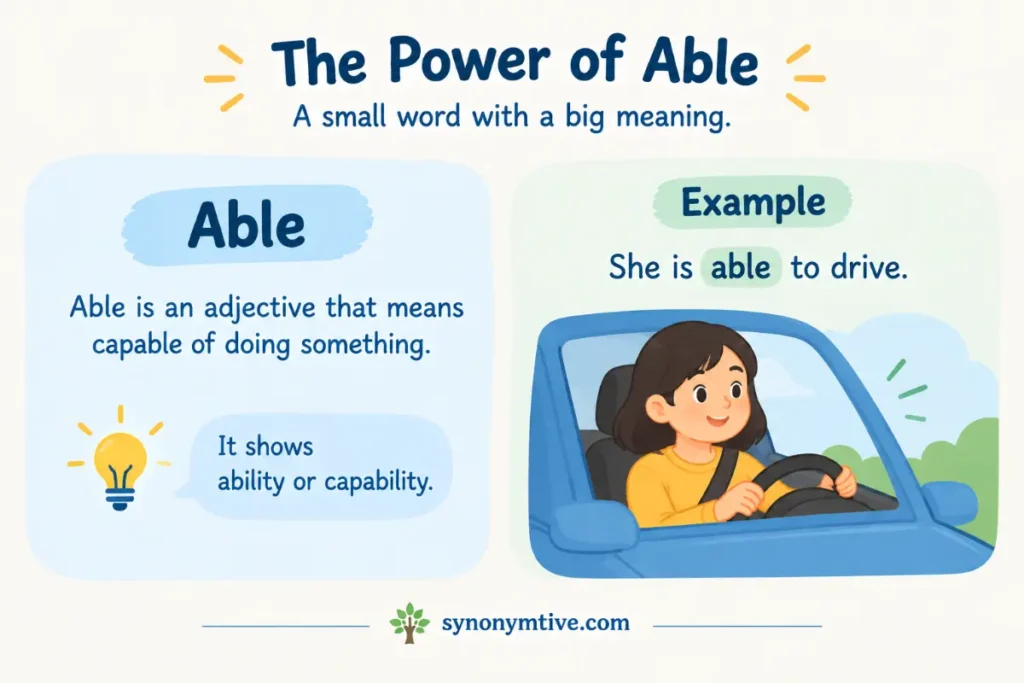
The main source of confusion is the word able. Able is an adjective that means capable of doing something. For example, you can say, She is able to drive, because the sentence tells us that she has the ability to drive.
English also uses prefixes to create related words. The prefix un often creates an opposite meaning, as in happy and unhappy or known and unknown. Because of this pattern, learners may expect the opposite of able to be inable. Modern English instead uses unable.
Another reason for the confusion is the spelling of enable. The word looks as if it contains a form of able with a prefix added to it. A reader may assume that enable and unable are simply opposite versions of the same word. They are not.
Enable means to make something possible. Unable means not capable of doing something. The words have different meanings and different grammatical roles.
Consider this example. The training enabled James to operate the machine. This sentence says that the training gave James the ability to operate the machine.
Now compare it with this sentence. James was unable to operate the machine before he received the training. Here, unable describes James’s lack of ability.
The two words can appear in the same situation, but they explain different parts of that situation. One describes something that creates an ability, while the other describes a person or thing that lacks an ability.
What Does Enable Mean
Enable is a verb. Its central meaning is to make something possible or give someone the ability to do something.
For example, The scholarship enabled Maria to attend college. The scholarship did not physically take Maria to college. Instead, it gave her the opportunity or means to attend.
The word can also describe a tool or system that provides a particular function. The new software enables employees to share files online. In this sentence, the software makes file sharing possible.
Enable is also very common in technology. When you see Enable Notifications or Enable Bluetooth on a phone or computer, the word means turn on or activate a feature.
This gives enable several common uses, but the basic idea stays the same. Something is being made possible, available, or active.
How To Use Enable In A Sentence
One of the most common sentence patterns is enable someone to do something. This structure means that one person, thing, action, or condition gives another person the ability or opportunity to perform an action.
The new course enabled students to improve their writing.
The extra time enabled us to finish the project.
The new road enabled drivers to reach the town more quickly.
The training enabled workers to operate the equipment safely.
In each example, something makes an action possible. The course helps students improve, the extra time makes finishing possible, the road makes travel easier, and the training gives workers the needed ability.
Another common pattern is enable something to happen. For example, the new system enables faster payments. This sentence does not focus on a specific person’s ability. Instead, it explains that the system makes faster payments possible.
You can also use enable when talking about settings or functions. A website might tell you to enable notifications, enable location services, or enable automatic updates. In these cases, enable means activate or turn on.
Enable Someone To Do Something
The structure enable someone to do something is especially useful in formal and everyday writing. It clearly shows the relationship between a source of ability and an action.
The teacher enabled the students to understand the difficult lesson.
The new equipment enabled the workers to finish the job faster.
The extra money enabled the family to repair the house.
The guide enabled visitors to find the museum easily.
A common grammar mistake is leaving out to after enable when the word is followed by a person and an action.
Incorrect: The training enabled him complete the task.
Correct: The training enabled him to complete the task.
The pattern is simple. Use enable, then the person or thing receiving the ability, then to plus the verb.
For example, The program enabled users to save their work automatically. The software enabled employees to work from home. The instructions enabled me to fix the problem.
This structure is worth remembering because it appears often in school writing, business communication, technical instructions, and everyday explanations.
Enable A Feature
Modern technology has made another use of enable extremely common. Phones, computers, websites, applications, and other devices use the word to describe features that can be turned on.
You might see a message such as Enable Notifications. You might also see Enable Bluetooth, Enable Camera Access, Enable Location Services, or Enable Automatic Updates.
In these examples, enable means activate. The feature already exists, but it is not currently active. Selecting the setting makes the feature available.
The opposite word is disable. If you enable notifications, you turn them on. If you disable notifications, you turn them off.
This pair is easy to remember because the meaning is direct. Enable means activate or make available. Disable means deactivate or stop from working.
What Does Inable Mean
Inable is not the standard modern word to use when you mean not able. Most modern English readers will expect unable instead.
You may find inable in old texts, historical dictionaries, or unusual sources. Language changes over time, and some words that once appeared in English are now rare or obsolete.
That historical use does not make inable a good choice for normal modern writing. If you are writing an email, article, essay, report, resume, school assignment, or business message, use unable when you mean not able.
For example, write I was unable to attend the meeting. Do not write I was inable to attend the meeting.
Likewise, write The computer was unable to connect to the network. This is the standard modern form.
The important point is not simply that one spelling is preferred. The words perform different roles. Enable means make possible. Unable means not capable.
Why Unable Is The Correct Opposite Of Able
Able means having the ability to do something. Unable means not having that ability.
For example, She is able to swim means that she has the ability to swim. She is unable to swim means that she does not have the ability to swim.
The prefix un commonly creates an opposite meaning. That is why able becomes unable rather than inable in standard English.
You can see the same pattern in other familiar words. Happy becomes unhappy. Known becomes unknown. Certain becomes uncertain. Able becomes unable.
English does not apply this pattern perfectly to every word, but unable is the established modern form.
The safest approach is to remember the complete word instead of trying to create it from a prefix. If the meaning is not able, write unable.
Enable And Unable Are Different Parts Of Speech
Grammar provides another useful way to separate the words.
Enable is a verb. It describes an action that makes something possible.
Unable is an adjective. It describes a person or thing that lacks the ability to perform an action.
Consider these sentences.
The new system enables employees to work remotely.
The old system was unable to process the requests.
In the first sentence, enables tells us what the system does. In the second sentence, unable describes the system.
Another pair makes the difference clearer.
The training enabled Sarah to use the equipment.
Sarah was unable to use the equipment before the training.
The training created an ability. Sarah previously lacked that ability. The words work together, but they are not interchangeable.
Enable Vs Disable
Enable and disable form one of the most useful word pairs in technology and everyday instructions.
Enable means to activate something, make it available, or allow it to operate. Disable means to deactivate something, make it unavailable, or stop it from operating.
For example, Enable notifications tells a user to turn notifications on. Disable notifications tells the user to turn them off.
The same pattern appears with many features.
You can enable automatic updates or disable automatic updates. You can enable Bluetooth or disable Bluetooth. You can enable location access or disable location access.
The past forms are enabled and disabled.
The feature is enabled means the feature is active. The feature is disabled means the feature is inactive.
This distinction matters in instructions because choosing the wrong word can reverse the intended action.
Enable Vs Able
Enable and able are closely related, but they are not the same word.
Able is an adjective that describes capability. Enable is a verb that describes the act of making something possible.
For example, She is able to solve the problem means that she has the ability to solve it.
The new software enables her to solve the problem means that the software gives her the ability or tools needed to solve it.
The difference becomes easier when you compare these two sentences.
He is able to swim.
The lessons enabled him to swim.
The first sentence describes his ability. The second sentence explains what helped create that ability.
You should not replace able with enable simply because the words are related. Their grammar and meaning are different.
Enable Vs Allow
Enable and allow can sometimes be used in similar sentences, but they do not always emphasize the same idea.
Allow usually focuses on permission. If a teacher allows students to leave early, the teacher gives them permission to leave.
Enable usually focuses on ability or possibility. If a new system enables students to submit work online, the system provides the function that makes online submission possible.
Consider this comparison.
The manager allowed employees to work from home.
The software enabled employees to work from home.
The first sentence focuses on permission. The second focuses on the tools or system that make remote work possible.
Sometimes both words can work.
The settings allow users to change their passwords.
The settings enable users to change their passwords.
The first version can emphasize permission or access. The second version can emphasize the function provided by the settings.
Good word choice depends on the idea you want to highlight.
Enable Vs Permit
Permit is another word that can overlap with allow and enable. Permit usually focuses on giving permission.
The law permits businesses to operate on Sundays.
The new system enables businesses to process payments online.
These sentences have different meanings. The law gives permission. The system provides a way to perform an action.
In some contexts, permit and enable can both be possible, but they are not exact synonyms.
If the main idea is permission, permit or allow is often more natural. If the main idea is ability, function, or possibility, enable is often the better choice.
This distinction becomes especially useful in formal writing because precise word choice can make a sentence clearer.
Common Mistakes With Enable
One of the most common mistakes is using inable instead of unable. For example, I was inable to finish the work is not the normal modern form. The correct sentence is I was unable to finish the work.
Another mistake is using enable when you mean able. The sentence She is enable to complete the task is incorrect. The correct sentence is She is able to complete the task.
A different mistake occurs when writers leave out to after enable. The sentence The program enabled us finish the work is incorrect. The standard form is The program enabled us to finish the work.
Writers also sometimes confuse enable and disable. If an instruction says enable a setting, it normally means turn the setting on. If it says disable the setting, it means turn the setting off.
These mistakes become much easier to avoid once you focus on the meaning instead of the spelling. Ask what the sentence is trying to say. If something is making an action possible, use enable. If someone cannot perform an action, use unable. If a feature needs to be turned off, use disable.
Real Examples With Enable
The new software enables employees to share files securely. This sentence explains that the software provides a function.
The scholarship enabled Maria to attend college. Here, the scholarship made attendance possible.
The new road enables drivers to reach the airport faster. The road creates a better way to travel.
The training enabled the staff to use the equipment correctly. The training gave the staff the needed ability.
The payment system enables customers to pay by phone. The system provides a payment option.
This setting enables automatic backups. The setting activates or makes the backup function available.
The new website enables customers to track their orders. The website gives customers access to a tracking function.
Better planning enabled the team to finish the project early. Planning made the result possible.
The new design enables the machine to use less power. The design allows the machine to operate in a more efficient way.
The guide enabled visitors to find the building easily. The guide gave visitors the information they needed.
These examples show why enable is useful. It connects a source of ability or possibility with the action that becomes possible.
Real Examples With Unable
I was unable to attend the meeting. This means I could not attend.
She was unable to answer the question. She did not have the ability or opportunity to answer it.
The computer was unable to connect to the network. The computer could not establish the connection.
They were unable to finish the project on time. They could not complete the project within the available time.
The printer was unable to process the document. The printer could not complete the required action.
He was unable to open the file. Something prevented him from opening it.
The team was unable to score before halftime. The team did not manage to score during that period.
My phone was unable to connect to the network. The phone could not establish a connection.
The company was unable to deliver the order that day. The company could not complete the delivery at that time.
The child was unable to reach the shelf. The child did not have the physical ability to reach it.
Notice the common pattern. Unable is often followed by to and a verb.
I was unable to sleep.
She was unable to respond.
They were unable to continue.
The machine was unable to operate.
This structure is one of the easiest ways to recognize correct usage.
How The Prefixes Cause Confusion
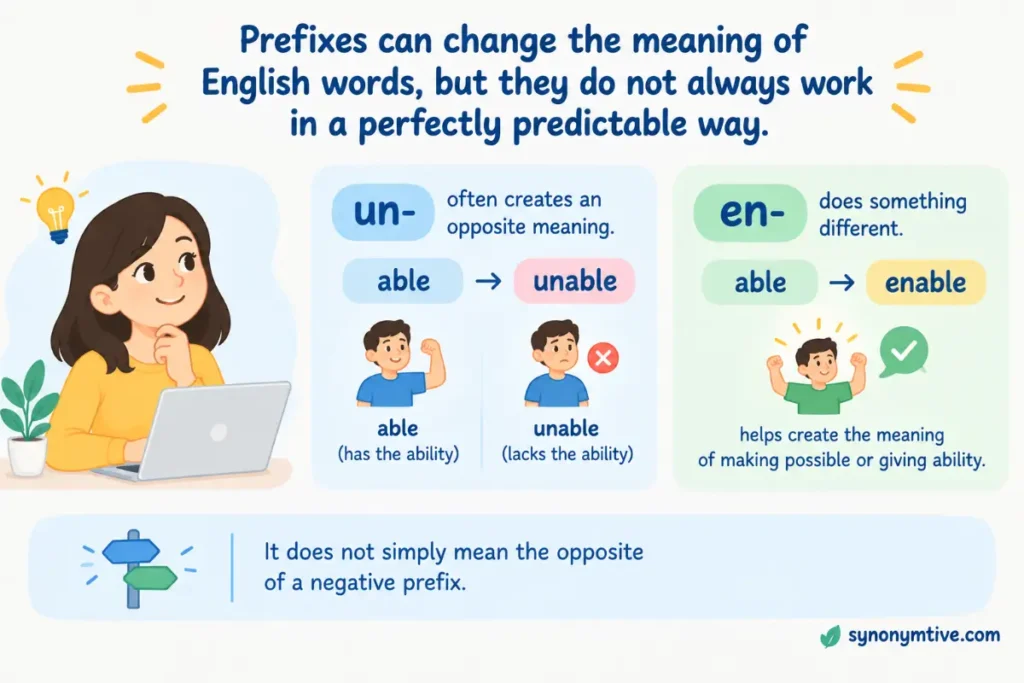
Prefixes can change the meaning of English words, but they do not always work in a perfectly predictable way.
The prefix un often creates an opposite meaning. That is why able becomes unable.
The prefix en in enable does something different. It helps create the meaning of making possible or giving ability. It does not simply mean the opposite of a negative prefix.
This is why it is risky to create words by adding prefixes based only on logic. English contains many forms that have developed through long use, and modern speakers follow established patterns rather than mathematical rules.
The best solution is to learn the common forms as complete words.
Remember able and unable as a pair. Then remember enable and disable as another pair.
Able describes capability.
Unable describes a lack of capability.
Enable means make possible or activate.
Disable means stop, deactivate, or turn off.
Once these four meanings are separated, the spelling becomes much easier.
A Simple Memory Trick
A quick way to remember enable is to think make able.
If something enables you to do something, it makes you able to do it.
For example, The training enabled me to use the machine can be understood as The training made me able to use the machine.
For unable, think not able.
I was unable to attend means I was not able to attend.
For disable, think turn off.
Disable notifications means turn notifications off.
This gives you three simple memory links.
Enable means make able.
Unable means not able.
Disable means turn off.
The word inable does not belong in this basic modern set. If you need the negative form of able, use unable.
Is Inable Ever Correct
You may encounter inable in historical writing or rare sources. Some older forms of English contain words that modern writers rarely use.
That fact can create confusion when someone searches a dictionary, old book, or historical database and finds the word. A word can exist in historical usage without being a normal choice in present day English.
For modern communication, use unable when you mean not able. This applies to schoolwork, business writing, websites, emails, reports, resumes, and everyday messages.
If your goal is clear communication with modern English readers, established modern usage should guide your choice.
The same principle applies to many older words. Historical English can help us understand how the language changed, but it does not mean every historical form belongs in current writing.
When To Use Enable
Use enable when something makes an action possible.
The new course enabled students to improve their skills.
Use it when one person or thing gives another person an ability.
The training enabled workers to operate the equipment.
Use it when a system provides a function.
The website enables customers to track their orders.
Use it when you activate a setting.
Enable automatic updates.
Use it when a condition makes an outcome possible.
Better planning enabled the group to finish early.
The central idea is always connected to possibility, ability, access, or activation.
When To Use Unable
Use unable when a person or thing cannot perform an action.
I was unable to attend the meeting.
The computer was unable to connect.
The team was unable to finish the project.
They were unable to find the building.
Unable is especially common in the structure unable to plus verb.
You can say, She was unable to respond. You can say, We were unable to continue. You can say, He was unable to complete the form.
In formal writing, unable can sometimes sound more neutral or formal than cannot or could not.
For example, I cannot attend the meeting is direct and natural. I am unable to attend the meeting is also correct and can sound more formal.
Choose the form that matches the tone of your sentence.
Is Unable The Opposite Of Enable
Enable and unable are not direct opposites.
Enable is a verb that means make possible or give ability. Unable is an adjective that means not capable of doing something.
The direct opposite of enable is often disable when you are talking about a setting, function, or system.
Enable the feature.
Disable the feature.
If enable means give someone an ability, the opposite idea may be expressed by prevent, stop, or make impossible.
The training enabled him to operate the machine.
The lack of training prevented him from operating the machine.
This shows why context matters. English does not always have one perfect opposite for every word.
Enable In Formal Writing
Enable is common in professional and academic writing because it expresses cause and possibility clearly.
The new policy enables employees to request flexible schedules.
The updated system enables researchers to organize large amounts of data.
The revised process enables customers to receive faster service.
These sentences show how one thing creates the possibility for another action.
Still, enable should not be used simply to make writing sound formal. Sometimes a simpler word is clearer.
The guide helped us find the station.
The manager allowed us to leave early.
The new tool lets users edit their files.
These sentences are natural and direct. Enable is useful when the focus is specifically on ability, function, or possibility.
Enable In Technology
Technology is one of the areas where enable appears most often.
Phones, computers, applications, websites, and other devices use enable for settings and features. A user might be told to enable notifications, enable Bluetooth, enable location access, enable camera access, or enable automatic updates.
In each case, the word means activate or turn on.
The opposite is disable.
If you enable notifications, notifications become active. If you disable them, they stop being active.
You will also see enabled and disabled in settings menus.
The feature is enabled means it is active. The feature is disabled means it is inactive.
This usage is so common that many people first learn enable through technology.
Enable In Everyday English
Enable can sound formal in some sentences, but it is also a normal everyday word.
For example, This pass enables you to enter the building is perfectly natural. The pass gives you the ability or permission needed to enter.
The new bus route enables people to travel more easily is another everyday example.
The extra time enabled me to finish my work is also natural.
Still, casual speakers may choose simpler words in some situations.
The pass lets you enter the building.
The new tool helps me finish the job.
The manager allowed us to leave early.
The choice depends on the meaning you want to emphasize. Enable is useful when you want to highlight the fact that something makes an action possible.
Related Words You Should Know
Able is an adjective that means capable of doing something. For example, She is able to solve the problem means she has the ability to solve it.
Unable is also an adjective. It means not capable of doing something, as in She is unable to solve the problem.
Enable is a verb. It means make something possible or give someone the ability to do something. The training enabled her to solve the problem is an example.
Enabled is the past tense and past participle of enable. It can also describe a feature that has been activated. For example, The update enabled the new function, or The feature is enabled.
Enabling is the present participle of enable. It can describe an action that is making something possible. For example, The new system is enabling users to work more efficiently.
Disable is a verb meaning stop something from working, turn something off, or prevent a function from operating. For example, Disable notifications if you no longer want alerts.
Disabled is the past tense and past participle of disable. It can also describe something that is inactive or turned off. For example, The feature is disabled.
Learning these related forms makes the whole word family easier to understand.
Common Sentence Patterns
One useful pattern is enable someone to do something.
The new software enables employees to work remotely.
Another pattern is enable something to happen.
The system enables faster payments.
A third pattern is enable a feature or setting.
Enable automatic updates.
The negative ability pattern is be unable to do something.
She was unable to attend the meeting.
The opposite technology pattern is disable a feature or setting.
Disable automatic updates.
These patterns are more useful than memorizing isolated definitions because they show you how the words actually work in sentences.
How To Choose The Right Word In Enable Vs Inable
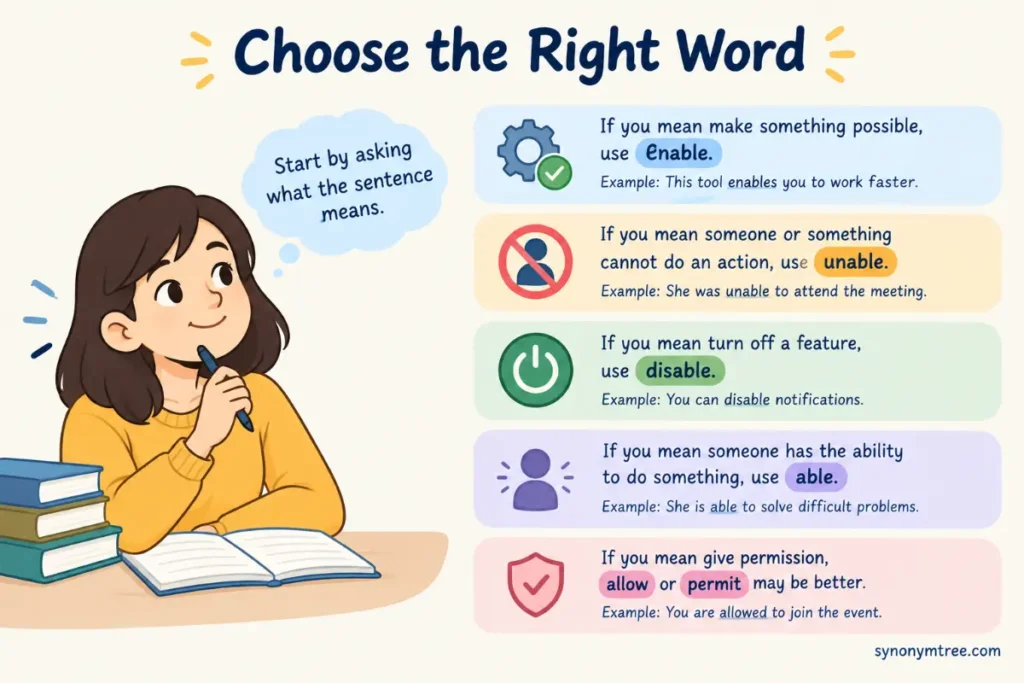
Start by asking what the sentence means.
If you mean make something possible, use enable.
If you mean someone or something cannot do an action, use unable.
If you mean turn off a feature, use disable.
If you mean someone has the ability to do something, use able.
If you mean give permission, allow or permit may be better.
For example, The new software enables employees to edit files focuses on a function. She is able to edit files focuses on her ability. She was unable to edit files says that she could not do it. The administrator disabled file editing says that the function was turned off.
Once you identify the meaning, the correct word usually becomes obvious.
Final Examples To Compare
The new training enabled workers to operate the machine. The training gave them the ability to use it.
The workers were unable to operate the machine before the training. They did not have the required ability.
The workers were able to operate the machine after training. This sentence simply describes their new ability.
The manager allowed the workers to use the machine. This sentence focuses on permission.
The manager disabled the machine after the work was finished. This sentence says that the machine was turned off or prevented from operating.
These examples show how small changes in word choice can change the meaning of a sentence.
Conclusion
The answer to enable vs inable is straightforward. Use enable when you mean make something possible, give someone an ability, or activate a feature. Do not normally use inable in modern English when you mean not able.
For the negative form of able, use unable. For an activated feature, use enabled, and for a feature that has been turned off, use disabled. These distinctions cover most situations that cause confusion.
The easiest memory trick is to connect each word with its core meaning. Enable means make able. Unable means not able. Disable means turn off. When you see a sentence that includes one of these words, focus on the meaning first and the spelling will follow naturally.
FAQs
Is enable the correct word to use?
Yes. Enable is the standard modern English verb for making something possible, giving someone an ability, or activating a feature. It is common in everyday, professional, academic, and technical writing.
Is inable a correct English word?
Inable has appeared in rare or historical English usage, but it is not the normal modern word for not able. In contemporary writing, use unable instead.
Should I use unable or inable?
Use unable. For example, write I was unable to attend the meeting. The form inable is not the standard choice for modern English.
What is the difference between enable and unable?
Enable is a verb that means make something possible or give someone an ability. Unable is an adjective that means not capable of doing something.
What is the opposite of enable?
Disable is usually the opposite of enable when you are talking about a feature, setting, or function. In other contexts, prevent or stop may express the opposite idea more naturally.
Is enable a verb or an adjective?
Enable is a verb. It describes the action of making something possible or giving someone the ability to do something.
What is the difference between able and enable?
Able is an adjective that describes capability. Enable is a verb that means to make something possible or give someone the ability to do something.
Can I say enable to?
Yes. A common structure is enable someone to do something. For example, The course enabled students to improve their writing is correct.
