
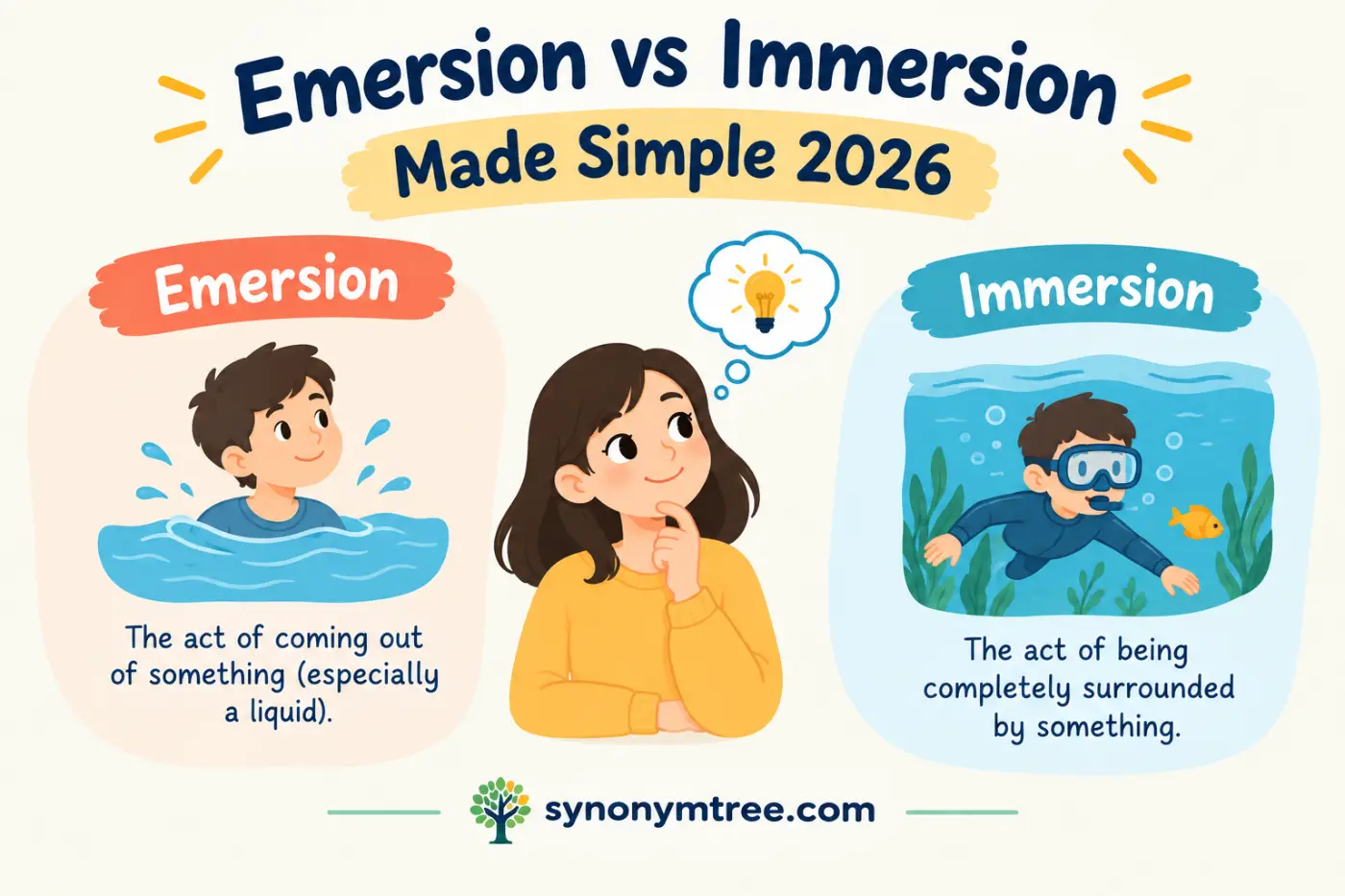
If you are confused about emersion vs immersion, the key difference is direction. Emersion means coming out of something or emerging from a submerged or hidden state. Immersion means going into something, being covered by it, or becoming deeply involved in it.
These words look almost identical because they share many of the same letters. The small prefix change creates a major difference in meaning. Immersion points inward or downward, while emersion points outward or upward.
You will most often see immersion in everyday English. It can describe putting an object into water, becoming deeply involved in an activity, or learning a language by surrounding yourself with it. Emersion is much less common and usually appears in technical, scientific, or formal writing.
This guide explains the difference in plain English. You will learn the meanings, origins, correct usage, examples, common mistakes, related words, and easy memory tricks.
Quick Definition
Emersion means the act of emerging or coming out of something, especially after being covered, hidden, or submerged. Immersion means the act of putting something into a liquid or becoming deeply involved in an activity, environment, or subject. The main difference is simple: immersion means going in, while emersion means coming out.
Direct Answer
The correct word depends on the action. Use emersion for coming out or emerging, and use immersion for going into something, being submerged, or becoming deeply involved.
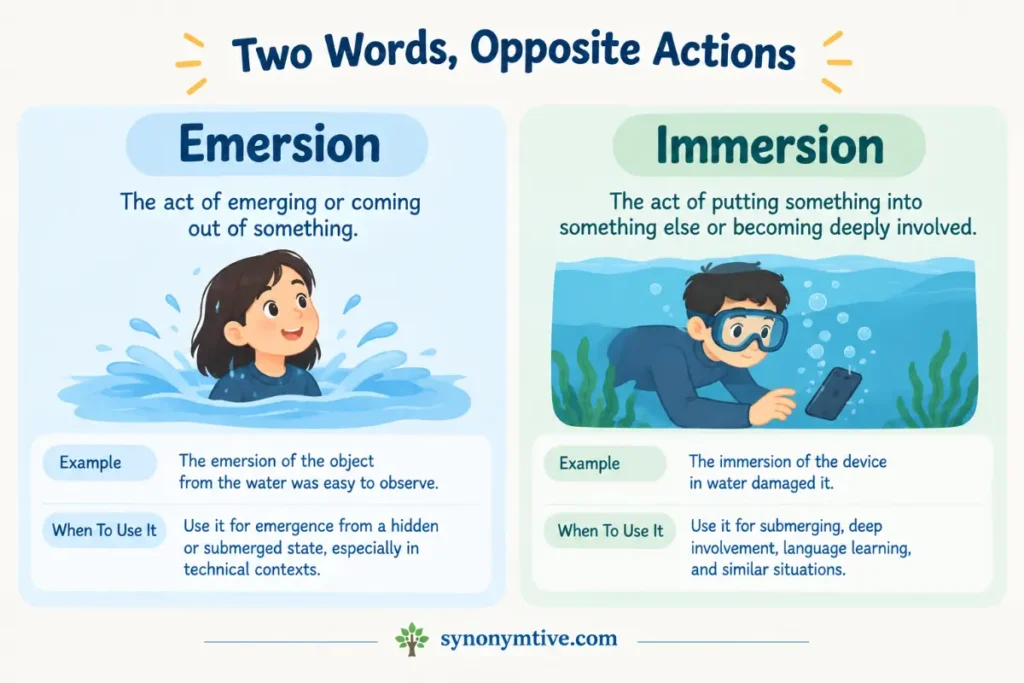
Comparison Table Of Emersion vs Immersion
| Word | Meaning | Example Sentence | When To Use It |
|---|---|---|---|
| Emersion | The act of emerging or coming out of something. | The emersion of the object from the water was easy to observe. | Use it for emergence from a hidden or submerged state, especially in technical contexts. |
| Immersion | The act of putting something into something else or becoming deeply involved. | The immersion of the device in water damaged it. | Use it for submerging, deep involvement, language learning, and similar situations. |
What Does Emersion Mean
Emersion means emerging or coming out of something. It is related to the idea of moving from a covered or hidden state into an exposed state. In simple terms, something was inside, below, or hidden, and then it becomes visible or comes out.
The word is uncommon in normal conversation. Most people would simply say emergence, appearance, coming out, or rising instead. For example, a technical writer might describe the emersion of an object from water.
Scientists may also use the word to describe a celestial body becoming visible after being hidden by another object. In each case, the central idea is movement outward.
Emersion In Simple English
Think of emersion as coming out. If a swimmer rises out of the water, the action can be described as emersion. Similarly, if an object becomes visible after being hidden, emersion can describe that appearance.
The word has a formal and specialized sound. For everyday writing, simpler words such as emerge or reappear will usually sound more natural. Still, emersion is a valid English word when the context calls for it.
Emersion In Science
Emersion has a specific use in astronomy. It can describe the moment when a celestial object reappears after being hidden or blocked from view. For example, a moon can pass behind another object from an observer’s point of view.
When the moon becomes visible again, that reappearance can be called an emersion. The idea is closely connected to the basic meaning of emerging. The object was hidden, and then it became visible again.
Emersion And Emergence
Emersion and emergence are close in meaning, but they are not always interchangeable. Emergence is the much more common word and can describe something becoming visible, developing, appearing, or coming into existence.
For example, you can say, “The emergence of new technology changed the industry.” You can also say, “The emergence of the sun ended the darkness.” These sentences describe something appearing or becoming noticeable.
Emersion is more specific because it focuses on coming out of a state of immersion, concealment, or obstruction. If you simply mean that something appeared or developed, emergence is usually the better choice.
What Does Immersion Mean
Immersion means putting something deeply into a substance, usually a liquid, or becoming deeply involved in an activity, subject, or environment. This word is much more common than emersion. You may see it in everyday conversations about swimming, cooking, cleaning, science, education, travel, entertainment, and language learning.
For example, you might say, “The immersion of the fruit in water helped remove dirt.” You can also say, “The student learned Spanish through full immersion.” In another context, you might say, “The movie created a sense of immersion.”
The first example involves physical placement. The second involves deep language exposure. The third describes a strong experience.
Immersion In Water
One of the most basic meanings of immersion involves water. If you place an object under water, you immerse it in water. This meaning is common in science, medicine, cooking, cleaning, swimming, and everyday instructions.
For example, you could say, “The instructions call for immersion of the cloth in warm water.” You might also read, “The device should not be used after immersion in water.” A swimmer could even practice full body immersion.
In each example, something enters or becomes covered by water. The important idea is physical placement inside a liquid.
Immersion In An Activity
Immersion can also describe deep involvement. If you spend several hours studying a subject and give it your full attention, you can say you are immersed in it.
For example, you might write, “She became immersed in the history book.” Another natural sentence is, “He was immersed in the music.” A third example is, “The team became immersed in the project.”
Here, no water is involved. Instead, immersion describes strong mental or emotional involvement.
Language Immersion
Language immersion is one of the most common modern uses of the word. A language immersion program surrounds learners with the language they are trying to learn. They may hear it in class, read it in books, speak it with teachers, and use it during daily activities.
For example, you could say, “The school offers an English immersion program.” Another example is, “She improved her Spanish through language immersion.” Students may also spend several weeks in a French immersion course.
The basic idea is simple. Instead of studying a language only for a short period each day, learners spend much more time surrounded by it. This gives them repeated exposure to vocabulary, grammar, pronunciation, and natural speech.
The Main Difference Between Emersion And Immersion
The easiest way to separate these words is to focus on direction. Emersion means coming out, while immersion means going in or becoming deeply involved. Imagine a person standing in a swimming pool.
When the person goes underwater, that is immersion. When the person rises back above the water, that is emersion. This simple picture can help you remember the difference.
The two words are almost opposites in this physical sense. One describes entering or being surrounded by something, while the other describes leaving that state. That distinction is much more useful than trying to memorize the spelling alone.
Immersion Moves In
Immersion describes movement into something or deep involvement with something. You can immerse an object in water, immerse yourself in a book, or immerse yourself in another culture.
You can also immerse yourself in a language. In each case, the idea is that you become surrounded by or deeply involved with something.
The direction is inward. Remembering that simple idea will help you choose immersion in most situations.
Emersion Moves Out
Emersion describes movement out of something. An object can emerge from water, a celestial body can reappear after being hidden, or a person can rise from a submerged position.
The direction is outward. That makes emersion the useful term when the focus is on leaving a submerged or hidden state.
For everyday writing, however, emerge is often easier and more natural than emersion. The technical noun can be useful when the specific process itself matters.
Why These Words Are Confused
The confusion comes mainly from their similar spelling. Both words contain mersion, which comes from a Latin root connected with dipping or plunging.
The difference comes from the prefixes. The prefix im gives immersion its inward or into meaning, while the prefix e gives emersion its outward or out of meaning.
Because emersion is rare, people also sometimes assume it is a spelling mistake for immersion. It is not. Emersion is a real word, but it has a much narrower use.
This difference matters when you are proofreading, writing an essay, or choosing the right word for a technical explanation. A single prefix can change the direction and meaning of the entire word.
The Prefix Makes The Difference
Looking at the word parts can make this pair easier to remember. The prefix in each word gives you a useful clue about the direction of the action.
The Meaning Of Immersion
Immersion comes from Latin roots associated with dipping or plunging into something. The im part can be connected with the idea of going into. That gives you a useful mental image.
Think of immersion as going in. The object or person enters something and becomes surrounded by it. This is why the word works for water, language, culture, books, activities, and other experiences.
The Meaning Of Emersion
Emersion comes from a related Latin root but points in the opposite direction. The word describes emerging or coming out.
Think of emersion as coming out. Something that was hidden, covered, or submerged becomes visible or exposed again. This is why the word can appear in scientific and astronomical contexts.
These memory connections are not a replacement for knowing the full definitions. They simply make the difference easier to recall when you need to choose between the two words.
Examples Of Immersion In Real Sentences
Seeing the word in several settings makes its meaning clearer. Immersion can describe physical actions, mental attention, cultural experiences, and language learning. The basic idea changes slightly with the context, but deep involvement or placement remains central.
Physical Immersion
The doctor recommended immersion of the injured area in warm water. The instructions warn against immersion of the phone in liquid. The child enjoyed full immersion in the pool.
The experiment required immersion of the sample in a solution. The fabric needs complete immersion before it can be cleaned. These examples all involve something being placed into or surrounded by a liquid.
Mental Immersion
She became immersed in the novel before bedtime. He was so immersed in the game that he forgot the time. The audience became immersed in the story.
The musician was completely immersed in the performance. I became immersed in the research and lost track of the afternoon. Here, immersion means deep attention rather than physical submersion.
Cultural Immersion
The travelers wanted cultural immersion instead of a short guided tour. Living with a local family gave the students greater cultural immersion. The program offers cultural immersion through food, music, and daily activities.
She chose a study program that provided strong cultural immersion. These examples involve becoming deeply surrounded by a culture or way of life. Cultural immersion can involve language, food, customs, daily routines, and social experiences.
Language Immersion
The school uses language immersion to help students practice Spanish. The child benefited from French immersion at school. Language immersion gave the learners more chances to hear natural speech.
The program combines classroom lessons with language immersion. In these examples, learners are surrounded by the language. They receive repeated exposure through listening, reading, speaking, and daily communication.
Examples Of Emersion In Real Sentences
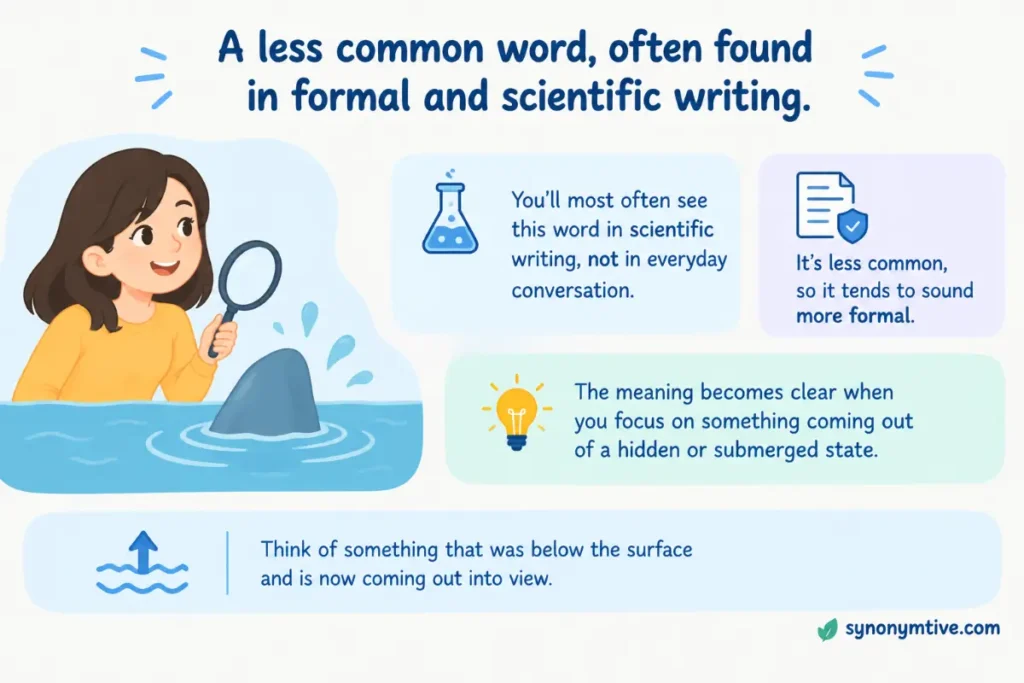
Emersion is less common, so its examples tend to sound more formal. You are more likely to see it in scientific writing than in casual conversation. Still, the meaning becomes clear when you focus on something coming out of a hidden or submerged state.
Physical Emersion
The emersion of the object from the water was recorded by the research team. The experiment measured the object’s movement during immersion and emersion. The diver’s emersion marked the end of the underwater test.
These sentences describe something coming out of water or another surrounding substance. The word emphasizes the transition from being submerged to being exposed.
Astronomical Emersion
The astronomer recorded the emersion of the moon after it had been hidden from view. Observers waited for the emersion of the star from behind the moon. The predicted time of emersion helped observers prepare their equipment.
This scientific use is one of the clearest examples of the word. The celestial object is hidden for a period and then becomes visible again.
Formal Use
The report described the gradual emersion of the structure from the flooded area. The word can work in technical writing when the writer needs to describe a specific process of emerging.
Still, a simpler word may often be clearer. For general readers, emergence or reappearance may communicate the idea more naturally.
When Should You Use Immersion
Use immersion when you mean entering, submerging, surrounding, or becoming deeply involved. This applies to both physical and figurative situations.
You can use it when talking about water. For example, “The child practiced immersion in the shallow pool.” You can also use it when discussing study, as in, “The course provides full immersion in Spanish.”
Immersion also works when describing deep attention. You could say, “He became immersed in the novel.” The word also works for culture, as in, “The trip offered cultural immersion during the stay.”
The key idea stays the same. Something becomes surrounded by or deeply involved with something else.
When Should You Use Emersion
Use emersion when you specifically mean coming out of a submerged, hidden, or blocked state. It is especially useful in technical and scientific contexts.
For ordinary writing, however, you will often have a clearer alternative. Instead of saying, “The emersion of the object from the water was observed,” you could write, “The object emerged from the water.”
The second sentence is easier for most readers. That does not make emersion incorrect, but it means the word has a narrower role.
If you are writing for a general audience, simple words usually communicate the idea better. Use emersion when its specific technical meaning adds value.
Common Mistakes With These Words
Several mistakes appear again and again. Most happen because the words look so similar. The best way to avoid them is to focus on the direction of the action.
Using Immersion For Coming Out
A common mistake is using immersion when something leaves water or another surrounding substance. For example, the sentence “The swimmer’s immersion from the pool took place at noon” uses the wrong word for the intended meaning.
A better sentence is, “The swimmer’s emersion from the water took place at noon.” For most readers, an even more natural sentence is, “The swimmer emerged from the water at noon.”
Using Emersion For Going In
The opposite mistake happens when someone uses emersion for entering or becoming deeply involved. For example, “The emersion of the object in the water was recorded” is incorrect if the object is going into the water.
A better sentence is, “The immersion of the object in the water was recorded.” If the object is coming out, emersion may be appropriate.
Assuming Emersion Is A Misspelling
Emersion is a legitimate English word. It is simply uncommon. Many readers know immersion but have rarely seen emersion, which can make the correct word look strange.
If your context involves emerging from something, the word can be valid. Still, consider using emerge, emergence, or reappear if your audience needs simple everyday English.
Using Both Words As If They Mean The Same Thing
The two words are related, but they do not have the same meaning. Immersion moves into or surrounds, while emersion moves out or describes emerging.
Replacing one with the other can reverse the meaning of a sentence. Before choosing the word, ask yourself if the subject is entering something or leaving it.
Immersion And Immersive
Immersion and immersive are closely related. The first names the process, while the second describes something that creates a deep or absorbing experience.
For example, you can say, “The course uses language immersion.” You can also say, “The course offers an immersive language experience.”
The adjective immersive has become common in discussions about games, movies, virtual reality, education, travel, and entertainment. For example, “The game creates an immersive environment.”
Another natural example is, “The museum offers an immersive exhibit.” These examples describe something that draws people deeply into an experience.
Emersion And Emergent
Emersion is also easy to confuse with words built from emerge. The verb emerge means to come out, become visible, or become known. The noun emergence refers to the act or process of emerging.
The adjective emergent describes something that is beginning to appear or develop. For example, “The company is responding to an emergent problem.”
These words are much more common than emersion. If you simply want to say that something appeared or came out, one of these forms may be the better choice.
Emersion And Submersion
Submersion is another word that belongs to this group. Submersion means being placed fully under a liquid or another substance. For example, “The submersion of the boat damaged several parts.”
A diver may also practice controlled submersion. The word focuses strongly on being under something, especially water.
Submersion and immersion can sometimes describe similar physical actions. However, immersion has a broader figurative meaning because you can be immersed in a book, language, culture, or activity.
Submersion And Immersion
Submersion often emphasizes being completely under something. Immersion can describe full physical placement, but it also describes deep involvement.
That makes immersion the broader word in everyday English. If you are talking about language, culture, study, entertainment, or deep attention, immersion is usually the natural choice.
Emersion And Emergence
These two words are especially close. Emergence is much more common and has a wider range of meanings.
For example, you can say, “The emergence of spring brought warmer weather.” You can also say, “The emergence of a new leader changed the group.”
Another example is, “The emergence of the sun ended the stormy afternoon.” None of these examples requires the more specialized word emersion.
Emersion is better reserved for situations where the idea of coming out of immersion, concealment, or obstruction matters. If the sentence only means that something appeared, emergence will usually be clearer.
Which Word Is More Common
Immersion is far more common in modern English. You will see it in education, science, medicine, travel, technology, entertainment, sports, and ordinary conversation.
Emersion is rare. It appears most often in technical, scientific, astronomical, or formal contexts. That difference matters when you are writing for a broad audience.
If you use emersion correctly but your readers do not know the word, the sentence may slow them down. In many cases, emerge or reappear is easier.
Good writing is not just about choosing a technically correct word. It is also about choosing a word that communicates quickly.
How To Remember The Difference
The easiest memory trick is to focus on the first letters. Immersion means in, so the object or person goes into something. Emersion means exit, so the object or person comes out.
Think of a swimmer. Going under the water is immersion. Coming back out is emersion.
You can also remember this simple sequence: immersion means inside, while emersion means emerges. This trick works because the words describe opposite directions.
A Simple Water Example
Imagine holding a ball above a bucket of water. When you push the ball into the water, you are causing immersion. When you pull it back out, you are causing emersion.
That is the clearest physical comparison. The first action moves into the water, while the second action moves out.
Now imagine the same idea in a classroom. A student who spends hours surrounded by Spanish lessons, Spanish conversations, and Spanish reading experiences language immersion.
If that student later leaves the language environment, you would not normally call that emersion. The word does not extend naturally to every figurative situation.
This shows why meaning and context both matter. A word can have a clear dictionary meaning but still be uncommon in certain situations.
How To Choose The Right Word
Ask yourself one simple question. Is something going in or coming out? If it is going in, being covered, or becoming deeply involved, choose immersion.
If it is coming out or becoming visible after being hidden or submerged, emersion may be correct. Then ask a second question: Would a simpler word be clearer?
If the answer is yes, consider emerge, emergence, appear, reappear, rise, or come out. For most everyday writing, those words will sound more natural than emersion.
Immersion In Everyday English
You probably use the concept of immersion more often than you realize. You can become immersed in a television show, become immersed in a novel, immerse yourself in music, or study through language immersion.
The word works across physical and figurative meanings because the central idea is being surrounded by something.
That broad usefulness makes immersion an important word to know. It is common enough to appear naturally in both casual and formal writing.
Emersion In Everyday English
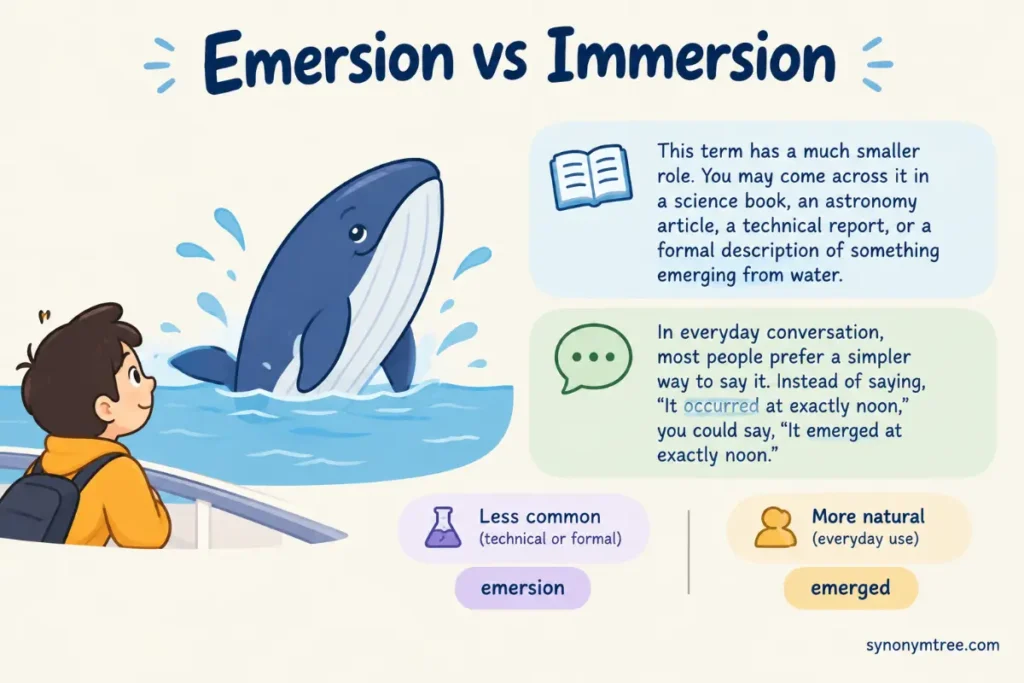
Emersion has a much smaller role. You may encounter it in a science textbook, astronomy article, technical report, or formal description of something emerging from water.
In casual conversation, most speakers would choose a simpler expression. Instead of saying, “The emersion occurred at exactly noon,” a speaker might say, “It emerged at exactly noon.”
Another option is to say, “The object became visible again.” Both versions can communicate the basic idea, but the simpler sentence is easier for most readers.
Why Precise Word Choice Matters
Choosing the right word helps readers understand your meaning without stopping to interpret it. Immersion is familiar and flexible, while emersion is precise but uncommon.
That means the best choice depends on the situation. A scientific paper may need emersion because the writer is describing a specific technical event.
A general audience article may be clearer with emerge or reappear. Good writing is not just about choosing a technically correct word, but also about choosing a word that gives the reader the exact meaning with the least confusion.
Quick Practice
Try choosing the correct word for each sentence. The students spent the summer in a French language ______ program. The answer is immersion.
The diver’s ______ from the water marked the end of the experiment. The answer can be emersion. The researchers measured the ______ of the sample in the liquid.
The answer is immersion. The astronomers recorded the ______ of the star after it was hidden from view. The answer is emersion.
She became deeply ______ in the novel. The answer is immersed. The bird ______ from the water.
The answer is emerged. These examples show an important point: the noun immersion is common, but you do not always need the noun form.
Sometimes immersed or emerge gives you a more natural sentence. Choosing the right form can make your writing clearer and more direct.
Conclusion
The easiest way to remember emersion vs immersion is to focus on direction. Immersion means going into something, being covered by it, or becoming deeply involved in it. Emersion means coming out of something or becoming visible again after being hidden or submerged.
Immersion is the word you will use much more often. It works for physical actions such as putting something into water and figurative ideas such as language immersion, cultural immersion, and becoming immersed in a book.
Emersion is a legitimate word, but it is much less common and has a narrower meaning. It is most useful in technical, scientific, and formal contexts where the idea of emerging from a hidden or submerged state matters.
When you are unsure, picture a swimmer. Going under the water is immersion, while coming back out is emersion. If your sentence simply means that something appeared or came out, emerge or emergence will often be the clearest choice for a general audience.
Frequently Asked Questions
Is emersion the opposite of immersion?
In the basic physical sense, they describe opposite directions. Immersion means going into or being surrounded by something, while emersion means coming out of it.
What is the difference between emersion and immersion?
The main difference is direction. Immersion describes entering, submerging, or becoming deeply involved, while emersion describes emerging or coming out.
Is emersion a real word?
Yes. Emersion is a real English word, but it is uncommon. It is mainly used in technical, scientific, astronomical, and formal contexts.
Is emersion vs immersion a spelling mistake?
No. Emersion vs immersion is a real vocabulary distinction. The words have related roots but different meanings, so one is not simply a misspelling of the other.
Is immersion the same as submersion?
They can overlap when talking about putting something under water. However, immersion also has figurative meanings, such as deep involvement in a language, culture, book, or activity.
What is the difference between emersion and emergence?
Emergence is the more common word for the act of appearing, developing, or coming out. Emersion has a narrower meaning connected with emerging from a submerged, hidden, or obstructed state.
What is an example of immersion?
A person who spends several weeks surrounded by Spanish conversations, books, and lessons is experiencing language immersion. The word can also describe physically placing an object in water.
What is an example of emersion?
The reappearance of a celestial object after it has been hidden from view can be described as emersion. The word can also describe an object or person coming out of water.
