
If you are unsure about envolve vs involve, the answer is simple. Involve is the correct English word when you mean to include someone or something, require participation, or connect something with an activity or situation. Envolve is not the standard spelling of that word.
The confusion happens because involve has a soft sounding beginning, and many people hear the first syllable as en. That can make envolve seem like a natural spelling. However, standard English uses involve, not envolve, for meanings such as include, require, contain, or participate.
There is another reason this spelling can cause trouble. English has several real words that begin with en, such as enable, encourage, enjoy, and enrich. Because of that pattern, someone may naturally write envolve instead of involve. This guide explains the correct spelling, meaning, pronunciation, grammar, examples, common mistakes, and related words so you can use the right form with confidence.
Quick Definition
Involve is a real English verb that means to include someone or something, require something, or connect a person or thing with an activity or situation. Envolve is not the standard English spelling for these meanings.
Direct Answer
Involve is the correct word. Envolve is an incorrect spelling when you mean include, require, or connect with something.
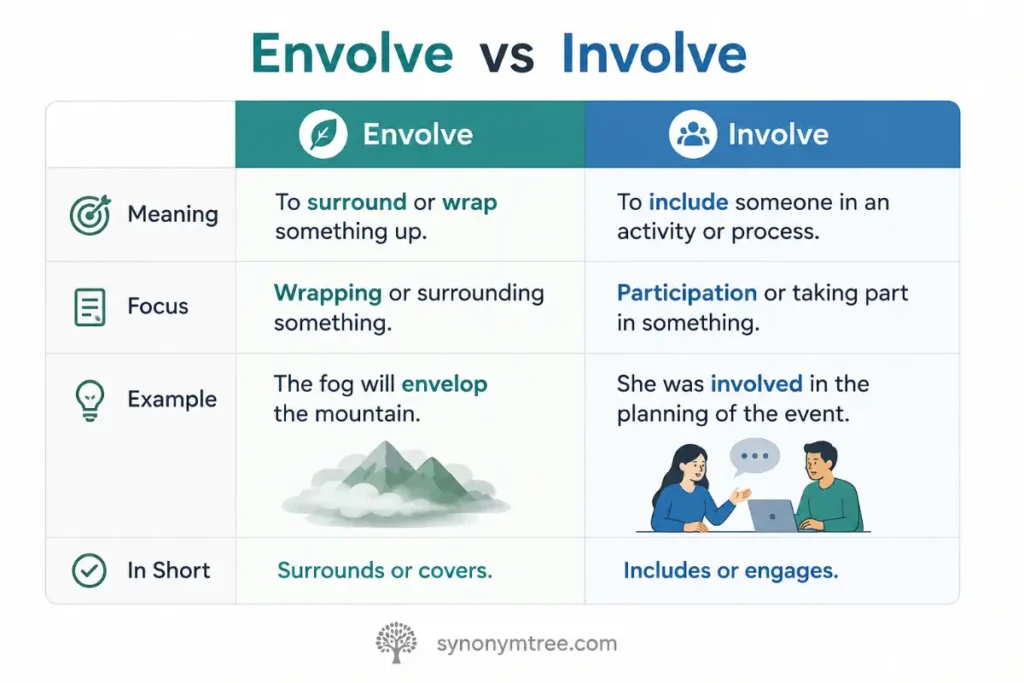
Comparison Table for Envolve vs Involve
| Word | Meaning | Example Sentence | When to Use It |
|---|---|---|---|
| Involve | To include someone or something | The project will involve several teachers. | Use this standard English verb when talking about inclusion, participation, connection, or requirements. |
| Envolve | Not the standard spelling of involve | Envolve several teachers. | Do not use this spelling when you mean involve. |
Why Do People Confuse These Words
The main problem comes from pronunciation and spelling patterns. When people hear involve in normal conversation, the first sound can be easy to miss. The word begins with the short vowel sound in in, but the following sound quickly blends into the rest of the word.
Someone may then remember the sound as en-volve and write envolve. That mistake makes sense from a sound based point of view, but standard spelling does not follow that guess.
English also contains many common words that start with en. For example, we have enable, encourage, enlarge, enjoy, enrich, enter, and ensure. This familiar pattern can make envolve look believable even though it is not the accepted spelling for this verb.
Another source of confusion comes from the related word evolve. Evolve is a correct English word, and it sounds somewhat similar to involve. The two words also have different meanings. If you mix the spelling patterns of involve and evolve, you may accidentally create envolve.
The easiest solution is to connect the spelling with the meaning. If you want to say that something includes a person, requires an action, or connects someone with an activity, use involve.
The Correct Spelling
The standard spelling is involve.
It contains the letters i n at the beginning, followed by v o l v e. The complete spelling is:
I N V O L V E
The final part, volve, may look unusual at first. However, you can recognize the same ending pattern in words such as revolve, evolve, and devolve.
For example:
The job will involve travel.
The lesson involves several activities.
The decision involved careful planning.
All three sentences use involve correctly.
The Incorrect Spelling
Envolve is not the standard English verb used to mean include or require.
For example, this sentence contains an incorrect spelling:
The job will envolve travel.
The correct version is:
The job will involve travel.
Likewise, this sentence is incorrect:
The plan will envolve the entire team.
Write it this way instead:
The plan will involve the entire team.
You may encounter envolve somewhere in informal writing, user generated content, or a spelling error. Seeing the form online does not make it standard English. When you write for school, work, business, or publication, choose involve.
What Does Involve Mean
Involve has several closely related meanings. The exact meaning depends on the sentence, but the central idea usually involves connection, inclusion, or requirement.
One common meaning is to include someone or something in an activity.
For example:
The coach involved every player in the practice.
This means the coach included every player.
Another meaning is to require something as part of a task or process.
For example:
The repair will involve replacing two parts.
Here, the repair requires the replacement of two parts.
The word can also mean to connect someone with a situation or event.
For example:
The investigation involved several employees.
This sentence says that several employees had a connection to the investigation. The exact nature of that connection depends on the larger context.
Involve can also describe something that takes effort, time, skill, or attention.
For example:
Learning a new language involves regular practice.
The sentence says that regular practice forms part of the process.
These meanings share a common idea. Something or someone becomes connected to an action, process, event, group, or situation.
How To Use Involve Correctly
The most useful way to learn this word is to see how it works in real sentences.
Involve With People
Use involve when a person becomes part of an activity or process.
The teacher involved the students in the discussion.
The manager involved her staff in the planning process.
The club involves local volunteers in its events.
The director involved the entire cast in the rehearsal.
Each sentence shows people taking part in something.
You can also use involve when someone becomes connected to a situation.
The report involved three departments.
The case involved several witnesses.
The dispute involved two neighboring businesses.
The project involved a small team of designers.
In these examples, involve connects people or groups to a particular situation.
Involve With Activities
Involve often describes what an activity requires.
Cooking this meal involves several steps.
The training involves daily practice.
The course involves reading and writing.
The job involves working with customers.
The task involves careful attention.
Here, the word does not simply mean include another person. Instead, it tells the reader what forms part of an activity or process.
Involve With Things
You can also use involve when an object, idea, or process connects with another thing.
The project involves several new tools.
The plan involves major changes.
The repair involves a new battery.
The process involves several stages.
The discussion involved a difficult question.
This use appears often in business writing, school assignments, instructions, and everyday speech.
Involve As A Verb
Involve is a verb. A verb tells us about an action, process, state, or condition.
The base form is involve.
You can change its form to match the tense and subject.
For example:
I involve my team in major decisions.
She involves her team in major decisions.
They involved the team yesterday.
The project involved several steps.
The plan will involve more work.
The word also appears in continuous forms.
The teacher is involving the students in the activity.
The company is involving local workers in the project.
These forms all come from the same verb.
Present Tense
Use involve for the base form and general statements.
The course involves group work.
The job involves travel.
I involve my family in major decisions.
Use involves with a singular third person subject.
The course involves group work.
The job involves travel.
She involves her team in the process.
Past Tense
The past form is involved.
The meeting involved several departments.
The project involved careful research.
The teacher involved the class in the activity.
The investigation involved many people.
Notice that the spelling changes from involve to involved by adding d.
Present Participle
The present participle is involving.
The teacher is involving the students in the discussion.
The project is involving several departments.
They are involving local residents in the planning.
The ending changes from involve to involving.
Past Participle
The past participle is also involved.
We have involved several experts in the project.
She has involved her team in the decision.
The company had involved outside advisers.
This form often appears with helping verbs such as have, has, and had.
Common Sentence Patterns With Involve
Learning common patterns can make the word easier to use.
One common pattern is:
Involve someone in something.
For example:
The coach involved the players in the decision.
The school involved parents in the planning.
The company involved employees in the discussion.
This pattern focuses on participation.
Another pattern is:
Involve something.
For example:
The job involves travel.
The project involves research.
The process involves several steps.
This pattern focuses on what a task or situation requires.
A third pattern is:
Involve doing something.
For example:
The job involves working with children.
The course involves studying several books.
The repair involves replacing the damaged part.
This structure tells us what action forms part of a process.
You can also use:
Be involved in something.
For example:
She is involved in the project.
They were involved in the event.
He is involved in community work.
This structure is extremely common in everyday English.
Involve And Involved In
Many learners understand involve but become unsure when they see involved in. The two forms have related meanings, but their grammar differs.
Consider this sentence:
The manager involved the staff in the decision.
Here, involved acts as the main verb. The manager actively brought the staff into the decision making process.
Now compare it with:
The staff were involved in the decision.
Here, involved describes the staff’s connection to the decision. The sentence focuses on their participation or connection rather than the manager’s action.
You can also write:
She is involved in the project.
He became involved in the organization.
They remain involved in the program.
These sentences describe participation or connection.
The phrase involved in appears frequently with activities, groups, projects, events, causes, and situations.
For example:
She is involved in school activities.
He is involved in the local club.
They became involved in the project.
My brother is involved in sports.
The volunteers are involved in the campaign.
This structure is worth learning as a complete pattern.
Involve In Everyday English
You do not need formal writing to use involve. The word appears naturally in conversations, messages, instructions, and daily explanations.
For example, a friend might ask:
Does the trip involve a lot of walking?
Someone discussing a job might say:
The position involves working on weekends.
A parent might say:
The activity involves all the kids.
A student might write:
The assignment involves three short questions.
A manager might explain:
The new plan involves the whole team.
These sentences sound natural because involve clearly shows what a situation includes or requires.
The word can also help you ask for more information.
Does the job involve travel?
Does the class involve group work?
These questions are useful because involve lets you ask about requirements without making the sentence complicated.
Real Examples With Involve
Examples make the spelling easier to remember because you see the word in context.
The new project will involve five employees.
This position involves working with customers.
The lesson involves reading a short story.
Our plan involves several small changes.
The activity involves everyone in the group.
The repair involved replacing the old wire.
The meeting involved two department heads.
Her work involves helping young students.
The competition involves several rounds.
The process involves careful testing.
The decision involved many factors.
The course involves weekly assignments.
The event involves local businesses.
The job involves regular travel.
The training involves both theory and practice.
The project involved a large amount of research.
The teacher involved the students in the experiment.
The company involved its employees in the discussion.
The coach involved every player in the exercise.
The committee involved several community members.
These examples show why involve works in many settings. It can describe people, actions, requirements, processes, groups, and connections.
Common Mistakes With This Word
Spelling errors often happen when a familiar sound leads you toward the wrong letters. Envolve is one example.
Writing Envolve Instead Of Involve
This is the main spelling mistake.
Incorrect:
The project will envolve several people.
Correct:
The project will involve several people.
Incorrect:
The job envolves customer service.
Correct:
The job involves customer service.
Incorrect:
This task envolved careful planning.
Correct:
This task involved careful planning.
The second example also shows a common mistake with the past tense. The correct form is involved, not envolved.
Writing Envolved
Some writers know that involve changes to involved in the past tense but spell the middle of the word incorrectly.
The correct forms are:
Involve.
Involves.
Involved.
Involving.
Avoid forms such as envolved or envolving.
The spelling stays connected to the base word. Once you remember involve, the other forms become easier.
Confusing Involve With Evolve
Evolve is a different word.
Evolve means to develop or change gradually.
Involve means to include, require, or connect.
Compare these sentences:
The plan will evolve over time.
The plan will involve several people.
The first sentence describes change. The second describes participation or connection.
Here is another pair:
The company evolved over many years.
The company involved several departments in the project.
These words may look similar, but their meanings are very different.
Confusing Involve With Envelope
Envelope is another real word, but it has nothing to do with the verb involve.
An envelope is a paper container used for a letter or document.
For example:
I put the letter in an envelope.
The word envelope can also function as a verb in technical contexts, but it does not mean include or require.
If your sentence means include or require, use involve.
How To Remember The Correct Spelling from Envolve vs Involve
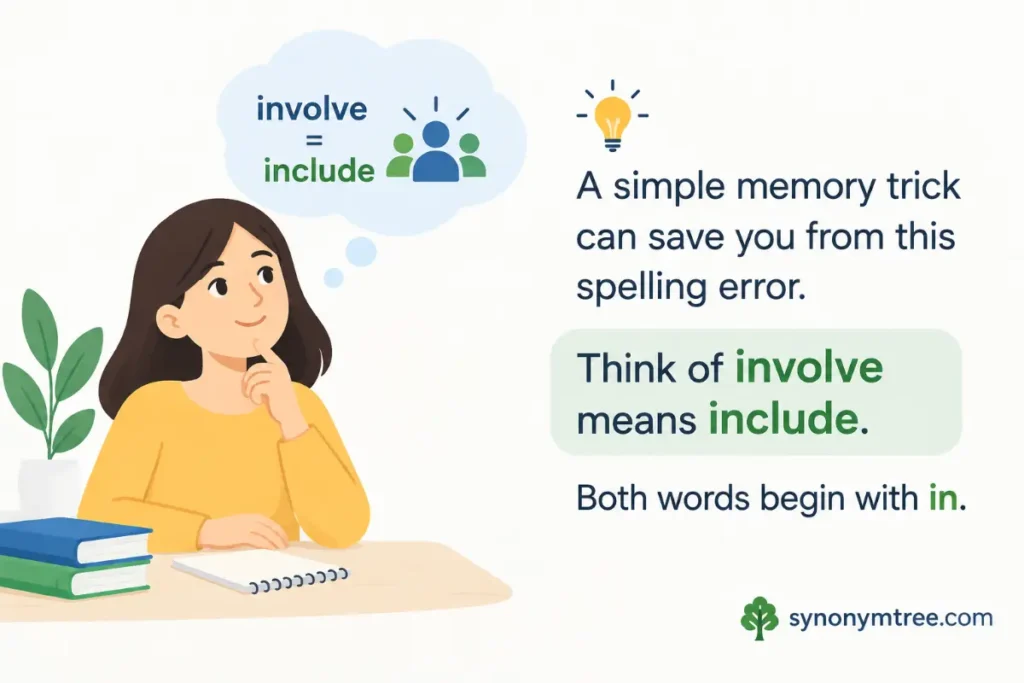
A simple memory trick can save you from this spelling error.
Think of the phrase involve means include.
Both words begin with in.
Involve. Include.
That connection gives you a quick reminder.
You can also remember this short sentence:
Involve starts with in.
Say the phrase silently when you write the word. The goal is to connect the meaning with the spelling instead of relying only on pronunciation.
Another useful trick is to remember the word family.
Involve.
Involved.
Involving.
Involves.
Once the base spelling becomes familiar, the other forms become much easier to recognize.
Use The Meaning Test
Ask yourself what you mean.
If your sentence means include, require, or connect, choose involve.
For example:
The project will ___ ten people.
The meaning clearly points to include. Therefore, the correct answer is involve.
The job will ___ travel.
The meaning points to require. Again, involve fits.
The discussion ___ several important issues.
The meaning points to contain or include. Use involved.
This quick test works better than guessing from sound.
Use The Evolve Test
If you are thinking about change or development, consider evolve instead.
For example:
The plan may evolve over time.
Technology continues to evolve.
Her ideas evolved during the course.
These sentences describe development or gradual change.
If you are talking about participation or requirements, use involve instead.
The plan will involve several departments.
The course involves weekly practice.
The job involves customer service.
The meaning gives you the answer.
Involve And Evolve Compared
Because these words look and sound similar, they deserve a closer comparison.
Involve relates to inclusion, connection, participation, or requirements.
Evolve relates to development, change, or gradual growth.
Consider this example:
The business evolved after several years.
The business involved many employees in the new plan.
The first sentence says the business changed or developed. The second says employees took part in a plan.
Here is another comparison:
The design evolved during the project.
The design process involved several engineers.
Again, one word describes change, while the other describes participation.
The difference becomes clear once you focus on the action.
Ask yourself whether the sentence describes something becoming different over time or something becoming part of an activity. For development, choose evolve. For inclusion or connection, choose involve.
Involve And Include Compared
Include is one of the closest simple synonyms for involve, but the words do not always work in exactly the same way.
Include often means that something forms part of a group, list, set, or whole.
For example:
The price includes breakfast.
The package includes two meals.
The list includes ten names.
Involve often focuses more on participation, connection, or requirements.
For example:
The job involves customer service.
The project involves several teams.
The process involves careful testing.
You can sometimes replace involve with include, but the tone or meaning may shift.
The project includes three departments.
The project involves three departments.
The first sentence simply tells us that three departments form part of the project. The second can suggest that those departments actively participate in the work.
That small difference can help you choose the stronger word.
Involve And Require Compared
Require is another related word.
Require means that something is necessary.
Involve can sometimes express a similar idea.
For example:
The job requires travel.
The job involves travel.
Both sentences tell the reader that travel forms part of the job. However, require puts more emphasis on necessity, while involve often sounds more neutral.
Compare these examples:
The application requires two references.
The application involves several steps.
The first sentence says two references are necessary. The second explains that several steps form part of the process.
When you want to stress a rule or condition, require often works better. When you want to describe what a task or process includes, involve often sounds more natural.
Involve And Participate Compared
Participate describes a person’s action. Involve can describe the action of bringing someone into something or the activity itself.
For example:
The students participated in the discussion.
The teacher involved the students in the discussion.
The first sentence focuses on what the students did. The second focuses on what the teacher did.
You can also say:
She participated in the project.
She was involved in the project.
The two sentences are close, but involved can have a broader meaning. It may suggest participation, connection, responsibility, or association.
That difference matters in formal writing.
Is Involve A Formal Word
Involve is neither highly formal nor overly casual. It works well in everyday speech and professional writing.
You can use it in a text message.
Does the event involve food?
You can use it in an email.
The new schedule involves some changes.
You can use it in a school essay.
The experiment involved several steps.
You can use it in a business report.
The proposal involves three departments.
Because the word fits many levels of English, you do not need to replace it simply to sound more advanced.
Clear writing often works better than complicated writing.
How Involve Works In Academic Writing
Students often use involve when explaining processes, studies, tasks, or ideas.
For example:
The experiment involved two groups of students.
The study involved several stages.
The research involved collecting data from different sources.
The process involved careful observation.
The assignment involves comparing two texts.
These sentences are direct and clear.
You can also use involved in to describe participation.
Several students were involved in the study.
The researchers were involved in the project.
The community was involved in the planning.
For school writing, choose the form that matches your meaning. Use involve when describing what something includes or requires. Use involved in when describing someone’s connection or participation.
How Involve Works In Business Writing
Business writers use involve often because projects usually include people, tasks, costs, departments, and processes.
For example:
The project involves three teams.
The new plan involves several changes.
The position involves regular customer contact.
The role involves managing a small team.
The process involves several approval stages.
These sentences give useful information without adding unnecessary words.
In a business email, you might write:
The update will involve changes to the current process.
In a report, you might write:
The project involved several departments.
In a job description, you might write:
The position involves coordinating daily operations.
The word works well because it quickly explains what a task, role, or project contains.
How Involve Works In Job Descriptions
Job descriptions use involve frequently because employers need to explain duties.
For example:
The role involves helping customers.
The position involves preparing weekly reports.
The job involves managing schedules.
The role involves working with a small team.
The position involves occasional travel.
These sentences describe responsibilities in a simple way.
You can also use require when you need to stress a condition.
The position requires a valid license.
The role requires two years of experience.
The job requires weekend availability.
Use involve when you describe what the work includes. Use require when you describe something the worker must have or do.
How Involve Works In Everyday Questions
The word is especially useful when you want to ask about details.
Does the course involve homework?
Does the job involve travel?
These questions are clear because involve asks about what forms part of the situation.
You can also ask:
Who is involved?
What does the job involve?
What will the project involve?
How many people are involved?
These are common and natural English questions.
The phrase What does it involve? is especially useful. It asks someone to explain the tasks, steps, requirements, or activities connected to something.
For example:
I heard you started a new job.
Yes.
What does it involve?
It involves helping customers and managing orders.
That conversation sounds natural because involve gives the speaker a simple way to ask for details.
When Not To Use Involve
Even though involve has several meanings, you should not use it for every kind of connection.
If you mean physical attachment, words such as attach, connect, tie, or join may work better.
For example:
Attach the cable to the device.
Connect the phone to the charger.
Tie the rope to the post.
Join the two pieces together.
Involve usually describes participation, inclusion, requirements, or association rather than a simple physical connection.
Likewise, if you mean gradual change, use evolve rather than involve.
The design evolved over time.
Not:
The design involved over time.
If you mean a person took part in something, participate may be the clearest choice.
She participated in the meeting.
If you mean something is necessary, require may be more precise.
The application requires two forms of identification.
Choosing the most precise word makes your writing easier to understand.
Related Words You Should Know
Understanding related words can help you build a stronger vocabulary around involve.
Involvement is the noun form.
For example:
Her involvement in the project helped the team.
The manager praised his involvement in the event.
Involved can describe participation or connection.
For example:
She is involved in the program.
They became involved in the project.
Involving is the present participle.
For example:
The teacher is involving the class in the activity.
Involvement can also describe the amount of participation.
For example:
The project needs greater community involvement.
These words all connect to the same basic idea.
A Simple Rule For Writers
When you want to say include, think of involve.
When you want to say require as part of a process, think of involve.
These simple meaning checks can prevent many spelling and word choice mistakes.
A Quick Editing Test
If you have written envolve, stop and check the meaning.
Ask yourself:
Does it mean require something as part of a task?
Does it describe participation or connection?
If the answer is yes, change envolve to involve.
Then check the tense.
Present:
The job involves travel.
Past:
The job involved travel.
Continuous:
The job is involving several teams.
Base form after will:
The job will involve travel.
Base form after does:
Does the job involve travel?
That last point matters. After does, use involve, not involves.
Correct:
Does the job involve travel?
Incorrect:
Does the job involves travel?
The same pattern applies to questions with do.
Correct:
Do the tasks involve research?
Incorrect:
Do the tasks involves research?
Learning these patterns helps you avoid both spelling and grammar errors.
Why Clear Spelling Matters in Envolve vs Involve
A single wrong letter can change how professional your writing looks.
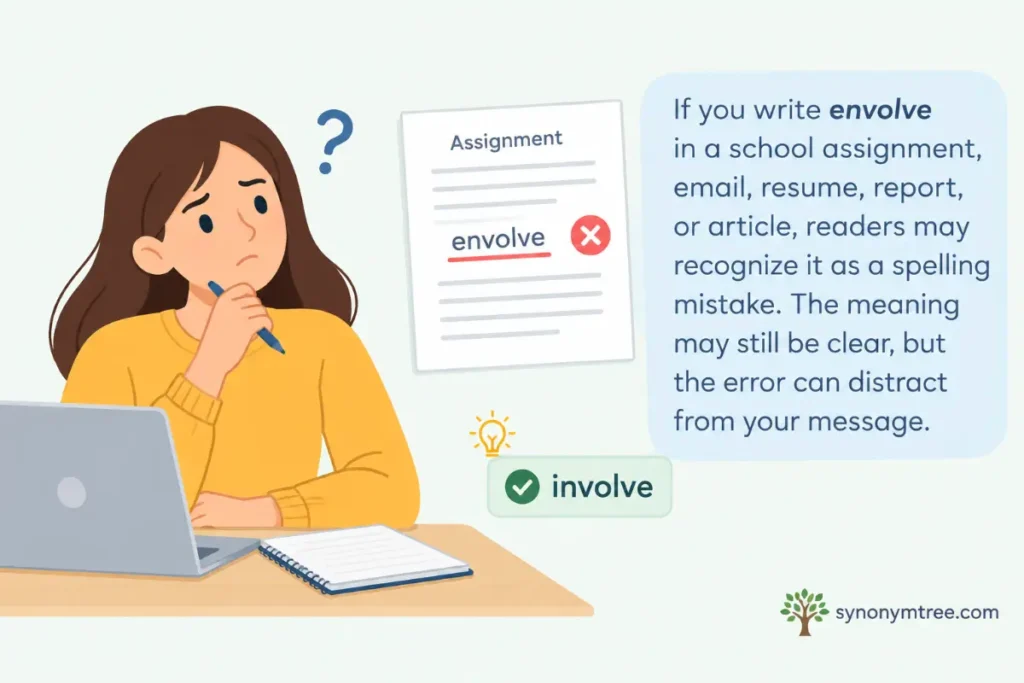
If you write envolve in a school assignment, email, resume, report, or article, readers may recognize it as a spelling mistake. The meaning may still be clear, but the error can distract from your message.
Correct spelling also helps search engines, spell checkers, teachers, editors, and readers understand your intended word.
You do not need to memorize complicated rules for this one. Just remember the standard spelling: involve.
Once you have seen the word in enough sentences, it becomes easier to recognize automatically.
A Final Set Of Practice Examples
Try reading these sentences aloud and notice how naturally involve fits.
The new plan will involve several changes.
The teacher involved the class in the activity.
The job involves working with customers.
The course involves weekly reading.
The repair involved replacing a damaged part.
The event involves local volunteers.
The project involved careful planning.
The role involves managing a small team.
The process involves several steps.
The decision involved many factors.
Does the job involve travel?
Does the course involve exams?
What does the project involve?
Who is involved in the meeting?
She is involved in the program.
They became involved in the community project.
He was involved in the discussion.
The students were involved in the activity.
The business evolved over time.
The business involved several employees in the new plan.
The first eighteen sentences use involve or a related form. The last two sentences help separate involve from evolve.
That contrast gives you a useful final reminder. Involve connects people, things, actions, or requirements. Evolve describes change and development.
Conclusion
The answer to envolve vs involve is straightforward. Involve is the correct spelling when you mean include, require, connect, or bring someone into an activity. Envolve is not the standard spelling for those meanings.
The confusion mainly comes from pronunciation and from the many English words that start with en. The similar word evolve can also cause mistakes, but it has a different meaning. Evolve describes gradual change, while involve describes inclusion, participation, connection, or requirements.
For a quick memory trick, think involve means include. If your sentence talks about something becoming part of an activity or process, start with in and write involve.
Next time you catch yourself typing envolve, pause and check the meaning. If you mean include, require, or connect, use involve. That one small check will keep your spelling clear and correct.
FAQs
Is envolve a correct English word?
No. Envolve is not the standard English spelling when you mean include, require, or connect with something. The correct word is involve.
Why do people spell involve as envolve?
People often spell it this way because the first part of involve can sound like en in quick speech. English also has many common words that begin with en, so the incorrect spelling may look natural. The standard spelling still begins with in.
Is involve or envolve correct?
Involve is correct. Envolve is an incorrect spelling for the meanings discussed in this guide.
What does involve mean?
Involve can mean include someone or something, require something as part of a process, or connect someone with an activity or situation. For example, The job involves travel means travel forms part of the job.
Is involve the same as include?
The words can have similar meanings, but they are not always interchangeable. Include often means that something forms part of a group or whole, while involve can place more focus on participation, connection, or what a process requires.
Is involve the same as evolve?
No. Involve means include, require, or connect. Evolve means develop or change gradually.
How do you remember the spelling of involve?
Connect involve with include because both start with in. You can also remember the basic word family involve, involved, involves, and involving.
What is the past tense of involve?
The past tense is involved. For example, The project involved several teams.
