
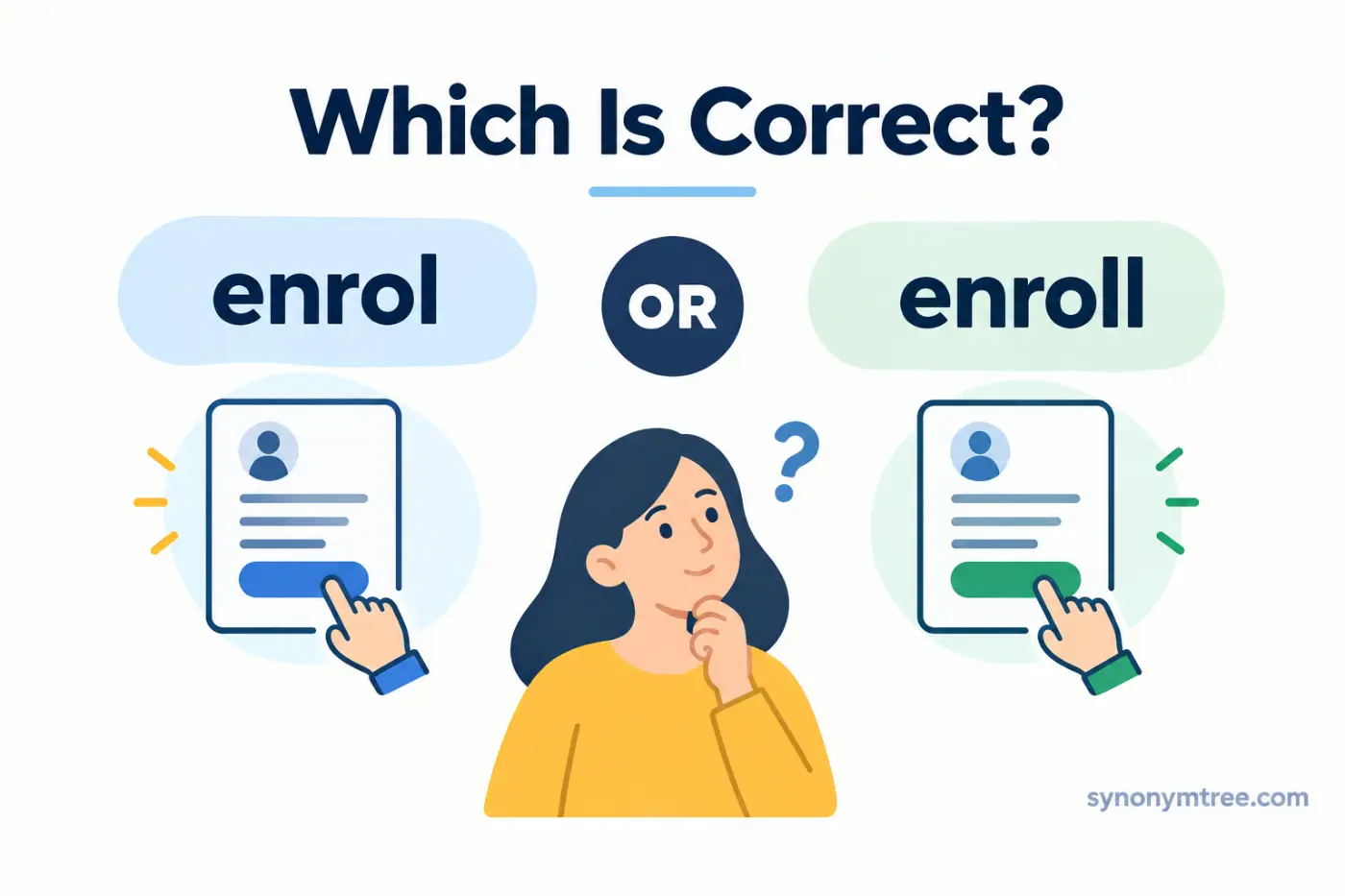
If you are confused about enrol or enroll, both spellings are correct, but they belong to different forms of English. Enroll is the standard spelling in American English, while enrol is the standard spelling in British English and several other varieties of English.
The difference comes down to regional spelling. The two words have the same meaning and are used in the same kinds of sentences. Both mean to officially join a school, course, program, organization, or other activity.
For US readers, enroll is the spelling you should normally use. You might write, “I plan to enroll in college next fall.” In British English, the same sentence would usually use “enrol.”
This guide explains the spelling difference, the reason both forms exist, how to use each form, and which version works best in American writing. You will also see examples, related forms, common mistakes, and an easy way to remember the rule.
Quick Definition
Enroll and enrol are two spellings of the same verb. They mean to officially register or join a school, course, program, organization, or similar activity. Enroll is the preferred American spelling, while enrol is common in British English and other varieties that follow British spelling.
Direct Answer
Both enroll and enrol are correct spellings. Use enroll in American English and enrol in British English.
Enroll And Enrol At A Glance
| Word | Meaning | Example Sentence | When to Use It |
|---|---|---|---|
| Enroll | To officially register or join | I want to enroll in the course. | American English |
| Enrol | To officially register or join | I want to enrol in the course. | British English and related varieties |
The meaning does not change when you remove or add the second letter l. The main difference is regional spelling.
An American reader will usually expect enroll in school forms, websites, instructions, articles, and other everyday writing. A British reader may expect enrol, especially in formal education or government writing.
Why Are There Two Spellings
The spelling difference developed from regional English conventions. English has many words that use different spellings in American and British writing. This does not mean one spelling is always correct and the other is always wrong.
The same pattern appears in words such as color and colour, center and centre, and traveled and travelled. English developed differently in different regions, so spelling rules also developed along different paths.
The difference between enroll and enrol follows this larger pattern. American English generally keeps the double l in the base verb. British English generally uses one l in the base form.
The two forms still point to the same action. If a student registers for a class, that student can enroll in American English or enrol in British English.
Language learners sometimes think one spelling must be a mistake because the words look almost identical. That assumption can lead to unnecessary corrections. Regional English allows both forms.
What Does Enroll Mean
The verb enroll means to officially register someone or yourself for something. The thing can be a class, school, college, training program, membership, or another organized activity.
For example, a parent might enroll a child in school. A student might enroll in a college course. An adult might enroll in a professional training program.
The word often suggests an official process. Simply attending a class does not always mean that someone has enrolled. Enrollment usually involves registration or acceptance into a program.
Consider this sentence.
“I enrolled in a photography course last month.”
The sentence tells us that the speaker officially registered for the course. It does not simply say that the speaker watched a few photography lessons.
The verb can also describe an institution registering a person.
“The school enrolled 200 new students this year.”
Here, the school performs the action. The students become officially registered.
The word can also appear in contexts outside education. A person can enroll in a health plan, a training program, a membership program, or another organized service.
When Should Americans Use Enroll
American English uses enroll as the standard spelling. This applies to schools, colleges, universities, online courses, training programs, and many other settings.
You might see sentences such as these in American writing.
“I plan to enroll at the university in August.”
“She enrolled in an online writing course.”
“Parents can enroll their children in the summer program.”
“Thousands of students enroll in the college each year.”
“The company allows employees to enroll in its training program.”
In each sentence, the spelling with two l letters matches standard US English.
The same spelling applies to related forms. For example, American English normally uses enrollment, enrolled, and enrolling.
This distinction matters for polished professional writing. If you are writing for a US audience, using the American spelling makes your work look consistent and natural.
When Should British Writers Use Enrol
British English commonly uses enrol with one l. The meaning remains exactly the same.
A British writer might write:
“I plan to enrol at the university in September.”
“She enrolled on the training course.”
“The school allows parents to enrol their children online.”
“Students can enrol in the program before the deadline.”
The spelling reflects British English conventions. It does not indicate a different meaning.
The form is also common in countries and regions that use British spelling conventions. This includes many places where British English has influenced education, government, publishing, and formal communication.
Still, local usage can vary. A specific country, institution, or publication may have its own style preferences. When writing for a particular audience, consistency matters more than trying to make every English variety follow one rule.
Why Does American English Use Double L
The double l in American English can seem unusual because many readers are more familiar with the British spelling. The reason is tied to differences in spelling conventions rather than a difference in meaning.
American English often preserves a double consonant in this type of word. British English commonly keeps one l in the base form.
This difference becomes especially useful when you compare the base verb with its other forms.
American English uses:
“enroll.”
“enrolled.”
“enrolling.”
“enrollment.”
British English uses:
“enrol.”
“enrolled.”
“enrolling.”
“enrolment.”
Notice something interesting. The British form changes to a double l when certain endings are added. The American form already has the double l in the base verb.
That means the spelling difference is not simply about adding or removing a letter at random. It follows regional spelling patterns.
Enroll And Enrol In American English
For US readers, the choice is simple. Use enroll.
If you are writing an American school notice, use “Students must enroll before Friday.”
If you are writing an American resume, use the spelling that matches the rest of your document. For example, “Enrolled in advanced accounting courses” follows US spelling.
The same rule applies to websites and business materials aimed at American customers.
A sentence such as “Click here to enroll” looks natural to a US reader. A sentence such as “Click here to enrol” may look like British spelling in an otherwise American page.
That does not make the British form wrong. It simply makes the regional difference visible.
For SEO content aimed at the United States, use the spelling that matches your audience and search intent. If the article discusses the spelling difference itself, you can naturally mention both forms.
Enroll And Enrol In British English
British English generally uses enrol.
A British school might say, “You can enrol online.”
A British university might say, “Students must enrol before the start of term.”
A training provider might write, “Enrol today to reserve your place.”
These sentences are grammatically correct in British English.
British English also tends to use enrolment rather than enrollment. That spelling difference can help you identify the regional form.
For example, a British university website might use the phrase “student enrolment.” An American university would usually write “student enrollment.”
The meaning stays the same.
Is Enrol Or Enroll More Correct
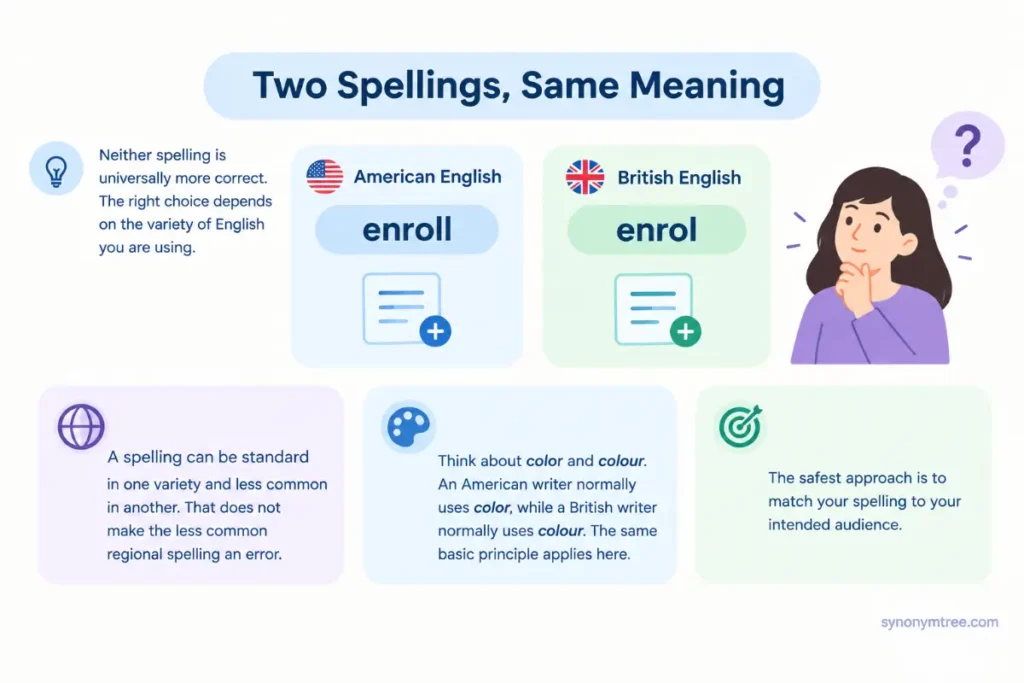
Neither spelling is universally more correct. The right choice depends on the variety of English you are using.
American English prefers enroll. British English prefers enrol.
A spelling can be standard in one variety and less common in another. That does not make the less common regional spelling an error.
Think about color and colour. An American writer normally uses color, while a British writer normally uses colour. The same basic principle applies here.
The safest approach is to match your spelling to your intended audience.
If your readers are mainly in the United States, choose enroll. If your readers are mainly in the United Kingdom and follow British English, choose enrol.
What Is The Difference Between Enroll And Enrol
The main difference is spelling, not meaning.
Both words describe the act of officially joining or registering for something. The difference appears because American and British English use different spelling conventions.
American English uses enroll with two l letters. British English uses enrol with one l.
The pronunciation is also essentially the same. A reader will usually understand either spelling from context.
This makes the pair different from true word pairs that have different meanings. You are not choosing between two separate actions. You are choosing between two regional spellings of the same verb.
That distinction helps prevent a common mistake. Some writers search for a difference in meaning that does not exist.
How To Use Enroll In A Sentence
Enroll can appear in several common sentence patterns. The first pattern uses a person as the subject and an educational or organized activity as the object of the preposition.
“I enrolled in a computer science class.”
Here, the speaker joined the class officially.
Another common pattern uses a person as the subject and a person or group as the object.
“The school enrolled 500 new students.”
The school officially registered the students.
You can also use enroll with a direct object when someone registers another person.
“Maria enrolled her son in the summer program.”
The sentence means Maria completed the registration process for her son.
The word can also appear with online services.
“I enrolled in the company health plan.”
In this case, enrollment does not involve a classroom. It means the person officially joined the plan.
Common Prepositions With Enroll
The preposition that follows enroll can depend on the context and variety of English.
American English often uses “enroll in.”
“I enrolled in the course.”
“She enrolled in college.”
“They enrolled in the training program.”
The phrase “enroll at” can also appear when the focus is the institution.
“She enrolled at State University.”
The difference between in and at is subtle. “Enroll in” often highlights the course or program. “Enroll at” often highlights the school or institution.
For example, “I enrolled in a biology course at the university” contains both ideas naturally.
British English can use similar patterns, though specific institutions may have preferred wording. You should follow the usage common in the variety and context you are writing for.
Enroll In College
In American English, enroll in college is a common phrase.
For example:
“She plans to enroll in college next year.”
“I enrolled in college after high school.”
“Many students enroll in college each fall.”
You can also say that someone enrolls at a particular college.
“He enrolled at the University of Michigan.”
The choice depends on what you want to emphasize. “Enroll in college” focuses on entering college as an educational path. “Enroll at a college” identifies the institution.
These phrases are not interchangeable in every sentence, but both are standard.
Enroll In A Course
Enroll in a course means officially register for that course.
For example:
“I enrolled in an English course.”
“She wants to enroll in a business class.”
“Students can enroll in the course until Friday.”
The phrase is especially common for online education. Websites often use wording such as “Enroll Now” on course pages.
The word does not necessarily mean that the student has started studying yet. Registration can happen before classes begin.
That distinction matters in formal writing. A student can enroll in September and begin attending classes later.
Enroll At A School
The phrase enroll at a school identifies the institution where a person registers.
For example:
“My daughter will enroll at a new school next year.”
“He enrolled at a local high school.”
“They enrolled at the university after moving to the city.”
The phrase often appears when the writer wants to name the institution.
Compare these two sentences.
“I enrolled in an economics course.”
“I enrolled at the university.”
The first sentence focuses on a specific course. The second focuses on the institution.
Both are useful, and context tells you which one fits better.
Can You Say Enroll Someone
Yes. Enroll can take a direct object when someone registers another person.
For example:
“The parent enrolled the child in school.”
“The manager enrolled the employees in a safety course.”
“The nurse helped enroll the patient in the program.”
The person doing the registration becomes the subject. The person being registered becomes the object.
This construction is common in education and administrative writing.
You can also use the reflexive form when a person registers themselves.
“I enrolled in the course.”
Here, the speaker takes care of their own registration.
Enrolled And Enrolling
The spelling rules continue into the forms of the verb.
In American English, the forms are enrolled and enrolling.
For example:
“I enrolled last week.”
“She is enrolling in college this fall.”
“They have enrolled in the program.”
In British English, the forms are also enrolled and enrolling.
For example:
“I enrolled last week.”
“She is enrolling in the course.”
The important point is that the past and present participle forms use two l letters in both major varieties.
The main visible difference appears in the base form and the noun form.
American English uses enroll and enrollment. British English uses enrol and enrolment.
Enrollment And Enrolment
The noun form creates another spelling difference.
American English uses enrollment.
British English uses enrolment.
Both nouns describe the act or process of enrolling. They can also refer to the number of people enrolled in a school, program, or organization.
An American university might report, “Enrollment increased this year.”
A British university might report, “Enrolment increased this year.”
The meaning is the same.
This is useful to remember because writers sometimes use the American verb with the British noun or the British verb with the American noun. Such combinations may not always be wrong, but they can make the writing look inconsistent.
If you are writing in American English, use enroll and enrollment. If you are writing in British English, use enrol and enrolment.
Enrolled Or Enroled
This is a common spelling question. The correct past tense is enrolled in American English and enrolled in British English.
The form enroled with one l is generally not the standard spelling.
That may seem surprising because British English uses enrol in the base form. However, the past tense takes two l letters.
For example:
“Sarah enrolled in the course.”
“The students enrolled before the deadline.”
“I enrolled at the college last year.”
The same spelling works in both American and British English.
So do not assume that adding ed to enrol produces enroled. The standard form is enrolled.
Enrolling Or Enroling
The present participle also uses two l letters.
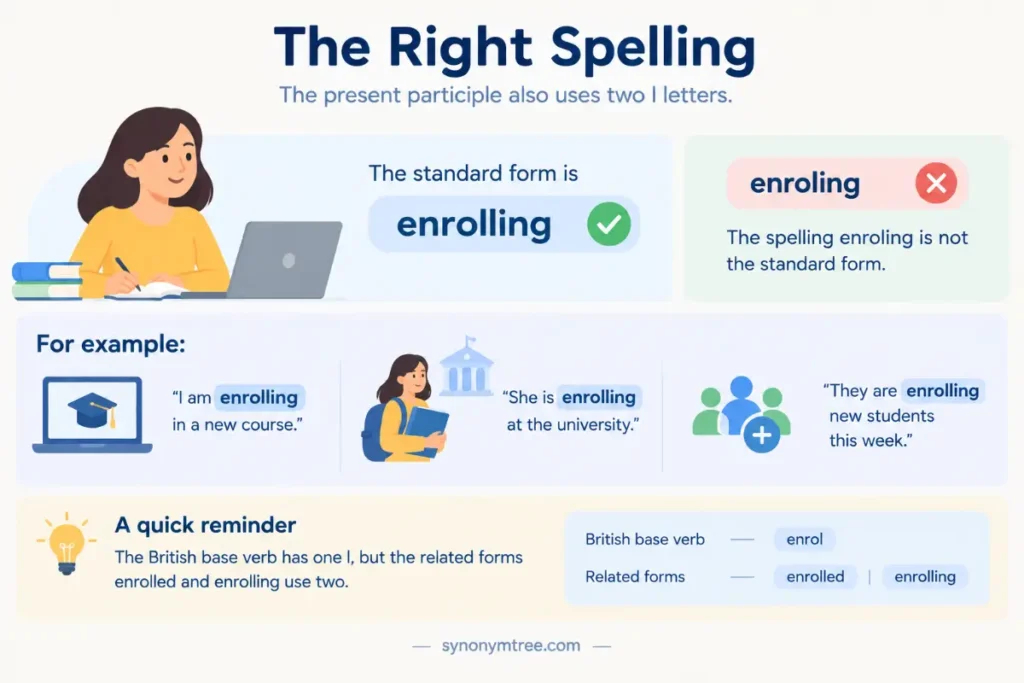
The standard form is enrolling.
For example:
“I am enrolling in a new course.”
“She is enrolling at the university.”
“They are enrolling new students this week.”
The spelling enroling is not the standard form.
This is another useful reminder that English spelling rules can depend on the form of the word. The British base verb has one l, but the related forms enrolled and enrolling use two.
Common Mistakes With These Spellings
One common mistake is using enrol in American writing without realizing that the audience expects US spelling. The word may still be understood, but it can look out of place in an otherwise American document.
Another mistake is treating enroll as the only correct form everywhere. English has several major regional varieties, and British English uses enrol as its standard spelling.
A third mistake involves the past tense. Some writers create enroled because they expect the British base form to keep one l. Standard English uses enrolled instead.
Another problem appears with enrollment and enrolment. Writers sometimes switch between the two forms in the same document. Consistency makes professional writing cleaner.
You should also avoid assuming that spelling differences always signal different meanings. In this case, they do not. The two forms describe the same basic action.
A Simple Memory Trick
An easy way to remember the American spelling is to connect it with other common American spellings that use double l.
Think of enroll as the US form with the extra l.
Then connect enrol with British English.
You can also remember the noun forms as a pair.
American English: enrollment.
British English: enrolment.
Once you remember that pattern, the related forms become easier to recognize.
There is another useful trick. If your document already uses American spellings such as color and center, choose enroll. If it uses British spellings such as colour and centre, choose enrol.
The surrounding spelling style can help you make the right choice.
Examples Of Enroll In American English
Here are natural examples that show how Americans commonly use the word.
“I decided to enroll in a Spanish class.”
“Students must enroll before the semester begins.”
“She enrolled at the university last fall.”
“My parents enrolled me in a private school.”
“More students are expected to enroll next year.”
“You can enroll online in just a few steps.”
“The company allows new employees to enroll in its benefits program.”
“He enrolled in a professional training course.”
“We need to enroll before the registration period closes.”
“The school is trying to enroll more students.”
These examples show that the verb works in education, training, employment, and administrative settings.
Examples Of Enrol In British English
British English uses the same basic structures with the one l spelling.
“I decided to enrol in a Spanish course.”
“Students must enrol before the term begins.”
“She enrolled at the university last autumn.”
“Parents can enrol their children online.”
“Many students enrol in higher education each year.”
“You can enrol in the program through the school website.”
“The company asked new employees to enrol in the training scheme.”
“He enrolled on a professional course.”
The exact preposition can vary by region and context. The spelling of the base verb remains the main difference discussed here.
Enroll Versus Register
Enroll and register are close in meaning, but they are not always interchangeable.
Enroll often suggests officially joining a course, school, program, or organized activity. Register has a broader meaning and can describe recording your name or details for an event, service, system, or activity.
For example, you might register for a conference. You might also enroll in a training program.
A school may use both words. You could register for classes and then become enrolled in the university.
In everyday American English, enroll is strongly associated with education and organized programs. Register is broader.
That distinction helps you choose the most natural word instead of treating the two as perfect synonyms.
Enroll Versus Join
Join is even broader than enroll.
You can join a club, team, group, organization, or conversation. Enroll usually suggests a formal registration process.
For example, “I joined the soccer team” sounds natural. “I enrolled in the soccer team” does not normally sound natural.
On the other hand, “I enrolled in a soccer training program” works because a training program can require formal registration.
The choice depends on the type of activity and the registration process.
Enroll Versus Sign Up
Sign up is a common informal alternative to enroll.
For example:
“I signed up for the course.”
“I enrolled in the course.”
Both sentences can describe registration for a class.
The tone differs. Sign up sounds more casual and conversational. Enroll sounds more formal and often appears in school, business, and administrative writing.
A website might say “Sign up today” because the phrase is friendly and direct. A university document might use “enroll” because it describes an official academic process.
Neither word is automatically better. The context determines the best choice.
Enroll Versus Admit
Enroll and admit describe different parts of the education process.
A school admits a student when it accepts that student for entry. The student enrolls when they officially register or enter the program.
For example:
“The university admitted Sarah in March.”
“Sarah enrolled in August.”
Admission can come before enrollment.
This distinction matters in college writing. Getting accepted into a school does not always mean the student has completed enrollment.
Enroll In Health Plans
The word enroll also appears in health insurance and employee benefits.
For example:
“Employees can enroll in the health plan during open enrollment.”
This use follows the same basic meaning. The person officially registers for a plan.
American workplaces often use enrollment to describe the period when employees select benefits. You may see phrases such as open enrollment, enrollment period, and enrollment deadline.
The word has moved beyond education because the underlying idea remains the same. A person formally joins a structured program or service.
Enroll In Online Programs
Online education has made enroll especially common on websites.
A course page might say:
“Enroll now.”
“Enroll in the full course.”
“Students can enroll at any time.”
The word works well because online courses often involve a formal registration process.
In American English, enroll is the standard spelling on pages aimed at US users. A British education site may use enrol instead.
The difference can also appear in buttons, page titles, emails, and help instructions. Good website copy keeps the regional spelling consistent across the entire site.
Is Enroll A Verb
Yes. Enroll is a verb.
A verb describes an action, and enroll describes the action of officially registering or joining a program or institution.
For example:
“I enroll in classes every fall.”
“She enrolled in the program.”
“They are enrolling new students.”
The noun is enrollment.
“The enrollment period ends Friday.”
The adjective enrolled can describe someone who has officially registered.
“She is an enrolled student.”
Understanding the parts of speech makes it easier to use the word correctly.
Is Enrol A Verb
Yes. Enrol is also a verb. It is simply the British spelling of the same verb.
For example:
“I plan to enrol in the course.”
“She enrolled at the university.”
“They are enrolling new students.”
The meaning does not change.
The difference lies in regional spelling conventions.
Should You Use Enroll In Or Enroll On
American English commonly uses enroll in.
For example:
“I enrolled in the course.”
“She enrolled in college.”
“They enrolled in the program.”
British English can also use enrol in, especially with schools and programs. Some British contexts may use enrol on for a course.
For example:
“She enrolled on a training course.”
This does not mean American writers should automatically replace in with on. For US English, enroll in is the safest and most familiar construction.
When writing for an American audience, phrases such as enroll in college and enroll in a course will usually sound natural.
Is Enroll Formal Or Informal
Enroll is neutral and can work in both formal and everyday writing.
You can use it in a casual sentence such as:
“I want to enroll in that class.”
You can also use it in formal writing such as:
“Applicants must enroll before the registration deadline.”
The word does not sound overly formal. It is a normal part of American English.
Sign up is more conversational. Register can range from casual to formal. Enroll fits comfortably in the middle and works well in educational and administrative contexts.
How Schools Use The Word
Schools use enroll in several ways.
A school can enroll students. A student can enroll in a course. A parent can enroll a child. An administrator can process enrollment.
For example:
“The school will enroll new students in August.”
“Parents can enroll their children online.”
“Students must enroll in at least four classes.”
“The enrollment office handles registration.”
These examples show why the word appears so often in education.
It describes an official step rather than simple attendance.
How Businesses Use The Word
Businesses can also use enroll when people join formal programs.
A company might enroll employees in training. A customer might enroll in a rewards program. An employee might enroll in a retirement plan or benefits program.
For example:
“New employees must enroll in the training program.”
“Customers can enroll in the rewards plan.”
“Employees can enroll in the retirement program during the enrollment period.”
The word works because these programs involve formal registration.
How To Keep Your Spelling Consistent
The best way to handle regional spelling is to choose one form of English and stay consistent.
If your document targets Americans, use American spelling throughout. That means enroll, enrollment, color, center, and other common US forms.
If your document follows British English, use the British forms throughout. That means enrol, enrolment, colour, centre, and similar spellings.
Consistency helps readers trust the writing. Switching between regional forms can make a document look careless even when every individual word is understandable.
For websites, audience matters too. A US focused website should generally follow US spelling. A UK focused website should normally follow UK spelling.
What If Your Audience Is International
An international audience can make spelling choices less obvious.
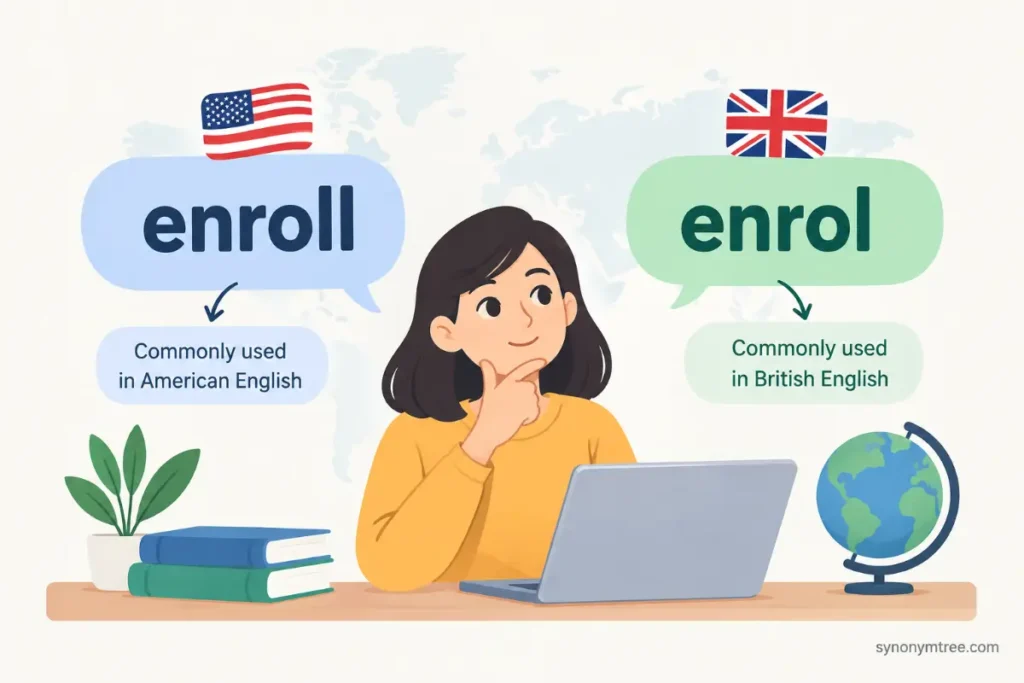
In that case, start by identifying the main audience. If most readers use American English, enroll is usually the better choice. If the content mainly serves readers who use British English, enrol may be more appropriate.
You can also mention both forms when the spelling difference itself is the subject. That makes the article useful to readers from different regions.
Still, you should not alternate randomly between forms. Pick a primary spelling for the main text and explain the regional alternative clearly.
This approach gives readers the information they need without creating unnecessary inconsistency.
How Dictionaries Handle The Two Forms
Major English dictionaries generally recognize both forms, but they identify their regional usage differently.
American dictionaries commonly list enroll as the main form. British dictionaries commonly list enrol as the British form.
That difference reflects standard usage rather than a difference in meaning.
Dictionary labels such as American English, British English, or chiefly British help readers understand the regional preference.
This is why checking a dictionary does not always produce one universal answer. English spelling depends partly on the variety of English being used.
A Quick Test For Choosing The Right Form
Ask yourself one simple question. Who is going to read the writing.
For a US audience, use enroll.
For a British audience, use enrol.
Then check the related noun.
US English uses enrollment.
British English uses enrolment.
If the surrounding words follow one spelling system, keep the same system for this word too.
That simple check solves most spelling questions involving these two forms.
Conclusion
The choice between enrol or enroll depends on the variety of English you are using. American English uses enroll, while British English uses enrol. Both spellings have the same basic meaning and describe the act of officially registering or joining something.
For US writing, choose enroll in school documents, resumes, websites, articles, emails, and business materials. The related American noun is enrollment. British English uses enrol and enrolment.
Remember that the past tense and present participle use two l letters in both major varieties. The standard forms are enrolled and enrolling, not enroled or enroling.
The practical rule is simple. If you are writing for Americans, use enroll. If you are following British English, use enrol. Once you match the spelling to your audience, you can use the word confidently and keep the rest of your writing consistent.
Common Questions
Is enrol correct in American English?
Enrol is recognized as a British spelling, but enroll is the standard spelling in American English. For a US audience, use enroll in formal and everyday writing.
Is enroll correct in British English?
Enroll can be understood in British English, but enrol is the standard British spelling. A British writer will normally choose enrol when following British spelling conventions.
Is enrol or enroll more common in the United States?
Enroll is the standard and more common form in American English. US schools, universities, businesses, and websites normally use enroll and enrollment.
Is enrolled spelled with one l?
No. The standard spelling is enrolled with two l letters. This spelling is used in both American and British English.
Is enrolling spelled with one l?
No. The standard form is enrolling with two l letters. The same spelling is used in American and British English.
What is the noun form of enroll?
The American noun is enrollment. The British noun is enrolment. Both refer to the process or act of officially registering in a school, program, plan, or other organized activity.
Do enroll and register mean the same thing?
They can overlap, but enroll usually suggests officially joining a school, course, or organized program. Register has a wider meaning and can refer to recording your name for many different services or events.
Should I use enroll in a US resume?
Yes. If your resume uses American English, enroll is the preferred spelling. For example, you can write “Enrolled in advanced business courses” when describing your education.
