
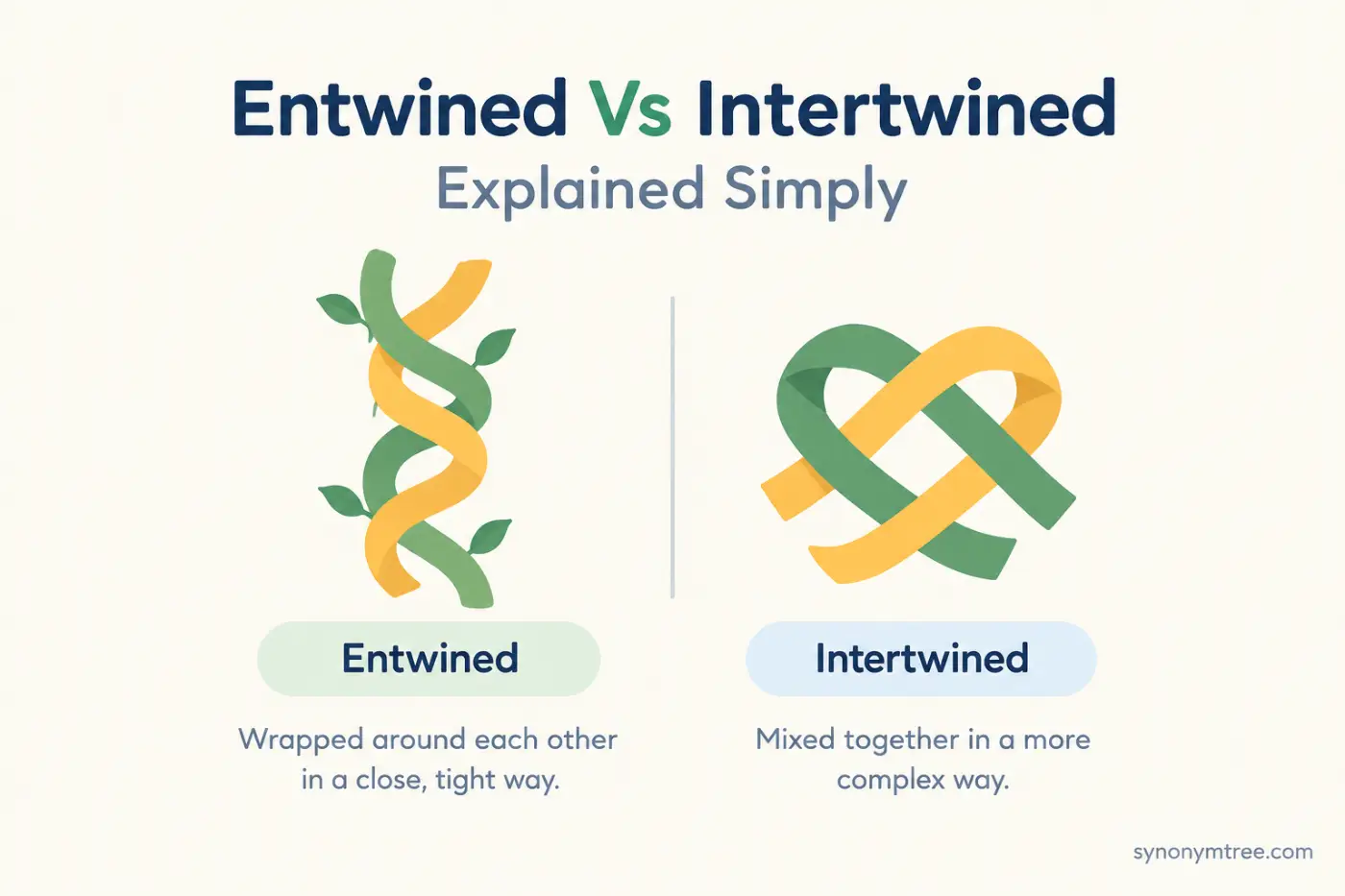
The difference between entwined vs intertwined can seem tiny because both words describe things that are closely connected, twisted, or linked together. In many sentences, you can even replace one with the other without changing the basic meaning.
Still, the two words have slightly different shades of meaning. Entwined often highlights things wrapped or twisted around each other. Intertwined can also describe physical things, but it often stresses a close connection between people, ideas, events, or situations.
That small difference matters when you want your writing to sound natural and precise. This guide explains both words, shows how they work in real sentences, compares their meanings, and covers the common mistakes that cause confusion.
Quick Definition
Entwined means twisted, wrapped, or closely connected with something else. Intertwined means twisted or woven together, often with each part crossing or connecting with the others. Both words can describe physical objects and abstract connections.
Direct Answer
Entwined and intertwined are both correct words, and they often have the same meaning. Use entwined for things that wrap or twist around each other, while intertwined often emphasizes several parts becoming closely linked.
Comparison Table
| Word or Phrase | Meaning | Example Sentence | When to Use It |
|---|---|---|---|
| Entwined | Twisted or wrapped together | The vines entwined around the fence. | Physical wrapping or close connection |
| Intertwined | Woven or linked closely together | Their lives became intertwined over the years. | Physical mixing or strong connections |
| Entwine | To twist or wrap things together | The branches entwine above the path. | Present or general action |
| Intertwine | To twist, weave, or connect together | The two stories intertwine near the end. | Physical or abstract connections |
| Entwined with | Closely connected or wrapped around | The roots entwined with the rocks. | Showing a close relationship |
| Intertwined with | Closely linked or mixed | Her career became intertwined with the company. | Showing a strong mutual connection |
What Entwined Means
Entwined comes from the verb entwine. The word describes something that has twisted, wrapped, or connected itself with another thing.
The word often creates a picture of two things winding around each other. Think of vines climbing around a tree trunk or two strands of rope twisting together.
For example, you could write, “The branches entwined above the doorway.” The sentence shows a physical relationship because the branches grew or moved around each other.
The word can also describe an emotional or personal connection. A sentence such as “Their lives became entwined” suggests that the lives grew deeply connected.
Entwined In Physical Situations
Physical use gives you one of the clearest ways to understand this word.
Imagine two vines growing around the same fence. Their stems may cross, loop, and wrap around one another. You can say that the vines are entwined.
Here are a few natural examples.
“The roots entwined beneath the soil.”
“Her fingers entwined with his.”
“The wires became entwined around the pole.”
“Two branches entwined above the garden gate.”
“The ribbons lay entwined on the table.”
Each sentence describes something that has twisted or joined closely with something else.
Entwined In Abstract Situations
English speakers also use this word for ideas, lives, feelings, and relationships.
For example, “Their families became entwined through marriage” does not mean that the families physically twisted around one another. Instead, it means their lives became closely connected.
You might also say, “Her memories entwined with the old house.” That sentence suggests a strong connection between the person’s memories and the place.
This figurative use gives the word a strong sense of closeness. Two things can remain separate, yet their connection can become difficult to ignore.
What Intertwined Means
Intertwined comes from the verb intertwine. It means twisted, woven, or linked together so that separate parts connect closely.
The word often suggests several strands, parts, or factors crossing one another. Those parts can describe physical objects, ideas, events, histories, relationships, or lives.
For instance, “The two roads became intertwined” can describe a physical path. However, “Their careers became intertwined” describes a strong connection between two people’s professional lives.
That wider figurative use makes intertwined especially useful in formal writing.
Intertwined In Physical Situations
You can use the word for objects that cross, twist, or weave together.
Consider a basket made from several strips of material. The strips cross over and under each other. You can describe them as intertwined.
Other examples include:
“The two cables intertwined.”
“The roots became intertwined beneath the tree.”
“Her fingers remained intertwined with his.”
“The threads intertwined tightly.”
“The branches grew intertwined over the wall.”
These examples all involve physical parts that connect through twisting or crossing.
Intertwined In Abstract Situations
This is where the word becomes especially useful.
People often describe lives as intertwined. They may also describe histories, cultures, economies, stories, or interests in the same way.
For example:
“The town’s history is intertwined with the railroad.”
“Music and memory are deeply intertwined.”
“Their personal and professional lives became intertwined.”
“The two issues are closely intertwined.”
“Language and culture are often intertwined.”
In these examples, nothing literally twists around anything else. The word describes a strong relationship between separate things.
Entwined Vs Intertwined In Meaning
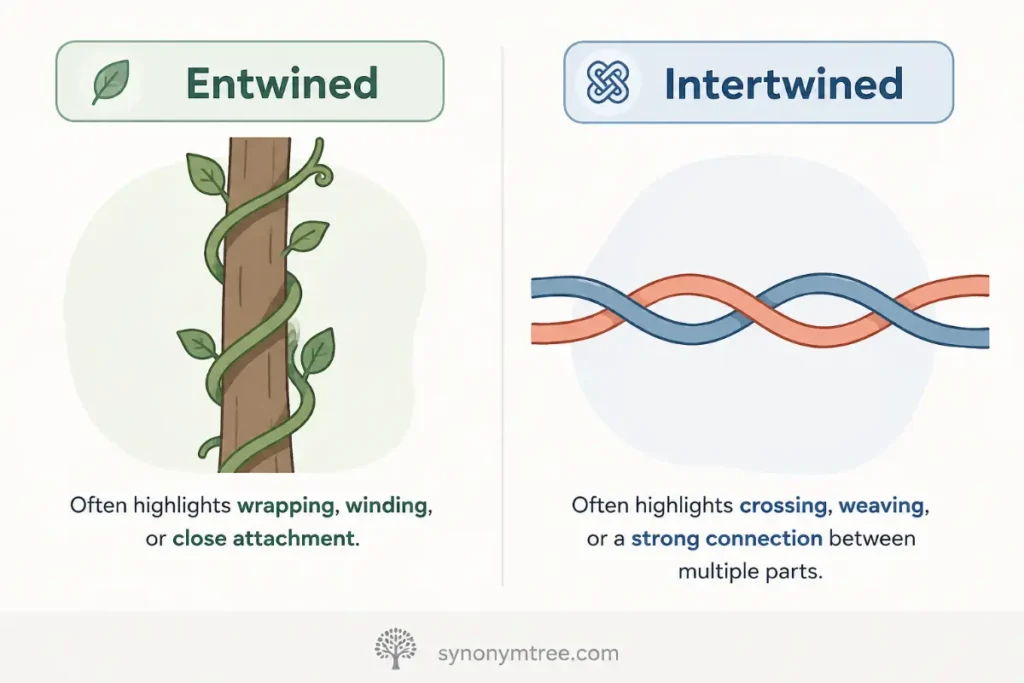
The biggest difference comes down to emphasis.
Entwined often highlights wrapping, winding, or close attachment. Intertwined often highlights crossing, weaving, or a strong connection between multiple parts.
That distinction does not always create a strict rule. Native speakers sometimes use the words in the same sentence without creating a major difference in meaning.
For example, both of these sentences work:
“The vines entwined around the tree.”
“The vines intertwined around the tree.”
The first sentence puts a little more attention on the wrapping action. The second can suggest that the vines became mixed or woven together.
Now consider an abstract example.
“Their lives became entwined.”
“Their lives became intertwined.”
Both sentences say that the lives became closely connected. However, intertwined can sound slightly stronger when the writer wants to stress how deeply different lives or experiences connect.
When Entwined Sounds Better
Choose entwined when you want to create an image of wrapping or winding.
“The ivy entwined around the old wall.”
“Her fingers entwined in his.”
“The dancers moved with entwined arms.”
It also works well when you want a more poetic or emotional tone.
“Their hopes became entwined.”
“Love and loss became entwined in her memories.”
“Their stories remained entwined for years.”
When Intertwined Sounds Better
Choose intertwined when you want to show that several things have become closely linked.
“The two families have intertwined for generations.”
“Technology and education are increasingly intertwined.”
“The novel has three intertwined storylines.”
“Politics and economics are deeply intertwined.”
“Their histories are closely intertwined.”
This word works especially well in essays, reports, academic writing, history, business writing, and explanations of complex relationships.
Are Entwined And Intertwined Interchangeable
Often, yes.
Both words can describe things that twist together or become closely connected. In many everyday sentences, replacing one with the other will not create a grammatical error.
For example, these sentences are both natural.
“The roots entwined beneath the ground.”
“The roots intertwined beneath the ground.”
The choice becomes more important when the sentence depends on a specific image or relationship.
If you want to emphasize something wrapping around another object, entwined may fit better. If you want to stress that separate parts have become woven into one connected system, intertwined may sound more natural.
The context usually makes the best choice clear.
A Simple Comparison
Think of entwined as wrapped together.
Think of intertwined as woven or linked together.
That shortcut will help in many situations, even though the words overlap.
Entwined Vs Intertwined In Real Sentences
Seeing the words in different settings makes the distinction easier to understand.
Nature
“The vines entwined around the oak.”
This sentence creates a clear image of vines wrapping around the tree.
“The roots intertwined beneath the soil.”
Here, the focus falls on roots crossing and mixing together underground.
Relationships
“The couple sat with their fingers entwined.”
The word works naturally because the fingers physically connect.
“Their lives became intertwined after years of friendship.”
Here, the word describes a close personal connection rather than physical contact.
Family
“Their families became entwined through marriage.”
This suggests that the families became connected.
“Their family histories are intertwined.”
This version emphasizes the way the histories overlap and connect.
Business
“The company’s future became entwined with the new technology.”
This sentence suggests a close connection between the company and the technology.
“The two industries are deeply intertwined.”
This sounds especially natural because it describes two larger systems that depend on or affect each other.
Ideas
“Her memories became entwined with the old song.”
The sentence gives a personal and emotional impression.
“Memory and music are closely intertwined.”
This version sounds broader and more analytical.
Stories
“The two characters’ stories became entwined.”
This suggests that their paths became connected.
“The novel follows several intertwined stories.”
This makes the connection among several storylines especially clear.
How The Grammar Works
Both entwined and intertwined can work as verbs, participles, and adjectives depending on the sentence.
Understanding this point helps you use them correctly.
Entwine As A Verb
Entwine means to twist or wrap things together.
“The vines entwine around the fence.”
“The branches entwine above the path.”
“The two strands entwine as they grow.”
The subject performs the action in each sentence.
Entwined As A Past Participle
Entwined can describe the result of that action.
“The vines have entwined around the fence.”
“Her fingers entwined with his.”
“The branches remained entwined.”
In these sentences, the word describes a state or result.
Intertwine As A Verb
Intertwine means to twist, weave, or connect things together.
“The strands intertwine to form a strong cord.”
“The two paths intertwine near the river.”
“The stories intertwine throughout the novel.”
Again, the subject performs the action.
Intertwined As A Past Participle
Intertwined describes things that have become linked or woven together.
“The strands have intertwined.”
“Their histories have intertwined.”
“The two themes remain closely intertwined.”
This form appears very often in descriptive and formal writing.
Entwine Vs Intertwine
The base verbs create the same basic comparison.
Entwine means to twist or wrap around something or to become closely connected.
Intertwine means to twist or weave together or to connect closely.
The prefix inter can help you remember the second word. The prefix often carries the idea of between or among. That makes intertwine a useful word when several parts cross or connect with one another.
For example, imagine three strands becoming part of one braid. They do not simply wrap around one object. They cross among themselves. Intertwine fits that image very well.
Still, do not treat the prefix as a strict rule. English words do not always follow a simple formula. Context matters more than the prefix alone.
Common Mistakes With These Words
People usually make mistakes with these words because their meanings overlap.
A writer may choose one word because it sounds familiar without considering the image or relationship the sentence needs.
Mistake One Using Them As Exact Opposites
Entwined and intertwined are not opposites.
They both describe connection or twisting. The difference mainly involves emphasis.
You should not think of one as correct and the other as incorrect in every shared context.
Mistake Two Assuming Intertwined Only Describes Objects
That idea is too narrow.
You can use intertwined for abstract subjects.
“Culture and language are intertwined.”
“Her memories became intertwined with the place.”
“Their goals became intertwined.”
These sentences sound completely natural.
Mistake Three Using Entwined Only For Plants
Plants provide common examples, but the word has a much wider use.
You can describe fingers, arms, branches, vines, ropes, ribbons, lives, memories, stories, and relationships as entwined.
For example, “Their futures became entwined” gives you a natural figurative use.
Mistake Four Adding An Unnecessary Preposition
Writers sometimes add words that make a sentence awkward.
Instead of writing, “The vines entwined together with each other,” keep the sentence simple.
“The vines entwined.”
Or:
“The vines entwined around the fence.”
Clear writing usually needs fewer words.
Mistake Five Treating Them As Different Tenses
The difference between entwine and entwined involves grammar, not simply meaning.
“Entwine” is the base verb.
“Entwined” commonly works as the past tense or past participle.
The same pattern applies to intertwine and intertwined.
How To Choose The Right Word in Entwined vs Intertwined
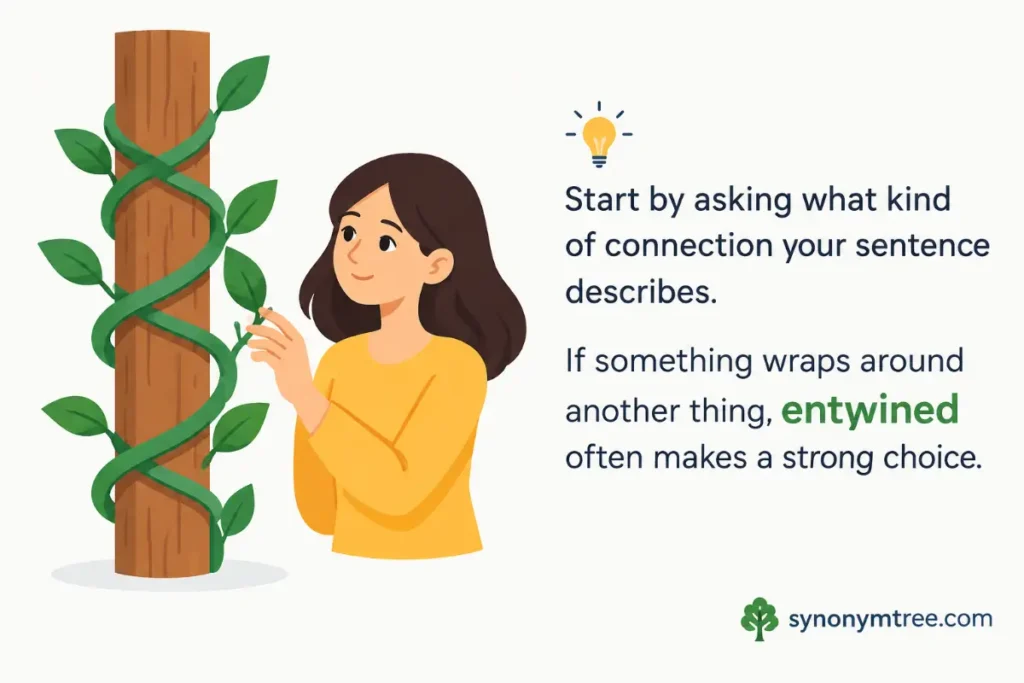
Start by asking what kind of connection your sentence describes.
If something wraps around another thing, entwined often makes a strong choice.
If you describe lives, histories, ideas, or systems, both words may work. Intertwined often sounds more natural in formal or analytical writing.
If the sentence has a poetic or emotional tone, entwined can create a softer image.
Use Entwined For A Wrapped Image
Picture a vine climbing around a tree.
“The ivy entwined around the trunk.”
The image is easy to see. The ivy wraps around the tree.
Use Intertwined For A Connected System
Now picture several factors affecting one another.
“Education and economic growth are intertwined.”
The sentence does not describe physical twisting. It describes a close relationship between two areas.
Use Either When The Meaning Stays Clear
Sometimes you do not need to search for a tiny difference.
“The branches entwined.”
“The branches intertwined.”
Both are clear.
In that situation, choose the word that sounds most natural with the surrounding sentence.
Entwined In Literature And Creative Writing
Entwined often works well in creative writing because it creates a strong visual image.
A writer can use it to describe two people standing close together, plants covering a building, or emotions connected to a memory.
For example:
“The roses entwined around the iron gate.”
“Their hands remained entwined as they walked.”
“Hope entwined with fear.”
The word can make an abstract idea easier to picture.
It also works well when the writer wants to suggest closeness that has developed over time. The connection may seem natural, deep, and difficult to separate.
Intertwined In Formal Writing
Intertwined often appears in essays and explanatory writing because it can describe complex relationships.
Consider this sentence:
“Trade and migration intertwined the histories of the two regions.”
The writer does not mean that trade and migration physically twisted together. The sentence explains that both forces helped shape the same history.
Another example is:
“Technology and communication are deeply intertwined.”
This sentence shows that the two areas have a close relationship.
The word can therefore help writers explain systems that overlap. It works well in history, business, science, education, culture, and social topics.
Entwined Or Intertwined For Relationships
Both words can describe relationships, but the tone can differ slightly.
Entwined often sounds more personal or poetic.
“Their hearts were entwined.”
“Their lives became entwined.”
“Her childhood memories were entwined with the old home.”
Intertwined often sounds more neutral or analytical.
“Their careers became intertwined.”
“Their interests are closely intertwined.”
Neither style is automatically better. Pick the word that matches the tone of your sentence.
Entwined Or Intertwined For Stories
Writers often use these words when talking about plots.
You can say:
“Their stories became entwined.”
This works well when two characters or story paths become connected.
You can also say:
“The novel contains several intertwined storylines.”
That version strongly suggests multiple storylines that cross and connect throughout the book.
For a single connection, entwined may sound more personal or literary. For multiple connected threads, intertwined often gives the reader a clearer sense of complexity.
Entwined Or Intertwined For Ideas
Both words can describe ideas.
“Justice and freedom became entwined in the speech.”
“Justice and freedom are intertwined throughout the speech.”
The second sentence sounds more analytical. It suggests that the two ideas repeatedly connect across the whole piece.
You could also write:
“The author’s main themes are intertwined.”
That sentence tells the reader that the themes do not stand alone. They interact and support one another.
This use appears often in literary analysis and academic writing.
Synonyms For Entwined
Several words can replace entwined, but each carries a slightly different shade of meaning.
Wrapped suggests something surrounding another thing.
Twisted focuses on turning or bending.
Woven suggests strands crossing to form a connected structure.
Connected focuses on a relationship rather than physical form.
Linked emphasizes a relationship between separate things.
Joined suggests that two or more things have become connected.
Interlaced suggests parts crossing over and under each other.
Entangled often suggests that things have become mixed or difficult to separate.
For example, “The vines were interlaced” gives a more structured image than “The vines were wrapped around the wall.”
Likewise, “Their careers were linked” sounds more neutral than “Their careers were entwined.”
Synonyms For Intertwined
Common alternatives include interlaced, woven together, connected, linked, combined, entangled, and interconnected.
Each option has its own strength.
Interlaced works well for physical strands or patterns.
Interconnected strongly emphasizes relationships among several parts.
Linked is simple and direct.
Entangled can suggest confusion or difficulty.
Woven together creates a more literary image.
For example, “The country’s economy is interconnected with global trade” sounds more technical than “The country’s economy is intertwined with global trade.”
The best synonym depends on the sentence and the tone you want.
Entwined Vs Intertwined And Entangled
These three words can overlap, but entangled often adds a different idea.
If two vines are entwined, they have wrapped around each other.
If wires are entangled, they may have become tangled in a messy or difficult way.
That negative or troublesome sense makes entangled less suitable in some situations.
For example:
“The dancers moved with entwined arms.”
“The dancers moved with intertwined arms.”
The first two can sound natural depending on the intended image. The third suggests an awkward mess, so it changes the meaning.
Entwined Vs Intertwined And Interlaced
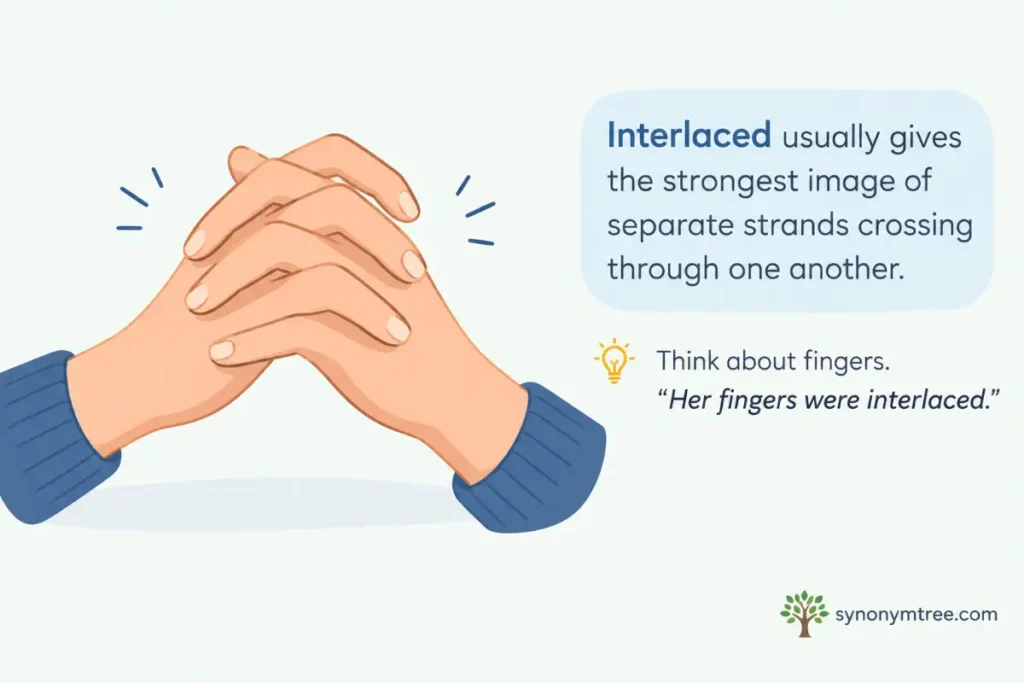
Interlaced usually gives the strongest image of separate strands crossing through one another.
Think about fingers.
“Her fingers were interlaced.”
This suggests that the fingers pass between each other.
Entwined can describe the same physical closeness but often creates a more flowing image.
“Her fingers entwined with his.”
Intertwined can also work.
“Her fingers intertwined with his.”
All three are possible, but their imagery differs slightly.
A Simple Memory Trick
Use this mental picture.
Entwined means wrapped.
Intertwined means woven together.
Imagine a vine wrapping around a tree. Think entwined.
Now imagine several threads crossing to make fabric. Think intertwined.
This trick will not cover every possible sentence, but it gives you a useful starting point.
For abstract writing, think about the type of connection.
A poetic connection often suits entwined.
A complex or mutual connection often suits intertwined.
Which Word Sounds More Formal
Intertwined often sounds more formal and analytical.
You may see it in essays, research writing, history discussions, business reports, and explanations of social issues.
For example:
“Economic policy and public health are closely intertwined.”
Entwined can appear in formal writing too, but it often has a more literary or expressive tone.
For example:
“The nation’s identity became entwined with its cultural traditions.”
The choice depends on the writer’s purpose. Neither word belongs to only one level of formality.
Which Word Should You Use In An Essay
For most essays, intertwined makes a strong choice when you need to explain how ideas, events, themes, or factors connect.
For example:
“The novel shows how family and identity are intertwined.”
You can use entwined when you want a more vivid or literary tone.
For example:
“The character’s childhood became entwined with memories of the river.”
If you are writing an analytical essay, look at the relationship you want to explain. If the parts influence and connect with one another, intertwined often gives you the clearest result.
Which Word Should You Use In Everyday Writing
In everyday writing, either word can work.
“The wires are entwined.”
“The wires are intertwined.”
Both sentences tell the reader that the wires have become twisted together.
For simple writing, you can also choose a plainer word such as tangled, twisted, or connected when that better matches the situation.
Simple words often make a sentence easier to understand.
For example, “The cables are tangled” sounds more direct than “The cables are intertwined” if the cables have become messy and difficult to separate.
Quick Practice Examples
Try comparing these pairs.
“The vines entwined around the tree.”
“The vines intertwined with the branches.”
The first focuses on wrapping around the tree. The second highlights the vines and branches becoming mixed together.
“Their lives became entwined.”
“Their lives became intertwined.”
Both describe a close relationship. The second can suggest a more complex connection.
“Memory and music became entwined.”
“Memory and music became intertwined.”
Both work. The second sounds slightly more analytical.
“The roots entwined beneath the soil.”
“The roots intertwined beneath the soil.”
Both are natural. The choice depends on the image you want to create.
A Quick Choice Guide
When you are unsure, use these questions.
If something wraps around another object, entwined makes a good choice.
If several things cross or weave together, intertwined often fits better.
You do not need to force a difference where English speakers normally allow overlap.
Conclusion
The easiest way to remember entwined vs intertwined is to think about the type of connection you want to show. Entwined often suggests wrapping or winding around something, while intertwined often suggests weaving, crossing, or becoming closely connected.
The two words overlap a lot, so you will often see both in similar sentences. Neither word is automatically wrong just because the other one could also work. Use entwined when you want a vivid image of things wrapping together or a poetic sense of closeness. Choose intertwined when you want to explain a strong connection among people, ideas, events, themes, or systems.
When you are stuck, replace the word with wrapped or woven together. If wrapped fits your meaning, entwined may be the better choice. If woven together fits, intertwined will often give you the clearest sentence.
FAQs
Is entwined the same as intertwined?
They have very similar meanings. Both can describe things that twist together or become closely connected. Entwined often suggests wrapping, while intertwined can suggest weaving or a deeper connection among several parts.
Is intertwined more formal than entwined?
Intertwined often sounds more formal because writers commonly use it to describe complex relationships among ideas, systems, histories, and people. Entwined can sound more poetic or visual. Both words work in formal and informal writing.
Can I use entwined for people?
Yes. Entwined can describe people who stand physically close or whose lives have become strongly connected. For example, you can say, “Their lives became entwined.”
Can intertwined describe abstract ideas?
Yes. Intertwined works very well with abstract ideas. You can describe themes, cultures, histories, interests, problems, or systems as intertwined.
What is the difference between entwined and entangled?
Entwined usually suggests close twisting or connection without a negative meaning. Entangled can suggest a messy, confusing, or difficult situation. Choose entangled when the connection creates trouble or makes separation difficult.
Is entwined a correct word?
Yes. Entwined is the past tense and past participle form of entwine. It can also work as an adjective to describe things that are twisted or closely connected.
Is intertwined a correct word?
Yes. Intertwined is the past tense and past participle form of intertwine. It can describe physical objects as well as abstract relationships.
Which is better for academic writing entwined or intertwined?
Intertwined is often the stronger choice for academic writing because it clearly describes relationships among ideas, factors, events, and systems. Entwined still works when the context calls for a more expressive or literary tone.
