
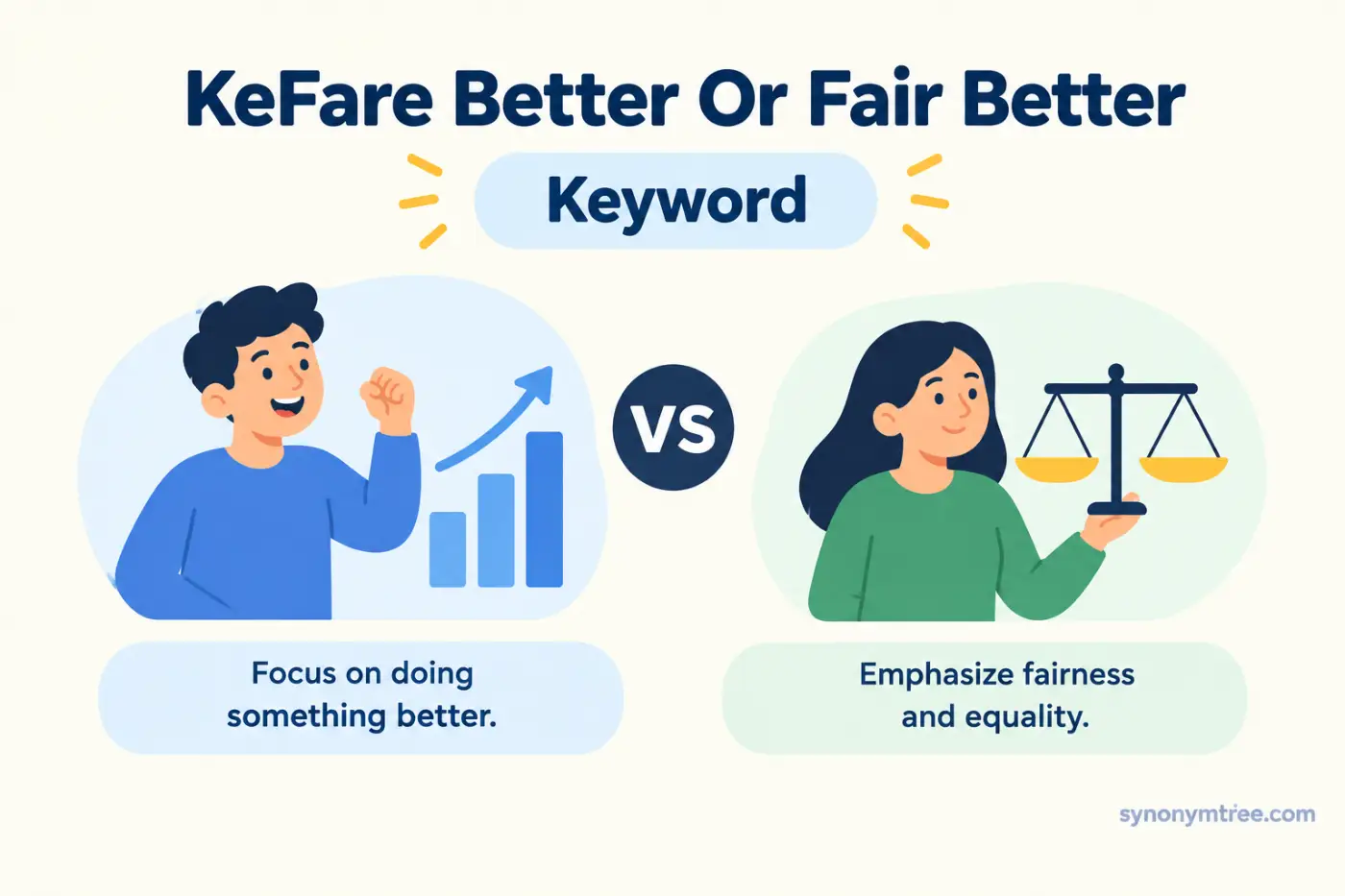
If you are trying to decide between fare better or fair better, the correct phrase is fare better. Use fare when you mean to perform, progress, or do well in a particular situation. Fair has a different meaning and does not work in this expression.
For example, you can say, She may fare better with more practice. You can also say, Students often fare better when they study consistently. In both sentences, fare describes how someone performs or progresses.
Fair is commonly used to describe something reasonable, just, acceptable, or average. It can also describe light coloring, pleasant weather, or a public event. Because fare and fair sound alike, they are easy to confuse in writing. The simple rule is this: fare describes how someone does, while fair describes something that is just, reasonable, or acceptable.
Fare Better Is The Correct Phrase
Fare better is the standard expression when you mean to perform better or have a better result. The verb fare refers to how someone or something progresses in a particular situation.
You might say that a student fares better after getting extra help. You could also say that a business fares better during a strong economy. In both cases, fare tells us about performance or progress.
The word better compares one result with another. When you say someone will fare better, you are saying that the person is likely to do better under a particular condition.
Consider these examples.
After changing his study routine, Marcus began to fare better in math.
Small businesses may fare better when they understand their local customers.
She would fare better with a little more preparation.
The team could fare better next season if it improves its defense.
These sentences all use fare correctly because they describe performance or progress.
What Does Fare Mean
Fare is a verb when it describes how someone performs or progresses. This meaning appears often in phrases such as fare well, fare poorly, fare better, fare worse, and fare best.
For example, you might say, The new employee is faring well in the position. This means the employee is doing well or making good progress.
Fare can also describe how something performs in a particular situation. A product might fare well in a competitive market. A plan might fare poorly after conditions change.
The verb becomes fared in the past tense and faring in the present participle.
The students fared better than expected on the exam.
The company is faring well after its recent changes.
The older model fared poorly in the latest test.
The verb fare has a useful connection with the idea of getting through a situation. When you ask how someone fared, you are asking how that person did.
For example, How did you fare on the test? means How did you do on the test?
What Does Fair Mean
Fair has several meanings, but none of its common meanings fit the phrase fair better when you want to describe performance.
As an adjective, fair can mean reasonable or just. A fair price is a reasonable price. Fair treatment means treatment that is considered just and equal.
Fair can also mean acceptable or average. If someone describes a performance as fair, they may mean it was satisfactory but not especially strong.
For example, The student received a fair grade. This suggests the grade was acceptable or reasonable.
Fair can also describe appearance or weather. Someone might have fair skin or fair hair. Fair weather usually means pleasant weather.
As a noun, fair can refer to a public event where people gather for entertainment, food, games, shopping, or other activities.
For example, The family visited the county fair on Saturday.
These meanings show why fair cannot replace fare in fare better. The two words have different meanings even though they sound alike.
Why Fare Better Is Easy To Confuse
The main reason people confuse fare better and fair better is pronunciation. In standard American English, fare and fair are homophones. They sound the same but have different spellings and meanings.
When you hear the phrase spoken aloud, you cannot tell which spelling the writer intends. The difference becomes clear only when you look at the written sentence.
This creates a common spelling problem. Someone may understand the meaning perfectly but still choose fair because it is a familiar word.
The best way to avoid this mistake is to connect fare with performance. If you are describing how someone does in a situation, fare is usually the word you need.
She will fare better with more experience.
He fared better after changing his approach.
They are faring better than they expected.
Each sentence describes progress or performance, so fare is correct.
Fare Better Meaning
Fare better means to perform better, progress more successfully, or achieve a better result.
The expression usually appears when two situations are being compared. One condition may produce a better outcome than another.
For example, A student may fare better with a quiet place to study means that the student is likely to perform better in a quiet environment.
The phrase can also compare people, groups, products, plans, or situations.
Older workers may fare better with flexible schedules.
Some plants fare better in cooler temperatures.
The second plan may fare better with a smaller budget.
In every example, fare describes the outcome or progress of something.
How To Use Fare Better In A Sentence
Fare better normally works as a verb phrase. The subject can be a person, group, organization, product, plan, or other thing that can perform or progress.
A common structure is subject plus fare better plus condition.
Students may fare better with regular practice.
Another useful structure compares two things with than.
The newer system fares better than the older one.
You can also use fare better with a particular situation.
She may fare better with additional support.
Another structure uses if to describe a condition.
The team could fare better if it changes its strategy.
The phrase also works in past tense.
The company fared better than analysts expected.
You can use the present participle in continuous forms.
The business is faring better this year.
These patterns make fare better easy to use once you connect fare with performance.
Fare Better Than
Fare better than is especially common when comparing two people, groups, choices, or situations.
For example, The second team fared better than the first team means the second team achieved a better result.
You might also say, Employees who receive clear instructions often fare better than employees who receive little guidance.
The comparison can be direct or indirect. Sometimes the second part is understood from context.
She fares better when she works in the morning.
This sentence suggests that she performs better in the morning than at another time.
Fare better than can also describe products or systems.
The updated software fares better than the previous version.
The phrase does not necessarily mean something is perfect. It simply means that one option or condition produces a better result than another.
Fare Better With
Fare better with is useful when a particular person or thing performs better after receiving something.
For example, Some students fare better with visual examples. This means visual examples help those students perform more effectively.
You can use this structure in many situations.
Children may fare better with clear routines.
Some customers fare better with personal assistance.
Certain plants fare better with regular watering.
New employees often fare better with clear instructions.
The phrase focuses on the condition that supports better performance.
Fare Better If
Fare better if introduces a condition that could lead to a better outcome.
For example, You may fare better if you start earlier means starting earlier could help you achieve a better result.
This structure works well in advice and explanations.
You may fare better if you review the material before the exam.
The project could fare better if the team sets clearer goals.
The company might fare better if it reduces unnecessary expenses.
The phrase is useful because it connects an action or condition with a possible result.
Fare Better In
Fare better in can describe performance within a particular environment, situation, field, or setting.
For example, Some students fare better in smaller classes.
An athlete may fare better in warmer weather.
A product could fare better in international markets.
The exact meaning depends on the context. The important point is that fare still describes performance or progress.
Fare Well And Fare Poorly
Fare better belongs to a larger group of expressions built around the verb fare.
Fare well means to perform well or have a good result.
The students fared well on the final exam.
Fare poorly means to perform poorly or have a weak result.
The team fared poorly during the first half.
Fare worse means to perform worse than another person, group, or situation.
The older model fared worse in the durability test.
Fare best means to perform better than other options or under other conditions.
She fares best when she has plenty of time to prepare.
Learning these related expressions makes fare better easier to remember.
Fare Better In School
Fare better is common when talking about education and academic performance.
You might say, Students often fare better when they have a consistent study schedule. The phrase tells us that the students perform better under that condition.
Parents and teachers may also use fare better when discussing learning environments.
Some children fare better in quiet classrooms.
Students may fare better with regular feedback.
Many learners fare better when they understand the purpose of an assignment.
These examples all focus on academic progress, so fare is the correct spelling.
Using fair in these sentences would change the meaning or create an error.
Fare Better At Work
The phrase also works naturally in professional writing and everyday workplace communication.
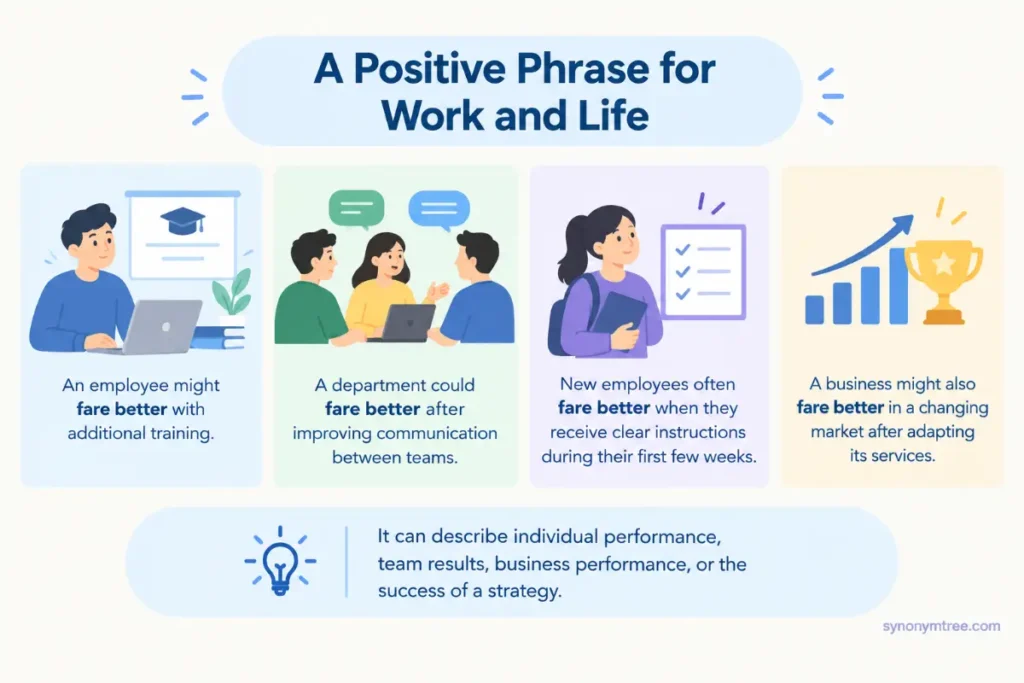
An employee might fare better with additional training. A department could fare better after improving communication between teams.
For example, New employees often fare better when they receive clear instructions during their first few weeks.
A business might also fare better in a changing market after adapting its services.
Fare better can therefore describe individual performance, team results, business performance, or the success of a strategy.
Fare Better In Everyday Speech
Although fare can sound slightly formal in some contexts, fare better is a common and useful expression.
In casual speech, someone might ask, How did you do? In more formal writing, the same idea can appear as How did you fare?
For example, How did you fare on the interview? means How did the interview go for you?
The phrase fare better also works naturally in conversation.
You might fare better if you ask for help.
I think she will fare better next time.
He fared better after getting more practice.
These sentences sound natural and clearly describe performance.
Fare As A Noun
Fare has another common meaning that is completely different from fare better.
As a noun, fare can mean the money paid for transportation.
For example, The bus fare increased this year.
A passenger may pay a train fare, taxi fare, or airline fare.
Fare can also refer to the food served or available at a particular place.
The restaurant offers traditional local fare.
This meaning is different from the verb fare in fare better. Context tells you which meaning applies.
The transportation meaning is easy to recognize because it usually relates to paying for travel.
Fair As An Adjective
Fair is often used as an adjective.
It can mean just or reasonable.
The manager made a fair decision.
It can mean acceptable or average.
The student gave a fair answer.
It can describe light coloring.
She has fair hair.
It can describe pleasant weather.
We had fair weather during the trip.
These meanings are unrelated to the verb fare.
Fair As A Noun
Fair can also be a noun that describes a public event.
Families often visit a county fair for food, games, rides, and entertainment.
For example, We went to the fair last weekend uses fair as a noun.
You could also talk about a job fair where employers and job seekers meet.
A book fair is another common example.
None of these meanings connect to the expression fare better.
Fare Better Or Fair Better In School Writing
When writing a school assignment, use fare better if you are describing improved performance.
For example, Students may fare better when they review their notes regularly.
Another example is, Some students fare better when they study in a quiet environment.
Fair would be incorrect in these sentences because the meaning is about performance.
If you want to describe something as reasonable or acceptable, fair is the correct word.
For example, The teacher gave the students a fair amount of time to finish the assignment.
Here fair describes the amount of time as reasonable.
The difference depends on meaning, not pronunciation.
Fare Better Or Fair Better In Professional Writing
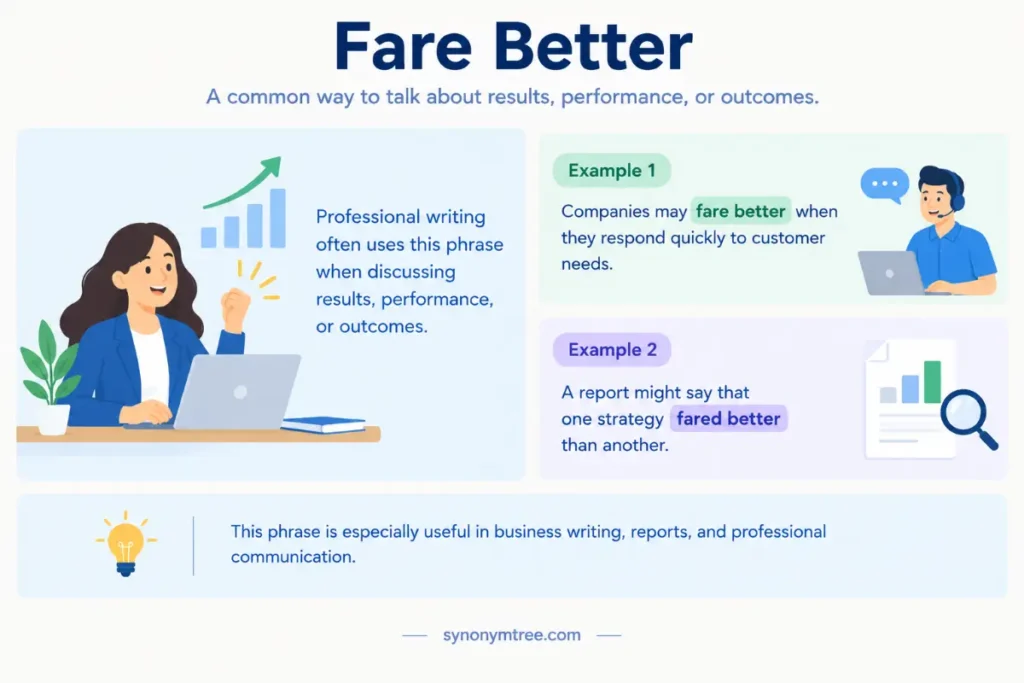
Professional writing often uses fare better when discussing results, performance, or outcomes.
For example, Companies may fare better when they respond quickly to customer needs.
A report might say that one strategy fared better than another.
Fair belongs in professional writing when you mean reasonable, impartial, or acceptable.
For example, The company should provide fair treatment to all employees.
These two words can appear in the same document, but they serve different purposes.
Common Mistakes With Fare Better
The most common mistake is writing fair better when the intended meaning is perform better.
For example, She will fair better with more practice is incorrect.
The correct version is, She will fare better with more practice.
Another common mistake is using fare when the sentence describes fairness.
For example, The manager made a fare decision is incorrect if you mean the decision was just or reasonable.
The correct sentence is, The manager made a fair decision.
A useful editing habit is to pause whenever you see fare or fair. Ask yourself what the word means in the sentence. If it describes performance or progress, choose fare. If it describes justice, reasonableness, acceptability, appearance, weather, or an event, fair may be correct.
Fare Better And Fare Worse
Fare better and fare worse are opposite expressions.
Fare better means to perform better or achieve a better result.
Fare worse means to perform worse or achieve a poorer result.
For example, The new system fares better with larger files.
The older system fares worse under the same conditions.
Both phrases compare performance in different conditions.
You can also use them to compare people or groups.
The first group fared better than the second group.
The second group fared worse than expected.
Fare Better And Fare Well
Fare better and fare well are related but not identical.
Fare well means to perform well or progress successfully.
Fare better means to perform better than another condition, time, person, or expected result.
For example, She fared well on the test means she performed well.
She fared better on the second test means her performance on the second test was better than another reference point.
That reference point may be stated or understood from context.
This distinction helps you choose the expression that matches your intended meaning.
Fare Better And Do Better
In many everyday sentences, fare better and do better communicate similar ideas.
For example, You may do better with more practice.
You may fare better with more practice.
Both sentences suggest that more practice could improve the result.
Do better is more common in casual conversation. Fare better can sound more formal or polished, especially in writing.
You can choose between them based on tone and context. The spelling of fare stays the same when you use the expression fare better.
A Simple Memory Trick
The easiest way to remember fare better is to connect fare with performance.
Think of the question, How did you fare?
The answer tells you how you did.
You can then connect the expression to fare better.
If someone performs better, they fare better.
Fair belongs to ideas such as fairness, justice, reasonable treatment, and acceptable quality.
A simple rule is: Fare describes how you do. Fair describes what is just or reasonable.
This distinction can help you avoid the most common spelling mistake.
Quick Comparison
| Phrase | Correct? | Meaning |
|---|---|---|
| Fare better | Yes | Perform or progress better |
| Fair better | No | Incorrect for this meaning |
| Fare well | Yes | Perform or progress well |
| Fare worse | Yes | Perform or progress worse |
| Fair treatment | Yes | Just or reasonable treatment |
| Fair price | Yes | Reasonable price |
| Fair weather | Yes | Pleasant weather |
| Bus fare | Yes | Money paid for transportation |
The key difference is meaning. Fare can describe performance, transportation cost, or food in certain contexts. Fair can describe justice, reasonableness, acceptable quality, appearance, weather, or a public event.
Fare Better Or Fair Better Examples
Here are several natural examples that show how fare better works in different contexts.
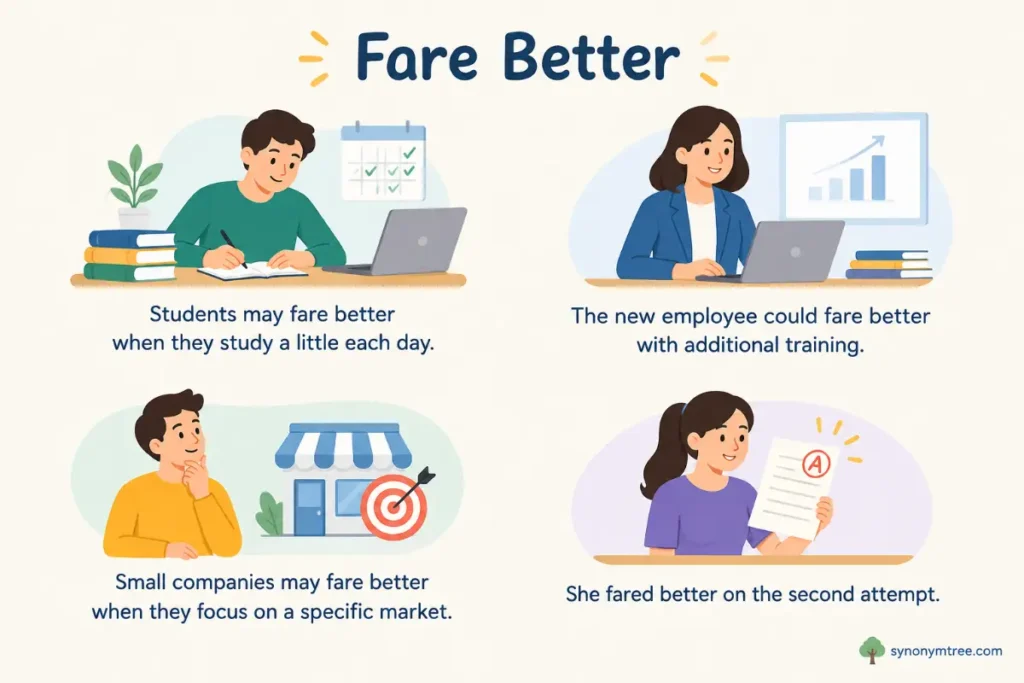
Students may fare better when they study a little each day.
The new employee could fare better with additional training.
Small companies may fare better when they focus on a specific market.
She fared better on the second attempt.
The team is faring better than it did last season.
You might fare better if you ask for help.
The updated program fares better with large files.
Some customers fare better when they receive clear instructions.
The second plan may fare better under these conditions.
The younger players fared better than expected.
Each example describes performance, progress, or results. That is why fare is correct.
Now compare those sentences with examples using fair.
The teacher gave everyone a fair chance.
The price seems fair.
The decision was fair.
They enjoyed a fair day at the beach.
The family visited the county fair.
Here fair has a completely different role.
Related Words You Should Know
Understanding related words can make this distinction easier.
Fare is connected to the verb meaning perform or progress. Its forms include fares, fared, and faring.
For example, The team fares well under pressure uses the present form. The team fared well last season uses the past form. The team is faring well this year uses the present participle.
Fair has its own word family and related expressions. Fairness refers to the quality of being fair. Fairly can mean reasonably or quite, depending on context.
For example, The rules should promote fairness.
The work was fairly easy.
These words connect to fair rather than fare.
Why Spelling Matters
In speech, fare and fair can sound identical. In writing, however, the spelling carries meaning.
Choosing the wrong spelling can make a sentence look incorrect even if the intended idea is clear.
This is especially important in school assignments, professional emails, resumes, reports, and other formal writing.
A quick proofreading check can prevent the error. Look at the sentence and ask if the word describes performance or fairness.
If it describes performance, progress, or results, fare is likely correct.
If it describes justice, reasonableness, acceptable quality, appearance, weather, or an event, fair may be correct.
Final Answer
The correct phrase is fare better or fair better when you’re checking which spelling fits the meaning of performing or progressing better. The correct expression is fare better when you mean perform better, progress better, or achieve a better result. Fair better is not the standard expression for this meaning.
Use fare in sentences such as She may fare better with more practice and The company fared better than expected. Use fair for meanings connected with justice, reasonableness, acceptable quality, appearance, weather, or public events.
Remember the simple distinction. Fare describes how someone or something does, while fair describes something that is just, reasonable, or acceptable. Once you connect fare with performance, choosing fare better or fair better becomes much easier.
FAQs
Is fare better or fair better correct?
Fare better is correct when you mean perform better or achieve a better result. Fair better is incorrect for this meaning.
What does fare better mean?
Fare better means to perform better, progress more successfully, or get a better result. It can describe people, groups, businesses, products, plans, and other things that can have an outcome.
Why do people confuse fare and fair?
Fare and fair sound the same in standard American English, so they are easy to confuse when writing. Their meanings and spellings are different, which makes context important.
Can I say fare better than?
Yes. Fare better than is a common structure used to compare performance or results. For example, The new system fares better than the old system.
Is fair better ever correct?
Fair better is not correct when you mean perform better or progress better. In that situation, use fare better.
What is the difference between fare better and do better?
Both expressions can mean that someone performs better. Do better is more common in casual speech, while fare better can sound more formal and is often useful in written English.
What does fare mean in fare better?
In fare better, fare is a verb meaning to perform or progress. The expression describes how someone or something does in a particular situation.
What does fair mean?
Fair has several meanings. It can describe something just, reasonable, acceptable, light in color, or pleasant in terms of weather, and it can also refer to a public event.
How can I remember fare better?
Connect fare with the question How did you fare? Both expressions relate to performance or results. Think of fare as describing how someone does and fair as describing what is just or reasonable.
